


Galatians 2:12
Bible text: King James Version (1769 Blayney text) · Public domain
Bible text: King James Version with Strong's numbers · Public domain
Bible text: Berean Standard Bible · Public domain
Bible text: American Standard Version (1901) · Public domain
Bible text: World English Bible, Messianic edition · Public domain
Bible text: Geneva Bible (1599) · Public domain
Bible text: Young's Literal Translation · Public domain
- πρὸproBeforeG4253PREPPreposition
- τοῦtou<the>G3588T-GSNDefinite article Genitive Singular Neuter
- γὰρgarforG1063CONJConjunction
- ἐλθεῖνeltheinto comeG2064V-2AANVerb 2nd Aorist Active Infinitive
- τιναςtinascertain onesG5100X-APMIndefinite pronoun Accusative Plural Masculine
- ἀπὸapofromG575PREPPreposition
- ἸακώβουIakōbouJamesG2385N-GSM-PNoun Genitive Singular Masculine Individual
- μετὰmetawithG3326PREPPreposition
- τῶνtōntheG3588T-GPNDefinite article Genitive Plural Neuter
- ἐθνῶνethnōnGentilesG1484N-GPNNoun Genitive Plural Neuter
- συνήσθιεν·sunēsthienhe was eatingG4906V-IAI-3SVerb Imperfect Active Indicative 3rd Singular
- ὅτεhotewhenG3753CONJConjunction
- δὲdehoweverG1161CONJConjunction
- ἦλθονēlthonthey cameG2064V-2AAI-3PVerb 2nd Aorist Active Indicative 3rd Plural
- ὑπέστελλενhupestellenhe was drawing backG5288V-IAI-3SVerb Imperfect Active Indicative 3rd Singular
- καὶkaiandG2532CONJConjunction
- ἀφώριζενaphōrizenhe was separatingG873V-IAI-3SVerb Imperfect Active Indicative 3rd Singular
- ἑαυτὸνhe'autonhimselfG1438F-3ASMReflexive pronoun Accusative 3rd Singular Masculine
- φοβούμενοςphoboumenosbeing afraid ofG5399V-PNP-NSMVerb Present Middle Or Passive Deponent Participle Nominative Singular Masculine
- τοὺςtousthoseG3588T-APMDefinite article Accusative Plural Masculine
- ἐκekofG1537PREPPreposition
- περιτομῆς·peritomēs[the] circumcisionG4061N-GSFNoun Genitive Singular Feminine
English is a literal word-by-word gloss of the Greek, not the KJV's wording. Why?
This is the original text the KJV's translators worked from — each Greek word with its own literal English meaning in this verse, prepared by scholars at Tyndale House, Cambridge. The KJV translates whole sentences, not word by word, so its wording differs: one Greek word can become several English words, and the KJV may choose “charity” where the gloss reads “love”. Both are faithful — they answer different questions. For the KJV's own rendering, switch to the KJV text.
Details
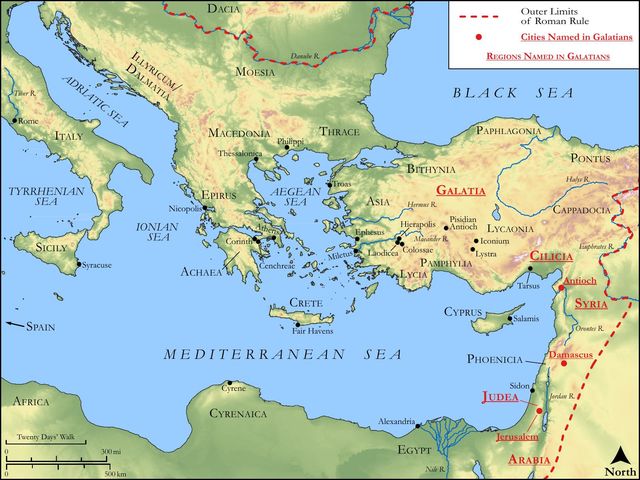
See on the biblical-era maps

Study this verse
Public-domain commentary
Matthew Henry
From his Commentary on the Whole Bible. Henry comments on passages, not single verses — this entry covers Galatians 2:11–21. His four-level outline is real structure in the source text, so it is rendered as structure.
I.From the account which Paul gives of what passed between him and the other apostles at Jerusalem, the Galatians might easily discern both the falseness of what his enemies had insinuated against him and their own folly and weakness in departing from that gospel which he had preached to them. But to give the greater weight to what he had already said, and more fully to fortify them against the insinuations of the judaizing teachers, he acquaints them with another interview which he had with the apostle Peter at Antioch, and what passed between them there, _Gal 2:11-14. Antioch was one of the chief churches of the Gentile Christians, as Jerusalem was of those Christians who turned from Judaism to the faith of Christ. There is no colour of reason for the supposition that Peter was bishop of Antioch. If he had, surely Paul would not have withstood him in his own church, as we here find he did; but, on the contrary, it is here spoken of as an occasional visit which he made thither. In their other meeting, there had been good harmony and agreement. Peter and the other apostles had both acknowledged Paul's commission and approved his doctrine, and they parted very good friends. But in this Paul finds himself obliged to appose Peter, for he was to be blamed, a plain evidence that he was not inferior to him, and consequently of the weakness of the pope's pretence to supremacy and infallibility, as the successor of Peter. Here we may observe,
1.Peter's fault. When he came among the Gentile churches, he complied with them, and did eat with them, though they were not circumcised, agreeably to the instructions which were given in particular to him (Acts 10), when he was warned by the heavenly vision to call nothing common or unclean. But, when there came some Jewish Christians from Jerusalem, he grew more shy of the Gentiles, only to humour those of the circumcision and for fear of giving them offence, which doubtless was to the great grief and discouragement of the Gentile churches. Then he withdrew, and separated himself. His fault herein had a bad influence upon others, for the other Jews also dissembled with him; though before they might be better disposed, yet now, from his example, they took on them to scruple eating with the Gentiles, and pretended they could not in conscience do it, because they were not circumcised. And (would you think it?) Barnabas himself, one of the apostles of the Gentiles, and one who had been instrumental in planting and watering the churches of the Gentiles, was carried away with their dissimulation. Here note,
(1.)The weakness and inconstancy of the best of men, when left to themselves, and how apt they are to falter in their duty to God, out of an undue regard to the pleasing of men. And,
(2.)The great force of bad examples, especially the examples of great men and good men, such as are in reputation for wisdom and honour.
2.The rebuke which Paul gave him for his fault. Notwithstanding Peter's character, yet, when he observes him thus behaving himself to the great prejudice both of the truth of the gospel and the peace of the church, he is not afraid to reprove him for it. Paul adhered resolutely to his principles, when others faltered in theirs; he was as good a Jew as any of them (for he was a Hebrew of the Hebrews), but he would magnify his office as the apostle of the Gentiles, and therefore would not see them discouraged and trampled upon. When he saw that they walked not uprightly, according to the truth of the gospel - that they did not live up to that principle which the gospel taught, and which they had professed to own and embrace, namely, that by the death of Christ the partition-wall between Jew and Gentile was taken down, and the observance of the law of Moses was no longer in force - when he observed this, as Peter's offence was public, so he publicly reproved him for it: He said unto him before them all, If thou, being a Jew, livest after the manner of the Gentiles, and not as do the Jews, why compellest thou the Gentiles to live as do the Jews? Herein one part of his conduct was a contradiction to the other; for if he, who was a Jew, could himself sometimes dispense with the use of the ceremonial law, and live after the manner of the Gentiles, this showed that he did not look upon the observance of it as still necessary, even for the Jews themselves; and therefore that he could not, consistently with his own practice, impose it upon the Gentile Christians. And yet Paul charges him with this, yea, represents him as compelling the Gentiles to live as did the Jews - not by open force and violence, but this was the tendency of what he did; for it was in effect to signify this, that the Gentiles must comply with the Jews, or else not be admitted into Christian communion.
II.Paul having thus established his character and office, and sufficiently shown that he was not inferior to any of the apostles, no, not to Peter himself, from the account of the reproof he gave him he takes occasion to speak of that great fundamental doctrine of the gospel - That justification is only by faith in Christ, and not by the works of the law (though some think that all he says to the end of the chapter is what he said to Peter at Antioch), which doctrine condemned Peter for his symbolizing with the Jews. For, if it was the principle of his religion that the gospel is the instrument of our justification and not the law, then he did very ill in countenancing those who kept up the law, and were for mixing it with faith in the business of our justification. This was the doctrine which Paul had preached among the Galatians, to which he still adhered, and which it is his great business in this epistle to mention and confirm. Now concerning this Paul acquaints us,
1.With the practice of the Jewish Christians themselves: "We," says he, "who are Jews by nature, and not sinners of the Gentiles (even we who have been born and bred in the Jewish religion, and not among the impure Gentiles), knowing that a man is not justified by the works of the law, but by the faith of Jesus Christ, even we ourselves have believed in Jesus Christ, that we might be justified by the faith of Christ, and not by the works of the law. And, if we have thought it necessary to seek justification by the faith of Christ, why then should we hamper ourselves with the law? What did we believe in Christ for? Was it not that we might be justified by the faith of Christ? And, if so, is it not folly to go back to the law, and to expect to be justified either by the merit of moral works or the influence of any ceremonial sacrifices or purifications? And if it would be wrong in us who are Jews by nature to return to the law, and expect justification by it, would it not be much more so to require this of the Gentiles, who were never subject to it, since by the works of the law no flesh shall be justified?" To give the greater weight to this he adds (Gal 2:17), "But if, while we seek to be justified by Christ, we ourselves also are found sinners, is Christ the minister of sin? If, while we seek justification by Christ alone, and teach others to do so, we ourselves are found giving countenance or indulgence to sin, or rather are accounted sinners of the Gentiles, and such as it is not fit to have communion with, unless we also observe the law of Moses, is Christ the minister of sin? Will it not follow that he is so, if he engage us to receive a doctrine that gives liberty to sin, or by which we are so far from being justified that we remain impure sinners, and unfit to be conversed with?" This, he intimates, would be the consequence, but he rejects it with abhorrence: "God forbid," says he, "that we should entertain such a thought of Christ, or of his doctrine, that thereby he should direct us into a way of justification that is defective and ineffectual, and leave those who embrace it still unjustified, or that would give the least encouragement to sin and sinners." This would be very dishonourable to Christ, and it would be very injurious to them also. "For," says he (Gal 2:18), "if I build again the things which I destroyed - if I (or any other), who have taught that the observance of the Mosaic law is not necessary to justification, should now, by word or practice, teach or intimate that it is necessary - I make myself a transgressor; I own myself to be still an impure sinner, and to remain under the guilt of sin, notwithstanding my faith in Christ; or I shall be liable to be charged with deceit and prevarication, and acting inconsistently with myself." Thus does the apostle argue for the great doctrine of justification by faith without the works of the law from the principles and practice of the Jewish Christians themselves, and from the consequences that would attend their departure from it, whence it appeared that Peter and the other Jews were much in the wrong in refusing to communicate with the Gentile Christians, and endeavouring to bring them under the bondage of the law.
2.He acquaints us what his own judgment and practice were.
(1.)That he was dead to the law. Whatever account others might make of it, yet, for his part, he was dead to it. He knew that the moral law denounced a curse against all that continue not in all things written therein, to do them; and therefore he was dead to it, as to all hope of justification and salvation that way. And as for the ceremonial law, he also knew that it was now antiquated and superseded by the coming of Christ, and therefore, the substance having come, he had no longer any regard to the shadow. He was thus dead to the law, through the law itself; it discovered itself to be at an end. By considering the law itself, he saw that justification was not to be expected by the works of it (since none could perform a perfect obedience to it) and that there was now no further need of the sacrifices and purifications of it, since they were done away in Christ, and a period was put to them by his offering up himself a sacrifice for us; and therefore, the more he looked into it the more he saw that there was no occasion for keeping up that regard to it which the Jews pleaded for. But, though he was thus dead to the law, yet he did not look upon himself as with law. He had renounced all hopes of justification by the works of it, and was unwilling any longer to continue under the bondage of it; but he was far from thinking himself discharged from his duty to God; on the contrary, he was dead to the law, that he might live unto God. The doctrine of the gospel, which he had embraced, instead of weakening the bond of duty upon him, did but the more strengthen and confirm it; and therefore, though he was dead to the law, yet it was only in order to his living a new and better life to God (as Rom 7:4, Rom 7:6), such a life as would be more agreeable and acceptable to God than his observance of the Mosaic law could now be, that is, a life of faith in Christ, and, under the influence thereof, of holiness and righteousness towards God. Agreeably hereunto he acquaints us,
(2.)That, as he was dead to the law, so he was alive unto God through Jesus Christ (Gal 2:20): I am crucified with Christ, etc. And here in his own person he gives us an excellent description of the mysterious life of a believer.
[1.]He is crucified, and yet he lives; the old man is crucified (Rom 6:6), but the new man is living; he is dead to the world, and dead to the law, and yet alive to God and Christ; sin is mortified, and grace quickened.
[2.]He lives, and yet not he. This is strange: I live, and yet not I; he lives in the exercise of grace; he has the comforts and the triumphs of grace; and yet that grace is not from himself, but from another. Believers see themselves living in a state of dependence.
[3.]He is crucified with Christ, and yet Christ lives in him; this results from his mystical union with Christ, by means of which he is interested in the death of Christ, so as by virtue of that to die unto sin; and yet interested in the life of Christ, so as by virtue of that to live unto God.
[4.]He lives in the flesh, and yet lives by faith; to outward appearance he lives as other people do, his natural life is supported as others are; yet he has a higher and nobler principle that supports and actuates him, that of faith in Christ, and especially as eyeing the wonders of his love in giving himself for him. Hence it is that, though he lives in the flesh, yet he does not live after the flesh. Note, Those who have true faith live by that faith; and the great thing which faith fastens upon is Christ's loving us and giving himself for us. The great evidence of Christ's loving us is his giving himself for us; and this is that which we are chiefly concerned to mix faith with, in order to our living to him.
Lastly, The apostle concludes this discourse with acquainting us that by the doctrine of justification by faith in Christ, without the works of the law (which he asserted, and others opposed), he avoided two great difficulties, which the contrary opinion was loaded with: - 1. That he did not frustrate the grace of God, which the doctrine of the justification by the works of the law did; for, as he argues (Rom 11:6), If it be of works, it is no more of grace. 2. That he did not frustrate the death of Christ; whereas, if righteousness come by the law, then it must follow that Christ has died in vain; for, if we look for salvation by the law of Moses, then we render the death of Christ needless: for to what purpose should he be appointed to die, if we might have been saved without it?
Historical interpretation
Five Centuries of Reception
8 surviving comments on this verse. Each one is dated, so this reads as a timeline rather than a list.
Select a marker to jump to its quote. Markers stagger vertically where authors wrote within a few decades of each other.
But they themselves, while knowing the same God, continued in the ancient observances; so that even Peter, fearing also lest he might incur their reproof, although formerly eating with the Gentiles, because of the vision, and of the Spirit who had rested upon them, yet, when certain persons came from James, withdrew himself, and did not eat with them. And Paul said that Barnabas likewise did the same thing.
Paul, however, censures Peter for not walking straightforwardly according to the truth of the gospel. No doubt he blames him; but it was solely because of his inconsistency in the matter of "eating," which he varied according to the sort of persons (whom he associated with) "fearing them which were of the circumcision," but not on account of any perverse opinion touching another god.
Perhaps indeed he would at this point have kept silent about the sin that he says he reproved in Peter, for it was enough that Peter had been corrected by popular reproof and Paul’s open accusation. But it is profitable and extremely requisite for this letter. He has two reasons for relating the incident. First, his own gospel was not reproved, and he himself, when he reproved Peter, heard no reproof from Peter. Next, this too, as I said, was extremely pertinent: it is because the Galatians thought that they needed to add to the principles of the gospel to obtain life … that this letter is being written to them. Hence it is very good to tell the story, because it is this very fault that was reproved by Paul in Peter and by the people also. In this way it follows that the Galatians too are sinning.
But in what way was Peter sinning? He had not adopted this ruse to bring in the Jews, meeting them on their own terms (which Paul himself had done and glories in having done, meeting the Jews on their own terms but for their profit). Rather, the sin of Peter lay in the fact that he withdrew, through fear of those who were of the circumcision.
Having by these means declared the unanimity and harmony between the Apostles and himself, he is obliged to proceed to mention his debate with Peter at Antioch.
"But when Cephas came to Antioch, I resisted him to the face, because he stood condemned. For before that certain came from James, he did eat with the Gentiles: but when they came, he drew back and separated himself, fearing them that were of the circumcision."
Many, on a superficial reading of this part of the Epistle, suppose that Paul accused Peter of hypocrisy. But this is not so, indeed it is not, far from it; we shall discover great wisdom, both of Paul and Peter, concealed herein for the benefit of their hearers. But first a word must be said about Peter's freedom in speech, and how it was ever his way to outstrip the other disciples. Indeed it was upon one such occasion that he gained his name from the unbending and impregnable character of his faith. For when all were interrogated in common, he stepped before the others and answered, "Thou art the Christ, the Son of the living God." (Mat. xvi: 16.) This was when the keys of heaven were committed to him. So too, he appears to have been the only speaker on the Mount; (Mat. xvii: 4.) and when Christ spoke of His crucifixion, and the others kept silence, he said, "Be it far from Thee." (Mat. xvi: 22.) These words evince, if not a cautious temper, at least a fervent love; and in all instances we find him more vehement than the others, and rushing forward into danger. So when Christ was seen on the beach, and the others were pushing the boat in, he was too impatient to wait for its coming to land. (John xxi: 7.) And after the Resurrection, when the Jews were murderous and maddened, and sought to tear the Apostles in pieces, he first dared to come forward, and to declare, that the Crucified was taken up into heaven. (Acts ii: 14, Acts 2:36) It is a greater thing to open a closed door, and to commence an action, than to be free-spoken afterwards. How could he ever dissemble who had exposed his life to such a populace? He who when scourged and bound would not bate a jot of his courage, and this at the beginning of his mission, and in the heart of the chief city where there was so much danger,-how could he, long afterwards in Antioch, where no danger was at hand, and his character had received lustre from the testimony of his actions, feel any apprehension of the believing Jews? How could he, I say, who at the very first and in their chief city feared not the Jews while Jews, after a long time and in a foreign city, fear those of them who had been converted? Paul therefore does not speak this against Peter, but with the same meaning in which he said, "for they who were reputed to be somewhat, whatsoever they were, it maketh no matter to me." But to remove any doubt on this point, we must unfold the reason of these expressions.
The Apostles, as I said before, permitted circumcision at Jerusalem, an abrupt severance from the law not being practicable; but when they come to Antioch, they no longer continued this observance, but lived indiscriminately with the believing Gentiles which thing Peter also was at that time doing. But when some came from Jerusalem who had heard the doctrine he delivered there, he no longer did so fearing to perplex them, but he changed his course, with two objects secretly in view, both to avoid offending those Jews, and to give Paul a reasonable pretext for rebuking him. For had he, having allowed circumcision when preaching at Jerusalem, changed his course at Antioch, his conduct would have appeared to those Jews to proceed from fear of Paul, and his disciples would have condemned his excess of pliancy. And this would have created no small offence; but in Paul, who was well acquainted with all the facts, his withdrawal would have raised no such suspicion, as knowing the intention with which he acted. Wherefore Paul rebukes, and Peter submits, that when the master is blamed, yet keeps silence, the disciples may more readily come over. Without this occurrence Paul's exhortation would have had little effect, but the occasion hereby afforded of delivering a severe reproof, impressed Peter's disciples with a more lively fear. Had Peter disputed Paul's sentence, he might justly have been blamed as upsetting the plan, but now that the one reproves and the other keeps silence, the Jewish party are filled with serious alarm; and this is why he used Peter so severely. Observe too Paul's careful choice of expressions, whereby he points out to the discerning, that he uses them in pursuance of the plan, and not from anger.
His words are, "When Cephas came to Antioch, I resisted him to the face, because he stood condemned;" that is, not by me but by others; had he himself condemned him, he would not have shrunk from saying so. And the words, "I resisted him to the face," imply a scheme for had their discussion been real, they would not have rebuked each other in the presence of the disciples, for it would have been a great stumbling block to them. But now this apparent contest was much to their advantage; as Paul had yielded to the Apostles at Jerusalem, so in turn they yield to him at Antioch. The cause of censure is this, "For before that certain came from James," who was the teacher at Jerusalem, "he did eat with the Gentiles, but when they came he drew back and separated himself, fearing them that were of the Circumcision:" his cause of fear was not his own danger, (for if he feared not in the beginning, much less would he do so then,) but their defection. As Paul himself says to the Galatians, "I am afraid of you, lest by any means I have bestowed labor upon you in vain:" (Gal. iv: 11.) and again, "I fear lest by any means as the serpent beguiled Eve, ...so your minds should be corrupted." (2 Cor. xi: 3.) Thus the fear of death they knew not, but the fear lest their disciples should perish, agitated their inmost soul.
(Verse 11 onwards) But when Peter came to Antioch, I opposed him to his face, because he stood condemned. For before certain men came from James, he was eating with the Gentiles. But when they came, he withdrew and separated himself, fearing those of the circumcision. And the rest of the Jews acted hypocritically along with him, so that even Barnabas was led astray by their hypocrisy. When I saw that they were not walking straight, according to the truth of the gospel, I said to Peter in the presence of all, 'If you, who are a Jew, live like the Gentiles and not like the Jews, how can you compel the Gentiles to live like Jews?' We are Jews by nature, and not Gentile sinners, but we know that a person is not justified by the works of the law, but through faith in Jesus Christ. Therefore, when the apostle Paul saw that the grace of Christ was in danger, he employed a new battle tactic of the old warrior, to correct the dispensation of Peter, by which he desired the salvation of the Jews, with a new dispensation of contradiction, and to resist him to his face. Not arguing against his intention, but rather publicly contradicting him, so that by Paul's argument and resistance, those who had believed from the Gentiles would be saved. Now if anyone thinks that Paul truly resisted the apostle Peter and boldly did wrong to his predecessor for the sake of the truth of the Gospel, that person's argument will not stand. For even Paul became a Jew to the Jews in order to gain the Jews, and he will be held guilty of the same hypocrisy when he shaved his head in Cenchreae and offered a sacrifice in Jerusalem (Acts 18), and when he circumcised Timothy (Ibid., 16), and practiced foot-washing, which are clearly ceremonial practices of the Jews. Therefore, if the one who was sent to preach to the Gentiles did not think it necessary to say: 'Be without offense to the Jews and to the Church of God' (1 Corinthians 10:32); how can I please everyone in all things, not seeking my own profit, but the profit of many, so that they may be saved? And he did certain things that were contrary to the freedom of the Gospel, so as not to scandalize the Jews. With what authority, with what audacity does he dare to reprehend this in Peter, who was an apostle of the circumcision, when he himself, the apostle of the Gentiles, is accused of committing the same? But as we have already said, he yielded to the public opinion, to Peter and the rest, so that the hypocrisy of observing the Law, which was harming those who had believed from the Gentiles, would be corrected by the hypocrisy of correction, and both peoples would be saved, both those who praise circumcision follow Peter; and those who do not want to be circumcised, preach Paul's freedom. But what he said was blameworthy, therefore he moderated the fasting; so that we understand that he was not so blameworthy to Paul, as he separated himself from those brothers with whom he had eaten before. But a useful simulation, and one to be adopted in time, let us teach an example of King Jehu of Israel, who could not kill the priests of Baal unless he pretended to want to worship the idol, saying: 'Gather (or 'gather together') for me all the priests of Baal: for if Ahab served Baal in few things, I will serve him in many.' (4 Kings 10:18). And David, when he changed his appearance before Abimelech, and who dismissed him and went away. (1 Kings 21) And it is not surprising, even though righteous men, nevertheless, pretend for a time, for their own and others’ salvation, when our Lord Himself, not having sin nor the flesh of sin, assumed the pretense of sinful flesh, so that, condemning sin in the flesh, He would make us the righteousness of God in Himself. Certainly, Paul had read in the Gospel the Lord commanding: But if your brother sins against you, go and correct him between you and him alone. If your brother sins against you, rebuke him; and if he repents, forgive him. (Luke 17:3) And in what way, when he even commanded this to be done to the least of the brothers, did he dare to rebuke the greatest of the apostles so boldly and steadfastly in public; unless it had pleased Peter to be rebuked in this way, and Paul had not done him any harm, about whom he had said before: I went to Jerusalem to see Peter, and I stayed with him for fifteen days: but I saw none of the other apostles. And again: For he who worked in Peter for the apostleship of the circumcision. And below: Peter and James and John, who seemed to be pillars, and the others whom he praises in his praises. Many times, when I was a young man in Rome, I would engage in debates on fictitious lawsuits and exercise myself in true competitions. I would run to the courts of the judges, and I would see the most eloquent orators contending with each other with such bitterness that they would often neglect their duties and turn to personal insults, biting each other with jokes. If they do this, so that they may not incur any suspicion of prevarication, and deceive the surrounding people, what do we think the great pillars of the Church, Peter and Paul, and the vessels of wisdom, ought to have done among the dissenting Jews and Gentiles? Unless it was for the purpose of making their pretended contention the peace of the believers, and the faith of the Church might be established by a holy dispute among them. There are some who think that Cephas, whom Paul writes that he confronted to his face, is not the apostle Peter, but another one of the seventy disciples called by that name. They say that Peter could not have avoided the company of the Gentiles, as he had also baptized the centurion Cornelius. And when he went up to Jerusalem, those who were of the circumcision argued against him, saying: Why did you go to men uncircumcised and eat with them? After recounting the vision, he concluded his response with these words: Therefore, if God gave them the same gift as he gave us when we believed in the Lord Jesus Christ, who was I to hinder God? When they heard this, they fell silent and glorified God, saying, 'So then, even to the Gentiles God has granted repentance unto life.' Especially since the writer of the history, Luke, makes no mention of this disagreement; nor does he ever say that Peter was in Antioch with Paul, and that Porphyry was blaspheming; but if it is believed that Peter erred or that Paul insolently refuted the chief of the apostles, first it must be answered that we do not know the name of some other Cephas, unless it is the one who is called both Cephas and Peter in the Gospel, in Paul's other Epistles, and also in this very passage. Not that Peter signifies one thing and Cephas another, but that as we call the rock in Latin and Greek, so the Hebrews and Syrians, because of the similarity of their languages, name it Cephas. Moreover, the entire argument of the epistle, which is indirectly mentioned concerning Peter, James, and John, contradicts this interpretation. It is not surprising that Luke has remained silent on this matter, considering that he has omitted many other things that Paul claims to have endured, by the liberty of a historian, and it is not necessarily contradictory if one deemed worthy of recounting what another left out among other things for a different reason. Lastly, we have learned that Peter was the first bishop of the Church of Antioch, and then transferred to Rome, which Luke completely omitted. Finally, if we are to create another person called Cephas because of Porphyry's blasphemy, so that Peter is not thought to have erred, countless divine Scriptures will have to be erased, which he condemns because he does not understand. But also against Porphyry, we will fight in another way if Christ commands it: now let us continue with the rest.
While active in Judea the holy apostles were forced to live according to the law on account of the weakness of the believers from Jewish backgrounds, for they held fast to the regulations of the law. But when they shifted to the cities of the Gentiles they had no need of such an accommodation but lived according to the freedom of the gospel. This is what the godly Peter did when he arrived in Antioch. He ate freely with the Gentiles. But when some of the Jews came he separated from the Gentiles, so that he might not give those who came from the Jews any pretext for doing harm. This is the meaning of “fearing those of the circumcision.” For he who did not fear the whole host of the Jews did not succumb to fear of men, but he did not wish to furnish them with a pretext for scandal.
From those who came down from Jerusalem. “Because he was afraid of those from the circumcision.” In other words, that he might not scandalize them, and might not suffer anything terrible on their account.
Continue studying Galatians 2:12 across the web’s major study libraries — every link below opens this exact verse, chapter, or book on the destination site.
Read & Compare
 BibleGatewayThis verse in more than 200 translations and 70 languages.
 Bible.comThe YouVersion reader — hundreds of translations, reading plans, and highlights.
 ESV.orgCrossway's official English Standard Version reader.
 NET BibleThe NET translation with 60,000+ translators' notes on every rendering decision.
 STEP BibleTyndale House's free study tool — original text, vocabulary, and scholarly resources.
 BibliaLogos Bible Software's free web reader.
 USCCBThe New American Bible (Revised Edition) with the U.S. bishops' study notes.
Commentaries
 BibleHub CommentariesDozens of classic commentaries on this verse, gathered on one page.
 StudyLightMore than 100 commentary sets — the largest collection on the web.
 BibleRefPlain-English commentary on what this verse means, verse by verse.
 Enduring WordDavid Guzik's free commentary on this chapter, widely used by Bible teachers.
 Bible Study ToolsVerse commentary alongside Greek and Hebrew study aids.
Original Language & Research
- BibleHub InterlinearThe verse word by word — original language, transliteration, and English.
- BibleHub LexiconEvery word's original-language definition and Strong's entry.
 Blue Letter BibleDeep-study tools — Strong's numbers, concordance, and word studies.
 CNTR CollationThe earliest Greek manuscripts of this verse, collated letter by letter.
Sermons, Hymns & Audio


TrulyRandomVerse is not affiliated with these sites and doesn’t control their content. They’re linked because they’re genuinely useful.
Summary
Galatians 2:12 recounts a critical incident in Antioch where the Apostle Peter, initially enjoying table fellowship with Gentile believers, abruptly withdrew and separated himself upon the arrival of certain Jewish Christians from Jerusalem associated with James. His actions, motivated by fear of those advocating for Jewish legal observances for Gentile converts (the "circumcision party"), directly contradicted the gospel's message of unity and justification by faith, prompting a public rebuke from Paul. This verse is central to Paul's argument for the purity of the gospel and freedom from the Law.
Context
ShowHideLiterary Context
Galatians 2:12 is embedded within Paul's autobiographical defense of his apostleship and the gospel he preaches, particularly against the "Judaizers" who insisted that Gentile converts must be circumcised and adhere to Mosaic Law to be true Christians. Chapter 2 details Paul's journey to Jerusalem to confirm his gospel with the apostles and then immediately shifts to the Antioch incident, which serves as a powerful, real-world illustration of the theological conflict. This incident directly precedes Paul's public confrontation with Peter, as detailed in Galatians 2:14. The entire book of Galatians is a passionate argument for justification by faith alone, apart from works of the Law.
Historical & Cultural Context
The early church grappled with how Jewish and Gentile believers could coexist and share fellowship, given centuries of deeply ingrained Jewish dietary laws and social distinctions. Table fellowship was a profound expression of unity and acceptance in that day, especially among Christians who shared a common meal (agape feast, Eucharist). The "certain came from James" likely refers to Jewish Christians from Jerusalem who held a more conservative view on the Law's continuing relevance for Gentile converts, often dubbed the "circumcision party" or Judaizers. James, as a leader of the Jerusalem church, represented a significant authority, and his emissaries would have carried weight. Peter's fear stemmed from the potential disapproval or criticism from these influential figures, highlighting the intense pressure to conform to traditional Jewish practices even within the nascent Christian community.
Key Themes
ShowHideThis verse powerfully illustrates several key themes central to Galatians and the broader New Testament. It highlights the tension between justification by faith and works of the Law, demonstrating how even a leading apostle could compromise the former by implicitly endorsing the latter through his actions. Peter's withdrawal underscores the danger of hypocrisy and inconsistency in Christian living, especially when driven by the fear of man rather than faithfulness to God's truth, a theme echoed in Proverbs 29:25. Furthermore, the incident reveals the essential New Testament truth of unity in Christ, emphasizing that the gospel breaks down all ethnic and social barriers, making Jew and Gentile one body, as profoundly articulated in Ephesians 2:14-16. The need for apostolic accountability is also evident, as Paul, despite Peter's stature, courageously confronts him for compromising the gospel.
Exposition and Analysis
ShowHideKey Word Analysis
ShowHideThis word, meaning "to withhold under (out of sight)," "to cower or shrink," or "to conceal," describes Peter's deliberate act of pulling back. It implies a conscious, perhaps even furtive, movement away from the Gentiles, suggesting a desire to avoid confrontation or disapproval from the Jewish visitors. It's not a casual departure but a strategic retreat motivated by fear.
Derived from words meaning "from" and "to set a boundary," this term signifies a decisive act of exclusion or demarcation. Peter didn't just withdraw; he actively set himself apart, drawing a clear line between himself and the Gentile believers. This action was highly symbolic, implying that the Gentiles were somehow "unclean" or less acceptable without adherence to Jewish customs, thereby undermining the very essence of gospel unity.
This word means "to frighten," "to be alarmed," or "to be in awe of." In this context, Peter's fear was not a reverential awe of God but an apprehension of human judgment or disapproval. It was a fear of "them which were of the circumcision," indicating a concern for his reputation or standing among a particular faction of Jewish believers, rather than a steadfast commitment to the truth of the gospel.
Verse Breakdown
ShowHide"For before that certain came from James"
This clause sets the scene, indicating a prior period of harmonious fellowship. The phrase "from James" signifies emissaries or influential individuals from the Jerusalem church, led by James, who was a prominent figure and likely held a more conservative view regarding the Law's application to Gentile converts. Their arrival served as the catalyst for Peter's change in behavior.
"he did eat with the Gentiles"
This highlights Peter's previous, commendable practice. Eating together was a profound act of fellowship and acceptance in that day, signifying shared life and equality. Peter's willingness to eat with Gentiles demonstrated his understanding and acceptance of the gospel's power to break down traditional barriers, a lesson he had learned vividly through his vision in Acts 10.
"but when they were come, he withdrew and separated himself"
This marks the dramatic shift in Peter's conduct. The conjunction "but" emphasizes the sharp contrast. His actions were not accidental but deliberate: he "withdrew" (pulled back) and "separated himself" (drew a boundary), effectively disassociating from the Gentile believers. This act was a public declaration that, for some reason, fellowship with uncircumcised Gentiles was no longer acceptable in the presence of the "circumcision party."
"fearing them which were of the circumcision"
This crucial phrase reveals Peter's motivation. His actions were not based on a renewed theological conviction but on human fear—specifically, fear of the disapproval or criticism from those who insisted on the necessity of circumcision and adherence to the Mosaic Law for Gentile converts. This fear led him to compromise his convictions and act inconsistently with the truth of the gospel he preached.
Literary Devices
ShowHideGalatians 2:12 effectively employs several literary devices to underscore its theological point. The most prominent is Juxtaposition, contrasting Peter's initial, commendable practice of eating with Gentiles with his subsequent, fear-driven withdrawal. This stark difference highlights his Hypocrisy, a central theme of the passage. The phrase "them which were of the circumcision" is an example of Metonymy, where "circumcision" stands for the party or faction of Jewish believers who advocated for the necessity of the rite. Peter's action itself becomes Symbolism, representing a re-erection of the dividing wall between Jew and Gentile that Christ had torn down. Furthermore, the narrative functions as a Case Study or Exemplum, providing a concrete, historical example for Paul's broader theological argument against legalism and for the purity of the gospel of grace.
Theological and Thematic Connections
ShowHideThe incident in Galatians 2:12 serves as a powerful theological object lesson, underscoring the vital distinction between justification by faith and reliance on works of the Law. Peter's actions, though driven by fear, implicitly suggested that Gentile believers were somehow incomplete or inferior without observing Jewish customs, thereby undermining the radical equality and unity that Christ established. This compromise threatened the very essence of the gospel, which declares that salvation is received solely through faith in Jesus Christ, not through adherence to any ritual or law. The passage thus champions the purity of the gospel, emphasizing that true fellowship and acceptance before God are based on shared faith in Christ, not on ethnic or legalistic distinctions. It reminds us that the church's unity is forged in Christ's finished work, not in human traditions or social conformity.
Reflection and Application
ShowHidePeter's momentary lapse in Galatians 2:12 offers profound lessons for believers today, serving as a cautionary tale against the subtle yet powerful influence of human approval and the compromise of truth. It challenges us to examine our own lives for areas where we might be tempted to prioritize social acceptance or peer pressure over our convictions, particularly concerning the universal reach and freedom found in the gospel. True Christian integrity demands consistency: living out what we profess, regardless of who is watching or what the social cost might be. This passage calls us to cultivate a courage rooted in the fear of God, which liberates us from the fear of man, enabling us to extend genuine, barrier-breaking fellowship to all who are in Christ. It also reminds us of our responsibility to protect the purity of the gospel, ensuring that salvation remains by grace through faith alone, without any added requirements that might diminish Christ's finished work.
Questions for Reflection
ShowHideFAQ
ShowHideWho were "certain came from James," and why were they significant?
ShowHideThe "certain came from James" were likely Jewish Christians from the church in Jerusalem, where James (the brother of Jesus) was a prominent leader. Their significance lay in their association with the Jerusalem church's authority and, more specifically, with a faction often referred to as the "circumcision party" or Judaizers. These individuals believed that Gentile converts to Christianity needed to adhere to Mosaic Law, including circumcision, to be fully righteous or acceptable before God. Their arrival exerted significant pressure on Peter and other Jewish believers in Antioch, leading to Peter's withdrawal from table fellowship with Gentiles, as he feared their disapproval. This group represented a significant challenge to Paul's gospel of grace.
Why was Peter's action of withdrawing so significant and problematic?
ShowHidePeter's action was highly significant and problematic for several reasons. Firstly, it contradicted his own past experience and understanding, particularly his vision in Acts 10 which taught him that God had cleansed Gentiles and that no person should be called "unclean." Secondly, by withdrawing from eating with Gentiles, Peter implicitly endorsed the view that Gentiles were somehow ritually impure or less acceptable without adhering to Jewish customs. This undermined the core gospel truth that Jew and Gentile are made one in Christ, justified by faith alone, and that the ceremonial law no longer separates them. His actions created a division within the church and threatened the purity of the gospel message, implying that salvation required more than just faith in Jesus.
Does this incident mean Peter was a false apostle or that his authority was diminished?
ShowHideNo, this incident does not mean Peter was a false apostle, nor does it permanently diminish his apostolic authority. Instead, it highlights that even prominent apostles, like Peter, were fallible human beings capable of error and compromise. Peter's actions were a temporary lapse in judgment, driven by human fear, not a fundamental rejection of the gospel. Paul's public rebuke, recorded in Galatians 2:14, demonstrates the supreme authority of the gospel itself over any individual leader. It also shows the importance of accountability within the early church. Peter later affirmed Paul's teachings (see 2 Peter 3:15-16), indicating that he learned from this experience and remained a faithful apostle.
Christ-Centered Fulfillment
ShowHideThe incident in Galatians 2:12, though a moment of human failure and compromise, profoundly underscores the necessity and supremacy of Christ's work in establishing true unity and righteousness. Peter's fear-driven withdrawal from Gentile believers, and his implicit re-erection of the dividing wall of the Law, starkly highlights the human tendency to revert to works-based righteousness and tribalism. However, Christ, through His finished work on the cross, is the one who truly "has broken down in his flesh the dividing wall of hostility" (Ephesians 2:14). He is the ultimate fulfillment of the Law, providing a righteousness not based on human effort or ethnic distinction, but on faith in Him alone (Romans 3:21-26). In Christ, there is "neither Jew nor Gentile, neither slave nor free, nor is there male and female, for you are all one in Christ Jesus" (Galatians 3:28). Peter's error serves as a negative example, pointing to the positive truth that only Christ's perfect work, not human adherence to external rules or fear of social pressure, can genuinely unite diverse peoples and secure their standing before God. His grace alone enables true, uncompromised fellowship.