


Galatians 2:14
Bible text: King James Version (1769 Blayney text) · Public domain
Bible text: King James Version with Strong's numbers · Public domain
Bible text: Berean Standard Bible · Public domain
Bible text: American Standard Version (1901) · Public domain
Bible text: World English Bible, Messianic edition · Public domain
Bible text: Geneva Bible (1599) · Public domain
Bible text: Young's Literal Translation · Public domain
- ἀλλ᾽all᾽ButG235CONJConjunction
- ὅτεhotewhenG3753CONJConjunction
- εἶδονeidonI sawG1492V-2AAI-1SVerb 2nd Aorist Active Indicative 1st Singular
- ὅτιhotithatG3754CONJConjunction
- οὐκouknotG3756PRT-NNegative Particle Negative
- ὀρθοποδοῦσινorthopodousinthey are walking uprightlyG3716V-PAI-3PVerb Present Active Indicative 3rd Plural
- πρὸςprosaccording toG4314PREPPreposition
- τὴνtēntheG3588T-ASFDefinite article Accusative Singular Feminine
- ἀλήθειανalētheiantruthG225N-ASFNoun Accusative Singular Feminine
- τοῦtouof theG3588T-GSNDefinite article Genitive Singular Neuter
- εὐαγγελίουeuangeliougospelG2098N-GSNNoun Genitive Singular Neuter
- εἶπονeiponI saidG2036V-2AAI-1SVerb 2nd Aorist Active Indicative 1st Singular
- τῷtō<the>G3588T-DSMDefinite article Dative Singular Masculine
- ΚηφᾷKēphato PeterG2786N-DSM-PNoun Dative Singular Masculine Individual
- ἔμπροσθενemprosthenbeforeG1715PREPPreposition
- πάντων·pantōnallG3956A-GPMAdjective Genitive Plural Masculine
- εἰeiIfG1487CONDConjunction
- σὺsuyou yourselfG4771P-2NSPersonal pronoun Nominative 2nd Singular
- ἸουδαῖοςIoudaiosa JewG2453N-NSM-PGNoun Nominative Singular Masculine Person Gentilic
- ὑπάρχωνhuparchōnbeingG5225V-PAP-NSMVerb Present Active Participle Nominative Singular Masculine
- ἐθνικῶςethnikōslike a GentileG1483ADV-TAdverb Title
- καὶkaiandG2532CONJConjunction
- οὐχὶouchinotG3780PRT-NNegative Particle Negative
- ἸουδαϊκῶςIoudaikōslike a JewG2452ADV-TAdverb Title
- ζῇςzēasliveG2198V-PAI-2SVerb Present Active Indicative 2nd Singular
- πῶςpōswhyG4459PRT-IInterrogative Particle Interrogative
- τὰtatheG3588T-APNDefinite article Accusative Plural Neuter
- ἔθνηethnēGentilesG1484N-APNNoun Accusative Plural Neuter
- ἀναγκάζειςanagkazeisdo you compelG315V-PAI-2SVerb Present Active Indicative 2nd Singular
- ἰουδαΐζειν;ioudaizeinto Judaize?G2450V-PANVerb Present Active Infinitive
English is a literal word-by-word gloss of the Greek, not the KJV's wording. Why?
This is the original text the KJV's translators worked from — each Greek word with its own literal English meaning in this verse, prepared by scholars at Tyndale House, Cambridge. The KJV translates whole sentences, not word by word, so its wording differs: one Greek word can become several English words, and the KJV may choose “charity” where the gloss reads “love”. Both are faithful — they answer different questions. For the KJV's own rendering, switch to the KJV text.
Details
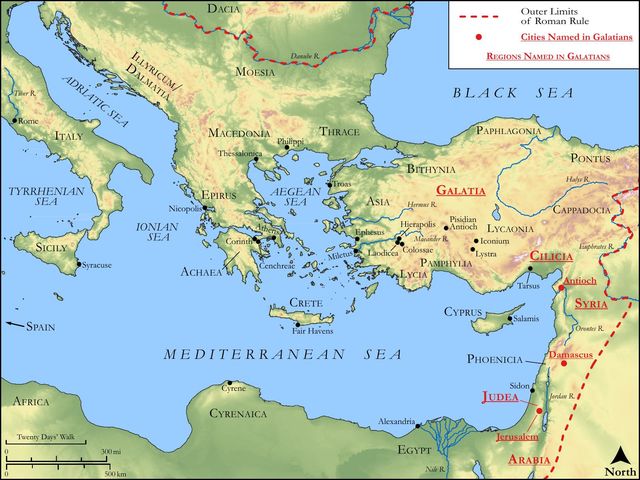
See on the biblical-era maps

Study this verse
Public-domain commentary
Matthew Henry
From his Commentary on the Whole Bible. Henry comments on passages, not single verses — this entry covers Galatians 2:11–21. His four-level outline is real structure in the source text, so it is rendered as structure.
I.From the account which Paul gives of what passed between him and the other apostles at Jerusalem, the Galatians might easily discern both the falseness of what his enemies had insinuated against him and their own folly and weakness in departing from that gospel which he had preached to them. But to give the greater weight to what he had already said, and more fully to fortify them against the insinuations of the judaizing teachers, he acquaints them with another interview which he had with the apostle Peter at Antioch, and what passed between them there, _Gal 2:11-14. Antioch was one of the chief churches of the Gentile Christians, as Jerusalem was of those Christians who turned from Judaism to the faith of Christ. There is no colour of reason for the supposition that Peter was bishop of Antioch. If he had, surely Paul would not have withstood him in his own church, as we here find he did; but, on the contrary, it is here spoken of as an occasional visit which he made thither. In their other meeting, there had been good harmony and agreement. Peter and the other apostles had both acknowledged Paul's commission and approved his doctrine, and they parted very good friends. But in this Paul finds himself obliged to appose Peter, for he was to be blamed, a plain evidence that he was not inferior to him, and consequently of the weakness of the pope's pretence to supremacy and infallibility, as the successor of Peter. Here we may observe,
1.Peter's fault. When he came among the Gentile churches, he complied with them, and did eat with them, though they were not circumcised, agreeably to the instructions which were given in particular to him (Acts 10), when he was warned by the heavenly vision to call nothing common or unclean. But, when there came some Jewish Christians from Jerusalem, he grew more shy of the Gentiles, only to humour those of the circumcision and for fear of giving them offence, which doubtless was to the great grief and discouragement of the Gentile churches. Then he withdrew, and separated himself. His fault herein had a bad influence upon others, for the other Jews also dissembled with him; though before they might be better disposed, yet now, from his example, they took on them to scruple eating with the Gentiles, and pretended they could not in conscience do it, because they were not circumcised. And (would you think it?) Barnabas himself, one of the apostles of the Gentiles, and one who had been instrumental in planting and watering the churches of the Gentiles, was carried away with their dissimulation. Here note,
(1.)The weakness and inconstancy of the best of men, when left to themselves, and how apt they are to falter in their duty to God, out of an undue regard to the pleasing of men. And,
(2.)The great force of bad examples, especially the examples of great men and good men, such as are in reputation for wisdom and honour.
2.The rebuke which Paul gave him for his fault. Notwithstanding Peter's character, yet, when he observes him thus behaving himself to the great prejudice both of the truth of the gospel and the peace of the church, he is not afraid to reprove him for it. Paul adhered resolutely to his principles, when others faltered in theirs; he was as good a Jew as any of them (for he was a Hebrew of the Hebrews), but he would magnify his office as the apostle of the Gentiles, and therefore would not see them discouraged and trampled upon. When he saw that they walked not uprightly, according to the truth of the gospel - that they did not live up to that principle which the gospel taught, and which they had professed to own and embrace, namely, that by the death of Christ the partition-wall between Jew and Gentile was taken down, and the observance of the law of Moses was no longer in force - when he observed this, as Peter's offence was public, so he publicly reproved him for it: He said unto him before them all, If thou, being a Jew, livest after the manner of the Gentiles, and not as do the Jews, why compellest thou the Gentiles to live as do the Jews? Herein one part of his conduct was a contradiction to the other; for if he, who was a Jew, could himself sometimes dispense with the use of the ceremonial law, and live after the manner of the Gentiles, this showed that he did not look upon the observance of it as still necessary, even for the Jews themselves; and therefore that he could not, consistently with his own practice, impose it upon the Gentile Christians. And yet Paul charges him with this, yea, represents him as compelling the Gentiles to live as did the Jews - not by open force and violence, but this was the tendency of what he did; for it was in effect to signify this, that the Gentiles must comply with the Jews, or else not be admitted into Christian communion.
II.Paul having thus established his character and office, and sufficiently shown that he was not inferior to any of the apostles, no, not to Peter himself, from the account of the reproof he gave him he takes occasion to speak of that great fundamental doctrine of the gospel - That justification is only by faith in Christ, and not by the works of the law (though some think that all he says to the end of the chapter is what he said to Peter at Antioch), which doctrine condemned Peter for his symbolizing with the Jews. For, if it was the principle of his religion that the gospel is the instrument of our justification and not the law, then he did very ill in countenancing those who kept up the law, and were for mixing it with faith in the business of our justification. This was the doctrine which Paul had preached among the Galatians, to which he still adhered, and which it is his great business in this epistle to mention and confirm. Now concerning this Paul acquaints us,
1.With the practice of the Jewish Christians themselves: "We," says he, "who are Jews by nature, and not sinners of the Gentiles (even we who have been born and bred in the Jewish religion, and not among the impure Gentiles), knowing that a man is not justified by the works of the law, but by the faith of Jesus Christ, even we ourselves have believed in Jesus Christ, that we might be justified by the faith of Christ, and not by the works of the law. And, if we have thought it necessary to seek justification by the faith of Christ, why then should we hamper ourselves with the law? What did we believe in Christ for? Was it not that we might be justified by the faith of Christ? And, if so, is it not folly to go back to the law, and to expect to be justified either by the merit of moral works or the influence of any ceremonial sacrifices or purifications? And if it would be wrong in us who are Jews by nature to return to the law, and expect justification by it, would it not be much more so to require this of the Gentiles, who were never subject to it, since by the works of the law no flesh shall be justified?" To give the greater weight to this he adds (Gal 2:17), "But if, while we seek to be justified by Christ, we ourselves also are found sinners, is Christ the minister of sin? If, while we seek justification by Christ alone, and teach others to do so, we ourselves are found giving countenance or indulgence to sin, or rather are accounted sinners of the Gentiles, and such as it is not fit to have communion with, unless we also observe the law of Moses, is Christ the minister of sin? Will it not follow that he is so, if he engage us to receive a doctrine that gives liberty to sin, or by which we are so far from being justified that we remain impure sinners, and unfit to be conversed with?" This, he intimates, would be the consequence, but he rejects it with abhorrence: "God forbid," says he, "that we should entertain such a thought of Christ, or of his doctrine, that thereby he should direct us into a way of justification that is defective and ineffectual, and leave those who embrace it still unjustified, or that would give the least encouragement to sin and sinners." This would be very dishonourable to Christ, and it would be very injurious to them also. "For," says he (Gal 2:18), "if I build again the things which I destroyed - if I (or any other), who have taught that the observance of the Mosaic law is not necessary to justification, should now, by word or practice, teach or intimate that it is necessary - I make myself a transgressor; I own myself to be still an impure sinner, and to remain under the guilt of sin, notwithstanding my faith in Christ; or I shall be liable to be charged with deceit and prevarication, and acting inconsistently with myself." Thus does the apostle argue for the great doctrine of justification by faith without the works of the law from the principles and practice of the Jewish Christians themselves, and from the consequences that would attend their departure from it, whence it appeared that Peter and the other Jews were much in the wrong in refusing to communicate with the Gentile Christians, and endeavouring to bring them under the bondage of the law.
2.He acquaints us what his own judgment and practice were.
(1.)That he was dead to the law. Whatever account others might make of it, yet, for his part, he was dead to it. He knew that the moral law denounced a curse against all that continue not in all things written therein, to do them; and therefore he was dead to it, as to all hope of justification and salvation that way. And as for the ceremonial law, he also knew that it was now antiquated and superseded by the coming of Christ, and therefore, the substance having come, he had no longer any regard to the shadow. He was thus dead to the law, through the law itself; it discovered itself to be at an end. By considering the law itself, he saw that justification was not to be expected by the works of it (since none could perform a perfect obedience to it) and that there was now no further need of the sacrifices and purifications of it, since they were done away in Christ, and a period was put to them by his offering up himself a sacrifice for us; and therefore, the more he looked into it the more he saw that there was no occasion for keeping up that regard to it which the Jews pleaded for. But, though he was thus dead to the law, yet he did not look upon himself as with law. He had renounced all hopes of justification by the works of it, and was unwilling any longer to continue under the bondage of it; but he was far from thinking himself discharged from his duty to God; on the contrary, he was dead to the law, that he might live unto God. The doctrine of the gospel, which he had embraced, instead of weakening the bond of duty upon him, did but the more strengthen and confirm it; and therefore, though he was dead to the law, yet it was only in order to his living a new and better life to God (as Rom 7:4, Rom 7:6), such a life as would be more agreeable and acceptable to God than his observance of the Mosaic law could now be, that is, a life of faith in Christ, and, under the influence thereof, of holiness and righteousness towards God. Agreeably hereunto he acquaints us,
(2.)That, as he was dead to the law, so he was alive unto God through Jesus Christ (Gal 2:20): I am crucified with Christ, etc. And here in his own person he gives us an excellent description of the mysterious life of a believer.
[1.]He is crucified, and yet he lives; the old man is crucified (Rom 6:6), but the new man is living; he is dead to the world, and dead to the law, and yet alive to God and Christ; sin is mortified, and grace quickened.
[2.]He lives, and yet not he. This is strange: I live, and yet not I; he lives in the exercise of grace; he has the comforts and the triumphs of grace; and yet that grace is not from himself, but from another. Believers see themselves living in a state of dependence.
[3.]He is crucified with Christ, and yet Christ lives in him; this results from his mystical union with Christ, by means of which he is interested in the death of Christ, so as by virtue of that to die unto sin; and yet interested in the life of Christ, so as by virtue of that to live unto God.
[4.]He lives in the flesh, and yet lives by faith; to outward appearance he lives as other people do, his natural life is supported as others are; yet he has a higher and nobler principle that supports and actuates him, that of faith in Christ, and especially as eyeing the wonders of his love in giving himself for him. Hence it is that, though he lives in the flesh, yet he does not live after the flesh. Note, Those who have true faith live by that faith; and the great thing which faith fastens upon is Christ's loving us and giving himself for us. The great evidence of Christ's loving us is his giving himself for us; and this is that which we are chiefly concerned to mix faith with, in order to our living to him.
Lastly, The apostle concludes this discourse with acquainting us that by the doctrine of justification by faith in Christ, without the works of the law (which he asserted, and others opposed), he avoided two great difficulties, which the contrary opinion was loaded with: - 1. That he did not frustrate the grace of God, which the doctrine of the justification by the works of the law did; for, as he argues (Rom 11:6), If it be of works, it is no more of grace. 2. That he did not frustrate the death of Christ; whereas, if righteousness come by the law, then it must follow that Christ has died in vain; for, if we look for salvation by the law of Moses, then we render the death of Christ needless: for to what purpose should he be appointed to die, if we might have been saved without it?
Historical interpretation
Three Centuries of Reception
8 surviving comments on this verse. Each one is dated, so this reads as a timeline rather than a list.
Select a marker to jump to its quote. Markers stagger vertically where authors wrote within a few decades of each other.
The apostle Peter would not have been rebuked if he had separated himself from the Gentiles for fear of giving scandal to the Jews. But what was rebuked in the apostle Peter was that, when he previously had been living in Gentile fashion with believers, he started to teach that the Gentiles ought to follow Jewish practice because he was overcome by fear upon the arrival of Jews from James. Therefore it was said to him, “If you, being a Jew, live in Gentile fashion, why do you force the Gentiles to follow Jewish practice?” For he had introduced doubt about discipleship in the gospel, which is a crime, since he was destroying what he had built. Thus it is that the apostle Paul calls this “insincerity.
"But when I saw that they walked not uprightly according to the truth of the Gospel."
Neither let this phrase disturb you, for in using it he does not condemn Peter, but so expresses himself for the benefit of those who were to be reformed by the reproof of Peter.
"I said unto Cephas before them all."
Observe his mode of correcting the others; he speaks "before them all," that the hearers might be alarmed thereby. And this is what he says,
"If thou, being a Jew, livest as do the Gentiles, and not as do the Jews, how compellest thou the Gentiles to live as do the Jews?"
But it was the Jews and not the Gentiles who were carried away together with Peter; why then does Paul impute what was not done, instead of directing his remarks, not against the Gentiles, but against the dissembling Jews? And why does he accuse Peter alone, when the rest also dissembled together with him? Let us consider the terms of his charge; "If thou, being a Jew, livest as do the Gentiles, and not as do the Jews, how compellest thou the Gentiles to live as do the Jews?" for in fact Peter alone had withdrawn himself. His object then is to remove suspicion from his rebuke; had he blamed Peter for observing the Law, the Jews would have censured him for his boldness towards their Teacher. But now arraigning him in behalf of his own peculiar disciples, I mean the Gentiles, he facilitates thereby the reception of what he has to say which he also does by abstaining from reproof of the others, and addressing it all to the Apostle. "If thou," he says, "being a Jew, livest as do the Gentiles, and not as do the Jews;" which almost amounts to an explicit exhortation to imitate their Teacher, who, himself a Jew, lived after the manner of the Gentiles. This however he says not, for they could not have received such advice, but under color of reproving him in behalf of the Gentiles, he discloses Peter's real sentiments. On the other hand, if he had said, Wherefore do you compel these Jews to Judaize? his language would have been too severe. But now he effects their correction by appearing to espouse the part, not of the Jewish, but of the Gentile, disciples; for rebukes, which are moderately severe, secure the readiest reception. And none of the Gentiles could object to Paul that he took up the defense of the Jews. The whole difficulty was removed by Peter's submitting in silence to the imputation of dissimulation, in order that he might deliver the Jews from its reality. At first Paul directs his argument to the character which Peter wore, "If thou, being a Jew:" but he generalizes as he goes on, and includes himself in the phrase,
(Verse 14.) But when I saw that they were not walking straight towards the truth of the Gospel, I said to Peter in front of everyone. Just as those who pretend to limp with healthy steps do not have a fault in their feet, but there is some reason why they limp, so Peter, knowing that circumcision and uncircumcision mean nothing, but the observance of God's commandments does, used to eat with the Gentiles, but for a time he withdrew from them, lest he should make the Jews lose faith in Christ. And so Paul, using the same tactic as Peter had pretended, confronted him to his face and spoke openly in front of everyone; not so much to accuse Peter, but rather to correct those for whose sake Peter had pretended, or even to remove pride from the Jews and despair from the Gentiles. But if someone does not like this interpretation, in which neither Peter is shown to have sinned nor Paul to have boldly accused him, they must explain in what way Paul criticizes this in the other case, which he himself committed.
If you, being a Jew, live as a Gentile and not as a Jew, how do you force the Gentiles to live as Jews? Peter is strongly convinced by an unbreakable argument, or rather, through Peter, those who were compelling him to engage in disputes: If, Peter, you being a Jew by nature, born a Jew and observing all the precepts of the Law, now know that these things have no inherent usefulness but are examples and images of things to come, and if you, eating with those who are from the Gentiles, do not live in a superstitious manner as you did before, but now live freely and impartially; how then can you compel those who believed from the Gentiles to Judaize, now separating yourself from them and considering them unclean? For if those from whom you separate are unclean, and yet you do separate, it follows that you compel them to be circumcised and become Jews; while you yourself, being born a Jew, live like a Gentile. And he joyfully shows the reason why he disputed against him: namely, because he was compelling the Gentiles to judaize through his own hypocrisy, as they desired to imitate him.
Those who wish to defend Peter from error and from the depravity of life into which he had fallen overturn the very way of religion in which lies the salvation of all. This shatters and diminishes the authority of the Scriptures. They do not see that in this defense they are implicitly charging the apostle Paul not only with the crime of lying but even with perjury in the very teaching of piety, that is, in the letter in which Paul proclaims the gospel. It is for this reason he says, before narrating these things [in 1:20], “What I write to you, understand before God that I do not lie.
So that one might fulfill the works of the law, his infirmity being assisted not by his own merit but by the grace of God, they were not to demand from the Gentiles a fleshly observation of the law but were to understand that through the same grace of God they were able to fulfill the spiritual works of the law.
That he rebuked him “before all” was necessary, in order that everyone might be bettered by his rebuke. For it was not expedient to correct in secret an error that was doing public harm. It should be added that in his steadfastness and charity Peter, to whom the Lord had said three times, “Do you love me? Feed my sheep,” was very ready to bear this rebuke from a junior shepherd for the salvation of the flock. For the one who was being rebuked was himself more remarkable and more difficult to imitate than the one rebuking. For it is easier to see what one should correct in others than to see what ought to be corrected in oneself. It is easier to correct others by admonishing and rebuking than to be corrected readily even by yourself, let alone by another, still less if you add another and “before all.”
He says this so that Hebrews no less than Gentiles may be compelled to accept the grace of faith, not the impositions of the law, which no one could fulfill.
Namely that they did not cease altogether from [observing] the tradition of the Law. As we already said, he spoke in this way on account of the economy; for the whole event was an economy, including the rebuke made by Paul, and the silence and condescension of Peter. For both of them sought one thing, namely, that those who believed in Christ should cease to observe the Law. “If you are a Jew and live as a pagan, and not as a Jew.” Namely, you do not keep the observance of the Law, but like those believers from the nations, you no longer keep the new months and the sabbaths. “How then do you force the nations to do this?” This too indicates the economy of this affair. Although he does not force you, nor does he attempt to persuade the nations to Judaize, Paul says that he does so that the rebuke addressed to Peter might be found to be a useful occasion to him with respect to his own disciples. By saying all this he educates the Galatians to easily cope with the weight of the rebuke for if Peter, being from the Jews, and persuading others to Judaize, was rebuked, and accepted the rebuke, as having been properly addressed to him, how much more should the Galatians, who are from the nations, and believed in Christ, and subjected themselves again to the slavery of the Law should accept the rebuke when it is addressed to them.
Continue studying Galatians 2:14 across the web’s major study libraries — every link below opens this exact verse, chapter, or book on the destination site.
Read & Compare
 BibleGatewayThis verse in more than 200 translations and 70 languages.
 Bible.comThe YouVersion reader — hundreds of translations, reading plans, and highlights.
 ESV.orgCrossway's official English Standard Version reader.
 NET BibleThe NET translation with 60,000+ translators' notes on every rendering decision.
 STEP BibleTyndale House's free study tool — original text, vocabulary, and scholarly resources.
 BibliaLogos Bible Software's free web reader.
 USCCBThe New American Bible (Revised Edition) with the U.S. bishops' study notes.
Commentaries
 BibleHub CommentariesDozens of classic commentaries on this verse, gathered on one page.
 StudyLightMore than 100 commentary sets — the largest collection on the web.
 BibleRefPlain-English commentary on what this verse means, verse by verse.
 Enduring WordDavid Guzik's free commentary on this chapter, widely used by Bible teachers.
 Bible Study ToolsVerse commentary alongside Greek and Hebrew study aids.
Original Language & Research
- BibleHub InterlinearThe verse word by word — original language, transliteration, and English.
- BibleHub LexiconEvery word's original-language definition and Strong's entry.
 Blue Letter BibleDeep-study tools — Strong's numbers, concordance, and word studies.
 CNTR CollationThe earliest Greek manuscripts of this verse, collated letter by letter.
Sermons, Hymns & Audio


TrulyRandomVerse is not affiliated with these sites and doesn’t control their content. They’re linked because they’re genuinely useful.
Summary
Galatians 2:14 captures a pivotal moment in early church history where the Apostle Paul publicly confronted Peter (Cephas) in Antioch for his inconsistent behavior concerning the implications of the gospel. Peter, by withdrawing from eating with Gentiles when Jewish believers arrived, implicitly compelled Gentile Christians to adopt Jewish customs, thereby undermining the truth that salvation is by grace through faith alone, apart from works of the Law, and jeopardizing the unity of the body of Christ. Paul's bold rebuke underscored the supremacy of gospel truth over social pressure and personal compromise.
Context
ShowHideLiterary Context
This verse is situated within Paul's defense of his apostolic authority and the true gospel in his letter to the Galatians. Chapters 1 and 2 establish Paul's independent commission from Christ and his consistent message, contrasting it with the false teachings of the Judaizers who insisted on Gentile circumcision and adherence to the Mosaic Law for salvation. The immediate preceding verses (Galatians 2:11-13) set the scene for the confrontation in Antioch, describing Peter's initial fellowship with Gentiles and his subsequent withdrawal due to fear of "certain from James." Paul's public rebuke of Peter is presented as a crucial example of how the purity of the gospel must be upheld, even against respected leaders, leading directly into Paul's theological exposition on justification by faith in Galatians 2:15-21.
Historical & Cultural Context
The incident occurred in Antioch, a significant center for Gentile Christianity and a launching point for missionary journeys. The early church grappled with how Jewish and Gentile believers could coexist and worship together, particularly concerning dietary laws and circumcision. Jewish Christians, especially those from Jerusalem and influenced by figures like James, often felt a strong pull to maintain traditional Jewish practices. Peter's behavior reflected the immense social and religious pressure to conform to Jewish customs, even if it compromised the theological implications of the gospel. Eating together (table fellowship) was a profound symbol of unity and acceptance in ancient cultures, and Peter's withdrawal was a public declaration of separation, implying that Gentiles were somehow "unclean" or less than fully accepted without adherence to Jewish law.
Key Themes
ShowHideGalatians 2:14 powerfully contributes to several overarching themes in the book of Galatians. Foremost is the truth of the gospel itself – that salvation and justification come solely through faith in Christ, not through adherence to the Mosaic Law or Jewish customs (as articulated in Galatians 2:16). Paul's confrontation highlights the danger of hypocrisy and inconsistency when one's actions contradict the very principles they profess, showing how Peter's behavior "walked not uprightly according to the truth of the gospel." The verse also underscores the theme of Christian liberty, emphasizing freedom from the ceremonial law and the dangers of legalism, which can place unnecessary burdens on believers and undermine the sufficiency of Christ's work (compare with Galatians 5:1). Finally, it speaks to unity in the body of Christ, demonstrating Paul's commitment to ensuring that ethnic distinctions do not create division or a two-tiered system within the church (a concept further developed in Galatians 3:28).
Exposition and Analysis
ShowHideKey Word Analysis
ShowHideThis verb, often translated as "to see" or "to know," implies a direct perception and understanding of Peter's actions and their theological implications. Paul didn't just observe; he comprehended the deviation from gospel truth.
Literally meaning "to walk straight-footed," this word metaphorically signifies living consistently or conducting oneself in conformity with a standard. Paul's use of the negative ("not uprightly") indicates Peter's behavior was a deviation from the "straight path" of the gospel's truth and its implications for Christian living and fellowship.
This term means "to necessitate" or "to constrain." Paul asserts that Peter's actions, though perhaps not explicitly verbal commands, exerted a powerful social and theological pressure on Gentiles, forcing them to adopt Jewish customs to maintain fellowship and acceptance. This was a subtle but potent form of coercion.
Verse Breakdown
ShowHide"But when I saw that they walked not uprightly according to the truth of the gospel"
Paul begins by stating the reason for his intervention. He perceived that Peter, Barnabas, and other Jewish believers were not living consistently with the core tenets and implications of the gospel message. Their actions, specifically withdrawing from table fellowship with Gentiles, implicitly denied the full acceptance of Gentiles into the new covenant community without adherence to Jewish customs.
"I said unto Peter before them all"
Paul's confrontation was public, not private. This highlights the seriousness of the issue – a public error required a public correction, especially from a leader like Peter, whose actions had public consequences for the gospel's integrity and church unity.
"If thou, being a Jew, livest after the manner of Gentiles, and not as do the Jews"
Paul points out Peter's hypocrisy. Peter, a Jew by birth and tradition, had himself been living freely, eating with Gentiles and disregarding Jewish dietary laws when convenient (as evidenced by his initial behavior). This demonstrated his own practical understanding of Christian liberty.
"why compellest thou the Gentiles to live as do the Jews?"
This is the core of Paul's rebuke. If Peter, a Jew, was free to live like a Gentile, why was he, by his actions, forcing or pressuring Gentiles to adopt Jewish customs ("to Judaize")? This inconsistency undermined the gospel's message of freedom and equality in Christ, implying that Gentile believers were incomplete or inferior unless they conformed to Jewish practices.
Literary Devices
ShowHidePaul employs Rhetorical Question in the latter part of the verse ("why compellest thou the Gentiles to live as do the Jews?"). This is not a question seeking information but a powerful rhetorical device designed to expose the illogical and hypocritical nature of Peter's actions. It forces Peter (and the readers) to confront the inherent contradiction: if Peter, a Jew, enjoyed freedom from the Law, how could he implicitly demand that Gentiles submit to it? This question serves to highlight the grave theological implications of Peter's behavior, which effectively undermined the very gospel of grace. The passage also demonstrates Irony, as Peter, who had received a vision about clean and unclean foods (see Acts 10:9-16), and who had been instrumental in the early inclusion of Gentiles (see Acts 10:44-48), was now acting in a way that contradicted those foundational experiences.
Theological and Thematic Connections
ShowHideGalatians 2:14 serves as a foundational text for understanding the radical nature of the gospel of grace and its implications for Christian freedom and unity. It underscores the critical truth that salvation is not earned through adherence to any law or cultural custom, but is a free gift received through faith in Jesus Christ. Peter's error was not malicious intent, but a failure to live consistently with the profound implications of this truth, particularly regarding the full inclusion and equality of Gentile believers. Paul's public correction demonstrates the paramount importance of safeguarding the gospel's purity, even when it means confronting respected leaders, ensuring that no human tradition or social pressure compromises the sufficiency of Christ's work on the cross. The incident highlights the ongoing tension between gospel truth and cultural accommodation, challenging believers to always prioritize the former.
Reflection and Application
ShowHideThe confrontation in Galatians 2:14 offers profound lessons for believers today. It calls us to a rigorous self-examination of our own consistency and integrity in living out the gospel. Are there areas where our actions or associations subtly (or overtly) contradict the truth of God's grace, perhaps by imposing unnecessary burdens on others or creating divisions based on non-essential matters? We are challenged to stand firm for the truth of the gospel, even when it is unpopular or requires confronting those we respect. This means prioritizing Christ's finished work and the freedom it brings over cultural norms, personal preferences, or social pressures that might subtly undermine the "truth of the gospel." Ultimately, this passage urges us to champion unity in Christ, recognizing that all believers, regardless of background, are equally accepted and made one in Him, and to live in a way that consistently reflects this glorious reality.
Questions for Reflection
ShowHideFAQ
ShowHideWhy was Peter's action considered "not uprightly according to the truth of the gospel" if he wasn't explicitly teaching false doctrine?
ShowHidePeter's actions, though not a verbal declaration of false doctrine, carried significant theological weight and had practical implications that contradicted the gospel. By withdrawing from table fellowship with Gentile believers when Jewish Christians arrived, Peter was implicitly suggesting that the Gentiles were somehow "unclean" or less fully accepted unless they conformed to Jewish dietary laws and customs. This created a two-tiered Christianity and undermined the truth that both Jews and Gentiles are made one in Christ through faith, without the need for adherence to the Mosaic Law. Paul saw this as a practical denial of the gospel's truth, which declares that all are justified by faith in Jesus, making such distinctions irrelevant for fellowship and salvation (see Galatians 3:28). His behavior was a powerful, non-verbal sermon that distorted the gospel's message of radical inclusion and grace.
Christ-Centered Fulfillment
ShowHideGalatians 2:14, though a narrative of apostolic conflict, deeply underscores the Christ-centered nature of the gospel. Peter's error lay in allowing social pressure to obscure the profound truth that Christ's finished work on the cross has abolished the dividing wall between Jew and Gentile, creating one new humanity (as powerfully articulated in Ephesians 2:14-16). The "truth of the gospel" that Paul so fiercely defended is precisely that justification comes not by works of the Law, but by faith in Jesus Christ, who became a curse for us to redeem us from the Law's demands (see Galatians 3:13). Peter's withdrawal implicitly suggested that Christ's work was insufficient, requiring additional adherence to Jewish customs for full acceptance. Paul's rebuke, therefore, was a defense of Christ's singular and complete sufficiency. The freedom from the Law that Paul championed is not an end in itself, but a freedom in Christ, enabling believers from every background to be united in Him, without any need for external rituals or ethnic distinctions to complete their standing before God. This passage ultimately points to Christ as the sole basis for our acceptance, our unity, and our freedom, making Him the center of all true fellowship and salvation.