


Galatians 2:5
Bible text: King James Version (1769 Blayney text) · Public domain
Bible text: Berean Standard Bible · Public domain
Bible text: American Standard Version (1901) · Public domain
Bible text: World English Bible, Messianic edition · Public domain
Bible text: Geneva Bible (1599) · Public domain
Bible text: Young's Literal Translation · Public domain
- οἷςhoisto whomG3739R-DPMRelative pronoun Dative Plural Masculine
- οὐδὲoudenot evenG3761CONJ-NConjunction Negative
- πρὸςprosforG4314PREPPreposition
- ὥρανhōranan hourG5610N-ASFNoun Accusative Singular Feminine
- εἴξαμενeixamendid we yieldG1502V-AAI-1PVerb Aorist Active Indicative 1st Plural
- τῇtēa<the>G3588T-DSFDefinite article Dative Singular Feminine
- ὑποταγῇhupotagēain subjectionG5292N-DSFNoun Dative Singular Feminine
- ἵναinaso thatG2443CONJConjunction
- ἡhētheG3588T-NSFDefinite article Nominative Singular Feminine
- ἀλήθειαalētheiatruthG225N-NSFNoun Nominative Singular Feminine
- τοῦtouof theG3588T-GSNDefinite article Genitive Singular Neuter
- εὐαγγελίουeuangeliougospelG2098N-GSNNoun Genitive Singular Neuter
- διαμείνῃdiameinēmay continueG1265V-AAS-3SVerb Aorist Active Subjunctive 3rd Singular
- πρὸςproswithG4314PREPPreposition
- ὑμᾶςhumasyouG4771P-2APPersonal pronoun Accusative 2nd Plural
English is a literal word-by-word gloss of the Greek, not the KJV's wording. Why?
This is the original text the KJV's translators worked from — each Greek word with its own literal English meaning in this verse, prepared by scholars at Tyndale House, Cambridge. The KJV translates whole sentences, not word by word, so its wording differs: one Greek word can become several English words, and the KJV may choose “charity” where the gloss reads “love”. Both are faithful — they answer different questions. For the KJV's own rendering, switch to the KJV text.
Details
See on the biblical-era maps
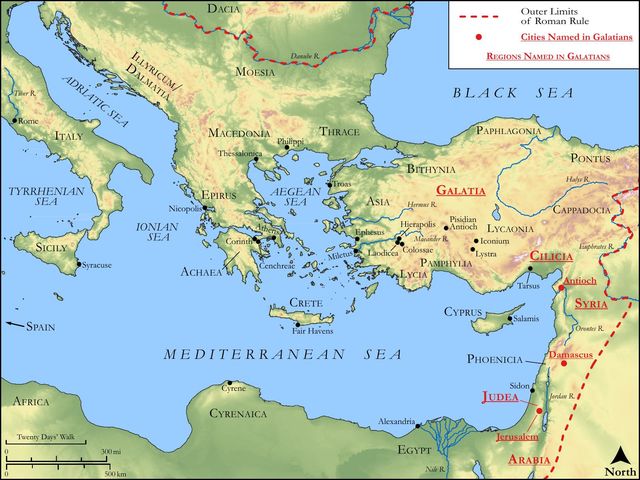

Study this verse
Public-domain commentary
Matthew Henry
From his Commentary on the Whole Bible. Henry comments on passages, not single verses — this entry covers Galatians 2:1–10. His three-level outline is real structure in the source text, so it is rendered as structure.
It should seem, by the account Paul gives of himself in this chapter, that, from the very first preaching and planting of Christianity, there was a difference of apprehension between those Christians who had first been Jews and those who had first been Gentiles. Many of those who had first been Jews retained a regard to the ceremonial law, and strove to keep up the reputation of that; but those who had first been Gentiles had no regard to the law of Moses, but took pure Christianity as perfective of natural religion, and resolved to adhere to that. Peter was the apostle to them; and the ceremonial law, though dead with Christ, yet not being as yet buried, he connived at the respect kept up for it. But Paul was the apostle of the Gentiles; and, though he was a Hebrew of the Hebrews, yet he adhered to pure Christianity. Now in this chapter he tells us what passed between him and the other apostles, and particularly between him and Peter hereupon.
In these verses he informs us of another journey which he took to Jerusalem, and of what passed between him and the other apostles there, Gal 2:1-10. Here he acquaints us,
I.With some circumstances relating to this his journey thither. As particularly,
1.With the time of it: that it was not till fourteen years after the former (mentioned Gal 1:18), or, as others choose to understand it, from his conversion, or from the death of Christ. It was an instance of the great goodness of God that so useful a person was for so many years preserved in his work. And it was some evidence that he had no dependence upon the other apostles, but had an equal authority with them, that he had been so long absent from them, and was all the while employed in preaching and propagating pure Christianity, without being called into question by them for it, which it may be thought he would have been, had he been inferior to them, and his doctrine disapproved by them.
2.With his companions in it: he went up with Barnabas, and took with him Titus also. If the journey here spoken of was the same with that recorded Acts 15 (as many think), then we have a plain reason why Barnabas went along with him; for he was chosen by the Christians at Antioch to be his companion and associate in the affair he went about. But, as it does not appear that Titus was put into the same commission with him, so the chief reason of his taking him along with him seems to have been to let those at Jerusalem see that he was neither ashamed nor afraid to own the doctrine which he had constantly preached; for though Titus had now become not only a convert to the Christian faith, but a preacher of it too, yet he was by birth a Gentile and uncircumcised, and therefore, by making him his companion, it appeared that their doctrine and practice were of a piece, and that as he had preached the non-necessity of circumcision, and observing the law of Moses, so he was ready to own and converse with those who were uncircumcised.
3.With the reason of it, which was a divine revelation he had concerning it: he went up be revelation; not of his own head, much less as being summoned to appear there, but by special order and direction from Heaven. It was a privilege with which this apostle was often favoured to be under a special divine direction in his motions and undertakings; and, though this is what we have no reason to expect, yet it should teach us, in every thing of moment we go about, to endeavour, as far as we are capable, to see our way made plain before us, and to commit ourselves to the guidance of Providence.
II.He gives us an account of his behaviour while he was at Jerusalem, which was such as made it appear that he was not in the least inferior to the other apostles, but that both his authority and qualifications were every way equal to theirs. He particularly acquaints us,
1.That he there communicated the gospel to them, which he preached among the Gentiles, but privately, etc. Here we may observe both the faithfulness and prudence of our great apostle.
(1.)His faithfulness in giving them a free and fair account of the doctrine which he had all along preached among the Gentiles, and was still resolved to preach - that of pure Christianity, free from all mixtures of Judaism. This he knew was a doctrine that would be ungrateful to many there, and yet he was not afraid to own it, but in a free and friendly manner lays it open before them and leaves them to judge whether or no it was not the true gospel of Christ. And yet,
(2.)He uses prudence and caution herein, for fear of giving offence. He chooses rather to do it in a more private than in a public way, and to those that were of reputation, that is, to the apostles themselves, or to the chief among the Jewish Christians, rather than more openly and promiscuously to all, because, when he came to Jerusalem, there were multitudes that believed, and yet continued zealous for the law, Act 21:20. And the reason of this his caution was lest he should run, or had run, in vain, lest he should stir up opposition against himself and thereby either the success of his past labours should be lessened, or his future usefulness be obstructed; for nothing more hinders the progress of the gospel than differences of opinion about the doctrines of it, especially when they occasion quarrels and contentions among the professors of it, as they too usually do. It was enough to his purpose to have his doctrine owned by those who were of greatest authority, whether it was approved by others or not. And therefore, to avoid offence, he judges it safest to communicate it privately to them, and not in public to the whole church. This conduct of the apostle may teach all, and especially ministers, how much need they have of prudence, and how careful they should be to use it upon all occasions, as far as is consistent with their faithfulness.
2.That in his practice he firmly adhered to the doctrine which he had preached. Paul was a man of resolution, and would adhere to his principles; and therefore, though he had Titus with him, who was a Greek, yet he would not suffer him to be circumcised, because he would not betray the doctrine of Christ, as he had preached it to the Gentiles. It does not appear that the apostles at all insisted upon this; for, though they connived at the use of circumcision among the Jewish converts, yet they were not for imposing it upon the Gentiles. But there were others who did, whom the apostle here calls false brethren, and concerning whom he informs us that they were unawares brought in, that is, into the church, or into their company, and that they came only to spy out their liberty which they had in Christ Jesus, or to see whether Paul would stand up in defence of that freedom from the ceremonial law which he had taught as the doctrine of the gospel, and represented as the privilege of those who embraced the Christian religion. Their design herein was to bring them into bondage, which they would have effected could they have gained the point they aimed at; for, had they prevailed with Paul and the other apostles to have circumcised Titus, they would easily have imposed circumcision upon other Gentiles, and so have brought them under the bondage of the law of Moses. But Paul, seeing their design, would by no means yield to them; he would not give place by subjection, no, not for an hour, not in this one single instance; and the reason of it was that the truth of the gospel might continue with them - that the Gentile Christians, and particularly the Galatians, might have it preserved to them pure and entire, and not corrupted with the mixtures of Judaism, as it would have been had he yielded in this matter. Circumcision was at that time a thing indifferent, and what in some cases might be complied with without sin; and accordingly we find even Paul himself sometimes giving way to it, as in the case of Timothy, Act 16:3. But when it is insisted on as necessary, and his consenting to it, though only in a single instance, is likely to be improved as giving countenance to such an imposition, he has too great a concern for the purity and liberty of the gospel, to submit to it; he would not yield to those who were for the Mosaic rites and ceremonies, but would stand fast in the liberty wherewith Christ hath made us free, which conduct of his may give us occasion to observe that what under some circumstances may lawfully be complied with, yet, when that cannot be done without betraying the truth, or giving up the liberty, of the gospel, it ought to be refused.
3.That, though he conversed with the other apostles, yet he did not receive any addition to his knowledge or authority from them, Gal 2:6. By those who seemed to be somewhat he means the other apostles, particularly James, Peter, and John, whom he afterwards mentions by name, Gal 2:9. And concerning these he grants that they were deservedly had in reputation by all, that they were looked upon (and justly too) as pillars of the church, who were set not only for its ornament, but for its support, and that on some accounts they might seem to have the advantage of him, in that they had seen Christ in the flesh, which he had not, and were apostles before him, yea, even while he continued a persecutor. But yet, whatever they were, it was no matter to him. This was no prejudice to his being equally an apostle with them; for God does not accept the persons of men on the account of any such outward advantages. As he had called them to this office, so he was at liberty to qualify others for it, and to employ them in it. And it was evident in this case that he had done so; for in conference they added nothing to him, they told him nothing but what he before knew by revelation, nor could they except against the doctrine which he communicated to them, whence it appeared that he was not at all inferior to them, but was as much called and qualified to be an apostle as they themselves were.
4.That the issue of this conversation was that the other apostles were fully convinced of his divine mission and authority, and accordingly acknowledged him as their fellow-apostle, Gal 2:7-10. They were not only satisfied with his doctrine, but they saw a divine power attending him, both in preaching it and in working miracles for the confirmation of it: that he who wrought effectually in Peter to the apostleship of the circumcision, the same was mighty in him towards the Gentiles. And hence they justly concluded that the gospel of the uncircumcision was committed to Paul, as the gospel of the circumcision was to Peter. And therefore, perceiving the grace that was given to him (that he was designed to the honour and office of an apostle as well as themselves) they gave unto him and Barnabas the right hand of fellowship, a symbol whereby they acknowledged their equality with them, and agreed that these should go to the heathen, while they continued to preach to the circumcision, as judging it most agreeable to the mind of Christ, and most conducive to the interest of Christianity, so to divide their work. And thus this meeting ended in an entire harmony and agreement; they approved both Paul's doctrine and conduct, they were fully satisfied in him, heartily embraced him as an apostle of Christ, and had nothing further to add, only that they would remember the poor, which of his own accord he was very forward to do. The Christians of Judea were at that time labouring under great wants and difficulties; and the apostles, out of their compassion to them and concern for them, recommend their case to Paul, that he should use his interest with the Gentile churches to procure a supply for them. This was a reasonable request; for, if the Gentiles were made partakers of their spiritual things, it was their duty to minister to them in carnal things, as Rom 15:27. And he very readily falls in with it, whereby he showed his charitable and catholic disposition, how ready he was to own the Jewish converts as brethren, though many of them could scarcely allow the like favour to the converted Gentiles, and that mere difference of opinion was no reason with him why he should not endeavour to relieve and help them. Herein he has given us an excellent pattern of Christian charity, and has taught us that we should by no means confine it to those who are just of the same sentiments with us, but be ready to extend it to all whom we have reason to look upon as the disciples of Christ.
Historical interpretation
Six Centuries of Reception
7 surviving comments on this verse. Each one is dated, so this reads as a timeline rather than a list.
Select a marker to jump to its quote. Markers stagger vertically where authors wrote within a few decades of each other.
I have learned that certain of the ministers of Satan have wished to disturb you, some of them asserting that Jesus was born [only ] in appearance, was crucified in appearance, and died in appearance; others that He is not the Son the Creator, and others that He is Himself God over all. Others, again, hold that He is a mere man, and others that this flesh is not to rise again, so that our proper course is to live and partake of a life of pleasure, for that this is the chief good to beings who are in a little while to perish. A swarm of such evils has burst in upon us. But ye have not "given place by subjection to them, no, not for one hour." For ye are the fellow-citizens as well as the disciples of Paul, who "fully preached the Gospel from Jerusalem, and round about unto Illyricum," and bare about "the marks of Christ" in his flesh.
And again he says, "For an hour we did give place to subjection,
Neither must we prescribe this from custom, but overcome opposite custom by reason. For neither did Peter, whom first the Lord chose, and upon whom He built His Church, when Paul disputed with him afterwards about circumcision, claim anything to himself insolently, nor arrogantly assume anything; so as to say that he held the primacy, and that he ought rather to be obeyed by novices and those lately come. Nor did he despise Paul because he had previously been a persecutor of the Church, but admitted the counsel of truth, and easily yielded to the lawful reason which Paul asserted, furnishing thus an illustration to us both of concord and of patience, that we should not obstinately love our own opinions, but should rather adopt as our own those which at any time are usefully and wholesomely suggested by our brethren and colleagues, if they be true and lawful. Paul, moreover, looking forward to this, and consulting faithfully for concord and peace, has laid down in his epistle this rule: "Moreover, let the prophets speak two or three, and let the rest judge. But if anything be revealed to another that sitteth by, let the first hold his peace." In which place he has taught and shown that many things are revealed to individuals for the better, and that each one ought not obstinately to contend for that which he had once imbibed and held; but if anything has appeared better and more useful, he should gladly embrace it. For we are not overcome when better things are presented to us, but we are instructed, especially in those matters which pertain to the unity of the Church and the truth of our hope and faith; so that we, priests of God and prelates of His Church, by His condescension, should know that remission of sins cannot be given save in the Church, nor can the adversaries of Christ claim to themselves anything belonging to His grace.
"To whom we gave place in the way of subjection, no, not for an hour."
Observe the force and emphasis of the phrase; he says not, "by argument," but, "by subjection," for their object was not to teach good doctrine, but to subjugate and enslave them. Wherefore, says he, we yielded to the Apostles, but not to these.
"That the truth of the Gospel might continue with you."
That we may confirm, says he, by our deeds what we have already declared by words,-namely, that the "old things are passed away, behold they are become new;" and that "if any man is in Christ he is a new creature;" (2 Cor. v: 17.) and that "if ye receive circumcision, Christ will profit you nothing." (Gal. v: 2.) In maintaining this truth we gave place not even for an hour. Then, as he was directly met by the conduct of the Apostles, and the reason of their enjoining the rite would probably be asked, he proceeds to solve this objection. This he does with great skill, for he does not give the actual reason, which was, that the Apostles acted by way of condescension and in the use of a scheme, as it were; for otherwise his hearers would have been injured. For those, who are to derive benefit from a scheme should be unacquainted with the design of it; all will be undone, if this appears. Wherefore, he who is to take part in it should know the drift of it; those who are to benefit by it should not. To make my meaning more evident, I will take an example from our present subject. The blessed Paul himself, who meant to abrogate circumcision, when he was about to send Timothy to teach the Jews, first circumcised him and so sent him. This he did, that his hearers might the more readily receive him; he began by circumcising, that in the end he might abolish it. But this reason he imparted to Timothy only, and told it not to the disciples. Had they known that the very purpose of his circumcision was the abolition of the rite, they would never have listened to his preaching, and the whole benefit would have been lost. But now their ignorance was of the greatest use to them, for their idea that his conduct proceeded from a regard to the Law, led them to receive both him and his doctrine with kindness and courtesy, and having gradually received him, and become instructed, they abandoned their old customs. Now this would not have happened had they known his reasons from the first; for they would have turned away from him, and being turned away would not have given him a hearing, and not hearing, would have continued in their former error. To prevent this, he did not disclose his reasons; here too he does not explain the occasion of the scheme, but shapes his discourse differently.
(Vers. 3-5.) But not even Titus, who was with me, though he was a Gentile, was compelled to be circumcised. Yet because of false brothers secretly brought in—who slipped in to spy out our freedom that we have in Christ Jesus, so that they might bring us into slavery— to them we did not yield in submission even for a moment, so that the truth of the gospel might be preserved for you. But even Titus, who was with me, was not compelled to be circumcised, although he was a Gentile. This matter arose because of false brothers secretly brought in, who slipped in to spy out our freedom that we have in Christ Jesus, so that they might bring us into slavery. But what is this truth of the Gospel, to give in to the hypocrisy of the Jews; and to consider as scybala what you once esteemed, and to despise as losses, and to observe and esteem as something, when they are nothing? But it strongly opposes the meaning of the Epistle itself, to call the Galatians back to circumcision. This is the main theme throughout his discourse, to teach that he is a Hebrew among the Hebrews, once observing all the works of the Law, circumcised on the eighth day according to the Law of the Pharisees: nevertheless, for the grace of Christ, to completely despise everything. For when he went to Jerusalem, and the false brethren, who believed in circumcision, wanted to compel him to circumcise Titus; neither Titus, nor did he give in to violence, so that they would safeguard the truth of the Gospel. But if he says that he was compelled by necessity to circumcise Titus: how does he recall the Galatians from circumcision, from which neither Titus, who was with him from the Gentiles, could excuse himself in Jerusalem? Therefore, according to the Greek manuscripts, it should be read, 'To whom we did not yield in subjection, not even for an hour,' so that it may be understood subsequently: so that the truth of the Gospel may remain with you. But if the testimony of the Latin exemplars is pleasing to anyone, we must understand it according to the higher sense: that the purpose was not for Titus to be circumcised, but to go to Jerusalem. For this reason, Paul and Barnabas submitted to going to Jerusalem, due to the sedition caused by the Law of Antioch. This was done so that the truth of the Gospel would be confirmed by the letter of the apostles and remain among the Galatians, which was not in the literal sense, but in the spiritual sense. It was not in the carnal understanding, but in spiritual intelligence, and not in overt Judaism, but in hidden understanding. It is worth knowing that the conjunction 'autem,' which is placed in this position, is superfluous if it is read without any purpose to respond to it and if it concludes the previous statement. However, it serves to maintain the order of reading and the sense of the passage. So, Titus, who was with me, being a Gentile, was not compelled to be circumcised. And immediately after, it explains the reason why he was being urged to undergo circumcision against his will. 'Because of the false brothers secretly brought in, who slipped in to spy out our freedom that we have in Christ Jesus, so that they might bring us into slavery.' But when they were serving as ministers and wished to drag us into the servitude of the Law from the freedom of Christ, we did not even yield to them for a moment, so that we might not give any occasion to them to accuse us. And we did this primarily because of the ecclesiastical peace, so that we could excuse ourselves from necessity, and we did all of this so that you would not have any opportunity to depart from the grace of the Gospel. Therefore, if we, while in Jerusalem, among so many Jews who were falsely claiming to be brothers and those who were exerting influence over us to some extent, could not be compelled by force or reason to observe the circumcision that we knew was abolished, then you, coming from the Gentiles, you in Galatia, you to whom no violence can be done, voluntarily abandoning the grace, have transcended the antiquity of the already abolished Law.
“Not even for a short while,” [he says,] “would we endure their arrogant opinions, but we preferred the truth of the gospel before all things.” … He says this about those who obeyed the law by custom. For since it was likely that the Galatians would say that even the first of the apostles also kept the law, and the divine apostle knew that they were forced to do this in deference to believers from among the Jews who were still weak, he was caught in the middle. It would have been highly perverse to condemn them, yet he did not wish to reveal their aim, in case he might do harm to the new dispensation. So he steers a middle course. And while he does indeed profess to be angry at what occurred, he is nonetheless not disposed to say anything more about them. So he commits everything to the verdict of God.
Not even for a short while, he says, did we submit to them, i.e. to those who slipped in, so that we might not be found saying one thing about the Gospel and doing another. What, then, did he say about the Gospel? So that if one is in Christ he is a new creation (II Cor. 5:17); And, the old things passed away, behold all things has become new (ibid.); and In freedom Christ has made us free (Gal. 5:1).
Continue studying Galatians 2:5 across the web’s major study libraries — every link below opens this exact verse, chapter, or book on the destination site.
Read & Compare
 BibleGatewayThis verse in more than 200 translations and 70 languages.
 Bible.comThe YouVersion reader — hundreds of translations, reading plans, and highlights.
 ESV.orgCrossway's official English Standard Version reader.
 NET BibleThe NET translation with 60,000+ translators' notes on every rendering decision.
 STEP BibleTyndale House's free study tool — original text, vocabulary, and scholarly resources.
 BibliaLogos Bible Software's free web reader.
 USCCBThe New American Bible (Revised Edition) with the U.S. bishops' study notes.
Commentaries
 BibleHub CommentariesDozens of classic commentaries on this verse, gathered on one page.
 StudyLightMore than 100 commentary sets — the largest collection on the web.
 BibleRefPlain-English commentary on what this verse means, verse by verse.
 Enduring WordDavid Guzik's free commentary on this chapter, widely used by Bible teachers.
 Bible Study ToolsVerse commentary alongside Greek and Hebrew study aids.
Original Language & Research
- BibleHub InterlinearThe verse word by word — original language, transliteration, and English.
- BibleHub LexiconEvery word's original-language definition and Strong's entry.
 Blue Letter BibleDeep-study tools — Strong's numbers, concordance, and word studies.
 CNTR CollationThe earliest Greek manuscripts of this verse, collated letter by letter.
Sermons, Hymns & Audio


TrulyRandomVerse is not affiliated with these sites and doesn’t control their content. They’re linked because they’re genuinely useful.
Summary
Galatians 2:5 stands as a powerful declaration of Paul's unwavering commitment to the integrity and purity of the gospel message. It encapsulates his resolute refusal to yield, even for a moment, to those who sought to impose legalistic requirements, specifically circumcision, upon Gentile believers. Paul's steadfastness was not a matter of personal stubbornness but a zealous defense of the foundational truth that salvation is by grace through faith alone, ensuring that the authentic, unadulterated good news would remain accessible and clear to all.
Context
ShowHideLiterary Context
This verse is a pivotal statement within Paul's impassioned defense of his apostolic authority and the gospel of grace against a rising tide of legalism in the Galatian churches. Paul recounts his "private" meeting with the Jerusalem apostles (Peter, James, and John) in Galatians 2:1-2, where he laid out the gospel he preached to the Gentiles. The immediate preceding verses, Galatians 2:3-4, introduce Titus, an uncircumcised Gentile, as a living test case, and highlight the infiltration of "false brethren" who "crept in unawares to spy out our liberty which we have in Christ Jesus, that they might bring us into bondage." Paul's declaration in Galatians 2:5 directly follows this challenge, asserting his absolute refusal to submit to their demands. This firm stance sets the stage for the subsequent affirmation by the Jerusalem leaders of Paul's gospel to the Gentiles in Galatians 2:6-10, solidifying the unity of the gospel message across Jewish and Gentile believers.
Historical & Cultural Context
The historical backdrop for Galatians 2:5 is the nascent Christian movement grappling with its Jewish roots and the inclusion of Gentiles. The central issue was whether Gentile converts needed to adhere to the Mosaic Law, particularly circumcision, to be considered true followers of Christ. This was a critical debate, later formally addressed at the Jerusalem Council (recorded in Acts 15). For many Jewish Christians, circumcision was a covenant sign of God's people, deeply ingrained in their identity and tradition. To abandon it for Gentiles seemed to undermine God's Law. However, Paul vehemently argued that salvation is by faith in Christ alone, not by works of the Law, including circumcision. To impose circumcision on Gentiles would have been a massive theological step backward, implying that Christ's work was insufficient and that human effort or ritual observance was necessary for salvation. Paul's refusal to concede was a defense of the core of the gospel against a culturally powerful and religiously significant practice.
Key Themes
ShowHideGalatians 2:5 powerfully contributes to several overarching themes in the book of Galatians. First, it underscores the purity and singularity of the gospel of grace, emphasizing that salvation is solely through faith in Christ, apart from works of the law (Galatians 2:16). Paul's unyielding stance demonstrates his conviction that any addition to grace fundamentally corrupts the message. Second, it highlights the theme of Christian liberty, asserting the freedom believers have in Christ from the bondage of legalistic requirements (Galatians 5:1). By refusing to allow Titus to be circumcised, Paul protected the spiritual freedom of all Gentile believers. Third, the verse speaks to apostolic authority and integrity. Paul's account of this confrontation serves to validate his apostleship and the divine origin of the gospel he preached, demonstrating that even the most esteemed apostles in Jerusalem affirmed his message, not because he submitted to them, but because he stood firm on the truth. This confrontation was crucial for the future of the church, ensuring that the path to God was open to all through faith, not through adherence to a specific ethnic or religious code.
Exposition and Analysis
ShowHideKey Word Analysis
ShowHideFrom a primary verb meaning "to be weak," hence "to yield." In this context, Paul uses it to emphasize his absolute refusal to submit or concede to the demands of the false brethren. It signifies a deliberate act of not yielding ground, not giving way under pressure.
Derived from hypotassō, meaning "to place under, to subject." Here, it refers to the act of submitting oneself to authority or control. Paul's emphatic "no, not for an hour" indicates that he would not enter into a state of subordination to the legalistic demands, even for the briefest period, because it would imply the validity of their false teaching.
This term denotes not merely factual correctness but reality, authenticity, and integrity. Paul was fighting for the genuine, unadulterated reality of the good news. It implies the objective, divine reality of salvation by grace through faith, which stands in stark contrast to the human-made additions of legalism.
From diá (through) and ménō (to remain, abide), meaning "to stay constantly (in being or relation)." This word highlights Paul's ultimate purpose: to ensure the perpetual and uninterrupted presence of the authentic gospel message among the Galatian believers. His firm stand was not for personal victory but for the enduring spiritual well-being of the church.
Verse Breakdown
ShowHide"To whom we gave place by subjection, no, not for an hour"
This clause reveals Paul's unyielding resolve in the face of immense pressure. The "whom" refers to the "false brethren" mentioned in Galatians 2:4 who insisted on circumcision for Gentile converts. Paul emphatically states that he and his companions absolutely refused to submit to their demands, not even for the shortest conceivable period ("not for an hour"). This phrase underscores the critical nature of the issue—a momentary concession would have been seen as an endorsement of their legalistic doctrine, with devastating consequences for the gospel.
"that the truth of the gospel might continue with you"
This second clause articulates the profound theological motivation behind Paul's uncompromising stance. His refusal to yield was not born of pride or obstinacy, but out of a deep pastoral concern for the Galatian believers. The phrase "the truth of the gospel" refers to the authentic, unadulterated message of salvation by grace through faith in Christ alone, apart from works of the Mosaic Law. Paul understood that any compromise on this point would corrupt the very essence of the good news, preventing it from remaining pure and accessible to them and future generations. His aim was to preserve the integrity of the message so that it could "continue" or "remain" among them, ensuring their genuine spiritual freedom and salvation.
Literary Devices
ShowHidePaul employs several potent literary devices in Galatians 2:5. The most prominent is Emphatic Negation, particularly through the phrase "no, not for an hour." This double negative ("no, not") combined with the temporal limitation ("for an hour") creates a powerful Hyperbole, underscoring the absolute and unwavering nature of Paul's refusal to compromise. It is not merely a statement of non-compliance but a declaration of fierce, unyielding opposition to any distortion of the gospel. This emphatic language serves to highlight the extreme importance Paul placed on the purity of the message. Furthermore, there is an inherent Antithesis between the concept of "subjection" (to legalistic demands) and the preservation of "the truth of the gospel." Paul presents these as mutually exclusive; yielding to one would inevitably undermine the other. This rhetorical contrast sharpens the theological stakes of the confrontation, emphasizing that compromise on the gospel's truth is not an option.
Theological and Thematic Connections
ShowHideGalatians 2:5 is a cornerstone text for understanding the absolute necessity of preserving the purity of the gospel. It teaches us that the core message of salvation by grace through faith in Jesus Christ, apart from human works or ritualistic adherence, is non-negotiable. To add any requirement, no matter how seemingly small or well-intentioned, is to fundamentally corrupt the good news and undermine the sufficiency of Christ's atoning work. Paul's unwavering stand serves as a timeless paradigm for all believers and church leaders to guard against any teaching that diminishes grace or imposes burdens that Christ has removed. This commitment to truth ensures that the church remains grounded in the authentic message that truly liberates and saves.
Reflection and Application
ShowHideGalatians 2:5 calls every believer to a profound discernment and steadfastness regarding the core truths of the Christian faith. In a world constantly seeking to add conditions to grace or dilute the radical simplicity of the gospel, Paul's example is a powerful reminder that some truths are non-negotiable. We are challenged to examine what we believe, why we believe it, and whether our faith is truly rooted in the finished work of Christ or subtly influenced by human efforts, traditions, or cultural pressures. This verse encourages us to cultivate a deep understanding of the gospel so that we can recognize and resist any teaching that subtly or overtly undermines the sufficiency of Christ's sacrifice. Our freedom in Christ is a precious gift, purchased at an infinite cost, and it must be guarded with vigilance, not for our own sake alone, but so that the liberating truth of the gospel might continue to flourish and transform lives for generations to come.
Questions for Reflection
ShowHideFAQ
ShowHideWho were the "false brethren" mentioned in Galatians 2:4-5, and what was their agenda?
ShowHideThe "false brethren" were individuals, likely Jewish Christians, who had infiltrated the Christian community in Jerusalem (and possibly elsewhere) with a specific agenda. They are described as having "crept in unawares to spy out our liberty which we have in Christ Jesus, that they might bring us into bondage" (Galatians 2:4). Their agenda was to insist that Gentile converts to Christianity must be circumcised and adhere to other aspects of the Mosaic Law in order to be truly saved or fully accepted into the Christian community. This directly contradicted Paul's teaching that salvation is by grace through faith alone, apart from works of the law. Paul saw their demands as a threat to the very essence of the gospel, which offers freedom from legalistic burdens through Christ.
Why was Paul so unyielding, refusing to give place "not for an hour"?
ShowHidePaul's unyielding stance stemmed from his profound conviction that the gospel of grace was at stake. He understood that even a momentary concession on the necessity of circumcision for salvation would validate a false teaching and fundamentally corrupt the good news of Jesus Christ. For Paul, adding any human work or ritual as a requirement for salvation diminished the absolute sufficiency of Christ's work on the cross. His refusal was not a matter of personal stubbornness but a zealous defense of the "truth of the gospel" (Galatians 2:5), ensuring that salvation remained a free gift received by faith, accessible to all, and not earned through human effort or adherence to the Law. He was protecting the spiritual freedom and genuine salvation of Gentile believers.
What is meant by "the truth of the gospel" in this verse?
ShowHide"The truth of the gospel" refers to the authentic, unadulterated message of salvation that Paul preached. This truth centers on the belief that humanity is justified before God not by observing the Mosaic Law (including circumcision), but solely by God's grace through faith in Jesus Christ. It emphasizes that Christ's death and resurrection are fully sufficient for atonement and righteousness, making human works unnecessary for salvation (Romans 3:28). Paul's concern was that if circumcision or other legal requirements were added, it would distort this fundamental truth, implying that Christ's work was incomplete or that human effort contributed to salvation, thereby nullifying grace (Galatians 5:4).
Christ-Centered Fulfillment
ShowHideGalatians 2:5, while depicting Paul's resolute defense of the gospel, ultimately points to the supreme truth embodied in Jesus Christ himself. The "truth of the gospel" that Paul fought so fiercely to preserve is none other than the reality of salvation found exclusively in Christ. He is the ultimate fulfillment of the Law, having perfectly obeyed it and bore its curse on the cross, thereby freeing us from its condemnation and the need to earn our righteousness through works (Galatians 3:13). The freedom from "subjection" to legalistic demands, which Paul so adamantly protected, is a freedom secured by Christ's finished work, not by human effort or ritual adherence. Through His sacrifice, Christ became the "Lamb of God, who takes away the sin of the world!" (John 1:29), offering a righteousness that is imputed to us by faith, not achieved by our own merit (Romans 4:5). Therefore, Paul's unwavering stance in Galatians 2:5 is a testament to the all-sufficiency and finality of Christ's redemptive work, ensuring that the good news of salvation by grace alone through faith in Him would "continue" for all generations, unburdened by human additions.