


Galatians 3:1
Bible text: King James Version (1769 Blayney text) · Public domain
Bible text: King James Version with Strong's numbers · Public domain
Bible text: Berean Standard Bible · Public domain
Bible text: American Standard Version (1901) · Public domain
Bible text: World English Bible, Messianic edition · Public domain
Bible text: Geneva Bible (1599) · Public domain
Bible text: Young's Literal Translation · Public domain
- ὮŌOG5599INJInterjection
- ἀνόητοιanoētoifoolishG453A-VPMAdjective Vocative Plural Masculine
- ΓαλάταιGalataiGalatians!G1052N-VPM-LGNoun Vocative Plural Masculine Location Gentilic
- τίςtisWhoG5101I-NSMInterrogative pronoun Nominative Singular Masculine
- ὑμᾶςhumasyouG4771P-2APPersonal pronoun Accusative 2nd Plural
- ἐβάσκανενebaskanenhas bewitchedG940V-AAI-3SVerb Aorist Active Indicative 3rd Singular
- τῇtēatheG3588T-DSFDefinite article Dative Singular Feminine
- ἀληθείᾳalētheiatruthG225N-DSFNoun Dative Singular Feminine
- μὴmēnotG3361PRT-NNegative Particle Negative
- πείθεσθαιpeithesthaito obeyG3982V-PPNVerb Present Passive Infinitive
- οἷςhoiswhoseG3739R-DPMRelative pronoun Dative Plural Masculine
- κατ᾽kat᾽beforeG2596PREPPreposition
- ὀφθαλμοὺςophthalmouseyesG3788N-APMNoun Accusative Plural Masculine
- ἸησοῦςIēsousJesusG2424N-NSM-PNoun Nominative Singular Masculine Individual
- ΧριστὸςChristosChristG5547N-NSM-TNoun Nominative Singular Masculine Title
- προεγράφηproegraphēwas publicly portrayedG4270V-2API-3SVerb 2nd Aorist Passive Indicative 3rd Singular
- ἐνenamongG1722PREPPreposition
- ὑμῖνhuminyouG4771P-2DPPersonal pronoun Dative 2nd Plural
- ἐσταυρωμένος;estaurōmenos[as] crucified?G4717V-RPP-NSMVerb Perfect Passive Participle Nominative Singular Masculine
English is a literal word-by-word gloss of the Greek, not the KJV's wording. Why?
This is the original text the KJV's translators worked from — each Greek word with its own literal English meaning in this verse, prepared by scholars at Tyndale House, Cambridge. The KJV translates whole sentences, not word by word, so its wording differs: one Greek word can become several English words, and the KJV may choose “charity” where the gloss reads “love”. Both are faithful — they answer different questions. For the KJV's own rendering, switch to the KJV text.
Details
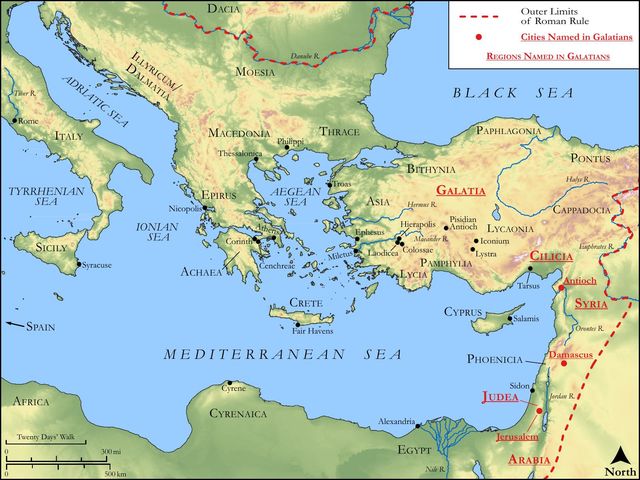
See on the biblical-era maps

Study this verse
Public-domain commentary
Matthew Henry
From his Commentary on the Whole Bible. Henry comments on passages, not single verses — this entry covers Galatians 3:1–5. His three-level outline is real structure in the source text, so it is rendered as structure.
The apostle is here dealing with those who, having embraced the faith of Christ, still continued to seek for justification by the works of the law; that is, who depended upon their own obedience to the moral precepts as their righteousness before God, and, wherein that was defective, had recourse to the legal sacrifices and purifications to make it up. These he first sharply reproves, and then endeavours, by the evidence of truth, to convince them. This is the right method, when we reprove any for a fault or an error, to convince them that it is an error, that it is a fault.
He reproves them, and the reproof is very close and warm: he calls them foolish Galatians, Gal 3:1. Though as Christians they were Wisdom's children, yet as corrupt Christians they were foolish children. Yea, he asks, Who hath bewitched you? whereby he represents them as enchanted by the arts and snares of their seducing teachers, and so far deluded as to act very unlike themselves. That wherein their folly and infatuation appeared was that they did not obey the truth; that is, they did not adhere to the gospel way of justification, wherein they had been taught, and which they had professed to embrace. Note, It is not enough to know the truth, and to say we believe it, but we must obey it too; we must heartily submit to it, and stedfastly abide by it. Note, also, Those are spiritually bewitched who, when the truth as it is in Jesus is plainly set before them, will not thus obey it. Several things proved and aggravated the folly of these Christians.
1.Jesus Christ had been evidently set forth as crucified among them; that is, they had had the doctrine of the cross preached to them, and the sacrament of the Lord's supper administered among them, in both which Christ crucified had been set before them. Now, it was the greatest madness that could be for those who had acquaintance with such sacred mysteries, and admittance to such great solemnities, not to obey the truth which was thus published to them, and signed and sealed in that ordinance. Note, The consideration of the honours and privileges we have been admitted to as Christians should shame us out of the folly of apostasy and backsliding.
2.He appeals to the experiences they had had of the working of the Spirit upon their souls (Gal 3:2); he puts them in mind that, upon their becoming Christians, they had received the Spirit, that many of them at least had been made partakers not only of the sanctifying influences, but of the miraculous gifts, of the Holy Spirit, which were eminent proofs of the truth of the Christian religion and the several doctrines of it, and especially of this, that justification is by Christ only, and not by the works of the law, which was one of the peculiar and fundamental principles of it. To convince them of the folly of their departing from this doctrine, he desires to know how they came by these gifts and graces: Was it by the works of the law, that is, the preaching of the necessity of these in order to justification? This they could not say, for that doctrine had not then been preached to them, nor had they, as Gentiles, any pretence to justification in that way. Or was it by the hearing of faith, that is, the preaching of the doctrine of faith in Christ as the only way of justification? This, if they would say the truth, they were obliged to own, and therefore must be very unreasonable if they should reject a doctrine of the good effects of which they had had such experience. Note,
(1.)It is usually by the ministry of the gospel that the Spirit is communicated to persons. And,
(2.)Those are very unwise who suffer themselves to be turned away from the ministry and doctrine which have been blessed to their spiritual advantage.
3.He calls upon them to consider their past and present conduct, and thence to judge whether they were not acting very weakly and unreasonably (Gal 3:3, Gal 3:4): he tells them that they had begun in the Spirit, but now were seeking to be made perfect by the flesh; they had embraced the doctrine of the gospel, by means of which they had received the Spirit, and wherein only the true way of justification is revealed. And thus they had begun well; but now they were turning to the law, and expected to be advanced to higher degrees of perfection by adding the observance of it to faith in Christ, in order to their justification, which could end in nothing but their shame and disappointment: for this, instead of being an improvement upon the gospel, was really a perversion of it; and, while they sought to be justified in this way, they were so far from being more perfect Christians that they were more in danger of becoming no Christians at all; hereby they were pulling down with one hand what they had built with the other, and undoing what they had hitherto done in Christianity. Yea, he further puts them in mind that they had not only embraced the Christian doctrine, but suffered for it too; and therefore their folly would be the more aggravated, if now they should desert it: for in this case all that they had suffered would be in vain - it would appear that they had been foolish in suffering for what they now deserted, and their sufferings would be altogether in vain, and of no advantage to them. Note,
(1.)It is the folly of apostates that they lose the benefit of all they have done in religion, or suffered for it. And,
(2.)It is very sad for any to live in an age of services and sufferings, of sabbaths, sermons, and sacraments, in vain; in this case former righteousness shall not be mentioned.
4.He puts them in mind that they had had ministers among them (and particularly himself) who came with a divine seal and commission; for they had ministered the Spirit to them, and wrought miracles among them: and he appeals to them whether they did it by the works of the law or by the hearing of faith, whether the doctrine that was preached by them, and confirmed by the miraculous gifts and operations of the Spirit, was that of justification by the works of the law or by the faith of Christ; they very well knew that it was not the former, but the latter; and therefore must needs be inexcusable in forsaking a doctrine which had been so signally owned and attested, and exchanging it for one that had received no such attestations.
Historical interpretation
Two Centuries of Reception
6 surviving comments on this verse. Each one is dated, so this reads as a timeline rather than a list.
Select a marker to jump to its quote. Markers stagger vertically where authors wrote within a few decades of each other.
They bear in mind how the churches were rebuked by the apostle: "O foolish Galatians, who hath bewitched you? " and, "Ye did run so well; who hath hindered you? " and how the epistle actually begins: "I marvel that ye are so soon removed from Him, who hath called you as His own in grace, to another gospel.
Here he passes to another subject; in the former chapters he had shown himself not to be an Apostle of men, nor by men, nor in want of Apostolic instruction. Now, having established his authority as a teacher, he proceeds to discourse more confidently, and draws a comparison between faith and the Law. At the outset he said, "I marvel that ye are so quickly removing;" but here, "O foolish Galatians;" then, his indignation was in its birth, but now, after his refutation of the charges against himself, and his proofs, it bursts forth. Let not his calling them "foolish" surprise you; for it is not a transgression of Christ's command not to call one's brother a fool, but rather a strict observance of it. For it is not said simply, "Whosoever shall say to his brother, Thou fool," but, whosoever shall do so, "without a cause." And who more fittingly than they could so be called, who after so great events, adhered to past things, as if nothing else had ever happened? If on this account Paul is to be called a "reviler," Peter may likewise, on account of Annanias and Sapphira, be called a homicide; but as it would be wildness to do so in that case, much more in this. Moreover it is to be considered, that this vehemence is not used at the beginning, but after these evidences and proofs, which, rather than Paul himself, might now be held to administer the rebuke. For after he had shown that they rejected the faith, and made the death of Christ to be without a purpose, he introduces his reproof, which, even as it is, is less severe than they merited. Observe too how soon he stays his arm; for he adds not, Who has seduced you? who has perverted you? who has been sophistical with you? but, "Who hath cast an envious eye on you?" thus tempering his reprimand with somewhat of praise. For it implies that their previous course had excited jealousy, and that the present occurrence arose from the malignity of a demon, whose breath had blasted their prosperous estate.
And when you hear of jealousy in this place, and in the Gospel, of an evil eye, which means the same, you must not suppose that the glance of the eye has any natural power to injure those who look upon it. For the eye, that is, the organ itself, cannot be evil; but Christ in that place means jealousy by the term. To behold, simply, is the function of the eye, but to behold in an evil manner belongs to a mind depraved within. As through this sense the knowledge of visible objects enters the soul, and as jealousy is for the most part generated by wealth, and wealth and sovereignty and pomp are perceived by the eye, therefore he calls the eye evil; not as beholding merely, but as beholding enviously from some moral depravity. Therefore by the words, "Who hath looked enviously on you," he implies that the persons in question acted, not from concern, not to supply defects, but to mutilate what existed. For envy, far from supplying what is wanting, subtracts from what is complete, and vitiates the whole. And he speaks thus, not as if envy had any power of itself, but meaning, that the teachers of these doctrines did so from envious motives.
Yet was He not crucified in Galatia, but at Jerusalem. His reason for saying, "among you," is to declare the power of faith to see events which are at a distance. He says not, "crucified," but, "openly set forth crucified," signifying that by the eye of faith they saw more distinctly than some who were present as spectators. For many of the latter received no benefit, but the former, who were not eye-witnesses, yet saw it by faith more clearly. These words convey both praise and blame; praise, for their implicit acceptance of the truth; blame, because Him whom they had seen, for their sakes, stripped naked, transfixed, nailed to the cross, spit upon, mocked, fed with vinegar, upbraided by thieves, pierced with a spear; (for all this is implied in the words, "openly set forth, crucified,") Him had they left, and betaken themselves to the Law, unshamed by any of those sufferings. Here observe how Paul, leaving all mention of heaven, earth, and sea, every where preaches the power of Christ, bearing about as he did, and holding up His cross: for this is the sum of the Divine love toward us.
(Chapter III - Verse 1) O foolish Galatians, who has bewitched you? This place can be understood in two ways. Either the foolish Galatians are called so because they have come from greater things to lesser things, having begun in the spirit and are now being consumed in the flesh. Or it is because each province has its own peculiarities. The Cretans are always liars, evil beasts, lazy gluttons, truly spoken of by the poet Epimenides, confirmed by the Apostle. The vain Moors and the fierce Dalmatians are struck by the Latin historian. Timid Phrygians, all poets tear apart. They say that more talented people are born in Athens, and philosophers boast about it. Cicero criticizes the Greeks, calling them either frivolous or cruel barbarians before Caesar. And for Flaccus, he says: 'Ingeniousness is innate, he says, and educated vanity.' The true Israel, with a heavy heart and a stiff neck, accuses all the Scriptures. Therefore, I think that the Apostle Paul also rebuked the Galatians for their regional customs. Although some, inserting profound questions as if under the guise of avoiding heresy, which introduces diverse natures, may say that even the Tyrians and Sidonians, Moabites and Ammonites, and Idumaeans, Babylonians and Egyptians, and all the Nations mentioned in the Scriptures, have certain languages for preceding reasons, and deservedly for their prior actions, so that the justice of God may not come into doubt: since it is asserted that every nation has either good or evil, which another does not have. We will pursue those declining heights: either accusing them of foolishness, saying that they cannot judge the spirit of the Law and the letter; or blaming the fault of the nation, that they are unteachable and foolish, and slower to wisdom. But what follows - 'Who bewitched you?' (1 Corinthians 11) - we should explain according to Paul (who, although unskilled in speech, is not lacking in knowledge): not that he knows that there is a bewitching power, which is commonly believed to be harmful; but he uses the word as a trite expression, and as in other things, so also in this place, he takes up the phrase of everyday conversation. We read in Proverbs: The gift of the envious tortures the eyes. The envious person among us is more significantly called a fascinator in Greek, and in the Wisdom of Solomon it is written: The fascination of wickedness obscures good things (Wis. 4:22). With these examples we are taught that the envious person is tormented by the happiness of others, or that someone in whom there is some good is harmed by another person who fascinates, that is, envies. It is said that the fascinus properly harms infants, young children, and those who have not yet firmly set foot. Where and some of the Gentiles:
I do not know who bewitches the tender eyes of my lambs. (Virgil. Eclog. 3.) Whether this is true or not, God knows: because it is possible that even demons may serve this sin; and they may turn away from the good works anyone has learned or achieved in the work of God. Now this is in question, because we consider this example to be taken from the opinion of the common people: just as it is said that a tender age can be harmed by a spell, so too it seems that the Galatians, who were recently born and raised in the faith of Christ, and nourished by milk and not solid food (1 Corinthians 3), have been harmed by some sort of spell, and the spirit of the Holy One has made them vomit the food of faith, causing a nausea in their spirit. But if someone contradicts, let him explain how the ideas of the Titans' valley in the Books of Kings (2 Kings 23), the sirens and centaurs in Isaiah (Chap. 34), Arcturus and Orion, and the Pleiades in Job (Chap. 9), and the like, which are certainly terms borrowed from the myths of the Gentiles, have been taken from common opinion. Let us therefore ask Marcion, who rejects the prophets, how he interprets what follows.
Before whose eyes Jesus Christ was proclaimed, among you he was crucified. For Christ was rightly proclaimed to us, from whose gallows and suffering, slaps and whips, the chorus of all the prophets foretold: that his cross was not only from the Gospel, in which he is said to be crucified; but long before he deigned to descend to the earth and take on the form of a crucified man, we have known. And it is no small praise of the Galatians that they have believed in the Crucified One, as it was proclaimed to them before: namely, by reading the prophets and knowing all the sacraments of the old Law, they have come to believe in the way and order. It is read in some codices: Who bewitched you to not believe the truth? But because this is not found in the exemplars of Adamantius, we have omitted it.
Christ is rightly said to be portrayed before us, since the whole chorus of Old Testament prophets spoke of his gallows and passion, his blows and whippings.… Nor was it a small number of Galatians who believed in the crucifixion as it has previously been portrayed for them. It was of course by this means that, reading the prophets continually and knowing all the ordinances of the law, they were led in due course to belief.
We must expound what follows—“Who has bewitched you?”—in a way worthy of Paul, who even if rough in his speech is not so in his understanding. It must not be interpreted in such a way as to make Paul legitimize the witchcraft that is popularly supposed to do harm. Rather he has used a colloquial ex-pression, and as elsewhere so here he has adopted a word from everyday speech.… In the same way as tender infants are said to be harmed by witchcraft, so too the Galatians, recently born in the faith of Christ and nourished with milk, not solid food, have been injured as though someone has cast a spell on them.
This indicates their previous zeal for piety and manifests the fatherly affection of the apostle. He grieves over them for their loss of wealth accumulated.
Continue studying Galatians 3:1 across the web’s major study libraries — every link below opens this exact verse, chapter, or book on the destination site.
Read & Compare
 BibleGatewayThis verse in more than 200 translations and 70 languages.
 Bible.comThe YouVersion reader — hundreds of translations, reading plans, and highlights.
 ESV.orgCrossway's official English Standard Version reader.
 NET BibleThe NET translation with 60,000+ translators' notes on every rendering decision.
 STEP BibleTyndale House's free study tool — original text, vocabulary, and scholarly resources.
 BibliaLogos Bible Software's free web reader.
 USCCBThe New American Bible (Revised Edition) with the U.S. bishops' study notes.
Commentaries
 BibleHub CommentariesDozens of classic commentaries on this verse, gathered on one page.
 StudyLightMore than 100 commentary sets — the largest collection on the web.
 BibleRefPlain-English commentary on what this verse means, verse by verse.
 Enduring WordDavid Guzik's free commentary on this chapter, widely used by Bible teachers.
 Bible Study ToolsVerse commentary alongside Greek and Hebrew study aids.
Original Language & Research
- BibleHub InterlinearThe verse word by word — original language, transliteration, and English.
- BibleHub LexiconEvery word's original-language definition and Strong's entry.
 Blue Letter BibleDeep-study tools — Strong's numbers, concordance, and word studies.
 CNTR CollationThe earliest Greek manuscripts of this verse, collated letter by letter.
Sermons, Hymns & Audio


TrulyRandomVerse is not affiliated with these sites and doesn’t control their content. They’re linked because they’re genuinely useful.
Summary
In Galatians 3:1, the Apostle Paul issues a scathing rebuke to the Galatian churches, expressing profound astonishment and frustration that they have so quickly deviated from the foundational truth of the gospel. He challenges their spiritual discernment, questioning who has "bewitched" them, given that the message of Jesus Christ's crucifixion and its implications for salvation by grace through faith was so vividly and clearly presented to them. This verse serves as a dramatic opening to Paul's fervent defense of justification by faith alone, setting the stage for his theological argument against the legalistic teachings of the Judaizers.
Context
ShowHideLiterary Context
Galatians 3:1 marks an abrupt and forceful transition in Paul's letter. Having spent the first two chapters defending his apostleship and the authenticity of his gospel message (e.g., his confrontation with Peter in Galatians 2:11-14), Paul now directly addresses the Galatian believers themselves. This verse immediately follows his declaration in Galatians 2:21 that if righteousness could be gained through the Law, then Christ died for nothing. The opening question, "O foolish Galatians," is a rhetorical device designed to shock and provoke introspection, highlighting the stark contrast between the clear gospel they received and their current theological confusion. It sets the tone for the logical and theological arguments that will unfold throughout chapters 3 and 4, where Paul systematically dismantles the legalistic claims of the Judaizers by appealing to the Abrahamic covenant, the purpose of the Law, and the nature of sonship through Christ.
Historical & Cultural Context
The churches in Galatia, likely located in the Roman province of Galatia (modern-day central Turkey), were predominantly Gentile converts. After Paul's initial evangelistic work, a group of Jewish Christians, often referred to as Judaizers, infiltrated these congregations. These Judaizers insisted that Gentile believers needed to be circumcised and adhere to aspects of the Mosaic Law, particularly dietary laws and Sabbath observance, in addition to faith in Christ, to be truly saved or fully righteous before God. This teaching was a direct assault on the core of Paul's gospel of salvation by grace through faith alone. The cultural context involved a tension between Jewish identity and Gentile inclusion, with some Jewish believers struggling to fully embrace the universal reach of the gospel that transcended ethnic and legal boundaries. Paul's use of "bewitched" might also subtly allude to common Gentile superstitions about the "evil eye" or magical influence, making his rebuke resonate powerfully with his audience.
Key Themes
ShowHideThis verse powerfully encapsulates several key themes central to the book of Galatians. Foremost is the Purity and Sufficiency of the Gospel, emphasizing that salvation is by grace through faith in Christ alone, without the need for works of the Law. The Galatians' deviation highlights the Danger of Legalism and False Teaching, showing how quickly believers can be led astray from the simplicity of the gospel when human effort is added as a requirement for divine favor. Paul's passionate tone underscores the Importance of Spiritual Discernment—the ability to distinguish between truth and error, especially concerning foundational doctrines. The phrase "evidently set forth, crucified among you" points to the Centrality of Christ's Crucifixion as the singular, all-sufficient act of redemption, which was the core message Paul preached (1 Corinthians 2:2). Finally, the verse implicitly introduces the theme of Freedom in Christ versus Bondage to the Law, a dichotomy Paul will extensively develop throughout the remainder of the letter, urging the Galatians to stand firm in the liberty Christ has given them (Galatians 5:1).
Exposition and Analysis
ShowHideKey Word Analysis
ShowHideThis term, derived from a negative particle and a word related to "mind" or "understanding," signifies "unintelligent," "senseless," or "lacking understanding." Paul is not necessarily calling the Galatians stupid in intellect, but rather spiritually undiscerning. They have failed to grasp the profound implications of the gospel they initially embraced, acting without spiritual insight or sound judgment in quickly abandoning the truth for a false teaching.
This verb literally means "to malign" or "to cast an evil eye upon," and by extension, "to fascinate" or "to charm" through false representations. Paul uses a potent metaphor, suggesting that the false teachers had exerted a deceptive, almost magical, influence over the Galatians, causing them to be deluded and swayed away from the clear, rational truth of the gospel as if by an enchantment. It implies a sudden, inexplicable loss of spiritual clarity.
This compound verb means "to write previously" or "to announce publicly/prescribe." In this context, it carries the sense of being "publicly portrayed," "openly displayed," or "clearly placarded." Paul emphasizes that the message of Christ's crucifixion was not obscure or hidden but was presented with such vividness and clarity through his preaching that it was as if Christ himself was visibly crucified before their very eyes. It highlights the undeniable and unmistakable nature of the gospel message they received.
Verse Breakdown
ShowHide"O foolish Galatians"
Paul's opening exclamation is a direct, impassioned, and rhetorical rebuke. It conveys his astonishment and disappointment at their spiritual dullness or lack of discernment, implying they have acted irrationally or without proper consideration of the truth they previously accepted.
"who hath bewitched you"
This rhetorical question attributes their sudden departure from the truth to a deceptive, almost mystical, influence. It highlights the insidious and powerful nature of the false teaching that has captivated their minds and led them astray, suggesting a spiritual delusion rather than a reasoned theological shift.
"that ye should not obey the truth"
This clause reveals the consequence of being "bewitched"—a failure to continue in obedience to the gospel, which Paul identifies as "the truth." Their acceptance of legalism signifies a departure from living in accordance with the genuine, liberating message of Christ.
"before whose eyes Jesus Christ hath been evidently set forth, crucified among you?"
This final, crucial clause underscores the magnitude of their error. Paul reminds them that the core message of Christ's atoning death was not abstract but was proclaimed with such clarity and power that it was as if they had personally witnessed the crucifixion. The "among you" emphasizes the personal and communal impact of this clear gospel presentation, making their current defection all the more inexplicable and inexcusable.
Literary Devices
ShowHidePaul employs several powerful Literary Devices in this verse to convey his urgent message. The opening "O foolish Galatians" is a direct Apostrophe, an address to an absent or abstract entity, or in this case, a direct, passionate address to his audience, designed to grab their attention and convey his strong emotion. The phrase "who hath bewitched you" is a striking Metaphor, comparing the deceptive influence of the false teachers to a magical spell or an "evil eye," suggesting an irrational and powerful enchantment that has clouded their judgment. This also functions as a Rhetorical Question, designed not to elicit an answer, but to emphasize the absurdity and unreasonableness of their current theological stance. Finally, the vivid imagery of "Jesus Christ hath been evidently set forth, crucified among you" is a powerful Hyperbole or Vivid Imagery, emphasizing the unmistakable clarity and impact of Paul's original preaching. It's as if the crucifixion was re-enacted before their very eyes, making their turning away from it all the more incomprehensible.
Theological and Thematic Connections
ShowHideGalatians 3:1 serves as a stark reminder of the constant spiritual battle for the purity of the gospel. Paul's astonishment underscores the radical simplicity and sufficiency of Christ's work on the cross for salvation, contrasting it sharply with any human attempt to add works or rituals as a means of justification. The "truth" that the Galatians were failing to obey is the truth of salvation by grace through faith alone, a truth that liberates believers from the burden of the Law and empowers them to live in the freedom of Christ. This verse highlights that genuine faith is not merely intellectual assent but involves a continuous obedience to the implications of the gospel, particularly regarding how one seeks righteousness before God.
Reflection and Application
ShowHidePaul's impassioned rebuke to the Galatians resonates deeply with believers in every age. It serves as a potent warning against spiritual complacency and the insidious nature of false teaching, particularly those that subtly or overtly diminish the absolute sufficiency of Christ's atoning work. We are called to exercise constant discernment, anchoring our faith firmly in the clear, unadulterated truth of the gospel—that salvation is a gift received by grace through faith, not earned by human effort or adherence to external regulations. Any teaching that adds conditions to this free gift, whether through legalism, ritualism, or self-righteousness, "bewitches" us away from the liberating power of Christ crucified. Our spiritual eyes must remain fixed on Him, who was "evidently set forth" for our redemption, ensuring that our obedience is to His truth alone, leading to genuine freedom and a life lived in gratitude for His finished work.
Questions for Reflection
ShowHideFAQ
ShowHideWhat does Paul mean by "O foolish Galatians"?
ShowHideWhen Paul calls the Galatians "foolish" (Greek: anóētos), he is not necessarily implying a lack of intelligence but rather a lack of spiritual discernment or understanding. It suggests that they have acted senselessly or irrationally by so quickly abandoning the clear truth of the gospel they had received. He is expressing his profound astonishment and disappointment that they could be so easily swayed from the foundational message of salvation by grace through faith in Christ, especially after it was so vividly presented to them. It's a strong pastoral rebuke, intended to shock them into realizing the gravity of their theological error.
What does "who hath bewitched you" imply about the false teachers?
ShowHideThe phrase "who hath bewitched you" (Greek: baskaínō) is a powerful metaphor. It implies that the false teachers (Judaizers) used deceptive and manipulative tactics, akin to casting an "evil eye" or a magical spell, to sway the Galatians away from the truth. It suggests that the Galatians' shift was not due to a reasoned theological debate but rather to a sudden, almost irrational, spiritual delusion or enchantment. Paul uses this strong language to highlight the insidious and spiritually dangerous nature of the legalistic message that had infiltrated the churches, pulling them away from the simplicity and clarity of Christ's sacrifice. It underscores the deceptive power of error when it masquerades as truth, as seen in other warnings against false teaching throughout the New Testament, such as in 2 Corinthians 11:3.
Christ-Centered Fulfillment
ShowHideGalatians 3:1, with its passionate declaration that "Jesus Christ hath been evidently set forth, crucified among you," powerfully anchors the Christian faith in the historical and saving work of Christ. Paul's indignant question highlights that the gospel is not a complex set of rituals or laws, but the clear, undeniable reality of God's Son, Jesus, who willingly suffered and died on the cross for humanity's sin. This "evidently set forth" crucifixion is the ultimate demonstration of God's love and justice, fulfilling the Old Testament prophecies of a suffering servant (e.g., Isaiah 53:5). The Galatians' error lay in adding human works to this perfect, finished work, effectively diminishing its sufficiency. The New Testament consistently points to Christ's crucifixion as the singular event that provides salvation, justification, and reconciliation with God (e.g., Romans 5:8, 1 Peter 2:24). Therefore, the "truth" that the Galatians were failing to obey is the truth of Christ's all-sufficient sacrifice, which alone frees believers from the curse of the Law and grants them righteousness by faith, making Him the sole object of our trust and the very center of our spiritual lives (Philippians 3:9).