


Judges 1:16
Bible text: King James Version (1769 Blayney text) · Public domain
Bible text: King James Version with Strong's numbers · Public domain
Bible text: Berean Standard Bible · Public domain
Bible text: American Standard Version (1901) · Public domain
Bible text: World English Bible, Messianic edition · Public domain
Bible text: Geneva Bible (1599) · Public domain
Bible text: Young's Literal Translation · Public domain
- וּבְנֵיu·ve·Neiand [the] descendants ofH1121Conj-w ¦ N-mpcNoun Plural Masculine Constructוּandבְנֵי[the] descendants of
- קֵינִיkei·Ni[the] KeniteH7017N-msNoun Gentilic Singular Masculine Absolute
- חֹתֵןcho·Ten[the] father-in-law ofH2859V-Qal-Prtcpl-msVerb Qal Participle Singular Masculine Construct
- מֹשֶׁהmo·ShehMosesH4872N-proper-mNoun Proper Masculine
- עָלוּ'a·Luthey went upH5927V-Qal-Perf-3cpVerb Qal Perfect 3rd Plural common gender
- מֵעִירme·'Irfrom [the] city ofH5899Prep-m ¦ N-fscNoun Singular Feminine Constructמֵfromעִיר[the] city of
- הַתְּמָרִיםha·te·ma·Rimthe palm treesH5899Art ¦ N-mpNoun Plural Masculine Absoluteהַtheתְּמָרִיםpalm trees
- אֶת'etwithH854PrepPreposition
- בְּנֵיbe·Nei[the] descendants ofH1121N-mpcNoun Plural Masculine Construct
- יְהוּדָהye·hu·DahJudahH3063N-properNoun Proper Location
- מִדְבַּרmid·Bar[the] wilderness ofH4057N-mscNoun Singular Masculine Construct
- יְהוּדָהye·hu·DahJudahH3063N-properNoun Proper Location
- אֲשֶׁר'a·SherwhichH834RelParticle Relative
- בְּנֶגֶבbe·Ne·gev[is] in [the] NegevH5045Prep-b ¦ N-properNoun Proper Locationבְּ[is] inנֶגֶב[the] Negev
- עֲרָד'a·RadAradH6166N-properNoun Proper Location
- וַיֵּלֶךְvai·Ye·lekhand he wentH1980Conj-w ¦ V-Qal-ConsecImperf-3msVerb Qal Consecutive Imperfect 3rd Singular Masculineוַandיֵּלֶךְhe went
- וַיֵּשֶׁבvai·Ye·shevand he dweltH3427Conj-w ¦ V-Qal-ConsecImperf-3msVerb Qal Consecutive Imperfect 3rd Singular Masculineוַandיֵּשֶׁבhe dwelt
- אֶת'etwithH854PrepPreposition
- הָעָםha·'Amthe peopleH5971Art ¦ N-msNoun Singular Masculine Absoluteהָtheעָםpeople
English is a literal word-by-word gloss of the Hebrew, not the KJV's wording. Why?
This is the original text the KJV's translators worked from — each Hebrew word with its own literal English meaning in this verse, prepared by scholars at Tyndale House, Cambridge. The KJV translates whole sentences, not word by word, so its wording differs: one Hebrew word can become several English words, and the KJV may choose “the LORD” where the gloss reads “Yahweh”. Both are faithful — they answer different questions. For the KJV's own rendering, switch to the KJV text.
Details
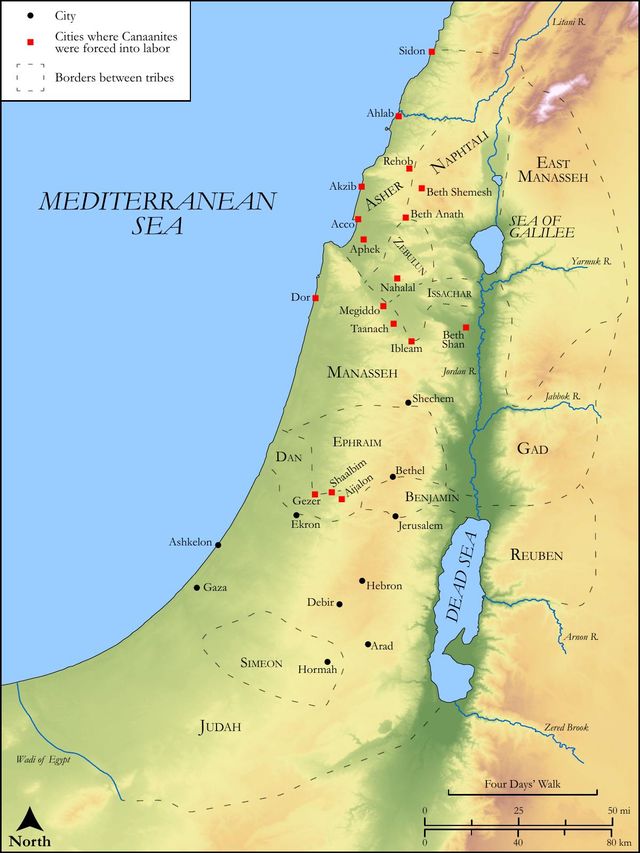
See on the biblical-era maps

Study this verse
Public-domain commentary
Matthew Henry
From his Commentary on the Whole Bible. Henry comments on passages, not single verses — this entry covers Judges 1:9–20.
We have here a further account of that glorious and successful campaign which Judah and Simeon made. 1. The lot of Judah was pretty well cleared of the Canaanites, yet not thoroughly. Those that dwelt in the mountain (the mountains that were round about Jerusalem) were driven out (Jdg 1:9, Jdg 1:19), but those in the valley kept their ground against them, having chariots of iron, such as we read of, Jos 17:16. Here the men of Judah failed, and thereby spoiled the influence which otherwise their example hitherto might have had on the rest of the tribes, who followed them in this instance of their cowardice, rather than in all the other instances of their courage. They had iron chariots, and therefore it was thought not safe to attack them: but had not Israel God on their side, whose chariots are thousands of angels (Psa 68:17), before whom these iron chariots would be but as stubble to the fire? Had not God expressly promised by the oracle (Jdg 1:2) to give them success against the Canaanites in this very expedition, without excepting those that had iron chariots? Yet they suffered their fears to prevail against their faith, they could not trust God under any disadvantages, and therefore durst not face the iron chariots, but meanly withdrew their forces, when with one bold stroke they might have completed their victories; and it proved of pernicious consequence. They did run well, what hindered them? Gal 5:7. 2. Caleb was put in possession of Hebron, which, though given him by Joshua ten or twelve years before (as Dr. Lightfoot computes), yet being employed in public service, for the settling of the tribes, which he preferred before his own private interests, it seems he did not till now make himself master of; so well content was that good man to serve others, while he left himself to be served last; few are like-minded, for all seek their own, Phi 2:20, Phi 2:21. Yet now the men of Judah all came in to his assistance for the reducing of Hebron (Jdg 1:10), slew the sons of Anak, and put him in possession of it, Jdg 1:20. They gave Hebron unto Caleb. And now Caleb, that he might return the kindness of his countrymen, is impatient to see Debir reduced and put into the hands of the men of Judah, to expedite which he proffers his daughter to the person that will undertake to command in the siege of that important place, Jdg 1:11, Jdg 1:12. Othniel bravely undertakes it, and wins the town and the lady (Jdg 1:13), and by his wife's interest and management with her father gains a very good inheritance for himself and his family, Jdg 1:14, Jdg 1:15. We had this passage before, Jos 15:16-19, where it was largely explained and improved. 3. Simeon got ground of the Canaanites in his border, Jdg 1:17, Jdg 1:18. In the eastern part of Simeon's lot, they destroyed the Canaanites in Zephath, and called it Hormah - destruction, adding this to some other devoted cities not far off, which they had some time ago, with good reason, called by that name, Num 21:2, Num 21:3. And this perhaps was the complete performance of the vow they them made that they would utterly destroy these cities of the Canaanites in the south. In the western part they took Gaza, Askelon, and Ekron, cities of the Philistines; they gained present possession of the cities, but, not destroying the inhabitants, the Philistines in process of time recovered the cities, and proved inveterate enemies to the Israel of God, and no better could come of doing their work by the halves. 4. The Kenites gained a settlement in the tribe of Judah, choosing it there rather than in any other tribe, because it was the strongest, and there they hoped to be safe and quiet, Jdg 1:16. These were the posterity of Jethro, who either went with Israel when Moses invited them (Num 10:29) or met them about the same place when they came up from their wanderings in the wilderness thirty-eight years after, and went with them then to Canaan, Moses having promised them that they should fare as Israel fared, Num 10:32. They had at first seated themselves in the city of palm-trees, that is, Jericho, a city which never was to be rebuilt, and therefore the fitter for those who dwelt in tents, and did not mind building. But afterwards they removed into the wilderness of Judah, either out of their affection to that place, because solitary and retired, or out of their affection to that tribe, which perhaps had been in a particular manner kind to them. Yet we find the tent of Jael, who was of that family, far north, in the lot of Naphtali, when Sisera took shelter there, Jdg 4:17. This respect Israel showed them, to let them fix where they pleased, being a quiet people, who, wherever they were, were content with a little. Those that molested none were molested by none. Blessed are the meek, for thus they shall inherit the earth.
Historical interpretation
Historical reception
2 surviving comments on this verse. Each one is dated, so this reads as a timeline rather than a list.
The city of palms: Jericho, so called from the abundance of palm trees.
The Cinite: Jethro the father in law of Moses was called Cinoeus, or the Cinite; and his children who came along with the children of Israel settled themselves among them in the land of Chanaan, embracing their worship and religion. From these the Rechabites sprung, of whom see Jer. 35.-- Ibid.
Continue studying Judges 1:16 across the web’s major study libraries — every link below opens this exact verse, chapter, or book on the destination site.
Read & Compare
 BibleGatewayThis verse in more than 200 translations and 70 languages.
 Bible.comThe YouVersion reader — hundreds of translations, reading plans, and highlights.
 ESV.orgCrossway's official English Standard Version reader.
 NET BibleThe NET translation with 60,000+ translators' notes on every rendering decision.
 STEP BibleTyndale House's free study tool — original text, vocabulary, and scholarly resources.
 BibliaLogos Bible Software's free web reader.
 USCCBThe New American Bible (Revised Edition) with the U.S. bishops' study notes.
Commentaries
 BibleHub CommentariesDozens of classic commentaries on this verse, gathered on one page.
 StudyLightMore than 100 commentary sets — the largest collection on the web.
 BibleRefPlain-English commentary on what this verse means, verse by verse.
 Enduring WordDavid Guzik's free commentary on this chapter, widely used by Bible teachers.
 Bible Study ToolsVerse commentary alongside Greek and Hebrew study aids.
Original Language & Research
- BibleHub InterlinearThe verse word by word — original language, transliteration, and English.
- BibleHub LexiconEvery word's original-language definition and Strong's entry.
 Blue Letter BibleDeep-study tools — Strong's numbers, concordance, and word studies.
 SefariaThe Hebrew text with Rashi and centuries of Jewish commentary.
Sermons, Hymns & Audio


TrulyRandomVerse is not affiliated with these sites and doesn’t control their content. They’re linked because they’re genuinely useful.
Summary
Judges 1:16 meticulously records the strategic relocation of the Kenite people, identified through their ancestral connection to Moses' father-in-law, from the fertile "city of palm trees" (Jericho) to the more challenging "wilderness of Judah, which lieth in the south of Arad." This significant migration, undertaken in concert with the tribe of Judah, stands as a notable instance of positive inter-tribal and inter-people alliance during the complex and often fragmented period of Israel's early settlement in Canaan, underscoring the enduring and beneficial bond between the Kenites and the Israelite nation.
Context
ShowHideLiterary Context
Judges 1 functions as a critical prologue to the entire book, establishing the foundational failures and partial successes that define the subsequent cycle of apostasy, oppression, and deliverance. In contrast to the triumphant conclusion of the Book of Joshua, Judges 1 presents a more somber and realistic portrayal of Israel's incomplete conquest of the Promised Land. The chapter initiates with the tribe of Judah taking the lead in post-Joshua military efforts, achieving some initial victories but also encountering significant setbacks, particularly in their failure to fully dispossess the inhabitants of the plains. Within this broader narrative of struggle and partial obedience, Judges 1:16 emerges as a distinctive thread, highlighting a rare and positive example of cooperation and integration between the tribe of Judah and the non-Israelite Kenites. This alliance stands in stark contrast to the pervasive failures of Israel to drive out the Canaanites as explicitly commanded by God throughout the Deuteronomic law, particularly in Deuteronomy 7. The verse provides precise geographical and relational details that enrich our understanding of the intricate tribal dynamics and the varied outcomes of the settlement period.
Historical & Cultural Context
The era of the Judges (approximately 1200-1050 BCE) was characterized by a decentralized tribal structure, persistent external threats, and internal disunity among the Israelite tribes. Following the death of Joshua, each tribe bore the primary responsibility for securing and settling its divinely allotted territory. The Kenites were a nomadic or semi-nomadic people, frequently associated with the craft of metallurgy, who had cultivated a long-standing, amicable relationship with Israel. This bond originated from the hospitality and counsel extended to Moses by Jethro (also known as Reuel or Hobab), a Kenite priest of Midian, as detailed in Exodus 18. This deep historical connection, forged during the Exodus and wilderness wanderings, continued to shape their interactions during the challenging period of Canaanite settlement. Their movement from the fertile Jericho region to the more arduous "wilderness of Judah" suggests a strategic partnership, potentially leveraging the Kenites' intimate knowledge of arid southern territories, echoing Hobab's valuable role as a guide for Israel in Numbers 10:29-32. This alliance was culturally significant, demonstrating a capacity for coexistence and mutual benefit amidst a period often defined by conflict and separation.
Key Themes
ShowHideJudges 1:16 contributes meaningfully to several overarching themes present within the Book of Judges and the broader Deuteronomistic History. Firstly, it prominently showcases the theme of Alliance and Coexistence, illustrating that not all interactions between Israel and other peoples were antagonistic; some were cooperative and mutually beneficial, especially when rooted in pre-existing relationships of trust and respect. Secondly, the verse underscores the Continuity of Covenantal Relationship, specifically the enduring bond between Israel and the Kenites through Moses' father-in-law, thereby demonstrating how past faithfulness and hospitality could yield positive fruit across generations. Thirdly, the passage subtly touches upon the theme of Tribal Settlement and Inheritance, highlighting Judah's ongoing efforts to expand and secure its territorial claims, even through strategic partnerships with non-Israelite groups. Finally, by presenting a positive counter-example of inter-group relations, Judges 1:16 implicitly contrasts with the pervasive theme of Incomplete Conquest and Disobedience that largely dominates the remainder of Judges 1 and the book as a whole, where Israel's repeated failure to fully dispossess the Canaanites leads to recurring cycles of apostasy, oppression, and divine judgment.
Exposition and Analysis
ShowHideKey Word Analysis
ShowHideThis term designates a specific nomadic or semi-nomadic people group, whose name is often associated with the craft of metallurgy or smithing. Their unique and enduring relationship with Israel is central to their biblical significance, primarily through Moses' father-in-law, Jethro/Reuel/Hobab, who was a Kenite. Their presence in this verse highlights a long-standing bond of friendship and alliance, setting them apart from the typical hostile interactions Israel had with other Canaanite inhabitants.
This well-known descriptive epithet refers unequivocally to Jericho, a city of immense historical and strategic importance, famously captured by Joshua and the Israelites in Joshua 6. The mention here indicates that the Kenites had previously resided in or near this fertile oasis, renowned for its abundant date palms. Their departure from this region signifies a substantial geographical shift and a move away from the central plains of Canaan.
This precise familial designation is critically important, as it immediately links the Kenites to the revered figure of Moses and the foundational events of the Exodus. It serves as a powerful reminder to the reader of the covenantal relationship established through Jethro's wise counsel to Moses in Exodus 18 and Hobab's crucial role as a wilderness guide in Numbers 10. This detail underscores the continuity of a unique and mutually beneficial alliance between Israel and this non-Israelite group, rooted in a shared history and profound mutual respect.
Verse Breakdown
ShowHide"And the children of the Kenite, Moses' father in law"
This opening clause precisely identifies the specific group in question—the Kenites—and immediately establishes their significant lineage and historical connection to the revered figure of Moses, thereby highlighting a relationship characterized by long-standing trust and alliance.
"went up out of the city of palm trees with the children of Judah"
This segment describes a joint, coordinated movement. "The city of palm trees" is unequivocally Jericho, indicating their previous dwelling place. The crucial phrase "with the children of Judah" signifies a cooperative venture and a direct alliance between the Kenites and the leading tribe of Israel in the ongoing conquest and settlement efforts.
"into the wilderness of Judah, which [lieth] in the south of Arad"
This clause specifies the precise destination of their migration. The "wilderness of Judah" refers to the arid, sparsely populated southern regions within Judah's tribal allotment. The precise geographical marker "south of Arad" further pinpoints their new settlement area, indicating a strategic move into a challenging, yet potentially valuable, frontier zone for both groups.
"and they went and dwelt among the people"
This final clause clarifies the enduring nature of their settlement. It implies a more permanent integration and peaceful coexistence rather than a temporary encampment or transient passage. The Kenites did not merely pass through; they established a dwelling "among the people" (presumably the people of Judah or other inhabitants of the region), signifying an accepted and peaceful cohabitation.
Literary Devices
ShowHideJudges 1:16 masterfully employs several literary devices to convey its multifaceted meaning and significance. Allusion is profoundly prominent, as the phrase "Moses' father in law" immediately evokes the rich narratives of Exodus 18 and Numbers 10. This brief reference serves as a powerful shorthand, instantly enriching the reader's understanding of the Kenites' deep and long-standing historical relationship with Israel, a bond built on trust and mutual benefit. The precise use of Geographical Markers ("the city of palm trees," "wilderness of Judah," "south of Arad") provides a vivid and concrete setting for the narrative, grounding the events in a tangible reality and enabling the reader to visualize the Kenites' journey across distinct and challenging landscapes. Furthermore, the verse subtly utilizes Contrast by presenting a positive example of inter-group cooperation (between the Kenites and Judah) within a chapter predominantly dedicated to recounting Israel's failures to fully dispossess other nations. This contrast highlights the potential for peaceful coexistence and strategic alliances when God's people act with wisdom, honor historical bonds, and discern divine leading, even amidst broader disobedience.
Theological and Thematic Connections
ShowHideJudges 1:16 offers a profound theological insight into God's providential care and the nuanced nature of His covenant. While Israel was explicitly commanded to drive out the inhabitants of Canaan, this verse demonstrates that God's overarching plan could also accommodate and even strategically utilize alliances with those outside the immediate covenant community, especially when such relationships were rooted in a history of faithfulness and mutual respect. The Kenites, through their ancestral connection to Moses' father-in-law, represent a unique case of a non-Israelite people who maintained a positive, symbiotic relationship with God's chosen nation. This highlights a broader theological truth: God's work often involves diverse individuals and groups, and His people are called to discern when to engage in cooperative relationships, recognizing the value and contribution of those who may not be "of us" but are "with us" in purpose. It underscores the importance of honoring historical bonds and the potential for God to work through unexpected partnerships, even in the midst of a conquest narrative where complete separation was often the rule.
Reflection and Application
ShowHideJudges 1:16, though a concise historical note, yields profound lessons for contemporary life and faith, challenging our assumptions about community and collaboration. It reminds us that our spiritual journey is rarely solitary; God frequently places us in relationship with diverse individuals and communities. The Kenites, though ethnically and culturally distinct from Israel, became integral to their story, offering practical wisdom and choosing to dwell among them. This narrative challenges us to critically examine our own posture towards those who may not share our exact background, beliefs, or cultural norms but who may prove to be invaluable partners in pursuing common good or even advancing God's kingdom purposes. Are we genuinely open to strategic alliances and respectful coexistence, or do we instinctively default to isolation, suspicion, or judgment? This verse calls us to value the unique contributions of others, to honor long-standing relationships, and to recognize that God often orchestrates unexpected collaborations to advance His sovereign will. It encourages us to cultivate a spirit of radical hospitality and mutual support, understanding that true strength and flourishing often emerge from unity forged across differences, beautifully reflecting the diverse yet unified body of Christ.
Questions for Reflection
ShowHideFAQ
ShowHideWho were the Kenites, and why are they mentioned with Moses' father-in-law?
ShowHideThe Kenites were a nomadic or semi-nomadic people group, possibly known for their metalworking skills. Their mention with "Moses' father in law" (Jethro, also known as Reuel or Hobab) is crucial because it highlights a long-standing and uniquely positive relationship between this non-Israelite tribe and the people of Israel. Jethro, as a Midianite priest and Kenite, offered invaluable counsel to Moses in Exodus 18, and his son, Hobab, served as a vital guide for Israel in the wilderness, providing essential knowledge of the terrain in Numbers 10. This deep familial and historical connection signifies a unique covenantal bond and a history of mutual support that continued into the challenging period of the Judges.
What is the significance of "the city of palm trees"?
ShowHide"The city of palm trees" is a well-known biblical epithet for Jericho, a strategically important city located in the Jordan Valley, famously conquered by Joshua and the Israelites in Joshua 6. Its mention here indicates that the Kenites had previously been residing in or near this fertile oasis. Their departure from Jericho with the tribe of Judah signifies a significant geographical relocation from a central, fertile plain to the more arid southern wilderness. This move suggests a strategic partnership and a deeper integration with Judah's territorial claims and settlement efforts.
Why did they move to the "wilderness of Judah"?
ShowHideThe move to the "wilderness of Judah, which lieth in the south of Arad," was likely a mutually strategic decision for both the Kenites and Judah. For the Kenites, as a semi-nomadic people, this arid region might have offered suitable grazing lands for their flocks and opportunities for their metallurgical crafts. For Judah, having the Kenites, with their intimate knowledge of the wilderness terrain and their proven historical loyalty, settle within their southern territory would have provided a valuable alliance. This partnership would have helped Judah secure its southern borders and expand its influence into challenging frontier areas, demonstrating a practical collaboration in the complex process of tribal settlement and land acquisition.
Christ-Centered Fulfillment
ShowHideJudges 1:16, with its depiction of a non-Israelite people, the Kenites, dwelling peacefully and cooperatively among the tribe of Judah, powerfully foreshadows the expansive and open to all nature of God's redemptive plan, ultimately and perfectly fulfilled in Jesus Christ. The Kenites, though distinct by lineage and not part of Abraham's direct descendants, were brought into the story of God's people through a historical bond and mutual benefit, choosing to live "among the people." This narrative prefigures the profound breaking down of the dividing wall between Jew and Gentile, a central and transformative theme in the New Testament. In Christ, the old distinctions of ethnicity, background, and national identity are transcended; as Ephesians 2:14-16 declares, Christ "is our peace, who hath made both one, and hath broken down the middle wall of partition between us... for to make in himself of twain one new man, so making peace." The Kenites' inclusion points to the ultimate reality that through faith in Christ, people from "every kindred, and tongue, and people, and nation" are brought near and become fellow citizens with God's people, members of His household, and co-heirs with Christ (Revelation 7:9; Ephesians 2:19). Just as the Kenites found a place and purpose among Judah, so too do all believers find their true dwelling, identity, and belonging in the spiritual family of God, united under the headship of Christ, the ultimate "Lamb of God, who takes away the sin of the world!" (John 1:29).