


Numbers 10:29
Bible text: King James Version (1769 Blayney text) · Public domain
Bible text: King James Version with Strong's numbers · Public domain
Bible text: Berean Standard Bible · Public domain
Bible text: American Standard Version (1901) · Public domain
Bible text: World English Bible, Messianic edition · Public domain
Bible text: Geneva Bible (1599) · Public domain
Bible text: Young's Literal Translation · Public domain
- וַיֹּאמֶרvai·Yo·merand he saidH559Conj-w ¦ V-Qal-ConsecImperf-3msVerb Qal Consecutive Imperfect 3rd Singular Masculineוַandיֹּאמֶרhe said
- מֹשֶׁהmo·ShehMosesH4872N-proper-mNoun Proper Masculine
- לְחֹבָבle·cho·oto HobabH2246Prep-l ¦ N-proper-mNoun Proper MasculineלְtoחֹבָבHobab
- בֶּןben[the] son ofH1121N-mscNoun Singular Masculine Construct
- רְעוּאֵלre·'u·'ElReuelH7467N-proper-mNoun Proper Masculine
- הַמִּדְיָנִיha·mid·ya·Nithe MidianiteH4084Art ¦ N-msNoun Gentilic Singular Masculine AbsoluteהַtheמִּדְיָנִיMidianite
- חֹתֵןcho·Ten[the] father-in-law ofH2859V-Qal-Prtcpl-msVerb Qal Participle Singular Masculine Construct
- מֹשֶׁהmo·ShehMosesH4872N-proper-mNoun Proper Masculine
- נֹסְעִיםno·se·'Im[are] about to set outH5265V-Qal-Prtcpl-mpVerb Qal Participle Plural Masculine Absolute
- אֲנַחְנוּ'a·Nach·nuweH587Pro-1cpPronoun Personal 1st Plural common gender
- אֶל'eltoH413PrepPreposition
- הַמָּקוֹםha·ma·kOmthe placeH4725Art ¦ N-msNoun Singular Masculine Absoluteהַtheמָּקוֹםplace
- אֲשֶׁר'a·SherwhichH834RelParticle Relative
- אָמַר'a·Marhe saidH559V-Qal-Perf-3msVerb Qal Perfect 3rd Singular Masculine
- יְהוָהYah·wehYahwehH3068N-properNoun Proper Title
- אֹתוֹ'o·To<obj.> itH853DirObjM ¦ 3msParticle Object Indicatorאֹת<obj.>וֹit
- אֶתֵּן'e·TenI will giveH5414V-Qal-Imperf-1csVerb Qal Imperfect 1st Singular common gender
- לָכֶםla·Khemto <the> youPrep-l ¦ 2mpSuffix Personal 2nd Plural Masculineלָto <the>כֶםyou
- לְכָהle·Khahcome !H1980V-Qal-Imp-2ms ¦ SfxVerb Qal Imperative 2nd Singular Masculineלְכָcomeה!
- אִתָּנוּ'i·Ta·nuwith usH854Prep ¦ 1cpPreposition Definiteאִתָּwithנוּus
- וְהֵטַבְנוּve·he·Tav·nuand we will do goodH3190Conj-w ¦ V-Hiphil-ConsecPerf-1cpVerb Hiphil Consecutive Perfect 1st Plural common genderוְandהֵטַבְנוּwe will do good
- לָךְLakhto <the> youPrep-l ¦ 2msSuffix Personal 2nd Singular Masculineלָto <the>ךְyou
- כִּיkiforH3588PrtParticle Conditional
- יְהוָהYah·wehYahwehH3068N-properNoun Proper Title
- דִּבֶּרdi·berhe has spokenH1696V-Piel-Perf-3msVerb Piel Perfect 3rd Singular Masculine
- טוֹבTovgoodH2896Adj-msAdjective Singular Masculine Absolute
- עַל'alonH5921PrepPreposition
- יִשְׂרָאֵלYis·ra·'ElIsraelH3478N-properNoun Proper Location
English is a literal word-by-word gloss of the Hebrew, not the KJV's wording. Why?
This is the original text the KJV's translators worked from — each Hebrew word with its own literal English meaning in this verse, prepared by scholars at Tyndale House, Cambridge. The KJV translates whole sentences, not word by word, so its wording differs: one Hebrew word can become several English words, and the KJV may choose “the LORD” where the gloss reads “Yahweh”. Both are faithful — they answer different questions. For the KJV's own rendering, switch to the KJV text.
Details
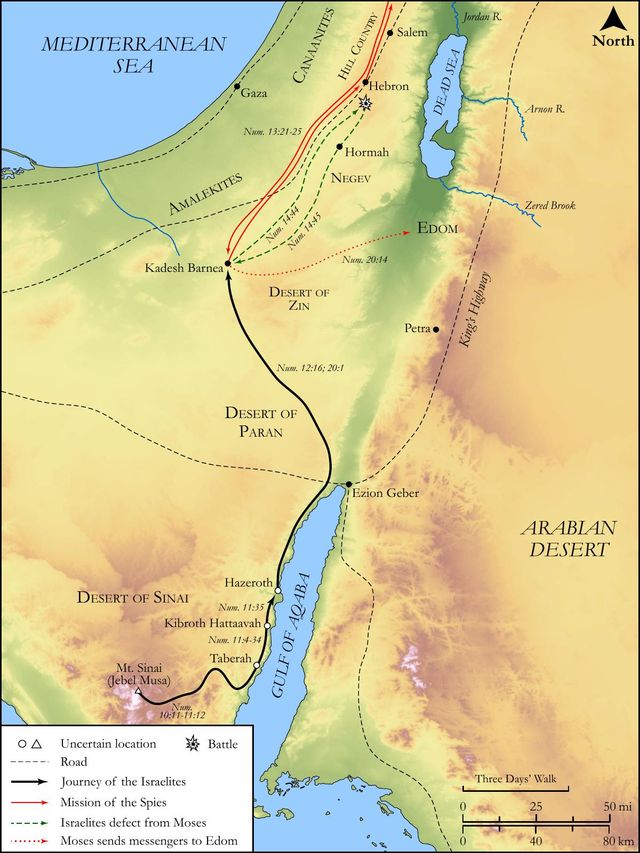
See on the biblical-era map
Study this verse
Public-domain commentary
Matthew Henry
From his Commentary on the Whole Bible. Henry comments on passages, not single verses — this entry covers Numbers 10:29–36. His four-level outline is real structure in the source text, so it is rendered as structure.
Here is, I. An account of what passed between Moses and Hobab, now upon this advance which the camp of Israel made towards Canaan. Some think that Hobab was the same with Jethro, Moses's father-in-law, and that the story, Ex. 18, should come in here; it seems more probable that Hobab was the son of Jethro, alias Reuel, or Raguel (Exo 2:18), and that when the father, being aged, went to his own land (Exo 18:27), he left his son Hobab with Moses, as Barzillai left Chimham with David; and the same word signifies both a father-in-law and a brother-in-law. Now this Hobab staid contentedly with Israel while they encamped at mount Sinai, near his own country; but, now that they were removing, he was for going back to his own country and kindred, and his father's house. Here is, 1. The kind invitation Moses gives him to go forward with them to Canaan, Num 10:29. He tempts him with a promise that they would certainly be kind to him, and puts God's word in for security: The Lord hath spoken good concerning Israel. As if he had said, "Come, cast in thy lot among us, and thou shalt fare as we fare; and we have the promise of God that we shall fare well." Note, Those that are bound for the heavenly Canaan should invite and encourage all their friends to go along with them, for we shall have never the less of the treasures of the covenant, and the joys of heaven, for others coming in to share with us. And what argument can be more powerful with us to take God's people for our people than this, that God hath spoken good concerning them? It is good having fellowship with those that have fellowship with God (Jo1 1:3), and going with those with whom God is, Zac 8:23. 2. Hobab's inclination, and present resolution, to go back to his own country, Num 10:30. One would have thought that he who had seen so much of the special presence of God with Israel, and such surprising tokens of his favour to them, would not have needed much invitation to embark with them. But his refusal must be imputed to the affection he had for his native air and soil, which was not overpowered, as it ought to have been, by a believing regard to the promise of God and a value for covenant blessings. He was indeed a son of Abraham's loins (for the Midianites descended from Abraham by Keturah), but not an heir of Abraham's faith (Heb 11:8), else he would not have given Moses this answer. Note, The things of this world, which are seen, draw strongly from the pursuit of the things of the other world, which are not seen. The magnetic virtue of this earth prevails with most people above the attractives of heaven itself. 3. The great importunity Moses used with him to alter his resolution, Num 10:31, Num 10:32. He urges, (1.) That he might be serviceable to them: "We are to encamp in the wilderness" (a country well known to Hobab), "and thou mayest be to us instead of eyes, not to show us where we must encamp, nor what way we must march" (which the cloud was to direct), "but to show us the conveniences and inconveniences of the place we march through and encamp in, that we may make the best use we can of the conveniences, and the best fence we can against the inconveniences." Note, It will very well consist with our trust in God's providence to make use of the help of our friends in those things wherein they are capable of being serviceable to us. Even those that were led by miracle must not slight the ordinary means of direction. Some think that Moses suggests this to Hobab, not because he expected much benefit from his information, but to please him with the thought of being some way useful to so great a body, and so to draw him on with them, by inspiring him with an ambition to obtain that honour. Calvin gives quite another sense of this place, very agreeably with the original, which yet I do not find taken notice of by any since. "Leave us not, I pray thee, but come along, to share with us in the promised land, for therefore hast thou known our encampment in the wilderness, and hast been to us instead of eyes; and we cannot make thee amends for sharing with us in our hardships, and doing us so many good offices, unless thou go with us to Canaan. Surely for this reason thou didst set out with us that thou mightest go on with us." Note, Those that have begun well should use that as a reason for their persevering, because otherwise they lose the benefit and recompence of all they have done and suffered. (2.) That they would be kind to him: What goodness the Lord shall do to us, the same we will do to thee, Num 10:32. Note, [1.] We can give only what we receive. We can do no more service and kindness to our friends than God is pleased to put it into the power of our hand to do. This is all we dare promise, to do good as God shall enable us. [2.] Those that share with God's Israel in their labours and hardships shall share with them in their comforts and honours. Those that are wiling to take their lot with them in the wilderness shall have their lot with them in Canaan; if we suffer with them we shall reign with them, Ti2 2:12; Luk 22:28, Luk 22:29.
We do not find any reply that Hobab here made to Moses, and therefore we hope that his silence gave consent, and he did not leave them, but that, when he perceived he might be useful, he preferred that before the gratifying of his own inclination; in this case he left us a good example. And we find (Jdg 1:16; Sa1 15:6) that his family was no loser by it.
II.An account of the communion between God and Israel in this removal.
They left the mount of the Lord (Num 10:33), that Mount Sinai where they had seen his glory and heard his voice, and had been taken into covenant with him (they must not expect that such appearances of God to them as they had there been blessed with should be constant); they departed from that celebrated mountain, which we never read of in scripture any more, unless with reference to these past stories; now farewell, Sinai; Zion is the mountain of which God has said. This is my rest for ever (Psa 132:14), and of which we must say so. But when they left the mount of the Lord they took with them the ark of the covenant of the Lord, by which their stated communion with God was to be kept up. For,
1.By it God did direct their paths. The ark of the covenant went before them, some think in place, at least in this removal; others think only in influence; though it was carried in the midst of the camp, yet the cloud that hovered over it directed all their motions. The ark (that is, the God of the ark) is said to search out a resting place for them; not that God's infinite wisdom and knowledge need to make searches, but every place they were directed to was as convenient for them as if the wisest man they had among them had been employed to go before them, and mark out their camp to the best advantage. thus Canaan is said to be a land which God spied out, Eze 20:6.
2.By it they did in all their ways acknowledge God, looking upon it as a token of God's presence; when that moved, or rested, they had their eye up unto God. Moses, as the mouth of the congregation, lifted up a prayer, both at the removing and at the resting of the ark; thus their going out and coming in were sanctified by prayer, and it is an example to us to begin and end every day's journey, and every day's work, with prayer.
(1.)Here is his prayer when the ark set forward: Rise up, Lord, and let thy enemies be scattered, Num 10:35. They were now in a desolate country, but they were marching towards an enemy's country, and their dependence was upon God for success and victory in their wars, as well as for direction and supply in the wilderness. David used this prayer long after (Psa 68:1), for he also fought the Lords' battles. Note,
[1.]There are those in the world that are enemies to God, and haters of him: secret and open enemies; enemies to his truths, his laws, his ordinances, his people.
[2.]The scattering and defeating of God's enemies is a thing to be earnestly desired, and believingly expected, by all the Lord's people. This prayer is a prophecy. Those that persist in rebellion against God are hasting towards their own ruin.
[3.]For the scattering and defeating of God's enemies, there needs no more but God's arising. When God arose to judgment, the work was soon done, Psa 76:8, Psa 76:9. "Rise, Lord, as the sun riseth to scatter the shadows of the night." Christ's rising from the dead scattered his enemies, Psa 68:18.
(2.)His prayer when the ark rested, Num 10:36.
[1.]That God would cause his people to rest. So some read it, "Return, O Lord, the many thousands of Israel, return them to their rest again after this fatigue." Thus it is said (Isa 63:14), The Spirit of the Lord caused him to rest. Thus he prays that God would give Israel success and victory abroad, and peace and tranquillity at home.
[2.]That God himself would take up his rest among them. So we read it: Return to the thousands of Israel, the ten thousand thousand, so the word is. Note, First, The church of God is a great body; there are many thousands belonging to God's Israel. Secondly, We ought in our prayers to concern ourselves for this body. Thirdly, The welfare and happiness of the Israel of God consist in the continual presence of God among them. Their safety consists not in their numbers, though they are thousands, many thousands, but in the favour of God, and his gracious return to them and residence with them. These thousands are cyphers; he is the figure: and upon this account, Happy art thou, O Israel! who is like unto thee, O people!
Historical interpretation
Two Centuries of Reception
2 surviving comments on this verse. Each one is dated, so this reads as a timeline rather than a list.
Select a marker to jump to its quote. Markers stagger vertically where authors wrote within a few decades of each other.
We can better persuade proud men to do what is useful if we say that their setting out will profit us rather than them, or if we say that improvement will profit us rather than them and ask that the cost be on our account, not theirs. For pride is easily turned to good if it can be adapted to the profit of others. Thus Moses, with God guiding him, advanced through the desert with a column of cloud going before him. When he wished to draw his relative Hobab away from his life with the Gentiles and subject him to the lordship of almighty God, he said, “We are going to the place that the Lord will give us. Come with us, so that we can do you good, for the Lord has promised good to Israel.” When Hobab answered, “I will not go with you but will return to my land, where I was born,” Moses added, “Do not leave us. You know where we should make camp in the desert, and you will be our guide.” Moses’ mind was not limited by ignorance of the route. For knowledge of the Deity had made him familiar with prophecy. The column had gone before him. Familiar speech had taught him about all things interiorly, through careful conversation with God. But this prudent man, speaking to a proud listener, asked Hobab to give him help. Moses needed Hobab as a guide along the way, so that he could be Hobab’s guide in life. So Moses acted so that the proud listener, as he urged the better way on him, would become more devoted to him if he were thought to be indispensable. He thought he outranked Moses, who asked him for help, and thus yielded to Moses’ words as Moses entreated him. Exposition of the Old and New Testament, Numbers
We can better persuade proud men to do what is useful if we say that their setting out will profit us rather than them, or if we say that improvement will profit us rather than them and ask that the cost be on our account, not theirs. For pride is easily turned to good if it can be adapted to the profit of others. Thus Moses, with God guiding him, advanced through the desert with a column of cloud going before him. When he wished to draw his relative Hobab away from his life with the Gentiles and subject him to the lordship of almighty God, he said, “We are going to the place that the Lord will give us. Come with us, so that we can do you good, for the Lord has promised good to Israel.” When Hobab answered, “I will not go with you but will return to my land, where I was born,” Moses added, “Do not leave us. You know where we should make camp in the desert, and you will be our guide.” Moses’ mind was not limited by ignorance of the route. For knowledge of the Deity had made him familiar with prophecy. The column had gone before him. Familiar speech had taught him about all things interiorly, through careful conversation with God. But this prudent man, speaking to a proud listener, asked Hobab to give him help. Moses needed Hobab as a guide along the way, so that he could be Hobab’s guide in life. So Moses acted so that the proud listener, as he urged the better way on him, would become more devoted to him if he were thought to be indispensable. He thought he outranked Moses, who asked him for help, and thus yielded to Moses’ words as Moses entreated him.
Continue studying Numbers 10:29 across the web’s major study libraries — every link below opens this exact verse, chapter, or book on the destination site.
Read & Compare
 BibleGatewayThis verse in more than 200 translations and 70 languages.
 Bible.comThe YouVersion reader — hundreds of translations, reading plans, and highlights.
 ESV.orgCrossway's official English Standard Version reader.
 NET BibleThe NET translation with 60,000+ translators' notes on every rendering decision.
 STEP BibleTyndale House's free study tool — original text, vocabulary, and scholarly resources.
 BibliaLogos Bible Software's free web reader.
 USCCBThe New American Bible (Revised Edition) with the U.S. bishops' study notes.
Commentaries
 BibleHub CommentariesDozens of classic commentaries on this verse, gathered on one page.
 StudyLightMore than 100 commentary sets — the largest collection on the web.
 BibleRefPlain-English commentary on what this verse means, verse by verse.
 Enduring WordDavid Guzik's free commentary on this chapter, widely used by Bible teachers.
 Bible Study ToolsVerse commentary alongside Greek and Hebrew study aids.
Original Language & Research
- BibleHub InterlinearThe verse word by word — original language, transliteration, and English.
- BibleHub LexiconEvery word's original-language definition and Strong's entry.
 Blue Letter BibleDeep-study tools — Strong's numbers, concordance, and word studies.
 SefariaThe Hebrew text with Rashi and centuries of Jewish commentary.
Sermons, Hymns & Audio


TrulyRandomVerse is not affiliated with these sites and doesn’t control their content. They’re linked because they’re genuinely useful.
Summary
Numbers 10:29 captures a poignant moment as Moses, on the cusp of Israel's departure from Sinai, extends a heartfelt invitation to his brother-in-law, Hobab, a Midianite. This appeal is deeply rooted in the unwavering divine promise that the LORD would bestow abundant goodness upon Israel, offering Hobab a tangible share in the covenant blessings and the prosperity awaiting God's chosen people. The verse beautifully illustrates Moses' profound spiritual reliance on God's guidance coupled with his practical wisdom in seeking human expertise for the challenging journey into the wilderness.
Context
ShowHideLiterary Context
Numbers 10:29 marks a pivotal transition in Israel's narrative, immediately preceding their long-anticipated departure from Mount Sinai, where they had encamped for nearly a year. The preceding verses (Numbers 10:1-10) meticulously detail the divine instructions for constructing and utilizing the silver trumpets, instruments crucial for signaling assembly, movement, and warfare. Following this, Numbers 10:11-28 provides an exhaustive account of the precise marching order for each tribe and its divisions, emphasizing the highly organized and divinely orchestrated nature of their journey. Moses' personal appeal to Hobab is strategically placed just before the actual commencement of the march, adding a vital human dimension to the divine blueprint. It underscores that even with supernatural guidance, practical human wisdom and relationships are essential for navigating the complexities of an unknown wilderness, bridging the gap between divine command and its human implementation.
Historical & Cultural Context
The Midianites were a prominent nomadic people, distantly related to Israel through Abraham's son Midian (Genesis 25:2). Their lifestyle necessitated an intimate knowledge of the vast Arabian desert, including its scarce water sources, safe routes, and potential dangers. Hobab, as a Midianite, possessed invaluable expertise in these areas. Moses' own history is deeply intertwined with Midian, as he spent forty years there, marrying Zipporah, a Midianite, and encountering God at the burning bush while tending Jethro's (Hobab's father/father-in-law) flock (Exodus 3:1). This established familial bond made Hobab a natural, trusted, and highly practical choice for a guide, complementing the miraculous pillar of cloud and fire that provided overarching divine direction. The invitation also reflects customs of hospitality, kinship, and the formation of alliances for mutual benefit and protection during perilous journeys, especially through formidable terrains.
Key Themes
ShowHideThis verse powerfully encapsulates several key themes central to the book of Numbers and the broader Pentateuch. Firstly, it highlights Divine Promise and Faithfulness, as Moses explicitly grounds his invitation in the certainty of God's covenant pledge: "We are journeying unto the place of which the LORD said, I will give it you." This echoes the foundational promises made to Abraham in Genesis 12:7 and reiterated throughout the Exodus narrative, emphasizing God's unwavering commitment to His people. Secondly, the invitation to Hobab underscores the theme of Inclusion and Shared Blessing. Moses' offer, "come thou with us, and we will do thee good," extends the promise of prosperity and divine favor beyond the immediate covenant people, foreshadowing God's broader redemptive plan to bless all nations through Israel, a vision later articulated in prophecies like Isaiah 56:7. Lastly, the interaction demonstrates Practical Wisdom and Reliance on Human Expertise. While Israel was guided by the miraculous pillar of cloud by day and fire by night (Numbers 9:15-23), Moses recognized the complementary value of Hobab's intimate knowledge of the wilderness. This illustrates a profound biblical principle: divine provision often works in conjunction with human responsibility and the utilization of God-given skills and resources, rather than negating them.
Exposition and Analysis
ShowHideKey Word Analysis
ShowHideFrom the root חָבַב (ḥāḇaḇ), meaning "cherished." Hobab is identified as "the son of Raguel the Midianite, Moses' father in law." While "father in law" (H2859, châthan) can broadly refer to a male relative by marriage, the context and later biblical references (e.g., Judges 4:11) strongly suggest Hobab was Moses' brother-in-law, the son of Jethro (also known as Reuel/Raguel). The name "Cherished" or "Beloved" adds a personal and affectionate tone to Moses' earnest invitation.
Derived from the primitive root טֹוּב (ṭôwb, H2895), meaning "to be (transitively, do or make) good (or well) in the widest sense." This term signifies an active impartation of blessing, prosperity, and well-being. It is a promise of tangible benefit and a share in the divine favor that God had pledged to Israel, encompassing material prosperity, security, and the general welfare that accompanies God's presence among His people.
From the primitive root דָּבַר (dâbar, H1696), meaning "to speak," but often implying a definitive, authoritative utterance or declaration. When applied to the LORD, as in "the LORD hath spoken good," it conveys the unchangeable and certain nature of God's word. It is not merely a suggestion or a hope, but a firm, divine pronouncement that serves as the unshakeable foundation for Moses' confidence and the basis of his invitation to Hobab.
Verse Breakdown
ShowHide"And Moses said unto Hobab, the son of Raguel the Midianite, Moses' father in law"
This opening clause meticulously introduces the two main figures: Moses, the leader of Israel, and Hobab, his brother-in-law. The detailed identification of Hobab by his lineage and his specific familial relationship to Moses underscores the personal and trusting nature of this significant invitation. It sets the stage for a conversation rooted in kinship and mutual respect.
"We are journeying unto the place of which the LORD said, I will give it you"
This is Moses' foundational declaration, articulating the divine mandate and ultimate destination of Israel's journey. It highlights that their movement is not arbitrary but divinely purposed, driven by God's explicit covenant promise to bestow the land upon them. This statement anchors the entire invitation in the theological certainty of God's faithfulness to His word.
"come thou with us, and we will do thee good"
Here, Moses extends the direct and compelling invitation to Hobab. The phrase "come thou with us" is a call to join in the collective journey and destiny of God's chosen people. The subsequent promise, "we will do thee good," is a concrete assurance of shared prosperity, protection, and the manifold benefits of being associated with a people under divine favor. It is an offer of inclusion into the covenant community's blessings.
"for the LORD hath spoken good concerning Israel"
This concluding clause provides the ultimate theological justification and motivation for Moses' invitation. It grounds the promise of "doing good" to Hobab in the unshakeable reality of God's declared favor and blessing upon Israel. Moses is not offering limited human resources, but rather inviting Hobab to partake in the boundless and guaranteed goodness that God Himself has promised for His people, emphasizing God's faithfulness as the ultimate guarantor.
Literary Devices
ShowHideNumbers 10:29 skillfully employs several literary devices to convey its message. The primary device is Invitation, as Moses directly appeals to Hobab to join Israel's journey, framing the proposition as an offer of shared blessing and prosperity. This invitation is deeply rooted in Covenant Language, particularly evident in the phrase "the place of which the LORD said, I will give it you," which directly echoes God's repeated and foundational promises of land and inheritance to Abraham and his descendants. This establishes the divine authority and certainty behind Moses' words, lending weight to his appeal. Furthermore, the verse utilizes Rhetorical Persuasion, as Moses constructs his argument for Hobab's participation on the unassailable foundation of God's declared goodness ("for the LORD hath spoken good concerning Israel"). This logical and theological appeal aims to convince Hobab of the tangible and spiritual benefits of aligning himself with Israel. Finally, the inclusion of a non-Israelite in this sacred journey and the explicit promise of shared blessing serves as Foreshadowing of God's broader redemptive plan, which would ultimately extend salvation and blessing to all nations through the lineage of Israel.
Theological and Thematic Connections
ShowHideNumbers 10:29 is rich in theological implications, profoundly illustrating God's unwavering faithfulness to His covenant promises and His expansive heart for inclusion, extending even beyond the immediate bounds of Israel. Moses' earnest invitation to Hobab, a Midianite, demonstrates that God's blessings, while specifically covenanted to Israel, are not exclusively confined to them. The promise "we will do thee good" directly reflects the Abrahamic blessing, where Israel was called to be a conduit of blessing to all families of the earth. It highlights the profound principle that those who align themselves with God's people and His divine purposes will inevitably partake in His goodness and favor. This passage also beautifully underscores the delicate balance between divine sovereignty and human agency: God provides miraculous guidance and promises, yet He also chooses to use human wisdom, relationships, and practical skills to accomplish His overarching will, demonstrating a collaborative approach to His redemptive plan.
Reflection and Application
ShowHideNumbers 10:29 offers profound and enduring lessons for contemporary believers and the church today. Just as Moses extended an earnest invitation to Hobab to share in the promised goodness of God, we are likewise called to extend the invitation of the gospel to those outside the covenant community. Our confidence in sharing the good news is rooted not in our own limited abilities or resources, but in the unwavering, unchangeable promises of God, who has "spoken good" concerning His people and His ultimate plan of redemption for humanity. This verse also challenges us to value, embrace, and integrate diverse gifts, talents, and perspectives within the body of Christ. Moses, despite having direct divine guidance through the pillar of cloud and fire, humbly recognized and sought the practical wisdom Hobab possessed regarding the wilderness. Similarly, the church thrives and fulfills its mission more effectively when it embraces the unique skills, experiences, and cultural insights of all its members, recognizing that God orchestrates both supernatural provision and human cooperation. We are called to be a people who not only receive God's goodness but actively and generously share it, inviting others to partake in the abundant life and eternal blessings found in His presence and promises, trusting that He will indeed "do them good."
Questions for Reflection
ShowHideFAQ
ShowHideWho was Hobab and what was his relationship to Moses?
ShowHideHobab is identified in Numbers 10:29 as "the son of Raguel the Midianite, Moses' father in law." The Hebrew term for "father in law" (châthan, H2859) is a broader term that can refer to a father-in-law, a brother-in-law, or any male relative by marriage. While Raguel (also known as Reuel or Jethro in Exodus 2:18) was Moses' father-in-law, the context in Numbers and later in Judges 4:11 strongly suggests that Hobab was Jethro's son, making him Moses' brother-in-law. This close familial connection highlights the personal and trusting nature of Moses' invitation, indicating a relationship of deep respect and reliance.
Why did Moses need Hobab if God was guiding Israel with a pillar of cloud and fire?
ShowHideThis question touches on a crucial theological balance between divine sovereignty and human responsibility. While God miraculously guided Israel with the pillar of cloud by day and fire by night (Numbers 9:15-23), which indicated when and where to move, Moses recognized the invaluable practical wisdom Hobab possessed. As a Midianite, Hobab was intimately familiar with the intricate details of the desert terrain, including identifying water sources, recognizing edible plants, discerning potential dangers, and finding optimal routes for a large multitude. Moses sought Hobab's expertise for specific, practical guidance in navigating the vast, unknown wilderness—for instance, choosing suitable encampment sites or identifying hidden paths. This demonstrates that God often works through human means and wisdom, even when providing supernatural direction, illustrating a holistic approach to leadership that seamlessly integrates both profound faith and astute practical foresight.
Does this verse suggest God needs human help to fulfill His promises?
ShowHideNo, this verse does not suggest that God is dependent on human help to fulfill His promises. God is absolutely sovereign, omnipotent, and fully capable of accomplishing His will independently. Rather, it beautifully illustrates God's chosen method of working through human cooperation and partnership. Moses' invitation to Hobab reflects a profound divine principle: God often uses human instruments, skills, and relationships to bring about His purposes. He chooses to involve His people and, at times, others in His redemptive plan, not because He lacks power or capability, but because He desires to include them in His work, to bless them through their participation, and to demonstrate His goodness through human agency. It highlights the beautiful synergy between divine provision and human responsibility, where human wisdom and effort are consecrated to God's greater, sovereign plan.
Christ-Centered Fulfillment
ShowHideNumbers 10:29, with Moses' earnest invitation to Hobab to share in the promised goodness of God, finds its ultimate and most profound fulfillment in the person and work of Jesus Christ. The "place of which the LORD said, I will give it you" ultimately points beyond the earthly Promised Land to the spiritual inheritance and eternal kingdom offered through Christ. Jesus is the ultimate "good" that God has "spoken" concerning His people, embodying the very essence of divine blessing and favor, for "all the promises of God find their Yes in him" (2 Corinthians 1:20). Just as Moses invited a non-Israelite to partake in the blessings of the covenant, Christ extends an open, universal invitation to all nations, to Jew and Gentile alike, to "come thou with us" and share in the unparalleled goodness of salvation, reconciliation, and eternal life in His kingdom. Through His atoning work on the cross, Jesus has decisively broken down the dividing wall of hostility (Ephesians 2:14), making those who were once far off fellow citizens with the saints and members of God's household (Ephesians 2:19). He is the true guide, the ultimate pillar of cloud and fire in human form, leading His people not merely to a physical land but to a spiritual reality where they are blessed with every spiritual blessing in Him (Ephesians 1:3). The shared good promised to Hobab is fully realized in the glorious shared inheritance of believers in Christ, who are co-heirs with Him in God's eternal kingdom (Romans 8:17).