


Genesis 32:12
Bible text: King James Version (1769 Blayney text) · Public domain
Bible text: Berean Standard Bible · Public domain
Bible text: American Standard Version (1901) · Public domain
Bible text: World English Bible, Messianic edition · Public domain
Bible text: Geneva Bible (1599) · Public domain
Bible text: Young's Literal Translation · Public domain
- וְאַתָּהve·'a·Tahand youH859Conj-w ¦ Pro-2msPronoun Personal 2nd Singular Masculineוְandאַתָּהyou
- אָמַרְתָּ'a·Mar·tayou have saidH559V-Qal-Perf-2msVerb Qal Perfect 2nd Singular Masculine
- הֵיטֵבhei·Tevcertainly <to do good>H3190V-Hiphil-InfAbsVerb Hiphil Infinitive Absolute
- אֵיטִיב'ei·TivI will do goodH3190V-Hiphil-Imperf-1csVerb Hiphil Imperfect 1st Singular common gender
- עִמָּךְ'i·Makhwith youH5973Prep ¦ 2msPreposition Definiteעִמָּwithךְyou
- וְשַׂמְתִּיve·sam·Tiand I will makeH7760Conj-w ¦ V-Qal-ConsecPerf-1csVerb Qal Consecutive Perfect 1st Singular common genderוְandשַׂמְתִּיI will make
- אֶת'et<obj.>H853DirObjMParticle Object Indicator
- זַרְעֲךָzar·'a·Khayour offspringH2233N-msc ¦ 2msNoun Singular Masculine Constructזַרְעֲoffspringךָyour
- כְּחוֹלke·Chollike [the] sand ofH2344Prep-k ¦ N-mscNoun Singular Masculine Constructכְּlikeחוֹל[the] sand of
- הַיָּםhai·Yamthe seaH3220Art ¦ N-msNoun Singular Masculine Absoluteהַtheיָּםsea
- אֲשֶׁר'a·SherwhichH834RelParticle Relative
- לֹאlo'notH3808NegParticle Negative
- יִסָּפֵרyi·sa·Ferit will be countedH5608V-Niphal-Imperf-3msVerb Niphal Imperfect 3rd Singular Masculine
- מֵרֹבme·Rofrom multitudeH7230Prep-m ¦ N-msNoun Singular Masculine Absoluteמֵfromרֹבmultitude
English is a literal word-by-word gloss of the Hebrew, not the KJV's wording. Why?
This is the original text the KJV's translators worked from — each Hebrew word with its own literal English meaning in this verse, prepared by scholars at Tyndale House, Cambridge. The KJV translates whole sentences, not word by word, so its wording differs: one Hebrew word can become several English words, and the KJV may choose “the LORD” where the gloss reads “Yahweh”. Both are faithful — they answer different questions. For the KJV's own rendering, switch to the KJV text.
Details
See on the biblical-era maps


Study this verse
Public-domain commentary
Matthew Henry
From his Commentary on the Whole Bible. Henry comments on passages, not single verses — this entry covers Genesis 32:9–12. His four-level outline is real structure in the source text, so it is rendered as structure.
Our rule is to call upon God in the time of trouble; we have here an example to this rule, and the success encourages us to follow this example. It was now a time of Jacob's trouble, but he shall be saved out of it; and here we have him praying for that salvation, Jer 30:7. In his distress he sought the Lord, and he heard him. Note, Times of fear should be times of prayer; whatever frightens us should drive us to our knees, to our God. Jacob had lately seen his guard of angels, but, in this distress, he applied to God, not to them; he knew they were his fellow-servants, Rev 22:9. Nor did he consult Laban's teraphim; it was enough for him that he had a God to go to. To him he addresses himself with all possible solemnity, so running for safety into the name of the Lord, as a strong tower, Pro 18:10. This prayer is the more remarkable because it won him the honour of being an Israel, a prince with God, and the father of the praying remnant, who are hence called the seed of Jacob, to whom he never said, Seek you me in vain. Now it is worth while to enquire what there was extraordinary in this prayer, that it should gain the petitioner all this honour.
I.The request itself is one, and very express:
Deliver me from the hand of my brother, Gen 32:11. Though there was no human probability on his side, yet he believed the power of God could rescue him as a lamb out of the bloody jaws of the loin. Note,
1.We have leave to be particular in our addresses to God, to mention the particular straits and difficulties we are in; for the God with whom we have to do is one we may be free with: we have liberty of speech (parresia) at the throne of grace.
2.When our brethren aim to be our destroyers, it is our comfort that we have a Father to whom we may apply as our deliverer.
II.The pleas are many, and very powerful; never was cause better ordered, Job 23:4.
He offers up his request with great faith, fervency, and humility. How earnestly does he beg! Deliver me, I pray thee, Gen 32:11. His fear made him importunate. With what holy logic does he argue! With what divine eloquence does he plead! Here is a noble copy to write after.
1.He addresses himself to God as the God of his fathers, Gen 32:9. Such was the humble self-denying sense he had of his own unworthiness that he did not call God his own God, but a God in covenant with his ancestors: O God of my father Abraham, and God of my father Isaac; and this he could the better plead because the covenant, by divine designation, was entailed upon him. Note, God's covenant with our fathers may be a comfort to us when were are in distress. It has often been so to the Lord's people, Psa 22:4, Psa 22:5. Being born in God's house, we are taken under his special protection.
2.He produces his warrant: Thou saidst unto me, Return unto thy country. He did not rashly leave his place with Laban, nor undertake this journey out of a fickle humour, or a foolish fondness for his native country, but in obedience to God's command. Note,
(1.)We may be in the way of our duty, and yet may meet with trouble and distress in that way. As prosperity will not prove us in the right, so cross events will not prove us in the wrong; we may be going whither God calls us, and yet may think our way hedged up with thorns.
(2.)We may comfortably trust God with our safety, while we carefully keep to our duty. If God be our guide, he will be our guard.
3.He humbly acknowledges his own unworthiness to receive any favour from God (Gen 32:10): I am not worthy; it is an unusual plea. Some would think he should have pleaded that what was now in danger was his own, against all the world, and that he had earned it dear enough; no, he pleads, Lord, I am not worthy of it. Note, Self-denial and self-abasement well become us in all our addresses to the throne of grace. Christ never commended any of his petitioners so much as him who said, Lord, I am not worthy (Mat 8:8), and her who said, Truth, Lord, yet the dogs eat of the crumbs which fall from their master's table, Mat 15:27. Now observe here,
(1.)How magnificently and honourably he speaks of the mercies of God to him. We have here, mercies, in the plural number, and inexhaustible spring, and innumerable streams; mercies and truth, that is, past mercies given according to the promise, and further mercies secured by the promise. Note, What is laid up in God's truth, as well as what is laid out in God's mercies, is the matter both of the comforts and the praises of active believers. Nay, observe, it is all the mercies, and all the truth; the manner of expression is copious, and intimates that his heart was full of God's goodness.
(2.)How meanly and humbly he speaks of himself, disclaiming all thought of his own merit: "I am not worthy of the least of all thy mercies, much less am I worthy of so great a favour as this I am now suing for." Jacob was a considerable man, and, upon many accounts, very deserving, and, in treating with Laban, had justly insisted on his merits, but not before God. I am less than all thy mercies; so the word is. Note, The best and greatest of men are utterly unworthy of the least favour from God, and just be ready to own it upon all occasions. It was the excellent Mr. Herbert's motto, Less than the least of all God's mercies. Those are best prepared for the greatest mercies that see themselves unworthy of the least.
4.He thankfully owns God's goodness to him in his banishment, and how much it had outdone his expectations: "With my staff I passed over this Jordan, poor and desolate, like a forlorn and despised pilgrim;" he had no guides, no companions, no attendants, no conveniences for travel, but his staff only, nothing else to stay himself upon; "and now I have become two bands, now I am surrounded with a numerous and comfortable retinue of children and servants:" though it was his distress that had now obliged him to divide his family into two bands, yet he makes use of that for the magnifying of the mercy of his increase. Note,
(1.)The increase of our families is then comfortable indeed to us when we see God's mercies, and his truth, in it.
(2.)Those whose latter end greatly increases ought, with humility and thankfulness, to remember how small their beginning was. Jacob pleads, "Lord, thou didst keep me when I went out with only my staff, and had but one life to lose; wilt thou not keep me now that so many are embarked with me?"
5.He urges the extremity of the peril he was in: Lord, deliver me from Esau, for I fear him, Gen 32:11. The people of God have not been shy of telling God their fears; for they know he takes cognizance of them, and considers them. The fear that quickens prayer is itself pleadable. It was not a robber, but a murderer, that he was afraid of; nor was it his own life only that lay at stake, but the mothers' and the children's, that had left their native soil to go along with him. Note, Natural affection may furnish us with allowable acceptable pleas in prayer.
6.He insists especially upon the promise God had made him (Gen 32:9): Thou saidst, I will deal well with thee, and again, in the close (Gen 32:12): Thou saidst, I will surely do thee good. Note,
(1.)The best we can say to God in prayer is what he has said to us. God's promises, as they are the surest guide of our desires in prayer, and furnish us with the best petitions, so they are the firmest ground of our hopes, and furnish us with the best pleas. "Lord, thou saidst thus and thus; and wilt thou not be as good as thy word, the word upon which thou had caused me to hope?" Psa 119:49.
(2.)The most general promises are applicable to particular cases. "Thou saidst, I will do thee good; Lord, do me good in this matter." He pleads also a particular promise, that of the multiplying of hes seed. "Lord, what will become of that promise, if they be all cut off?" Note,
[1.]There are promises to the families of good people, which are improvable in prayer for family-mercies, ordinary and extraordinary, Gen 17:7; Psa 112:2; Psa 102:28.
[2.]The world's threatenings should drive us to God's promises.
Continue studying Genesis 32:12 across the web’s major study libraries — every link below opens this exact verse, chapter, or book on the destination site.
Read & Compare
 BibleGatewayThis verse in more than 200 translations and 70 languages.
 Bible.comThe YouVersion reader — hundreds of translations, reading plans, and highlights.
 ESV.orgCrossway's official English Standard Version reader.
 NET BibleThe NET translation with 60,000+ translators' notes on every rendering decision.
 STEP BibleTyndale House's free study tool — original text, vocabulary, and scholarly resources.
 BibliaLogos Bible Software's free web reader.
 USCCBThe New American Bible (Revised Edition) with the U.S. bishops' study notes.
Commentaries
 BibleHub CommentariesDozens of classic commentaries on this verse, gathered on one page.
 StudyLightMore than 100 commentary sets — the largest collection on the web.
 BibleRefPlain-English commentary on what this verse means, verse by verse.
 Enduring WordDavid Guzik's free commentary on this chapter, widely used by Bible teachers.
 Bible Study ToolsVerse commentary alongside Greek and Hebrew study aids.
Original Language & Research
- BibleHub InterlinearThe verse word by word — original language, transliteration, and English.
- BibleHub LexiconEvery word's original-language definition and Strong's entry.
 Blue Letter BibleDeep-study tools — Strong's numbers, concordance, and word studies.
 SefariaThe Hebrew text with Rashi and centuries of Jewish commentary.
Sermons, Hymns & Audio


TrulyRandomVerse is not affiliated with these sites and doesn’t control their content. They’re linked because they’re genuinely useful.
Summary
Genesis 32:12 captures Jacob's earnest prayer to God, recalling divine promises of protection and an innumerable lineage as he prepares to meet his estranged brother Esau. In this moment of intense fear and vulnerability, Jacob grounds his fervent plea not in his own merit or past actions, but in God's unwavering covenant faithfulness and previously declared commitments, demonstrating profound reliance on the revealed word of God despite overwhelming anxiety and the consequences of past transgressions. This verse powerfully illustrates the spiritual discipline and transformative power of anchoring prayer in God's immutable character and His sovereign promises.
Context
ShowHideLiterary Context
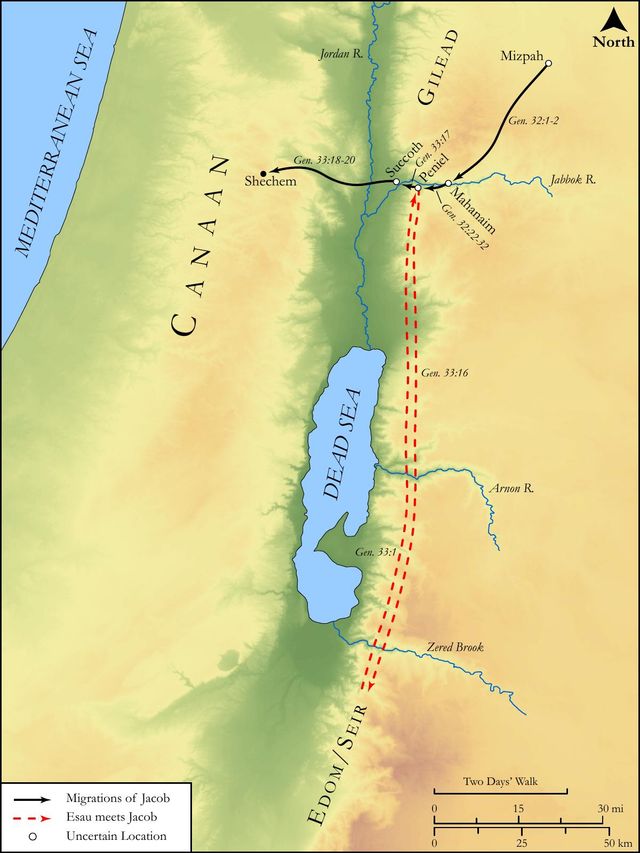
Genesis 32:12 is embedded within a pivotal narrative sequence detailing Jacob's return to Canaan after twenty years with Laban. Having departed from Laban (Genesis 31), Jacob is now faced with the daunting prospect of meeting his estranged brother Esau, whom he had deceived years earlier to secure the birthright and blessing (Genesis 27). News that Esau is approaching with 400 men fills Jacob with "great fear and distress" (Genesis 32:7). In response, Jacob employs a two-pronged strategy: he divides his camp to mitigate potential loss and sends a substantial peace offering ahead to appease Esau. However, his ultimate act of reliance is this profound prayer (Genesis 32:9-12), where he appeals directly to God's past promises, culminating in the specific invocation of God's word found in verse 12. This prayer precedes his wrestling match with the angel at Peniel (Genesis 32:22-32), marking a crucial turning point in his spiritual journey and character development.
Historical & Cultural Context
Among the patriarchs, the concept of a large lineage was paramount, signifying divine favor, strength, and continuity. A man's "seed" (offspring) was his legacy, ensuring the perpetuation of his name and tribal identity. Promises of numerous descendants, like those given to Abraham, Isaac, and Jacob, were therefore of immense significance, far beyond mere population growth; they spoke to the very survival and flourishing of a people. Furthermore, the cultural norm dictated severe consequences for past grievances, especially between brothers over matters of inheritance and blessing. Jacob's fear of Esau was not unfounded; Esau's vow to kill him (Genesis 27:41) was a genuine threat. Jacob's return to Canaan also represented a return to the land of promise, a geographical and theological anchor for the covenant God had established with his forefathers. His prayer, therefore, is deeply rooted in both the personal and communal anxieties of his time and culture.
Key Themes
ShowHideThis verse contributes significantly to several overarching themes in Genesis and the broader biblical narrative. Firstly, it powerfully underscores God's unwavering covenant faithfulness. Despite Jacob's past deceptions and present fears, God's promises remain steadfast and reliable. Secondly, it highlights the importance and power of prayer in distress, demonstrating how a believer can appeal to God based on His revealed character and word, rather than personal merit. Jacob's humility and dependence on God in this moment are a stark contrast to his earlier self-reliance. Thirdly, the theme of the "seed" promise is central, connecting Jacob's lineage directly to the broader Abrahamic covenant and its unfolding through history. This promise of innumerable descendants is foundational to the formation of the nation of Israel and, ultimately, points to the singular "Seed" through whom all nations would be blessed (Genesis 12:3). Finally, the narrative showcases divine sovereignty amidst human weakness, illustrating that God's overarching plan and promises are sovereign and will be accomplished, often working through and despite human failings and fears.
Exposition and Analysis
ShowHideJacob's desperate prayer in Genesis 32:12 is a profound act of faith, where he directly appeals to God's previously stated promises. This is not an attempt to remind an forgetful God, but rather an act of self-affirmation for Jacob, solidifying his trust in God's declared intentions and character in a moment of extreme vulnerability.
Key Word Analysis
ShowHideThis primitive root signifies "to say" with great latitude, encompassing declaring, appointing, commanding, promising, and even thinking or intending. In this context, it emphasizes the divine origin and authoritative nature of the promise Jacob is recalling. It highlights that God's word is not merely a suggestion but a definitive declaration upon which Jacob can firmly stand.
This root means "to be (causative) make well," encompassing concepts of being sound, beautiful, happy, successful, or right. It signifies comprehensive well-being, prosperity, and favor from God. Jacob is appealing for God's active beneficence, not just in terms of physical safety from Esau, but for a holistic flourishing that aligns with God's divine purpose for his life and lineage.
Derived from the verb "to sow," this term primarily refers to physical offspring or posterity. However, in biblical theology, especially within the covenant promises, it carries profound theological weight, pointing to the continuation of the covenant line through which God's redemptive plan would unfold. It foreshadows the singular "Seed" (Christ) through whom all nations would ultimately be blessed, giving Jacob's prayer a far-reaching prophetic dimension beyond his immediate family.
Verse Breakdown
ShowHide"And thou saidst"
This opening phrase immediately establishes the foundation of Jacob's prayer: God's own spoken word. Jacob is not inventing a request but recalling a divine promise previously given to him at Bethel (Genesis 28:13-15) and echoing the promises made to Abraham (Genesis 12:2-3) and Isaac. It underscores Jacob's understanding that his hope lies not in his own cunning or strength, but in the immutable character and faithfulness of the God who speaks.
"I will surely do thee good"
This clause directly quotes or paraphrases God's promise of comprehensive blessing and well-being. The double emphasis ("surely do good") in the Hebrew signifies an absolute certainty and divine commitment. Jacob is appealing for God's active intervention to ensure his safety and prosperity, trusting that God's intention for his life is one of favor and flourishing, even in the face of imminent danger. This is a plea for God to fulfill His promise of protection and provision.
"and make thy seed as the sand of the sea, which cannot be numbered for multitude"
This powerful imagery directly echoes the covenant promises of innumerable descendants given to Abraham (Genesis 22:17) and reaffirmed to Isaac and Jacob. The comparison to "sand of the sea" signifies an immense, uncountable multitude, emphasizing the assurance of a continuing and flourishing lineage. For Jacob, the preservation of his "seed" is not just about personal survival but about the continuation of the covenant line through which God's redemptive plan for humanity would progress. His prayer for safety is inextricably linked to the preservation of this divinely chosen family.
Literary Devices
ShowHideThe verse employs several significant literary devices that amplify its theological weight. Most prominent is the use of Simile, specifically comparing Jacob's future "seed" to "the sand of the sea." This vivid image conveys the immense, uncountable number of descendants God promises, emphasizing the scope and certainty of the divine covenant. Closely related is Hyperbole, as the phrase "cannot be numbered for multitude" uses exaggeration to stress the sheer impossibility of counting such a vast number, reinforcing the boundless nature of God's blessing. Furthermore, the entire prayer functions as an Appeal to Authority, where Jacob grounds his petition entirely in God's own previously spoken words and promises. This rhetorical strategy highlights Jacob's humility and his profound reliance on God's character and faithfulness, rather than his own merit or strength.
Theological and Thematic Connections
ShowHideGenesis 32:12 serves as a profound theological touchstone, illustrating God's unwavering commitment to His covenant promises, even in the face of human fear and past failings. Jacob's prayer, rooted entirely in God's reliability rather than his own worthiness, underscores the principle that God's faithfulness transcends human circumstances and shortcomings. It highlights the continuity of the Abrahamic covenant, demonstrating how the promise of innumerable "seed" is meticulously carried forward through the chosen lineage, emphasizing divine election and preservation for redemptive purposes. This passage also models the power of prayer anchored in God's word, inviting believers to approach God with confidence by recalling and verbalizing His revealed will and past commitments, thereby strengthening faith and aligning human desires with divine purposes.
Reflection and Application
ShowHideGenesis 32:12 offers profound lessons for believers navigating their own "Esau moments"—situations of intense fear, uncertainty, or anticipated conflict arising from past actions or external threats. Like Jacob, we are encouraged to recall and verbalize God's past promises and faithfulness, allowing His unchanging character and revealed word to anchor our faith amidst turbulent circumstances. This practice is not about informing God, who knows all things, but about building our own trust, strengthening our resolve, and aligning our hearts with His sovereign purposes. It reminds us that even when our past actions have contributed to difficult situations, God's overarching plan and promises remain sovereign, and His faithfulness transcends our immediate dangers and past misdeeds. Our prayers can be bold and confident when rooted in God's revealed will and His covenant commitments, trusting that He will "surely do us good" according to His perfect plan.
Questions for Reflection
ShowHideFAQ
ShowHideWhat is the significance of Jacob reminding God of His promises?
ShowHideJacob is not reminding God because God forgets, but rather to strengthen his own faith and to align his prayer with God's revealed will. It is an act of profound trust and dependence, demonstrating that Jacob is relying entirely on God's character and word, rather than his own strength, cunning, or merit, in a moment of great fear and vulnerability. This practice helps the believer internalize God's truth and build confidence in His faithfulness.
Does the "seed as the sand of the sea" promise refer only to physical descendants?
ShowHideWhile primarily referring to Jacob's numerous physical descendants who would form the nation of Israel, the "seed" (Hebrew: zeraʻ) also carries a deeper theological and prophetic meaning. It points ultimately to a singular, ultimate "Seed" through whom all the nations of the earth would be blessed, a promise that finds its ultimate fulfillment in Jesus Christ. Thus, it encompasses both physical lineage and the spiritual offspring of faith.
How does Jacob's prayer in Genesis 32:12 relate to his earlier life and spiritual development?
ShowHideJacob's prayer in Genesis 32:9-12 marks a significant moment of spiritual maturity and transformation. Unlike his earlier reliance on cunning, deception, and self-serving ambition (e.g., Genesis 27), here he fully depends on God's grace and promises. He acknowledges his unworthiness (Genesis 32:10) and places his hope entirely in God's faithfulness, even as he prepares to face the consequences of his past actions. This prayer is a testament to a heart being refined and transformed by divine encounter and the pressures of life.
Christ-Centered Fulfillment
ShowHideThe promise to "make thy seed as the sand of the sea," so earnestly invoked by Jacob, finds its ultimate and most profound fulfillment in Jesus Christ. While it assured a numerous physical lineage for Jacob, leading to the nation of Israel, the New Testament reveals that the true "seed" (singular, zeraʻ) of Abraham, through whom all nations are blessed, is Christ Himself (Galatians 3:16). Through Christ, the spiritual descendants of Abraham, comprised of all who believe, become an innumerable multitude, far exceeding any physical count. Paul clarifies that those who are "of faith are sons of Abraham" (Galatians 3:7), making them heirs according to the promise. Thus, Jacob's prayer for the preservation of his lineage was, unbeknownst to him, a prayer for the continuation of the covenant line that would ultimately bring forth the Messiah, the one through whom God's promises of salvation, blessing, and an innumerable spiritual family would extend to all humanity, fulfilling the covenant in its fullest, global sense (Romans 4:16-17).