


Genesis 32:13
Bible text: King James Version (1769 Blayney text) · Public domain
Bible text: Berean Standard Bible · Public domain
Bible text: American Standard Version (1901) · Public domain
Bible text: World English Bible, Messianic edition · Public domain
Bible text: Geneva Bible (1599) · Public domain
Bible text: Young's Literal Translation · Public domain
- וַיָּלֶןvai·Ya·lenand he stayed [the] nightH3885Conj-w ¦ V-Qal-ConsecImperf-3msVerb Qal Consecutive Imperfect 3rd Singular Masculineוַandיָּלֶןhe stayed [the] night
- שָׁםshamthereH8033AdvAdverb
- בַּלַּיְלָהba·Lay·lahin the nightH3915Prep-b ¦ N-msNoun Singular Masculine Absoluteבַּin theלַּיְלָהnight
- הַהוּאha·Hu'<the> thatH1931Art ¦ Pro-3msPronoun Personal 3rd Singular Masculineהַ<the>הוּאthat
- וַיִּקַּחvai·yi·Kachand he tookH3947Conj-w ¦ V-Qal-ConsecImperf-3msVerb Qal Consecutive Imperfect 3rd Singular Masculineוַandיִּקַּחhe took
- מִןminsome ofH4480PrepPreposition
- הַבָּאha·Ba'which cameH935Art ¦ V-Qal-Prtcpl-msVerb Qal Participle Singular Masculine Absoluteהַwhichבָּאcame
- בְיָדוֹve·ya·Doin his handH3027Prep-b ¦ N-csc ¦ 3msNoun Singular common gender Constructבְinיָדhandוֹhis
- מִנְחָהmin·Chaha giftH4503N-fsNoun Singular Feminine Absolute
- לְעֵשָׂוle·'e·Savfor EsauH6215Prep-l ¦ N-properNoun Proper LocationלְforעֵשָׂוEsau
- אָחִיו'a·Chivhis brotherH251N-msc ¦ 3msNoun Singular Masculine Constructאָחִיbrotherוhis
English is a literal word-by-word gloss of the Hebrew, not the KJV's wording. Why?
This is the original text the KJV's translators worked from — each Hebrew word with its own literal English meaning in this verse, prepared by scholars at Tyndale House, Cambridge. The KJV translates whole sentences, not word by word, so its wording differs: one Hebrew word can become several English words, and the KJV may choose “the LORD” where the gloss reads “Yahweh”. Both are faithful — they answer different questions. For the KJV's own rendering, switch to the KJV text.
Details
See on the biblical-era maps


Study this verse
Public-domain commentary
Matthew Henry
From his Commentary on the Whole Bible. Henry comments on passages, not single verses — this entry covers Genesis 32:13–23. His two-level outline is real structure in the source text, so it is rendered as structure.
Jacob, having piously made God his friend by a prayer, is here prudently endeavouring to make Esau his friend by a present. He had prayed to God to deliver him from the had of Esau, for he feared him; but neither did his fear sink into such a despair as dispirits for the use of means, nor did his prayer make him presume upon God's mercy, without the use of means. Note, When we have prayed to God for any mercy, we must second our prayers with our endeavours; else, instead of trusting god, we tempt him; we must so depend upon God's providence as to make use of our own prudence. "Help thyself, and God will help thee;" God answers our prayers by teaching us to order our affairs with discretion. To pacify Esau,
I.Jacob sent him a very noble present, not of jewels or fine garments (he had them not), but of cattle, to the number of 580 in all, Gen 32:13-15. Now,
1.It was an evidence of the great increase with which God had blessed Jacob that he could spare such a number of cattle out of his stock.
2.It was an evidence of his wisdom that he would willingly part with some, to secure the rest; some men's covetousness loses them more than ever it gained them, and, by grudging a little damage; skin for skin, and all that a man has, if he be a wise man, he will give for his life.
3.It was a present that he thought would be acceptable to Esau, who had traded so much in hunting wild beasts that perhaps he was but ill furnished with tame cattle with which to stock his new conquests. And we may suppose that the mixed colours of Jacob's cattle, ring-straked, speckled, and spotted, would please Esau's fancy.
4.He promised himself that by this present he should gain Esau's favour; for a gift commonly prospers, which way soever it turns (Pro 17:8), and makes room for a man (Pro 18:16); nay, it pacifies anger and strong wrath, Pro 21:14. Note, [1.] We must not despair of reconciling ourselves even to those that have been most exasperated against us; we ought not to judge men unappeasable, till we have tried to appease them. [2.] Peace and love, though purchased dearly, will prove a good bargain to the purchaser. Many a morose ill-natured man would have said, in Jacob's case, "Esau has vowed my death without cause, and he shall never be a farthing the better for me; I will see him far enough before I will send him a present:" but Jacob forgives and forgets.
II.He sent him a very humble message, which he ordered his servants to deliver in the best manner, Gen 32:17, Gen 32:18.
They must call Esau their lord, and Jacob his servant; they must tell him the cattle they had was a small present which Jacob had sent him, as a specimen of his acquisitions while he was abroad. The cattle he sent were to be disposed of in several droves, and the servants that attended each drove were to deliver the same message, that the present might appear the more valuable, and his submission, so often repeated, might be the more likely to influence Esau. They must especially take care to tell him that Jacob was coming after (Gen 32:18-20), that he might not suspect he had fled through fear. Note, A friendly confidence in men's goodness may help to prevent the mischief designed us by their badness: if Jacob will seem not to be afraid of Esau, Esau, it may be hoped, will not be a terror to Jacob.
Historical interpretation
Historical reception
2 surviving comments on this verse. Each one is dated, so this reads as a timeline rather than a list.
Select a marker to jump to its quote. Markers stagger vertically where authors wrote within a few decades of each other.
Then, intending to ask for peace from his brother, Jacob slept in the encampment. Perfect virtue possesses tranquility and a calm steadfastness; likewise the Lord has kept his gift for those who are more perfect and has said, “My peace I leave to you, my peace I give to you.” It is the part of those who have been perfected not to be easily influenced by worldly things or to be troubled with fear or tormented with suspicion or stunned with dread or distressed with pain. Rather, as if on a shore of total safety, they ought to calm their spirit, immovable as it is in the anchorage of faith, against the rising waves and tempests of the world. Christ brought this support to the spirits of Christians when he brought an inner peace to the souls of those who had proved themselves, so that our hearts should not be troubled or our spirits be distressed. That this peace is beyond all understanding our apostolic teacher proclaimed when he said, “And the peace of God, which surpasses all understanding, will guard your hearts and feelings in Christ Jesus.” And so the fruit of peace is the absence of disturbance in the heart. In short, the life of the just person is calm, but the unjust person is filled with disquiet and disturbance. Therefore the ungodly person is struck down more by his own suspicions than people are by the blows of others, and the stripes of the wounds in his soul are greater than those in the bodies of people who are lashed by others.It is a sublime thing that someone is tranquil within himself and in agreement with himself. Externally, peace is sought through the anxious forethought of the emperor or the hands of the soldiers. Or it results from the favorable outcome of wars or some massacre among the barbarians, if they turn their own weapons on one another in a hostile move. Such a peace comes to pass through no power of ours, but it is a stroke of good fortune. Surely the glory of that peace is assigned to the emperor, but we have in us the benefit of inward peace, which is in the spirit and is held in the heart of every one of us. The benefit of this peace is greater in that temptations coming from a spirit of wickedness, rather than hostile arms, are repulsed. This peace that shuts out the enticements of the bodily passions and calms the disturbances arising from them is nobler than the peace that checks the attacks of barbarians; it is a greater thing to withstand the enemy shut up within oneself than the one that is far off.
See the good man’s godliness and proper sense of values in requesting nothing from the Lord other than fulfillment of his promises. After giving thanks for his former benefits by confessing that while naked and destitute he had been brought to such affluence, Jacob entreats God to snatch him from danger. Recall that Jacob says, “You told me, ‘I will make your descendants to be like the sand of the sea, which in number will defy counting.’ ” Having made this appeal to the Lord, however, and having offered this supplication to the Lord, Jacob also made every effort on his own part. Selecting gifts from what he brought with him, the text says, Jacob sent them to his brother, spacing out what was sent and giving instructions with the aim of appeasing Esau by word and alerting him to his own arrival. Recall that the text says, “ ‘Behold, your servant is right behind us,’ so as first to appease him, and then we can meet face to face.” “After this,” remember Jacob says, “I will meet him face to face; perhaps he will be pleased to see me.” The gifts went ahead of him.
Continue studying Genesis 32:13 across the web’s major study libraries — every link below opens this exact verse, chapter, or book on the destination site.
Read & Compare
 BibleGatewayThis verse in more than 200 translations and 70 languages.
 Bible.comThe YouVersion reader — hundreds of translations, reading plans, and highlights.
 ESV.orgCrossway's official English Standard Version reader.
 NET BibleThe NET translation with 60,000+ translators' notes on every rendering decision.
 STEP BibleTyndale House's free study tool — original text, vocabulary, and scholarly resources.
 BibliaLogos Bible Software's free web reader.
 USCCBThe New American Bible (Revised Edition) with the U.S. bishops' study notes.
Commentaries
 BibleHub CommentariesDozens of classic commentaries on this verse, gathered on one page.
 StudyLightMore than 100 commentary sets — the largest collection on the web.
 BibleRefPlain-English commentary on what this verse means, verse by verse.
 Enduring WordDavid Guzik's free commentary on this chapter, widely used by Bible teachers.
 Bible Study ToolsVerse commentary alongside Greek and Hebrew study aids.
Original Language & Research
- BibleHub InterlinearThe verse word by word — original language, transliteration, and English.
- BibleHub LexiconEvery word's original-language definition and Strong's entry.
 Blue Letter BibleDeep-study tools — Strong's numbers, concordance, and word studies.
 SefariaThe Hebrew text with Rashi and centuries of Jewish commentary.
Sermons, Hymns & Audio


TrulyRandomVerse is not affiliated with these sites and doesn’t control their content. They’re linked because they’re genuinely useful.
Summary
Genesis 32:13 describes Jacob's pragmatic response to the impending encounter with his brother Esau. After a night of lodging and fervent prayer for deliverance, Jacob immediately begins to implement a strategic plan, preparing a substantial gift intended to appease Esau and pave the way for reconciliation, demonstrating a crucial balance between spiritual reliance and responsible human action.
Context
ShowHideLiterary Context
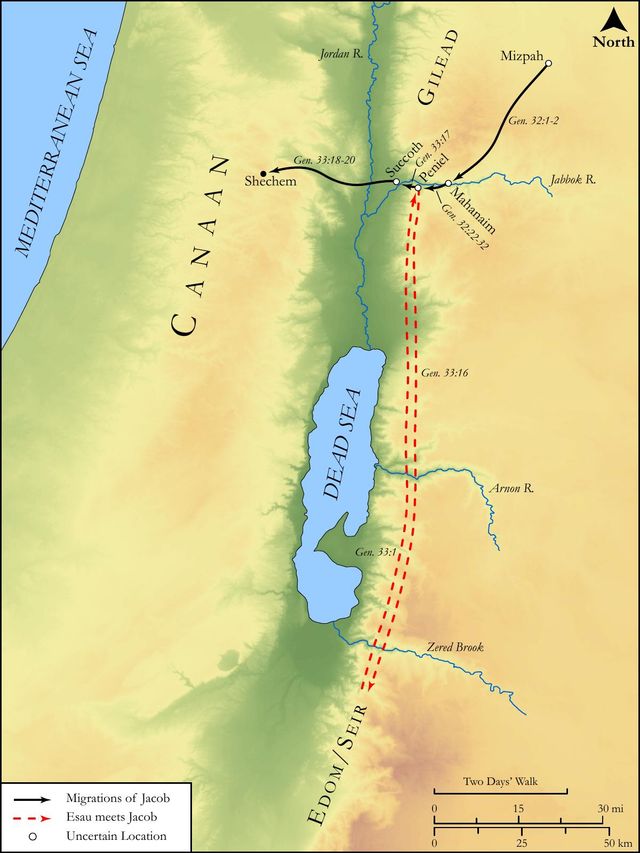
Genesis 32:13 is strategically positioned within a pivotal narrative arc detailing Jacob's return to Canaan after two decades with Laban. Having just departed from Laban and made a covenant with him at Mizpah Genesis 31:43-55, Jacob then encounters angels at Mahanaim, signifying divine protection and presence Genesis 32:1-2. However, this divine assurance is immediately followed by news that his estranged brother Esau is approaching with four hundred men Genesis 32:7, plunging Jacob into deep fear and distress. In response, Jacob divides his camp and offers a fervent, desperate prayer for deliverance, reminding God of His promises Genesis 32:9-12. Genesis 32:13 directly follows this intense spiritual supplication, marking Jacob's immediate transition from prayer to pragmatic, strategic action in preparation for the potentially volatile reunion with Esau.
Historical & Cultural Context
In the days of the patriarchs, the giving of gifts, particularly a 'minchah' (present or tribute), was a common and crucial diplomatic practice. Such offerings were often extended from a lesser party to a greater, or from one seeking favor or reconciliation, to appease anger, secure safe passage, or establish a covenant of peace. Given the profound offense Jacob committed against Esau by deceiving him of his birthright and blessing Genesis 27:36, Esau's approach with 400 men would have been interpreted by Jacob, and indeed by any contemporary, as a clear sign of hostile intent or at least a highly uncertain outcome. Jacob's actions reflect the cultural understanding that a substantial, well-timed gift could potentially avert conflict and restore honor, serving as a tangible expression of humility and a desire for peace. His nomadic wealth, primarily in livestock, provided the means for such a significant offering.
Key Themes
ShowHideThis verse contributes significantly to several overarching themes in the book of Genesis and Jacob's narrative. It highlights the intricate balance between Divine Sovereignty and Human Responsibility, demonstrating that while Jacob prays earnestly for God's deliverance, he simultaneously takes proactive, strategic steps. This exemplifies the biblical principle that faith does not negate prudent action, a theme echoed elsewhere in Scripture, such as in Proverbs 3:5-6. Furthermore, the act of preparing a 'present' underscores the theme of Reconciliation and Peacemaking, emphasizing the importance of initiating efforts to mend broken relationships, even when one has been the perpetrator of past wrongs, a concept later amplified in the New Testament's teachings on forgiveness and reconciliation (Matthew 5:23-24). Finally, Jacob's response to his profound fear Genesis 32:7 showcases the theme of Overcoming Adversity with Wisdom, transforming anxiety into calculated, strategic planning rather than paralysis.
Exposition and Analysis
ShowHideKey Word Analysis
ShowHideThis verb signifies to "stop (usually over night)" or "tarry." In this context, it emphasizes Jacob's deliberate decision to pause his journey and settle for the night, not merely for rest but for strategic planning and spiritual wrestling. It highlights a moment of intentional cessation before a significant confrontation, allowing for reflection and preparation.
More than just a literal limb, "hand" in Hebrew often denotes power, means, or possession. The phrase "came to his hand" implies that Jacob took from what was readily available to him, from his own resources and dominion. This signifies his resourcefulness and the practical application of his existing wealth towards his strategic objective, rather than seeking external aid.
While this term can denote a sacrificial offering (especially a bloodless one), in this context, it primarily refers to a "donation," "tribute," or "gift" intended to gain favor, appease anger, or establish peace. Jacob's use of a minchâh here is a diplomatic gesture, a tangible effort to mollify Esau's potential wrath and initiate reconciliation, acknowledging his brother's superior position or his own culpability.
Verse Breakdown
ShowHide"¶ And he lodged there that same night"
This phrase emphasizes Jacob's strategic pause. It's not just about resting, but about the deliberate decision to halt his journey and prepare. This "lodging" sets the stage for the intense prayer that precedes it and the strategic planning that follows. It signifies a moment of intentional, calculated delay before a critical encounter.
"and took of that which came to his hand"
This highlights Jacob's resourcefulness and the immediate availability of the means for his plan. "Came to his hand" implies that he utilized his own substantial possessions—his extensive livestock and servants—which were under his control. This underscores his pragmatic approach, working with the resources God had already blessed him with, rather than passively waiting or seeking new provisions. It speaks to responsible stewardship in the face of crisis.
"a present for Esau his brother"
The "present" (Hebrew: minchâh) is the core of Jacob's proactive strategy for reconciliation. This was not a mere token but a substantial, carefully selected gift intended to disarm Esau's potential wrath and "appease his face" (as later stated in Genesis 32:20). The designation "his brother" subtly reminds the reader of the fractured fraternal bond that Jacob is now attempting to mend, acknowledging the deep-seated resentment stemming from the deception over the birthright and blessing (Genesis 27:36). This act is a tangible expression of Jacob's humility and his earnest desire for peace.
Literary Devices
ShowHideGenesis 32:13 employs several literary devices that enrich its meaning. The immediate Juxtaposition of Jacob's intense prayer for deliverance Genesis 32:9-12 with his subsequent pragmatic action of preparing a gift underscores the narrative's emphasis on the harmonious interplay between spiritual reliance and human responsibility. This rapid shift highlights Jacob's active faith. The "present" itself functions as potent Symbolism, representing Jacob's humility, his earnest desire for reconciliation, and a tangible attempt to atone for his past deception. It is not merely a material offering but a symbolic gesture of peace and submission. Furthermore, there is a subtle Irony in Jacob, the 'supplanter' (whose name means 'heel-grabber'), now actively seeking to appease the brother he supplanted, using the very wealth that accrued from the blessings he had deceitfully acquired. This adds a layer of complexity to his character, showing his growth and willingness to confront the consequences of his past actions.
Theological and Thematic Connections
ShowHideGenesis 32:13 offers profound theological insights into the nature of faith and human agency. Jacob's actions exemplify the biblical truth that genuine trust in God's sovereign care does not negate, but rather empowers, prudent human responsibility. His fervent prayer for deliverance was not a passive plea, but a catalyst for immediate, strategic action. This demonstrates a mature faith that integrates spiritual reliance with diligent preparation. Moreover, Jacob's initiative in preparing a substantial 'present' (minchâh) for Esau highlights the vital theological theme of reconciliation. It underscores the divine imperative to actively pursue peace and mend broken relationships, even when one is the offender or fears retribution. This act prefigures the broader biblical concept of an offering made to restore relationship and appease wrath, a theme that resonates throughout Scripture and points toward the ultimate act of reconciliation.
Reflection and Application
ShowHideGenesis 32:13 provides a powerful paradigm for believers navigating the complexities of life, especially when facing daunting challenges or fractured relationships. Jacob's immediate transition from earnest prayer to diligent preparation instructs us that authentic faith is not passive resignation but an active engagement with our circumstances. It calls us to balance profound spiritual reliance on God's promises with the responsible and wise use of the resources and wisdom He has already provided. When confronted with strained or broken relationships, particularly those marked by past hurts or offenses, Jacob's example compels us to take proactive initiative in seeking reconciliation. This may involve tangible gestures of humility, restitution, or courageous communication, even when fear or pride might tempt us to retreat. His strategic planning in the face of overwhelming anxiety reminds us that wisdom and prudence are indispensable virtues, guiding our choices and enabling us to channel fear into constructive action rather than paralyzing despair. Ultimately, this verse challenges us to live out a dynamic faith that trusts God fully while diligently stewarding our part in His redemptive plan.
Questions for Reflection
ShowHideFAQ
ShowHideWhy did Jacob prepare a gift for Esau immediately after praying for deliverance?
ShowHideJacob's actions in Genesis 32:13 exemplify a crucial biblical principle: faith and human responsibility are not mutually exclusive but are designed to work in tandem. His fervent prayer to God for deliverance in Genesis 32:9-12 expressed his absolute reliance on divine protection and God's covenant promises. However, true faith is rarely passive. Immediately following his supplication, Jacob took practical, strategic steps—preparing a substantial gift (a minchâh)—to mitigate the immediate threat from Esau and to actively seek reconciliation. This demonstrates that trusting God does not mean passively waiting for Him to do everything, but rather wisely engaging with one's circumstances, utilizing the resources and wisdom God has already provided. It's an active faith that trusts God for the outcome while diligently fulfilling one's part.
Christ-Centered Fulfillment
ShowHideJacob's strategic 'present' (minchâh) for Esau, meticulously prepared to appease wrath and secure reconciliation, serves as a profound Old Testament foreshadowing of the ultimate peace offering made by God Himself. Humanity, profoundly estranged from God due to sin, stood under the righteous weight of divine wrath, a chasm far deeper than the one between Jacob and Esau. Yet, God, in His boundless love and initiative, did not wait for humanity to offer a gift. Instead, He sent His Son, Jesus Christ, as the perfect and final minchâh—a propitiatory sacrifice that fully appeases God's righteous anger and provides the means for reconciliation (Romans 3:25). Through Christ's atoning work on the cross, the broken relationship between God and humanity is mended, and believers are brought into a new covenant of peace (Colossians 1:20). This divine act of reconciliation, freely offered through Christ, far surpasses any earthly gift, providing an eternal peace and restoration that Jacob's temporary appeasement could only dimly prefigure (2 Corinthians 5:18-19).