


Genesis 43:11
Bible text: King James Version (1769 Blayney text) · Public domain
Bible text: King James Version with Strong's numbers · Public domain
Bible text: Berean Standard Bible · Public domain
Bible text: American Standard Version (1901) · Public domain
Bible text: World English Bible, Messianic edition · Public domain
Bible text: Geneva Bible (1599) · Public domain
Bible text: Young's Literal Translation · Public domain
- וַיֹּאמֶרvai·Yo·merand he saidH559Conj-w ¦ V-Qal-ConsecImperf-3msVerb Qal Consecutive Imperfect 3rd Singular Masculineוַandיֹּאמֶרhe said
- אֲלֵהֶם'a·le·Hemto themH413Prep ¦ 3mpPrepositionאֲלֵtoהֶםthem
- יִשְׂרָאֵלYis·ra·'ElIsraelH3478N-proper-mNoun Proper Masculine
- אֲבִיהֶם'a·vi·Hemtheir fatherH1N-msc ¦ 3mpNoun Singular Masculine Constructאֲבִיfatherהֶםtheir
- אִם'imifH518PrtParticle Conditional
- כֵּןkensoH3651AdvAdverb
- אֵפוֹא'e·fO'thenH645PrtParticle Interjection
- זֹאתzotthisH2063PrtParticle Demonstrative
- עֲשׂוּ'a·SudoH6213V-Qal-Imp-2mpVerb Qal Imperative 2nd Plural Masculine
- קְחוּke·ChutakeH3947V-Qal-Imp-2mpVerb Qal Imperative 2nd Plural Masculine
- מִזִּמְרַתmi·zim·Ratsome of [the] best products ofH2173Prep-m ¦ N-fscNoun Singular Feminine Constructמִsome ofזִּמְרַת[the] best products of
- הָאָרֶץha·'A·retzthe landH776Art ¦ N-fsNoun Singular Feminine Absoluteהָtheאָרֶץland
- בִּכְלֵיכֶםbikh·lei·Khemin your vesselsH3627Prep-b ¦ N-mpc ¦ 2mpNoun Plural Masculine Constructבִּinכְלֵיvesselsכֶםyour
- וְהוֹרִידוּve·ho·Ri·duand take downH3381Conj-w ¦ V-Hiphil-Imp-2mpVerb Hiphil Imperative 2nd Plural Masculineוְandהוֹרִידוּtake down
- לָאִישׁla·'Ishto the manH376Prep-l ¦ N-msNoun Singular Masculine Absoluteלָto theאִישׁman
- מִנְחָהmin·Chaha giftH4503N-fsNoun Singular Feminine Absolute
- מְעַטme·'Ata little ofH4592N-mscNoun Singular Masculine Construct
- צֳרִיtzo·RibalmH6875N-msNoun Singular Masculine Absolute
- וּמְעַטu·me·'Atand a little ofH4592Conj-w ¦ N-mscNoun Singular Masculine Constructוּandמְעַטa little of
- דְּבַשׁde·VashhoneyH1706N-msNoun Singular Masculine Absolute
- נְכֹאתne·KhotspiceH5219N-fsNoun Singular Feminine Absolute
- וָלֹטva·Lotand myrrhH3910Conj-w ¦ N-msNoun Singular Masculine Absoluteוָandלֹטmyrrh
- בָּטְנִיםba·te·Nimpistachio nutsH992N-mpNoun Plural Masculine Absolute
- וּשְׁקֵדִיםu·she·ke·Dimand almondsH8247Conj-w ¦ N-mpNoun Plural Masculine Absoluteוּandשְׁקֵדִיםalmonds
English is a literal word-by-word gloss of the Hebrew, not the KJV's wording. Why?
This is the original text the KJV's translators worked from — each Hebrew word with its own literal English meaning in this verse, prepared by scholars at Tyndale House, Cambridge. The KJV translates whole sentences, not word by word, so its wording differs: one Hebrew word can become several English words, and the KJV may choose “the LORD” where the gloss reads “Yahweh”. Both are faithful — they answer different questions. For the KJV's own rendering, switch to the KJV text.
Details
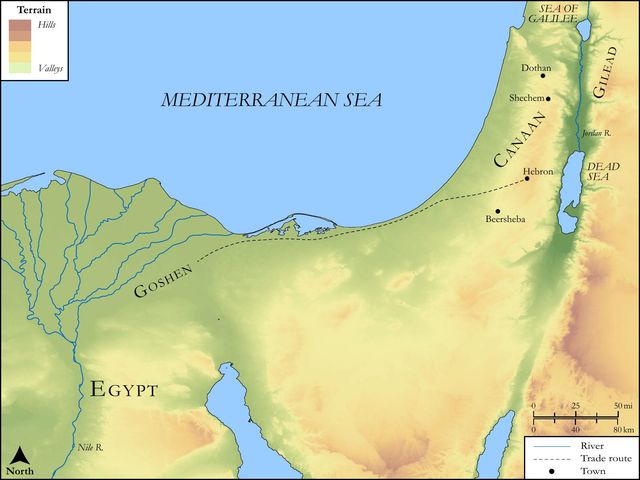
See on the biblical-era maps


Study this verse
Public-domain commentary
Matthew Henry
From his Commentary on the Whole Bible. Henry comments on passages, not single verses — this entry covers Genesis 43:11–14.
Observe here, I. Jacob's persuasibleness. He would be ruled by reason, though they were his inferiors that urged it. He saw the necessity of the case; and, since there was no remedy, he consented to yield to the necessity (Gen 43:11): "If it must be so now, take your brother. If no corn can be had but upon those terms, we may as well expose him to the perils of the journey as suffer ourselves and families, and Benjamin amongst the rest, to perish for want of bread." Skin for skin, and all that a man has, even a Benjamin, the dearest of all, will he give for his life. No death so dreadful as that by famine, Lam 4:9. Jacob had said (Gen 42:38), My son shall not go down; but now he is over-persuaded to consent. Note, It is no fault, but our wisdom and duty, to alter our purposes and resolutions when there is a good reason for our so doing. Constancy is a virtue, but obstinacy is not. It is God's prerogative not to repent, and to make unchangeable resolves.
II.Jacob's prudence and justice, which appeared in three things:
- 1. He sent back the money which they had found in the sacks' mouths, with this discreet construction of it, Peradventure it was an oversight. Note, Honesty obliges us to make restitution, not only of that which comes to us by our own fault, but of that which comes to us by the mistakes of others. Though we get it by oversight, if we keep it when the oversight is discovered, it is kept by deceit. In the stating of accounts, errors must be excepted, even those that make for us as well as those that make against us. Jacob's words furnish us with a favourable construction to put upon that which we are tempted to resent as an injury and affront; pass it by, and say, Peradventure it was an oversight. 2. He sent double money, as much again as they took the time before, upon supposition that the price of corn might have risen, - or to show a generous spirit, that they might be the more likely to find generous treatment with the man, the lord of the land. 3. He sent a present of such things as the land afforded, and as were scarce in Egypt - balm and honey, etc. (Gen 43:11), the commodities that Canaan exported, Gen 37:25. Note, (1.) Providence dispenses its gifts variously. Some countries produce one commodity, others another, that commerce may be preserved. (2.) Honey and spice will never make up the want of bread-corn. The famine was sore in Canaan, and yet they had balm and myrrh, etc. We may live well enough upon plain food without dainties; but we cannot live upon dainties without plain food. Let us thank God that that which is most needful and useful is generally most cheap and common. (3.) A gift in secret pacifies wrath, Pro 21:14. Jacob's sons were unjustly accused as spies, yet Jacob was willing to be at the expense of a present, to pacify the accuser. Sometimes we must not think it too much to buy peace even where we may justly demand it, and insist upon it as our right.
III.Jacob's piety appearing in his prayer:
God Almighty give you mercy before the man! Gen 43:14. Jacob had formerly turned an angry brother into a kind one with a present and a prayer; and here he betakes himself to the same tried method, and it sped well. Note, Those that would find mercy with men must seek it of God, who has all hearts in his hands, and turns them as he pleases.
IV.Jacob's patience.
He concludes all with this: "If I be bereaved of my children, I am bereaved; If I must part with them thus one after another, I must acquiesce, and say, The will of the Lord be done." Note, It is our wisdom to reconcile ourselves to the sorest afflictions, and make the best of them; for there is nothing got by striving with our Maker, Sa2 15:25, Sa2 15:26.
Historical interpretation
Historical reception
2 surviving comments on this verse. Each one is dated, so this reads as a timeline rather than a list.
Select a marker to jump to its quote. Markers stagger vertically where authors wrote within a few decades of each other.
Nevertheless Benjamin, the youngest, was kept back and still stayed close to his loving father. The bonds of the law held him back, and ancestral custom. The famine was increasing because he was coming late. Two brothers, Reuben and Judah—that is, humility and confession—make intercession on his behalf. He has them as guarantees with his father; to them Benjamin is entrusted. One of them is the firstborn, the other restored to life. The firstborn represents the law; the one restored to life, the gospel. The young Benjamin is led down by them and arrives, accompanied by good fragrances and carrying with him the cement with which stones of marble are fastened together; thus by his own preaching as by a spiritual cement he might fasten together living stones. He also carries honey, which destroys the harmful effects of an internal wound, without the bitter pain of any cutting. Such indeed was the preaching of Paul that it destroyed the festering infection and drained off the tainted fluid with the sting of its argument, for it sought rather to cauterize the sick vitals of the heart than to cut them. That the incense is a sign of prayer and the cassia and aloes are signs of burial, David the psalmist taught us when he said, “myrrh and aloes and cassia from your garments.” For Paul came to preach the cross of the Lord, an oak that is always verdant. And almonds appear, which are rather hard in the shell but more tender in the meat—it was right that Aaron’s priestly rod was of the almond tree, and Jeremiah’s staff as well5—double money too. Who would doubt that these gifts were useful? For the life of the patriarch and the preaching of the apostle are always verdant in the heart of each person, and the speech of the saints shines brightly with the splendor of the precept of salvation, like silver tried by the fire. And it is with reason that they carry double money, for in them there is prefigured the coming of Paul, who presented presbyters who labor in the word and in the teaching with a double honor.
(Chapter 43, Verse 11) And bring gifts to the man, some resin, and honey, incense, and resin, and turpentine, and nuts. Or, as Aquila and Symmachus translated, almonds. Therefore, we have included this chapter to know where in our codices the term 'incense' is found, in Hebrew it is 'Necotha' (), which Aquila translated as storax. From which the house of 'nechota,' which is read in Isaiah (39:21), is understood to be the most obvious cell for incense, or storax, as different fragrances are stored in it.
Continue studying Genesis 43:11 across the web’s major study libraries — every link below opens this exact verse, chapter, or book on the destination site.
Read & Compare
 BibleGatewayThis verse in more than 200 translations and 70 languages.
 Bible.comThe YouVersion reader — hundreds of translations, reading plans, and highlights.
 ESV.orgCrossway's official English Standard Version reader.
 NET BibleThe NET translation with 60,000+ translators' notes on every rendering decision.
 STEP BibleTyndale House's free study tool — original text, vocabulary, and scholarly resources.
 BibliaLogos Bible Software's free web reader.
 USCCBThe New American Bible (Revised Edition) with the U.S. bishops' study notes.
Commentaries
 BibleHub CommentariesDozens of classic commentaries on this verse, gathered on one page.
 StudyLightMore than 100 commentary sets — the largest collection on the web.
 BibleRefPlain-English commentary on what this verse means, verse by verse.
 Enduring WordDavid Guzik's free commentary on this chapter, widely used by Bible teachers.
 Bible Study ToolsVerse commentary alongside Greek and Hebrew study aids.
Original Language & Research
- BibleHub InterlinearThe verse word by word — original language, transliteration, and English.
- BibleHub LexiconEvery word's original-language definition and Strong's entry.
 Blue Letter BibleDeep-study tools — Strong's numbers, concordance, and word studies.
 SefariaThe Hebrew text with Rashi and centuries of Jewish commentary.
Sermons, Hymns & Audio


TrulyRandomVerse is not affiliated with these sites and doesn’t control their content. They’re linked because they’re genuinely useful.
Summary
Genesis 43:11 captures the poignant moment of Jacob's reluctant surrender to the escalating famine, which compels him to send his beloved youngest son, Benjamin, to Egypt. Driven by the dire necessity for food and a strategic desire to appease the powerful Egyptian governor, Jacob meticulously instructs his sons to prepare and carry a carefully selected tribute of the finest produce from the land of Canaan, hoping to secure favor, ensure their safe return, and ultimately, preserve his family.
Context
ShowHideLiterary Context
This verse is situated at a critical juncture in the Joseph narrative, specifically within the broader story of Jacob's family's interaction with Egypt during a severe famine. Previously, Jacob's ten elder sons had traveled to Egypt to buy grain, only to be accused of espionage by the powerful governor (Joseph, though they did not recognize him). Joseph had demanded they bring their youngest brother, Benjamin, to him as proof of their honesty, holding Simeon as collateral (read about Joseph's demand for Benjamin). Jacob had vehemently refused, fearing for Benjamin's life after the presumed loss of Joseph (Jacob's anguish over Benjamin). However, as the famine worsened and their existing food supply was depleted, Judah steps forward, guaranteeing Benjamin's safety with his own life (Judah's pledge for Benjamin). Jacob's words in Genesis 43:11 mark his agonizing, yet necessary, capitulation to these circumstances, setting the stage for the brothers' second journey to Egypt and the eventual revelation of Joseph's identity.
Historical & Cultural Context
The lands of the patriarchs were highly susceptible to famine, often caused by drought, which could devastate agricultural societies. Egypt, with its reliance on the Nile River's annual inundation, was typically more resilient, making it a crucial source of grain during regional food shortages, as seen in the account of the seven years of plenty and famine. The practice of bringing gifts or tribute to powerful rulers or officials was a common and essential diplomatic custom. Such offerings served multiple purposes: to gain an audience, to express respect, to seek favor, to atone for perceived offenses, or to secure protection or trade agreements. The value and nature of the gifts often reflected the giver's status and the importance of the request. Jacob's selection of specific items—balm, honey, spices, myrrh, nuts, and almonds—reflects the unique produce of Canaan, items that would have been considered valuable, even luxurious, in Egypt, demonstrating a genuine effort to impress and appease the governor.
Key Themes
ShowHideThis verse contributes to several overarching themes within Genesis and the broader biblical narrative. It highlights the theme of Divine Providence, as God's unseen hand is orchestrating events, using the famine and Jacob's reluctant decision to bring about His larger plan for the preservation of Jacob's family and the fulfillment of His covenant promises, a theme echoed in Joseph's later declaration. It also underscores the theme of Human Responsibility and Wisdom in the face of crisis; despite his profound anguish and fear, Jacob acts with practical wisdom, making careful preparations and taking strategic steps to navigate the dire situation. Furthermore, the necessity of sending Benjamin and the accompanying gifts foreshadows the theme of Reconciliation and Atonement, as these actions, born out of desperation, inadvertently pave the way for the mending of broken family relationships and the ultimate restoration between Joseph and his brothers, a concept found throughout the narrative of Joseph and his brothers.
Exposition and Analysis
ShowHideKey Word Analysis
ShowHideFrom the root meaning "he will rule as God," this is the symbolic name given to Jacob after his struggle with God (Genesis 32:28). Its use here emphasizes Jacob's identity as the patriarch of God's chosen people, highlighting the profound spiritual and covenantal implications of his decisions, even in moments of deep personal distress. It underscores that the fate of God's covenant family rests on his choices.
Derived from a root meaning "to prune," this term literally refers to "pruned" or "choice" fruit. It signifies the highest quality produce, the choicest yield of the land. Jacob's instruction to take "the best fruits" indicates a deliberate effort to offer a gift of significant value and respect, demonstrating his earnest desire to gain favor and underscore the importance of his plea, even from a land suffering from famine.
This word denotes a donation, tribute, or offering. While it can refer to a sacrificial offering (often bloodless), in this context, it functions as a diplomatic gift or tribute intended to appease a superior, secure an audience, or gain favor. Jacob's use of "present" reveals his strategic intent to soften the Egyptian governor's heart and ensure a favorable outcome for his sons and the acquisition of grain, recognizing the power dynamics at play.
Verse Breakdown
ShowHide"And their father Israel said unto them,"
This opening clause establishes the speaker as Jacob, now bearing the covenant name "Israel," emphasizing his patriarchal authority and the weight of his words. It sets the scene for a pivotal command given to his sons, highlighting the familial and national stakes involved.
"If [it must be] so now, do this;"
This phrase powerfully conveys Jacob's profound reluctance and resignation. The "If it must be so now" (Hebrew: 'êphôw) expresses a desperate acknowledgment of unavoidable necessity, a surrender to circumstances that he initially resisted with all his might. It underscores the direness of the famine and the family's absolute dependence on Egypt for survival, marking a moment of anguish and submission to an unavoidable fate. The command "do this" then introduces his specific instructions.
"take of the best fruits in the land in your vessels,"
Jacob instructs his sons to gather the highest quality produce available in Canaan. This command emphasizes the value and respect intended for the Egyptian governor. The phrase "in your vessels" indicates the practical preparation for carrying these precious items on their journey, highlighting Jacob's meticulous planning despite his emotional distress.
"and carry down the man a present,"
This clause specifies the purpose of the gathered items: they are a "present" (minchâh), a strategic tribute intended for "the man"—the powerful Egyptian governor, Joseph, whose true identity remains unknown to them. This act of sending tribute was a common practice in the diplomacy of that day, aimed at gaining an audience, securing favor, and ensuring a positive outcome, as Jacob's own present had gone before him to Esau.
"a little balm, and a little honey, spices, and myrrh, nuts, and almonds:"
This detailed list enumerates the specific items comprising the tribute. Each item was considered valuable and often luxurious in that day. "Balm" (tsori) was a valuable medicinal and aromatic resin; "honey" (debash) likely referred to date syrup or other sweet fruit products; "spices" (nekô'th) were aromatic gums or powders; "myrrh" (lôṭ) was a fragrant gum resin used in perfumes and anointing oils; "nuts" (bôṭen) were likely pistachio nuts; and "almonds" (shâqêd) were a prized delicacy. Collectively, these gifts represent the choicest produce of Canaan, serving as a tangible expression of respect, humility, and an earnest plea for favor from Jacob's family.
Literary Devices
ShowHideThe verse employs several literary devices to convey its profound meaning. Irony is prominent, as Jacob's desperate attempt to appease an unknown Egyptian official is, unbeknownst to him, an offering to his own son, Joseph, whom he believed lost. This dramatic irony heightens the tension and foreshadows the eventual revelation and reconciliation. Symbolism is evident in the carefully selected gifts themselves; they are not merely commodities but represent the "best" of Canaan, symbolizing a gesture of humility, respect, and a plea for life from a land in distress. The inclusion of "a little balm" may even carry a symbolic hope for healing and restoration, subtly hinting at the mending of broken relationships. Furthermore, the phrase "If it must be so now" functions as a powerful expression of Resignation, conveying Jacob's deep anguish and the overwhelming force of circumstances that compel him to act against his deepest fears.
Theological and Thematic Connections
ShowHideGenesis 43:11 powerfully illustrates the tension between human fear and divine providence. Despite Jacob's profound anguish and the seemingly insurmountable challenges of famine and the demand for Benjamin, God is sovereignly orchestrating events for the preservation of His covenant people. Jacob's practical wisdom in preparing a valuable gift demonstrates human responsibility, but it is God's unseen hand that guides these actions to fulfill His larger redemptive plan. The gifts, intended to appease an unknown ruler, ultimately serve as a catalyst for the reconciliation of a fractured family, pointing to God's ability to bring good out of difficult circumstances and to restore what was broken.
Reflection and Application
ShowHideGenesis 43:11 offers profound insights for believers navigating moments of profound uncertainty and fear. Jacob's reluctant surrender, marked by his phrase "If it must be so now," reminds us that there are times when circumstances beyond our control compel us to take steps we dread. Yet, even in his anguish, Jacob demonstrates remarkable practical wisdom, meticulously preparing a generous offering. This teaches us the importance of acting prudently and responsibly, even when our faith is tested and our hearts are heavy. We are called to exercise wisdom, make necessary preparations, and take proactive steps, trusting that God can use our human efforts, however imperfect or fear-driven, to accomplish His divine purposes. Furthermore, the passage subtly underscores the power of humble gestures and the pursuit of reconciliation; these gifts, born of necessity, ultimately paved the way for a profound family reunion, reminding us that acts of giving and seeking favor can be vital steps towards restoring broken relationships and fostering peace. Ultimately, Jacob's actions, though steeped in fear, align with God's overarching plan to preserve his chosen family, encouraging us to trust in divine providence and God's sovereign hand, even when circumstances seem bleak or fearful, knowing that God is at work behind the scenes, bringing about His good and perfect will.
Questions for Reflection
ShowHideFAQ
ShowHideWhy did Jacob insist on sending gifts to the Egyptian governor?
ShowHideJacob sent gifts primarily to appease the powerful Egyptian governor and secure his favor. He understood that a valuable present could open doors, demonstrate respect, and potentially soften the official's stance, increasing the likelihood of his sons' safe return and the successful acquisition of more grain. It was a common diplomatic practice among the kings of that day, where gifts were essential for gaining an audience and demonstrating earnestness, as seen in Proverbs 18:16.
What was the significance of the specific items Jacob chose as gifts?
ShowHideThe specific items—balm, honey, spices, myrrh, nuts, and almonds—were chosen because they were highly valued, often exotic, and considered luxuries in ancient Egypt. They represented the "best fruits" (zimrâh) of Canaan, signifying Jacob's earnest desire to present a generous and respectful offering. They were not merely food but high-value commodities, some with medicinal or aromatic properties, indicating their worth as a significant tribute. Their selection also showcased the unique produce of Canaan, distinguishing them from Egyptian goods.
Did Jacob trust God in this difficult situation, or was he acting purely out of fear?
ShowHideJacob's words, "If it must be so now," clearly indicate his deep reluctance and fear for Benjamin's safety, especially after the presumed loss of Joseph. However, his actions—making careful preparations, sending valuable gifts, and ultimately allowing Benjamin to go—demonstrate a blend of human responsibility and a reluctant submission to circumstances that God was orchestrating. While his faith was undoubtedly tested and he expressed great anxiety, his compliance ultimately aligned with God's providential plan to preserve his family through Joseph, illustrating that God can work through our fears and practical steps to achieve His purposes, as Romans 8:28 suggests.
Christ-Centered Fulfillment
ShowHideGenesis 43:11, though focused on Jacob's human wisdom and anxiety, subtly points to Christ through the broader narrative of Joseph. Joseph, rejected by his brothers and sold into slavery, rises to power in Egypt and becomes the deliverer of his family and many nations from famine, much as Christ, rejected by humanity (Isaiah 53:3), becomes the ultimate Savior and provider of spiritual sustenance (John 6:35). The gifts brought by Jacob's sons to Joseph, intended to gain favor and secure their lives, can be seen as a foreshadowing of the homage and gifts brought to Christ, particularly by the Magi, acknowledging His kingship and divine nature (Matthew 2:11). Ultimately, this passage illustrates God's sovereign plan unfolding through human circumstances, preserving His covenant people through an unexpected and seemingly harsh means, much like God's ultimate provision for humanity's salvation came through the unexpected and sacrificial life of Jesus Christ, who became the true "balm" for our souls (Jeremiah 8:22) and the "sweet aroma" of an offering to God (Ephesians 5:2).