


Genesis 43:10
Bible text: King James Version (1769 Blayney text) · Public domain
Bible text: Berean Standard Bible · Public domain
Bible text: American Standard Version (1901) · Public domain
Bible text: World English Bible, Messianic edition · Public domain
Bible text: Geneva Bible (1599) · Public domain
Bible text: Young's Literal Translation · Public domain
- כִּיkiforH3588PrtParticle Conditional
- לוּלֵאlu·Le'if notH3884PrtParticle Conditional
- הִתְמַהְמָהְנוּhit·mah·Ma·he·nuwe had delayedH4102V-Hithpael-Perf-1cpVerb Hithpael Perfect 1st Plural common gender
- כִּיkiforH3588PrtParticle Conditional
- עַתָּה'a·TahnowH6258AdvAdverb
- שַׁבְנוּShav·nuwe have returnedH7725V-Qal-Perf-1cpVerb Qal Perfect 1st Plural common gender
- זֶהzehthisH2088PrtParticle Demonstrative
- פַעֲמָיִםfa·'a·Ma·yimtwo timesH6471N-fdNoun Dual Feminine Absolute
English is a literal word-by-word gloss of the Hebrew, not the KJV's wording. Why?
This is the original text the KJV's translators worked from — each Hebrew word with its own literal English meaning in this verse, prepared by scholars at Tyndale House, Cambridge. The KJV translates whole sentences, not word by word, so its wording differs: one Hebrew word can become several English words, and the KJV may choose “the LORD” where the gloss reads “Yahweh”. Both are faithful — they answer different questions. For the KJV's own rendering, switch to the KJV text.
Details
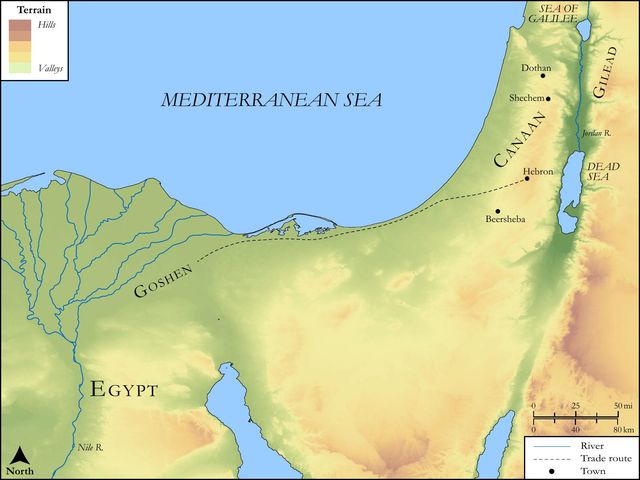
See on the biblical-era maps


Study this verse
Public-domain commentary
Matthew Henry
From his Commentary on the Whole Bible. Henry comments on passages, not single verses — this entry covers Genesis 43:1–10.
Here, 1. Jacob urges his sons to go and buy more corn in Egypt, Gen 43:1, Gen 43:2. The famine continued; and the corn they had bought was all spent, for it is meat that perisheth. Jacob, as a good master of a family, is in care to provide for those of his own house food convenient; and shall not God provide for his children, for the household of faith? Jacob bids them go again and buy a little food; now, in time of scarcity, a little must suffice, for nature is content with a little. 2. Judah urges him to consent that Benjamin should go down with them, how much soever it went against his feelings and previous determination. Note, It is not at all inconsistent with the honour and duty which children owe their parents humbly and modestly to advise them, and, as occasion is, to reason with them. Plead with your mother, plead, Hos 2:2. (1.) He insists upon the absolute necessity they were under of bringing Benjamin with them, of which he, who was a witness to all that had passed in Egypt, was a more competent judge than Jacob could be. Joseph's protestation (Gen 43:3) may be alluded to to show upon what terms we must draw nigh to God; unless we bring Christ along with us in the arms of our faith, we cannot see the face of God with comfort. (2.) He engages to take all possible care of him, and to do his utmost for his safety, Gen 43:8, Gen 43:9. Judah's conscience had lately smitten him for what he had done a great while ago against Joseph (Gen 42:21); and, as an evidence of the truth of his repentance, he is ready to undertake, as far as a man could do it, for Benjamin's security. He will not only not wrong him, but will do all he can to protect him. This is restitution, as far as the case will admit; when he knew not how he could restore Joseph, he would make some amends for the irreparable injury he had done him by doubling his care concerning Benjamin.
Continue studying Genesis 43:10 across the web’s major study libraries — every link below opens this exact verse, chapter, or book on the destination site.
Read & Compare
 BibleGatewayThis verse in more than 200 translations and 70 languages.
 Bible.comThe YouVersion reader — hundreds of translations, reading plans, and highlights.
 ESV.orgCrossway's official English Standard Version reader.
 NET BibleThe NET translation with 60,000+ translators' notes on every rendering decision.
 STEP BibleTyndale House's free study tool — original text, vocabulary, and scholarly resources.
 BibliaLogos Bible Software's free web reader.
 USCCBThe New American Bible (Revised Edition) with the U.S. bishops' study notes.
Commentaries
 BibleHub CommentariesDozens of classic commentaries on this verse, gathered on one page.
 StudyLightMore than 100 commentary sets — the largest collection on the web.
 BibleRefPlain-English commentary on what this verse means, verse by verse.
 Enduring WordDavid Guzik's free commentary on this chapter, widely used by Bible teachers.
 Bible Study ToolsVerse commentary alongside Greek and Hebrew study aids.
Original Language & Research
- BibleHub InterlinearThe verse word by word — original language, transliteration, and English.
- BibleHub LexiconEvery word's original-language definition and Strong's entry.
 Blue Letter BibleDeep-study tools — Strong's numbers, concordance, and word studies.
 SefariaThe Hebrew text with Rashi and centuries of Jewish commentary.
Sermons, Hymns & Audio


TrulyRandomVerse is not affiliated with these sites and doesn’t control their content. They’re linked because they’re genuinely useful.
Summary
Judah's impassioned statement in Genesis 43:10 serves as a stark reminder to his father, Jacob, of the severe consequences of their prolonged hesitation to return to Egypt for vital grain. He underscores that had they not delayed, they would have already completed their crucial second journey, securing the necessary provisions and alleviating their family's desperate hunger, thereby emphasizing the critical need for immediate and decisive action in the face of a devastating famine.
Context
ShowHideLiterary Context
Genesis 43:10 is embedded within the climactic narrative of Jacob's family facing a severe famine and their ongoing interactions with Joseph, the now-exalted governor of Egypt. Following their initial trip to Egypt for grain, where Simeon was detained and Benjamin's presence was demanded as proof of honesty, the family has returned to Canaan. Jacob, still grieving the presumed loss of Joseph and now fearing for Benjamin, has been deeply reluctant to send his youngest son back to Egypt. The family's food supply from the first journey is exhausted, and their survival hinges on a second expedition. Judah's statement comes as he desperately tries to persuade his father to release Benjamin, highlighting the dire practical consequences of Jacob's continued emotional paralysis and emphasizing the urgency of their predicament.
Historical & Cultural Context
The famine described in Genesis is not localized but a widespread, multi-year event affecting both Canaan and Egypt, indicative of a severe drought that would have devastated agricultural societies. In such a crisis, Egypt, with its Nile-fed irrigation, was often a granary for the lands round about it. The cultural norm of a patriarch's authority is evident in Jacob's initial refusal, yet the familial duty to preserve the household in the face of starvation ultimately compels action. The practice of sending sons to procure food from a foreign land was common, and the need for a surety (as Judah later offers) was a recognized legal and social custom to guarantee a person's return or good conduct.
Key Themes
ShowHideThis verse contributes to several overarching themes in Genesis. It powerfully illustrates the theme of Divine Providence working through human circumstances, even through fear and delay, to bring about God's ultimate purposes, particularly the preservation of the covenant family. It also highlights the theme of Human Responsibility and Decision-Making in the face of crisis, contrasting Jacob's paralyzing fear with Judah's emerging Leadership and Self-Sacrifice. The narrative also subtly reinforces the theme of Consequences of Inaction, especially when confronting the dire urgency of the famine and the need to overcome fear, as seen in Jacob's initial refusal to send Benjamin, fearing he would lose him as he believed he had lost Joseph, as detailed in Jacob's deep reluctance.
Exposition and Analysis
ShowHideKey Word Analysis
ShowHideThis conjunction introduces a strong conditional clause, meaning "if not" or "were it not that." In Judah's statement, it sets up a hypothetical scenario, emphasizing the direct causal link between their lingering and their current predicament. It highlights the missed opportunity and the regrettable outcome that has resulted from their inaction.
Derived from a root meaning "to question or hesitate," this verb powerfully conveys the idea of reluctance, delay, or tarrying. Judah uses it to express his profound frustration with Jacob's protracted indecision and emotional paralysis regarding the journey to Egypt. It paints a picture of time wasted due to fear and indecision, directly impacting the family's survival.
This primitive root means "to turn back," "to return," or "to go back." In this context, it signifies the completion of the round trip to Egypt. Judah's use of this word emphasizes the practical, tangible outcome that would have already been achieved had they acted promptly, underscoring the severity of their current delay and the hunger it prolongs.
Verse Breakdown
ShowHide"For except we had lingered,"
This opening clause establishes a counterfactual condition. Judah is pointing out that if they had not wasted time or hesitated, the current dire situation would be different. The "lingering" refers specifically to Jacob's prolonged reluctance to allow Benjamin to accompany his brothers back to Egypt, which has stalled their ability to secure more food.
"surely now"
This phrase emphasizes the immediate and present consequence of their past inaction. It conveys a sense of exasperated urgency, highlighting that the moment for action was long past, and the family is suffering the present effects of that delay. It's an appeal to Jacob's sense of immediate reality.
"we had returned this second time."
This final clause articulates the positive outcome that was forfeited due to the delay. Judah asserts that by this point, they would have already completed their second journey to Egypt, acquired the necessary grain, and returned home, alleviating their hunger. The "second time" underscores the critical nature of this particular trip for their survival and the extent of the missed opportunity.
Literary Devices
ShowHideJudah's statement is a powerful example of Rhetorical Argumentation, as he employs a logical, almost exasperated, appeal to persuade Jacob. The structure of the verse itself forms a clear Conditional Statement ("except we had lingered, surely now we had returned"), highlighting a cause-and-effect relationship between their delay and their current suffering. This conditional structure also functions as a form of Lament or Regret, expressing what could have been versus what is. The phrase "this second time" serves as a form of Emphasis, underscoring the urgency and the missed opportunity, making the consequences of their inaction painfully clear to Jacob.
Theological and Thematic Connections
ShowHideGenesis 43:10, while a practical statement of urgency, resonates with deeper theological and thematic currents within the broader biblical narrative. It highlights the tension between human agency and divine sovereignty, as Jacob's understandable fear and delay, though frustrating to Judah, ultimately serve God's larger providential plan to bring the entire family into Egypt, where they would be preserved and grow into a nation. Judah's emergence as a responsible leader, willing to confront his father and later offer himself as a surety, foreshadows his tribe's future prominence and the lineage of the Messiah. The narrative also underscores the spiritual lesson that procrastination, especially when rooted in fear rather than wisdom, can lead to prolonged suffering and hinder the timely reception of God's provision, even if God ultimately works all things for good.
Reflection and Application
ShowHideGenesis 43:10 offers profound lessons for contemporary believers navigating life's challenges. Judah's exasperated plea serves as a potent reminder that while prudence and prayer are essential, there are moments when decisive action, fueled by faith rather than fear, becomes imperative. Jacob's lingering, born of understandable grief and anxiety, illustrates how even legitimate fears can paralyze us, preventing us from stepping into God's provision or fulfilling necessary responsibilities. This passage calls us to examine areas in our lives where fear or indecision might be causing unnecessary delay and prolonged suffering, urging us to trust in God's guiding hand even when the path forward seems daunting. Furthermore, Judah's willingness to step into a leadership void and confront his father with hard truths, and later to offer himself as a guarantee for Benjamin, models a mature, sacrificial love and responsibility that we are called to emulate within our families, communities, and the church. It challenges us to move beyond passive waiting to active, faith-filled engagement, trusting that God will work through our obedience.
Questions for Reflection
ShowHideFAQ
ShowHideWhy was Jacob so hesitant to send Benjamin to Egypt?
ShowHideJacob was profoundly reluctant to send Benjamin to Egypt primarily due to his past trauma and deep emotional attachment. He believed he had already lost his beloved son Joseph, whom he thought was dead, and now Simeon was being held captive in Egypt. Benjamin was his youngest son, and the only other child of his cherished wife Rachel. Jacob feared that sending Benjamin would result in his death or disappearance, which he expressed would "bring down my gray hairs with sorrow to Sheol" (Genesis 42:38). His hesitation was rooted in a protective, albeit paralyzing, love and a deep-seated fear of further loss.
What does Judah's statement reveal about the family's situation?
ShowHideJudah's statement reveals the extreme urgency and desperation of the family's situation. They were facing a severe and prolonged famine, and their existing food supply was exhausted. The "lingering" caused by Jacob's fear meant prolonged hunger, suffering, and the very real threat of starvation for the entire household. It underscores that their survival depended entirely on making this second, critical journey to Egypt. Judah's directness also highlights his growing maturity and leadership, as he confronts his father with the practical, dire consequences of his emotional paralysis, emphasizing the need for immediate and decisive action to secure their future.
Christ-Centered Fulfillment
ShowHideThe desperate situation of Jacob's family and Judah's sacrificial plea in Genesis 43:10 profoundly foreshadow the person and work of Jesus Christ. Judah's willingness to stand as surety for Benjamin, offering himself as a substitute to spare his father further grief and ensure Benjamin's safe return, is a powerful type of Christ. Just as Judah pledged his life for his brother, Jesus Christ became our ultimate Surety of a better covenant, offering His perfect life as a ransom for us, the Lamb of God who takes away the sin of the world. The entire narrative of Joseph, providentially exalted to save his family and many nations despite being rejected by his brothers, serves as a magnificent prefigurement of Christ, who was rejected by His own, suffered unjustly, yet was exalted by God to bring salvation and sustenance to a world lost in sin. Even the human fear and delay evident in Jacob's hesitation are woven into God's perfect tapestry of redemption, demonstrating that His sovereign plan unfolds even through our imperfections, culminating in the saving work of Jesus Christ, who died for us while we were still sinners.