


Genesis 43:9
Bible text: King James Version (1769 Blayney text) · Public domain
Bible text: Berean Standard Bible · Public domain
Bible text: American Standard Version (1901) · Public domain
Bible text: World English Bible, Messianic edition · Public domain
Bible text: Geneva Bible (1599) · Public domain
Bible text: Young's Literal Translation · Public domain
- אָנֹכִי'a·no·KhiIH595Pro-1csPronoun Personal 1st Singular common gender
- אֶעֶרְבֶנּוּ'e·'er·Ve·nuI will stand surety for himH6148V-Qal-Imperf-1cs ¦ 3msVerb Qal Imperfect 1st Singular common genderאֶעֶרְבֶI will stand surety forנּוּhim
- מִיָּדִיmi·ya·Difrom my handH3027Prep-m ¦ N-csc ¦ 1csNoun Singular common gender Constructמִfromיָּדִhandיmy
- תְּבַקְשֶׁנּוּte·vak·She·nuyou will require himH1245V-Piel-Imperf-2ms ¦ 3msVerb Piel Imperfect 2nd Singular Masculineתְּבַקְשֶׁyou will requireנּוּhim
- אִם'imifH518PrtParticle Conditional
- לֹאlo'notH3808NegParticle Negative
- הֲבִיאֹתִיוha·vi·'o·TivI have brought himH935V-Hiphil-Perf-1cs ¦ 3msVerb Hiphil Perfect 1st Singular common genderהֲבִיאֹתִיI have broughtוhim
- אֵלֶיךָ'e·Lei·khato youH413Prep ¦ 2msPrepositionאֵלֶיtoךָyou
- וְהִצַּגְתִּיוve·hi·tzag·Tivand I will set himH3322Conj-w ¦ V-Hiphil-ConsecPerf-1cs ¦ 3msVerb Hiphil Consecutive Perfect 1st Singular common genderוְandהִצַּגְתִּיI will setוhim
- לְפָנֶיךָle·fa·Nei·kha<to> before youH6440Prep-l ¦ N-mpc ¦ 2msNoun Plural Masculine Constructלְ<to>פָנֶיbeforeךָyou
- וְחָטָאתִיve·cha·Ta·tiand I will be culpableH2398Conj-w ¦ V-Qal-ConsecPerf-1csVerb Qal Consecutive Perfect 1st Singular common genderוְandחָטָאתִיI will be culpable
- לְךָle·Khato youPrep-l ¦ 2msSuffix Personal 2nd Singular Masculineלְtoךָyou
- כָּלkolallH3605N-mscNoun Singular Masculine Construct
- הַיָּמִיםhai·ya·Mimthe daysH3117Art ¦ N-mpNoun Plural Masculine Absoluteהַtheיָּמִיםdays
English is a literal word-by-word gloss of the Hebrew, not the KJV's wording. Why?
This is the original text the KJV's translators worked from — each Hebrew word with its own literal English meaning in this verse, prepared by scholars at Tyndale House, Cambridge. The KJV translates whole sentences, not word by word, so its wording differs: one Hebrew word can become several English words, and the KJV may choose “the LORD” where the gloss reads “Yahweh”. Both are faithful — they answer different questions. For the KJV's own rendering, switch to the KJV text.
Details
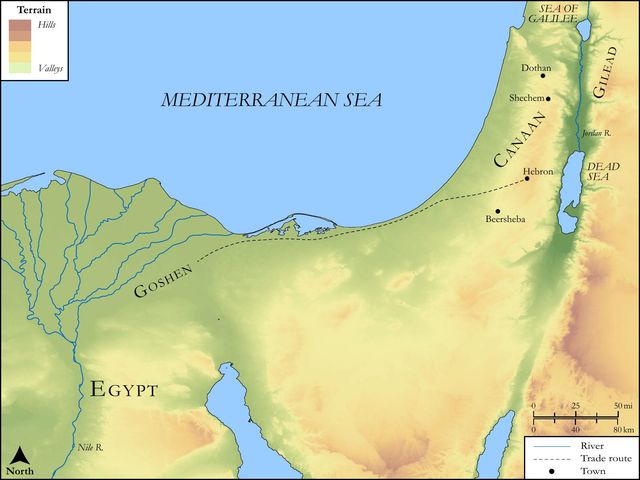
See on the biblical-era maps


Study this verse
Public-domain commentary
Matthew Henry
From his Commentary on the Whole Bible. Henry comments on passages, not single verses — this entry covers Genesis 43:1–10.
Here, 1. Jacob urges his sons to go and buy more corn in Egypt, Gen 43:1, Gen 43:2. The famine continued; and the corn they had bought was all spent, for it is meat that perisheth. Jacob, as a good master of a family, is in care to provide for those of his own house food convenient; and shall not God provide for his children, for the household of faith? Jacob bids them go again and buy a little food; now, in time of scarcity, a little must suffice, for nature is content with a little. 2. Judah urges him to consent that Benjamin should go down with them, how much soever it went against his feelings and previous determination. Note, It is not at all inconsistent with the honour and duty which children owe their parents humbly and modestly to advise them, and, as occasion is, to reason with them. Plead with your mother, plead, Hos 2:2. (1.) He insists upon the absolute necessity they were under of bringing Benjamin with them, of which he, who was a witness to all that had passed in Egypt, was a more competent judge than Jacob could be. Joseph's protestation (Gen 43:3) may be alluded to to show upon what terms we must draw nigh to God; unless we bring Christ along with us in the arms of our faith, we cannot see the face of God with comfort. (2.) He engages to take all possible care of him, and to do his utmost for his safety, Gen 43:8, Gen 43:9. Judah's conscience had lately smitten him for what he had done a great while ago against Joseph (Gen 42:21); and, as an evidence of the truth of his repentance, he is ready to undertake, as far as a man could do it, for Benjamin's security. He will not only not wrong him, but will do all he can to protect him. This is restitution, as far as the case will admit; when he knew not how he could restore Joseph, he would make some amends for the irreparable injury he had done him by doubling his care concerning Benjamin.
Continue studying Genesis 43:9 across the web’s major study libraries — every link below opens this exact verse, chapter, or book on the destination site.
Read & Compare
 BibleGatewayThis verse in more than 200 translations and 70 languages.
 Bible.comThe YouVersion reader — hundreds of translations, reading plans, and highlights.
 ESV.orgCrossway's official English Standard Version reader.
 NET BibleThe NET translation with 60,000+ translators' notes on every rendering decision.
 STEP BibleTyndale House's free study tool — original text, vocabulary, and scholarly resources.
 BibliaLogos Bible Software's free web reader.
 USCCBThe New American Bible (Revised Edition) with the U.S. bishops' study notes.
Commentaries
 BibleHub CommentariesDozens of classic commentaries on this verse, gathered on one page.
 StudyLightMore than 100 commentary sets — the largest collection on the web.
 BibleRefPlain-English commentary on what this verse means, verse by verse.
 Enduring WordDavid Guzik's free commentary on this chapter, widely used by Bible teachers.
 Bible Study ToolsVerse commentary alongside Greek and Hebrew study aids.
Original Language & Research
- BibleHub InterlinearThe verse word by word — original language, transliteration, and English.
- BibleHub LexiconEvery word's original-language definition and Strong's entry.
 Blue Letter BibleDeep-study tools — Strong's numbers, concordance, and word studies.
 SefariaThe Hebrew text with Rashi and centuries of Jewish commentary.
Sermons, Hymns & Audio


TrulyRandomVerse is not affiliated with these sites and doesn’t control their content. They’re linked because they’re genuinely useful.
Summary
Genesis 43:9 records Judah's profound and self-sacrificing pledge to his father, Jacob, taking full personal responsibility for the safe return of his youngest brother, Benjamin, from Egypt. This pivotal promise was essential to persuade Jacob to allow Benjamin to accompany his brothers on a perilous journey, demonstrating Judah's emerging leadership, deep commitment to his family's survival, and a remarkable transformation of character amidst a severe famine.
Context
ShowHideLiterary Context
This verse is a crucial turning point within the larger narrative of Jacob's family's interaction with Joseph in Egypt. Following their initial trip for grain, Joseph, unrecognized by his brothers, had detained Simeon and demanded Benjamin's presence to prove their honesty, as recounted in Genesis 42. Jacob's profound grief over the presumed loss of Joseph and his intense fear for Benjamin's safety made him vehemently resist this demand, famously lamenting in Genesis 42:36 that all these things were against him. Reuben had previously offered his own two sons as collateral, a pledge Jacob dismissed as insufficient (Genesis 42:37). It is in this atmosphere of desperation, with the famine worsening and the family facing starvation, that Judah steps forward, offering a more compelling and personally binding guarantee that finally sways his grieving father.
Historical & Cultural Context
Among the patriarchs, oaths and pledges were held of immense value, particularly those involving personal honor and responsibility. A "surety" (Hebrew: ʻârab) was a formal guarantor, taking on the legal and moral liability for another's actions or safety. This was not a casual promise but a solemn, binding agreement, often witnessed and carrying severe social and personal consequences for failure. The famine was not a localized event but a severe, multi-year drought affecting the entire region, making the need for grain from Egypt a matter of life and death. For Jacob, the protection of Benjamin, the only remaining son of his beloved Rachel, was paramount, reflecting the deep patriarchal concern for lineage and the preservation of the family's future, which was tied to God's covenant promises to Abraham, Isaac, and Jacob.
Key Themes
ShowHideJudah's pledge contributes significantly to several overarching themes in Genesis. It highlights the theme of Divine Providence, as Joseph's seemingly harsh demands are part of God's larger plan to bring his family to Egypt for preservation. It powerfully illustrates Transformation and Redemption, particularly in Judah's character, as he moves from his complicity in the selling of Joseph (Genesis 37:26-27) to offering himself as a substitute for Benjamin. The passage also underscores the theme of Familial Reconciliation, as Judah's self-sacrifice paves the way for the eventual reunion and healing of the fractured family. Finally, it reinforces the Preservation of the Covenant Line, as Benjamin's safe return is crucial for the continuation of Jacob's descendants, through whom God's promises would be fulfilled, as seen throughout the book of Genesis.
Exposition and Analysis
ShowHideJudah's declaration in Genesis 43:9 is a powerful testament to his transformation and commitment. He steps into a leadership void, offering a binding personal guarantee to his father, Jacob, for Benjamin's safety. This pledge was not merely a casual promise but a solemn, legally and morally binding agreement that placed his own integrity and future on the line.
Key Word Analysis
ShowHideThis root word means "to braid" or "intermix," which extends to "to traffic" (as if by barter) and, crucially here, "to give to be security" or "to undertake." Judah is literally intermixing himself with Benjamin's fate, becoming personally intertwined and liable for his safe return. It signifies a deep, personal undertaking of responsibility and liability, where Judah stands as a guarantor.
This verb means "to search out," "to strive after," "to ask," "to beg," or "to demand." In this context, it emphasizes Jacob's absolute right to accountability. Judah is not just making a promise; he is granting Jacob the right to actively seek out and demand Benjamin's return from Judah's own hand, holding him directly responsible for any failure.
This word primarily means "to miss (a mark)," and by extension, "to sin," "to forfeit," "to lack," or "to condemn." Judah's willingness to "bear the blame for ever" implies that if he fails, he will perpetually be seen as having "sinned against" Jacob, incurring an enduring moral debt or an unceasing state of disgrace in his father's eyes. It's an acceptance of permanent guilt and forfeiture of honor.
Verse Breakdown
ShowHide"I will be surety for him;"
Judah initiates the pledge, taking personal responsibility. This is a voluntary, self-imposed obligation, demonstrating a profound shift from his earlier character. He is offering himself as a guarantor.
"of my hand shalt thou require him:"
This clause specifies the nature of the suretyship. Jacob has the right to demand Benjamin from Judah's direct accountability. It signifies that Judah's personal honor and future are on the line; he is the one to whom Jacob can turn for redress if Benjamin is not returned.
"if I bring him not unto thee, and set him before thee,"
This sets the precise condition for failure. The pledge is contingent upon Judah successfully returning Benjamin to Jacob's physical presence. The dual verbs "bring" and "set before" emphasize the complete and successful restoration of Benjamin.
"then let me bear the blame for ever:"
This is the severe consequence Judah willingly accepts. He is prepared to live under perpetual guilt, disgrace, or moral condemnation from his father if he fails. The phrase "for ever" (Hebrew: yôwm H3117, meaning "day" or "time," often used hyperbolically for an indefinite period) underscores the profound and lasting nature of the self-imposed penalty, signifying an unceasing burden of failure in Jacob's eyes.
Literary Devices
ShowHideJudah's pledge in this verse is rich with Foreshadowing. His willingness to offer himself as a personal guarantor and to "bear the blame for ever" for Benjamin's sake powerfully prefigures his later impassioned plea to Joseph in Genesis 44:32-34, where he explicitly offers himself as a substitute for Benjamin, solidifying his role as the family's emerging leader and protector. This act also serves as a profound Transformation Arc for Judah, marking his journey from complicity in selling Joseph to self-sacrificial love for his youngest brother. The gravity of his oath, sealed with the phrase "for ever," employs Hyperbole to underscore the immense weight and permanent nature of the commitment he is undertaking.
Theological and Thematic Connections
ShowHideJudah's courageous and self-sacrificial pledge in Genesis 43:9 serves as a pivotal moment in the biblical narrative, illustrating profound theological truths. It highlights the sanctity and weight of a sworn word, mirroring God's own unwavering faithfulness to His covenants with humanity. Judah's willingness to take on personal liability for Benjamin's well-being demonstrates a remarkable transformation from his earlier involvement in the betrayal of Joseph, marking a crucial step in his personal redemption and foreshadowing his lineage as the tribe from which the Messiah would ultimately come. This act of suretyship, driven by deep familial love and the imperative to preserve the family line, is instrumental in the eventual reconciliation and preservation of the entire family of Jacob, ensuring the continuation of God's redemptive plan.
Reflection and Application
ShowHideJudah's courageous pledge in Genesis 43:9 offers timeless lessons on integrity, responsibility, and the transformative power of selfless love. It teaches us the profound importance of honoring our commitments, especially when the well-being and future of others depend on our word; our promises should indeed be our bond, reflecting a character of reliability and trustworthiness. Furthermore, Judah's willingness to step up and take personal responsibility, even for outcomes beyond his direct control, exemplifies true leadership—a leadership that is characterized by courage, unwavering integrity, and a readiness to bear burdens for the sake of others. Finally, Judah's willingness to sacrifice his own standing and accept perpetual blame for his brother's safety is a powerful example of selfless, familial love, urging us to consider how we might bear the burdens, stand in the gap, and offer ourselves for the protection and well-being of those we love, mirroring the sacrificial love that is at the heart of the Gospel.
Questions for Reflection
ShowHideFAQ
ShowHideWhat does "surety" mean in the context of Genesis 43:9?
ShowHideIn Genesis 43:9, "surety" (Hebrew: ʻârab' H6148) means that Judah is personally guaranteeing Benjamin's safe return. He is taking on the full responsibility and liability for Benjamin's well-being, pledging that if Benjamin does not return, Judah will bear the blame and consequences as if he himself were the one lost or harmed. It signifies a deep, binding, and self-sacrificial commitment, placing his own honor and future on the line.
How does Judah's past actions relate to this pledge?
ShowHideJudah's pledge in Genesis 43:9 marks a significant turning point from his past. Earlier, Judah was instrumental in suggesting that Joseph be sold into slavery rather than killed (Genesis 37:26-27). This act of suretyship for Benjamin demonstrates a profound transformation: he is no longer willing to see a brother lost or harmed, but instead offers himself as a substitute, showing newfound responsibility, leadership, and a deep, redemptive love for his family. This transformation is crucial for the eventual reconciliation of Jacob's family.
Why was Jacob so reluctant to let Benjamin go to Egypt?
ShowHideJacob was deeply reluctant to let Benjamin go to Egypt primarily because he had already grieved the presumed death of his beloved son Joseph, also a son of Rachel, as detailed in Genesis 37. Benjamin was the only remaining son of Rachel, and Jacob feared that "mischief" would befall him, bringing his "gray hairs with sorrow to the grave" (Genesis 42:38). His reluctance stemmed from profound paternal anguish and a desire to protect his last remaining link to his most cherished wife.
Christ-Centered Fulfillment
ShowHideJudah's act of suretyship for Benjamin in Genesis 43:9 serves as a powerful Old Testament foreshadowing of the ultimate surety, Jesus Christ. Just as Judah willingly put himself under a perpetual obligation to his father for his brother's safety, accepting the consequence of bearing the blame "for ever," so Christ became our divine Surety. He did not merely pledge His word but Himself, bearing the full weight of our sin and condemnation on the cross (2 Corinthians 5:21), so that we might be brought safely to the Father. The author of Hebrews explicitly names Jesus as the "surety of a better covenant", highlighting His unique and perfect ability to guarantee our salvation and eternal security through His perfect sacrifice and ongoing intercession (Hebrews 9:15). Judah's willingness to stand in the gap for Benjamin, offering himself as a substitute, beautifully prefigures Christ's substitutionary atonement, where He bore the curse for us (Galatians 3:13), ensuring our reconciliation and eternal life.