


Genesis 43:1
Bible text: King James Version (1769 Blayney text) · Public domain
Bible text: Berean Standard Bible · Public domain
Bible text: American Standard Version (1901) · Public domain
Bible text: World English Bible, Messianic edition · Public domain
Bible text: Geneva Bible (1599) · Public domain
Bible text: Young's Literal Translation · Public domain
- וְהָרָעָבve·ha·ra·'Avand the famineH7458Conj-w ¦ Art ¦ N-msNoun Singular Masculine Absoluteוְandהָtheרָעָבfamine
- כָּבֵדka·Ved[was] heavyH3515Adj-msAdjective Singular Masculine Absolute
- בָּאָרֶץba·'A·retzin the landH776Prep-b ¦ N-fsNoun Singular Feminine Absoluteבָּin theאָרֶץland
English is a literal word-by-word gloss of the Hebrew, not the KJV's wording. Why?
This is the original text the KJV's translators worked from — each Hebrew word with its own literal English meaning in this verse, prepared by scholars at Tyndale House, Cambridge. The KJV translates whole sentences, not word by word, so its wording differs: one Hebrew word can become several English words, and the KJV may choose “the LORD” where the gloss reads “Yahweh”. Both are faithful — they answer different questions. For the KJV's own rendering, switch to the KJV text.
Details
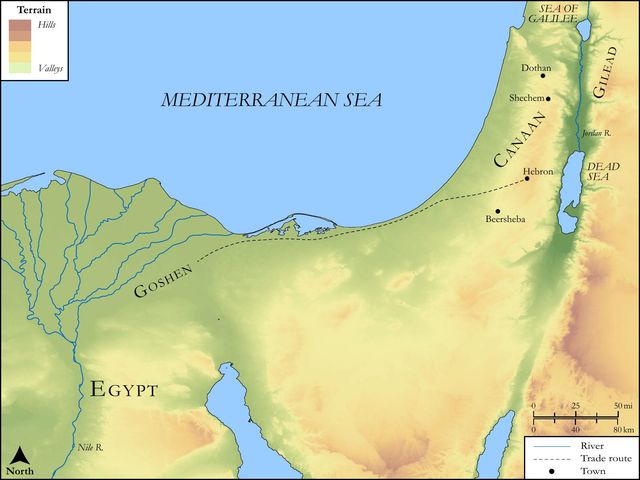
See on the biblical-era maps


Study this verse
Public-domain commentary
Matthew Henry
From his Commentary on the Whole Bible. Henry comments on passages, not single verses — this entry covers Genesis 43:1–10.
Here, 1. Jacob urges his sons to go and buy more corn in Egypt, Gen 43:1, Gen 43:2. The famine continued; and the corn they had bought was all spent, for it is meat that perisheth. Jacob, as a good master of a family, is in care to provide for those of his own house food convenient; and shall not God provide for his children, for the household of faith? Jacob bids them go again and buy a little food; now, in time of scarcity, a little must suffice, for nature is content with a little. 2. Judah urges him to consent that Benjamin should go down with them, how much soever it went against his feelings and previous determination. Note, It is not at all inconsistent with the honour and duty which children owe their parents humbly and modestly to advise them, and, as occasion is, to reason with them. Plead with your mother, plead, Hos 2:2. (1.) He insists upon the absolute necessity they were under of bringing Benjamin with them, of which he, who was a witness to all that had passed in Egypt, was a more competent judge than Jacob could be. Joseph's protestation (Gen 43:3) may be alluded to to show upon what terms we must draw nigh to God; unless we bring Christ along with us in the arms of our faith, we cannot see the face of God with comfort. (2.) He engages to take all possible care of him, and to do his utmost for his safety, Gen 43:8, Gen 43:9. Judah's conscience had lately smitten him for what he had done a great while ago against Joseph (Gen 42:21); and, as an evidence of the truth of his repentance, he is ready to undertake, as far as a man could do it, for Benjamin's security. He will not only not wrong him, but will do all he can to protect him. This is restitution, as far as the case will admit; when he knew not how he could restore Joseph, he would make some amends for the irreparable injury he had done him by doubling his care concerning Benjamin.
Continue studying Genesis 43:1 across the web’s major study libraries — every link below opens this exact verse, chapter, or book on the destination site.
Read & Compare
 BibleGatewayThis verse in more than 200 translations and 70 languages.
 Bible.comThe YouVersion reader — hundreds of translations, reading plans, and highlights.
 ESV.orgCrossway's official English Standard Version reader.
 NET BibleThe NET translation with 60,000+ translators' notes on every rendering decision.
 STEP BibleTyndale House's free study tool — original text, vocabulary, and scholarly resources.
 BibliaLogos Bible Software's free web reader.
 USCCBThe New American Bible (Revised Edition) with the U.S. bishops' study notes.
Commentaries
 BibleHub CommentariesDozens of classic commentaries on this verse, gathered on one page.
 StudyLightMore than 100 commentary sets — the largest collection on the web.
 BibleRefPlain-English commentary on what this verse means, verse by verse.
 Enduring WordDavid Guzik's free commentary on this chapter, widely used by Bible teachers.
 Bible Study ToolsVerse commentary alongside Greek and Hebrew study aids.
Original Language & Research
- BibleHub InterlinearThe verse word by word — original language, transliteration, and English.
- BibleHub LexiconEvery word's original-language definition and Strong's entry.
 Blue Letter BibleDeep-study tools — Strong's numbers, concordance, and word studies.
 SefariaThe Hebrew text with Rashi and centuries of Jewish commentary.
Sermons, Hymns & Audio


TrulyRandomVerse is not affiliated with these sites and doesn’t control their content. They’re linked because they’re genuinely useful.
Summary
Genesis 43:1 succinctly yet powerfully depicts the relentless and severe famine that continued to grip the land of Canaan, creating an acute crisis for Jacob and his family. This dire circumstance, marked by dwindling food supplies, serves as the immediate catalyst compelling Jacob to finally yield to the necessity of sending his sons, including Benjamin, back to Egypt to procure more grain, thereby setting the stage for the pivotal second encounter with the powerful Egyptian governor, Joseph.
Context
ShowHideLiterary Context
Genesis 43:1 opens a new, critical phase in the unfolding narrative of Jacob's family and Joseph's hidden plan. It immediately follows the return of Jacob's ten sons from their first journey to Egypt, where they had purchased grain and unexpectedly encountered their brother Joseph, though they did not recognize him. The preceding chapters detail Joseph's rise to power in Egypt (Genesis 41), the onset of the severe famine, and the first journey of Jacob's sons to Egypt to buy food (Genesis 42). At the close of Genesis 42, the brothers have returned with their purchased grain, but Simeon has been held captive, and Joseph has demanded that Benjamin accompany them on any future trip. Jacob's initial refusal to send Benjamin, fearing further loss after Joseph's presumed death, creates a dramatic tension. This opening verse of chapter 43, by emphasizing the continued severity of the famine, underscores the inescapable reality that forces Jacob's hand, pushing the family toward the difficult decision to return to Egypt under Joseph's stringent terms.
Historical & Cultural Context
Famines were a recurring and devastating reality in the lands of the patriarchs, which relied heavily on seasonal rainfall for agricultural success. Unlike modern societies with global food distribution networks, ancient communities were highly vulnerable to prolonged droughts or crop failures, which could lead to widespread starvation, disease, and societal collapse. Egypt, with its unique agricultural system based on the predictable inundation of the Nile River, often served as a granary for the surrounding regions during times of scarcity, making it a vital source of sustenance for peoples like the Canaanites. The "soreness" of the famine in Genesis 43:1 highlights its oppressive nature, extending beyond Egypt to Canaan, indicating a regional catastrophe. For a patriarchal family like Jacob's, the head of the household bore the immense responsibility for the survival and well-being of his large extended family, including wives, children, and servants. The decision to travel to a foreign land for food was not trivial; it involved significant risk, expense, and a profound acknowledgment of their vulnerability and dependence on external sources.
Key Themes
ShowHideThis verse powerfully contributes to several overarching themes within Genesis and the broader biblical narrative. Firstly, it reinforces the theme of Divine Sovereignty and Providence, demonstrating how God orchestrates even natural disasters like famine to accomplish His redemptive purposes. The famine, though a hardship, is the very mechanism God uses to bring Jacob's family to Egypt, where they will grow into a nation, protected from Canaanite influences, and ultimately be preserved for the fulfillment of the covenant promises. Secondly, it highlights Human Dependence on God's provision. Despite their wealth and resources, Jacob's family is utterly helpless against the famine, underscoring humanity's fundamental reliance on God for sustenance and life itself. Thirdly, the famine serves as a Test of Faith and Character, particularly for Jacob, who must grapple with his attachment to Benjamin and trust God amidst overwhelming circumstances. Finally, it advances the theme of Reconciliation and Restoration, as the famine is the direct impetus for the brothers' return to Egypt, leading to Joseph's revelation and the eventual reunion of the entire family, a crucial step in God's plan for Israel. The entire narrative from Genesis 37 to Genesis 50 is intricately woven around these themes, with the famine serving as a critical plot device.
Exposition and Analysis
ShowHideKey Word Analysis
ShowHideThis term (H7458) derives from a root meaning "to hunger" and denotes a state of hunger, dearth, or scarcity of food, whether localized or widespread. In this context, it signifies a severe, extensive lack of provisions that threatens life. Its presence in the verse immediately establishes the dire circumstances and the existential threat faced by Jacob's family, emphasizing that this is not a minor inconvenience but a life-or-death situation.
The Hebrew word (H3515) literally means "heavy" or "weighty." Figuratively, as used here, it conveys a sense of severity, grievousness, difficulty, or oppressiveness. When applied to the famine, it describes its extreme intensity and the crushing burden it imposed. It implies that the famine was not merely present but was acutely felt, causing significant suffering and demanding urgent, drastic action. This word highlights the profound impact of the famine on the land and its inhabitants, emphasizing its pervasive and debilitating nature.
This versatile term (H776) can refer to the earth generally, a specific country, or even a piece of ground. Here, it specifically denotes the "land" of Canaan, where Jacob and his family resided. The inclusion of "in the land" emphasizes the widespread nature of the famine, indicating that it was not merely an Egyptian problem but had extended its devastating effects to their own homeland, leaving them with no local recourse and underscoring their complete dependence on external provision from Egypt.
Verse Breakdown
ShowHide"¶ And the famine"
The conjunction "And" (וְ) links this verse directly to the preceding narrative, indicating a continuation of the dire circumstances. The term "famine" immediately establishes the central problem, a widespread and severe lack of food, which is the driving force behind the events that follow. This is not a new development but the persistent, worsening reality that has brought Jacob's family to the brink.
"[was] sore"
The verb "was" is supplied in the KJV, but the Hebrew simply presents "famine sore," emphasizing the state of being. The word "sore" (כָּבֵד, kâbêd) is crucial, conveying the intense severity and oppressive nature of the famine. It was not just present but grievous, heavy, and difficult to bear, exerting immense pressure on the family. This adjective underscores the acute suffering and the urgent need for action.
"in the land"
This phrase specifies the geographical scope of the famine's impact. It clarifies that the scarcity was not confined to Egypt, where Joseph had stored grain, but had also severely affected Canaan, Jacob's homeland. This detail highlights the pervasive nature of the crisis, leaving Jacob's family with no local alternatives and compelling them to return to Egypt, the only known source of sustenance.
Literary Devices
ShowHideThe verse employs several literary devices to convey its profound message. Emphasis is achieved through the stark, declarative statement "And the famine was sore in the land," immediately foregrounding the central crisis. The use of the adjective "sore" (Hebrew kâbêd, "heavy" or "grievous") functions as Hyperbole, underscoring the extreme and oppressive nature of the famine, suggesting it was an unbearable burden. This hyperbole effectively communicates the desperation of the situation. Furthermore, the verse serves as significant Foreshadowing, signaling the inevitability of Jacob's family returning to Egypt and thus setting the stage for the dramatic reunion with Joseph and the unfolding of God's redemptive plan. The very simplicity of the statement, devoid of elaborate description, lends it a sense of stark Realism, grounding the narrative in the harsh realities of life in the days of the patriarchs.
Theological and Thematic Connections
ShowHideGenesis 43:1, though brief, serves as a powerful theological anchor, illustrating God's sovereign hand at work even amidst natural calamity. The "sore" famine is not merely a random event but a divinely orchestrated circumstance designed to move Jacob's family to Egypt, a necessary step for their preservation and growth into a nation, ultimately fulfilling God's covenant promises to Abraham, Isaac, and Jacob. This highlights that God's purposes are often advanced through challenging circumstances, compelling His people to move in directions they might otherwise resist. It underscores humanity's absolute dependence on God's provision, especially when all earthly resources fail, and reinforces the truth that even in scarcity, God can provide, often through unexpected means and places.
Reflection and Application
ShowHideThe "sore famine" described in Genesis 43:1 resonates deeply with the human experience of hardship and scarcity. Just as Jacob's family faced an unavoidable crisis that forced difficult decisions and reliance on an external source, so too do individuals and communities today encounter "famines" in various forms—economic downturns, health crises, relational breakdowns, or spiritual dryness. This verse serves as a profound reminder that life often presents circumstances beyond our control, compelling us to acknowledge our limitations and our fundamental dependence on a higher power. It challenges us to reflect on where we place our ultimate trust when our own resources, plans, or strength prove insufficient. In such "sore" times, the narrative of Jacob's family encourages us to look beyond the immediate crisis to God's overarching purposes, trusting that He can work even through adversity to bring about good, preserve His people, and fulfill His promises, much like Joseph later affirmed in Genesis 50:20.
Questions for Reflection
ShowHideFAQ
ShowHideHow long did the famine described in Genesis last?
ShowHideThe famine described in the book of Genesis, particularly in the context of Joseph's story, was a divinely predicted and orchestrated event that lasted for seven years. This period of severe scarcity followed seven years of abundant harvests, during which Joseph, as Pharaoh's administrator, wisely stored up vast quantities of grain throughout Egypt (Genesis 41:29-36). Genesis 43:1 occurs well into this seven-year famine, likely in its latter half, as Jacob's family has already consumed the provisions from their first trip to Egypt and the severity of the famine continues unabated, forcing them to return for a second time. The widespread nature of the famine, affecting "all the face of the earth" (Genesis 41:56), underscores its global impact and the critical role of Egypt as the sole source of sustenance during this period.
Christ-Centered Fulfillment
ShowHideThe "sore famine" in Genesis 43:1, which drove Jacob's family to seek physical sustenance from Egypt, profoundly foreshadows humanity's spiritual famine and its ultimate remedy found in Jesus Christ. Just as the land was parched and barren, incapable of sustaining life, so too is humanity, apart from God, spiritually famished, starving under the weight of sin and separation from the source of true life. The desperate need for physical bread in Canaan points to the deeper, universal human longing for spiritual nourishment and deliverance. Jesus Christ is revealed as the ultimate provider, the "Bread of Life" (John 6:35), who fully satisfies every spiritual hunger and thirst. He declared, "Whoever comes to me will never go hungry, and whoever believes in me will never be thirsty" (John 6:35). Unlike the temporary relief offered by physical grain, Christ offers eternal sustenance, a living water that springs up to eternal life (John 4:13-14). He is the true manna from heaven, providing not just survival but abundant and eternal life (John 6:48-51). Thus, the physical famine in Genesis serves as a powerful type, illustrating humanity's profound spiritual need and pointing to the complete and everlasting provision found in our Lord and Savior, Jesus Christ.