


Genesis 43:2
Bible text: King James Version (1769 Blayney text) · Public domain
Bible text: Berean Standard Bible · Public domain
Bible text: American Standard Version (1901) · Public domain
Bible text: World English Bible, Messianic edition · Public domain
Bible text: Geneva Bible (1599) · Public domain
Bible text: Young's Literal Translation · Public domain
- וַיְהִיvay·Hiand it wasH1961Conj-w ¦ V-Qal-ConsecImperf-3msVerb Qal Consecutive Imperfect 3rd Singular Masculineוַandיְהִיit was
- כַּאֲשֶׁרka·'a·Sherjust whenH834Prep-k ¦ RelParticle Relativeכַּjustאֲשֶׁרwhen
- כִּלּוּki·Luthey finishedH3615V-Piel-Perf-3cpVerb Piel Perfect 3rd Plural common gender
- לֶאֱכֹלle·'e·Kholto eatH398Prep-l ¦ V-Qal-InfVerb Qal Infinitive Constructלֶtoאֱכֹלeat
- אֶת'et<obj.>H853DirObjMParticle Object Indicator
- הַשֶּׁבֶרha·She·verthe grainH7668Art ¦ N-msNoun Singular Masculine Absoluteהַtheשֶּׁבֶרgrain
- אֲשֶׁר'a·SherwhichH834RelParticle Relative
- הֵבִיאוּhe·Vi·'uthey had broughtH935V-Hiphil-Perf-3cpVerb Hiphil Perfect 3rd Plural common gender
- מִמִּצְרָיִםmi·mitz·Ra·yimfrom EgyptH4714Prep-m ¦ N-properNoun Proper LocationמִfromמִּצְרָיִםEgypt
- וַיֹּאמֶרvai·Yo·merand he saidH559Conj-w ¦ V-Qal-ConsecImperf-3msVerb Qal Consecutive Imperfect 3rd Singular Masculineוַandיֹּאמֶרhe said
- אֲלֵיהֶם'a·lei·Hemto themH413Prep ¦ 3mpPrepositionאֲלֵיtoהֶםthem
- אֲבִיהֶם'a·vi·Hemtheir fatherH1N-msc ¦ 3mpNoun Singular Masculine Constructאֲבִיfatherהֶםtheir
- שֻׁבוּShu·vugo backH7725V-Qal-Imp-2mpVerb Qal Imperative 2nd Plural Masculine
- שִׁבְרוּshiv·rubuyH7666V-Qal-Imp-2mpVerb Qal Imperative 2nd Plural Masculine
- לָנוּLa·nufor usPrep-l ¦ 1cpSuffix Personal 1st Plural common genderלָforנוּus
- מְעַטme·'ata little ofH4592N-mscNoun Singular Masculine Construct
- אֹכֶל'O·khelfoodH400N-msNoun Singular Masculine Absolute
English is a literal word-by-word gloss of the Hebrew, not the KJV's wording. Why?
This is the original text the KJV's translators worked from — each Hebrew word with its own literal English meaning in this verse, prepared by scholars at Tyndale House, Cambridge. The KJV translates whole sentences, not word by word, so its wording differs: one Hebrew word can become several English words, and the KJV may choose “the LORD” where the gloss reads “Yahweh”. Both are faithful — they answer different questions. For the KJV's own rendering, switch to the KJV text.
Details
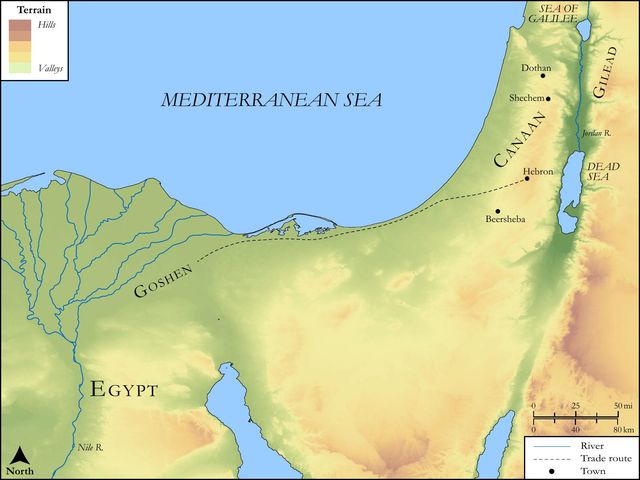
See on the biblical-era maps


Study this verse
Public-domain commentary
Matthew Henry
From his Commentary on the Whole Bible. Henry comments on passages, not single verses — this entry covers Genesis 43:1–10.
Here, 1. Jacob urges his sons to go and buy more corn in Egypt, Gen 43:1, Gen 43:2. The famine continued; and the corn they had bought was all spent, for it is meat that perisheth. Jacob, as a good master of a family, is in care to provide for those of his own house food convenient; and shall not God provide for his children, for the household of faith? Jacob bids them go again and buy a little food; now, in time of scarcity, a little must suffice, for nature is content with a little. 2. Judah urges him to consent that Benjamin should go down with them, how much soever it went against his feelings and previous determination. Note, It is not at all inconsistent with the honour and duty which children owe their parents humbly and modestly to advise them, and, as occasion is, to reason with them. Plead with your mother, plead, Hos 2:2. (1.) He insists upon the absolute necessity they were under of bringing Benjamin with them, of which he, who was a witness to all that had passed in Egypt, was a more competent judge than Jacob could be. Joseph's protestation (Gen 43:3) may be alluded to to show upon what terms we must draw nigh to God; unless we bring Christ along with us in the arms of our faith, we cannot see the face of God with comfort. (2.) He engages to take all possible care of him, and to do his utmost for his safety, Gen 43:8, Gen 43:9. Judah's conscience had lately smitten him for what he had done a great while ago against Joseph (Gen 42:21); and, as an evidence of the truth of his repentance, he is ready to undertake, as far as a man could do it, for Benjamin's security. He will not only not wrong him, but will do all he can to protect him. This is restitution, as far as the case will admit; when he knew not how he could restore Joseph, he would make some amends for the irreparable injury he had done him by doubling his care concerning Benjamin.
Continue studying Genesis 43:2 across the web’s major study libraries — every link below opens this exact verse, chapter, or book on the destination site.
Read & Compare
 BibleGatewayThis verse in more than 200 translations and 70 languages.
 Bible.comThe YouVersion reader — hundreds of translations, reading plans, and highlights.
 ESV.orgCrossway's official English Standard Version reader.
 NET BibleThe NET translation with 60,000+ translators' notes on every rendering decision.
 STEP BibleTyndale House's free study tool — original text, vocabulary, and scholarly resources.
 BibliaLogos Bible Software's free web reader.
 USCCBThe New American Bible (Revised Edition) with the U.S. bishops' study notes.
Commentaries
 BibleHub CommentariesDozens of classic commentaries on this verse, gathered on one page.
 StudyLightMore than 100 commentary sets — the largest collection on the web.
 BibleRefPlain-English commentary on what this verse means, verse by verse.
 Enduring WordDavid Guzik's free commentary on this chapter, widely used by Bible teachers.
 Bible Study ToolsVerse commentary alongside Greek and Hebrew study aids.
Original Language & Research
- BibleHub InterlinearThe verse word by word — original language, transliteration, and English.
- BibleHub LexiconEvery word's original-language definition and Strong's entry.
 Blue Letter BibleDeep-study tools — Strong's numbers, concordance, and word studies.
 SefariaThe Hebrew text with Rashi and centuries of Jewish commentary.
Sermons, Hymns & Audio


TrulyRandomVerse is not affiliated with these sites and doesn’t control their content. They’re linked because they’re genuinely useful.
Summary
Genesis 43:2 vividly portrays the escalating crisis within Jacob's household as the severe famine relentlessly continues, leading to the complete depletion of the grain supply they had previously acquired from Egypt. This dire and immediate need for sustenance compels Jacob, despite his profound reluctance, to instruct his sons to undertake another perilous journey to Egypt for more food, thereby setting in motion the events that will ultimately lead to the difficult decision to send Benjamin and the long-awaited reunion with Joseph.
Context
ShowHideLiterary Context
This verse serves as a pivotal turning point, immediately following the brothers' return from their initial grain-buying expedition to Egypt in Genesis 42. During that trip, Joseph, unrecognized by his brothers, had made a weighty demand: they must bring their youngest brother, Benjamin, on their next visit to prove their honesty and secure the release of Simeon, whom he held captive (Genesis 42:20). Jacob had vehemently resisted this demand, fearing for Benjamin's safety, especially after the presumed loss of Joseph (Genesis 42:38). Genesis 43:2 highlights the exhaustion of their provisions, making further delay impossible and forcing Jacob to confront the agonizing choice between his deep-seated fear and the survival of his entire family.
Historical & Cultural Context
The narrative unfolds against the backdrop of a severe, multi-year famine that gripped all the lands round about Egypt, as foretold in Genesis 41. Egypt, with its unique agricultural system reliant on the Nile's annual inundation and Joseph's provident management, was the only region with abundant grain. This made Egypt the sole source of sustenance for surrounding nations, including Canaan, where Jacob and his family resided. The term "corn" in the KJV refers to general grain (like wheat or barley), not maize. The act of "eating up" all the grain underscores the widespread and devastating impact of this famine, forcing even wealthy patriarchs like Jacob to rely on external provision and endure arduous journeys for survival.
Key Themes
ShowHideGenesis 43:2 powerfully contributes to several overarching themes within the book. Firstly, it emphasizes the severity of the famine and the fragility of human life in the face of natural disaster, highlighting humanity's dependence on divine provision. Secondly, it underscores the theme of divine sovereignty and providence, as the famine, though a hardship, is God's chosen instrument to bring Jacob's family into Egypt, ultimately fulfilling His covenant promises and preserving the nascent nation of Israel (Genesis 50:20). Finally, it develops the theme of Jacob's leadership and the family's survival, showcasing his continued role as patriarch, making difficult decisions for the well-being of his descendants, even when it means confronting his deepest fears.
Exposition and Analysis
ShowHideKey Word Analysis
ShowHideThe KJV phrase "eaten up" combines two Hebrew verbs. ʼâkal (to eat) signifies the act of consumption, while kâlâh (to end, consume, finish) emphasizes the complete depletion or exhaustion of the supply. Together, they powerfully convey that the grain was not merely consumed but entirely finished, leaving no reserves. This highlights the absolute necessity of their next action.
This word refers to Jacob, the patriarch of the family. Its use here underscores his authority and responsibility as the head of the household. Despite his advanced age and emotional distress over Joseph and Benjamin, he remains the one who makes the crucial decisions for the family's survival, demonstrating his enduring role as the leader and provider.
Derived from a root meaning "to deal in grain," this verb specifically refers to the act of purchasing grain. It indicates that the family was not seeking charity but was prepared to pay for their sustenance, reflecting the economic realities of the time. The repeated need to "buy" food from Egypt further emphasizes the ongoing nature of the famine and their complete reliance on this external source.
Verse Breakdown
ShowHide"And it came to pass, when they had eaten up the corn which they had brought out of Egypt,"
This opening clause establishes the critical situation. The phrase "it came to pass" (a common Hebrew narrative transition) signals a significant development. The core meaning is that the entire supply of grain ("corn," i.e., general grain like wheat or barley) that the brothers had brought back from their first trip to Egypt was now completely consumed. This signifies the dire reality of the ongoing famine, which had exhausted even a substantial initial purchase, leaving the family without food and facing imminent starvation.
"their father said unto them,"
This simple phrase identifies the speaker as Jacob, the patriarch, and sets the stage for his authoritative command. It highlights his continued role as the decision-maker and provider for his large family, even in the face of profound personal anguish and the difficult choices ahead. His words carry the weight of patriarchal authority and the desperation of the circumstances.
"Go again, buy us a little food."
This is Jacob's direct command, born out of absolute necessity. "Go again" emphasizes the reluctant return journey they must undertake. The instruction to "buy us a little food" reveals the immediate and pressing need for sustenance. The word "little" (Hebrew, mᵉʻaṭ H4592) suggests a pragmatic approach, perhaps acknowledging the difficulty and cost of acquiring grain, or simply expressing the immediate, urgent need for any amount to survive, rather than a large, long-term supply. This command, though brief, sets the entire subsequent narrative in motion, forcing the family to confront the demands of the Egyptian ruler.
Literary Devices
ShowHideThe verse employs several subtle but powerful literary devices. Irony is present in the fact that Jacob's family, the chosen lineage through whom God's promises would be fulfilled, is brought to the brink of starvation, forcing them into a situation that ultimately leads to the fulfillment of Joseph's dreams and the preservation of the family. The very hardship (famine) becomes the catalyst for divine purpose. There is also an element of Foreshadowing, as Jacob's reluctant command to "Go again" sets the stage for the dramatic reunion with Joseph, the revelation of his identity, and the eventual relocation of the entire family to Egypt. The phrase "eaten up the corn" functions as Hyperbole to emphasize the absolute and total depletion of their resources, conveying the extreme urgency and desperation of their situation.
Theological and Thematic Connections
ShowHideGenesis 43:2, though seemingly simple, is rich with theological implications. It starkly illustrates the sovereignty of God working through natural circumstances and human desperation. The famine, a devastating natural event, is not random but serves as a divine instrument to orchestrate the next phase of God's plan for Jacob's family. It forces them into a position where they must confront their past (their sin against Joseph) and rely entirely on external provision, ultimately leading them to the very one God had strategically placed in power to save them. This highlights that even in moments of scarcity and fear, God is actively guiding His people, using hardship to bring about His redemptive purposes and to deepen their trust in His ultimate provision.
Reflection and Application
ShowHideGenesis 43:2 offers a profound lesson on how God often uses our moments of acute need and discomfort to propel us into His greater purposes. Just as the complete depletion of food forced Jacob to make a decision he desperately wanted to avoid, so too can our own "famines"—whether financial, emotional, spiritual, or relational—become catalysts for growth and divine intervention. This verse calls us to examine how we respond when our resources are exhausted and our fears are heightened. Do we despair, or do we, like Jacob, reluctantly but ultimately, take the necessary steps, trusting that God is at work even in the most challenging circumstances? It reminds us that our deepest needs often lead us to the very place where God intends to reveal His provision and His plan, often in ways we could never anticipate. This passage encourages a posture of dependence on God, recognizing that even when our cupboards are bare, His sovereignty remains abundant.
Questions for Reflection
ShowHideFAQ
ShowHideWhat does "corn" mean in Genesis 43:2?
ShowHideIn the King James Version, the term "corn" is an archaic English word that refers broadly to any type of grain, such as wheat, barley, or other cereals, which were staple crops in Egypt and Canaan. It does not refer to maize, the plant commonly known as "corn" in modern American English, which originated in the Americas and was unknown in Egypt and Canaan. Therefore, when the verse states "they had eaten up the corn," it means Jacob's family had completely consumed all their stored grain, highlighting the severity of the famine that necessitated their return to Egypt for more provisions.
Christ-Centered Fulfillment
ShowHideWhile Genesis 43:2 describes a mundane act of survival in a time of famine, it subtly yet powerfully points to the overarching redemptive narrative that culminates in Christ. The physical hunger and complete depletion of resources experienced by Jacob's family serve as a profound metaphor for humanity's spiritual destitution and inability to sustain itself. Just as the famine forced Jacob's sons to seek life-sustaining provision from an external source—Joseph in Egypt—so too does humanity's spiritual hunger, brought about by sin, drive us to Christ. Joseph, as a type of Christ, is the one who holds the power to provide life, reconcile, and preserve. He is the "bread" from Egypt, foreshadowing Jesus, who declared Himself the "Bread of Life" (John 6:35), the only one who can truly satisfy our deepest spiritual hunger. The necessary journey to Egypt, born of physical necessity, thus prefigures the spiritual journey of faith, where we come to Christ for eternal salvation and preservation, finding in Him the ultimate provision for our souls and reconciliation with God, just as Joseph brought reconciliation and life to his family (John 6:51).