


Genesis 42:1
Bible text: King James Version (1769 Blayney text) · Public domain
Bible text: Berean Standard Bible · Public domain
Bible text: American Standard Version (1901) · Public domain
Bible text: World English Bible, Messianic edition · Public domain
Bible text: Geneva Bible (1599) · Public domain
Bible text: Young's Literal Translation · Public domain
- וַיַּרְאvai·Yar'and he sawH7200Conj-w ¦ V-Qal-ConsecImperf-3msVerb Qal Consecutive Imperfect 3rd Singular Masculineוַandיַּרְאhe saw
- יַעֲקֹבya·'a·KoJacobH3290N-proper-mNoun Proper Masculine
- כִּיkithatH3588PrtParticle Conditional
- יֶשׁyeshthereH3426Adj-csAdjective Numerical Singular common gender Absolute
- שֶׁבֶרShe·ver[was] grainH7668N-msNoun Singular Masculine Absolute
- בְּמִצְרָיִםbe·mitz·Ra·yimin EgyptH4714Prep-b ¦ N-properNoun Proper LocationבְּinמִצְרָיִםEgypt
- וַיֹּאמֶרvai·Yo·merand he saidH559Conj-w ¦ V-Qal-ConsecImperf-3msVerb Qal Consecutive Imperfect 3rd Singular Masculineוַandיֹּאמֶרhe said
- יַעֲקֹבya·'a·KoJacobH3290N-proper-mNoun Proper Masculine
- לְבָנָיוle·va·Navto his sonsH1121Prep-l ¦ N-mpc ¦ 3msNoun Plural Masculine Constructלְtoבָנָיsonsוhis
- לָמָּהLa·mah<to> why?H4100Prep-l ¦ InterrogPronoun Interrogativeלָ<to>מָּהwhy?
- תִּתְרָאוּtit·ra·'Uare you looking at one anotherH7200V-Hithpael-Imperf-2mpVerb Hithpael Imperfect 2nd Plural Masculine
English is a literal word-by-word gloss of the Hebrew, not the KJV's wording. Why?
This is the original text the KJV's translators worked from — each Hebrew word with its own literal English meaning in this verse, prepared by scholars at Tyndale House, Cambridge. The KJV translates whole sentences, not word by word, so its wording differs: one Hebrew word can become several English words, and the KJV may choose “the LORD” where the gloss reads “Yahweh”. Both are faithful — they answer different questions. For the KJV's own rendering, switch to the KJV text.
Details
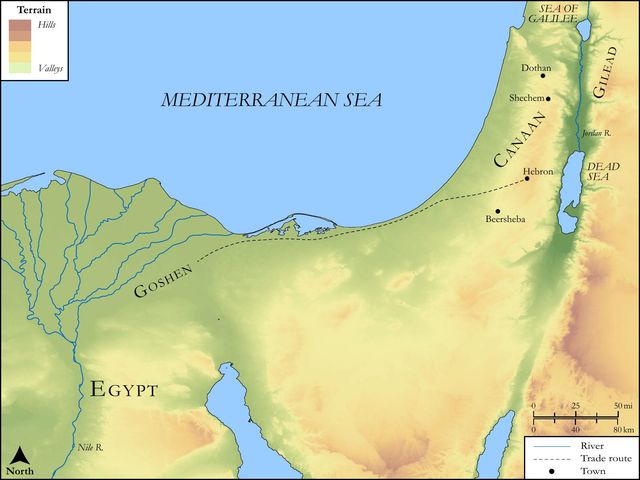
See on the biblical-era maps


Study this verse
Public-domain commentary
Matthew Henry
From his Commentary on the Whole Bible. Henry comments on passages, not single verses — this entry covers Genesis 42:1–6. His two-level outline is real structure in the source text, so it is rendered as structure.
Though Jacob's sons were all married, and had families of their own, yet, it should seem, they were still incorporated in one society, under the conduct and presidency of their father Jacob. We have here,
I.The orders he gave them to go and buy corn in Egypt, Gen 42:1, Gen 42:2. Observe,
1.The famine was grievous in the land of Canaan. It is observable that all the three patriarches, to whom Canaan was the land of promise, met with famine in that land, which was not only to try their faith, whether they could trust God though he should slay them, though he should starve them, but to teach them to seek the better country, that is, the heavenly, Heb 11:14-16. We have need of something to wean us from this world, and make us long for a better.
2.Still, when there was famine in Canaan, there was corn in Egypt. Thus Providence orders it, that one place should be a succour and supply to another; for we are all brethren. The Egyptians, the seed of accursed Ham, have plenty, when God's blessed Israel want: Thus God, in dispensing common favours, often crosses hands. Yet observe, The plenty Egypt now had was owing, under God, to Joseph's prudence and care: if his brethren had not sold him into Egypt, but respected him according to his merits, who knows but he might have done the same thing for Jacob's family which now he had done for Pharaoh, and the Egyptians might then have come to them to buy corn? but those who drive away from among them wise and good men know not what they do.
3.Jacob saw that there was corn in Egypt; he saw the corn that his neighbours had bought there and brought home. It is a spur to exertion to see where supplies are to be had, and to see others supplied. Shall others get food for their souls, and shall we starve while it is to be had?
4.He reproved his sons for delaying to provide corn for their families. Why do you look one upon another? Note, When we are in trouble and want, it is folly for us to stand looking upon one another, that is, to stand desponding and despairing, as if there were no hope, no help, - to stand disputing either which shall have the honour of going first or which shall have the safety of coming last, - to stand deliberating and debating what we shall do, and doing nothing, - to stand dreaming under a spirit of slumber, as if we had nothing to do, and to stand delaying, as if we had time at command. Let it never be said, "We left that to be done tomorrow which we could a well have done today." 5. He quickened them to go to Egypt: Get you down thither. Masters of families must not only pray for daily bread for their families, and food convenient, but must lay out themselves with care and industry to provide it.
II.Their obedience to these orders, Gen 42:3.
They went down to buy corn; they did not send their servants, but very prudently went themselves, to lay out their own money. Let none think themselves too great nor too good to take pains. Masters of families should see with their own eyes, and take heed of leaving too much to servants. Only Benjamin went not with them, for he was his father's darling. To Egypt they came, among others, and, having a considerable cargo of corn to buy, they were brought before Joseph himself, who probably expected they would come; and, according to the laws of courtesy, they bowed down themselves before him, Gen 42:6. Now their empty sheaves did obeisance to his full one. Compare this with Isa 60:14 and Rev 3:9.
Historical interpretation
Historical reception
1 surviving comment on this verse from the historical church.
And Jacob said to his sons, “Why are you idle? Behold, I have heard that there is grain in Egypt. Go down there and buy food for us.” This is not something Jacob said one time; he says it daily to his sons who come to Christ’s grace too late, “Why are you idle? Behold, I have heard that there is grain in Egypt.” From this grain there comes the grain that rises again. And so whoever suffers famine ought to attribute it to his own laziness. “Behold, I have heard that there is grain in Egypt.” Generally, indeed, younger men hear of something more quickly than their elders, for many of the former travel about and are engaged out of doors. But an old man is the first to hear of this business matter, yet an old man who has lived to a great age in faith, an old man whose old age is worthy of respect, and the time of his old age is a spotless life.
Continue studying Genesis 42:1 across the web’s major study libraries — every link below opens this exact verse, chapter, or book on the destination site.
Read & Compare
 BibleGatewayThis verse in more than 200 translations and 70 languages.
 Bible.comThe YouVersion reader — hundreds of translations, reading plans, and highlights.
 ESV.orgCrossway's official English Standard Version reader.
 NET BibleThe NET translation with 60,000+ translators' notes on every rendering decision.
 STEP BibleTyndale House's free study tool — original text, vocabulary, and scholarly resources.
 BibliaLogos Bible Software's free web reader.
 USCCBThe New American Bible (Revised Edition) with the U.S. bishops' study notes.
Commentaries
 BibleHub CommentariesDozens of classic commentaries on this verse, gathered on one page.
 StudyLightMore than 100 commentary sets — the largest collection on the web.
 BibleRefPlain-English commentary on what this verse means, verse by verse.
 Enduring WordDavid Guzik's free commentary on this chapter, widely used by Bible teachers.
 Bible Study ToolsVerse commentary alongside Greek and Hebrew study aids.
Original Language & Research
- BibleHub InterlinearThe verse word by word — original language, transliteration, and English.
- BibleHub LexiconEvery word's original-language definition and Strong's entry.
 Blue Letter BibleDeep-study tools — Strong's numbers, concordance, and word studies.
 SefariaThe Hebrew text with Rashi and centuries of Jewish commentary.
Sermons, Hymns & Audio


TrulyRandomVerse is not affiliated with these sites and doesn’t control their content. They’re linked because they’re genuinely useful.
Summary
Genesis 42:1 opens a pivotal chapter in the patriarchal narrative, revealing Jacob's family in Canaan facing a severe famine while news of available grain in Egypt reaches them. Jacob, observing his sons' passive despair, challenges their inaction and commands them to journey to Egypt for sustenance, thereby initiating the divinely orchestrated reunion with Joseph and the preservation of God's chosen lineage.
Context
ShowHideLiterary Context
This verse immediately follows the detailed account of Joseph's rise to power in Egypt and his divinely inspired administration of the seven years of plenty and the subsequent onset of the global famine (see Genesis 41). The narrative shifts from Joseph's administrative success to the plight of his family, setting the stage for the dramatic and long-awaited reunion. Jacob's family, unaware that Joseph is alive and in power, is now directly impacted by the very famine Joseph prepared for. This verse serves as the narrative catalyst, propelling Jacob's sons into the situation that will inevitably lead them to their brother and fulfill the dreams Joseph had decades earlier (see Genesis 37:5-11).
Historical & Cultural Context
Canaan and Egypt were highly susceptible to famine due to reliance on seasonal rains and river floods (like the Nile). A "severe" famine, as described in Genesis 41:56, would have been catastrophic, leading to widespread starvation and forced migration in search of food. Egypt, with its unique Nile-fed agriculture and Joseph's strategic grain storage, became the sole beacon of hope for survival in the region. Patriarchal families, like Jacob's, were large, extended households, and the patriarch (Jacob) held ultimate authority and responsibility for the family's welfare and survival. His sons' inaction in the face of such a crisis would have been seen as a dereliction of their duty.
Key Themes
ShowHideGenesis 42:1 contributes significantly to several overarching themes in the book of Genesis. It highlights Divine Providence, demonstrating how God orchestrates seemingly unrelated events—Joseph's enslavement and rise, the famine, and Jacob's command—to fulfill His covenant promises (see Genesis 12:1-3). The verse also underscores the theme of Human Responsibility within God's Plan, as Jacob's initiative is a necessary human response to the crisis, even as God's sovereign hand guides the entire process. Furthermore, it sets up the theme of Reconciliation and Forgiveness that will unfold as Joseph's brothers are brought low and confronted with their past actions (see Genesis 45:1-15).
Exposition and Analysis
ShowHideKey Word Analysis
ShowHideFrom the root meaning "heel-catcher" or "supplanter," this name signifies the patriarch who wrestled with God and man, and whose name was changed to Israel (see Genesis 32:28). Here, he is depicted in his role as the head of the family, discerning the dire situation and taking decisive action for his household's survival.
This primitive root means "to see," encompassing literal observation, figurative perception, and even discernment. In this context, Jacob's "seeing" is not merely visual but implies a clear understanding and recognition of the critical reality—the presence of grain in Egypt versus the famine in Canaan—which prompts his subsequent action and rebuke.
This term refers to "grain" or "victuals" (provisions), specifically broken kernels or produce. In the KJV, "corn" is a general term for cereal grains like wheat or barley, not modern maize. Jacob's observation of "corn" in Egypt means he recognized a reliable source of sustenance, a stark contrast to the scarcity his family was enduring.
Verse Breakdown
ShowHide"Now when Jacob saw that there was corn in Egypt"
This opening clause immediately establishes the setting and the core problem. Jacob, the patriarch, is acutely aware of the widespread famine affecting his region. Crucially, he also possesses the vital information that Egypt, under Joseph's wise administration, has an abundance of "corn" (grain). His perception is the catalyst for the entire subsequent narrative, highlighting the contrast between the dire local conditions and the distant hope of provision.
"Jacob said unto his sons"
This phrase marks Jacob's direct address to his ten elder sons, who are present and seemingly inactive. As the head of the household, his word carries authority and initiates the necessary course of action. It underscores his role as the leader responsible for the family's welfare, even in their advanced age.
"Why do ye look one upon another?"
This rhetorical question is a sharp rebuke from Jacob. The Hebrew phrase lammah titra'u (לָמָּה תִּתְרָאוּ) implies a sense of mutual helplessness, passive staring, or even a silent, unproductive exchange of glances in the face of crisis. Jacob is expressing his exasperation with their inertia and lack of initiative. He is challenging them to move beyond passive despair and take practical, decisive action to secure food for the family.
Literary Devices
ShowHideThe verse employs several significant Literary Devices. The most prominent is the Rhetorical Question, "Why do ye look one upon another?" Jacob's question is not seeking information but rather serves as a sharp rebuke, designed to provoke action and shame his sons out of their passive despair. It highlights their inertia in contrast to the pressing need. There is also a subtle Irony at play: the sons are staring helplessly at each other, unaware that the very source of their salvation—their long-lost brother Joseph—is in the land where they must go. Furthermore, the verse functions as a narrative Catalyst, initiating the journey to Egypt that will lead to the dramatic reunion and the unfolding of God's overarching plan for the preservation of Israel.
Theological and Thematic Connections
ShowHideGenesis 42:1 powerfully illustrates God's meticulous Divine Providence, even through human inaction and exasperation. The famine, a natural disaster, becomes a divinely appointed mechanism to move Jacob's family into Egypt, where they will be preserved and grow into a great nation, fulfilling the covenant promises made to Abraham, Isaac, and Jacob. Jacob's observation and subsequent command, while seemingly a pragmatic response to a crisis, are integral steps within God's larger, sovereign plan, demonstrating that human responsibility and divine orchestration work in concert.
Reflection and Application
ShowHideIn our own lives, facing overwhelming circumstances can often lead to paralysis, much like Jacob's sons "looking one upon another." This verse serves as a potent reminder that while we trust in God's sovereign provision, we are also called to active, Spirit-led initiative. We are not to be passive observers of our difficulties but proactive seekers of God-ordained solutions. Jacob's rebuke challenges us to move beyond despair, blame, or inaction, and to engage with our circumstances with wisdom and courage. It encourages us to discern where God might be providing "corn" in our "Egypts"—unexpected resources, opportunities, or guidance—and to step out in faith and obedience, even when the path is uncertain. This proactive stance, rooted in trust, allows us to participate in God's unfolding plan for our lives and for the world around us.
Questions for Reflection
ShowHideFAQ
ShowHideWhat does "corn" mean in Genesis 42:1?
ShowHideIn the King James Version, "corn" is an archaic term referring broadly to grain, such as wheat or barley, which were staple crops in Canaan and Egypt. It does not refer to maize (what modern English speakers typically call "corn"), which originated in the Americas and was unknown in that region at the time. The Hebrew word used is sheber (שֶׁבֶר), meaning "grain" or "victuals." Jacob's observation that there was "corn in Egypt" meant there was a supply of food available there.
Why did Jacob's sons "look one upon another"?
ShowHideJacob's rhetorical question, "Why do ye look one upon another?" (Hebrew: lammah titra'u), conveys a sense of mutual helplessness, idleness, or even a silent, unproductive exchange of glances in the face of the severe famine. It expresses Jacob's exasperation with their passive despair and lack of initiative. He was urging them to cease their unproductive staring and instead consider a practical course of action to find food, which was readily available in Egypt.
Does Jacob's question imply a lack of faith?
ShowHideJacob's question is primarily an expression of practical leadership and a call to action rather than a sign of a lack of faith. While he undoubtedly relied on God's providence, he also understood the necessity of human effort and initiative in response to a crisis. His question challenges his sons' inertia, prompting them to take the necessary steps to secure food, which ultimately aligns with God's larger plan to preserve his family and bring them into Egypt. It highlights the biblical principle that faith often requires corresponding action.
Christ-Centered Fulfillment
ShowHideGenesis 42:1, though a scene of earthly need and human response, subtly foreshadows the ultimate provision found in Christ. Joseph, the one who stored up grain and became the savior of his family and the nations, stands as a profound type of Christ, who is the true "bread of life" (as declared in John 6:35), offering eternal sustenance to a spiritually famished world. Just as Jacob's sons had to journey to Egypt to receive physical nourishment from Joseph, humanity must come to Christ to receive spiritual life and salvation. The entire narrative of Jacob's family being preserved and brought to Egypt, a place of refuge and growth, ultimately points to God's meticulous plan to preserve the lineage through which the Messiah would come (see Matthew 1:1-17), ensuring that the promised Redeemer would be born to bring everlasting provision and deliverance to all who believe (as seen in John 3:16).