


Joshua 7:10
Bible text: King James Version (1769 Blayney text) · Public domain
Bible text: Berean Standard Bible · Public domain
Bible text: American Standard Version (1901) · Public domain
Bible text: World English Bible, Messianic edition · Public domain
Bible text: Geneva Bible (1599) · Public domain
Bible text: Young's Literal Translation · Public domain
- וַיֹּאמֶרvai·Yo·merand he saidH559Conj-w ¦ V-Qal-ConsecImperf-3msVerb Qal Consecutive Imperfect 3rd Singular Masculineוַandיֹּאמֶרhe said
- יְהוָהYah·wehYahwehH3068N-properNoun Proper Title
- אֶל'eltoH413PrepPreposition
- יְהוֹשֻׁעַye·ho·Shu·a'JoshuaH3091N-proper-mNoun Proper Masculine
- קֻםkumstand upH6965V-Qal-Imp-2msVerb Qal Imperative 2nd Singular Masculine
- לָךְLakhfor <the> yourselfPrep-l ¦ 2msSuffix Personal 2nd Singular Masculineלָfor <the>ךְyourself
- לָמָּהLa·mah<to> why?H4100Prep-l ¦ InterrogPronoun Interrogativeלָ<to>מָּהwhy?
- זֶּהZehthisH2088PrtParticle Demonstrative
- אַתָּה'a·Tah[are] youH859Pro-2msPronoun Personal 2nd Singular Masculine
- נֹפֵלno·FelfallingH5307V-Qal-Prtcpl-msVerb Qal Participle Singular Masculine Absolute
- עַל'alonH5921PrepPreposition
- פָּנֶיךָpa·Nei·khayour faceH6440N-mpc ¦ 2msNoun Plural Masculine Constructפָּנֶיfaceךָyour
English is a literal word-by-word gloss of the Hebrew, not the KJV's wording. Why?
This is the original text the KJV's translators worked from — each Hebrew word with its own literal English meaning in this verse, prepared by scholars at Tyndale House, Cambridge. The KJV translates whole sentences, not word by word, so its wording differs: one Hebrew word can become several English words, and the KJV may choose “the LORD” where the gloss reads “Yahweh”. Both are faithful — they answer different questions. For the KJV's own rendering, switch to the KJV text.
Details
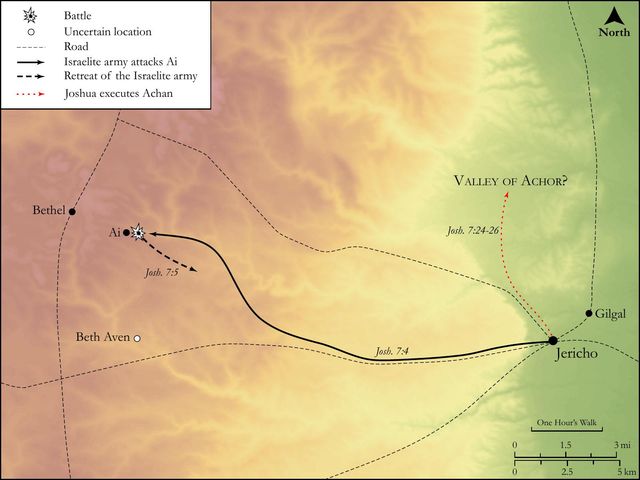
See on the biblical-era map
Study this verse
Public-domain commentary
Matthew Henry
From his Commentary on the Whole Bible. Henry comments on passages, not single verses — this entry covers Joshua 7:10–15. His three-level outline is real structure in the source text, so it is rendered as structure.
We have here God's answer to Joshua's address, which, we may suppose, came from the oracle over the ark, before which Joshua had prostrated himself, v. 6. Those that desire to know the will of God must attend with their desires upon the lively oracles, and wait at wisdom's gates for wisdom's dictates, Pro 8:34. And let those that find themselves under the tokens of God's displeasure never complain of him, but complain to him, and they shall receive an answer of peace. The answer came immediately, while he was yet speaking (Isa 65:24), as that to Daniel, Dan 9:20, etc.
I.God encourages Joshua against his present despondencies, and the black and melancholy apprehensions he had of the present posture of Israel's affairs (Jos 7:10): "Get thee up, suffer not thy spirits to droop and sink thus; wherefore liest thou thus upon thy face?" No doubt Joshua did well to humble himself before God, and mourn as he did, under the tokens of his displeasure; but now God told him it was enough, he would not have him continue any longer in that melancholy posture, for God delights not in the grief of penitents when they afflict their souls further than as it qualifies them for pardon and peace; the days even of that mourning must be ended. Arise, shake thyself from the dust, Isa 53:2. Joshua continued his mourning till eventide (Jos 7:6), so late that they could do nothing that night towards the discovery of the criminal, but were forced to put it off till next morning. Daniel (Dan 9:21), and Ezra (Ezr 9:5, Ezr 9:6), continued their mourning only till the time of the evening sacrifice; that revived them both: but Joshua went past that time, and therefore is thus roused: "Get thee up, do not lie all night there." Yet we find that Moses fell down before the Lord forty days and forty nights, to make intercession for Israel, Deu 9:18. Joshua must get up because he has other work to do than to lie there; the accursed thing must be discovered and cast out, and the sooner the better; Joshua is the man that must do it, and therefore it is time for him to lay aside his mourning weeds, and put on his judge's robes, and clothe himself with zeal as a cloak. Weeping must not hinder sowing, nor one duty of religion jostle out another. Every thing is beautiful in its season. Shechaniah perhaps had an eye to this in what he said to Ezra upon a like occasion. See Ezr 10:2-4.
II.He informs him of the true and only cause of this disaster, and shows him wherefore he contended with them (Jos 7:11):
Israel hath sinned. "Think not that God's mind is changed, his arm shortened, or his promise about to fail; no, it is sin, it is sin, that great mischief-maker, that has stopped the current of divine favours and has made this breach upon you." The sinner is not named, though the sin is described, but it is spoken of as the act of Israel in general, till they have fastened it upon the particular person, and their godly sorrow have so wrought a clearing of themselves, as theirs did, Co2 7:11. Observe how the sin is here made to appear exceedingly sinful.
1.They have transgressed my covenant, an express precept with a penalty annexed to it. It was agreed that God should have all the spoil of Jericho, and they should have the spoil of the rest of the cities of Canaan; but, in robbing God of his part, they transgressed this covenant.
2.They have even taken of the devoted thing, in contempt of the curse which was so solemnly denounced against him that should dare to break in upon God's property, as if that curse had nothing in it formidable.
3.They have also stolen; they did it clandestinely, as if they could conceal it from the divine omniscience, and they were ready to say, The Lord shall not see, or will not miss so small a matter out of so great a spoil. Thus thou thoughtest I was altogether such a one as thyself.
4.They have dissembled also. Probably, when the action was over, Joshua called all the tribes, and asked them whether they had faithfully disposed of the spoil according to the divine command, and charged them, if they knew of any transgression, that they should discover it, but Achan joined with the rest in a general protestation of innocency, and kept his countenance, like the adulterous woman that eats and wipes her mouth, and says, I have done no wickedness. Nay,
5.They have put the accursed thing among their own goods, as if they had as good a title to that as to any thing they have, never expecting to be called to an account, nor designing to make restitution. All this Joshua, though a wise and vigilant ruler, knew nothing of, till God told him, who knows all the secret wickedness that is in the world, which men know nothing of God could at this time have told him who the person was that had done this thing, but he does not,
(1.)To exercise the zeal of Joshua and Israel, in searching out the criminal.
(2.)To give the sinner himself space to repent and make confession. Joshua no doubt proclaimed it immediately throughout the camp that there was such a transgression committed, upon which, if Achan had surrendered himself, and penitently owned his guilt, and prevented the scrutiny, who knows but he might have had the benefit of that law which accepted of a trespass-offering, with restitution, from those that had sinned through ignorance in the holy things of the law? Lev 5:15, Lev 5:16. But Achan never discovering himself till the lot discovered him evidenced the hardness of his heart, and therefore he found no mercy.
III.He awakens him to enquire further into it, by telling him,
1.That this was the only ground for the controversy God had with them, this, and nothing else; so that when this accursed thing was put away he needed not fear, all would be well, the stream of their successes, when this one obstruction was removed, would run as strong as ever.
2.That if this accursed thing were not destroyed they could not expect the return of God's gracious presence; in plain terms, neither will I be with you any more as I have been, except you destroy the accursed, that is, the accursed person, who is made so by the accursed thing. That which is accursed will be destroyed; and those whom God has entrusted to bear the sword bear it in vain if they make it not a terror to that wickedness which brings these judgments of God on a land. By personal repentance and reformation, we destroy the accursed thing in our own hearts, and, unless we do this, we must never expect the favour of the blessed God. Let all men know that it is nothing but sin that separates between them and God, and, if it be not sincerely repented of and forsaken, it will separate eternally.
IV.He directs him in what method to make this enquiry and prosecution.
1.He must sanctify the people, now over-night, that is, as it is explained, he must command them to sanctify themselves, Jos 7:13. And what can either magistrates or ministers do more towards sanctification? They must put themselves into a suitable frame to appear before God and submit to the divine scrutiny, must examine themselves, now that God was coming to examine them, must prepare to meet their God. They were called to sanctify themselves when they were to receive the divine law (Ex. 19), and now also when they were to come under the divine judgment; for in both God is to be attended with the utmost reverence. "There is an accursed thing in the midst of you, and therefore sanctify yourselves," that is, Let all that are innocent be able to clear themselves, and be the more careful to cleanse themselves. The sin of others may be improved by us as furtherances of our sanctification, as the scandal of the incestuous Corinthian occasioned a blessed reformation in that church, Co2 7:11.
2.He must bring them all under the scrutiny of the lot (Jos 7:14); the tribe which the guilty person was of should first be discovered by lot, then the family, then the household, and last of all the person. The conviction came upon him thus gradually that he might have some space given him to come in and surrender himself; for God is not willing that any should perish, but that all should come to repentance. Observe, The Lord is said to take the tribe, and family, and household, on which the lot fell, because the disposal of the lot is of the Lord, and, however casual it seems, is under the direction of infinite wisdom and justice; and to show that when the sin of sinners finds them out God is to be acknowledged in it; it is he that seizes them, and the arrests are in his name. God hath found out the iniquity of thy servants, Gen 44:16. It is also intimated with what a certain and unerring judgment the righteous God does and will distinguish between the innocent and the guilty, so that though for a time they seem involved in the same condemnation, as the whole tribe did when it was first taken by the lot, yet he who has his fan in his hand will effectually provide for the taking out of the precious from the vile; so that though the righteous be of the same tribe, and family, and household, with the wicked, yet they shall never be treated as the wicked, Gen 18:25.
3.When the criminal was found out he must be put to death without mercy (Heb 10:28), and with all the expressions of a holy detestation, Jos 7:15. He and all that he has must be burnt with fire, that there might be no remainders of the accursed thing among them; and the reason given for this severe sentence is because the criminal has,
(1.)Given a great affront to God: He has transgressed the covenant of the Lord, who is jealous particularly for the honour of the holy covenant.
(2.)He has done a great injury to the church of God: He has wrought folly in Israel, has shamed that nation which is looked upon by all its neighbours to be a wise and understanding people, has infected that nation which is sanctified to God, and troubled that nation of which he is the protector. These being crimes so heinous in their nature, and of such pernicious consequence and example, the execution, which otherwise would have come under the imputation of cruelty, is to be applauded as a piece of necessary justice. It was sacrilege; it was invading God's rights, alienating his property, and converting to a private use that which was devoted to his glory and appropriated to the service of his sanctuary - this was the crime to be thus severely punished, for warning to all people in all ages to take heed how they rob God.
Continue studying Joshua 7:10 across the web’s major study libraries — every link below opens this exact verse, chapter, or book on the destination site.
Read & Compare
 BibleGatewayThis verse in more than 200 translations and 70 languages.
 Bible.comThe YouVersion reader — hundreds of translations, reading plans, and highlights.
 ESV.orgCrossway's official English Standard Version reader.
 NET BibleThe NET translation with 60,000+ translators' notes on every rendering decision.
 STEP BibleTyndale House's free study tool — original text, vocabulary, and scholarly resources.
 BibliaLogos Bible Software's free web reader.
 USCCBThe New American Bible (Revised Edition) with the U.S. bishops' study notes.
Commentaries
 BibleHub CommentariesDozens of classic commentaries on this verse, gathered on one page.
 StudyLightMore than 100 commentary sets — the largest collection on the web.
 BibleRefPlain-English commentary on what this verse means, verse by verse.
 Enduring WordDavid Guzik's free commentary on this chapter, widely used by Bible teachers.
 Bible Study ToolsVerse commentary alongside Greek and Hebrew study aids.
Original Language & Research
- BibleHub InterlinearThe verse word by word — original language, transliteration, and English.
- BibleHub LexiconEvery word's original-language definition and Strong's entry.
 Blue Letter BibleDeep-study tools — Strong's numbers, concordance, and word studies.
 SefariaThe Hebrew text with Rashi and centuries of Jewish commentary.
Sermons, Hymns & Audio


TrulyRandomVerse is not affiliated with these sites and doesn’t control their content. They’re linked because they’re genuinely useful.
Summary
Joshua 7:10 marks a critical turning point in Israel's post-Jericho campaign, as the LORD abruptly confronts Joshua, who is prostrate in despair after the humiliating defeat at Ai. God's sharp command, "Get thee up," coupled with the rhetorical question, "wherefore liest thou thus upon thy face?", serves as a divine jolt, revealing that Israel's setback was not due to a lack of divine power but to unaddressed sin within the camp. This verse pivots the narrative from passive lamentation to urgent action, underscoring God's demand for corporate holiness and His expectation that leaders will actively confront and purge sin to restore His favor and enable future victories.
Context
ShowHideLiterary Context
Joshua 7:10 is a pivotal moment following a significant reversal for Israel. Chapter 6 recounts the miraculous and decisive victory at Jericho, where God's power was undeniably displayed. This triumph was meant to instill faith and obedience. However, chapter 7 immediately plunges the nation into crisis with an unexpected and humiliating defeat at Ai, resulting in the loss of thirty-six men (Joshua 7:5). This defeat sends Joshua and the elders into deep despair, leading them to tear their clothes, put dust on their heads, and lie prostrate before the Ark of the Covenant, lamenting their fate and expressing profound concern for God's reputation among the surrounding nations (Joshua 7:6-9). God's direct address in verse 10 is an abrupt interruption of Joshua's lament, signaling that the time for mourning has ended and the moment for decisive action has arrived. It shifts the narrative focus from human despair to divine revelation and the subsequent necessity of corporate purification, setting the stage for the discovery of Achan's sin.
Historical & Cultural Context
The Israelites were engaged in the divinely ordained conquest of Canaan, a land promised to them by God. This period was characterized by intense military and spiritual warfare, where military success was directly tied to divine favor and obedience to the covenant. The defeat at Ai was not merely a tactical failure but a profound theological crisis, threatening to undermine the entire conquest and Israel's identity as God's chosen people. Among the nations round about, military outcomes were frequently interpreted as indicators of a deity's power or disfavor. Joshua's anguished plea concerning God's "great name" (Joshua 7:9) reflects this cultural understanding of divine reputation. The posture of prostration ("upon thy face") was a common expression of humility, supplication, and deep mourning when approaching a deity or a superior. However, in this specific instance, God perceives it as a posture of unproductive despair rather than active seeking of His will. This episode also powerfully illustrates the corporate nature of sin and blessing in ancient Israel, where the transgression of one individual (Achan) could bring judgment upon the entire community, necessitating a corporate response.
Key Themes
ShowHideJoshua 7:10 is central to several profound themes within the book of Joshua and the broader Old Testament. It powerfully highlights the theme of Divine Sovereignty and Holiness, demonstrating that God is actively involved in the affairs of His people and that His power is not diminished, but His blessing is contingent upon Israel's spiritual purity. The defeat underscores the critical importance of Obedience as a Prerequisite for Blessing, showing that God's covenant promises are conditional upon Israel's faithfulness, and disobedience inevitably leads to divine discipline. Furthermore, the verse emphasizes Corporate Responsibility, illustrating that the actions of an individual can have far-reaching consequences for the entire community, demanding corporate confession and purification. Finally, it strongly features Leadership Accountability, as God directly challenges Joshua, the chosen leader, to rise from his despair and take decisive action to identify and remove the sin. This underscores the leader's crucial role in maintaining the spiritual integrity and obedience of the people, preparing the ground for the subsequent narrative of Achan's discovery and punishment in Joshua 7:16-26.
Exposition and Analysis
ShowHideKey Word Analysis
ShowHideFrom the verb "to be," this is the covenant name of God, Jehovah or Yahweh, signifying His self-existent and eternal nature. In this context, the use of this specific name underscores God's personal involvement and His covenant relationship with Israel, emphasizing that it is the sovereign, faithful God who is speaking directly to Joshua, not merely a distant deity. His address carries ultimate authority and covenantal weight.
This is a powerful and direct imperative, meaning "to rise," "to stand up," or "to establish." While a literal command to change physical posture, its deeper implication here is a call to action, to cease from passive despair and to engage decisively with the problem. It signifies a divine summons to shift from a state of lamentation and inactivity to one of strategic readiness, spiritual resolve, and proactive investigation. God is not offering solace but a sharp, urgent directive to move from grief to governance.
This phrase describes the posture of prostration, literally "to fall upon one's face." While often a posture of humble worship, supplication, or deep mourning (as Joshua himself adopted in Joshua 7:6), in God's rhetorical question, it takes on a negative connotation of unproductive despair and inaction. God is not rebuking the act of prayer or humility itself, but the prolonged and unhelpful nature of this posture when a specific, identifiable problem requires immediate and decisive resolution. It highlights the inefficacy of continued lament when the solution lies in active obedience and the removal of sin.
Verse Breakdown
ShowHide"And the LORD said unto Joshua,"
This opening clause immediately establishes the divine authority and directness of the message. It signifies a personal, unmediated communication from Yahweh, the covenant God, to His chosen leader. This highlights God's active engagement with Israel's affairs and His direct oversight of their spiritual and military well-being, emphasizing that the instruction comes from the ultimate source of truth and power.
"Get thee up;"
This is God's initial, sharp, and authoritative imperative. It is a command to cease the current posture of prostration and despair. It functions as a divine summons to immediate action, urging Joshua to abandon his lament and adopt a posture of readiness, responsibility, and spiritual resolve. It clearly communicates that the time for mourning is over, and the time for decisive intervention and investigation has arrived.
"wherefore liest thou thus upon thy face?"
This is a potent rhetorical question, not posed to gain information but to express divine impatience, rebuke, and a direct challenge to Joshua's current state. God already knows the reason for Israel's defeat (Achan's sin), and this question implies that Joshua should be actively seeking the cause rather than merely lamenting the effect. It serves to jolt Joshua out of his despair and redirect his focus towards discernment, investigation, and decisive action, highlighting that his current posture is unproductive and inappropriate given the circumstances that demand immediate resolution.
Literary Devices
ShowHideJoshua 7:10 employs several powerful Literary Devices to convey its urgent message. The most prominent is the Rhetorical Question, "wherefore liest thou thus upon thy face?" This is not a genuine inquiry but a forceful statement of divine disapproval, designed to provoke Joshua into self-reflection and decisive action. It starkly highlights the incongruity of Joshua's passive despair in the face of a problem that demands active resolution. The verse also features strong Imperative language, specifically "Get thee up," which is a direct, authoritative command from God. This imperative underscores God's absolute sovereignty and His expectation of immediate obedience and decisive action from His chosen leader. Furthermore, the scene presents a form of Anthropomorphism, as God is depicted speaking directly to Joshua, expressing what appears to be impatience or frustration with his inaction. This human-like quality in God's communication makes the divine rebuke more immediate, relatable, and impactful for the human recipient, emphasizing the personal nature of God's interaction with His people.
Theological and Thematic Connections
ShowHideJoshua 7:10 profoundly illustrates that God is not indifferent to the struggles of His people, but He also expects them to move beyond passive despair to active obedience and accountability when sin is present. The defeat at Ai was not a sign of God's weakness or abandonment, but a direct consequence of Israel's unfaithfulness. God's sharp rebuke to Joshua underscores the timeless principle that divine blessing and victory are contingent upon corporate holiness and obedience. When setbacks or spiritual stagnation occur, the primary response should be to seek God's face, not merely in lament, but in diligent inquiry to uncover any hidden sin that might be hindering His favor. This passage serves as a potent reminder that while prayer and mourning are essential, there are moments when God calls His people, especially their leaders, to rise, investigate, and decisively address the root causes of spiritual defeat, trusting that He will reveal what needs to be purged.
Reflection and Application
ShowHideJoshua 7:10 offers a profound and challenging spiritual lesson for believers and leaders across all generations. While it is entirely natural and often necessary to grieve, lament, and express sorrow in times of trouble, defeat, or spiritual setback, this verse teaches that there comes a critical point where prolonged despair becomes unproductive and even disobedient in the face of a clear divine directive. God's piercing question to Joshua challenges us to move beyond a passive posture of lament to an active posture of inquiry, discernment, and resolute action. When we encounter setbacks in our personal lives, families, churches, or ministries, this passage urges us to humbly and diligently consider if there is unconfessed sin, unaddressed disobedience, or a lack of corporate holiness that might be hindering God's blessing and presence. It calls us to courageous self-examination and decisive action, trusting that God will reveal the cause if we earnestly seek Him and are prepared to obey His directives, no matter how challenging or uncomfortable. True spiritual leadership, as exemplified by God's charge to Joshua, involves not only fervent intercession but also the difficult, often painful, work of confronting sin, promoting repentance, and leading the community back to purity and wholehearted obedience to God's commands.
Questions for Reflection
ShowHideFAQ
ShowHideWhy did God rebuke Joshua instead of comforting him in his despair?
ShowHideGod's rebuke was not a rejection of Joshua's grief or a lack of compassion, but a crucial corrective intervention. Joshua's despair, while understandable given the devastating defeat, had become unproductive and was preventing him from addressing the true, spiritual cause of Israel's setback. God knew the defeat at Ai was not due to His diminished power or presence, but to unaddressed sin within the camp—specifically, Achan's transgression against the command regarding the devoted things (Joshua 7:1). Therefore, comfort would have been inappropriate and counterproductive in that moment. Instead, God's sharp command and rhetorical question served to jolt Joshua out of his lament and redirect his focus to the urgent task of identifying, confronting, and purging the sin. This highlights God's absolute priority for holiness and obedience over prolonged, passive mourning when decisive action is required. It was a call to leadership and responsibility, designed to restore the nation's spiritual integrity and enable future victories.
Does this verse mean that all setbacks are a result of personal or corporate sin?
ShowHideNot necessarily all setbacks, but Joshua 7:10 strongly suggests that when God's people experience unexpected defeat, a withdrawal of His blessing, or a hindrance to their progress, unaddressed sin should be a primary consideration for humble investigation. While the Bible teaches that some suffering is for purification, testing of faith, or to display God's glory (as seen in the case of the man born blind in John 9:1-3), this passage unequivocally demonstrates that unconfessed or unaddressed sin can indeed hinder God's favor and lead to negative consequences for individuals and communities. It encourages a posture of humble self-examination, corporate accountability, and diligent prayer, urging us to ask if there's anything in our lives or communities that is displeasing to God and needs to be dealt with. It's a call to spiritual discernment and repentance, not automatic self-condemnation for every difficulty.
Christ-Centered Fulfillment
ShowHideJoshua 7:10, with its divine rebuke and urgent call to action concerning the "accursed thing" in the camp, powerfully foreshadows the ultimate solution to humanity's pervasive sin problem found only in Jesus Christ. Just as God called Joshua to "get up" and deal with the defilement that hindered Israel's victory and separated them from divine favor, so too does the New Testament reveal that humanity's greatest defeat, spiritual death, and separation from God are fundamentally due to sin (Romans 3:23). However, unlike Achan's sin, which required a corporate purging and the death of the offender, Christ Himself became the "accursed thing" for us, taking upon Himself the full weight of God's righteous wrath against sin, bearing the curse that was due to humanity (Galatians 3:13). He did not merely lament our fallen state but actively intervened, rising from the dead to conquer sin, death, and the grave (Romans 6:9-10). Now, through His finished work, Christ calls His followers to "get up" from their spiritual slumber, from the despair of sin, and to actively participate in His kingdom work, living in the newness of life He provides (Ephesians 5:14). Through His sacrifice and resurrection, the ultimate "sin in the camp" of humanity has been definitively dealt with, allowing for true reconciliation with God, spiritual victory, and the empowerment to stand before God cleansed and righteous, no longer lying in despair but rising in the power of His resurrection (Romans 6:4) and walking in His light.