


Joshua 7:1
- וַיִּמְעֲלוּvai·yim·'a·Luand they acted unfaithfullyH4603Conj-w ¦ V-Qal-ConsecImperf-3mpVerb Qal Consecutive Imperfect 3rd Plural Masculineוַandיִּמְעֲלוּthey acted unfaithfully
- בְנֵיve·nei[the] people ofH1121N-mpcNoun Plural Masculine Construct
- יִשְׂרָאֵלYis·ra·'ElIsraelH3478N-properNoun Proper Location
- מַעַלMa·'alunfaithfulnessH4604N-msNoun Singular Masculine Absolute
- בַּחֵרֶםba·Che·remin the devoted thing[s]H2764Prep-b ¦ N-msNoun Singular Masculine Absoluteבַּin theחֵרֶםdevoted thing[s]
- וַיִּקַּחvai·yi·Kachand he tookH3947Conj-w ¦ V-Qal-ConsecImperf-3msVerb Qal Consecutive Imperfect 3rd Singular Masculineוַandיִּקַּחhe took
- עָכָן'a·KhanAchanH5912N-proper-mNoun Proper Masculine
- בֶּןben[the] son ofH1121N-mscNoun Singular Masculine Construct
- כַּרְמִיkar·MiCarmiH3756N-proper-mNoun Proper Masculine
- בֶןven[the] son ofH1121N-mscNoun Singular Masculine Construct
- זַבְדִּיzav·DiZabdiH2067N-proper-mNoun Proper Masculine
- בֶןven[the] son ofH1121N-mscNoun Singular Masculine Construct
- זֶרַחZe·rachZerahH2226N-proper-mNoun Proper Masculine
- לְמַטֵּהle·ma·Tehof [the] tribe ofH4294Prep-l ¦ N-mscNoun Singular Masculine Constructלְofמַטֵּה[the] tribe of
- יְהוּדָהye·hu·DahJudahH3063N-properNoun Proper Location
- מִןminsome ofH4480PrepPreposition
- הַחֵרֶםha·Che·remthe devoted thing[s]H2764Art ¦ N-msNoun Singular Masculine Absoluteהַtheחֵרֶםdevoted thing[s]
- וַיִּחַרvai·yi·charand it burnedH2734Conj-w ¦ V-Qal-ConsecImperf-3msVerb Qal Consecutive Imperfect 3rd Singular Masculineוַandיִּחַרit burned
- אַף'af[the] anger ofH639N-mscNoun Singular Masculine Construct
- יְהוָהYah·wehYahwehH3068N-properNoun Proper Title
- בִּבְנֵיbiv·Neion [the] people ofH1121Prep-b ¦ N-mpcNoun Plural Masculine Constructבִּonבְנֵי[the] people of
- יִשְׂרָאֵלYis·ra·'ElIsraelH3478N-properNoun Proper Location
English is a literal word-by-word gloss of the Hebrew, not the KJV's wording. Why?
This is the original text the KJV's translators worked from — each Hebrew word with its own literal English meaning in this verse, prepared by scholars at Tyndale House, Cambridge. The KJV translates whole sentences, not word by word, so its wording differs: one Hebrew word can become several English words, and the KJV may choose “the LORD” where the gloss reads “Yahweh”. Both are faithful — they answer different questions. For the KJV's own rendering, switch to the KJV text.
Details
See on the biblical-era map
Study this verse
Public-domain commentary
Matthew Henry
From his Commentary on the Whole Bible. Henry comments on passages, not single verses — this entry covers Joshua 7:1–5. His three-level outline is real structure in the source text, so it is rendered as structure.
The story of this chapter begins with a but. The Lord was with Joshua, and his fame was noised through all that country, so the foregoing chapter ends, and it left no room to doubt but that he would go on as he had begun conquering and to conquer. He did right, and observed his orders in every thing. But the children of Israel committed a trespass, and so set God against them; and then even Joshua's name and fame, his wisdom and courage, could do them no service. If we lose our God, we lose our friends, who cannot help us unless God be for us. Now here is,
I.Achan sinning, Jos 7:1.
Here is only a general mention made of the sin; we shall afterwards have a more particular account of it from his own mouth. The sin is here said to be taking of the accursed thing, in disobedience to the command and in defiance of the threatening, Jos 6:18. In the sacking of Jericho orders were given that they should neither spare any lives nor take any treasure to themselves; we read not of the breach of the former prohibition (there were none to whom they showed any mercy), but of the latter: compassion was put off and yielded to the law, but covetousness was indulged. The love of the world is that root of bitterness which of all others is most hardly rooted up. Yet the history of Achan is a plain intimation that he of all the thousands of Israel was the only delinquent in this matter. Had there been more in like manner guilty, no doubt we should have heard of it: and it is strange there were no more. The temptation was strong. It was easy to suggest what a pity it was that so many things of value should be burnt; to what purpose is this waste? In plundering cities, every man reckons himself entitled to what he can lay his hands on. It was easy to promise themselves secrecy and impunity. Yet by the grace of God such impressions were made upon the minds of the Israelites by the ordinances of God, circumcision and the passover, which they had lately been partakers of, and by the providences of God which had been concerning them, that they stood in awe of the divine precept and judgment, and generously denied themselves in obedience to their God. And yet, though it was a single person that sinned, the children of Israel are said to commit the trespass, because one of their body did it, and he was not as yet separated from them, nor disowned by them. They did it, that is, by what Achan did guilt was brought upon the whole society of which he was a member. This should be a warning to us to take heed of sin ourselves, lest by it many be defiled or disquieted (Heb 12:15), and to take heed of having fellowship with sinners, and of being in league with them, lest we share in their guilt. Many a careful tradesman has been broken by a careless partner. And it concerns us to watch over one another for the preventing of sin, because others' sins may redound to our damage.
II.The camp of Israel suffering for the same:
The anger of the Lord was kindled against Israel; he saw the offence, though they did not, and takes a course to make them see it; for one way or other, sooner or later, secret sins will be brought to light; and, if men enquire not after them, God will, and with his enquiries will awaken theirs. man a community is under guilt and wrath and is not aware of it till the fire breaks out: here it broke out quickly.
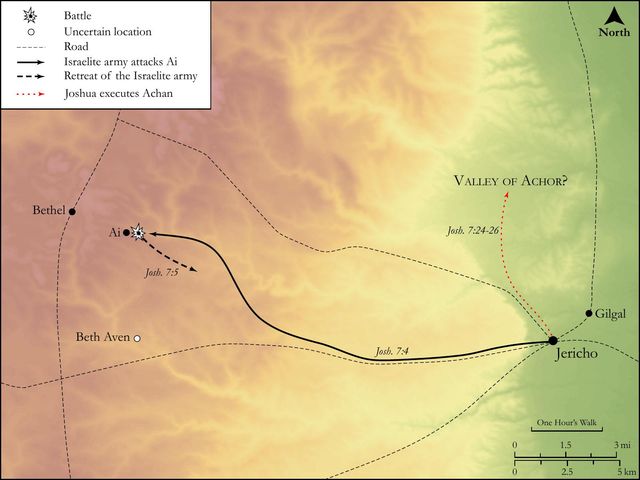
1.Joshua sends a detachment to seize upon the next city that was in their way, and that was Ai. Only 3000 men were sent, advice being brought him by his spies that the place was inconsiderable, and needed no greater force for the reduction of it, Jos 7:2, Jos 7:3. Now perhaps it was a culpable assurance, or security rather that led them to send so small a party on this expedition; it might also be an indulgence of the people in the love of ease, for they will not have all the people to labour thither. Perhaps the people were the less forward to go upon this expedition because they were denied the plunder of Jericho; and these spies were willing they should be gratified. Whereas when the town was to be taken, though God by his own power would throw down the walls, yet they must all labour thither and labour there too, in walking round it. It did not bode well at all that God's Israel began to think much of their labour, and contrived how to spare their pains. It is required that we work out our salvation, though it is God that works in us. It has likewise often proved of bad consequence to make too light of an enemy. They are but few (say the spies), but, as few as they were, they were too many for them. It will awaken our care and diligence in our Christian warfare to consider that we wrestle with principalities and powers.
2.The party he sent, in their first attack upon the town, were repulsed with some loss (Jos 7:4, Jos 7:5): They fled before the men of Ai, finding themselves unaccountably dispirited, and their enemies to sally out upon them with more vigour and resolution than they expected. In their retreat they had about thirty-six men cut off: no great loss indeed out of such a number, but a dreadful surprise to those who had no reason to expect any other in any attack than clear, cheap, and certain victory. And now, as it proves, it is well there were but 3000 that fell under this disgrace. Had the body of the army been there, they would have been no more able to keep their ground, now they were under guilt and wrath, than this small party, and to them the defeat would have been much more grievous and dishonourable. However, it was bad enough as it was, and served,
(1.)To humble God's Israel, and to teach them always to rejoice with trembling. Let not him that girdeth on the harness boast as he that putteth if off.
(2.)To harden the Canaanites, and to make them the more secure notwithstanding the terrors they had been struck with, that their ruin, when it came, might be the more dreadful.
(3.)To be an evidence of God's displeasure against Israel, and a call to them to purge out the old leaven. And this was principally intended in their defeat.
3.The retreat of this party in disorder put the whole camp of Israel into a fright: The hearts of the people melted, not so much for the loss as for the disappointment. Joshua had assured them that the living God would without fail drive out the Canaanites from before them, Jos 3:10. How can this event be reconciled to that promise? To every thinking man among them it appeared an indication of God's displeasure, and an omen of something worse, and therefore no marvel it put them into such a consternation; if God turn to be their enemy and fight against them, what will become of them? True Israelites tremble when God is angry.
Historical interpretation
Two Centuries of Reception
7 surviving comments on this verse. Each one is dated, so this reads as a timeline rather than a list.
Select a marker to jump to its quote. Markers stagger vertically where authors wrote within a few decades of each other.
But also we should not let it be passed over without comment that by one sinner wrath comes upon all the people.…But let us also see what sort of sin this person did. He stole, it says, “a tongue of gold” and placed it in his own tent.
I do not think so great a force of sin was in that theft of a little gold that it defiled the innumerable church of the Lord. But let us see if a deeper understanding does not reveal the enormity and severity of the sin. There is much elegance in words and much beauty in the discourses of philosophers and rhetoricians, who are all of the city of Jericho, that is, people of this world. If, therefore, you should find among the philosophers perverse doctrines beautified by the assertions of a splendid discourse, this is the “tongue of gold.” But beware that the splendor of the performance does not beguile you, that the beauty of the golden discourse not seize you. Remember that Jesus [Joshua] commanded all the gold found in Jericho to be anathema. If you read a poet with properly measured verses, weaving gods and goddesses in a very bright tune, do not be seduced by the sweetness of eloquence, for it is the “tongue of gold.” If you take it up and place it in your tent, if you introduce into your heart those things that are declared by the [poets and philosophers], then you will pollute the whole church of the Lord.
Look, did not Achan the son of Zerah dishonestly steal from the devoted things, and wrath came upon the whole people of Israel? And he alone sinned, but he was not the only one to die in his sin. Now to us, in the present circumstance every asset which does not belong to us but to someone else should be regarded as “the devoted things.” For he, Achan, took as spoil, and these men now have taken “as spoil”; but he took what belonged to the enemy, while these now have taken what belonged to their brothers, making for themselves a deadly profit.
"You shall not steal:" [Exodus 20:15] for Achan, when he had stolen in Israel at Jericho, was stoned to death; [Joshua 7:1] and Gehazi, who stole, and told a lie, inherited the leprosy of Naaman; [2 Kings 5:27] and Judas, who stole the poor's money, betrayed the Lord of glory to the Jews, [John 12:6] and repented, and hanged himself, and burst asunder in the midst, and all his bowels gushed out; [Matthew 27:5; Acts 1:18] and Ananias, and Sapphira his wife, who stole their own goods, and "tempted the Spirit of the Lord," were immediately, at the sentence of Peter our fellow-apostle, struck dead. [Acts 5:1-11]
Suppose any one should carefully examine all the communicants in the world, what kind of transgression is there which he would not detect? And what if he examined those in authority? Would he not find them eagerly bent upon gain? Making traffic of high places? Envious, malignant, vainglorious, gluttonous and slaves to money?Where then there is such impiety as this going on, what dreadful calamity must we not expect? And to be assured how severe vengeance they incur who are guilty of such sins as these, consider the examples of old. One single man, a common soldier, stole the sacred property, and all were struck. You know, doubtless, the history I mean? I am speaking of Achan the son of Carmi, the man who stole the consecrated spoil.…
On account of all these things, let us take heed to ourselves. Do you not see these wars? Do you not hear of these disasters? Do you learn no lesson from these things? Nations and whole cities are swallowed up and destroyed, and myriads as many again are enslaved to the barbarians.
If hell does not bring us to our senses, yet let these things. What, are these too mere threats, are they not facts that have already taken place? Great is the punishment they have suffered, yet a greater still shall we suffer, who are not brought to our senses even by their fate.
And Jericho had seen in her own ruin
Our hand’s control, when conquering Achan fell.
Renowned for bloodshed, proud of leveling walls,
He fell a victim to the enemy’s gold
When from the dust he gleaned the stuff accursed
And snatched the mournful plunder from the ruins.
His tribe did not avail, nor his descent
From Judah, founder of the race of Christ
And patriarch blessed in his noble scion.
Let those who imitate his race accept
A similar form of death and punishment.
And Jericho had seen in her own ruin
Our hand’s control, when conquering Achan fell.
Renowned for bloodshed, proud of leveling walls,
He fell a victim to the enemy’s gold
When from the dust he gleaned the stuff accursed
And snatched the mournful plunder from the ruins.
His tribe did not avail, nor his descent
From Judah, founder of the race of Christ
And patriarch blessed in his noble scion.
Let those who imitate his race accept
A similar form of death and punishment.
- "The Spiritual Combat 536.46"
You say these were the disgraceful acts of a few men and what was not done by all could not injure all. Indeed, I have said above quite often that the crime of one man was the destruction of many among the people of God, just as the people were ruined by Achan’s theft, just as pestilence arose from Saul’s jealousy, just as death came from the counting of the people by the holy David. The church of God is as the eye. As a speck of dirt, even though small, which falls into the eye blinds the sight completely, in the same way, if some, even though they are a few in the body of the church, commit filthy acts, they block almost all the light of the splendor of the church.
Continue studying Joshua 7:1 across the web’s major study libraries — every link below opens this exact verse, chapter, or book on the destination site.
Read & Compare
 BibleGatewayThis verse in more than 200 translations and 70 languages.
 Bible.comThe YouVersion reader — hundreds of translations, reading plans, and highlights.
 ESV.orgCrossway's official English Standard Version reader.
 NET BibleThe NET translation with 60,000+ translators' notes on every rendering decision.
 STEP BibleTyndale House's free study tool — original text, vocabulary, and scholarly resources.
 BibliaLogos Bible Software's free web reader.
 USCCBThe New American Bible (Revised Edition) with the U.S. bishops' study notes.
Commentaries
 BibleHub CommentariesDozens of classic commentaries on this verse, gathered on one page.
 StudyLightMore than 100 commentary sets — the largest collection on the web.
 BibleRefPlain-English commentary on what this verse means, verse by verse.
 Enduring WordDavid Guzik's free commentary on this chapter, widely used by Bible teachers.
 Bible Study ToolsVerse commentary alongside Greek and Hebrew study aids.
Original Language & Research
- BibleHub InterlinearThe verse word by word — original language, transliteration, and English.
- BibleHub LexiconEvery word's original-language definition and Strong's entry.
 Blue Letter BibleDeep-study tools — Strong's numbers, concordance, and word studies.
 SefariaThe Hebrew text with Rashi and centuries of Jewish commentary.
Sermons, Hymns & Audio


TrulyRandomVerse is not affiliated with these sites and doesn’t control their content. They’re linked because they’re genuinely useful.
Summary
Joshua 7:1 marks a profound and sobering turning point in the book of Joshua, immediately following Israel's miraculous and triumphant capture of Jericho. This verse abruptly reveals a grave act of disobedience by Achan, a man from the tribe of Judah, who illicitly took items from the "accursed thing" (Hebrew: cherem), which God had explicitly forbidden. This singular act of covenant violation by an individual is presented as a corporate trespass, igniting the fierce anger of the LORD against the entire nation of Israel and setting the stage for their subsequent defeat and the painful, public resolution required to restore their covenant standing with God.
Context
ShowHideLiterary Context
Joshua 7:1 serves as a dramatic and somber pivot from the triumphant narrative of Joshua 6, which culminated in the miraculous collapse of Jericho's walls and Israel's decisive victory. The preceding chapter meticulously details God's specific and stringent commands regarding the spoils of Jericho: all silver, gold, bronze, and iron vessels were to be consecrated to the LORD's treasury, while the city itself and everything else within it, including its inhabitants, was designated as cherem—utterly devoted to destruction. A strict prohibition against taking any of these accursed things for personal gain was explicitly stated in Joshua 6:18, accompanied by a dire warning that such an act would bring a curse upon Israel. Thus, Joshua 7:1 is not merely a new development but a direct, immediate consequence of the violation of these commands, disrupting the momentum of the conquest and revealing a hidden sin that would undermine Israel's corporate standing before their holy God.
Historical & Cultural Context
The concept of cherem (חרם), often translated as "accursed thing," "devoted thing," or "ban," is foundational to understanding this passage. In the context of ancient Near Eastern holy war, cherem referred to something irrevocably set apart for God, often for complete destruction, as an act of worship, judgment, or consecration. For Israel, it signified that certain spoils of war were not to be plundered for personal enrichment but were either to be utterly destroyed or consecrated to the sanctuary. This practice demonstrated God's absolute sovereignty over the land and its inhabitants, prevented the adoption of pagan practices, and underscored the purity required of His covenant people. Jericho, as the "firstfruits" of the conquest, was entirely cherem, symbolizing God's claim over all the land and His demand for absolute obedience. Achan's act was not merely theft but a profound sacrilege, a direct affront to God's holiness and a violation of the covenant, which was understood as a binding legal and spiritual agreement between God and Israel. The communal consequences of individual sin were also a recognized principle in ancient Israel, where the corporate identity of the nation meant that the actions of one could affect the well-being of all.
Key Themes
ShowHideThis verse introduces and powerfully illustrates several key themes prevalent throughout the book of Joshua and the broader Old Testament. Firstly, it underscores the seriousness of obedience to God's commands. Even after a great miracle, a single act of disobedience brings immediate and devastating consequences, demonstrating that God's covenant is conditional upon faithfulness. Secondly, it highlights the principle of corporate responsibility or solidarity within the covenant community. Achan's individual sin is attributed to "the children of Israel," and God's anger is kindled against the entire nation, leading to their subsequent defeat at Ai, as detailed in Joshua 7:5. This emphasizes the profound interconnectedness of God's people and the far-reaching impact of individual actions on the collective. Thirdly, it reveals the holiness of God and His intolerance for sin, particularly sacrilege. The "accursed thing" was a direct affront to God's holiness, and His swift and severe response underscores His righteous character and the necessity of purity within His people. This theme resonates with earlier accounts of divine judgment, such as Nadab and Abihu's unauthorized fire in Leviticus 10:1-2.
Exposition and Analysis
ShowHideKey Word Analysis
ShowHideThis term (H4604, derived from H4603) signifies an act of unfaithfulness, treachery, or sacrilege, particularly against God or sacred things. It is more than a simple sin; it implies a violation of trust or a breach of covenant duty, often involving the misappropriation of something holy or a failure to uphold a sacred obligation. In a legal sense, it refers to a violation of trust in matters relating to God's property or rights. Achan's act was a maʻal because he took what was devoted to God, thereby defrauding God and defiling the community.
This word (H2764) refers to something irrevocably devoted to God, often for destruction as an act of judgment or consecration. It means "set apart," "forbidden," or "under a ban." To take from the chêrem was to steal from God, to violate His explicit command, and to bring the divine curse upon oneself and, in this corporate context, upon the entire community. It was an act of profound disrespect for God's holiness and His sovereign claim over all things.
This verb (H2734) literally means "to glow or grow warm" or "to burn," and is frequently used metaphorically to describe intense anger or indignation, particularly God's righteous wrath. The immediate kindling of the LORD's anger signifies the gravity of Achan's sin and God's swift, uncompromising response to covenant unfaithfulness. It highlights that God's anger is not capricious but a just and holy reaction to sin that threatens the purity and well-being of His covenant people.
Verse Breakdown
ShowHide"But the children of Israel committed a trespass in the accursed thing"
This opening clause immediately establishes the central conflict and the corporate nature of the problem. Although only one individual (Achan) committed the act, the sin is attributed to the entire "children of Israel." This underscores the principle of corporate solidarity within the covenant community, where the actions of one member could profoundly affect the spiritual standing and consequences for the whole group. The "trespass" (maʻal) indicates a profound breach of trust and covenant fidelity, specifically concerning the "accursed thing" (chêrem), which was explicitly forbidden.
"for Achan, the son of Carmi, the son of Zabdi, the son of Zerah, of the tribe of Judah, took of the accursed thing"
This explanatory clause identifies the specific individual responsible for the trespass and provides his full lineage (H1121, H3756, H2067, H2226, H4294, H3063), emphasizing his identity within the covenant community and the prominent tribe of Judah. The detailing of his lineage highlights that this was not an anonymous act but one with a specific perpetrator whose identity was known to God, even if hidden from men. "Took" (H3947) of the accursed thing is the precise act of disobedience, violating the divine command given in Joshua 6:18-19.
"and the anger of the LORD was kindled against the children of Israel."
This concluding clause states the immediate and severe consequence of the trespass. God's "anger" (H639) "was kindled" (H2734), indicating a righteous and intense displeasure of the LORD (H3068). Crucially, this anger is directed not just at Achan but "against the children of Israel" (H1121, H3478), reinforcing the theme of corporate responsibility. This divine wrath signifies a disruption of the covenant relationship and foreshadows the negative repercussions that the entire nation will face, including their subsequent defeat at Ai.
Literary Devices
ShowHideThe verse employs several impactful literary devices that deepen its theological significance. Juxtaposition is powerfully evident in the stark contrast between the glorious, divinely-granted victory at Jericho in Joshua 6 and the immediate revelation of hidden sin and divine anger in Joshua 7:1. This creates a dramatic shift in narrative tone, highlighting the fragility of blessing in the face of disobedience. Foreshadowing is present as the "kindled anger of the LORD" immediately signals impending judgment and difficulty for Israel, setting the stage for their defeat at Ai and the subsequent investigation and resolution. The detailed genealogy of Achan (son of Carmi, son of Zabdi, son of Zerah, of the tribe of Judah) serves as a literary device to personalize the sin, making it concrete and attributable, while simultaneously emphasizing that even a prominent lineage cannot shield one from the consequences of sin. Finally, the use of corporate attribution ("the children of Israel committed a trespass") for an individual's sin is a powerful rhetorical device that emphasizes the theological concept of Israel's unity and shared covenant destiny, where the actions of one member can have profound collective repercussions for the entire community.
Theological and Thematic Connections
ShowHideJoshua 7:1 serves as a profound theological statement on the nature of sin, divine holiness, and corporate responsibility within God's covenant people. It demonstrates that God's commands are not arbitrary but are intrinsically linked to His holy character and the well-being of His people. Achan's sin, though seemingly individual, violated the sacred trust of the covenant and defiled the entire community, provoking God's righteous anger. This incident underscores that hidden sin is never truly hidden from God and that unconfessed or unaddressed sin can hinder the spiritual progress and blessing of an entire group, whether a family, a church, or a nation. God's immediate response highlights His intolerance for anything that compromises His holiness or the purity of His people, emphasizing that covenant faithfulness is paramount for experiencing divine favor and success.
Reflection and Application
ShowHideJoshua 7:1 offers timeless lessons for believers today, reminding us that the principles of God's holiness and the interconnectedness of His people remain vitally important. Achan's story serves as a stark warning: hidden sin, even when seemingly insignificant or private, has far-reaching consequences that can hinder not only our individual spiritual walk but also the collective progress and blessing of the community we belong to. It compels us to cultivate a radical honesty before God, knowing that "nothing in all creation is hidden from God's sight; everything is uncovered and laid bare before the eyes of him to whom we must give account" (Hebrews 4:13). Furthermore, this passage challenges our often individualistic understanding of faith, urging us to recognize our corporate responsibility within the body of Christ. Our choices, whether obedient or disobedient, can impact the spiritual vitality and effectiveness of our families, churches, and ministries. Therefore, we are called to vigilance, integrity, and a deep commitment to obedience, not just for our own sake, but for the sake of the entire community of faith, ensuring that nothing stands between us and God's favor and purposes.
Questions for Reflection
ShowHideFAQ
ShowHideWhat was the "accursed thing" and why was taking it so serious?
ShowHideThe "accursed thing" translates the Hebrew term cherem (חרם), which refers to something irrevocably devoted to God, often for complete destruction. In the context of the conquest of Jericho, God commanded that all inhabitants and most of the spoils (except certain metals for the treasury) be utterly destroyed. This was not merely a military strategy but a profound theological act, signifying God's judgment on the pagan inhabitants and preventing Israel from adopting their idolatrous practices or enriching themselves from what God had designated as His own. Taking from the cherem was therefore not just theft, but a sacrilege—a direct defiance of God's explicit command, a violation of His holiness, and an act of stealing from God Himself. It was a profound breach of the covenant, which brought a curse upon the entire community, as seen in God's warning in Joshua 6:18 and the subsequent consequences in Joshua 7.
Christ-Centered Fulfillment
ShowHideWhile Achan's sin brought a curse upon Israel, leading to corporate judgment and defeat, the broader biblical narrative points to Jesus Christ as the ultimate fulfillment of God's righteous judgment and the source of true cleansing for His people. Achan's act of taking the accursed thing resulted in Israel being "accursed" and suffering defeat, highlighting humanity's inherent inability to perfectly obey God's holy law and the devastating consequences of sin. However, the New Testament reveals that Jesus Christ became "a curse for us" (Galatians 3:13), bearing the full weight of God's wrath against sin on the cross. Where Achan's covetousness brought death and separation, Christ's perfect obedience, even to death, brought life and righteousness to all who believe (Romans 5:19). He is the true Lamb of God who takes away the sin of the world, providing atonement not just for individual transgressions but also for the corporate sin that often afflicts the community of faith. Through His singular, perfect sacrifice, the "accursed thing" of human sin is dealt with once and for all, and believers are reconciled to a holy God, enabling them to truly inherit the spiritual promises of God's kingdom, far greater than the earthly Promised Land.