


Joshua 22:18
Bible text: King James Version (1769 Blayney text) · Public domain
Bible text: King James Version with Strong's numbers · Public domain
Bible text: Berean Standard Bible · Public domain
Bible text: American Standard Version (1901) · Public domain
Bible text: World English Bible, Messianic edition · Public domain
Bible text: Geneva Bible (1599) · Public domain
Bible text: Young's Literal Translation · Public domain
- וְאַתֶּםve·'a·Temand youH859Conj-w ¦ Pro-2mpPronoun Personal 2nd Plural Masculineוְandאַתֶּםyou
- תָּשֻׁבוּta·Shu·vuyou are turning awayH7725V-Qal-Imperf-2mpVerb Qal Imperfect 2nd Plural Masculine
- הַיּוֹםhai·Yomthis dayH3117Art ¦ N-msNoun Singular Masculine Absoluteהַthisיּוֹםday
- מֵאַחֲרֵיme·'a·cha·Reifrom afterH310Prep-m ¦ Adj-mpcAdjective Numerical Plural Masculine Constructמֵfromאַחֲרֵיafter
- יְהוָהYah·wehYahwehH3068N-properNoun Proper Title
- וְהָיָהve·ha·Yahand it will beH1961Conj-w ¦ V-Qal-ConsecPerf-3msVerb Qal Consecutive Perfect 3rd Singular Masculineוְandהָיָהit will be
- אַתֶּם'a·TemyouH859Pro-2mpPronoun Personal 2nd Plural Masculine
- תִּמְרְדוּtim·re·Duyou are rebellingH4775V-Qal-Imperf-2mpVerb Qal Imperfect 2nd Plural Masculine
- הַיּוֹםhai·yOmthis dayH3117Art ¦ N-msNoun Singular Masculine Absoluteהַthisיּוֹםday
- בַּיהוָהba·Yah·wehagainst YahwehH3068Prep-b ¦ N-properNoun Proper TitleבַּagainstיהוָהYahweh
- וּמָחָרu·ma·Charand tomorrowH4279Conj-w ¦ N-msNoun Singular Masculine Absoluteוּandמָחָרtomorrow
- אֶל'elagainstH413PrepPreposition
- כָּלkolallH3605N-mscNoun Singular Masculine Construct
- עֲדַת'a·Dat[the] congregation ofH5712N-fscNoun Singular Feminine Construct
- יִשְׂרָאֵלYis·ra·'ElIsraelH3478N-properNoun Proper Location
- יִקְצֹףyik·Tzofhe will be angryH7107V-Qal-Imperf-3msVerb Qal Imperfect 3rd Singular Masculine
English is a literal word-by-word gloss of the Hebrew, not the KJV's wording. Why?
This is the original text the KJV's translators worked from — each Hebrew word with its own literal English meaning in this verse, prepared by scholars at Tyndale House, Cambridge. The KJV translates whole sentences, not word by word, so its wording differs: one Hebrew word can become several English words, and the KJV may choose “the LORD” where the gloss reads “Yahweh”. Both are faithful — they answer different questions. For the KJV's own rendering, switch to the KJV text.
Details
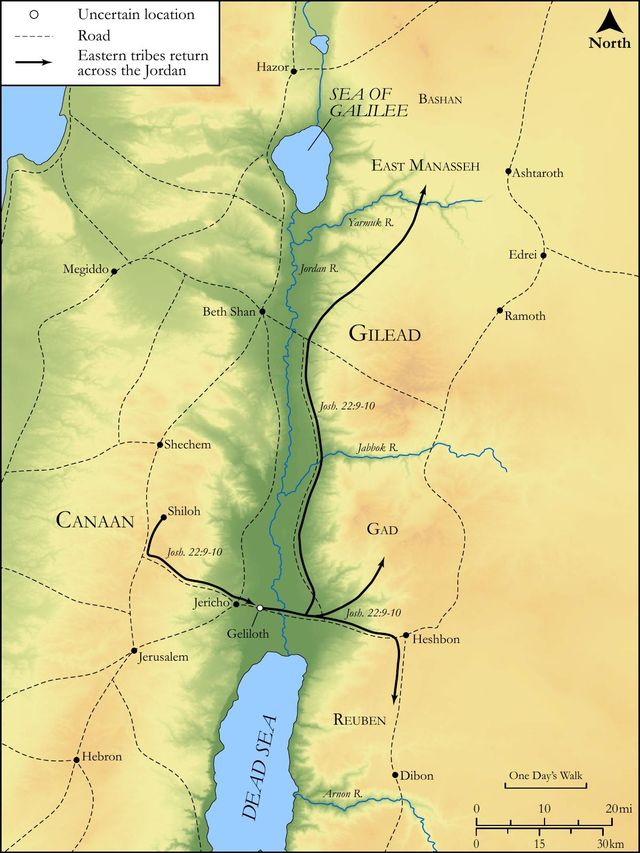
See on the biblical-era map
Study this verse
Continue studying Joshua 22:18 across the web’s major study libraries — every link below opens this exact verse, chapter, or book on the destination site.
Read & Compare
 BibleGatewayThis verse in more than 200 translations and 70 languages.
 Bible.comThe YouVersion reader — hundreds of translations, reading plans, and highlights.
 ESV.orgCrossway's official English Standard Version reader.
 NET BibleThe NET translation with 60,000+ translators' notes on every rendering decision.
 STEP BibleTyndale House's free study tool — original text, vocabulary, and scholarly resources.
 BibliaLogos Bible Software's free web reader.
 USCCBThe New American Bible (Revised Edition) with the U.S. bishops' study notes.
Commentaries
 BibleHub CommentariesDozens of classic commentaries on this verse, gathered on one page.
 StudyLightMore than 100 commentary sets — the largest collection on the web.
 BibleRefPlain-English commentary on what this verse means, verse by verse.
 Enduring WordDavid Guzik's free commentary on this chapter, widely used by Bible teachers.
 Bible Study ToolsVerse commentary alongside Greek and Hebrew study aids.
Original Language & Research
- BibleHub InterlinearThe verse word by word — original language, transliteration, and English.
- BibleHub LexiconEvery word's original-language definition and Strong's entry.
 Blue Letter BibleDeep-study tools — Strong's numbers, concordance, and word studies.
 SefariaThe Hebrew text with Rashi and centuries of Jewish commentary.
Sermons, Hymns & Audio


TrulyRandomVerse is not affiliated with these sites and doesn’t control their content. They’re linked because they’re genuinely useful.
Summary
Joshua 22:18 encapsulates the profound alarm and corporate fear experienced by the main Israelite tribes concerning the perceived apostasy of the Transjordanian tribes (Reuben, Gad, and the half-tribe of Manasseh). This verse, part of Phinehas's impassioned confrontation, expresses the grave concern that the building of an unauthorized altar east of the Jordan would be interpreted by the LORD as a direct act of rebellion, thereby provoking divine wrath not merely upon the offending tribes but upon the entire congregation of Israel, mirroring past instances of corporate judgment. It highlights the deeply intertwined nature of covenant faithfulness and communal well-being in ancient Israel.
Context
ShowHideLiterary Context
Joshua 22:18 is situated within a pivotal narrative that immediately follows the successful conquest and division of the land of Canaan. The tribes of Reuben, Gad, and the half-tribe of Manasseh, having fulfilled their military obligations, are dismissed by Joshua to return to their inheritance east of the Jordan River. Before crossing, they construct a large, conspicuous altar. This act is misinterpreted by the western tribes as a deliberate turning away from the LORD and a violation of the central sanctuary worship established at Shiloh. The verse is part of the stern rebuke delivered by Phinehas, son of Eleazar the priest, and ten tribal leaders, who confront the Transjordanian tribes, fearing that their perceived rebellion will bring corporate judgment upon all Israel, reminiscent of previous national sins.
Historical & Cultural Context
The historical setting is the immediate post-conquest period, a time when Israel was transitioning from a nomadic, unified military force to a settled confederation of tribes. Centralized worship at a single sanctuary (first the tabernacle, later the temple) was a cornerstone of the Mosaic covenant, designed to prevent idolatry and maintain tribal unity under the LORD. Building altars elsewhere was strictly forbidden unless explicitly commanded by God, as seen in the clear directives of Deuteronomy 12:5-14. The fear of corporate judgment was deeply ingrained in Israelite consciousness, stemming from events like the sin at Peor, which brought a plague upon the nation (Numbers 25:1-9), and Achan's trespass, which led to defeat at Ai (Joshua 7:1-26). This cultural understanding of corporate solidarity and divine retribution fueled the western tribes' alarm.
Key Themes
ShowHideThis verse powerfully contributes to several key themes within Joshua and the broader Deuteronomistic History. It underscores the gravity of covenant faithfulness and the severe consequences of perceived rebellion against the LORD, emphasizing that such actions provoke divine anger that can affect the entire community. The narrative highlights the theme of corporate responsibility, where the actions of a segment of the population are believed to have far-reaching implications for the whole group, as seen in the phrase "the whole congregation of Israel." Furthermore, it illuminates God's jealousy for exclusive worship and His demand for allegiance, demonstrating that any perceived deviation from His prescribed worship, like building an unauthorized altar, was seen as a direct affront to His unique sovereignty and could ignite His fierce wrath, as warned in passages like Deuteronomy 6:14-15.
Exposition and Analysis
ShowHideKey Word Analysis
ShowHideThis verb (H7725) signifies a departure, removal, or turning aside from a path or course. In a theological context, it often denotes apostasy or deviation from God's commands and covenant. Here, it implies a deliberate act of abandoning the LORD's prescribed way of worship and allegiance, which is seen as a grave offense.
This is a strong term (H4775) indicating open defiance, revolt, or insubordination against an authority. In the context of Israel's relationship with God, it describes a conscious and intentional act of disobedience to His divine rule and covenant stipulations. It's not merely a mistake but a deliberate turning against the LORD's sovereignty.
This word (H7107), derived from a primitive root meaning "to crack off" or "burst out in rage," describes intense anger, particularly God's righteous indignation. When applied to God, it conveys His fierce, burning displeasure against sin and rebellion, often leading to punitive action. The immediacy implied by "tomorrow" emphasizes the swiftness and certainty of divine judgment.
Verse Breakdown
ShowHide"But that ye must turn away this day from following the LORD?"
This rhetorical question expresses the accusers' profound shock and fear that the Transjordanian tribes have already committed an act of apostasy. "Turning away from following the LORD" encapsulates a complete departure from covenant faithfulness, implying a rejection of His authority and exclusive worship. The phrase "this day" emphasizes the perceived immediacy and gravity of the offense.
"and it will be, [seeing] ye rebel to day against the LORD"
This clause presents the direct consequence of the perceived rebellion. The parenthetical "[seeing]" clarifies that the subsequent wrath is a direct result of this act of defiance. "Rebel against the LORD" reiterates the understanding that building the altar is not just a cultural misunderstanding but a direct affront to God's sovereignty and a breach of the covenant.
"that to morrow he will be wroth with the whole congregation of Israel."
This final clause articulates the terrifying expectation of corporate judgment. The phrase "to morrow" suggests an imminent and unavoidable divine response. Crucially, the wrath is not confined to the perceived offenders but extends to "the whole congregation of Israel," highlighting the principle of corporate solidarity and shared accountability within the covenant community. This fear is rooted in previous historical precedents where the sin of a few led to widespread divine punishment.
Literary Devices
ShowHideThe passage effectively employs Rhetorical Question to convey the accusers' incredulity and deep concern ("But that ye must turn away this day from following the LORD?"). This device not only expresses their alarm but also serves to confront the accused directly with the perceived gravity of their actions. Hyperbole is evident in the immediate leap to "the whole congregation of Israel" facing wrath "to morrow," reflecting the intense fear and the perceived existential threat to the entire nation's covenant standing. The narrative also utilizes Foreshadowing by referencing past corporate judgments (e.g., Peor, Achan), which sets a precedent for the expected divine wrath and heightens the dramatic tension, making the threat of collective punishment feel very real and imminent to both the characters and the original audience.
Theological and Thematic Connections
ShowHideJoshua 22:18 powerfully underscores the Old Testament principle of corporate solidarity and the severe consequences of covenant infidelity. The fear expressed by the western tribes reveals a profound understanding that Israel's well-being was inextricably linked to its collective obedience to the LORD. Any perceived deviation from God's commands, especially regarding exclusive worship, was not merely an individual or tribal matter but a threat to the entire nation's relationship with God, potentially inviting His righteous wrath. This highlights God's demand for holiness and His intolerance for anything that compromises His unique position as Israel's sovereign God.
Reflection and Application
ShowHideJoshua 22:18 serves as a profound reminder of the interconnectedness within the community of faith and the serious implications of our actions, both individually and corporately. While the immediate context involves a misunderstanding that is ultimately resolved (the altar was a memorial, not for sacrifice), the intensity of the reaction from the western tribes speaks to a deeply held conviction about the gravity of rebellion against God and the potential for corporate consequences. For believers today, this passage encourages a sober awareness of how our faithfulness, or lack thereof, can impact the spiritual health and witness of the church. It calls us to live with integrity, to uphold sound doctrine, and to engage in clear, empathetic communication within the body of Christ, seeking understanding before judgment. It also reminds us that God takes our worship and allegiance seriously, desiring our wholehearted devotion and warning against any spiritual "altars" that might subtly draw us away from Him.
Questions for Reflection
ShowHideFAQ
ShowHideWhy was building an altar considered such a serious offense?
ShowHideIn ancient Israel, the LORD commanded a centralized place of worship—first the Tabernacle, later the Temple—where all sacrifices were to be offered. This was crucial for maintaining the purity of worship, preventing idolatry, and ensuring tribal unity under God's exclusive sovereignty (as detailed in Deuteronomy 12:5-14). Building an unauthorized altar was seen as a direct challenge to this divine command, a potential act of apostasy, and a dangerous step towards syncretism or idolatry, which could provoke God's wrath upon the entire nation. The fear was that it would lead to a repeat of previous national sins that resulted in severe divine judgment, such as the incident at Peor (Numbers 25:1-9).
How does this passage relate to the idea of corporate sin and corporate judgment in the Bible?
ShowHideThis passage powerfully illustrates the biblical concept of corporate solidarity, where the actions of individuals or a segment of the community can have consequences for the entire group. The fear expressed in Joshua 22:18 is that the perceived rebellion of the Transjordanian tribes would bring God's wrath upon "the whole congregation of Israel." This principle is evident throughout the Old Testament, from Achan's sin causing Israel's defeat at Ai (Joshua 7:1-26) to the nation suffering for the sins of its kings. While the New Testament emphasizes individual accountability and salvation through Christ, the concept of corporate responsibility still applies to the church as a body, where the actions and witness of its members collectively impact its standing and mission in the world.
Was the fear of the western tribes justified?
ShowHideFrom their perspective, given Israel's history of corporate judgment for idolatry and disobedience, their fear was entirely justified. The building of a large, conspicuous altar outside the prescribed central sanctuary was a clear violation of Mosaic law as they understood it. Their concern stemmed from a genuine desire to uphold God's covenant and avoid bringing His wrath upon the nation. The narrative later reveals that the Transjordanian tribes built the altar not for sacrifice, but as a "witness" (Hebrew, 'ed) to future generations that they too belonged to the LORD and had a share in His covenant people (Joshua 22:27). This highlights the importance of clear communication and understanding before drawing conclusions or taking drastic action.
Christ-Centered Fulfillment
ShowHideJoshua 22:18, with its intense focus on corporate sin and the fear of divine wrath, finds its ultimate fulfillment and resolution in the person and work of Jesus Christ. The Old Testament principle of corporate solidarity, where the sin of a few could bring judgment upon the many, foreshadows the profound theological truth of Christ's substitutionary atonement. Unlike the fear that the rebellion of some would bring wrath upon the whole congregation, Christ, the perfect Lamb of God, willingly bore the wrath of God for the sins of the entire world, becoming a curse for us (Galatians 3:13). He is the true and ultimate "altar" upon which the one perfect sacrifice was made, rendering all other altars and sacrifices obsolete (Hebrews 10:10-14). Through His obedience, even unto death on the cross, Jesus fully satisfied God's righteous demands, removing the threat of corporate judgment for those who are "in Christ" (Romans 5:18-19). He is the one who truly turns us to the LORD, reconciling us to God and establishing a new covenant where forgiveness and peace replace the fear of wrath, uniting all believers into one body, the Church, under His headship (Ephesians 2:14-16).