


1 Kings 9:6
Bible text: King James Version (1769 Blayney text) · Public domain
Bible text: King James Version with Strong's numbers · Public domain
Bible text: Berean Standard Bible · Public domain
Bible text: American Standard Version (1901) · Public domain
Bible text: World English Bible, Messianic edition · Public domain
Bible text: Geneva Bible (1599) · Public domain
Bible text: Young's Literal Translation · Public domain
- אִם'im<if>H518PrtParticle Conditional
- שׁוֹבShovcertainly [if] <to turn back>H7725V-Qal-InfAbsVerb Qal Infinitive Absolute
- תְּשֻׁבוּןte·shu·Vunyou will turn back !H7725V-Qal-Imperf-2mp ¦ SfxVerb Qal Imperfect 2nd Plural Masculineתְּשֻׁבוּyou will turn backן!
- אַתֶּם'a·TemyouH859Pro-2mpPronoun Personal 2nd Plural Masculine
- וּבְנֵיכֶםu·ve·nei·Khemand your descendantsH1121Conj-w ¦ N-mpc ¦ 2mpNoun Plural Masculine Constructוּandבְנֵיdescendantsכֶםyour
- מֵאַחֲרַיme·'a·cha·Raifrom after meH310Prep-m ¦ Adj-mpc ¦ 1csAdjective Numerical Plural Masculine Constructמֵfromאַחֲרַafterיme
- וְלֹאve·Lo'and notH3808Conj-w ¦ NegParticle Negativeוְandלֹאnot
- תִשְׁמְרוּtish·me·Ruyou will keepH8104V-Qal-Imperf-2mpVerb Qal Imperfect 2nd Plural Masculine
- מִצְוֹתַיmitz·vo·Taimy commandmentsH4687N-fpc ¦ 1csNoun Plural Feminine Constructמִצְוֹתַcommandmentsיmy
- חֻקֹּתַיchu·ko·Taimy statutesH2708N-fpc ¦ 1csNoun Plural Feminine Constructחֻקֹּתַstatutesיmy
- אֲשֶׁר'a·SherwhichH834RelParticle Relative
- נָתַתִּיna·Ta·tiI have setH5414V-Qal-Perf-1csVerb Qal Perfect 1st Singular common gender
- לִפְנֵיכֶםlif·nei·Khem<to> before youH6440Prep-l ¦ N-mpc ¦ 2mpNoun Plural Masculine Constructלִ<to>פְנֵיbeforeכֶםyou
- וַהֲלַכְתֶּםva·ha·lakh·Temand you will walkH1980Conj-w ¦ V-Qal-ConsecPerf-2mpVerb Qal Consecutive Perfect 2nd Plural Masculineוַandהֲלַכְתֶּםyou will walk
- וַעֲבַדְתֶּםva·'a·vad·Temand you will serveH5647Conj-w ¦ V-Qal-ConsecPerf-2mpVerb Qal Consecutive Perfect 2nd Plural Masculineוַandעֲבַדְתֶּםyou will serve
- אֱלֹהִים'E·lo·HimgodsH430N-mpNoun Plural Masculine Absolute
- אֲחֵרִים'a·che·RimotherH312Adj-mpAdjective Plural Masculine Absolute
- וְהִשְׁתַּחֲוִיתֶםve·hish·ta·cha·vi·Temand you will bow downH7812Conj-w ¦ V-Hishtaphel-ConsecPerf-2mpVerb Hishtaphel Consecutive Perfect 2nd Plural Masculineוְandהִשְׁתַּחֲוִיתֶםyou will bow down
- לָהֶםla·Hemto themPrep-l ¦ 3mpSuffix Personal 3rd Plural Masculineלָtoהֶםthem
English is a literal word-by-word gloss of the Hebrew, not the KJV's wording. Why?
This is the original text the KJV's translators worked from — each Hebrew word with its own literal English meaning in this verse, prepared by scholars at Tyndale House, Cambridge. The KJV translates whole sentences, not word by word, so its wording differs: one Hebrew word can become several English words, and the KJV may choose “the LORD” where the gloss reads “Yahweh”. Both are faithful — they answer different questions. For the KJV's own rendering, switch to the KJV text.
Details
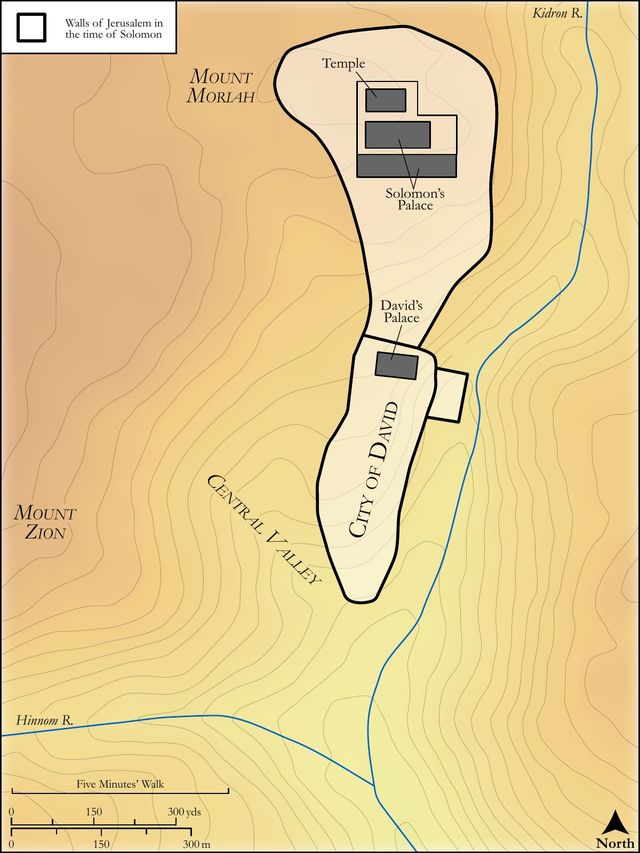
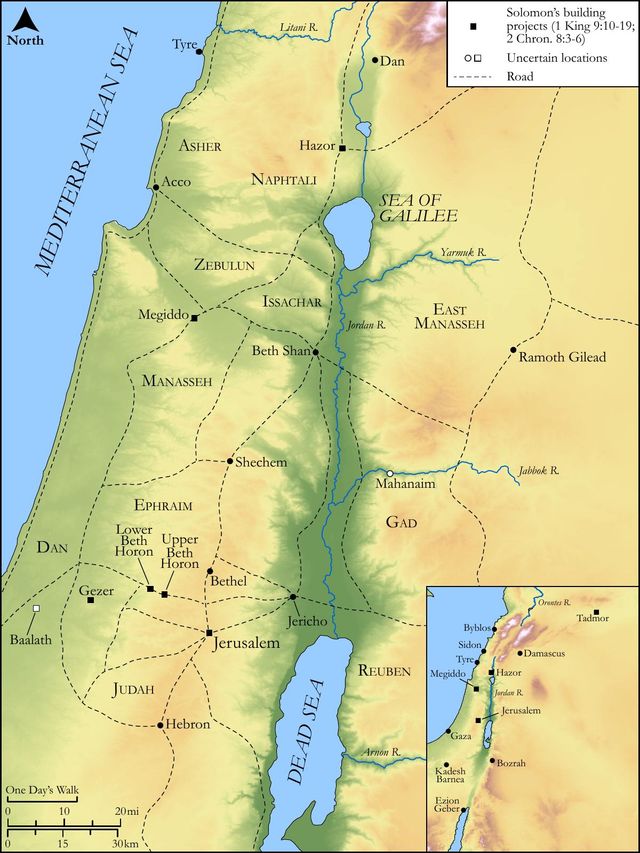
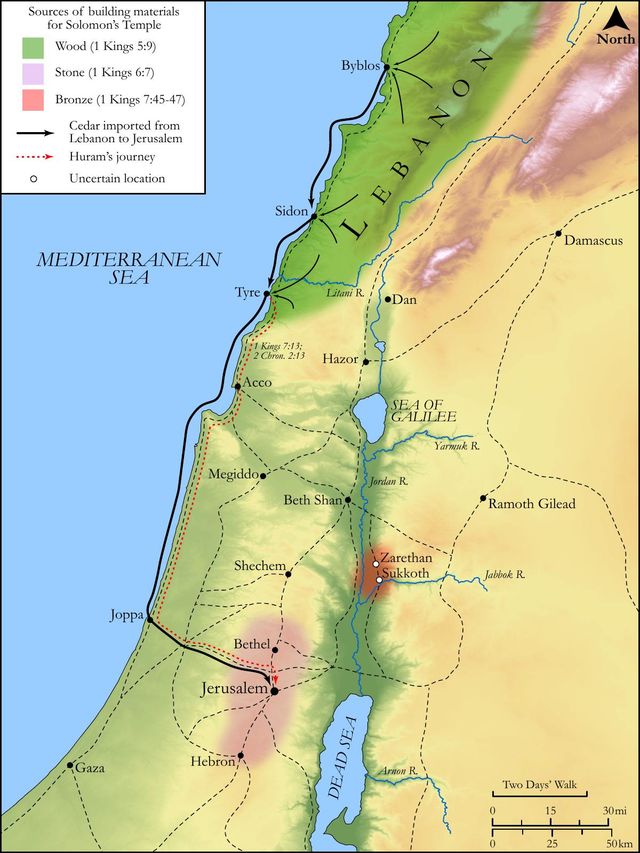
See on the biblical-era maps
Study this verse
Public-domain commentary
Matthew Henry
From his Commentary on the Whole Bible. Henry comments on passages, not single verses — this entry covers 1 Kings 9:1–9. His three-level outline is real structure in the source text, so it is rendered as structure.
God had given a real answer to Solomon's prayer, and tokens of his acceptance of it, immediately, by the fire from heaven which consumed the sacrifices (as we find Ch2 7:1); but here we have a more express and distinct answer to it. Observe,
I.In what way God gave him this answer.
He appeared to him, as he had done at Gibeon, in the beginning of his reign, in a dream or vision, Kg1 9:2. The comparing of it with that intimates that it was the very night after he had finished the solemnities of his festival, for so that was, Ch2 1:6, Ch2 1:7. And then Kg1 9:1, speaking of Solomon's finishing all his buildings, which was not till many years after the dedication of the temple, must be read thus, Solomon finished (as it is Ch2 7:11), and Kg1 9:2 must be read, and the Lord had appeared.
II.The purport of this answer.
1.He assures him of his special presence in the temple he had built, in answer to the prayer he had made (Kg1 9:3): I have hallowed this house. Solomon had dedicated it, but it was God's prerogative to hallow it - to sanctify or consecrate it. Men cannot make a place holy, yet what we, in sincerity, devote to God, we may hope he will graciously accept as his; and his eyes and his heart shall be upon it. Apply it to persons, the living temples. Those whom God hallows or sanctifies, whom he sets apart for himself, have his eye, his heart, his love and care, and this perpetually.
2.He shows him that he and his people were for the future upon their good behaviour. Let them not be secure now, as if they might live as they please now that they have the temple of the Lord among them, Jer 7:4. No, this house was designed to protect them in their allegiance to God, but not in their rebellion or disobedience. God deals plainly with us, sets before us good and evil, the blessing and the curse, and lets us know what we must trust to. God here tells Solomon,
(1.)That the establishment of his kingdom depended upon the constancy of his obedience (Kg1 9:4, Kg1 9:5): "If thou wilt walk before me as David did, who left thee a good example and encouragement enough to follow it (and advantage thou wilt be accountable for if thou do not improve it), if thou wilt walk as he did, in integrity of heart and uprightness" (for that is the main matter - no religion without sincerity), "then I will establish the throne of thy kingdom, and not otherwise," for on that condition the promise was made, Psa 132:12. If we perform our part of the covenant, God will not fail to perform his; if we improve the grace God has given us, he will confirm us to the end. Let not the children of godly parents expect the entail of the blessing, unless they tread in the steps of those that have gone before them to heaven, and keep up the virtue and piety of their ancestors.
(2.)That the ruin of his kingdom would be the certain consequence of his or his children's apostasy from God (Kg1 9:6): "But know thou, and let thy family and kingdom know it, and be admonished by it, that if you shall altogether turn from following me" (so it is thought it should be read), "if you forsake my service, desert my altar, and go and serve other gods" (for that was the covenant-breaking sin), "if you or your children break off from me, this house will not save you. But, [1.] Israel, though a holy nation, will be cut off (Kg1 9:7), by one judgment after another, till they become a proverb and a by-word, and the most despicable people under the sun, though now the most honourable." This supposes the destruction of the royal family, though it is not particularly threatened; the king is, of course, undone, if the kingdom be. [2.] "The temple, though a holy house, which God himself has hallowed for his name, shall be abandoned and laid desolate (Kg1 9:8, Kg1 9:9): This house which is high." They prided themselves in the stateliness and magnificence of the structure, but let them know that it is not so high as to be out of the reach of God's judgments, if they vilify it so as to exchange it for groves and idol-temples, and yet, at the same time, magnify it so as to think it will secure the favour of God to them though they ever so much corrupt themselves. This house which is high. Those that now pass by it are astonished at the bulk and beauty of it; the richness, contrivance, and workmanship, are admired by all spectators, and it is called a stupendous fabric; but, if you forsake God, its height will make its fall the more amazing, and those that pass by will be as much astonished at its ruins, while the guilty, self-convicted, self-condemned, Israelites, will be forced to acknowledge, with shame, that they themselves were the ruin of it; for when it shall be asked, Why hath the Lord done thus to his house? they cannot but answer, It was because they forsook the Lord their God. See Deu 29:24, Deu 29:25. Their sin will be read in their punishment. They deserted the temple, and therefore God deserted it; they profaned it with their sins and laid it common, and therefore God profaned it with his judgments and laid it waste. God gave Solomon fair warning of this, now that he had newly built and dedicated it, that he and his people might not be high-minded, but fear.
Continue studying 1 Kings 9:6 across the web’s major study libraries — every link below opens this exact verse, chapter, or book on the destination site.
Read & Compare
 BibleGatewayThis verse in more than 200 translations and 70 languages.
 Bible.comThe YouVersion reader — hundreds of translations, reading plans, and highlights.
 ESV.orgCrossway's official English Standard Version reader.
 NET BibleThe NET translation with 60,000+ translators' notes on every rendering decision.
 STEP BibleTyndale House's free study tool — original text, vocabulary, and scholarly resources.
 BibliaLogos Bible Software's free web reader.
 USCCBThe New American Bible (Revised Edition) with the U.S. bishops' study notes.
Commentaries
 BibleHub CommentariesDozens of classic commentaries on this verse, gathered on one page.
 StudyLightMore than 100 commentary sets — the largest collection on the web.
 BibleRefPlain-English commentary on what this verse means, verse by verse.
 Enduring WordDavid Guzik's free commentary on this chapter, widely used by Bible teachers.
 Bible Study ToolsVerse commentary alongside Greek and Hebrew study aids.
Original Language & Research
- BibleHub InterlinearThe verse word by word — original language, transliteration, and English.
- BibleHub LexiconEvery word's original-language definition and Strong's entry.
 Blue Letter BibleDeep-study tools — Strong's numbers, concordance, and word studies.
 SefariaThe Hebrew text with Rashi and centuries of Jewish commentary.
Sermons, Hymns & Audio


TrulyRandomVerse is not affiliated with these sites and doesn’t control their content. They’re linked because they’re genuinely useful.
Summary
1 Kings 9:6 delivers a profound divine warning from God to King Solomon, extending its solemn implications to all future generations of Israel. This verse explicitly outlines the dire consequences—specifically, the forfeiture of the promised land and the destruction of the Temple—that would result if the people, or their descendants, were to abandon their covenant fidelity by turning away from the Lord's commandments and statutes to serve and worship other gods. It powerfully underscores the conditional nature of God's covenant blessings, emphasizing that Israel's continued prosperity and secure presence in the land were directly contingent upon their unwavering obedience and exclusive devotion to Yahweh.
Context
ShowHideLiterary Context
This pronouncement in 1 Kings 9:6 immediately follows God's second significant appearance to King Solomon, occurring after the magnificent dedication of the Temple in Jerusalem. God has just reaffirmed His commitment to Solomon and the Davidic dynasty, promising an enduring kingdom if Solomon walks in integrity and uprightness, keeping God's statutes and judgments, as David his father did, as detailed in 1 Kings 9:4-5. The stark warning of verse 6 thus serves as a critical counterpoint to the preceding promises, establishing the non-negotiable condition for the continuation of those blessings. It sets a crucial tension within the narrative, foreshadowing the challenges to Israel's faithfulness that would define much of its subsequent history and the eventual division and exile of the kingdom.
Historical & Cultural Context
The warning in 1 Kings 9:6 is deeply rooted in the foundational covenant established at Mount Sinai, particularly as articulated and reiterated in the book of Deuteronomy. The Mosaic Covenant, which governed Israel's relationship with Yahweh, explicitly tied the nation's well-being, security, and continued habitation in the promised land to their obedience to God's laws, as vividly portrayed in Deuteronomy 28. Conversely, apostasy and idolatry were consistently identified as the primary violations that would lead to divine judgment, including exile from the land. In Solomon's era, Israel was surrounded by nations practicing polytheism and various forms of idolatry, making the temptation to syncretism or outright apostasy a constant and potent threat. God's warning here powerfully reaffirms the unique, exclusive nature of His covenant with Israel, demanding singular devotion in a multi-deity world.
Key Themes
ShowHideThis verse powerfully contributes to several overarching themes within 1 Kings and the broader Deuteronomistic History. Firstly, it highlights Covenant Fidelity and Obedience, emphasizing that God's blessings and the continuation of the Davidic kingdom are directly contingent upon Israel's ongoing adherence to His commandments and statutes. Secondly, it underscores the profound Danger of Idolatry, presenting the serving and worshipping of "other gods" as the ultimate act of betrayal against the Lord, a sin that directly violates the first two commandments of the Decalogue found in Exodus 20:3-6. Thirdly, the warning extends beyond Solomon to "ye or your children," illustrating the significant Generational Impact of spiritual choices, where the faithfulness or unfaithfulness of one generation profoundly affects the destiny of future generations, a principle echoed in Psalm 78:4-8. Finally, the verse clearly demonstrates God's Justice and Holiness, revealing His unwavering commitment to His own righteous character and His just response to rebellion and unfaithfulness within the covenant relationship.
Exposition and Analysis
ShowHideKey Word Analysis
ShowHideThis primitive root signifies "to turn back," "to turn away," or "to retreat." In this context, it denotes a deliberate and decisive act of apostasy—a conscious turning away from the covenant path God has set for His people. It implies a rejection of the relationship and the obligations it entails, moving from a state of following God to actively abandoning Him. The repetition of the root in the phrase "at all turn" (infinitive absolute) intensifies the certainty and gravity of such a departure.
These terms refer to the comprehensive body of divine law given to Israel through Moses. "Commandments" (mitsvâh) generally denotes specific divine instructions or precepts, often emphasizing the authoritative word of God. "Statutes" (chuqqâh) often refers to established ordinances, decrees, or fixed regulations, frequently carrying the sense of something "engraved" or permanently set, indicating their immutable nature. Together, they encompass the entire ethical, moral, and cultic framework of the Mosaic Covenant, representing the full scope of God's revealed will for His people.
This phrase is a direct and forceful articulation of idolatry. "Serve" (ʻâbad) implies active devotion, allegiance, and practical commitment, often involving labor or ritual service to a master or deity. "Worship" (shâchâh) refers to the act of prostration or bowing down, signifying reverence, adoration, and submission. The combination emphasizes both the internal disposition of allegiance and the external acts of devotion directed towards deities other than Yahweh, which was the ultimate breach of the covenant and the gravest sin for Israel.
Verse Breakdown
ShowHide"[But] if ye shall at all turn from following me, ye or your children,
": This opening clause establishes the conditional nature of the warning ("if"), setting the stage for the consequences that follow in later verses. The emphatic phrase "at all turn" (using the infinitive absolute) underscores the certainty and gravity of such a departure from God. Crucially, the warning is explicitly directed not only at Solomon and his contemporaries ("ye") but also at "your children," highlighting the generational scope of covenant responsibility and the long-term implications of spiritual choices, indicating that the nation's future destiny hinges on the faithfulness of successive generations.
and will not keep my commandments and my statutes which I have set before you,
This specifies the nature of the "turning away"—it is characterized by a failure to "keep" (i.e., observe, obey, guard, or preserve) God's divine laws. These "commandments and statutes" are those "set before" Israel, implying they are clearly revealed, accessible, and binding obligations. This clause underscores that passive neglect or active disobedience to the revealed will of God constitutes a turning away from Him, a breach of the covenant relationship.
but go and serve other gods, and worship them
This final clause describes the ultimate and most egregious form of turning away: active engagement in idolatry. It is not merely a failure to obey God but a deliberate choice to "go" (implying a conscious journey or commitment) and devote oneself to foreign deities. The twin verbs "serve" and "worship" comprehensively define the act of idolatry, encompassing both practical allegiance and ritual adoration, directly violating the very essence of Israel's covenant with Yahweh, which demanded exclusive worship and loyalty.
Literary Devices
ShowHideThe passage employs several potent literary devices to convey its grave warning. The most prominent is the Conditional Clause, structured with an "if...then" logic, even though the "then" (the consequences) is elaborated in the subsequent verses 1 Kings 9:7-9. This structure highlights the direct cause-and-effect relationship between Israel's obedience and their destiny. There is also a strong element of Antithesis, sharply contrasting the path of "following me" and "keeping my commandments" with the destructive alternative of "serving other gods, and worshipping them." This stark opposition emphasizes the mutually exclusive nature of devotion to Yahweh versus idolatry. The Repetition of the phrase "serve other gods, and worship them" serves to underscore the specific and heinous nature of the sin being warned against, reinforcing its severity and the clarity of the prohibition against polytheism. Finally, the warning itself functions as Foreshadowing, tragically predicting the future apostasy of both Solomon himself 1 Kings 11:4-8 and the nation of Israel, which would ultimately lead to the division of the kingdom and later, the Babylonian exile.
Theological and Thematic Connections
ShowHide1 Kings 9:6 serves as a pivotal theological statement, articulating God's unwavering commitment to His covenant and His absolute demand for exclusive worship. It reveals that while God's promises are steadfast, their fulfillment for the human recipient is often contingent upon faithfulness. This verse echoes the consistent biblical theme that true prosperity and security for God's people are found not in military might or political alliances, but in wholehearted devotion to Him and obedience to His revealed will. The warning against idolatry is not merely about external rituals but about the heart's ultimate allegiance, reminding us that anything that displaces God from the center of our lives becomes an "other god." This principle remains timeless, challenging believers to examine where their ultimate trust and devotion truly lie, for God will not share His glory.
Reflection and Application
ShowHideThe solemn warning in 1 Kings 9:6, though delivered to an ancient king and nation, resonates powerfully with believers today. It calls us to a profound spiritual vigilance, recognizing that the human heart is perpetually prone to wander and find its security or satisfaction in things other than God. While we live under a new covenant of grace, the principle of exclusive devotion to God alone remains paramount. Modern "other gods" may not be carved idols but can manifest as materialism, the pursuit of power, self-worship, unchecked ambition, or even the subtle elevation of good things (family, career, comfort) above the Creator. This verse challenges us to regularly examine our allegiances, ensuring that our lives are characterized by a genuine "following" of God and a diligent "keeping" of His Word, not out of legalism, but out of a heart transformed by grace. Furthermore, the generational aspect of the warning implores us to consider our spiritual legacy, recognizing our profound responsibility to nurture faith in the next generation, teaching them to love and obey the Lord above all else, thereby safeguarding them from the subtle and overt temptations of idolatry in their own time.
Questions for Reflection
ShowHideFAQ
ShowHideWhat are the "commandments and statutes" mentioned in this verse?
ShowHideThe "commandments and statutes" refer to the comprehensive body of divine law that God gave to Israel through Moses, forming the core of the Mosaic Covenant. This includes the Ten Commandments, as detailed in Exodus 20:1-17, as well as the detailed civil, ceremonial, and moral laws found throughout the books of Exodus, Leviticus, Numbers, and Deuteronomy. These laws were not merely arbitrary rules but were designed to shape Israel into a distinct, holy nation that reflected God's character and enjoyed His blessings in the promised land, provided they remained faithful to the covenant terms. Their purpose was to guide Israel in their relationship with God and with one another, ensuring their prosperity and unique identity among the nations, as seen in Deuteronomy 6:1-3.
Did King Solomon himself heed this warning, or did he fall into the very sin described?
ShowHideTragically, King Solomon did not fully heed this solemn warning, despite his initial wisdom and devotion. As recorded in 1 Kings 11:4, "when Solomon was old, his wives turned away his heart after other gods, and his heart was not wholly true to the Lord his God, as was the heart of David his father." He built high places for foreign deities, including Chemosh and Molech, for his foreign wives, as described in 1 Kings 11:7-8. This disobedience directly led to God's judgment, resulting in the division of the kingdom after Solomon's reign, a fulfillment of the very consequences warned about in 1 Kings 9:6-9.
Christ-Centered Fulfillment
ShowHideThe warning in 1 Kings 9:6, highlighting humanity's inherent struggle with obedience and the devastating consequences of idolatry, finds its ultimate fulfillment and resolution in Jesus Christ. The conditional nature of the Old Covenant, where blessings were contingent upon perfect human obedience, starkly reveals the inability of Israel, and indeed all humanity, to consistently keep God's commandments and statutes. This verse, therefore, implicitly points to the need for a perfect obedience that fallen humanity could not provide. Jesus, the true and greater Son of David, perfectly fulfilled the Law and the Prophets, living a life of absolute fidelity to God's will, never turning from following Him, and never serving or worshipping other gods, as affirmed in Matthew 5:17. His perfect obedience, culminating in His sacrificial death, addresses the very failure warned against in 1 Kings 9:6, providing atonement for the idolatry and disobedience of humanity. Through His new covenant, established by His blood, believers are not called to earn salvation through perfect law-keeping, but to receive it by grace through faith, as powerfully articulated in Ephesians 2:8-9. In Christ, the Spirit is given, enabling a transformed heart that desires to follow God and keep His commandments, not out of fear of judgment, but out of love and gratitude, fulfilling the spirit of the law from within, as promised in Hebrews 8:10 and exemplified in John 14:15. Thus, what Israel failed to achieve under the Old Covenant is perfectly accomplished and graciously provided for all who are in Christ, securing an eternal kingdom far more enduring than any earthly dynasty.