


Joshua 22:27
- כִּיkiforH3588PrtParticle Conditional
- עֵד'ed[is] a witnessH5707N-msNoun Singular Masculine Absolute
- הוּאhu'itH1931Pro-3msPronoun Personal 3rd Singular Masculine
- בֵּינֵינוּbei·Nei·nubetween usH996Adj-mpc ¦ 1cpAdjective Numerical Plural Masculine Constructבֵּינֵיbetweenנוּus
- וּבֵינֵיכֶםu·vei·nei·Khemand between youH996Conj-w ¦ Adj-mpc ¦ 2mpAdjective Numerical Plural Masculine Constructוּandבֵינֵיbetweenכֶםyou
- וּבֵיןu·Veinand betweenH996Conj-w ¦ Adj-mscAdjective Numerical Singular Masculine Constructוּandבֵיןbetween
- דֹּרוֹתֵינוּdo·ro·tei·Nuour generationsH1755N-fpc ¦ 1cpNoun Plural Feminine Constructדֹּרוֹתֵיgenerationsנוּour
- אַחֲרֵינוּ'a·cha·rei·Nuafter usH310Adj-mpc ¦ 1cpAdjective Numerical Plural Masculine Constructאַחֲרֵיafterנוּus
- לַעֲבֹדla·'a·Vodto serveH5647Prep-l ¦ V-Qal-InfVerb Qal Infinitive Constructלַtoעֲבֹדserve
- אֶת'et<obj.>H853DirObjMParticle Object Indicator
- עֲבֹדַת'a·vo·Dat[the] service ofH5656N-fscNoun Singular Feminine Construct
- יְהוָהYah·wehYahwehH3068N-properNoun Proper Title
- לְפָנָיוle·fa·Nav<to> before himH6440Prep-l ¦ N-mpc ¦ 3msNoun Plural Masculine Constructלְ<to>פָנָיbeforeוhim
- בְּעֹלוֹתֵינוּbe·'o·lo·Tei·nuwith our burnt offeringsH5930Prep-b ¦ N-fpc ¦ 1cpNoun Plural Feminine Constructבְּwithעֹלוֹתֵיburnt offeringsנוּour
- וּבִזְבָחֵינוּu·viz·va·Chei·nuand with our sacrificesH2077Conj-w ¦ Prep-b ¦ N-mpc ¦ 1cpNoun Plural Masculine Constructוּandבִwithזְבָחֵיsacrificesנוּour
- וּבִשְׁלָמֵינוּu·vish·la·Mei·nuand with our peace offeringsH8002Conj-w ¦ Prep-b ¦ N-mpc ¦ 1cpNoun Plural Masculine Constructוּandבִwithשְׁלָמֵיpeace offeringsנוּour
- וְלֹאve·lo'and notH3808Conj-w ¦ NegParticle Negativeוְandלֹאnot
- יֹאמְרוּyo·me·Ruthey will sayH559V-Qal-Imperf-3mpVerb Qal Imperfect 3rd Plural Masculine
- בְנֵיכֶםve·nei·Khemyour descendantsH1121N-mpc ¦ 2mpNoun Plural Masculine Constructבְנֵיdescendantsכֶםyour
- מָחָרma·ChartomorrowH4279N-msNoun Singular Masculine Absolute
- לְבָנֵינוּle·va·Nei·nuto our descendantsH1121Prep-l ¦ N-mpc ¦ 1cpNoun Plural Masculine Constructלְtoבָנֵיdescendantsנוּour
- אֵין'einnotH369N-mscNoun Singular Masculine Construct
- לָכֶםla·Khem[belongs] to <the> youPrep-l ¦ 2mpSuffix Personal 2nd Plural Masculineלָ[belongs] to <the>כֶםyou
- חֵלֶקChe·leka portionH2506N-msNoun Singular Masculine Absolute
- בַּיהוָהba·Yah·wehin YahwehH3068Prep-b ¦ N-properNoun Proper TitleבַּinיהוָהYahweh
English is a literal word-by-word gloss of the Hebrew, not the KJV's wording. Why?
This is the original text the KJV's translators worked from — each Hebrew word with its own literal English meaning in this verse, prepared by scholars at Tyndale House, Cambridge. The KJV translates whole sentences, not word by word, so its wording differs: one Hebrew word can become several English words, and the KJV may choose “the LORD” where the gloss reads “Yahweh”. Both are faithful — they answer different questions. For the KJV's own rendering, switch to the KJV text.
Details
See on the biblical-era map
Study this verse
Historical interpretation
Historical reception
1 surviving comment on this verse from the historical church.
But let us see what sacrament lies within this deed. The former people of the circumcision are represented in Reuben, who was the firstborn; but also in Gad, who also is the firstborn out of Zilpah; and Manasseh, no less a firstborn. But insofar as I say “firstborn,” I speak chronologically. Therefore, these things are said not that it might be evident some division and separation is between us and those who were righteous before the coming of Christ, but that they might reveal themselves to still be our brothers even if they existed before the coming of Christ. For although they possessed an altar then before the coming of the Savior, nevertheless, they knew and perceived that it was not that true altar but that it was a form and figure of what would be the true altar. Those persons knew this because the true victims and those who were able to take away sins were not offered on that altar that the firstborn people possessed but on this one where Jesus was. Here the heavenly victims, here the true sacrifices are consumed. Therefore, they are made “one flock and one shepherd,” those former righteous ones and those who are now Christians.
Continue studying Joshua 22:27 across the web’s major study libraries — every link below opens this exact verse, chapter, or book on the destination site.
Read & Compare
 BibleGatewayThis verse in more than 200 translations and 70 languages.
 Bible.comThe YouVersion reader — hundreds of translations, reading plans, and highlights.
 ESV.orgCrossway's official English Standard Version reader.
 NET BibleThe NET translation with 60,000+ translators' notes on every rendering decision.
 STEP BibleTyndale House's free study tool — original text, vocabulary, and scholarly resources.
 BibliaLogos Bible Software's free web reader.
 USCCBThe New American Bible (Revised Edition) with the U.S. bishops' study notes.
Commentaries
 BibleHub CommentariesDozens of classic commentaries on this verse, gathered on one page.
 StudyLightMore than 100 commentary sets — the largest collection on the web.
 BibleRefPlain-English commentary on what this verse means, verse by verse.
 Enduring WordDavid Guzik's free commentary on this chapter, widely used by Bible teachers.
 Bible Study ToolsVerse commentary alongside Greek and Hebrew study aids.
Original Language & Research
- BibleHub InterlinearThe verse word by word — original language, transliteration, and English.
- BibleHub LexiconEvery word's original-language definition and Strong's entry.
 Blue Letter BibleDeep-study tools — Strong's numbers, concordance, and word studies.
 SefariaThe Hebrew text with Rashi and centuries of Jewish commentary.
Sermons, Hymns & Audio


TrulyRandomVerse is not affiliated with these sites and doesn’t control their content. They’re linked because they’re genuinely useful.
Summary
Joshua 22:27 presents the passionate and pivotal defense of the Transjordanian tribes—Reuben, Gad, and the half-tribe of Manasseh—regarding the large altar they erected near the Jordan River. Far from being a rival cultic site, this verse articulates their profound and pure intention: the altar was to serve as an enduring, tangible witness for all future generations, affirming their full and legitimate participation in the covenant with the LORD and their rightful access to worship Him alongside their brethren. This act was a proactive measure designed to prevent any future denial of their spiritual heritage and their integral "part in the LORD."
Context
ShowHideLiterary Context
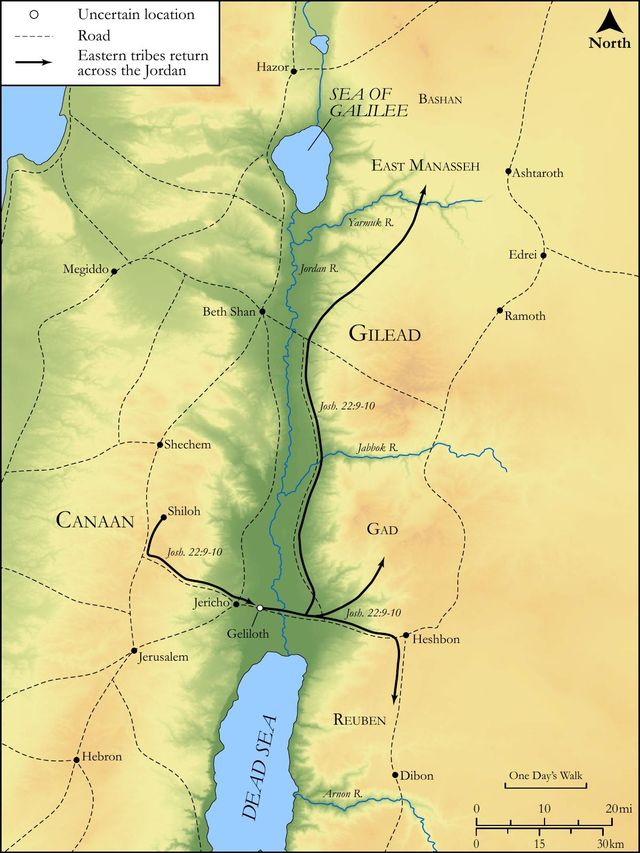
Joshua 22:27 is situated at the climax of a deeply tense narrative that nearly erupted into civil war among the tribes of Israel. Having fulfilled their military obligations in the conquest of Canaan, the Transjordanian tribes were honorably dismissed by Joshua to return to their inheritance east of the Jordan. On their journey, they constructed a large, conspicuous altar. Upon hearing this, the western tribes, residing west of the Jordan, immediately interpreted this act as a grave apostasy and a direct violation of the Mosaic Law, which mandated centralized worship at the tabernacle in Shiloh (Deuteronomy 12). Their alarm led them to gather for war at Shiloh (Joshua 22:12). However, before engaging in hostilities, they wisely dispatched a delegation, led by the high priest Phinehas, to confront the eastern tribes. Joshua 22:27 forms the core of the eastern tribes' eloquent and heartfelt explanation, revealing the altar's true symbolic purpose as a witness to their unwavering loyalty to Yahweh and their shared covenantal identity. This explanation successfully diffused the tension, leading to peace and rejoicing among all Israel (Joshua 22:33).
Historical & Cultural Context
The period immediately following the conquest of Canaan was a critical juncture for Israel, as they transitioned from a nomadic, unified military campaign to a settled, tribal confederation. The command for centralized worship at the tabernacle, initially established at Shiloh (Joshua 18:1), was paramount for maintaining national and religious unity. Any unauthorized altar was not merely a minor infraction but a profound act of rebellion, threatening to fragment the nascent nation and invite divine judgment, reminiscent of the severe consequences of the golden calf incident (Exodus 32). The geographical barrier of the Jordan River naturally created a sense of separation for the Transjordanian tribes, raising legitimate concerns among their western brethren about their adherence to the covenant and their susceptibility to the pagan practices of surrounding peoples. In a pre-literate society, the construction of a large, visible monument was a common and culturally understood method for establishing a public, enduring testimony or memorial, making the eastern tribes' choice of an altar-like structure a powerful, albeit initially misunderstood, statement.
Key Themes
ShowHideThis verse profoundly articulates several foundational themes central to Israel's identity and covenant relationship with God. Firstly, it underscores the unity of Israel under one God, transcending geographical divisions. The eastern tribes' primary motivation was to affirm their shared identity and prevent a schism that would deny their descendants access to the central worship of the LORD. Secondly, it highlights the profound biblical emphasis on intergenerational faithfulness and the diligent transmission of spiritual heritage. The fear that "your children may not say to our children in time to come, Ye have no part in the LORD" reveals a deep pastoral concern for the spiritual well-being and covenant inclusion of future generations, echoing the commands to teach God's statutes diligently to one's children found in Deuteronomy 6:7. Thirdly, the verse clearly distinguishes between legitimate worship at the central sanctuary and a symbolic witness. By explicitly mentioning "burnt offerings, and... sacrifices, and... peace offerings," the eastern tribes affirmed their unwavering commitment to the prescribed forms of worship at Shiloh, clarifying that their altar was not a rival cultic site but a visible sign of their right to participate in the one true worship of Israel.
Exposition and Analysis
ShowHideKey Word Analysis
ShowHideThis crucial term (H5707, עֵד) denotes a concrete object or person that serves as a testimony, a reminder, or a monument providing proof of a fact or an agreement. It is critically distinct from a sacrificial altar (mizbēaḥ). The eastern tribes explicitly state the altar's purpose as a "witness between us, and you, and our generations after us." This signifies its role as a visible, enduring, and non-verbal declaration of their shared covenant identity and their right to participate in the legitimate worship of Yahweh. It was a physical sign, akin to a boundary stone or a pile of stones commemorating a significant event, intended to prevent future theological amnesia or separation and to confirm their ongoing relationship with God and their brethren.
The word (H1755, דּוֹר) signifies a revolution of time, specifically an age or a generation. In this context, the concern for "our generations after us" underscores the profound intergenerational focus of the eastern tribes' action. They were not merely thinking of their immediate circumstances but were deeply invested in securing the spiritual future and covenantal standing of their descendants. This highlights a core biblical principle of passing on faith and heritage from one generation to the next, ensuring continuity in the covenant relationship with the LORD.
This term (H2506, חֵלֶק) primarily means "portion," "share," or "allotment." In the declaration, "Ye have no part in the LORD," it signifies a denial of their rightful inheritance within the covenant community of Israel and their access to God's presence and blessings. It implies spiritual dispossession, a severing of their connection to the God of Israel and the privileges of His people. The eastern tribes feared their descendants would be excluded from the worship and community life centered around the tabernacle, effectively being deemed outsiders to the Abrahamic and Mosaic covenants and disinherited from their spiritual birthright.
Verse Breakdown
ShowHide"But [that] it [may be] a witness between us, and you, and our generations after us,"
This opening clause immediately declares the altar's primary, non-sacrificial purpose. It is a perpetual "witness" or testimony, explicitly intended not merely for the current generation but for "our generations after us." This highlights the profound intergenerational concern of the eastern tribes, aiming to establish an enduring physical sign that would bridge the geographical divide and prevent future misunderstandings or spiritual alienation between the Transjordanian and Cisjordanian tribes. The altar was a visual argument for their shared identity and covenantal inclusion, a silent declaration of their spiritual belonging.
"that we might do the service of the LORD before him with our burnt offerings, and with our sacrifices, and with our peace offerings;"
This clause clarifies what the altar witnesses to. It testifies to their right and unwavering intention to "do the service of the LORD"—to participate fully in the prescribed forms of worship at the central sanctuary. By specifically naming "burnt offerings" (Hebrew, ‘ôlâh'), "sacrifices" (Hebrew, zebach'), and "peace offerings" (Hebrew, shelem'), they emphatically affirm their adherence to Mosaic Law and their desire to bring legitimate sacrifices to the tabernacle in Shiloh, not to this new altar. This statement directly counters the western tribes' fear of a rival cult, asserting their commitment to the singular, authorized place of worship.
"that your children may not say to our children in time to come, Ye have no part in the LORD."
This final, climactic clause reveals the deep-seated fear driving the eastern tribes' action. Their ultimate concern was the spiritual legacy of their descendants. They foresaw a future where geographical separation might lead to theological estrangement, where the western tribes' children might question or deny the covenantal inclusion of the eastern tribes' children. The altar was a proactive measure to prevent this spiritual dispossession, ensuring that their lineage would always be recognized as having a legitimate "part" or share in the covenant, the inheritance, and the worship of the LORD God of Israel, thus securing their spiritual identity for generations.
Literary Devices
ShowHideJoshua 22:27 employs several powerful literary devices to convey its profound message and emotional weight. The Repetition of phrases like "our generations after us" and "our children in time to come" powerfully underscores the eastern tribes' deep and pervasive concern for their descendants' spiritual heritage. This emphasis highlights the biblical imperative to diligently pass on faith and covenant identity across generations. The altar itself functions as a potent Symbolism; it is not merely a pile of stones but a tangible, enduring representation of their covenantal identity, their right to worship, and their unbroken connection to the God of Israel. It serves as a Metonymy, where the physical structure stands in for the abstract concept of their shared faith, legitimacy, and spiritual belonging. The entire passage, culminating in this verse, is a masterful example of Rhetorical Persuasion, as the eastern tribes' eloquent and heartfelt defense successfully diffuses a potentially devastating civil war by appealing to shared faith, future unity, and a common understanding of God's commands. The fear expressed, "Ye have no part in the LORD," creates a powerful Antithesis with their stated desire to "do the service of the LORD," highlighting the stark contrast between their true intentions and the western tribes' initial misinterpretation.
Theological and Thematic Connections
ShowHideJoshua 22:27 is a profound testament to the theological importance of unity, covenant fidelity, and the intergenerational transmission of faith within the community of Israel. It underscores the principle that outward forms (like an altar) must always serve and point to inward spiritual realities (like a genuine covenant relationship and legitimate worship). The eastern tribes' actions demonstrate a deep understanding of their corporate identity as God's chosen people, emphasizing that geographical distance should not equate to spiritual separation. Their fear of their children being told "Ye have no part in the LORD" speaks to the vital necessity of belonging to the covenant community and having unhindered access to God's presence through prescribed worship. This incident serves as a powerful reminder that misunderstandings, even among God's people, can lead to severe conflict, and that clear, Spirit-led communication rooted in shared theological convictions is paramount for preserving the integrity and unity of the body of believers.
Reflection and Application
ShowHideJoshua 22:27 offers timeless and profound lessons for contemporary believers and the church today. It challenges us to critically examine the visible signs and actions we present to the world and, crucially, to future generations. Are our lives, our corporate worship, and our community structures clear "witnesses" to our "part in the LORD," unequivocally demonstrating our belonging to His covenant? This verse highlights the critical importance of clear, compassionate communication within the body of Christ, reminding us that assumptions, unaddressed fears, and a lack of transparency can quickly escalate into division and conflict. It calls us to prioritize unity in essential matters of faith, even amidst diverse expressions, geographical separation, or differing methodologies. Most profoundly, it impresses upon us the sacred, urgent responsibility to intentionally and diligently pass on a vibrant, authentic faith to the next generation. We must ensure that our children and grandchildren never doubt their "part in the LORD," actively teaching them God's Word, modeling genuine devotion, and creating environments where they can experience God's presence and participate fully in His service.
Questions for Reflection
ShowHideFAQ
ShowHideWhat was the specific fear of the Transjordanian tribes?
ShowHideTheir specific fear, as articulated in Joshua 22:27, was that in future generations, their descendants might be denied their rightful "part in the LORD" by the western tribes. This meant being excluded from the covenant community, from legitimate worship at the central sanctuary in Shiloh, and from the blessings and identity associated with being the people of Israel. They feared their children would be seen as outsiders, effectively cut off from the spiritual heritage of their ancestors and from access to God's presence.
Why was building an altar a controversial act, given the command for centralized worship?
ShowHideThe Mosaic Law, particularly in Deuteronomy 12, strictly commanded that all sacrifices and offerings be brought to one designated place of worship—the tabernacle (and later the Temple). Building any other altar was seen as a direct violation of this command, potentially leading to idolatry, syncretism (mixing pagan practices with Israelite worship), and a fracturing of Israel's religious and national unity. The western tribes initially interpreted the eastern tribes' altar as an act of rebellion and a rival place of worship, which would have been a grave sin punishable by war. The eastern tribes' explanation clarified that their altar was a "witness" and not for sacrifice, thus alleviating the fear of rebellion.
How did this conflict resolve, and what does it teach us about conflict resolution?
ShowHideThe conflict resolved peacefully through open, honest, and patient communication. Instead of immediately resorting to war, the western tribes wisely sent a delegation led by Phinehas, a priest, to confront the eastern tribes and seek an explanation (Joshua 22:13-15). The eastern tribes, in turn, offered a clear, passionate, and theologically sound defense of their actions, explaining the altar's symbolic purpose as a "witness" to their shared faith and not a place of sacrifice (Joshua 22:21-29). This teaches us the vital importance of seeking understanding and clarification before judgment, engaging in dialogue, and prioritizing unity and truth over hasty reactions. It demonstrates that even legitimate concerns can be addressed through patient and prayerful communication, preventing destructive conflict and preserving the integrity of the community.
Christ-Centered Fulfillment
ShowHideJoshua 22:27, with its profound emphasis on a "witness" to a "part in the LORD" and legitimate access to worship, finds its ultimate and glorious fulfillment in Jesus Christ. The altar built by the Transjordanian tribes was a physical sign, a testimony to their right to participate in the Old Covenant. In the New Covenant, Jesus Himself is the ultimate, living, and perfect witness to God's saving work and our eternal "part" in Him. He is the "faithful and true witness" (Revelation 3:14) who fully reveals the Father and His redemptive plan. Furthermore, the eastern tribes' earnest desire to "do the service of the LORD with our burnt offerings, and with our sacrifices, and with our peace offerings" powerfully foreshadows the perfect and ultimate sacrifice of Christ. He is the Lamb of God who takes away the sin of the world, whose single, unrepeatable offering has forever perfected those who are being sanctified (Hebrews 10:14). Through His atoning work, all believers, regardless of their background, geographical location, or tribal affiliation, are granted full, unhindered, and eternal access to God's presence. There is no longer any fear of being told "Ye have no part in the LORD," for in Christ, we are made "fellow citizens with the saints and members of the household of God" (Ephesians 2:19). He is our peace, having broken down every dividing wall of hostility and uniting all who believe into one new humanity, one body in Him (Ephesians 2:14-16). Thus, the unity and access to God's service sought by the eastern tribes are fully realized and eternally secured in our union with Christ, our Great High Priest and the perfect Sacrifice.