


Joshua 22:28
Bible text: King James Version (1769 Blayney text) · Public domain
Bible text: King James Version with Strong's numbers · Public domain
Bible text: Berean Standard Bible · Public domain
Bible text: American Standard Version (1901) · Public domain
Bible text: World English Bible, Messianic edition · Public domain
Bible text: Geneva Bible (1599) · Public domain
Bible text: Young's Literal Translation · Public domain
- וַנֹּאמֶרva·No·merand we saidH559Conj-w ¦ V-Qal-ConsecImperf-1cpVerb Qal Consecutive Imperfect 1st Plural common genderוַandנֹּאמֶרwe said
- וְהָיָהve·ha·Yahand it will beH1961Conj-w ¦ V-Qal-ConsecPerf-3msVerb Qal Consecutive Perfect 3rd Singular Masculineוְandהָיָהit will be
- כִּיkithatH3588PrtParticle Conditional
- יֹאמְרוּyo·me·Ruthey will sayH559V-Qal-Imperf-3mpVerb Qal Imperfect 3rd Plural Masculine
- אֵלֵינוּ'e·Lei·nuto usH413Prep ¦ 1cpPrepositionאֵלֵיtoנוּus
- וְאֶלve·'eland toH413Conj-w ¦ PrepPrepositionוְandאֶלto
- דֹּרֹתֵינוּdo·ro·Tei·nuour generationsH1755N-fpc ¦ 1cpNoun Plural Feminine Constructדֹּרֹתֵיgenerationsנוּour
- מָחָרma·ChartomorrowH4279N-msNoun Singular Masculine Absolute
- וְאָמַרְנוּve·'a·Mar·nuand we will sayH559Conj-w ¦ V-Qal-ConsecPerf-1cpVerb Qal Consecutive Perfect 1st Plural common genderוְandאָמַרְנוּwe will say
- רְאוּre·'UseeH7200V-Qal-Imp-2mpVerb Qal Imperative 2nd Plural Masculine
- אֶת'et<obj.>H853DirObjMParticle Object Indicator
- תַּבְנִיתtav·Nit[the] copy ofH8403N-fscNoun Singular Feminine Construct
- מִזְבַּחmiz·Bach[the] altar ofH4196N-mscNoun Singular Masculine Construct
- יְהוָהYah·wehYahwehH3068N-properNoun Proper Title
- אֲשֶׁר'a·SherwhichH834RelParticle Relative
- עָשׂוּ'a·Suthey madeH6213V-Qal-Perf-3cpVerb Qal Perfect 3rd Plural common gender
- אֲבוֹתֵינוּ'a·vo·Tei·nuour ancestorsH1N-fpc ¦ 1cpNoun Plural Feminine Constructאֲבוֹתֵיancestorsנוּour
- לֹאlo'notH3808NegParticle Negative
- לְעוֹלָהle·'o·Lahfor burnt offeringH5930Prep-l ¦ N-fsNoun Singular Feminine Absoluteלְforעוֹלָהburnt offering
- וְלֹאve·Lo'and notH3808Conj-w ¦ NegParticle Negativeוְandלֹאnot
- לְזֶבַחle·Ze·vachfor sacrificeH2077Prep-l ¦ N-msNoun Singular Masculine Absoluteלְforזֶבַחsacrifice
- כִּיkiforH3588PrtParticle Conditional
- עֵד'ed[is] a witnessH5707N-msNoun Singular Masculine Absolute
- הוּאHu'itH1931Pro-3msPronoun Personal 3rd Singular Masculine
- בֵּינֵינוּbei·Nei·nubetween usH996Adj-mpc ¦ 1cpAdjective Numerical Plural Masculine Constructבֵּינֵיbetweenנוּus
- וּבֵינֵיכֶםu·vei·nei·Khemand between youH996Conj-w ¦ Adj-mpc ¦ 2mpAdjective Numerical Plural Masculine Constructוּandבֵינֵיbetweenכֶםyou
English is a literal word-by-word gloss of the Hebrew, not the KJV's wording. Why?
This is the original text the KJV's translators worked from — each Hebrew word with its own literal English meaning in this verse, prepared by scholars at Tyndale House, Cambridge. The KJV translates whole sentences, not word by word, so its wording differs: one Hebrew word can become several English words, and the KJV may choose “the LORD” where the gloss reads “Yahweh”. Both are faithful — they answer different questions. For the KJV's own rendering, switch to the KJV text.
Details
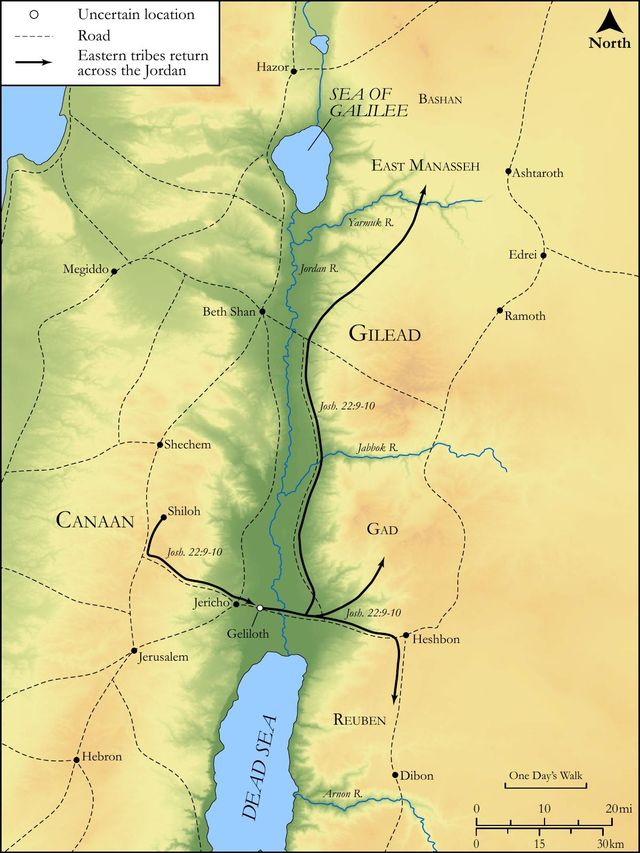
See on the biblical-era map
Study this verse
Historical interpretation
Historical reception
1 surviving comment on this verse from the historical church.
But let us see what sacrament lies within this deed. The former people of the circumcision are represented in Reuben, who was the firstborn; but also in Gad, who also is the firstborn out of Zilpah; and Manasseh, no less a firstborn. But insofar as I say “firstborn,” I speak chronologically. Therefore, these things are said not that it might be evident some division and separation is between us and those who were righteous before the coming of Christ, but that they might reveal themselves to still be our brothers even if they existed before the coming of Christ. For although they possessed an altar then before the coming of the Savior, nevertheless, they knew and perceived that it was not that true altar but that it was a form and figure of what would be the true altar. Those persons knew this because the true victims and those who were able to take away sins were not offered on that altar that the firstborn people possessed but on this one where Jesus was. Here the heavenly victims, here the true sacrifices are consumed. Therefore, they are made “one flock and one shepherd,” those former righteous ones and those who are now Christians.
Continue studying Joshua 22:28 across the web’s major study libraries — every link below opens this exact verse, chapter, or book on the destination site.
Read & Compare
 BibleGatewayThis verse in more than 200 translations and 70 languages.
 Bible.comThe YouVersion reader — hundreds of translations, reading plans, and highlights.
 ESV.orgCrossway's official English Standard Version reader.
 NET BibleThe NET translation with 60,000+ translators' notes on every rendering decision.
 STEP BibleTyndale House's free study tool — original text, vocabulary, and scholarly resources.
 BibliaLogos Bible Software's free web reader.
 USCCBThe New American Bible (Revised Edition) with the U.S. bishops' study notes.
Commentaries
 BibleHub CommentariesDozens of classic commentaries on this verse, gathered on one page.
 StudyLightMore than 100 commentary sets — the largest collection on the web.
 BibleRefPlain-English commentary on what this verse means, verse by verse.
 Enduring WordDavid Guzik's free commentary on this chapter, widely used by Bible teachers.
 Bible Study ToolsVerse commentary alongside Greek and Hebrew study aids.
Original Language & Research
- BibleHub InterlinearThe verse word by word — original language, transliteration, and English.
- BibleHub LexiconEvery word's original-language definition and Strong's entry.
 Blue Letter BibleDeep-study tools — Strong's numbers, concordance, and word studies.
 SefariaThe Hebrew text with Rashi and centuries of Jewish commentary.
Sermons, Hymns & Audio


TrulyRandomVerse is not affiliated with these sites and doesn’t control their content. They’re linked because they’re genuinely useful.
Summary
Joshua 22:28 presents the earnest defense of the Transjordanian tribes—Reuben, Gad, and the half-tribe of Manasseh—to their western brethren concerning the large altar they constructed by the Jordan River. This pivotal verse articulates their sincere and forward-looking intention: the altar was not erected for illicit sacrifices or as an act of apostasy, but rather as a strategic, tangible memorial. Its purpose was to serve as an enduring witness, ensuring the future inclusion of their descendants in the covenant worship of the Lord and perpetually affirming their shared identity and unity within the singular nation of Israel.
Context
ShowHideLiterary Context
Joshua 22 marks a critical juncture in the post-conquest period, as the Transjordanian tribes, having faithfully fulfilled their commitment to assist in the conquest of Canaan, are honorably dismissed by Joshua to return to their allotted inheritance east of the Jordan River (Joshua 22:1-9). Upon their return, their construction of a prominent altar near the Jordan immediately triggers alarm and misinterpretation among the western tribes. This act is perceived as a direct rebellion against the Lord and a grave violation of the Deuteronomic command for centralized worship at the Tabernacle (Deuteronomy 12:5-7). The misunderstanding escalates rapidly, leading the western tribes to mobilize for war against their brethren (Joshua 22:12). A delegation, led by the high priest Phinehas, confronts the eastern tribes (Joshua 22:13-20), prompting the detailed and impassioned defense recorded in Joshua 22:21-29. Joshua 22:28 stands as the crucial articulation of their pure intentions, ultimately averting civil war and restoring national unity (Joshua 22:30-34).
Historical & Cultural Context
The period immediately following the conquest of Canaan was foundational for solidifying Israel's national and religious identity. A cornerstone of their covenant with Yahweh was the strict command for centralized worship at the Tabernacle (and later the Temple), a divine injunction designed to prevent idolatry, syncretism, and to maintain the theological purity and national cohesion of the twelve tribes (Deuteronomy 12). The Jordan River, while a geographical boundary, also carried significant symbolic weight, potentially isolating the eastern tribes and raising concerns about their full integration into the covenant community. Their profound concern for future exclusion stemmed from the practical challenges of regular travel to the central sanctuary and the legitimate fear that their descendants might be perceived as separate or illegitimate members of the covenant. In Scripture, as with Jacob's heap of witness and the twelve stones set up at Gilgal, the erection of "witnesses" or "memorials"—often in the form of altars, pillars, or heaps of stones—was a common practice to commemorate significant events, covenants, or boundaries, serving as tangible, enduring reminders for future generations.
Key Themes
ShowHideThis passage profoundly contributes to several overarching themes within the book of Joshua and the broader Old Testament narrative. It powerfully underscores the unity of God's people, emphasizing the imperative of maintaining spiritual cohesion and shared identity despite geographical or tribal distinctions. The near-civil war vividly highlights the fragility of this unity and the vital role of clear communication and understanding in resolving conflict and preventing catastrophic misunderstanding, contrasting with the destructive consequences of miscommunication seen elsewhere. Furthermore, the eastern tribes' deep concern for their descendants reveals the crucial theme of intergenerational covenant fidelity—their earnest desire to ensure that future generations would remain connected to the Lord and His worship, upholding the covenant established with their forefathers. The altar itself embodies the theme of a memorial and witness, serving not as a functional cultic site but as a tangible sign of shared identity and allegiance to the one true God, echoing other significant memorials in Israel's history, such as the stones taken from the Jordan in Joshua 4 or Jacob's pillar in Genesis 31:48.
Exposition and Analysis
ShowHideKey Word Analysis
ShowHideThe Hebrew verb אָמַר (ʼâmar) is a primitive root meaning "to say," used with broad latitude to encompass answering, appointing, declaring, commanding, thinking, and uttering. In Joshua 22:28, its repeated use ("said we," "should so say," "may say again") emphasizes the communicative intent behind the altar. It highlights the eastern tribes' proactive foresight, anticipating future inquiries from western tribes and preparing a verbal defense, demonstrating their deep concern for intergenerational dialogue and the preservation of truth.
The Hebrew word תַּבְנִית (tabnîyth) denotes a "structure," "model," "likeness," or "resemblance," specifically implying something built according to a pre-existing design or blueprint. This term is crucial to the eastern tribes' defense, as it signifies that their altar was not an independent or rival cultic site, but a deliberate replica or representation of the legitimate altar at the central sanctuary in Shiloh. This choice of word immediately communicates their intention was not to create a new place of worship, but to visually affirm their connection to the established, divinely ordained system, thereby refuting any accusation of apostasy.
The Hebrew word עֵד (ʻêḏ) is derived from a root meaning "to return" or "to repeat," and concretely refers to a "witness" or "testimony," and abstractly, "evidence." It is a legal and covenantal term, often referring to something that stands as a perpetual reminder or confirmation of an event, agreement, or truth. The altar was intended to be a silent, enduring declaration, testifying to the shared identity and covenantal rights of the eastern tribes and their descendants, ensuring they would not be disinherited from the worship of Yahweh by their western brethren. Its very existence would "speak" to future generations about their rightful place within the covenant community.
Verse Breakdown
ShowHide"Therefore said we, that it shall be, when they should [so] say to us or to our generations in time to come, that we may say [again],"
This opening clause reveals the proactive and deeply concerned motivation of the Transjordanian tribes. Their decision to build the altar was not for immediate sacrificial use, but a strategic, forward-thinking measure designed to address a potential future crisis. They anticipated a scenario where their descendants might be challenged or excluded from the central worship of Israel dueating to their geographical separation. This phrase underscores their profound commitment to preemptively safeguard the spiritual inheritance and full inclusion of their future generations within the covenant community, demonstrating a remarkable foresight and intergenerational responsibility.
"Behold the pattern of the altar of the LORD, which our fathers made, not for burnt offerings, nor for sacrifices;"
This is the core of their defense, explaining the altar's true nature and function. By explicitly calling it a "pattern" (תַּבְנִית, tabnîyth), they declare it a replica, a visual echo of the true altar at Shiloh, not a rival. The explicit denial—"not for burnt offerings, nor for sacrifices"—is paramount. It directly refutes the western tribes' fear of illicit worship and demonstrates their unwavering adherence to the Deuteronomic command for centralized worship. This clarifies that the altar's purpose was purely symbolic, not functional for sacrifice, distinguishing it sharply from the legitimate altar of the Tabernacle.
"but it [is] a witness between us and you."
This concluding declaration succinctly states the altar's ultimate and singular purpose. It was built as a perpetual "witness" (עֵד, ʻêḏ), a tangible sign and reminder of the shared covenant, identity, and right of worship between the Transjordanian tribes and their western counterparts. It served as a visible bond, affirming that despite the Jordan River acting as a physical barrier, they were one people, united in their devotion to the Lord. This witness would stand for all generations, affirming their spiritual unity and preventing future schism or dispossession from the covenant community.
Literary Devices
ShowHideThe passage masterfully employs several literary devices to convey its message with clarity and impact. Antithesis is prominently featured in the declaration "not for burnt offerings, nor for sacrifices; but it [is] a witness," which sharply contrasts the altar's symbolic purpose with its potential misinterpretation as a functional sacrificial site. This opposition highlights the eastern tribes' precise intent. Repetition of the concept of "generations" (H1755, dôwr) and the act of "saying" (H559, ʼâmar') ("when they should [so] say to us or to our generations... that we may say [again]") underscores the profound intergenerational concern and the communicative intent behind the altar, emphasizing its role in future dialogue. Furthermore, Symbolism is central, as the altar itself transcends its physical form to become a powerful symbol of unity, identity, and covenant fidelity. It functions as a memorial, a tangible reminder of a shared past and a declaration of future commitment, akin to other significant markers in Israel's history. The subsequent naming of the altar "Ed" (Witness) in Joshua 22:34 further solidifies its symbolic function and the resolution of the conflict.
Theological and Thematic Connections
ShowHideJoshua 22:28 profoundly articulates the eastern tribes' unwavering commitment to maintaining their covenantal relationship with the Lord and their unity with the rest of Israel. Their acute fear of future exclusion from worship highlights the profound theological importance of the central sanctuary as the divinely appointed locus of God's presence, the means of atonement, and the unifying center of Israel's faith. The altar, therefore, becomes a powerful theological statement: a visible affirmation that despite geographical separation, they shared the same God, the same covenant, and the same right to approach Him. This incident underscores that true unity among God's people is not merely geographical proximity but a shared spiritual identity and allegiance to the one Lord, expressed through faithful adherence to His commands and a deep concern for the spiritual well-being of all members, especially future generations. It teaches the value of proactive measures to preserve faith and identity across time and distance, demonstrating that theological clarity and communication are paramount for communal flourishing.
Reflection and Application
ShowHideThe narrative of the altar by the Jordan River offers timeless and profound lessons for contemporary believers and the church. It champions the critical importance of clear, honest, and empathetic communication within any community, especially the body of Christ. Misunderstandings, left unaddressed or fueled by assumptions, can escalate into significant conflict and division, as nearly happened with the tribes of Israel. This passage calls us to cultivate a posture of seeking to understand before being understood, to ask clarifying questions with grace, and to assume the best intentions of our brethren, rather than quickly attributing malice. Furthermore, it reminds us of our sacred responsibility to future generations, prompting us to consider how we are preserving and faithfully passing on our spiritual heritage. What "memorials"—whether intentional traditions, personal testimonies, dedicated discipleship efforts, or clear doctrinal statements—are we establishing to ensure that those who come after us know their place in God's covenant and their right to approach Him? Ultimately, it challenges us to prioritize and actively pursue unity within the body of Christ, recognizing that our shared faith in the one Lord transcends superficial differences, geographical divides, and even initial misunderstandings.
Questions for Reflection
ShowHideFAQ
ShowHideWhy did the western tribes initially react with such hostility to the altar?
ShowHideThe western tribes reacted with intense hostility because they perceived the construction of a large altar by the Transjordanian tribes as a direct and egregious violation of God's command for centralized worship, as explicitly stipulated in Deuteronomy 12:5-7. This divine mandate required all sacrifices and offerings to be made at the single, divinely chosen sanctuary (then the Tabernacle in Shiloh) to prevent idolatry, syncretism, and to maintain the spiritual purity and national unity of Israel. Building another prominent altar appeared to them as an act of rebellion against the Lord, a breach of the covenant, and a potential reintroduction of pagan practices, which they feared would provoke divine wrath upon the entire nation, similar to the devastating consequences seen in the incident of Achan in Joshua 7. Their fear was rooted in a genuine theological concern for the integrity of Israel's covenant relationship with Yahweh and the purity of their worship, leading them to prepare for immediate military action.
Christ-Centered Fulfillment
ShowHideThe narrative of the altar of witness in Joshua 22:28 finds its ultimate fulfillment and resolution in the person and work of Jesus Christ. The Jordan River, which served as a physical boundary separating the tribes, foreshadows the profound spiritual chasm of sin that separated humanity from God and from one another. Just as the altar was a "pattern" and a "witness" to unity, Jesus is the ultimate and perfect "pattern" of God's character and the supreme "witness" to God's truth, embodying the very nature of God (Colossians 1:15). He is not merely a symbol but the divine reality to which all Old Testament altars and sacrifices pointed. Through His singular, perfect sacrifice on the cross, Jesus became the true and final Lamb of God who takes away the sin of the world, rendering all other altars and sacrificial systems obsolete. He is our one mediator between God and men, effectively breaking down every dividing wall of hostility—whether geographical, ethnic, or spiritual—between people groups, uniting all believers into one new humanity (Ephesians 2:14-16). The deep concern of the eastern tribes for future generations to have access to God's presence is fully realized in Christ, who grants all who believe in Him direct and perpetual access to the Father through the Holy Spirit (Ephesians 2:18). He is the enduring witness, the living memorial, guaranteeing our perpetual inclusion in God's family and our right to worship Him, not based on a physical structure, but on His finished work of reconciliation and redemption.