


Ezekiel 43:10
Bible text: King James Version (1769 Blayney text) · Public domain
Bible text: Berean Standard Bible · Public domain
Bible text: American Standard Version (1901) · Public domain
Bible text: World English Bible, Messianic edition · Public domain
Bible text: Geneva Bible (1599) · Public domain
Bible text: Young's Literal Translation · Public domain
- אַתָּה'a·TahyouH859Pro-2msPronoun Personal 2nd Singular Masculine
- בֶןvenO son ofH1121N-mscNoun Singular Masculine Construct
- אָדָם'a·DamhumankindH120N-msNoun Singular Masculine Absolute
- הַגֵּדha·GeddeclareH5046V-Hiphil-Imp-2msVerb Hiphil Imperative 2nd Singular Masculine
- אֶת'et<obj.>H853DirObjMParticle Object Indicator
- בֵּיתbeit[the] house ofH1004N-mscNoun Singular Masculine Construct
- יִשְׂרָאֵלYis·ra·'ElIsraelH3478N-properNoun Proper Location
- אֶת'et<obj.>H853DirObjMParticle Object Indicator
- הַבַּיִתha·Ba·yitthe houseH1004Art ¦ N-msNoun Singular Masculine Absoluteהַtheבַּיִתhouse
- וְיִכָּלְמוּve·yi·kal·Muso they may be ashamedH3637Conj-w ¦ V-Niphal-ConjImperf-3mpVerb Niphal Conjunction+Imperfect 3rd Plural Masculineוְsoיִכָּלְמוּthey may be ashamed
- מֵעֲוֹנוֹתֵיהֶםme·'a·vo·no·tei·Hemfrom their iniquitiesH5771Prep-m ¦ N-fpc ¦ 3mpNoun Plural Feminine Constructמֵfromעֲוֹנוֹתֵיiniquitiesהֶםtheir
- וּמָדְדוּu·ma·de·Duand they will measureH4058Conj-w ¦ V-Qal-ConsecPerf-3cpVerb Qal Consecutive Perfect 3rd Plural common genderוּandמָדְדוּthey will measure
- אֶת'et<obj.>H853DirObjMParticle Object Indicator
- תָּכְנִיתta·khe·Nita patternH8508N-fsNoun Singular Feminine Absolute
English is a literal word-by-word gloss of the Hebrew, not the KJV's wording. Why?
This is the original text the KJV's translators worked from — each Hebrew word with its own literal English meaning in this verse, prepared by scholars at Tyndale House, Cambridge. The KJV translates whole sentences, not word by word, so its wording differs: one Hebrew word can become several English words, and the KJV may choose “the LORD” where the gloss reads “Yahweh”. Both are faithful — they answer different questions. For the KJV's own rendering, switch to the KJV text.
Details
See on the biblical-era map
Study this verse
Public-domain commentary
Matthew Henry
From his Commentary on the Whole Bible. Henry comments on passages, not single verses — this entry covers Ezekiel 43:7–12. His two-level outline is real structure in the source text, so it is rendered as structure.
God does here, in effect, renew his covenant with his people Israel, upon his retaking possession of the house, and Ezekiel negotiates the matter, as Moses formerly. This would be of great use to the captives at their return both for direction and encouragement; but it looks further, to those that are blessed with the privileges of the gospel-temple, that they may understand how they are before him on their good behaviour.
I.God, by the prophet, puts them in mind of their former provocations, for which they had long lain under the tokens of his displeasure.
This conviction is spoken to them to make way for the comforts designed them. Though God gives and upbraids not, it becomes us, when he forgives, to upbraid ourselves with our unworthy conduct towards him. Let them now remember therefore,
1.That they had formerly defiled God's holy name, had profaned and abused all those sacred things by which he had made himself known among them, Eze 43:7. They and their kings had brought contempt on the religion they professed, and their relation to God, by their spiritual whoredom, their idolatry, and by worshipping images, which they called their kings (for so Moloch signifies) or lords (for so Baal signifies), but which were really the carcases of kings, not only lifeless and useless, but loathsome and abominable as dead carcases, in their high places, set up in honour of them. They had defiled God's name by their abominations. And what were they? It was in setting their threshold by my thresholds, and their post by my posts, that is, adding their own inventions to God's institutions, and urging all to a compliance with them, as if they had been of equal authority and efficacy, teaching for doctrines the commandments of men (Isa 29:13); or, rather, setting up altars to their idols even in the courts of the temple, than which a more impudent affront could not be put upon the divine Majesty. Thus they set up a separation wall between him and them, which stopped the current of his favours to them and spoiled the acceptableness of their services to him. See what an indignity sinners do to God, setting up their walls in opposition to his, and thrusting him out from what is his right; and see what injury they do to themselves, for the nearer any come to God with their sins the further they set him at a distance from them. Some give this sense of it: Though their houses joined close to God's house, their posts and thresholds to hi, so that they were in a manner his next neighbours, there was but a wall between me and them (so it is in the margin), so that it might have been expected they would acquaint themselves with him and be in care to please him, yet they were not so much as neighbourly. Note, It often proves too true, The nearer the church the further from God. They were, by profession, in covenant with God, and yet they had defiled the place of his throne and of the soles of his feet, his temple, where he did both reside and reign. Jerusalem is called the city of the great king (Psa 48:2) and his footstool, Psa 99:5; Psa 132:7. Note, When God's ordinances are profaned his holy name is polluted.
2.That for this God had had a controversy with them in their late troubles. They could not condemn him, for he had but brought upon them the desert of their sins: Wherefore I have consumed them in my anger. Note, Those that pollute God's holy name fall under his just displeasure.
II.He calls upon them to repent and reform, and, in order to that, to be ashamed of their iniquities (Eze 43:9):
"Now let them put away their whoredom; now that they have smarted so severely for it, and now that God is returning in mercy to them and setting up his sanctuary again in the midst of them, now let them cast away their idols and have no more to do with them, that they may not again forfeit the privileges which they have been taught to know the worth of by the want of them. Let them put away their idols, those loathsome carcases of their kings, far from me, from being a provocation to me." This was seasonable counsel now that the prophet had the model or pattern of the temple to set before them; for,
1.If they see that pattern, they will surely be ashamed of their sins (Eze 43:10): when they see what mercy God has in store for them, notwithstanding their utter unworthiness of it, they will be ashamed to think of their disingenuous conduct towards him. Note, The goodness of God to us should lead us to repentance, especially to a penitential shame. Let them measure the pattern themselves, and see how much it exceeds the former pattern, and guess by that what great things God has in store for them; and surely it will put them out of countenance to think what the desert of their sins was. And then,
2.If they be ashamed of their sins, they shall surely see more of the pattern, Eze 43:11. If they be ashamed of all that they have done, upon a general view of the goodness of God, let them have a more distinct particular account of the temple. Note, Those that improve what they see and know of the goodness of God shall see and know more of it. And then, and not till then, we are qualified for God's favours, when we are truly humbled for our own follies. "Show them the form of the house; let them see what a stately structure it will be; and withal show them the ordinances and laws of it." Note, With the foresights of our comforts it is fit that we should get the knowledge of our duty; with the privileges of God's house we must acquaint ourselves with the rules of it. Show them these ordinances, that they may keep them and do them. Note, Therefore we are made to know our duty, that we may do it, and be blessed in our deed.
III.He promises that they shall be such as they should be, and then he will be to them such as they would have him to be, Eze 43:7.
1.The house of Israel shall no more defile my holy name. This is pure gospel. The precept of the law says, You must not defile my name: the grace of the gospel says, You shall not. Thus what is required in the covenant is promised in the covenant, Jer 32:40.
2.Then I will dwell in the midst of them for ever; and the same again Eze 43:9. God secures to us his good-will be confirming in us his good work. If we do not defile his name, we may be sure that he will not depart from us.
IV.The general law of God's house is laid down (Eze 43:12), That, whereas formerly only the chancel, or sanctuary, was most holy, now the whole mountain of the house shall be so; the whole limit thereof, including all the courts and all the chambers, shall be as the most holy place, signifying that in gospel-times,
1.The whole church shall have the privilege of the holy of holies, that of a near access to God. All believers have now, under the gospel, boldness to enter into the holiest (Heb 10:19), with this advantage, that whereas the high priest entered in the virtue of the blood of bulls and goats, we enter in the virtue of the blood of Jesus, and, wherever we are, we have through him access to the Father.
2.The whole church shall be under a mighty obligation to press towards the perfection of holiness, as he who has called us is holy. All must now be most holy. Holiness becomes God's house for ever, and in gospel-times more than ever. Behold this is the law of the house; let none expect the protection of it that will not submit to this law.
Historical interpretation
Historical reception
1 surviving comment on this verse from the historical church.
(Verse 10 and following) But you, son of man, show the house of Israel the temple: and let them be confounded by their iniquities, and let them measure the structure, and let them be ashamed of all that they have done. Show them the form of the house and its structure, its exits and entrances, and all its descriptions and all its laws. Show them the entire order and all its laws, and write them in their sight, that they may keep all its arrangements and its laws, and do them. This is the law of the house on the top of the mountain: All its boundaries around, it will be most holy. This, therefore, is the law of the house. 70: And you, son of man, show the house of Israel the house, and they will cease from their sins, and its vision and its arrangement: and they themselves will bear their punishment for all the things they have done. And describe the house and its preparation, and its exits and entrances, and its substance and all its ordinances, and all its statutes you will show them, and describe them before them: and they will observe all my judgments and all my commandments, and they will do them, and the description of the house on the top of the mountain, all its boundaries around are most holy. This is the law of the house. It is not a small task to demonstrate to those who see with their eyes or with their minds, so that they themselves seem to have seen with you. Therefore, Josephus writes that those who were sent by Jesus son of Nave to describe the land were geometers and had the art which now belongs to philosophers, the art of Geometry. Thus, for the house of Israel, those who see God with their mind, the house is shown, that is, the temple which Ezekiel saw situated on the mountain, and not only on a mountain, but as it is now said, on the summit of the mountain: which we should not think is the one that is described as being built by Solomon in the books of Kings and Chronicles. For that [temple] belongs to another order and size, and in each [temple] it has great diversity: and it [the second temple] is so much inferior to the temple that Ezekiel now shows, that not only its worshipers and priests, but even its builder, Solomon, sinned and offended God, although he later repented, writing in the Proverbs, where he says: Finally, I repented and considered to choose discipline (Prov. XXIV, 2). But this, which is shown by Ezekiel and through Ezekiel to the house of Israel, is as follows: that whoever contemplates it with the mind, ceases from his iniquities, not some, but all of them: or as it is contained in Hebrew, is confused and endures punishment for all that he has done. But he endures the punishment of his iniquities, who ceases to commit past sins: and it greatly benefits him who has sinned before, to see the house of God, and to know the reason for all its structure; so that he may cease to sin, and having a longing for it, may say to the Lord: O Lord, I have loved the beauty of your house: and the place of the habitation of your glory (Ps. 25:8). And again: One thing I have asked of the Lord, this I seek: that I may dwell in the house of the Lord all the days of my life (Psalm 27:4), when I begin to live and be with Christ, who is the life of believers. It follows: His going out and coming in, understood as the house. But the going out of those who go out to those who are outside, and the coming in of those who penetrate the interior through the discipline of their masters. And every, he says, description or substance of it, as the Septuagint has translated, which pertains not so much to the nature of the house, but to the furnishings and riches. And you shall show them all the commandments, the entire order, and all the laws of the temple, to those who have carried the burden of their iniquities and have ceased or been confused about the things they had done before. But show it to them so that they may keep all the commandments. For it is of no use to know the description of the house and all its distributions, about which it is written: In my Father's house there are many mansions (John 14:2). And again: He established the boundaries of the nations according to the number of the children of Israel, even the angels of God (Deut. XXXII), unless you do what is commanded. But the house and law of all the commandments of God, and the city which is situated on the top of the mountain, that is to be believed, as it is written: A city cannot be hidden when it is situated on a mountain (Matth. I, 14). And: The rushing of the river makes the city of God rejoice (Ps. XLV, 4): which clearly refers to the Church, and is located on that mountain, which is at the top of all mountains, and from which the prince of Tyre was wounded: and all the borders and boundaries of this house are holy of holies. In that house, that is, in the tabernacle that was built by Moses, and in the temple that was constructed by Solomon, only the innermost parts, where the Cherubim, and the propitiatory, and the Ark of the Covenant, and the table of incense were located, were called the Holy of Holies. But in this house, which is shown by Ezekiel, and which is situated on the top of the mountain, all its boundaries are considered to be in the Holy of Holies. And what is inferred: This is the law of the house, either referring to the past, about which it has already been said, or to those things that will be said later.
Continue studying Ezekiel 43:10 across the web’s major study libraries — every link below opens this exact verse, chapter, or book on the destination site.
Read & Compare
 BibleGatewayThis verse in more than 200 translations and 70 languages.
 Bible.comThe YouVersion reader — hundreds of translations, reading plans, and highlights.
 ESV.orgCrossway's official English Standard Version reader.
 NET BibleThe NET translation with 60,000+ translators' notes on every rendering decision.
 STEP BibleTyndale House's free study tool — original text, vocabulary, and scholarly resources.
 BibliaLogos Bible Software's free web reader.
 USCCBThe New American Bible (Revised Edition) with the U.S. bishops' study notes.
Commentaries
 BibleHub CommentariesDozens of classic commentaries on this verse, gathered on one page.
 StudyLightMore than 100 commentary sets — the largest collection on the web.
 BibleRefPlain-English commentary on what this verse means, verse by verse.
 Enduring WordDavid Guzik's free commentary on this chapter, widely used by Bible teachers.
 Bible Study ToolsVerse commentary alongside Greek and Hebrew study aids.
Original Language & Research
- BibleHub InterlinearThe verse word by word — original language, transliteration, and English.
- BibleHub LexiconEvery word's original-language definition and Strong's entry.
 Blue Letter BibleDeep-study tools — Strong's numbers, concordance, and word studies.
 SefariaThe Hebrew text with Rashi and centuries of Jewish commentary.
Sermons, Hymns & Audio


TrulyRandomVerse is not affiliated with these sites and doesn’t control their content. They’re linked because they’re genuinely useful.
Summary
Ezekiel 43:10 delivers a divine mandate to the prophet Ezekiel, instructing him to reveal the intricate visionary temple to the exiled Israelites. This command serves as a critical bridge, connecting the detailed architectural blueprint of the temple to its profound spiritual purpose: to awaken a deep, redemptive shame over their past and present iniquities, thereby prompting heartfelt repentance and a re-alignment with God's holy standards, meticulously symbolized by the temple's precise "pattern."
Context
ShowHideLiterary Context
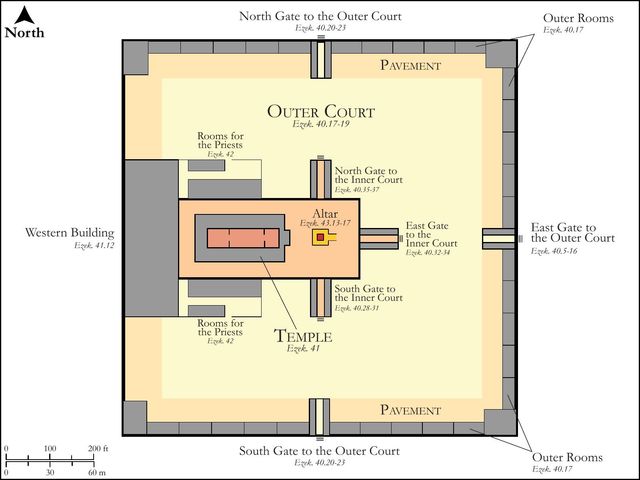
This verse is strategically placed within the climactic vision of the new temple, which spans Ezekiel chapters 40-48. Immediately preceding this command, Ezekiel has been given an extensive, guided tour of the temple's architectural details (chapters 40-42). Chapter 43 then marks a pivotal moment with the glorious return of the Lord's presence to this new temple, filling it with His glory (Ezekiel 43:1-5). Crucially, in Ezekiel 43:7-9, God declares His intent to dwell among the Israelites forever, but explicitly states that this requires their putting away idolatry and the defilement of their kings. Thus, Ezekiel 43:10 functions as the practical instruction for how this divine standard and the accompanying call to holiness are to be communicated. The visionary temple is not merely a future hope but an immediate instrument of conviction, designed to prepare the people for God's holy presence.
Historical & Cultural Context
Ezekiel's prophetic ministry unfolded during the Babylonian exile (597-538 BC), a period of profound national humiliation and spiritual reckoning for Judah. The destruction of Jerusalem and Solomon's Temple in 586 BC by Nebuchadnezzar was understood as divine judgment for the nation's persistent idolatry, moral corruption, and covenant unfaithfulness. While physically removed from their land, many exiles still harbored spiritual complacency or false hope. The detailed temple vision, given to Ezekiel while he was among the exiles by the Chebar Canal, served multiple purposes: it offered a blueprint for future restoration, symbolized God's enduring presence despite judgment, and, crucially, provided a stark contrast to Israel's past defilement. The concept of a "pattern" or blueprint was familiar from the tabernacle, which Moses made after the pattern shown him in the mount, and from the temple, whose pattern David gave to Solomon, divine specifications being essential for proper construction and ensuring the structure was fit for divine habitation.
Key Themes
ShowHideEzekiel 43:10 powerfully contributes to several overarching themes within the book of Ezekiel. First, it underscores the theme of Divine Revelation and Accountability, as God explicitly commands Ezekiel to "shew the house" to Israel, indicating that divine truth is revealed not for passive observation but for active engagement and transformation. Second, the verse highlights the theme of God's Holiness and Israel's Sin. The magnificent, meticulously designed temple represents God's absolute purity and perfect order, which stands in stark contrast to the "iniquities" of Israel, emphasizing the chasm between divine perfection and human depravity. This contrast is intended to elicit "shame," a catalyst for genuine repentance, a theme echoed in passages like Ezekiel 36:31. Finally, the command to "measure the pattern" introduces the theme of Conformity to Divine Standards. It's not enough to merely see the vision; Israel is called to internalize its dimensions, implying a call to align their lives, worship, and national conduct with God's unblemished requirements, a concept foundational to the covenant relationship found throughout the Pentateuch.
Exposition and Analysis
ShowHideKey Word Analysis
ShowHideThis word, appearing twice in the verse, signifies more than just a physical structure. From its root suggesting "builder," bayith' encompasses a wide semantic range including a physical dwelling, a family, a household, or even a dynasty. Here, the first "house" refers to the visionary temple, a symbol of God's dwelling place and His holy presence. The second "house" refers to the "house of Israel," denoting the entire nation, the collective people of God. The repetition emphasizes the divine intention for the sacred dwelling to impact the human dwelling, calling the people to reflect the holiness of the place where God intends to reside.
Derived from a root meaning "to wound," kâlam' primarily denotes a deep sense of humiliation, disgrace, or confusion. It is not merely a superficial embarrassment but a profound internal conviction that leads to self-reproach. In this context, the shame is a divinely intended consequence of confronting God's perfect standard as embodied in the temple. It is a "godly sorrow" (as described in 2 Corinthians 7:10) designed to expose the perversity of their "iniquities" and prompt genuine repentance, rather than merely leading to despair.
This word, from a root meaning "to weigh" or "to measure," refers to an "admeasurement" or "consummation"—a precise design, blueprint, or exact specification. It implies a complete and perfect plan, leaving no room for deviation. The command to "measure the pattern" is not about physically measuring the visionary temple, but about internalizing its divine specifications. It represents a call for Israel to meticulously examine God's holy standards, understand their implications, and align their lives and worship with this perfect, divinely ordained blueprint for righteousness.
Verse Breakdown
ShowHide"Thou son of man,"
This is God's consistent address to Ezekiel throughout the book, emphasizing the prophet's human frailty and mortality in stark contrast to the divine majesty and authority of the one speaking. It highlights that the message is from God, delivered through a humble human instrument, underscoring the divine origin and authority of the revelation.
"shew the house to the house of Israel,"
This is the core command. Ezekiel is not merely to receive the vision for himself, but to actively "shew" (Hebrew: nâgad, to declare, announce, explain) the visionary temple ("the house") to the entire nation ("the house of Israel"). This underscores the revelatory and communicative nature of prophecy; divine truth is meant to be shared for the transformation of the community, not kept in isolation.
"that they may be ashamed of their iniquities:"
This clause reveals the primary, redemptive purpose of the revelation. The detailed vision of God's holy dwelling is intended to serve as a mirror, reflecting Israel's moral and spiritual corruption ("iniquities" – Hebrew: ʻâvôn, meaning perversity, guilt, or sin). The resulting "shame" is a divinely orchestrated emotional response, a necessary precursor to genuine repentance and turning away from their twisted paths, leading to spiritual healing rather than mere condemnation.
"and let them measure the pattern."
This final command outlines the required response from Israel. "Measuring the pattern" (Hebrew: mâdad tokniyth) implies a diligent, thorough study and internalization of the temple's divine specifications. It's a call to understand the precise requirements of God's holiness and to use this perfect blueprint as a standard against which to evaluate their own lives, practices, and national conduct, leading to conformity and righteousness in every sphere.
Literary Devices
ShowHideEzekiel 43:10 employs several potent literary devices to convey its profound message. The direct address, Apostrophe, in "Thou son of man," immediately establishes the personal, authoritative nature of God's communication to Ezekiel, highlighting the prophet's role as a humble yet crucial messenger. The "house" (the temple) functions as powerful Symbolism, representing God's holy presence, His perfect order, and the divine standard for worship and life. Similarly, the "pattern" is symbolic of God's immutable laws and the precise requirements for a people who would dwell in His presence. There is a strong element of Contrast implicit in the verse: the ideal, holy temple and its perfect "pattern" are set against the "iniquities" of Israel. This juxtaposition is designed to expose the vast disparity between God's holiness and humanity's sinfulness, thereby eliciting the desired "shame." Finally, the use of Imperative Mood in the commands "shew" and "let them measure" underscores the non-negotiable nature of God's instructions and the expected, active response from His people.
Theological and Thematic Connections
ShowHideEzekiel 43:10 articulates a profound theological truth: God's revelation of His holiness is intrinsically linked to humanity's conviction of sin and subsequent call to repentance. The visionary temple, with its meticulous "pattern," serves as a tangible representation of God's absolute purity and His unyielding standards. By exposing Israel to this divine blueprint, God intended to highlight the depth of their "iniquities," fostering a shame that was not merely punitive but redemptive, designed to lead them back into right relationship with Him. This principle extends beyond ancient Israel, affirming that God continues to reveal His character and commands—supremely through His Word and His Son—to bring about conviction, repentance, and transformation in the lives of His people, enabling them to live in conformity with His holy nature and ultimately glorify Him.
Reflection and Application
ShowHideEzekiel 43:10 offers timeless principles for believers today. Just as ancient Israel was called to confront God's perfect standard in the visionary temple, we are called to measure our lives against the ultimate "pattern" revealed in Jesus Christ and the Holy Scriptures. This spiritual "measurement" is not meant to condemn but to illuminate areas where we fall short of God's glory, fostering a godly sorrow that leads to genuine repentance and transformation. It reminds us that true spiritual growth begins with a humble acknowledgment of our sinfulness in light of God's perfect holiness. This process of self-examination, guided by God's Word and empowered by the Holy Spirit, should inspire us to pursue greater conformity to Christ, allowing His Spirit to refine our character and conduct so that our lives increasingly reflect His beauty and bring Him glory in a world desperately in need of His light.
Questions for Reflection
ShowHideFAQ
ShowHideWhat is the "house" that Ezekiel is commanded to show?
ShowHideThe "house" refers to the highly detailed, visionary temple that God revealed to Ezekiel in chapters 40-42 of his prophecy. This was not a physical temple to be immediately built, but a symbolic blueprint representing God's ideal dwelling place among His people, characterized by perfect holiness, order, and precise measurements. It served as a divine standard and a promise of future restoration, emphasizing God's desire to dwell with a sanctified people, as seen in Ezekiel 43:7.
Why was Israel supposed to be "ashamed of their iniquities"?
ShowHideThe shame was a divinely intended consequence, a necessary step towards repentance and spiritual renewal. By confronting the magnificent holiness and perfect order of the visionary temple, Israel would be forced to see the stark contrast with their own history of idolatry, moral corruption, and covenant unfaithfulness. This "godly sorrow" (compare 2 Corinthians 7:10) was meant to lead them to acknowledge their deep-seated "iniquities" (twistedness, perversity) and turn back to God, preparing them for a renewed relationship and the eventual fulfillment of the temple's promise. It was a redemptive shame, designed to bring about true change.
Christ-Centered Fulfillment
ShowHideEzekiel 43:10 finds its ultimate and glorious fulfillment in Jesus Christ. While the visionary temple served as a physical "pattern" for Israel to measure themselves against, Jesus Himself is the perfect, living "pattern" of God's holiness and the true dwelling place of God among humanity. He is the ultimate revelation of God, as John 1:18 states, "No one has ever seen God; the only God, who is at the Father's side, he has made him known." Jesus declared Himself to be the true temple (e.g., John 2:19-21), signifying that God's presence no longer dwells primarily in a physical structure but uniquely in His Son. Through His sinless life, sacrificial death, and resurrection, Christ perfectly fulfilled the demands of God's holy "pattern," bearing the shame of our "iniquities" (as prophesied in Isaiah 53:5) and providing the means for us to be reconciled to God. Now, through faith in Him, believers are made new creations and indwelt by the Holy Spirit, becoming living temples of God (e.g., 1 Corinthians 6:19-20). The call to "measure the pattern" for us is to conform our lives to the perfect image of Christ, allowing His righteousness to expose our sin and His grace to empower our transformation, until we, the Church, collectively reflect the glory of God's dwelling place, anticipating the final new heavens and new earth where God will truly "dwell with them" (Revelation 21:3).