


Ezekiel 43:11
Bible text: King James Version (1769 Blayney text) · Public domain
Bible text: King James Version with Strong's numbers · Public domain
Bible text: Berean Standard Bible · Public domain
Bible text: American Standard Version (1901) · Public domain
Bible text: World English Bible, Messianic edition · Public domain
Bible text: Geneva Bible (1599) · Public domain
Bible text: Young's Literal Translation · Public domain
- וְאִםve·'imand ifH518Conj-w ¦ PrtParticle Conditionalוְandאִםif
- נִכְלְמוּnikh·le·Muthey are ashamedH3637V-Niphal-Perf-3cpVerb Niphal Perfect 3rd Plural common gender
- מִכֹּלmi·Kolfrom allH3605Prep-m ¦ N-msNoun Singular Masculine Absoluteמִfromכֹּלall
- אֲשֶׁר'a·SherthatH834RelParticle Relative
- עָשׂוּ'a·Suthey have doneH6213V-Qal-Perf-3cpVerb Qal Perfect 3rd Plural common gender
- צוּרַתtzu·Rat[the] design ofH6699N-fscNoun Singular Feminine Construct
- הַבַּיִתha·Ba·yitthe houseH1004Art ¦ N-msNoun Singular Masculine Absoluteהַtheבַּיִתhouse
- וּתְכוּנָתוֹu·te·khu·na·Toand its arrangementH8498Conj-w ¦ N-fsc ¦ 3msNoun Singular Feminine Constructוּandתְכוּנָתarrangementוֹits
- וּמוֹצָאָיוu·mo·tza·'Avand its exitsH4161Conj-w ¦ N-mpc ¦ 3msNoun Plural Masculine Constructוּandמוֹצָאָיexitsוits
- וּמוֹבָאָיוu·moa·'Avand its entrancesH4126Conj-w ¦ N-mpc ¦ 3msNoun Plural Masculine Constructוּandמוֹבָאָיentrancesוits
- וְכָלve·kholand allH3605Conj-w ¦ N-mscNoun Singular Masculine Constructוְandכָלall
- צוּרֹתָיוtzu·ro·Tavits designsH6699N-fpc ¦ 3msNoun Plural Feminine Constructצוּרֹתָיdesignsוits
- וְאֵתve·'Etand <obj.>H853Conj-w ¦ DirObjMParticle Object Indicatorוְandאֵת<obj.>
- כָּלkolallH3605N-mscNoun Singular Masculine Construct
- חֻקֹּתָיוchu·ko·Tavits statutesH2708N-fpc ¦ 3msNoun Plural Feminine Constructחֻקֹּתָיstatutesוits
- וְכָלve·kholand allH3605Conj-w ¦ N-mscNoun Singular Masculine Constructוְandכָלall
- צוּרֹתָיוtzu·ro·taivits designsH6699N-fpc ¦ 3msNoun Plural Feminine Constructצוּרֹתָיdesignsוits
- וְכָלve·kholand allH3605Conj-w ¦ N-mscNoun Singular Masculine Constructוְandכָלall
- תּוֹרֹתָיוto·ro·tovits lawsH8451N-fpc ¦ 3msNoun Plural Feminine Constructתּוֹרֹתָיlawsוits
- הוֹדַעho·Da'make known toH3045V-Hiphil-Imp-2msVerb Hiphil Imperative 2nd Singular Masculine
- אוֹתָם'o·Tam<obj.> themH853DirObjM ¦ 3mpParticle Object Indicatorאוֹתָ<obj.>םthem
- וּכְתֹבu·khe·Toand writeH3789Conj-w ¦ V-Qal-Imp-2msVerb Qal Imperative 2nd Singular Masculineוּandכְתֹבwrite
- לְעֵינֵיהֶםle·'ei·nei·Hemto their eyesH5869Prep-l ¦ N-fdc ¦ 3mpNoun Dual Feminine Constructלְtoעֵינֵיeyesהֶםtheir
- וְיִשְׁמְרוּve·yish·me·Ruso they may keepH8104Conj-w ¦ V-Qal-ConjImperf-3mpVerb Qal Conjunction+Imperfect 3rd Plural Masculineוְsoיִשְׁמְרוּthey may keep
- אֶת'et<obj.>H853DirObjMParticle Object Indicator
- כָּלkolallH3605N-mscNoun Singular Masculine Construct
- צוּרָתוֹtzu·ra·Toits designH6699N-fsc ¦ 3msNoun Singular Feminine Constructצוּרָתdesignוֹits
- וְאֶתve·'Etand <obj.>H853Conj-w ¦ DirObjMParticle Object Indicatorוְandאֶת<obj.>
- כָּלkolallH3605N-mscNoun Singular Masculine Construct
- חֻקֹּתָיוchu·ko·Tavits statutesH2708N-fpc ¦ 3msNoun Plural Feminine Constructחֻקֹּתָיstatutesוits
- וְעָשׂוּve·'a·Suand they will doH6213Conj-w ¦ V-Qal-ConsecPerf-3cpVerb Qal Consecutive Perfect 3rd Plural common genderוְandעָשׂוּthey will do
- אוֹתָם'o·Tam<obj.> themH853DirObjM ¦ 3mpParticle Object Indicatorאוֹתָ<obj.>םthem
English is a literal word-by-word gloss of the Hebrew, not the KJV's wording. Why?
This is the original text the KJV's translators worked from — each Hebrew word with its own literal English meaning in this verse, prepared by scholars at Tyndale House, Cambridge. The KJV translates whole sentences, not word by word, so its wording differs: one Hebrew word can become several English words, and the KJV may choose “the LORD” where the gloss reads “Yahweh”. Both are faithful — they answer different questions. For the KJV's own rendering, switch to the KJV text.
Details
See on the biblical-era map
Study this verse
Public-domain commentary
Matthew Henry
From his Commentary on the Whole Bible. Henry comments on passages, not single verses — this entry covers Ezekiel 43:7–12. His two-level outline is real structure in the source text, so it is rendered as structure.
God does here, in effect, renew his covenant with his people Israel, upon his retaking possession of the house, and Ezekiel negotiates the matter, as Moses formerly. This would be of great use to the captives at their return both for direction and encouragement; but it looks further, to those that are blessed with the privileges of the gospel-temple, that they may understand how they are before him on their good behaviour.
I.God, by the prophet, puts them in mind of their former provocations, for which they had long lain under the tokens of his displeasure.
This conviction is spoken to them to make way for the comforts designed them. Though God gives and upbraids not, it becomes us, when he forgives, to upbraid ourselves with our unworthy conduct towards him. Let them now remember therefore,
1.That they had formerly defiled God's holy name, had profaned and abused all those sacred things by which he had made himself known among them, Eze 43:7. They and their kings had brought contempt on the religion they professed, and their relation to God, by their spiritual whoredom, their idolatry, and by worshipping images, which they called their kings (for so Moloch signifies) or lords (for so Baal signifies), but which were really the carcases of kings, not only lifeless and useless, but loathsome and abominable as dead carcases, in their high places, set up in honour of them. They had defiled God's name by their abominations. And what were they? It was in setting their threshold by my thresholds, and their post by my posts, that is, adding their own inventions to God's institutions, and urging all to a compliance with them, as if they had been of equal authority and efficacy, teaching for doctrines the commandments of men (Isa 29:13); or, rather, setting up altars to their idols even in the courts of the temple, than which a more impudent affront could not be put upon the divine Majesty. Thus they set up a separation wall between him and them, which stopped the current of his favours to them and spoiled the acceptableness of their services to him. See what an indignity sinners do to God, setting up their walls in opposition to his, and thrusting him out from what is his right; and see what injury they do to themselves, for the nearer any come to God with their sins the further they set him at a distance from them. Some give this sense of it: Though their houses joined close to God's house, their posts and thresholds to hi, so that they were in a manner his next neighbours, there was but a wall between me and them (so it is in the margin), so that it might have been expected they would acquaint themselves with him and be in care to please him, yet they were not so much as neighbourly. Note, It often proves too true, The nearer the church the further from God. They were, by profession, in covenant with God, and yet they had defiled the place of his throne and of the soles of his feet, his temple, where he did both reside and reign. Jerusalem is called the city of the great king (Psa 48:2) and his footstool, Psa 99:5; Psa 132:7. Note, When God's ordinances are profaned his holy name is polluted.
2.That for this God had had a controversy with them in their late troubles. They could not condemn him, for he had but brought upon them the desert of their sins: Wherefore I have consumed them in my anger. Note, Those that pollute God's holy name fall under his just displeasure.
II.He calls upon them to repent and reform, and, in order to that, to be ashamed of their iniquities (Eze 43:9):
"Now let them put away their whoredom; now that they have smarted so severely for it, and now that God is returning in mercy to them and setting up his sanctuary again in the midst of them, now let them cast away their idols and have no more to do with them, that they may not again forfeit the privileges which they have been taught to know the worth of by the want of them. Let them put away their idols, those loathsome carcases of their kings, far from me, from being a provocation to me." This was seasonable counsel now that the prophet had the model or pattern of the temple to set before them; for,
1.If they see that pattern, they will surely be ashamed of their sins (Eze 43:10): when they see what mercy God has in store for them, notwithstanding their utter unworthiness of it, they will be ashamed to think of their disingenuous conduct towards him. Note, The goodness of God to us should lead us to repentance, especially to a penitential shame. Let them measure the pattern themselves, and see how much it exceeds the former pattern, and guess by that what great things God has in store for them; and surely it will put them out of countenance to think what the desert of their sins was. And then,
2.If they be ashamed of their sins, they shall surely see more of the pattern, Eze 43:11. If they be ashamed of all that they have done, upon a general view of the goodness of God, let them have a more distinct particular account of the temple. Note, Those that improve what they see and know of the goodness of God shall see and know more of it. And then, and not till then, we are qualified for God's favours, when we are truly humbled for our own follies. "Show them the form of the house; let them see what a stately structure it will be; and withal show them the ordinances and laws of it." Note, With the foresights of our comforts it is fit that we should get the knowledge of our duty; with the privileges of God's house we must acquaint ourselves with the rules of it. Show them these ordinances, that they may keep them and do them. Note, Therefore we are made to know our duty, that we may do it, and be blessed in our deed.
III.He promises that they shall be such as they should be, and then he will be to them such as they would have him to be, Eze 43:7.
1.The house of Israel shall no more defile my holy name. This is pure gospel. The precept of the law says, You must not defile my name: the grace of the gospel says, You shall not. Thus what is required in the covenant is promised in the covenant, Jer 32:40.
2.Then I will dwell in the midst of them for ever; and the same again Eze 43:9. God secures to us his good-will be confirming in us his good work. If we do not defile his name, we may be sure that he will not depart from us.
IV.The general law of God's house is laid down (Eze 43:12), That, whereas formerly only the chancel, or sanctuary, was most holy, now the whole mountain of the house shall be so; the whole limit thereof, including all the courts and all the chambers, shall be as the most holy place, signifying that in gospel-times,
1.The whole church shall have the privilege of the holy of holies, that of a near access to God. All believers have now, under the gospel, boldness to enter into the holiest (Heb 10:19), with this advantage, that whereas the high priest entered in the virtue of the blood of bulls and goats, we enter in the virtue of the blood of Jesus, and, wherever we are, we have through him access to the Father.
2.The whole church shall be under a mighty obligation to press towards the perfection of holiness, as he who has called us is holy. All must now be most holy. Holiness becomes God's house for ever, and in gospel-times more than ever. Behold this is the law of the house; let none expect the protection of it that will not submit to this law.
Historical interpretation
Historical reception
1 surviving comment on this verse from the historical church.
(Verse 10 and following) But you, son of man, show the house of Israel the temple: and let them be confounded by their iniquities, and let them measure the structure, and let them be ashamed of all that they have done. Show them the form of the house and its structure, its exits and entrances, and all its descriptions and all its laws. Show them the entire order and all its laws, and write them in their sight, that they may keep all its arrangements and its laws, and do them. This is the law of the house on the top of the mountain: All its boundaries around, it will be most holy. This, therefore, is the law of the house. 70: And you, son of man, show the house of Israel the house, and they will cease from their sins, and its vision and its arrangement: and they themselves will bear their punishment for all the things they have done. And describe the house and its preparation, and its exits and entrances, and its substance and all its ordinances, and all its statutes you will show them, and describe them before them: and they will observe all my judgments and all my commandments, and they will do them, and the description of the house on the top of the mountain, all its boundaries around are most holy. This is the law of the house. It is not a small task to demonstrate to those who see with their eyes or with their minds, so that they themselves seem to have seen with you. Therefore, Josephus writes that those who were sent by Jesus son of Nave to describe the land were geometers and had the art which now belongs to philosophers, the art of Geometry. Thus, for the house of Israel, those who see God with their mind, the house is shown, that is, the temple which Ezekiel saw situated on the mountain, and not only on a mountain, but as it is now said, on the summit of the mountain: which we should not think is the one that is described as being built by Solomon in the books of Kings and Chronicles. For that [temple] belongs to another order and size, and in each [temple] it has great diversity: and it [the second temple] is so much inferior to the temple that Ezekiel now shows, that not only its worshipers and priests, but even its builder, Solomon, sinned and offended God, although he later repented, writing in the Proverbs, where he says: Finally, I repented and considered to choose discipline (Prov. XXIV, 2). But this, which is shown by Ezekiel and through Ezekiel to the house of Israel, is as follows: that whoever contemplates it with the mind, ceases from his iniquities, not some, but all of them: or as it is contained in Hebrew, is confused and endures punishment for all that he has done. But he endures the punishment of his iniquities, who ceases to commit past sins: and it greatly benefits him who has sinned before, to see the house of God, and to know the reason for all its structure; so that he may cease to sin, and having a longing for it, may say to the Lord: O Lord, I have loved the beauty of your house: and the place of the habitation of your glory (Ps. 25:8). And again: One thing I have asked of the Lord, this I seek: that I may dwell in the house of the Lord all the days of my life (Psalm 27:4), when I begin to live and be with Christ, who is the life of believers. It follows: His going out and coming in, understood as the house. But the going out of those who go out to those who are outside, and the coming in of those who penetrate the interior through the discipline of their masters. And every, he says, description or substance of it, as the Septuagint has translated, which pertains not so much to the nature of the house, but to the furnishings and riches. And you shall show them all the commandments, the entire order, and all the laws of the temple, to those who have carried the burden of their iniquities and have ceased or been confused about the things they had done before. But show it to them so that they may keep all the commandments. For it is of no use to know the description of the house and all its distributions, about which it is written: In my Father's house there are many mansions (John 14:2). And again: He established the boundaries of the nations according to the number of the children of Israel, even the angels of God (Deut. XXXII), unless you do what is commanded. But the house and law of all the commandments of God, and the city which is situated on the top of the mountain, that is to be believed, as it is written: A city cannot be hidden when it is situated on a mountain (Matth. I, 14). And: The rushing of the river makes the city of God rejoice (Ps. XLV, 4): which clearly refers to the Church, and is located on that mountain, which is at the top of all mountains, and from which the prince of Tyre was wounded: and all the borders and boundaries of this house are holy of holies. In that house, that is, in the tabernacle that was built by Moses, and in the temple that was constructed by Solomon, only the innermost parts, where the Cherubim, and the propitiatory, and the Ark of the Covenant, and the table of incense were located, were called the Holy of Holies. But in this house, which is shown by Ezekiel, and which is situated on the top of the mountain, all its boundaries are considered to be in the Holy of Holies. And what is inferred: This is the law of the house, either referring to the past, about which it has already been said, or to those things that will be said later.
Continue studying Ezekiel 43:11 across the web’s major study libraries — every link below opens this exact verse, chapter, or book on the destination site.
Read & Compare
 BibleGatewayThis verse in more than 200 translations and 70 languages.
 Bible.comThe YouVersion reader — hundreds of translations, reading plans, and highlights.
 ESV.orgCrossway's official English Standard Version reader.
 NET BibleThe NET translation with 60,000+ translators' notes on every rendering decision.
 STEP BibleTyndale House's free study tool — original text, vocabulary, and scholarly resources.
 BibliaLogos Bible Software's free web reader.
 USCCBThe New American Bible (Revised Edition) with the U.S. bishops' study notes.
Commentaries
 BibleHub CommentariesDozens of classic commentaries on this verse, gathered on one page.
 StudyLightMore than 100 commentary sets — the largest collection on the web.
 BibleRefPlain-English commentary on what this verse means, verse by verse.
 Enduring WordDavid Guzik's free commentary on this chapter, widely used by Bible teachers.
 Bible Study ToolsVerse commentary alongside Greek and Hebrew study aids.
Original Language & Research
- BibleHub InterlinearThe verse word by word — original language, transliteration, and English.
- BibleHub LexiconEvery word's original-language definition and Strong's entry.
 Blue Letter BibleDeep-study tools — Strong's numbers, concordance, and word studies.
 SefariaThe Hebrew text with Rashi and centuries of Jewish commentary.
Sermons, Hymns & Audio


TrulyRandomVerse is not affiliated with these sites and doesn’t control their content. They’re linked because they’re genuinely useful.
Summary
Ezekiel 43:11 presents a pivotal divine instruction, contingent upon the spiritual state of the exiled Israelites. God commands Ezekiel to meticulously reveal the complete blueprint—encompassing both the physical architecture and the operational ordinances—of the visionary temple. This revelation is explicitly conditioned on the people demonstrating profound shame and repentance for their past transgressions. The ultimate purpose of this detailed disclosure is to prompt them towards a deeper understanding and diligent observance of God's holy standards, thereby fostering a restored relationship defined by purity and obedience.
Context
ShowHideLiterary Context
This verse is deeply embedded within Ezekiel's grand vision of the new temple (Ezekiel 40-48), a profound message of hope and restoration delivered to a people in Babylonian exile. Preceding this vision, Ezekiel graphically depicted the departure of God's glory from the defiled first temple due to Israel's pervasive idolatry and sin, as seen in passages like Ezekiel 8 and Ezekiel 10. Chapter 43 specifically marks the glorious return of the Lord's presence to this new, purified sanctuary (Ezekiel 43:4). Verse 11 functions as a crucial theological hinge, linking the divine revelation of the temple's intricate design and operational laws to the moral and spiritual readiness of the people. It underscores that the full apprehension and appropriation of God's holy presence and instructions are not automatic but are contingent upon a profound internal transformation, specifically a genuine turning away from past sin and a commitment to holiness.
Historical & Cultural Context
Ezekiel prophesied during the traumatic period of the Babylonian exile (597-538 BC), a time of immense national humiliation and spiritual reckoning for the Israelites. The catastrophic destruction of Jerusalem and Solomon's Temple in 586 BC was widely understood as divine judgment for generations of persistent idolatry, oppression, and covenant disobedience. In this desolate context, Ezekiel's vision of a new, meticulously ordered temple was far more than an architectural fantasy; it was a potent symbol of future restoration, God's renewed covenant presence, and the re-establishment of a holy community. The extraordinary level of detail in the temple's design and its accompanying ordinances would have powerfully underscored God's absolute sovereignty and His uncompromising demand for purity, contrasting sharply with the defiled and syncretistic practices that had led to their exile. The call for shame and repentance was a direct and necessary challenge to the spiritual apathy and moral compromise prevalent in pre-exilic Israel.
Key Themes
ShowHideEzekiel 43:11 contributes significantly to several overarching themes woven throughout the book of Ezekiel. Foremost, it powerfully articulates the theme of God's Holiness and Glory, emphasizing that His dwelling place and the worship conducted within it must perfectly reflect His absolute purity, standing in stark contrast to Israel's historical defilement. Second, the verse highlights the indispensable necessity of Repentance and Transformation, positing that genuine shame over sin is a foundational prerequisite for receiving, understanding, and truly embracing divine revelation. This aligns seamlessly with Ezekiel's broader prophetic message concerning a new heart and a new spirit that God promises to bestow upon His people (Ezekiel 36:26-27). Third, it reinforces the theme of Divine Instruction and Order, demonstrating that God's comprehensive plan for His people and His sanctuary is meticulously detailed and not open to human innovation or compromise. The repeated emphasis on "forms," "ordinances," and "laws" points to the exhaustive nature of God's expectations for a restored, obedient community, a theme consistently found in prophetic literature concerning the future Messianic age where God's law would go forth from Zion (Isaiah 2:3).
Exposition and Analysis
ShowHideKey Word Analysis
ShowHideThis primitive root, H3637, properly means "to wound," but is figuratively used to denote "to taunt or insult." In the context of Ezekiel 43:11, it signifies a deep, internal sense of humiliation, disgrace, or profound confusion over one's past actions. It transcends mere regret, representing a conviction of wrongdoing as a direct offense against God's holiness, thereby prompting a sincere desire for radical change and spiritual alignment. This profound shame is presented as a necessary spiritual precondition for receiving God's further revelation.
A primitive root, means "to know," encompassing a vast array of applications including "to ascertain by seeing," "to recognize," "to instruct," or "to make known." Here, it specifically means to "show" or "make known" the temple's elaborate form and laws. This implies a deliberate, active, and comprehensive act of divine instruction and revelation, imparted exclusively to those who have demonstrated the spiritual readiness to receive and respond to it. It is about imparting knowledge that leads to profound understanding and obedient action.
A feminine noun derived from a root meaning "to engrave" or "to decree," refers to an "enactment," "appointment," or "statute." It denotes fixed, prescribed rules or customs, emphasizing the non-negotiable, divinely established nature of the temple's operational laws and, by extension, the people's conduct. These are not suggestions or flexible guidelines but binding decrees from God, reflecting His immutable character and His precise requirements for worship and holy living.
Verse Breakdown
ShowHide"And if they be ashamed of all that they have done"
This opening clause establishes a foundational and non-negotiable condition for the subsequent divine revelation. The phrase "all that they have done" comprehensively refers to the totality of Israel's past sins, particularly their pervasive idolatry, covenant breaking, and moral corruption that directly led to the destruction of the first temple and their bitter exile. The "shame" (H3637, kâlam) signifies a deep, internal conviction, remorse, and genuine regret over these actions, representing a necessary spiritual posture of humility and sincere repentance before God.
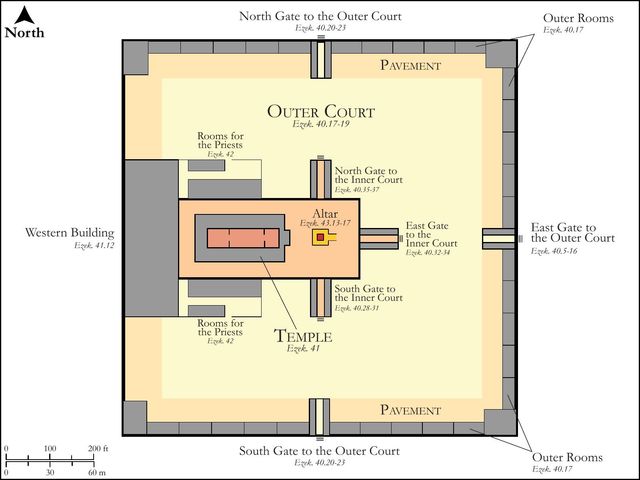
"shew them the form of the house, and the fashion thereof, and the goings out thereof, and the comings in thereof, and all the forms thereof, and all the ordinances thereof, and all the forms thereof, and all the laws thereof"
This extensive and highly detailed enumeration underscores the extreme precision and comprehensive nature of the divine blueprint for the visionary temple. "Form" (H6699, tsûwrâh) and "fashion" (H8498, tᵉkûwnâh) refer to the physical structure, architectural design, and overall appearance. "Goings out" (H4161, môwtsâʼ) and "comings in" (H4126, môwbâʼ) denote the entrances and exits, emphasizing the divinely regulated access to and from the holy space. The repeated "all the forms thereof," coupled with "ordinances" (H2708, chuqqâh) and "laws" (H8451, tôwrâh), highlights not only the physical structure but also the comprehensive operational statutes, rituals, and ethical requirements associated with the temple and its worship. This signifies that every conceivable aspect of the sacred space and its function is divinely prescribed, leaving no room for human interpretation or deviation.
"and write it in their sight, that they may keep the whole form thereof, and all the ordinances thereof, and do them."
The imperative command to "write it in their sight" emphasizes the critical importance of making these divine instructions explicit, tangible, visible, and universally accessible to the people. This act of writing ensures clarity, permanence, and accountability, preventing any claims of ignorance or misunderstanding. The ultimate purpose of this revelation is for the people to "keep" (H8104, shâmar) and "do" (H6213, ʻâsâh) these detailed forms and ordinances. This demonstrates unequivocally that the divine revelation is not merely for intellectual comprehension or passive admiration but for practical, diligent, and obedient application in their lives, leading to a holy walk consistent with the manifest presence of God among them.
Literary Devices
ShowHideEzekiel 43:11 is rich with several significant literary devices that amplify its theological message. Repetition is notably prominent, particularly with the phrases "all the forms thereof" and "all the ordinances thereof," which are reiterated multiple times. This rhetorical device serves to emphasize the exhaustive, comprehensive, and non-negotiable nature of God's instructions regarding His sanctuary, leaving absolutely no aspect to human improvisation or deviation. The opening clause, "And if they be ashamed...", functions as a powerful Proviso or conditional clause, establishing a crucial moral and spiritual prerequisite for the reception of divine revelation and underscoring the indispensable necessity of genuine repentance. The meticulous and extensive listing of architectural and ritual elements—"form," "fashion," "goings out," "comings in," "ordinances," "laws"—operates as a Merism. By enumerating specific, often contrasting or complementary, parts, the text effectively conveys the all-encompassing scope of God's design for His sanctuary and, by extension, the totality of the life lived in its holy sphere. This detailed description also creates vivid Imagery, allowing the exiled audience to mentally construct and grasp the divine ideal of holiness, order, and meticulous adherence to God's will, providing a tangible vision for their spiritual restoration.
Theological and Thematic Connections
ShowHideEzekiel 43:11 profoundly connects the reception of divine truth with the posture of human humility and repentance. It teaches a fundamental theological principle: God's revelation of His holy standards and His manifest presence is not given indiscriminately but is contingent upon a people's willingness to acknowledge, confess, and genuinely turn from their sin. The meticulous detail concerning the temple's design and laws underscores God's absolute sovereignty, His inherent holiness, and His uncompromising demand for purity in all aspects of worship and daily life. This visionary blueprint, granted during a period of national exile and spiritual desolation, offered a powerful message of hope for future restoration, yet it was a restoration predicated entirely on God's terms—a radical transformation of heart and an unwavering commitment to obedient living according to divine precepts. This foreshadows a deeper spiritual reality where God's presence would ultimately indwell His people, not in a physical temple, but through a renewed covenant relationship.
Reflection and Application
ShowHideEzekiel 43:11 offers timeless and transformative principles for our spiritual journey and our relationship with a holy God. First, it challenges us to cultivate a profound sense of "godly sorrow" or conviction over our sins, not as a source of debilitating condemnation, but as a divinely appointed catalyst for genuine repentance and a decisive turning towards God. This posture of humility and brokenness is the essential gateway for receiving deeper divine revelation and understanding. Second, just as the ancient Israelites were called to diligently study, understand, and obey the detailed blueprint of the visionary temple, we are likewise called to immerse ourselves in God's inspired Word, which serves as our infallible divine blueprint for life and worship. The Bible provides the "forms" and "ordinances" for living a life that is pleasing to God, guiding our "goings out" and our "comings in" in every sphere of existence. Our spiritual maturity and the depth of our experience of God's presence are directly linked to our willingness to not only intellectually grasp but also practically "keep" and "do" what God has commanded. This profound verse reminds us that true spiritual restoration, genuine intimacy with God, and the manifest experience of His presence are inextricably tied to a steadfast commitment to holiness and obedient living, consistently reflecting the character of the God who graciously chooses to dwell among us.
Questions for Reflection
ShowHideFAQ
ShowHideWhat does "if they be ashamed of all that they have done" mean in a practical sense for ancient Israel?
ShowHideFor ancient Israel, this phrase signified a profound and collective recognition of their national sins, encompassing their pervasive idolatry, consistent covenant breaking, and deep moral corruption, which had directly precipitated the destruction of Jerusalem and their exile to Babylon. It was not merely regret for the devastating consequences, but a deep, internal conviction that their actions had profoundly dishonored God and defiled His holy name. Practically, this "shame" would manifest as a decisive turning away from all forms of pagan practices, a renewed and wholehearted commitment to the Mosaic Law, and an earnest desire to live strictly according to God's righteous standards. This spiritual posture of humility and repentance was a crucial prerequisite for God to reveal His plans for their restoration and the new temple, signifying that a true and deep understanding of God's ways is only possible through a genuinely repentant heart, as beautifully articulated in passages like Psalm 51:17.
Why is there such an emphasis on the "form" and "ordinances" of the temple?
ShowHideThe profound emphasis on the "form" (H6699, tsûwrâh) and "ordinances" (H2708, chuqqâh) highlights God's absolute sovereignty and His meticulous attention to every detail concerning His dwelling place and the sacred worship conducted there. It signifies unequivocally that the temple was not a human invention or a matter of cultural preference, but a divine blueprint, precisely designed to reflect God's inherent holiness, perfect order, and unchangeable character. Every single aspect, from its precise physical dimensions to its intricate operational laws and rituals, was divinely prescribed to ensure purity, proper worship, and the maintenance of a holy and undefiled relationship between God and His people. This divine precision underscored that access to God's presence and the blessings of the covenant were strictly on His terms, not subject to human convenience, innovation, or compromise. It also served as a stark and powerful contrast to the chaotic, defiled, and unauthorized worship practices that had characterized pre-exilic Israel, which ultimately led to the departure of God's glory from the first temple (Ezekiel 10).
Christ-Centered Fulfillment
ShowHideEzekiel 43:11, with its conditional revelation of the temple's intricate form and precise ordinances based on the people's repentance, finds its ultimate and glorious Christ-centered fulfillment in the person and redemptive work of Jesus Christ. While the detailed architectural blueprint of Ezekiel's visionary temple was never literally constructed, its profound spiritual principles are perfectly and eternally embodied in Christ. Jesus Himself declared that He was the true temple, capable of being destroyed and rebuilt in three days (John 2:19-21), signifying that He is the ultimate dwelling place of God among humanity. The "goings out" and "comings in" of the temple, symbolizing regulated access to God's holy presence, are perfectly fulfilled in Christ, who authoritatively declared Himself to be "the way, the truth, and the life," through whom alone anyone can come to the Father (John 14:6). Furthermore, the "ordinances" and "laws" of the temple, which demanded absolute holiness and purity, are perfectly upheld in Christ's sinless life and are now, through the New Covenant, written not on stone tablets, but supernaturally on the hearts and minds of believers (Jeremiah 31:33). The profound shame and repentance required in Ezekiel 43:11 are fully met and transformed in the Gospel, where conviction of sin leads to saving faith in Christ's atoning sacrifice, which graciously cleanses us from all unrighteousness and restores us to fellowship with God (1 John 1:9). Through Christ, believers are transformed into living temples of the Holy Spirit (1 Corinthians 6:19), called to live in obedient conformity to the "law of Christ" (Galatians 6:2), thereby fulfilling the spiritual intent of Ezekiel's grand vision for a people who authentically reflect God's holiness and dwell in His manifest presence.