


Joshua 22:29
Bible text: King James Version (1769 Blayney text) · Public domain
Bible text: King James Version with Strong's numbers · Public domain
Bible text: Berean Standard Bible · Public domain
Bible text: American Standard Version (1901) · Public domain
Bible text: World English Bible, Messianic edition · Public domain
Bible text: Geneva Bible (1599) · Public domain
Bible text: Young's Literal Translation · Public domain
- חָלִילָהcha·li·Lahfar be itH2486PrtParticle Interjection
- לָּנוּLa·nuto <the> usPrep-l ¦ 1cpSuffix Personal 1st Plural common genderלָּto <the>נוּus
- מִמֶּנּוּmi·Me·nufrom usH4480Prep ¦ 1cpPreposition Definiteמִמֶּfromנּוּus
- לִמְרֹדlim·Rodto rebelH4775Prep-l ¦ V-Qal-InfVerb Qal Infinitive Constructלִtoמְרֹדrebel
- בַּיהוָהba·Yah·wehagainst YahwehH3068Prep-b ¦ N-properNoun Proper TitleבַּagainstיהוָהYahweh
- וְלָשׁוּבve·la·Shuvand to turn backH7725Conj-w ¦ Prep-l ¦ V-Qal-InfVerb Qal Infinitive Constructוְandלָtoשׁוּבturn back
- הַיּוֹםhai·yOmthis dayH3117Art ¦ N-msNoun Singular Masculine Absoluteהַthisיּוֹםday
- מֵאַחֲרֵיme·'a·cha·Reifrom afterH310Prep-m ¦ Adj-mpcAdjective Numerical Plural Masculine Constructמֵfromאַחֲרֵיafter
- יְהוָהYah·wehYahwehH3068N-properNoun Proper Title
- לִבְנוֹתliv·Notby buildingH1129Prep-l ¦ V-Qal-InfVerb Qal Infinitive Constructלִbyבְנוֹתbuilding
- מִזְבֵּחַmiz·Be·achan altarH4196N-msNoun Singular Masculine Absolute
- לְעֹלָהle·'o·Lahfor burnt offeringH5930Prep-l ¦ N-fsNoun Singular Feminine Absoluteלְforעֹלָהburnt offering
- לְמִנְחָהle·min·Chahfor grain offeringH4503Prep-l ¦ N-fsNoun Singular Feminine Absoluteלְforמִנְחָהgrain offering
- וּלְזָבַחu·le·Za·vachand for sacrificeH2077Conj-w ¦ Prep-l ¦ N-msNoun Singular Masculine Absoluteוּandלְforזָבַחsacrifice
- מִלְּבַדmi·le·Vad<from> <to> besidesH905Prep-m ¦ Prep-l ¦ N-mscNoun Singular Masculine Constructמִ<from>לְּ<to>בַדbesides
- מִזְבַּחmiz·Bach[the] altar ofH4196N-mscNoun Singular Masculine Construct
- יְהוָהYah·wehYahwehH3068N-properNoun Proper Title
- אֱלֹהֵינוּ'e·lo·Hei·nuour GodH430N-mpc ¦ 1cpNoun Plural Masculine ConstructאֱלֹהֵיGodנוּour
- אֲשֶׁר'a·SherwhichH834RelParticle Relative
- לִפְנֵיlif·Nei[is] <to> beforeH6440Prep-l ¦ N-mpcNoun Plural Masculine Constructלִ[is] <to>פְנֵיbefore
- מִשְׁכָּנוֹmish·ka·Nohis tabernacleH4908N-msc ¦ 3msNoun Singular Masculine Constructמִשְׁכָּנtabernacleוֹhis
English is a literal word-by-word gloss of the Hebrew, not the KJV's wording. Why?
This is the original text the KJV's translators worked from — each Hebrew word with its own literal English meaning in this verse, prepared by scholars at Tyndale House, Cambridge. The KJV translates whole sentences, not word by word, so its wording differs: one Hebrew word can become several English words, and the KJV may choose “the LORD” where the gloss reads “Yahweh”. Both are faithful — they answer different questions. For the KJV's own rendering, switch to the KJV text.
Details
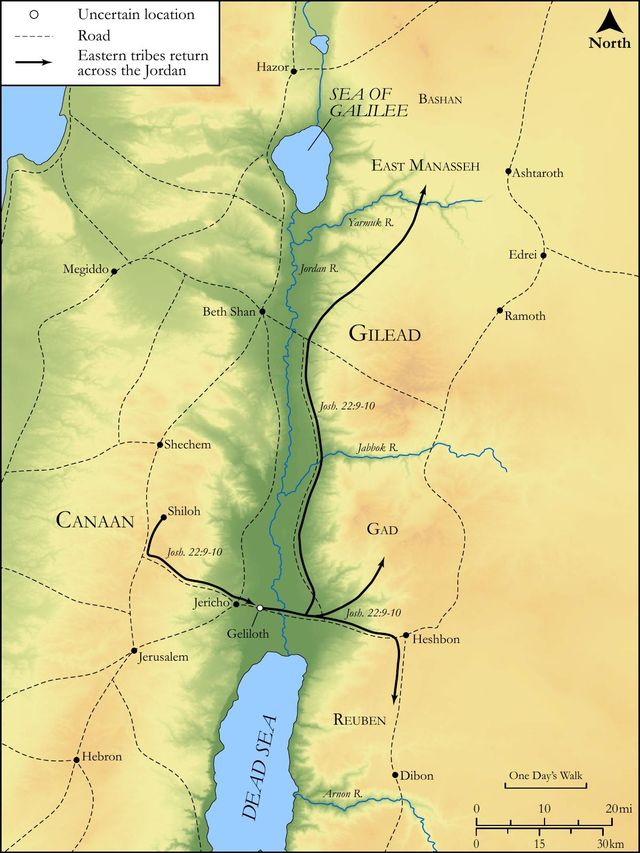
See on the biblical-era map
Study this verse
Historical interpretation
Historical reception
1 surviving comment on this verse from the historical church.
But let us see what sacrament lies within this deed. The former people of the circumcision are represented in Reuben, who was the firstborn; but also in Gad, who also is the firstborn out of Zilpah; and Manasseh, no less a firstborn. But insofar as I say “firstborn,” I speak chronologically. Therefore, these things are said not that it might be evident some division and separation is between us and those who were righteous before the coming of Christ, but that they might reveal themselves to still be our brothers even if they existed before the coming of Christ. For although they possessed an altar then before the coming of the Savior, nevertheless, they knew and perceived that it was not that true altar but that it was a form and figure of what would be the true altar. Those persons knew this because the true victims and those who were able to take away sins were not offered on that altar that the firstborn people possessed but on this one where Jesus was. Here the heavenly victims, here the true sacrifices are consumed. Therefore, they are made “one flock and one shepherd,” those former righteous ones and those who are now Christians.
Continue studying Joshua 22:29 across the web’s major study libraries — every link below opens this exact verse, chapter, or book on the destination site.
Read & Compare
 BibleGatewayThis verse in more than 200 translations and 70 languages.
 Bible.comThe YouVersion reader — hundreds of translations, reading plans, and highlights.
 ESV.orgCrossway's official English Standard Version reader.
 NET BibleThe NET translation with 60,000+ translators' notes on every rendering decision.
 STEP BibleTyndale House's free study tool — original text, vocabulary, and scholarly resources.
 BibliaLogos Bible Software's free web reader.
 USCCBThe New American Bible (Revised Edition) with the U.S. bishops' study notes.
Commentaries
 BibleHub CommentariesDozens of classic commentaries on this verse, gathered on one page.
 StudyLightMore than 100 commentary sets — the largest collection on the web.
 BibleRefPlain-English commentary on what this verse means, verse by verse.
 Enduring WordDavid Guzik's free commentary on this chapter, widely used by Bible teachers.
 Bible Study ToolsVerse commentary alongside Greek and Hebrew study aids.
Original Language & Research
- BibleHub InterlinearThe verse word by word — original language, transliteration, and English.
- BibleHub LexiconEvery word's original-language definition and Strong's entry.
 Blue Letter BibleDeep-study tools — Strong's numbers, concordance, and word studies.
 SefariaThe Hebrew text with Rashi and centuries of Jewish commentary.
Sermons, Hymns & Audio


TrulyRandomVerse is not affiliated with these sites and doesn’t control their content. They’re linked because they’re genuinely useful.
Summary
Joshua 22:29 articulates the fervent and unequivocal denial by the Transjordanian tribes—Reuben, Gad, and the half-tribe of Manasseh—of any rebellious intent against the LORD. This declaration is a pivotal moment in their defense, passionately clarifying that the large altar they constructed near the Jordan River was not for illicit sacrifices, but rather a profound memorial to their shared covenant loyalty and a testament to their desire to remain unified with the tribes west of the Jordan, thereby preventing what could have escalated into a devastating civil war.
Context
ShowHideLiterary Context
Joshua 22 serves as a crucial epilogue to the conquest and division of Canaan, detailing the return of the Transjordanian tribes to their inheritance. Having faithfully assisted their brethren in the conquest, Joshua dismisses them with blessings and exhortations to obey the Law. Upon their journey home, they build a large, conspicuous altar by the Jordan River. This act is immediately perceived by the other Israelite tribes as a grave act of apostasy and rebellion against the LORD, a direct violation of the command for a single, central place of worship at the Tabernacle in Shiloh, as outlined in Deuteronomy 12. The western tribes, fearing divine wrath upon all Israel, prepare for war, sending Phinehas and ten princes to confront the Transjordanian tribes. Joshua 22:29 is the climactic statement in the Transjordanian tribes' impassioned and articulate defense, emphatically denying any intention of establishing a rival cult or turning away from Yahweh. Their explanation, beginning in Joshua 22:21, clarifies the altar's true purpose as a witness to future generations, ensuring their continued participation in the covenant.
Historical & Cultural Context
The period immediately following the conquest of Canaan was one of establishing Israel's national and religious identity within their promised land. A cornerstone of Mosaic Law, particularly as articulated in Deuteronomy, was the command for a single, centralized place of worship where sacrifices were to be offered, as seen in Deuteronomy 12:5-7. This mandate was designed to prevent syncretism, idolatry, and the fragmentation of Israel's worship, which had plagued other nations and was a constant temptation for Israel. Altars, in Scripture, could serve various purposes: places of sacrifice, memorials such as Moses' altar Jehovah-nissi, or witnesses. The misunderstanding arose because the western tribes assumed the altar was for illicit sacrifices, a direct challenge to the LORD's authority and the unity of Israel. The very real threat of civil war underscores the gravity of perceived religious deviation and the deep commitment of the Israelites to maintaining covenant fidelity and avoiding the kind of apostasy that had led to God's judgment in the past.
Key Themes
ShowHideThis verse powerfully contributes to several overarching themes within Joshua and the broader Old Testament narrative. Firstly, it highlights Covenant Faithfulness and Loyalty to Yahweh. The emphatic denial "God forbid that we should rebel against the LORD" underscores the tribes' deep reverence for God and their unwavering commitment to the covenant, demonstrating that their fear of offending God superseded any other motive. Secondly, it reinforces the critical theme of Centralized Worship and the Prevention of Idolatry. The dispute itself, and the Transjordanian tribes' defense, revolves around the principle that legitimate worship, particularly sacrificial offerings, must occur at the LORD's designated altar before His Tabernacle. Building a rival altar would be an act of rebellion, leading to spiritual division and potential idolatry, similar to the condemned practices of the Canaanites. This principle was vital for Israel's spiritual purity and unity, as seen in Deuteronomy 12:11. Lastly, the episode emphasizes the critical importance of Unity within the Community of Faith and the dangers of Misunderstanding and the Necessity of Clear Communication. The potential for devastating civil war stemmed from a threat to Israel's national and spiritual cohesion. The tribes' passionate declaration served to preserve the unity of the twelve tribes, emphasizing that their actions were not intended to create a schism or defy the established divine order, but rather to affirm it. This entire narrative serves as a powerful lesson in seeking clarification before condemnation, as highlighted in Proverbs 18:13.
Exposition and Analysis
ShowHideKey Word Analysis
ShowHideThis strong interjection, derived from a root meaning "to profane," literally translates to "far be it!" or "unthinkable!" It expresses an emphatic rejection or abhorrence of an action or idea. In this context, it conveys a deep sense of moral and religious revulsion at the mere thought of rebelling against the LORD, indicating that the very notion is anathema to them. It functions as a powerful, oath-like statement of their innocence and unwavering fidelity.
This verb signifies an act of rebellion, revolt, or defiance against a legitimate authority, often carrying implications of breaking a covenant or treaty. Here, it refers to an act of spiritual and political insubordination against the LORD, Israel's divine King, by establishing a rival cultic center and thus undermining the divinely ordained unity and worship structure. The tribes vehemently deny any such intention.
This term refers to the portable sanctuary where God's presence dwelt among Israel, serving as the central place of worship and sacrifice. It was the divinely appointed locus for all legitimate offerings and interaction with God's covenant presence. The phrase "before his tabernacle" emphasizes the exclusive and singular nature of this designated place for proper worship, underscoring that any other altar for sacrifices would be an act of rebellion.
Verse Breakdown
ShowHide"God forbid that we should rebel against the LORD"
This opening clause is a powerful, almost oath-like, declaration of absolute loyalty. The Transjordanian tribes vehemently deny any intention of insubordination or disloyalty towards Yahweh, the covenant God of Israel. Their use of "God forbid" (חָלִילָה) underscores their utter abhorrence of such an act, portraying rebellion as the most grievous sin imaginable against their divine King.
"and turn this day from following the LORD"
This phrase further clarifies the nature of the "rebellion" they deny. It's not just an isolated act, but a fundamental turning away, a cessation of obedience and allegiance to Yahweh. "Following the LORD" implies adherence to His commands, His covenant, and His ways, particularly concerning worship and unity. Their denial asserts their unwavering commitment to continue in His path and remain faithful.
"to build an altar for burnt offerings, for meat offerings, or for sacrifices"
This specifies the exact nature of the perceived offense. The other tribes feared they were constructing a rival altar for the very types of sacrifices (burnt offerings, grain offerings, peace offerings) that were exclusively prescribed for the central Tabernacle. This would constitute a direct challenge to God's command and a schism in Israel's worship, which they vehemently deny as their intention.
"beside the altar of the LORD our God that [is] before his tabernacle"
This final clause highlights the core of the dispute: the location of legitimate worship. The Transjordanian tribes affirm their understanding that the only legitimate altar for these offerings is the one divinely sanctioned and placed "before his tabernacle." Their denial is that their new altar is for these offerings, thereby implicitly stating its purpose is something else entirely—a memorial, not a rival cultic site designed to usurp the LORD's designated place of worship.
Literary Devices
ShowHideJoshua 22:29 employs several potent Literary Devices to convey the tribes' fervent denial and commitment. The most prominent is Emphatic Denial, expressed through the strong interjection "God forbid" (חָלִילָה), which functions as a powerful Apostrophe directed at the very idea of rebellion, as if addressing and rejecting it outright. This creates a dramatic and emotionally charged tone, highlighting the depth of their revulsion at the accusation. The verse also utilizes Juxtaposition and Contrast by placing the perceived rebellious act (building an altar for illicit sacrifices) directly against their stated unwavering loyalty to the LORD and His designated altar. This contrast underscores the profound misunderstanding that threatened to tear Israel apart. Furthermore, the detailed listing of "burnt offerings, for meat offerings, or for sacrifices" serves as Specification, precisely identifying the types of cultic acts that were not the purpose of their altar, thereby clarifying the nature of their innocence and reinforcing the exclusivity of the Tabernacle's sacrificial system.
Theological and Thematic Connections
ShowHideJoshua 22:29 is a profound statement on the nature of true worship, covenant fidelity, and the essential unity of God's people. It underscores that obedience to God's revealed will, particularly concerning the prescribed forms and locations of worship, is paramount. Any deviation, even if well-intentioned, can be perceived as rebellion and lead to severe consequences. The tribes' passionate denial demonstrates a deep theological understanding that rebellion against the LORD is not merely a political act but a spiritual betrayal of the covenant relationship. It highlights God's desire for a unified people, worshipping Him in truth and order, and the dangers of misunderstanding that can fracture the body of believers. The episode serves as a timeless reminder that maintaining fellowship requires clear communication, a willingness to listen, and a shared commitment to God's established principles, prioritizing unity over hasty judgment.
Reflection and Application
ShowHideThe fervent denial of the Transjordanian tribes in Joshua 22:29 offers invaluable lessons for contemporary believers and the church. It challenges us to cultivate a profound commitment to God's revealed will, ensuring that our worship and service are truly in line with His desires, not merely our own interpretations or preferences. More broadly, this narrative highlights the critical importance of unity within the body of Christ. Just as a misunderstanding threatened to plunge Israel into civil war, so too can miscommunication, hasty judgment, and a lack of charity fracture Christian communities. We are called to assume good intentions in our brethren, to seek clarification before condemnation, and to communicate our own motives with transparency and humility. Our ultimate goal should always be to preserve the unity of the Spirit in the bond of peace, recognizing that our shared allegiance to Christ transcends minor differences and potential misinterpretations. This requires patience, active listening, and a willingness to extend grace, mirroring the way God extends grace to us.
Questions for Reflection
ShowHideFAQ
ShowHideWhy was building an altar such a grave offense to the other Israelite tribes?
ShowHideBuilding an altar was seen as a direct violation of God's command for a single, centralized place of worship, as explicitly stated in Deuteronomy 12. This command was crucial for maintaining the spiritual purity and unity of Israel, preventing idolatry and syncretism. A rival altar implied a rival cult, a turning away from Yahweh, and a schism within the nation, which could provoke divine wrath upon all Israel. The western tribes feared a repeat of past apostasies that had brought severe judgment upon the nation.
What was the actual purpose of the altar built by the Transjordanian tribes?
ShowHideAs explained by the Transjordanian tribes in Joshua 22:26-28, their altar was not for sacrifices but as a "witness" or "memorial." It was intended to serve as a perpetual reminder to future generations that they, too, were part of the LORD's covenant people and had a share in the Tabernacle worship, even though they lived across the Jordan. It was a visible sign of their shared heritage and their right to participate in the central worship, preventing their descendants from being excluded by the western tribes.
Christ-Centered Fulfillment
ShowHideJoshua 22:29, with its emphatic denial of rebellion and its focus on proper worship and unity, finds profound Christ-centered fulfillment. The very rebellion against the LORD that the Transjordanian tribes so vehemently denied is the universal human condition that Christ came to address. Humanity, by nature, has "turned this day from following the LORD" through sin and disobedience, building "altars" of self-worship and idolatry. Jesus Christ, however, perfectly fulfilled the Law's demands for true worship, not by physical altars and animal sacrifices, but by offering Himself as the ultimate and perfect sacrifice, the "Lamb of God, who takes away the sin of the world!" (John 1:29). He is the true and final "altar" upon which all acceptable worship is offered (Hebrews 13:10). Furthermore, Christ is the great reconciler, breaking down the "dividing wall of hostility" (Ephesians 2:14) between God and humanity, and between people, establishing a new spiritual unity in His body, the Church, where there is "neither Jew nor Gentile, neither slave nor free, nor is there male and female, for you are all one in Christ Jesus" (Galatians 3:28). The desire for unity and true worship expressed in Joshua 22:29 ultimately culminates in the person and work of Jesus, who enables us to worship God "in spirit and truth" (John 4:24) and perfectly reunites all who believe into one family under God.