


Ezra 9:14
Bible text: King James Version (1769 Blayney text) · Public domain
Bible text: King James Version with Strong's numbers · Public domain
Bible text: Berean Standard Bible · Public domain
Bible text: American Standard Version (1901) · Public domain
Bible text: World English Bible, Messianic edition · Public domain
Bible text: Geneva Bible (1599) · Public domain
Bible text: Young's Literal Translation · Public domain
- הֲנָשׁוּבha·na·Shuv¿ will we returnH7725Interrog ¦ V-Qal-Imperf-1cpVerb Qal Imperfect 1st Plural common genderהֲ¿נָשׁוּבwill we return
- לְהָפֵרle·ha·Ferto breakH6565Prep-l ¦ V-Hiphil-InfVerb Hiphil Infinitive Constructלְtoהָפֵרbreak
- מִצְוֹתֶיךָmitz·vo·Tei·khayour commandmentsH4687N-fpc ¦ 2msNoun Plural Feminine Constructמִצְוֹתֶיcommandmentsךָyour
- וּלְהִתְחַתֵּןu·le·hit·cha·Tenand to intermarryH2859Conj-w ¦ Prep-l ¦ V-Hithpael-InfVerb Hithpael Infinitive Constructוּandלְtoהִתְחַתֵּןintermarry
- בְּעַמֵּיbe·'a·Meiwith [the] peoples ofH5971Prep-b ¦ N-mpcNoun Plural Masculine Constructבְּwithעַמֵּי[the] peoples of
- הַתֹּעֵבוֹתha·to·'e·Votthe abominationsH8441Art ¦ N-fpNoun Plural Feminine Absoluteהַtheתֹּעֵבוֹתabominations
- הָאֵלֶּהha·'E·leh<the> theseH428Art ¦ PrtParticle Demonstrativeהָ<the>אֵלֶּהthese
- הֲלוֹאha·Lo'¿ notH3808Interrog ¦ NegParticle Negativeהֲ¿לוֹאnot
- תֶאֱנַףte·'e·nafwill you be angryH599V-Qal-Imperf-2msVerb Qal Imperfect 2nd Singular Masculine
- בָּנוּba·nuwith usPrep-b ¦ 1cpSuffix Personal 1st Plural common genderבָּwithנוּus
- עַד'aduntilH5704PrepPreposition
- כַּלֵּהka·Lehmake an endH3615V-Piel-InfAbsVerb Piel Infinitive Absolute
- לְאֵיןle·'Einto there notH369Prep-l ¦ N-mscNoun Singular Masculine Constructלְtoאֵיןthere not
- שְׁאֵרִיתshe·'e·Rit[will be] a remnantH7611N-fsNoun Singular Feminine Absolute
- וּפְלֵיטָהu·fe·lei·Tahand an escaped remnantH6413Conj-w ¦ N-fsNoun Singular Feminine Absoluteוּandפְלֵיטָהan escaped remnant
English is a literal word-by-word gloss of the Hebrew, not the KJV's wording. Why?
This is the original text the KJV's translators worked from — each Hebrew word with its own literal English meaning in this verse, prepared by scholars at Tyndale House, Cambridge. The KJV translates whole sentences, not word by word, so its wording differs: one Hebrew word can become several English words, and the KJV may choose “the LORD” where the gloss reads “Yahweh”. Both are faithful — they answer different questions. For the KJV's own rendering, switch to the KJV text.
Details
See on the biblical-era map
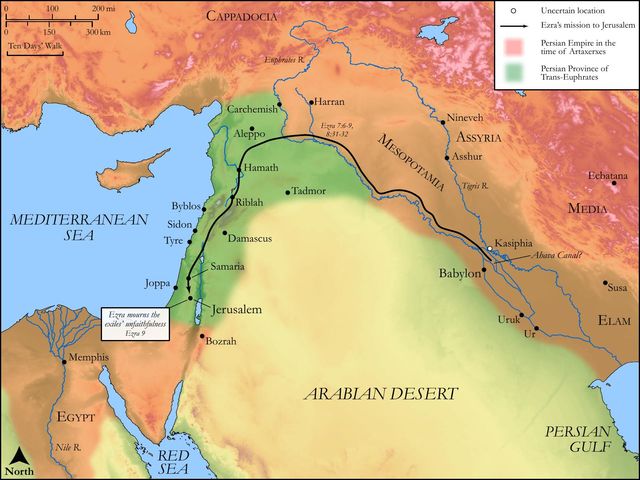
Study this verse
Public-domain commentary
Matthew Henry
From his Commentary on the Whole Bible. Henry comments on passages, not single verses — this entry covers Ezra 9:5–15. His four-level outline is real structure in the source text, so it is rendered as structure.
What the meditations of Ezra's heart were, while for some hours he sat down astonished, we may guess by the words of his mouth when at length he spoke with his tongue; and a most pathetic address he here makes to Heaven upon this occasion. Observe,
I.The time when he made this address - at the evening sacrifice, Ezr 9:5.
Then (it is likely) devout people used to come into the courts of the temple, to grace the solemnity of the sacrifice and to offer up their own prayers to God in concurrence with it. In their hearing Ezra chose to make this confession, that they might be made duly sensible of the sins of their people, which hitherto they had either not taken notice of or had made light of. Prayer may preach. The sacrifice, and especially the evening sacrifice, was a type of the great propitiation, that blessed Lamb of God which in the evening of the world was to take away sin by the sacrifice of himself, to which we may suppose Ezra had an eye of faith in this penitential address to God; he makes confession with his hand, as it were, upon the head of that great sacrifice, through which we receive the atonement. Certainly Ezra was no stranger to the message which the angel Gabriel had some years ago delivered to Daniel, at the time of the evening sacrifice, and as it were in explication of it, concerning Messiah the Prince (Dan 9:21, Dan 9:24); and perhaps he had regard to that in choosing this time.
II.His preparation for this address.
1.He rose up from his heaviness, and so far shook off the burden of his grief as was necessary to the lifting up of his heart to God. He recovered from his astonishment, got the tumult of his troubled spirits somewhat stilled and his spirit composed for communion with God.
2.He fell upon his knees, put himself into the posture of a penitent humbling himself and a petitioner suing for mercy, in both representing the people for whom he was now an intercessor.
3.He spread out his hands, as one affected with what he was going to say, offering it up unto God, waiting, and reaching out, as it were, with an earnest expectation, to receive a gracious answer. In this he had an eye to God as the Lord, and as his God, a God of power, but a God of grace.
III.The address itself.
It is not properly to be called a prayer, for there is not a word of petition in it; but, if we give prayer its full latitude, it is the offering up of pious and devout affections to God, and very devout, very pious, are the affections which Ezra here expresses. His address is a penitent confession of sin, not his own (from a conscience burdened with its own guilt and apprehensive of his own danger), but the sin of his people, from a gracious concern for the honour of God and the welfare of Israel. Here is a lively picture of ingenuous repentance. Observe in this address,
1.The confession he makes of the sin and the aggravations of it, which he insists upon, to affect his own heart and theirs that joined with him with holy sorrow and shame and fear, in the consideration of it, that they might be deeply humbled for it. And it is observable that, though he himself was wholly clear from this guilt, yet he puts himself into the number of the sinners, because he was a member of the same community - our sins and our trespass. Perhaps he now remembered it against himself, as his fault, that he had staid so long after his brethren in Babylon, and had not separated himself so soon as he might have done from the people of those lands. When we are lamenting the wickedness of the wicked, it may be, if we duly reflect upon ourselves and give our own hearts leave to deal faithfully with us, we may find something of the same nature, though in a lower degree, that we also have been guilty of. However, he speaks that which was, or should have been, the general complaint.
(1.)He owns their sins to have been very great: "Our iniquities are increased over our heads (Ezr 9:6); we are ready to perish in them as in keep waters;" so general was the prevalency of them, so violent the power of them, and so threatening were they of the most pernicious consequences. "Iniquity has grown up to such a height among us that it reaches to the heavens, so very impudent that it dares heaven, so very provoking that, like the sin of Sodom, it cries to heaven for vengeance." But let this be the comfort of true penitents that though their sins reach to the heavens God's mercy is in the heavens, Psa 36:5. Where sin abounds grace will much more abound.
(2.)Their sin had been long persisted in (Ezr 9:7): Since the days of our fathers have we been in a great trespass. The example of those that had gone before them he thought so far from excusing their fault that it aggravated it. "We should have taken warning not to stumble at the same stone. The corruption is so much the worse that it has taken deep root and begins to plead prescription, but by this means we have reason to fear that the measure of the iniquity is nearly full."
(3.)The great and sore judgments which God had brought upon them for their sins did very much aggravate them: "For our iniquities we have been delivered to the sword and to captivity (Ezr 9:7), and yet not reformed, yet not reclaimed - brayed in the mortar, and yet the folly not gone (Pro 27:22) - corrected, but not reclaimed."
(4.)The late mercies God had bestowed upon them did likewise very much aggravate their sins. This he insists largely upon, Ezr 9:8, Ezr 9:9. Observe,
[1.]The time of mercy: Now for a little space, that is, "It is but a little while since we had our liberty, and it is not likely to continue long." This greatly aggravated their sin, that they were so lately in the furnace and that they knew not how soon they might return to it again; and could they yet be secure?
[2.]The fountain of mercy: Grace has been shown us from the Lord. The kings of Persia were the instruments of their enlargement; but he ascribes it to God and to his grace, his free grace, without any merit of theirs.
[3.]The streams of mercy, - that they were not forsaken in their bondage, but even in Babylon had the tokens of God's presence, - that they were a remnant of Israelites left, a few out of many, and those narrowly escaped out of the hands of their enemies, by the favour of the kings of Persia, - and especially that they had a nail in his holy place, that is (as it is explained, Ezr 9:9), that they had set up the house of God. They had their religion settled and the service of the temple in a constant method. We are to reckon it a great comfort and advantage to have stated opportunities of worshipping God. Blessed are those that dwell in God's house, like Anna that departed not from the temple. This is my rest for ever, says the gracious soul.
[4.]The effects of all this. It enlightened their eyes, and it revived their hearts; that is, it was very comfortable to them, and the more sensibly so because it was in their bondage: it was life from the dead to them. Though but a little reviving, it was a great favour, considering that they deserved none and the day of small things was an earnest of greater. "Now," says Ezra, "how ungrateful are we to offend a God that has been so kind to us! how disingenuous to mingle in sin with those nations from whom we have been, in wonderful mercy, delivered! how unwise to expose ourselves to God's displeasure when we are tried with the returns of his favour and are upon our good behaviour for the continuance of it!"
(5.)It was a great aggravation of the sin that it was against an express command: We have forsaken thy commandments, Ezr 9:10. It seems to have been an ancient law of the house of Jacob not to match with the families of the uncircumcised, Gen 34:14. But, besides that, God had strictly forbidden it. He recites the command, Ezr 9:11, Ezr 9:12. For sin appears sin, appears exceedingly sinful, when we compare it with the law which is broken by it. Nothing could be more express: Give not your daughters to their sons, nor take their daughters to your sons. The reason given is because, if they mingled with those nations, they would pollute themselves. It was an unclean land, and they were a holy people; but if they kept themselves distinct from them it would be their honour and safety, and the perpetuating of their prosperity. Now to violate a command so express, backed with such reasons, and a fundamental law of their constitution, was very provoking to the God of heaven.
(6.)That in the judgments by which they had already smarted for their sins God had punished them less than their iniquities deserved, so that he looked upon them to be still in debt upon the old account. "What! and yet shall we run up a new score? Has God dealt so gently with us in correcting us, and shall we thus abuse his favour and turn his grace into wantonness?" God, in his grace and mercy, had said concerning Sion's captivity, She hath received of the Lord's hand double for all her sins (Isa 40:2); but Ezra, in a penitential sense of the great malignity that was in their sin, acknowledged that, though the punishment was very great, it was less than they deserved.
2.The devout affections that were working in him, in making this confession. Speaking of sin,
(1.)He speaks as one much ashamed. With this he begins (Ezr 9:6), O my God! I am ashamed and blush, O my God! (so the words are placed) to lift up my face unto thee. Note,
[1.]Sin is a shameful thing; as soon as ever our first parents had eaten forbidden fruit they were ashamed of themselves.
[2.]Holy shame is as necessary an ingredient in true and ingenuous repentance as holy sorrow.
[3.]The sins of others should be our shame, and we should blush for those who do not blush for themselves. We may well be ashamed that we are any thing akin to those who are so ungrateful to God and unwise for themselves. This is clearing ourselves, Co2 7:11.
[4.]Penitent sinners never see so much reason to blush and be ashamed as when they come to lift up their faces before God. A natural sense of our own honour which we have injured will make us ashamed, when we have done a wrong thing, to look men in the face; but a gracious concern for God's honour will make us much more ashamed to look him in the face. The publican, when he went to the temple to pray, hung down his head more than ever, as one ashamed, Luk 18:13.
[5.]An eye to God as our God will be of great use to us in the exercise of repentance. Ezra begins, O my God! and again in the same breath, My God. The consideration of our covenant-relation to God as ours will help to humble us, and break our hearts for sin, that we should violate both his precepts to us and our promises to him; it will also encourage us to hope for pardon upon repentance. "He is my God, notwithstanding this;" and every transgression in the covenant does not throw us out of covenant.
(2.)He speaks as one much amazed (Ezr 9:10) "What shall we say after this? For my part I know not what to say: if God do not help us, we are undone." The discoveries of guilt excite amazement: the more we think of sin the worse it looks. The difficulty of the case excites amazement. How shall we recover ourselves? Which way shall we make our peace with God?
[1.]True penitents are at a loss what to say. Shall we say, We have not sinned, or, God will not require it? If we do, we deceive ourselves, and the truth is not in us. Shall we say, Have patience with us and we will pay thee all, with thousands of rams, or our first-born for our transgression? God will not thus be mocked: he knows we are insolvent. Shall we say, There is no hope, and let come on us what will? That is but to make bad worse.
[2.]True penitents will consider what to say, and should, as Ezra, beg of God to teach them. What shall we say? Say, "I have sinned; I have done foolishly; God be merciful to me a sinner;" and the like. See Hos 14:2.
(3.)He speaks as one much afraid, Ezr 9:13, Ezr 9:14. "After all the judgments that have come upon us to reclaim us from sin, and all the deliverances that have been wrought for us to engage us to God and duty, if we should again break God's commandments, by joining in affinity with the children of disobedience and learning their ways, what else could we expect but that God should be angry with us till he had consumed us, and there should not be so much as a remnant left, nor any to escape the destruction?" There is not a surer nor sadder presage of ruin to any people than revolting to sin, to the same sins again, after great judgments and great deliverances. Those that will be wrought upon neither by the one nor by the other are fit to be rejected, as reprobate silver, for the founder melteth in vain.
(4.)He speaks as one much assured of the righteousness of God, and resolved to acquiesce in that and to leave the matter with him whose judgment is according to truth (Ezr 9:15): "Thou art righteous, wise, just, and good; thou wilt neither do us wrong nor be hard upon us; and therefore behold we are before thee, we lie at thy feet, waiting our doom; we cannot stand before thee, insisting upon any righteousness of our own, having no plea to support us or bring us off, and therefore we fall down before thee, in our trespass, and cast ourselves on thy mercy. Do unto us whatsoever seemeth good unto thee, Jdg 10:15. We have nothing to say, nothing to do, but to make supplication to our Judge," Job 9:15. Thus does this good man lay his grief before God and then leave it with him.
Continue studying Ezra 9:14 across the web’s major study libraries — every link below opens this exact verse, chapter, or book on the destination site.
Read & Compare
 BibleGatewayThis verse in more than 200 translations and 70 languages.
 Bible.comThe YouVersion reader — hundreds of translations, reading plans, and highlights.
 ESV.orgCrossway's official English Standard Version reader.
 NET BibleThe NET translation with 60,000+ translators' notes on every rendering decision.
 STEP BibleTyndale House's free study tool — original text, vocabulary, and scholarly resources.
 BibliaLogos Bible Software's free web reader.
 USCCBThe New American Bible (Revised Edition) with the U.S. bishops' study notes.
Commentaries
 BibleHub CommentariesDozens of classic commentaries on this verse, gathered on one page.
 StudyLightMore than 100 commentary sets — the largest collection on the web.
 BibleRefPlain-English commentary on what this verse means, verse by verse.
 Enduring WordDavid Guzik's free commentary on this chapter, widely used by Bible teachers.
 Bible Study ToolsVerse commentary alongside Greek and Hebrew study aids.
Original Language & Research
- BibleHub InterlinearThe verse word by word — original language, transliteration, and English.
- BibleHub LexiconEvery word's original-language definition and Strong's entry.
 Blue Letter BibleDeep-study tools — Strong's numbers, concordance, and word studies.
 SefariaThe Hebrew text with Rashi and centuries of Jewish commentary.
Sermons, Hymns & Audio


TrulyRandomVerse is not affiliated with these sites and doesn’t control their content. They’re linked because they’re genuinely useful.
Summary
Ezra 9:14 captures the profound despair and rhetorical intensity of Ezra's prayer, as he confronts the spiritual infidelity of the returned Jewish exiles. This verse, presented as a poignant question to God, articulates Ezra's deep-seated fear that the people's persistent and deliberate disobedience—specifically their intermarriage with pagan nations—will provoke God's righteous wrath to such an extent that He will utterly consume them, leaving no survivors or remnant. It serves as a stark reminder of the dire consequences of covenant unfaithfulness and implicitly acknowledges the justness of divine judgment.
Context
ShowHideLiterary Context
This verse stands as the climactic and emotionally charged rhetorical question within Ezra's extended prayer of confession and lament, spanning Ezra 9:6-15. The prayer itself is a direct response to the shocking discovery that the Jewish returnees, including priests and Levites, had engaged in widespread intermarriage with the surrounding pagan peoples (Ezra 9:1-2). Ezra's initial reaction to this egregious sin is one of profound grief and horror, expressed through tearing his garments, pulling out his hair, and sitting appalled until the evening sacrifice (Ezra 9:3-5). His subsequent prayer is a corporate confession, acknowledging Israel's long history of rebellion, God's just disciplinary actions (such as the Babylonian exile), and the current, seemingly unrepentant breach of the covenant. Verse 14 functions as the theological and emotional apex of his plea, articulating the ultimate fear of complete annihilation due to persistent and unaddressed rebellion, questioning how God could possibly refrain from a final, consuming judgment.
Historical & Cultural Context
The setting for Ezra 9:14 is post-exilic Jerusalem, approximately 458 BC, during the Persian Empire's rule. The Jewish people had only recently returned from seventy years of Babylonian captivity, a devastating judgment brought upon them precisely because of their idolatry, moral corruption, and persistent covenant unfaithfulness. The Mosaic Law contained explicit and severe prohibitions against intermarriage with the surrounding pagan nations (Deuteronomy 7:1-4), a command foundational to maintaining Israel's distinct identity as a holy nation set apart for Yahweh. These nations, including the Canaanites, Hittites, Perizzites, Jebusites, Ammonites, Moabites, Egyptians, and Amorites (as specified in Ezra 9:1), were known for their idolatrous practices, child sacrifice, and various forms of sexual immorality, all of which were "abominations" to God. For the returnees to engage in such intimate alliances was not merely a social misstep; it was a direct and deliberate betrayal of their covenant with Yahweh, threatening to reintroduce the very spiritual corruption and syncretism that had led to the previous divine judgment of exile.
Key Themes
ShowHideEzra 9:14 powerfully contributes to several overarching themes present in the book of Ezra and the broader biblical narrative. Firstly, it underscores the Consequences of Disobedience, illustrating that persistent and deliberate rebellion against God's explicit commands inevitably leads to severe divine judgment, threatening the very existence of the covenant community. Secondly, it highlights the paramount importance of Holiness and Separation, emphasizing God's call for His people to remain distinct from the defiling practices of the surrounding nations to preserve their spiritual purity and unique identity as His chosen people, a theme deeply rooted in the Pentateuch, particularly in passages like Leviticus 11:44-45. Thirdly, the verse speaks to Covenant Fidelity, demonstrating that the act of "joining in affinity" was a profound breach of the covenant God established with Israel, risking the complete abrogation of His promises and the loss of the "remnant" He had graciously preserved. Finally, Ezra's rhetorical question implicitly affirms Divine Justice, acknowledging that God's anger and the potential for complete consumption would be entirely righteous and deserved given the people's repeated and unrepentant transgressions against His holy character and explicit commands.
Exposition and Analysis
ShowHideKey Word Analysis
ShowHideThis word (H2859) is derived from a primitive root meaning "to give (a daughter) away in marriage" or, more generally, "to contract affinity by marriage." Its use here emphasizes the deep, intimate, and covenantal bond being forged through intermarriage. This was not a casual association but the most profound form of union, directly threatening Israel's distinct spiritual and ethnic identity by integrating them with those engaged in "abominations." It highlights the deliberate nature of the sin as an act of assimilation.
The term (H8441) is a powerful theological descriptor, referring to something morally disgusting or abhorrent to God. Throughout the Old Testament, it frequently denotes idolatry, pagan rituals, and various forms of sexual immorality. In this context of intermarriage, it signifies that the pagan peoples' way of life, their false gods, and their customs were utterly detestable to Yahweh. By joining in affinity with them, Israel was embracing and legitimizing practices that God had explicitly condemned, thus defiling themselves and their covenant relationship.
This verb (H3615) signifies "to end," "to cease," "to be finished," or "to utterly destroy." In Ezra's prayer, it carries the terrifying connotation of complete annihilation or total destruction. It implies that God's wrath, if fully unleashed, would be so intense and thorough that it would leave no survivors, no "remnant," and no possibility of escape. Ezra fears a final, irreversible judgment that would obliterate the nation, fulfilling the warnings of the covenant curses for persistent disobedience.
Verse Breakdown
ShowHide"Should we again break thy commandments, and join in affinity with the people of these abominations?"
This opening clause of Ezra's rhetorical question expresses profound dismay and incredulity. The word "again" (H7725, shûwb) highlights the cyclical nature of Israel's sin, particularly their repeated failure to adhere to God's covenant laws despite previous judgments, such as the Babylonian exile. "Break thy commandments" (H6565, pârar and H4687, mitsvâh) refers to their direct violation of God's statutes, specifically the prohibition against intermarriage. "Join in affinity" (H2859, châthan) pinpoints the exact nature of their transgression: forging intimate, marital bonds with those whose very existence and practices were an affront to God, referred to as "the people of these abominations" (H5971, ʻam and H8441, tôwʻêbah). This part of the question underscores the gravity, deliberateness, and historical pattern of their sin.
"wouldest not thou be angry with us till thou hadst consumed [us],"
This is the second part of the rhetorical question, anticipating God's inevitable and righteous response. Ezra does not question if God would be angry (H599, ʼânaph), but rather affirms that His anger would be a just and necessary consequence of their actions. The phrase "till thou hadst consumed [us]" (H3615, kâlâh) conveys the terrifying extent of this anticipated wrath—a complete and utter destruction, a final end to their existence as a people. It reflects a profound understanding of God's holiness, His intolerance for persistent sin within His covenant community, and the just demands of His divine character.
"so that [there should be] no remnant nor escaping?"
This final clause describes the ultimate, terrifying outcome of God's consuming wrath. The fear of "no remnant" (H7611, shᵉʼêrîyth) is particularly poignant, as the concept of a preserved remnant was a recurring theme of hope in prophetic literature, signifying God's faithfulness to His promises despite Israel's failures. Ezra's fear here suggests that the current sin is so egregious, so utterly defiant, that it might even exhaust God's patience to preserve a small portion of His people. "Nor escaping" (H6413, pᵉlêyṭâh) reinforces the idea of total, inescapable judgment, leaving no one to carry on the line, the covenant, or the hope of the Messiah.
Literary Devices
ShowHideEzra 9:14 is primarily structured as a Rhetorical Question. This device is employed not to solicit an answer from God, but to emphasize the undeniable truth and the profound despair felt by the speaker. Ezra uses it to highlight the utter foolishness and catastrophic implications of the people's actions, making the inevitable divine judgment seem self-evident. The question functions as a powerful lament and confession, articulating the logical and terrifying consequence of their sin. Furthermore, the language of "consumed," "no remnant," and "no escaping" employs vivid Imagery of destruction and utter annihilation. While God is just and does punish sin, the starkness of Ezra's language conveys the intensity of his fear and the perceived severity of the people's transgression, magnifying the potential for complete obliteration. This serves to underscore the gravity of their covenant breach and the terrifying prospect of God's unmitigated wrath. The question also contains an element of Repetition (the implied "again" in "break thy commandments" and the historical pattern of sin), reinforcing the cyclical nature of Israel's rebellion.
Theological and Thematic Connections
ShowHideEzra's desperate rhetorical question in Ezra 9:14 cuts to the core of Israel's covenant relationship with Yahweh. The repeated breaking of God's commandments, especially through intermarriage with those practicing "abominations," was not a minor infraction but a direct assault on the very identity and purpose of God's chosen people. The fear of "no remnant nor escaping" reflects a profound understanding of God's holiness and His righteous judgment against sin, a judgment that had already manifested in the Babylonian exile. This verse underscores the conditional nature of the covenant blessings, where continued fidelity was necessary for the nation's well-being and survival. Ezra's anguish highlights the tension between God's justice, which demands a response to sin, and His mercy, which had consistently preserved a remnant. The severity of the current sin threatened to exhaust even that divine mercy, leading to a complete and final end, thereby jeopardizing the very lineage through which God's redemptive plan would unfold.
Reflection and Application
ShowHideEzra 9:14 serves as a potent and enduring warning for believers across all generations regarding the gravity of spiritual compromise and the imperative of maintaining purity in our walk with God. While the specific command against intermarriage was for ancient Israel, the underlying principle of avoiding intimate alliances that could corrupt our faith and draw us away from God remains profoundly relevant. This extends beyond marital relationships to business partnerships, deep friendships, and even cultural engagements where our core values and commitment to Christ might be diluted or compromised. Ezra's visceral reaction to the sin of his people, and his fear of God's consuming wrath, should awaken within us a healthy reverence for God's holiness and a serious consideration of the consequences of our own disobedience. It calls us to a vigilant self-assessment, asking where we might be "joining in affinity" with the "abominations" of our contemporary world, whether through the idolatry of wealth, the pursuit of worldly approval, the compromise of biblical truth, or the embrace of ungodly ideologies. Our spiritual integrity depends on our willingness to separate ourselves from that which is antithetical to God's character and commands.
Questions for Reflection
ShowHideFAQ
ShowHideWhy was intermarriage such a severe sin for ancient Israel, warranting such a strong reaction from Ezra?
ShowHideIntermarriage was not merely a social or cultural issue; it was a profound theological breach of the covenant God made with Israel. God had chosen Israel to be a holy nation, set apart from the idolatrous and immoral practices of the surrounding peoples. The prohibition against intermarriage, articulated in passages like Deuteronomy 7:3-4, was designed to prevent spiritual assimilation. Marrying into pagan families inevitably led to the adoption of their gods and customs, corrupting Israel's worship of Yahweh and leading them into idolatry, which was the primary sin that had led to the Babylonian exile in the first place. Ezra understood that this sin directly threatened Israel's unique identity as God's people and jeopardized their very existence as the custodians of God's covenant and the lineage of the Messiah.
Did God truly intend to "consume" Israel entirely, leaving "no remnant," as Ezra feared?
ShowHideEzra's question reflects his deep anguish and a profound understanding of God's righteous anger against sin, especially repeated and deliberate covenant breaking. While God's justice demands a response to sin, His character also includes mercy and faithfulness to His promises. Throughout Israel's history, God consistently preserved a "remnant" despite their unfaithfulness, as seen in prophecies like Isaiah 1:9. Ezra's fear of "no remnant" highlights the extreme gravity of the sin, suggesting that the people had pushed God's patience to its absolute limit. Ultimately, God did not utterly consume them, demonstrating His enduring faithfulness to His covenant, even when His people were unfaithful. Ezra's prayer, though expressing fear, was also an act of confession and repentance, which often precedes God's mercy and provides a pathway for restoration.
How does this verse apply to Christians today, given that we are not under the Old Testament Mosaic Law?
ShowHideWhile Christians are not bound by the specific Mosaic Law regarding intermarriage with specific ethnic groups, the underlying principle of spiritual purity and avoiding compromising alliances remains highly relevant. The New Testament warns against being "unequally yoked with unbelievers" (2 Corinthians 6:14), a principle that extends beyond marriage to any close association that might compromise one's faith, values, or commitment to Christ. Ezra 9:14 reminds us of the seriousness of sin, the importance of holiness, and the potential spiritual consequences of allowing worldly influences to corrupt our devotion to God. It calls us to examine our relationships, decisions, and cultural engagements to ensure they align with biblical principles and do not lead us away from God's commands or dilute our witness for Christ.
Christ-Centered Fulfillment
ShowHideEzra's desperate cry in Ezra 9:14—fearing complete consumption and the loss of any "remnant" due to Israel's profound unfaithfulness—finds its ultimate and glorious answer in Jesus Christ. The very problem of sin, which provoked God's righteous anger and threatened to annihilate His people, is definitively addressed in the person and work of the Messiah. Christ is the true and faithful Israelite, the perfect "remnant" who perfectly obeyed God's commandments where Israel failed (Hebrews 4:15). His sacrificial death on the cross serves as the ultimate atonement for sin, absorbing the consuming wrath of God that Ezra so rightly feared (Romans 3:25 and 1 John 2:2). Through His resurrection, Christ established a new covenant, creating a spiritual "remnant"—the Church—comprising all who believe in Him, regardless of ethnic background (Galatians 3:28 and Ephesians 2:11-22). In Christ, the fear of utter consumption is replaced by the promise of eternal life and salvation from wrath (John 3:16), and the call to holiness, once impossible for a fallen humanity, is now empowered by the indwelling Spirit, enabling believers to fulfill the righteous requirement of the law (Romans 8:4). Thus, Christ is the fulfillment of God's promise to preserve a people for Himself, securing a remnant not through their own fragile obedience, but through His perfect obedience and atoning sacrifice.