


2 Chronicles 25:27
Bible text: King James Version (1769 Blayney text) · Public domain
Bible text: King James Version with Strong's numbers · Public domain
Bible text: Berean Standard Bible · Public domain
Bible text: American Standard Version (1901) · Public domain
Bible text: World English Bible, Messianic edition · Public domain
Bible text: Geneva Bible (1599) · Public domain
Bible text: Young's Literal Translation · Public domain
- וּמֵעֵתu·me·'Etand from [the] timeH6256Conj-w ¦ Prep-m ¦ N-csNoun Singular common gender Absoluteוּandמֵfromעֵת[the] time
- אֲשֶׁר'a·SherwhenH834RelParticle Relative
- סָרsarhe turned asideH5493V-Qal-Perf-3msVerb Qal Perfect 3rd Singular Masculine
- אֲמַצְיָהוּ'a·matz·Ya·huAmaziahH558N-proper-mNoun Proper Masculine
- מֵאַחֲרֵיme·'a·cha·Reifrom afterH310Prep-m ¦ Adj-mpcAdjective Numerical Plural Masculine Constructמֵfromאַחֲרֵיafter
- יְהוָהYah·wehYahwehH3068N-properNoun Proper Title
- וַיִּקְשְׁרוּvai·yik·she·Ruand people conspiredH7194Conj-w ¦ V-Qal-ConsecImperf-3mpVerb Qal Consecutive Imperfect 3rd Plural Masculineוַandיִּקְשְׁרוּpeople conspired
- עָלָיו'a·Lavon himH5921Prep ¦ 3msPrepositionעָלָיonוhim
- קֶשֶׁרKe·shera conspiracyH7195N-msNoun Singular Masculine Absolute
- בִּירוּשָׁלִַםbi·ru·sha·Limin JerusalemH3389Prep-b ¦ N-properNoun Proper LocationבִּinירוּשָׁלִַםJerusalem
- וַיָּנָסvai·Ya·nosand he fledH5127Conj-w ¦ V-Qal-ConsecImperf-3msVerb Qal Consecutive Imperfect 3rd Singular Masculineוַandיָּנָסhe fled
- לָכִישָׁהla·Khi·shahLachish towardsH3923N-proper ¦ SfxNoun Proper LocationלָכִישָׁLachishהtowards
- וַיִּשְׁלְחוּvai·yish·le·Chuand they sentH7971Conj-w ¦ V-Qal-ConsecImperf-3mpVerb Qal Consecutive Imperfect 3rd Plural Masculineוַandיִּשְׁלְחוּthey sent
- אַחֲרָיו'a·cha·Ravafter himH310Adj-mpc ¦ 3msAdjective Numerical Plural Masculine Constructאַחֲרָיafterוhim
- לָכִישָׁהla·Khi·shahLachish towardsH3923N-proper ¦ SfxNoun Proper LocationלָכִישָׁLachishהtowards
- וַיְמִיתֻהוּvay·mi·Tu·huand they put to death himH4191Conj-w ¦ V-Hiphil-ConsecImperf-3mp ¦ 3msVerb Hiphil Consecutive Imperfect 3rd Plural Masculineוַandיְמִיתֻthey put to deathהוּhim
- שָׁםShamthereH8033AdvAdverb
English is a literal word-by-word gloss of the Hebrew, not the KJV's wording. Why?
This is the original text the KJV's translators worked from — each Hebrew word with its own literal English meaning in this verse, prepared by scholars at Tyndale House, Cambridge. The KJV translates whole sentences, not word by word, so its wording differs: one Hebrew word can become several English words, and the KJV may choose “the LORD” where the gloss reads “Yahweh”. Both are faithful — they answer different questions. For the KJV's own rendering, switch to the KJV text.
Details
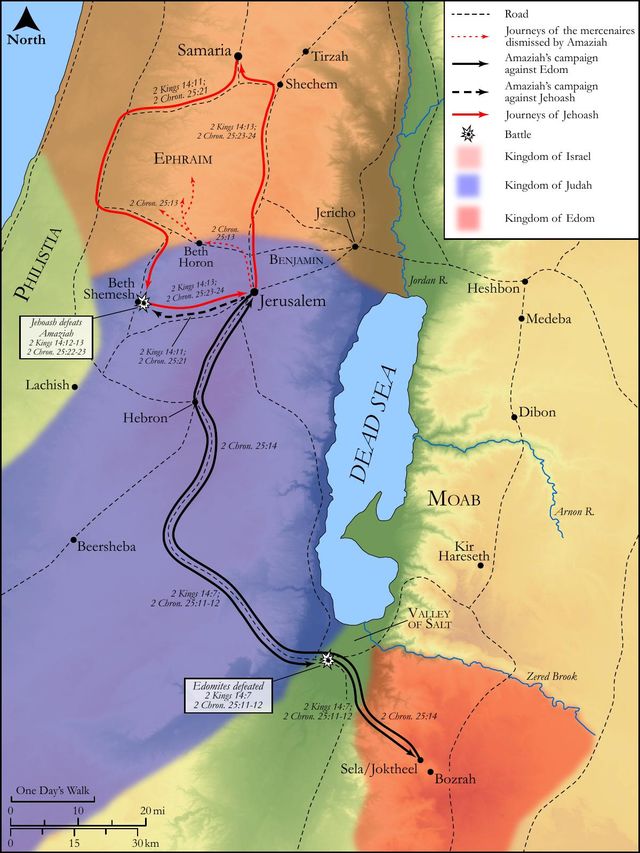
See on the biblical-era map
Study this verse
Public-domain commentary
Matthew Henry
From his Commentary on the Whole Bible. Henry comments on passages, not single verses — this entry covers 2 Chronicles 25:17–28. His three-level outline is real structure in the source text, so it is rendered as structure.
We have here this degenerate prince mortified by his neighbour and murdered by his own subjects.
I.Never was proud prince more thoroughly mortified than Amaziah was by Joash king of Israel.
1.This part of the story (which was as fully related Kg2 14:8, etc., as it is here) - embracing the foolish challenge which Amaziah sent to Joash (Ch2 25:17), his haughty scornful answer to it (Ch2 25:18), with the friendly advice he gave him to sit still and know when he was well off, (Ch2 25:19), - his wilfully persisting in his challenge (Ch2 25:20, Ch2 25:21), the defeat that was given him (Ch2 25:22), and the calamity he brought upon himself and his city thereby (Ch2 25:23, Ch2 25:24), - verifies two of Solomon's proverbs: - (1.) That a man's pride will bring him low, Pro 29:23. It goes before his destruction; not only procures it meritoriously, but is often the immediate occasion of it. He that exalteth himself shall be abased. (2.) That he that goes forth hastily to strive will probably not know what to do in the end thereof, when his neighbour has put him to shame, Pro 25:8. He that is fond of contention may have enough of it sooner than he thinks of.
2.But there are two passages in this story which we had not before in the Kings.
(1.)That Amaziah took advice before he challenged the king of Israel, Ch2 25:17. But of whom? Not of the prophet - he was not made of the king's counsel; but of his statesmen that would flatter him and bid him go up and prosper. It is good to take advice, but then it must be of those that are fit to advise us. Those that will not take advice from the word of God, which would guide them aright, will justly be left to the bad advice of those that will counsel them to their destruction. Let those be made fools that will not be made wise.
(2.)Amaziah's imprudence is here made the punishment of his impiety (Ch2 25:20): It was of the Lord; he left him to himself to act thus foolishly, that he and his people might be delivered into the hands of their enemies, because they had forsaken God and sought after the gods of Edom. Those that will not persuaded to do well for their souls will justly be given up to their own counsels to do ill for themselves even in their outward affairs.
II.Never was poor prince more violently pursued by his own subjects.
From the time that he departed from the Lord (so it may be read, Ch2 25:27) the hearts of his subjects departed from him, and they began to form a design against him in Jerusalem. It is probable they were exasperated against him more for his rashly engaging in a war against Israel than for his worshipping the gods of Edom. But at length the ferment grew so high, and he perceived the plot to be laid so deeply, that he thought fit to quit his royal city and flee to Lachish, either as a private place where he might be hid or as a strong place where he might be guarded; but they sent after him thither, and slew him there. By this the putting of him to death seems to have been done deliberately, and to have been the act, not of a disgusted servant or two, but of a considerable body that durst avow it. How unrighteous soever they were herein, God was righteous.
Continue studying 2 Chronicles 25:27 across the web’s major study libraries — every link below opens this exact verse, chapter, or book on the destination site.
Read & Compare
 BibleGatewayThis verse in more than 200 translations and 70 languages.
 Bible.comThe YouVersion reader — hundreds of translations, reading plans, and highlights.
 ESV.orgCrossway's official English Standard Version reader.
 NET BibleThe NET translation with 60,000+ translators' notes on every rendering decision.
 STEP BibleTyndale House's free study tool — original text, vocabulary, and scholarly resources.
 BibliaLogos Bible Software's free web reader.
 USCCBThe New American Bible (Revised Edition) with the U.S. bishops' study notes.
Commentaries
 BibleHub CommentariesDozens of classic commentaries on this verse, gathered on one page.
 StudyLightMore than 100 commentary sets — the largest collection on the web.
 BibleRefPlain-English commentary on what this verse means, verse by verse.
 Enduring WordDavid Guzik's free commentary on this chapter, widely used by Bible teachers.
 Bible Study ToolsVerse commentary alongside Greek and Hebrew study aids.
Original Language & Research
- BibleHub InterlinearThe verse word by word — original language, transliteration, and English.
- BibleHub LexiconEvery word's original-language definition and Strong's entry.
 Blue Letter BibleDeep-study tools — Strong's numbers, concordance, and word studies.
 SefariaThe Hebrew text with Rashi and centuries of Jewish commentary.
Sermons, Hymns & Audio


TrulyRandomVerse is not affiliated with these sites and doesn’t control their content. They’re linked because they’re genuinely useful.
Summary
The tragic end of King Amaziah's reign vividly illustrates the severe consequences of spiritual apostasy and unfaithfulness. This verse attributes his violent assassination directly to his deliberate turning away from the LORD, serving as a stark theological declaration that a leader's departure from divine covenant loyalty inevitably precipitates societal instability, internal rebellion, and ultimately, personal ruin. It encapsulates the culmination of a king's spiritual decline, demonstrating how a profound breach of trust with God can lead to a catastrophic downfall, even in a place of supposed refuge.
Context
ShowHideLiterary Context
This verse provides the somber conclusion to the detailed account of King Amaziah's reign in 2 Chronicles 25. The Chronicler meticulously builds the narrative, beginning with Amaziah's initial, albeit imperfect, obedience to the LORD (2 Chronicles 25:2). His early successes, including a significant military victory over the Edomites, are presented as blessings contingent on this initial faithfulness. However, the turning point, and the direct cause of his downfall, is explicitly stated: after his victory, Amaziah brought back the idols of Seir and worshipped them (2 Chronicles 25:14). Despite a prophet's clear warning and rebuke, Amaziah defiantly refused to repent, sealing his fate (2 Chronicles 25:15-16). His subsequent arrogant challenge to King Joash of Israel led to a humiliating defeat, the plundering of Jerusalem, and the destruction of its walls (2 Chronicles 25:17-24). Thus, the conspiracy and assassination described in 2 Chronicles 25:27 are presented as the direct, divinely sanctioned outcome of his unrepentant apostasy, forming the tragic climax of his narrative.
Historical & Cultural Context
King Amaziah ruled Judah from approximately 796 to 767 BC, a period marked by ongoing tensions between the northern kingdom of Israel and the southern kingdom of Judah. In ancient Near Eastern monarchies, especially in Israel and Judah, the king's role extended beyond mere political leadership; he was considered God's anointed representative, and his spiritual fidelity was inextricably linked to the nation's well-being. Apostasy, particularly idolatry, was viewed as a grave betrayal of the covenant with Yahweh and often invited divine judgment, which could manifest through natural disasters, military defeat, or internal rebellion. Conspiracies and regicide were unfortunately common methods of regime change in the ancient world, often reflecting deep-seated discontent among the populace or court officials. Lachish, mentioned as Amaziah's refuge, was a strategically vital and heavily fortified city in the Shephelah (lowlands) of Judah, second only to Jerusalem in importance. Its strong defenses made it a logical, albeit ultimately futile, place for a king to seek safety from a coup.
Key Themes
ShowHideThe narrative of Amaziah's reign, culminating in 2 Chronicles 25:27, powerfully reinforces several central themes prevalent throughout 2 Chronicles. Foremost is the principle of immediate retribution, where the faithfulness or unfaithfulness of Judah's kings directly dictates the nation's prosperity or decline. Amaziah's story serves as a prime example of the consequences of apostasy, demonstrating how a deliberate turning away from the LORD leads to personal and national calamity, echoing the warnings of covenant curses found in Deuteronomy 28. His initial "imperfect heart" (2 Chronicles 25:2) and subsequent blatant idolatry highlight the slippery slope of sin and the danger of spiritual compromise. The narrative also underscores leadership accountability, illustrating that a king's spiritual choices have profound public repercussions, eroding his authority and inviting internal rebellion. Ultimately, Amaziah's demise is presented as a vivid instance of divine judgment, where human actions (the conspiracy) become the instruments through which God executes His righteous verdict against unrepentant sin.
Exposition and Analysis
ShowHideKey Word Analysis
ShowHideThis verb signifies a decisive and deliberate departure, a turning aside from a previous path or allegiance. In the context of "turning away from following the LORD," it denotes a conscious act of apostasy, a renunciation of covenant loyalty and devotion. It implies not merely a passive drifting but an active reorientation of one's allegiance from God to other objects of worship or self-will, marking a profound spiritual rebellion.
This noun refers to a secret plot, an illicit alliance or binding agreement formed with the specific intent to overthrow established authority, particularly a king. Its use here highlights the treacherous and premeditated nature of the actions taken against Amaziah, underscoring the deep disaffection, loss of legitimacy, and political instability that his apostasy had fostered within his own kingdom.
This primitive root verb means "to die" or, causatively, "to kill." In this context, it starkly describes the violent and fatal outcome of the conspiracy against Amaziah. The directness of the term emphasizes the finality and brutality of his end, serving as the ultimate consequence of his spiritual rebellion and the successful execution of the conspirators' plot.
Verse Breakdown
ShowHide"Now after the time that Amaziah did turn away from following the LORD"
This opening clause is crucial, establishing a direct causal and chronological link between Amaziah's spiritual apostasy and the subsequent events of his downfall. It is not merely a temporal marker but a theological explanation, asserting that his deliberate turning from God was the precipitating factor for the conspiracy against him.
"they made a conspiracy against him in Jerusalem"
This indicates that the plot to assassinate Amaziah originated within his own capital city, among his own people or court. The "they" refers to unnamed conspirators, highlighting the widespread discontent and a loss of legitimate authority that stemmed from his unfaithfulness, leading to a collective rebellion against a king perceived to have forfeited divine favor.
"and he fled to Lachish"
Faced with the immediate threat of the conspiracy, Amaziah sought escape and refuge in Lachish, a well-known fortified city. This act of flight underscores his vulnerability and the severity of the threat to his life, despite his royal status, revealing his desperate attempt to evade his enemies.
"but they sent to Lachish after him, and slew him there"
This final clause describes the successful and determined execution of the conspiracy. The relentless pursuit to Lachish and his subsequent assassination there emphasize the inescapable nature of the judgment against him. His death in a place of supposed safety serves as a powerful symbol of the futility of human efforts to evade the consequences of spiritual rebellion and divine judgment.
Literary Devices
ShowHideThe Chronicler employs several potent literary devices in 2 Chronicles 25:27 to underscore its theological message. Causality is paramount, as the verse explicitly states that the conspiracy and assassination occurred "after the time that Amaziah did turn away from following the LORD." This establishes a direct cause-and-effect relationship, highlighting the Chronicler's theological agenda of immediate divine retribution for unfaithfulness. Irony is strongly present in Amaziah's flight to Lachish; a king who sought refuge in a powerful, fortified city ultimately met his end in that very place, demonstrating that no human stronghold can protect one from the consequences of divine disfavor. The narrative also utilizes Foreshadowing, as the prophet's earlier warnings to Amaziah (2 Chronicles 25:15-16), when unheeded, inevitably led to the tragic fulfillment of the implied judgment. The concise and direct reporting of the assassination contributes to a Tragic tone, marking the sad and violent end of a king whose reign began with promise but ended in ruin due to his spiritual rebellion.
Theological and Thematic Connections
ShowHideThe account of Amaziah's downfall in 2 Chronicles 25:27 serves as a profound theological statement on the nature of divine judgment and the severe consequences of apostasy. It underscores the unwavering principle that God holds leaders, and indeed all individuals, accountable for their faithfulness to Him. Amaziah's turning away from the LORD was not a private matter but had far-reaching public repercussions, leading to a loss of divine favor, political instability, and ultimately, his violent death. This narrative powerfully reinforces the biblical truth that God is sovereign over human affairs, even using human conspiracies as instruments of His righteous judgment. It highlights the insidious danger of spiritual complacency and the corrupting nature of idolatry, which can subtly erode a heart that once sought to do right, leading to a complete departure from God's ways and a tragic end. The Chronicler's emphasis on this direct link between obedience and outcome serves as a timeless warning.
Reflection and Application
ShowHideAmaziah's story offers a timeless and sobering lesson for all who seek to follow God, particularly those entrusted with positions of leadership or influence. It powerfully reminds us that outward success or initial obedience is not a guarantee of lifelong faithfulness. The insidious nature of idolatry, whether it manifests as bowing to literal statues or allowing anything—be it power, wealth, reputation, comfort, or even personal desires—to usurp God's rightful place in our hearts, can subtly erode our spiritual foundation. We are called to cultivate a heart of consistent and undivided devotion, diligently guarding against spiritual pride and complacency, especially after experiencing success or blessing. Our personal spiritual choices have far-reaching consequences, not only for ourselves but also for our families, communities, and any sphere of influence we may possess. This narrative compels us to heed divine warnings, whether communicated through Scripture, the wise counsel of others, or the circumstances of life, lest we, like Amaziah, face tragic outcomes for ignoring God's voice and abandoning our covenant with Him.
Questions for Reflection
ShowHideFAQ
ShowHideWas Amaziah's death an act of divine judgment or merely a political assassination?
ShowHideThe biblical narrative, particularly as presented by the Chronicler, unequivocally portrays Amaziah's death as both a political assassination and an act of divine judgment. The verse explicitly states that the conspiracy occurred "after the time that Amaziah did turn away from following the LORD," thereby establishing a clear causal link between his apostasy and his demise. While human agents carried out the plot, their actions are implicitly understood as instruments of God's righteous verdict against a king who had defiantly abandoned Him and embraced idolatry. This aligns perfectly with the Chronicler's overarching theological framework, where the prosperity and downfall of Judah's kings are directly tied to their faithfulness or unfaithfulness to the covenant, a principle consistently demonstrated throughout 2 Chronicles.
What was the significance of Lachish in Amaziah's story?
ShowHideLachish was a strategically important, heavily fortified city in the Shephelah region of Judah, making it a logical and seemingly secure place for a king to seek refuge during a crisis or coup attempt. Amaziah's flight to Lachish indicates his desperate attempt to escape the conspiracy and find safety in a stronghold. However, the fact that his pursuers tracked him down and "slew him there" adds a profound layer of irony and tragic symbolism to the narrative. It powerfully demonstrates that no human fortress, no matter how strong or strategically vital, can ultimately protect one from the consequences of divine disfavor or the predetermined outcome of unrepentant sin. His death in a place of supposed security underscores the inescapable nature of the judgment against him, highlighting the futility of relying on human defenses when one has abandoned God, a truth echoed in passages like Psalm 46:1.
Christ-Centered Fulfillment
ShowHideThe tragic account of King Amaziah's apostasy and violent end in 2 Chronicles 25:27 profoundly foreshadows the urgent need for a perfect King, one who will never "turn away from following the LORD." Amaziah's failure to maintain covenant faithfulness, his turning to idolatry after initial success, and the subsequent divine judgment upon him highlight the inherent sinfulness and unreliability of human kings, even those who initially show promise. This narrative points us directly to Jesus Christ, the ultimate and eternal King, who perfectly fulfilled all righteousness and never deviated from the will of His Father (Hebrews 4:15). Unlike Amaziah, whose pride and idolatry led to his downfall and death, Christ humbled Himself, even to the point of death on a cross, demonstrating perfect obedience to God's will (Philippians 2:8). The judgment that fell upon Amaziah for his unfaithfulness ultimately points to the greater judgment that Christ bore on our behalf, becoming a curse for us so that we might receive blessing and eternal life through His atoning sacrifice (Galatians 3:13). Where Amaziah sought refuge in a fortified city only to meet his end, Christ is our true refuge and stronghold, offering eternal salvation and security that no earthly power or conspiracy can undermine (Psalm 91:2). His reign is one of perfect justice, unwavering faithfulness, and unending peace, fulfilling all the broken promises and failed leadership of earthly kings and providing the ultimate answer to humanity's need for a righteous ruler.