


Old Testament · History · Book 14 of 66
2 Chronicles
The kings of David’s line in Jerusalem, from Solomon’s building of the temple to its burning, closing with Cyrus’s decree that the house be built again.
- 36 chapters
- 822 verses
- About 2 hours to read
- Solomon & The Temple, c. 970–930 BC
- The Divided Kingdom, c. 930–586 BC
Second Chronicles is the history of one house and one line. Solomon builds the temple on mount Moriah, the glory of the LORD fills it, and God answers his prayer by night: “If my people, which are called by my name, shall humble themselves, and pray, and seek my face, and turn from their wicked ways; then will I hear from heaven, and will forgive their sin, and will heal their land” (7:14). The kings who follow are measured by that word.
The book retells the reigns told in Kings, keeps to Judah after the division, and records much that Kings does not: Abijah’s appeal to Jeroboam and all Israel, Jehoshaphat’s singers before the army, Hezekiah’s Passover for all Israel, and Manasseh’s captivity and repentance. Prophets speak into reign after reign, and the verdicts turn on seeking and forsaking: “if ye seek him, he will be found of you; but if ye forsake him, he will forsake you” (15:2). It ends with the house burned and the land keeping its sabbaths, and then with Cyrus: “Who is there among you of all his people? The LORD his God be with him, and let him go up” (36:23).
If my people, which are called by my name, shall humble themselves, and pray, and seek my face, and turn from their wicked ways; then will I hear from heaven, and will forgive their sin, and will heal their land.
Before you read
- Who wrote it
- Not named in the book; traditionally Ezra the scribe. Its last two verses are repeated as the opening of Ezra (Ezra 1:1–3). The writer names prophets’ records among his sources: Nathan, Ahijah and Iddo for Solomon (9:29), and Isaiah for Uzziah and Hezekiah (26:22; 32:32).
- When it was written
- After the exile. The book closes in “the first year of Cyrus king of Persia” (36:22), when the land had kept sabbath seventy years (36:21).
- When it happens
- Solomon’s reign over all Israel, then Judah alone. After the northern tribes fall away (10:16–19), the book follows David’s line in Jerusalem and tells of Israel’s kings only where they meet Judah.
How 2 Chronicles is laid out
8 movements · 142 passages · 822 verses
Wisdom, and a house built
1:1–5:1 · 75 verses
At Gibeon God says to Solomon, “Ask what I shall give thee,” and he asks for wisdom and knowledge to judge the people; riches and honour are added. With cedar and a craftsman from Huram king of Tyre, he builds the house of the LORD in mount Moriah, where the LORD appeared to David, and furnishes it with the altar, the sea, the lavers and the golden vessels.
The glory fills the house
5:2–7:22 · 77 verses
The ark is brought into the oracle, and as the singers praise, “For he is good; for his mercy endureth for ever,” a cloud fills the house. Solomon kneels and asks God to hear from heaven every prayer made toward this place: in defeat, drought and pestilence, for the stranger, and from captivity. Fire falls on the sacrifice, and by night the LORD answers with a promise and a warning.
12 passages
- 5:1–10 The Work Finished and the Ark Brought to the Temple
- 5:11–14 God's Glory Fills the Temple
- 6:1–11 Solomon’s Address on the Temple
- 6:12–17 Solomon Assumes the Posture of Prayer
- 6:18–21 The Dedicatory Prayer: The Paradox of God’s Presence
- 6:22–31 Petitions for Justice and Repentance
- 6:32–35 Prayer for the Stranger
- 6:36–39 Prayer for Captives and Exile
- 6:40–42 Final Appeal and Conclusion
- 7:1–3 God Responds with Fire and Glory
- 7:4–11 The Dedication Feast and Sacrifices
- 7:12–22 God Appears and Gives Conditions
Solomon in all his glory
Chapters 8–9 · 49 verses
Solomon builds store cities, sets the priests and Levites in their courses “according to the order of David his father,” and sends his servants to Ophir. The queen of Sheba comes to prove him and finds that “the one half” was not told her. He passes all the kings of the earth in riches and wisdom, reigns forty years, and is buried in the city of David.
7 passages
A kingdom divided, a covenant sworn
Chapters 10–16 · 128 verses
Rehoboam will not hearken to the people, “for the cause was of God,” and Israel falls away. When he forsakes the law, Shishak comes up, and the princes humble themselves. Abijah prevails over Jeroboam because Judah relied on the LORD. Asa cries to God against Zerah’s host and leads Judah in a covenant to seek him, but later relies on Syria, and in his disease seeks the physicians.
The battle is God’s
Chapters 17–20 · 101 verses
Jehoshaphat walks in the first ways of David and sends princes and Levites through Judah with the book of the law. Joined with Ahab, he goes up to Ramoth-gilead, where Micaiah alone speaks the LORD’s word, and on his return Jehu the seer rebukes him. He sets judges. When Moab, Ammon and mount Seir invade, he proclaims a fast; singers go before the army, and the invaders destroy one another.
17 passages
- 17:1–2 Jehoshaphat Establishes His Rule
- 17:3–6 Jehoshaphat’s Piety and Prosperity
- 17:7–9 The Teaching Ministry in Judah
- 17:10–11 Foreign Nations Honor Jehoshaphat
- 17:12–19 Military Might and Organization
- 18:1–3 Jehoshaphat Allies with Ahab
- 18:4–11 Consulting the False Prophets
- 18:12–27 Micaiah Predicts Defeat
- 18:28–34 Ahab Is Slain at Ramoth-gilead
- 19:1–4 Jehoshaphat Rebuked and Reform Renewed
- 19:5–7 Judicial Reform in the Cities
- 19:8–11 Establishing the Central Court
- 20:1–4 Jehoshaphat Faces a Great Coalition
- 20:5–13 The King’s Prayer for Deliverance
- 20:14–19 The Prophet Jahaziel Gives Assurance
- 20:20–30 Faith Leads to Miraculous Victory
- 20:31–37 Summary of Jehoshaphat’s Later Reign
A light kept for David
Chapters 21–28 · 167 verses
Jehoram marries Ahab’s daughter and walks in his ways, yet the LORD will not destroy the house of David. Athaliah destroys the seed royal, but Joash is hidden in the house of God six years and crowned by Jehoiada. Joash, Amaziah and Uzziah begin well and turn aside: Joash has Zechariah stoned, Amaziah bows to the gods of Seir, Uzziah burns incense in the temple. Ahaz shuts its doors.
Hezekiah opens the doors
Chapters 29–32 · 117 verses
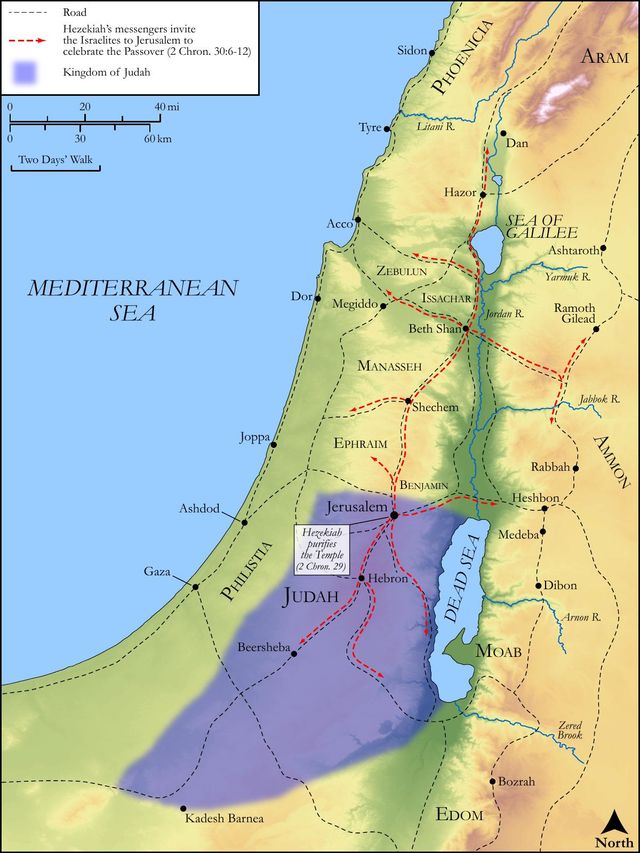
In the first month of his reign Hezekiah opens the doors of the house of the LORD and has it cleansed. His letters call all Israel, from Beersheba to Dan, to the Passover; many mock, but some humble themselves and come. When Sennacherib invades, Hezekiah and Isaiah pray, and an angel cuts off the Assyrian camp. After his sickness his heart is lifted up, and he humbles himself.
18 passages
- 29:1–2 Hezekiah Begins His Righteous Reign
- 29:3–11 Hezekiah Commands Temple Cleansing
- 29:12–19 The Levites Sanctify Themselves and the Temple
- 29:20–30 The Atonement Ceremony for Judah
- 29:31–36 The People Bring Voluntary Offerings
- 30:1–5 Hezekiah Invites All Israel to Passover
- 30:6–12 The Call for Repentance and Unity
- 30:13–20 Preparation and the Passover Sacrifice
- 30:21–27 The Feast of Unleavened Bread Extended
- 31:1–4 Idols Destroyed and Priestly Service Reorganized
- 31:5–10 The People Bring Tithes and Offerings
- 31:11–19 Administration of the Temple Storehouses
- 31:20–21 Hezekiah's Faithful Leadership
- 32:1–8 Sennacherib Invades Judah
- 32:9–19 Sennacherib Mocks Yahweh
- 32:20–23 God Delivers Jerusalem
- 32:24–26 Hezekiah’s Illness and Pride
- 32:27–33 Hezekiah's Wealth, Works, and Death
The last kings and the decree
Chapters 33–36 · 108 verses
Manasseh sets an idol in the house of God; carried to Babylon in fetters, he humbles himself and is brought back. Josiah seeks God while young, hears the book of the law, renews the covenant, keeps a great Passover, and falls at Megiddo. Zedekiah will not humble himself before Jeremiah. The Chaldeans burn the house; after seventy years of desolation, Cyrus charges that it be built again.
17 passages
- 33:1–10 Manasseh’s Wicked Reign Begins
- 33:11–20 Manasseh Captive and Repentant
- 33:21–25 The Short, Evil Reign of Amon
- 34:1–2 Josiah Begins His Righteous Reign
- 34:3–7 Josiah Purges Idolatry from the Land
- 34:8–13 Temple Repair Initiated
- 34:14–21 Discovery of the Book of the Law
- 34:22–28 Consultation with Huldah the Prophetess
- 34:29–33 Renewal of the Covenant
- 35:1–19 Josiah Celebrates the Greatest Passover
- 35:20–24 Josiah's Fatal Encounter with Necho
- 35:25–27 Mourning and Historical Record
- 36:1–4 Jehoahaz Reign and Egyptian Control
- 36:5–8 Jehoiakim Rebels Against Babylon
- 36:9–10 Jehoiachin and the Second Deportation
- 36:11–21 Zedekiah's Rule and the Final Judgment
- 36:22–23 The Edict of Cyrus and Restoration
The words 2 Chronicles turns on
Kings are judged by whether they seek the LORD or forsake him, rely on him, and humble themselves when rebuked; the house they open or shut shows which.
What 2 Chronicles teaches
bayith · house
A house for his name
Solomon knew what he was building: “who is able to build him an house, seeing the heaven and heaven of heavens cannot contain him?” (2:6). Yet God chose it: “now have I chosen and sanctified this house, that my name may be there for ever: and mine eyes and mine heart shall be there perpetually” (7:16). The kings are measured by what they do with it. Joash repairs it (24:4–14); Ahaz “shut up the doors of the house of the LORD” (28:24); Hezekiah “opened the doors of the house of the LORD, and repaired them” (29:3). Manasseh set an idol in the house of which God had said, “will I put my name for ever” (33:7). The Chaldeans “burnt the house of God” (36:19), and the book closes on a charge “to build him an house in Jerusalem” (36:23).
dârash · seek
If ye seek him
Azariah the prophet gives Asa the rule the book follows: “The LORD is with you, while ye be with him; and if ye seek him, he will be found of you; but if ye forsake him, he will forsake you” (15:2). The verdicts on the kings use the same verb. Rehoboam “did evil, because he prepared not his heart to seek the LORD” (12:14). Of Uzziah, “as long as he sought the LORD, God made him to prosper” (26:5), and Asa in his disease “sought not to the LORD, but to the physicians” (16:12). Seeking is first a matter of the heart. At Hezekiah’s Passover many ate who had not cleansed themselves, and he prayed, “The good LORD pardon every one That prepareth his heart to seek God” (30:18–19). “And the LORD hearkened to Hezekiah, and healed the people” (30:20).
shâʻan · rely
Relying on the LORD
Judah’s kings face armies they cannot match, and the faithful ones say so. Asa prays, “LORD, it is nothing with thee to help, whether with many, or with them that have no power: help us, O LORD our God; for we rest on thee” (14:11). Jehoshaphat is told, “the battle is not yours, but God’s” (20:15), and Hezekiah tells the people, “With him is an arm of flesh; but with us is the LORD our God to help us, and to fight our battles” (32:8). Asa later bought Syria’s help, and Hanani the seer told him, “thou hast relied on the king of Syria, and not relied on the LORD thy God” (16:7). “For the eyes of the LORD run to and fro throughout the whole earth, to shew himself strong in the behalf of them whose heart is perfect toward him” (16:9).
kânaʻ · humble
Humbled and heard
The promise begins, “If my people, which are called by my name, shall humble themselves” (7:14), and the book marks its turnings with the same word. When Shishak came, Rehoboam and the princes “humbled themselves; and they said, The LORD is righteous,” and the LORD answered, “They have humbled themselves; therefore I will not destroy them” (12:6–7). Hezekiah “humbled himself for the pride of his heart” (32:26). Manasseh, who made Judah “to do worse than the heathen” (33:9), “humbled himself greatly before the God of his fathers” in his affliction, and was brought home: “Then Manasseh knew that the LORD he was God” (33:12–13). Josiah was heard because “thou didst humble thyself before God” (34:27). Amon “humbled not himself” (33:23), nor did Zedekiah, “before Jeremiah the prophet” (36:12).
Christ in 2 Chronicles
Solomon asked at the dedication, “will God in very deed dwell with men on the earth?” (6:18). John answers that “the Word was made flesh, and dwelt among us,” and “we beheld his glory” (John 1:14). When Jesus said, “Destroy this temple, and in three days I will raise it up,” John adds, “he spake of the temple of his body” (John 2:19–21). The queen of Sheba came to Jerusalem to hear Solomon’s wisdom, and Jesus said of her, “behold, a greater than Solomon is here” (Matthew 12:42).
The book holds to the LORD’s promise “to give a light to him and to his sons for ever” (21:7), even when Athaliah destroyed the seed royal and one child was hidden in the house of God. It ends with no son of David on the throne. Matthew carries the line through these kings to “the time they were carried away to Babylon,” and on to Jesus (Matthew 1:7–16), and Gabriel promised Mary that God “shall give unto him the throne of his father David” (Luke 1:32).
- Solomon built the house
- Rehoboam
- Abijah
- Asa
- Jehoshaphat
- Jehoram
- Uzziah Matthew’s Ozias
- Jotham
- Ahaz shut the temple doors
- Hezekiah opened them
- Manasseh
- Amon
- Josiah
- … Matthew 1:11–16
- Jesus, who is called Christ
People
By how many verses name them
- SolomonSon of David and Bathsheba; a brother of Shammua, Shobab and Nathan74
- DavidSon of Jesse66
- HezekiahSon of Ahaz and Abi; a brother of Maaseiah; husband of Hephzibah; father of Manasseh38
- JehoshaphatA son of Asa and Azubah38
- AsaA son of Abijah; husband of Azubah; father of Jehoshaphat25
- RehoboamSon of Solomon and Naamah; a brother of Taphath and Basemath23
- AmaziahA son of Joash and Jehoaddan; husband of Jecoliah; father of Uzziah19
- JehoiadaHusband of Jehosheba; father of Zechariah18
253 more are named.
Places
102 named
- JerusalemThe city God chose for his name, where the house stands110
- Egypt16
- AssyriaAhaz turns to its kings; Sennacherib invades under Hezekiah13
- Ramoth-gileadWhere Ahab dies, as Micaiah said, and Jehoshaphat escapes8
- Samaria8
- Syria8
- BabylonWhere Manasseh is taken in fetters, and Judah carried captive7
- Damascus4
Where 2 Chronicles reaches
The passages it leans on, and the ones that lean on it
2 Chronicles 5:14 1 Kings 8:11 Exodus 40:35
The glory fills the house, in Kings’ account of the same day, as it once filled the tabernacle.
1 Chronicles 28:9 2 Chronicles 15:2
David’s charge to Solomon, “if thou seek him, he will be found of thee,” spoken again to Asa.
Exodus 14:13 2 Chronicles 20:17
“Stand still, and see the salvation of the LORD”: Moses’ word at the Red sea, given again to Jehoshaphat.
2 Chronicles 36:21 Leviticus 26:34 Jeremiah 29:10
The land enjoys “her sabbaths,” as the law warned, for the seventy years Jeremiah named.
2 Chronicles 36:22–23 Ezra 1:1–3 Isaiah 44:28
Cyrus’s decree ends this book and opens Ezra; Isaiah had named Cyrus, who would say to Jerusalem, “Thou shalt be built.”
Books 2 Chronicles links to most
The Church Fathers on 2 Chronicles
38 quotations from 16 writers before AD 800 · the ten most quoted, in date order
- Clement99
- Cyprian258
- Ephrem373
- Apostolic Constitutions380
- Gregory390
- Chrysostom407
- Jerome420
- Augustine430
- John Cassian435
- Bede735
Aphrahat, writing on prayer, recalled Asa against Zerah’s army.
Asa prayed, and his prayer manifested great power: when Zerah the Indian [Ethiopian] went out against him with an army of one million with him, Asa then prayed, saying, “By this shall your power be known, O our God, when you finish off a vast people by means of a small people.” God heard his prayer and sent his angel to rout them. Thus the vast army was defeated by the power of Asa’s prayer.
Jerome on Jehoshaphat and Josiah, kings who did right and are still shown at fault.
… they are called righteous, not because they are faultless but because their faults are eclipsed by their virtues. … Jehoshaphat and Josiah who are beyond a doubt described as righteous are narrated to have done things displeasing to the Lord.
Ephrem set Uzziah at the censer beside Adam at the tree.
Remember Uzziah, how he entered the sanctuary; by seeking to seize the priesthood he lost his kingdom. Adam, by wishing to enrich himself, incurred a double loss. Recognize in the sanctuary the Tree, in the censer the fruit and in the leprosy the nakedness. From these two treasures there proceeded harm in both cases.
Chrysostom held up Manasseh to a fallen friend: no sinner need despair of repentance.
Manasseh, having exceeded all in fury and tyranny … when he afterwards repented was ranked among the friends of God.
Keep studying
Articles
- Deuteronomy as the Measure of Israel's History: Judgment and Grace from Joshua to Kings
- The Kings of Judah: Faithful, Faltering and Wicked
- The History of the Temple in Jerusalem (Solomon's, Second, Herod's)
- The Fall of the Southern Kingdom (Judah) and the Babylonian Exile
- The Return from Exile under Zerubbabel