


2 Chronicles 30:20
Bible text: King James Version (1769 Blayney text) · Public domain
Bible text: Berean Standard Bible · Public domain
Bible text: American Standard Version (1901) · Public domain
Bible text: World English Bible, Messianic edition · Public domain
Bible text: Geneva Bible (1599) · Public domain
Bible text: Young's Literal Translation · Public domain
- וַיִּשְׁמַעvai·yish·Ma'and he listenedH8085Conj-w ¦ V-Qal-ConsecImperf-3msVerb Qal Consecutive Imperfect 3rd Singular Masculineוַandיִּשְׁמַעhe listened
- יְהוָהYah·wehYahwehH3068N-properNoun Proper Title
- אֶל'eltoH413PrepPreposition
- יְחִזְקִיָּהוּye·chiz·ki·Ya·huHezekiahH2396N-proper-mNoun Proper Masculine
- וַיִּרְפָּאvai·yir·Pa'and he healedH7495Conj-w ¦ V-Qal-ConsecImperf-3msVerb Qal Consecutive Imperfect 3rd Singular Masculineוַandיִּרְפָּאhe healed
- אֶת'et<obj.>H853DirObjMParticle Object Indicator
- הָעָםha·'Amthe peopleH5971Art ¦ N-msNoun Singular Masculine Absoluteהָtheעָםpeople
English is a literal word-by-word gloss of the Hebrew, not the KJV's wording. Why?
This is the original text the KJV's translators worked from — each Hebrew word with its own literal English meaning in this verse, prepared by scholars at Tyndale House, Cambridge. The KJV translates whole sentences, not word by word, so its wording differs: one Hebrew word can become several English words, and the KJV may choose “the LORD” where the gloss reads “Yahweh”. Both are faithful — they answer different questions. For the KJV's own rendering, switch to the KJV text.
Details
See on the biblical-era map
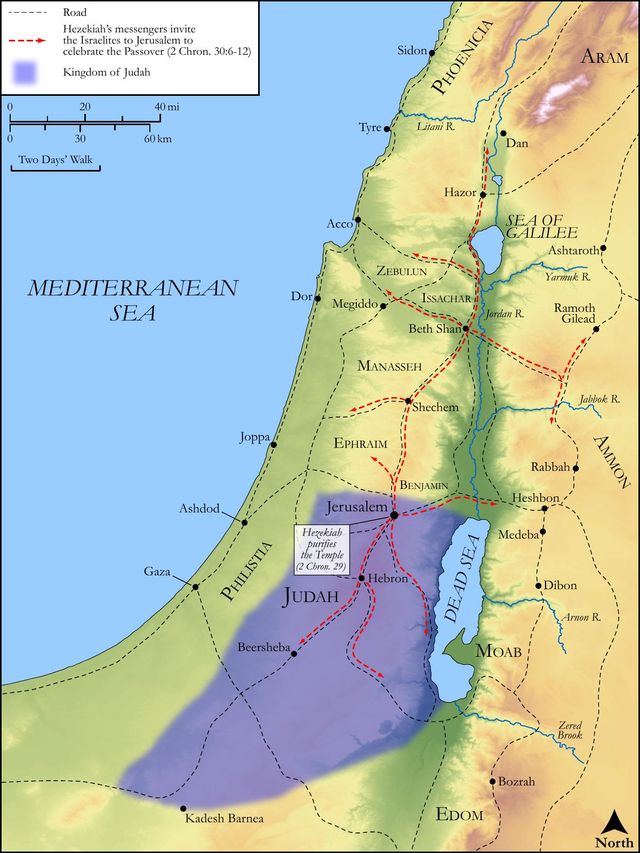
Study this verse
Public-domain commentary
Matthew Henry
From his Commentary on the Whole Bible. Henry comments on passages, not single verses — this entry covers 2 Chronicles 30:13–20. His three-level outline is real structure in the source text, so it is rendered as structure.
The time appointed for the passover having arrived, a very great congregation came together upon the occasion, Ch2 30:13. Now here we have,
I.The preparation they made for the passover, and good preparation it was:
They took away all the idolatrous altars that were found, not only in the temple, but in Jerusalem, Ch2 30:14. Before they kept the feast, they cast out this old leaven. The best preparation we can make for the gospel passover is to cast away our iniquities, our spiritual idolatries.
II.The celebration of the passover.
In this the people were so forward and zealous that the priests and Levites blushed to see themselves out-done by the commonalty, to see them more ready to bring sacrifices than they were to offer them. This put them upon sanctifying themselves (Ch2 30:15), that the work might not stand still for want of hands to carry it on. The notice we take of the zeal of others should make us ashamed of our own coldness, and quicken us not only to do our duty, but to do it well, and to sanctify ourselves to it. They did according to the duty of their place (Ch2 30:16), sprinkling the blood upon the altar, which was a type of Christ our passover sacrificed for us.
III.The irregularities they were guilty of in this solemnity.
The substance was well managed, and with a great deal of devotion; but, besides that it was a month out of time,
1.The Levites killed the passover, which should have been done by the priests only, Ch2 30:17. They also assisted more than the law ordinarily allowed in offering the other sacrifices, particularly those that were for the purifying of the unclean, many of which there was now occasion for. Some think that it was the offerers' work, not the priests', that the Levites had here the charge of. Ordinarily every man killed his lamb, but now for those that were under any ceremonial pollution the Levites killed it.
2.Many were permitted to eat the passover who were not purified according to the strictness of the law, Ch2 30:18. This was the second month, and there was not warrant to put them off further to the third month, as, if it had been the first month, the law would have permitted them to eat it the second. And they were loth to forbid them communicating at all, lest they should discourage new converts, and send those away complaining whom they desired to send away rejoicing. Grotius observes from this that ritual institutions must give way, not only to a public necessity, but to a public benefit and advantage.
IV.Hezekiah's prayer to God for the forgiveness of this irregularity.
It was his zeal that had called them together in such haste, and he would not that any should fare the worse for being straitened of time in their preparation. He therefore thought himself concerned to be an intercessor for those that ate the passover otherwise than it was written, that there might not be wrath upon them from the Lord. His prayer was,
1.A short prayer, but to the purpose: The good Lord pardon every one in the congregation that has fixed, engaged, or prepared, his heart to those services, though the ceremonial preparation be wanting. Note,
(1.)The great thing required in our attendance upon God in solemn ordinances is that we prepare our hearts to seek him, that we be sincere and upright in all we do, that the inward man be engaged and employed in it, and that we make heart-work of it; it is all nothing without this. Behold, thou desirest truth in the inward part. Hezekiah does not pray that this might be dispensed with, nor that the want of other things might be pardoned where there was not this. For this is the one thing needful, that we seek God, his favour, his honour, and that we set our hearts to do it.
(2.)Where this sincerity and fixedness of heart are there may still be many defects and infirmities, both the frame of the spirit and the performance of the service may be short of the purification of the sanctuary. Corruptions may not be so fully conquered, thoughts not so closely fixed, affections not so lively, faith not so operative, as they should be. Here is a defect in sanctuary purification. There is nothing perfect under the sun, nor a just man that doeth good, and sinneth not.
(3.)These defects need pardoning healing grace; for omissions in duty are sins as well as omissions of duty. If God should deal with us in strict justice according to the best of our performances, we should be undone.
(4.)The way to obtain pardon for our deficiencies in duty, and all the iniquities of our holy things, is to seek it of God by prayer; it is not so a pardon of course but that it must be obtained by petition through the blood of Christ.
(5.)In this prayer we must take encouragement from the goodness of God: The good Lord pardon; for, when he proclaimed his goodness, he insisted most upon this branch of it, forgiving iniquity, transgression, and sin.
(6.)It is the duty of those that have the charge of others, not only to look to themselves, but to those also that are under their charge, to see wherein they are wanting, and to pray for them, as Hezekiah here. See Job 1:5.
2.A successful prayer: The Lord hearkened to Hezekiah, was well pleased with his pious concern for the congregation, and, in answer to his prayer, healed the people (Ch2 30:20), not only did not lay their sin to their charge, but graciously accepted their services notwithstanding; for healing denotes not only forgiveness (Isa 6:10; Psa 103:3), but comfort and peace, Isa 57:18; Mal 4:2.
Continue studying 2 Chronicles 30:20 across the web’s major study libraries — every link below opens this exact verse, chapter, or book on the destination site.
Read & Compare
 BibleGatewayThis verse in more than 200 translations and 70 languages.
 Bible.comThe YouVersion reader — hundreds of translations, reading plans, and highlights.
 ESV.orgCrossway's official English Standard Version reader.
 NET BibleThe NET translation with 60,000+ translators' notes on every rendering decision.
 STEP BibleTyndale House's free study tool — original text, vocabulary, and scholarly resources.
 BibliaLogos Bible Software's free web reader.
 USCCBThe New American Bible (Revised Edition) with the U.S. bishops' study notes.
Commentaries
 BibleHub CommentariesDozens of classic commentaries on this verse, gathered on one page.
 StudyLightMore than 100 commentary sets — the largest collection on the web.
 BibleRefPlain-English commentary on what this verse means, verse by verse.
 Enduring WordDavid Guzik's free commentary on this chapter, widely used by Bible teachers.
 Bible Study ToolsVerse commentary alongside Greek and Hebrew study aids.
Original Language & Research
- BibleHub InterlinearThe verse word by word — original language, transliteration, and English.
- BibleHub LexiconEvery word's original-language definition and Strong's entry.
 Blue Letter BibleDeep-study tools — Strong's numbers, concordance, and word studies.
 SefariaThe Hebrew text with Rashi and centuries of Jewish commentary.
Sermons, Hymns & Audio


TrulyRandomVerse is not affiliated with these sites and doesn’t control their content. They’re linked because they’re genuinely useful.
Summary
2 Chronicles 30:20 records a pivotal moment of divine grace and responsiveness during the reign of King Hezekiah. After years of spiritual decline, Hezekiah initiated a nationwide Passover celebration, extending an invitation even to the remnants of the northern kingdom of Israel. Many who responded were ritually unclean, unable to participate according to the strict Mosaic Law. Recognizing their sincere desire to worship, Hezekiah interceded on their behalf, praying for God's pardon. This verse affirms that the LORD heard Hezekiah's compassionate plea and, in an act of profound mercy, accepted and "healed" the people, preventing any negative consequences of their ritual impurity and restoring them to a right standing before Him.
CONTEXT
ShowHideExposition and Analysis
ShowHideKey Word Analysis
ShowHideFrom the root הָיָה (hayah), meaning "to be," this is the sacred, covenant name of God, often transliterated as "Yahweh" or "Jehovah." Its use here emphasizes God's self-existent, eternal, personal, relational, and faithful character. It is the God who entered into covenant with Israel, who remembers His promises, and who actively intervenes in the lives of His people. The use of Yᵉhôvâh underscores that this is not a generic deity but the specific, living God of Israel who is intimately involved with their spiritual well-being and responsive to their sincere cries.
This primitive root signifies far more than merely hearing a sound; it implies attentive listening, profound understanding, and, crucially, a responsive action. When God "hearkens," it means He has heard with intent to act, acknowledging and responding favorably to the prayer or plea. In this context, it emphasizes God's direct, immediate, and positive response to Hezekiah's specific and compassionate intercession, demonstrating His attentiveness to the cries of His faithful servants.
This primitive root primarily means "to mend (by stitching)" or "to cure." While râphâʼ frequently denotes physical recovery from illness (e.g., Jeremiah 30:17), in this particular context, it carries a broader and primarily spiritual meaning. It signifies restoration, forgiveness, and making whole. It means God accepted the people despite their ritual impurity, overlooking their shortcomings because of their sincere desire to worship. It implies that God averted any potential divine judgment, plague, or negative consequences that might have arisen from their ritual uncleanness, thereby restoring them to a state of acceptance and favor before Him.
Verse Breakdown
ShowHide"And the LORD hearkened to Hezekiah"
This opening clause highlights God's immediate and direct responsiveness to King Hezekiah's intercessory prayer. Hezekiah had prayed specifically for the ritually unclean people, asking for God's pardon based on their sincere heart to seek Him rather than their adherence to purification rituals. God's "hearkening" indicates His attentiveness to the prayers of His faithful servants, especially when those prayers are offered with compassion, humility, and align with His own character of mercy and grace. It powerfully underscores the efficacy and divine favor upon intercessory prayer from a righteous leader.
"and healed the people"
This second clause describes the profound divine action that resulted from God's favorable response. The "healing" here is not primarily physical but spiritual, relational, and protective. It means God graciously accepted the people, forgave their ritual impurity, and prevented any negative consequences or judgment that might have otherwise befallen them for partaking in the Passover while unclean. It signifies a divine act of restoration, making them "whole" in their standing before Him, allowing their worship to be accepted and their lives to be preserved. This demonstrates God's grace triumphing over strict legalism when the heart is genuinely inclined towards Him in repentance and sincere desire.
Literary Devices
ShowHideThe verse employs Conciseness and a Divine Response Narrative with striking effectiveness. Its brevity, a mere seven words in the Hebrew, delivers a profound theological truth with remarkable impact, emphasizing the directness and immediacy of God's action. This succinctness serves to highlight the divine initiative and power. Furthermore, the verse functions as a clear example of a Divine Response Narrative, where a specific human action (Hezekiah's compassionate prayer in the preceding verses) is met with an explicit, powerful, and immediate divine counter-action (God's hearkening and healing). This narrative pattern reinforces the concept of a God who actively engages with His people, is attentive to their cries, and responds to their petitions, particularly those offered in faith and compassion. The straightforward declaration of God's action also serves as a form of Affirmation, validating Hezekiah's leadership and the people's sincere, though imperfect, worship.
Theological and Thematic Connections
ShowHide2 Chronicles 30:20 stands as a powerful testament to God's character, revealing His profound mercy and grace that transcend rigid legalism when confronted with a sincere heart. It underscores the biblical principle that while God desires obedience to His commands, He ultimately values a repentant and devoted spirit above perfect external adherence. This incident demonstrates that God is not bound by human ritualistic limitations but is moved by genuine faith and a deep desire for relationship. It highlights His readiness to forgive and restore those who genuinely seek Him, even when they fall short of ideal standards, affirming His boundless love and willingness to extend compassion. The divine "healing" speaks to God's capacity to make whole, not just physically, but spiritually, restoring broken relationships and averting deserved judgment.
Reflection and Application
ShowHideThis verse offers enduring encouragement for believers today, reminding us that God's grace is abundant and His mercy consistently triumphs over judgment. It challenges any tendency towards legalism, emphasizing that while obedience to His commands is vital, God ultimately prioritizes a humble, sincere heart that genuinely seeks Him over perfect adherence to every external rule or ritual. We are invited to approach God with confidence, even in our imperfections and perceived unworthiness, knowing that His compassion is vast and His willingness to forgive is boundless. The power of intercessory prayer is also profoundly affirmed; Hezekiah's selfless plea for others moved the heart of God, demonstrating that our prayers for those who are struggling, spiritually distant, or feeling unworthy can indeed bring about divine intervention and restoration. This should inspire us to pray fervently for our communities, our leaders, and those who seek God with a sincere heart but may feel burdened by their shortcomings or fall short of perceived standards.
Questions for Reflection
ShowHideFAQ
ShowHideWhat does "healed the people" specifically mean in this context?
ShowHideIn 2 Chronicles 30:20, "healed the people" (Hebrew: râphâʼ) primarily refers to God's act of spiritual and relational restoration and protection, rather than physical curing from an illness. Many of the people, especially those from the northern kingdom, had partaken in the Passover without undergoing the required ritual purification. According to Mosaic Law, this could have led to serious consequences, even divine judgment or being "cut off" from the community. God's "healing" meant He graciously overlooked their ritual impurity due to their sincere desire to seek Him, accepted their worship, and averted any potential plague or judgment that might have otherwise occurred. It was a profound act of grace that restored them to a right standing before Him, making them spiritually whole and acceptable.
Why was Hezekiah's prayer so effective?
ShowHideHezekiah's prayer was effective for several compelling reasons. Firstly, it was a selfless and compassionate prayer offered on behalf of others, demonstrating true pastoral concern for his people's spiritual well-being and their desire to worship. Secondly, it was rooted in a deep understanding of God's character, appealing to His mercy and grace rather than strict legalism, as seen in 2 Chronicles 30:18-19. Hezekiah recognized that God looks at the heart above outward conformity. Thirdly, Hezekiah himself was a righteous king who trusted fully in the LORD, setting an example for his people (as noted in 2 Kings 18:5). God responds favorably to the prayers of His faithful servants, especially when they align with His own divine purposes and compassionate nature.
Does this verse imply that ritual purity is unimportant?
ShowHideNo, this verse does not imply that ritual purity or obedience to God's commands is unimportant. The Mosaic Law, including its purity codes, was given by God and was essential for maintaining holiness within the covenant community. However, 2 Chronicles 30:20 highlights God's ultimate priority: a sincere heart that genuinely seeks Him. In this unique situation, where people had traveled far and truly desired to worship despite their inability to complete all purification rites, God's mercy triumphed. It teaches us that while God desires obedience to His commands, He is also a God of grace who looks beyond external adherence to the inner disposition of the heart, especially when there is genuine repentance and a longing for Him. This principle is consistent throughout Scripture, emphasizing that the spirit of the law often outweighs the letter when it comes to God's redemptive purposes and His desire for relationship.
Christ-Centered Fulfillment
ShowHideThe divine response in 2 Chronicles 30:20 beautifully foreshadows the ultimate redemptive work of Jesus Christ. Hezekiah's compassionate intercession for the ritually unclean people, leading to their acceptance and "healing" by God, serves as a powerful type of Christ's role as our great High Priest and Intercessor. Just as Hezekiah prayed for those who could not purify themselves, Jesus continually intercedes for us before the Father (Romans 8:34 and Hebrews 7:25). The "healing" of the people, which was a spiritual restoration and averting of judgment despite their impurity, finds its ultimate fulfillment in Christ's atoning sacrifice. Through His shed blood, Jesus cleanses us not merely from ritual uncleanness but from the defilement and penalty of sin itself, making us truly pure and acceptable before God (Hebrews 9:14 and 1 John 1:7). He is the Lamb of God who takes away the sin of the world, providing a perfect and final purification that no human ritual or legalistic adherence could ever achieve. Our access to God is no longer dependent on our ability to perfectly adhere to external rites, but on our sincere faith in Christ's finished work, allowing us to draw near with confidence to the throne of grace despite our inherent unworthiness.