


2 Chronicles 30:19
- כָּלkoleveryH3605N-mscNoun Singular Masculine Construct
- לְבָבוֹle·va·Vo[one who] his heartH3824N-msc ¦ 3msNoun Singular Masculine Constructלְבָב[one who] heartוֹhis
- הֵכִיןhe·Khinhe has directedH3559V-Hiphil-Perf-3msVerb Hiphil Perfect 3rd Singular Masculine
- לִדְרוֹשׁlid·Ro·oshto seekH1875Prep-l ¦ V-Qal-InfVerb Qal Infinitive Constructלִtoדְרוֹשׁseek
- הָאֱלֹהִיםha·'E·lo·Him<the> GodH430Art ¦ N-mpNoun Plural Masculine Absoluteהָ<the>אֱלֹהִיםGod
- יְהוָהYah·wehYahwehH3068N-properNoun Proper Title
- אֱלֹהֵי'e·lo·Hei[the] God ofH430N-mpcNoun Plural Masculine Construct
- אֲבוֹתָיו'a·vo·Tavhis ancestorsH1N-fpc ¦ 3msNoun Plural Feminine Constructאֲבוֹתָיancestorsוhis
- וְלֹאve·Lo'and notH3808Conj-w ¦ NegParticle Negativeוְandלֹאnot
- כְּטָהֳרַתke·to·ho·Rataccording to [the] purification ofH2893Prep-k ¦ N-fscNoun Singular Feminine Constructכְּaccording toטָהֳרַת[the] purification of
- הַקֹּדֶשׁha·Ko·deshthe holy placeH6944Art ¦ N-msNoun Singular Masculine Absoluteהַtheקֹּדֶשׁholy place
English is a literal word-by-word gloss of the Hebrew, not the KJV's wording. Why?
This is the original text the KJV's translators worked from — each Hebrew word with its own literal English meaning in this verse, prepared by scholars at Tyndale House, Cambridge. The KJV translates whole sentences, not word by word, so its wording differs: one Hebrew word can become several English words, and the KJV may choose “the LORD” where the gloss reads “Yahweh”. Both are faithful — they answer different questions. For the KJV's own rendering, switch to the KJV text.
Details
See on the biblical-era map
Study this verse
Public-domain commentary
Matthew Henry
From his Commentary on the Whole Bible. Henry comments on passages, not single verses — this entry covers 2 Chronicles 30:13–20. His three-level outline is real structure in the source text, so it is rendered as structure.
The time appointed for the passover having arrived, a very great congregation came together upon the occasion, Ch2 30:13. Now here we have,
I.The preparation they made for the passover, and good preparation it was:
They took away all the idolatrous altars that were found, not only in the temple, but in Jerusalem, Ch2 30:14. Before they kept the feast, they cast out this old leaven. The best preparation we can make for the gospel passover is to cast away our iniquities, our spiritual idolatries.
II.The celebration of the passover.
In this the people were so forward and zealous that the priests and Levites blushed to see themselves out-done by the commonalty, to see them more ready to bring sacrifices than they were to offer them. This put them upon sanctifying themselves (Ch2 30:15), that the work might not stand still for want of hands to carry it on. The notice we take of the zeal of others should make us ashamed of our own coldness, and quicken us not only to do our duty, but to do it well, and to sanctify ourselves to it. They did according to the duty of their place (Ch2 30:16), sprinkling the blood upon the altar, which was a type of Christ our passover sacrificed for us.
III.The irregularities they were guilty of in this solemnity.
The substance was well managed, and with a great deal of devotion; but, besides that it was a month out of time,
1.The Levites killed the passover, which should have been done by the priests only, Ch2 30:17. They also assisted more than the law ordinarily allowed in offering the other sacrifices, particularly those that were for the purifying of the unclean, many of which there was now occasion for. Some think that it was the offerers' work, not the priests', that the Levites had here the charge of. Ordinarily every man killed his lamb, but now for those that were under any ceremonial pollution the Levites killed it.
2.Many were permitted to eat the passover who were not purified according to the strictness of the law, Ch2 30:18. This was the second month, and there was not warrant to put them off further to the third month, as, if it had been the first month, the law would have permitted them to eat it the second. And they were loth to forbid them communicating at all, lest they should discourage new converts, and send those away complaining whom they desired to send away rejoicing. Grotius observes from this that ritual institutions must give way, not only to a public necessity, but to a public benefit and advantage.
IV.Hezekiah's prayer to God for the forgiveness of this irregularity.
It was his zeal that had called them together in such haste, and he would not that any should fare the worse for being straitened of time in their preparation. He therefore thought himself concerned to be an intercessor for those that ate the passover otherwise than it was written, that there might not be wrath upon them from the Lord. His prayer was,
1.A short prayer, but to the purpose: The good Lord pardon every one in the congregation that has fixed, engaged, or prepared, his heart to those services, though the ceremonial preparation be wanting. Note,
(1.)The great thing required in our attendance upon God in solemn ordinances is that we prepare our hearts to seek him, that we be sincere and upright in all we do, that the inward man be engaged and employed in it, and that we make heart-work of it; it is all nothing without this. Behold, thou desirest truth in the inward part. Hezekiah does not pray that this might be dispensed with, nor that the want of other things might be pardoned where there was not this. For this is the one thing needful, that we seek God, his favour, his honour, and that we set our hearts to do it.
(2.)Where this sincerity and fixedness of heart are there may still be many defects and infirmities, both the frame of the spirit and the performance of the service may be short of the purification of the sanctuary. Corruptions may not be so fully conquered, thoughts not so closely fixed, affections not so lively, faith not so operative, as they should be. Here is a defect in sanctuary purification. There is nothing perfect under the sun, nor a just man that doeth good, and sinneth not.
(3.)These defects need pardoning healing grace; for omissions in duty are sins as well as omissions of duty. If God should deal with us in strict justice according to the best of our performances, we should be undone.
(4.)The way to obtain pardon for our deficiencies in duty, and all the iniquities of our holy things, is to seek it of God by prayer; it is not so a pardon of course but that it must be obtained by petition through the blood of Christ.
(5.)In this prayer we must take encouragement from the goodness of God: The good Lord pardon; for, when he proclaimed his goodness, he insisted most upon this branch of it, forgiving iniquity, transgression, and sin.
(6.)It is the duty of those that have the charge of others, not only to look to themselves, but to those also that are under their charge, to see wherein they are wanting, and to pray for them, as Hezekiah here. See Job 1:5.
2.A successful prayer: The Lord hearkened to Hezekiah, was well pleased with his pious concern for the congregation, and, in answer to his prayer, healed the people (Ch2 30:20), not only did not lay their sin to their charge, but graciously accepted their services notwithstanding; for healing denotes not only forgiveness (Isa 6:10; Psa 103:3), but comfort and peace, Isa 57:18; Mal 4:2.
Continue studying 2 Chronicles 30:19 across the web’s major study libraries — every link below opens this exact verse, chapter, or book on the destination site.
Read & Compare
 BibleGatewayThis verse in more than 200 translations and 70 languages.
 Bible.comThe YouVersion reader — hundreds of translations, reading plans, and highlights.
 ESV.orgCrossway's official English Standard Version reader.
 NET BibleThe NET translation with 60,000+ translators' notes on every rendering decision.
 STEP BibleTyndale House's free study tool — original text, vocabulary, and scholarly resources.
 BibliaLogos Bible Software's free web reader.
 USCCBThe New American Bible (Revised Edition) with the U.S. bishops' study notes.
Commentaries
 BibleHub CommentariesDozens of classic commentaries on this verse, gathered on one page.
 StudyLightMore than 100 commentary sets — the largest collection on the web.
 BibleRefPlain-English commentary on what this verse means, verse by verse.
 Enduring WordDavid Guzik's free commentary on this chapter, widely used by Bible teachers.
 Bible Study ToolsVerse commentary alongside Greek and Hebrew study aids.
Original Language & Research
- BibleHub InterlinearThe verse word by word — original language, transliteration, and English.
- BibleHub LexiconEvery word's original-language definition and Strong's entry.
 Blue Letter BibleDeep-study tools — Strong's numbers, concordance, and word studies.
 SefariaThe Hebrew text with Rashi and centuries of Jewish commentary.
Sermons, Hymns & Audio


TrulyRandomVerse is not affiliated with these sites and doesn’t control their content. They’re linked because they’re genuinely useful.
Summary
Second Chronicles 30:19 offers a profound glimpse into King Hezekiah's great Passover celebration, revealing God's compassionate regard for a sincere heart over strict ritual adherence. It records Hezekiah's intercessory prayer for those from the northern tribes who, despite their earnest desire to seek the Lord, were ritually unclean according to the sanctuary's purification laws. This verse beautifully illustrates divine grace, affirming that God prioritizes genuine devotion and a prepared heart above external ceremonial perfection, a principle that resonates deeply throughout biblical theology and anticipates the New Covenant emphasis on inward transformation.
Context
ShowHideLiterary Context
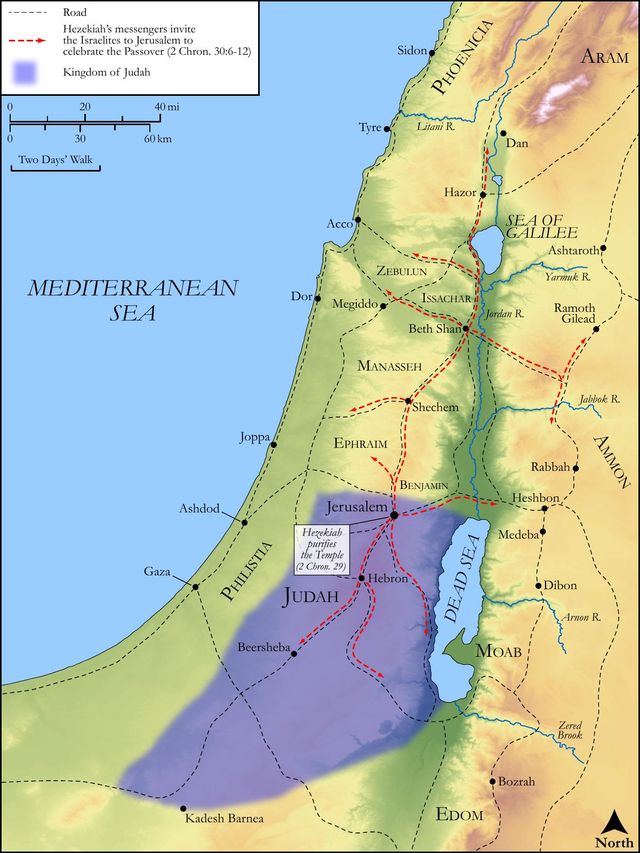
This verse is deeply embedded within the narrative of King Hezekiah's unprecedented Passover celebration, detailed comprehensively in 2 Chronicles 30. Following generations of spiritual decline and widespread idolatry, particularly in the northern kingdom, Hezekiah initiated a sweeping spiritual revival across Judah. He extended a bold invitation throughout all Israel and Judah, urging everyone, including the scattered remnant of the northern tribes, to journey to Jerusalem to observe the Passover, an event that had been neglected for centuries (2 Chronicles 30:1-5). Many from the northern kingdom, despite facing mockery and skepticism, humbly responded to this call and undertook the arduous journey to Jerusalem (2 Chronicles 30:10-11). However, due to the prolonged neglect of the Mosaic Law and the practical difficulties of their journey, many arrived without having undergone the prescribed ritual purifications necessary to participate in the sacred Passover feast (2 Chronicles 30:17-18). It is precisely in this context of sincere but ritually impure worshippers that Hezekiah offers his compassionate intercessory prayer, which is met with God's gracious and immediate response in 2 Chronicles 30:20.
Historical & Cultural Context
The historical setting is the divided kingdom of Israel, with the northern kingdom of Israel having largely succumbed to idolatry and facing severe weakening from Assyrian invasions, leading to the eventual exile of many of its inhabitants. Hezekiah's reign (c. 715–686 BC) marked a crucial period of religious reform in the southern kingdom of Judah, characterized by a fervent desire to restore the pure worship of Yahweh. The Passover, originally instituted in Exodus 12, was one of the most sacred annual feasts, commemorating Israel's miraculous deliverance from slavery in Egypt. Mosaic Law, particularly as detailed in books like Leviticus, prescribed stringent rules for ritual purity, especially for those approaching the sanctuary or participating in sacred rites. Uncleanliness could arise from various sources, including contact with a dead body, certain bodily discharges, or simply not having observed the prescribed washing rituals. To approach God's holy presence or participate in sacrifices while ritually impure was considered a serious offense, potentially incurring divine wrath (Leviticus 15:31). This verse powerfully highlights the tension between the strict requirements of the Law and the compassionate reality of human devotion, particularly during a time of profound national spiritual awakening and reunification efforts.
Key Themes
ShowHideSeveral crucial themes emerge from 2 Chronicles 30 and are profoundly encapsulated in verse 19. Firstly, the priority of the heart over external ritual is paramount. While the Law unequivocally mandated specific purifications, God's immediate and positive response to Hezekiah's prayer demonstrates that a genuinely prepared heart seeking Him is of far greater value than perfect ceremonial adherence. This principle anticipates and echoes later prophetic critiques of superficial religiosity, where outward observances lacked inward sincerity (Isaiah 1:11-17; Amos 5:21-24). Secondly, the theme of God's mercy and grace is powerfully displayed. Despite the people's undeniable ritual impurity, God "healed the people" (2 Chronicles 30:20), indicating His willingness to extend forgiveness, acceptance, and even physical healing when approached with humility and a sincere desire to worship. This underscores His covenant faithfulness and His unchanging character as a God who is "gracious and merciful, slow to anger and abounding in steadfast love" (Psalm 103:8). Finally, the verse speaks to the nature of true worship, emphasizing that it is not merely about meticulous rule-following but fundamentally about a relational posture of the heart, a deep longing for God's presence, and an earnest desire to honor Him, which ultimately transcends mere outward conformity.
Exposition and Analysis
ShowHideKey Word Analysis
ShowHideThis verb (H3559) means "to be erect," and causatively, "to set up, establish, fix, prepare, apply." When applied to the heart, as here, it signifies a deliberate, intentional, and settled purpose. It is not a casual inclination but a conscious act of orienting one's inner being—thoughts, affections, and will—towards God. The people did not accidentally find themselves seeking God; they actively "prepared their heart" (a deliberate act of spiritual resolve) to do so, demonstrating a genuine spiritual resolve despite external impediments.
This noun (H3824) refers to the most interior organ, signifying the seat of one's thoughts, affections, will, and understanding. In this context, "his heart" emphasizes the inner core of a person's being, highlighting that the people's desire to seek God was not superficial or external, but stemmed from their deepest motivations and intentions. It points to the internal, volitional aspect of true worship that God values above outward conformity.
This feminine noun (H2893) refers to ceremonial purification, or more broadly, moral purity. Here, it specifically denotes the ritual cleanliness prescribed by the Mosaic Law for approaching the sanctuary and participating in sacred rites. It encompasses a range of ceremonial washings, sacrifices, and periods of separation designed to remove ritual defilement. The contrast in the verse highlights the people's failure to meet these external, prescribed standards of cleanliness, setting up the tension that Hezekiah's prayer and God's response graciously resolve.
Verse Breakdown
ShowHide"[That] prepareth his heart to seek God, the LORD God of his fathers"
This initial clause identifies the subject of Hezekiah's prayer: those individuals whose inner disposition is genuinely oriented towards God. The phrase "prepareth his heart" emphasizes intentionality and sincerity of devotion, indicating a deep-seated desire to connect with and honor the God of Israel, the very God worshipped by their ancestors. This highlights the internal, volitional aspect of true worship and relationship with the Divine, underscoring that God values the inner posture of the worshipper.
"though [he be] not [cleansed] according to the purification of the sanctuary"
This contrasting clause introduces the dilemma and the basis for Hezekiah's intercession. Despite their sincere heart-preparation and genuine desire, these worshippers had not met the specific, external ritual requirements for purity mandated by the Law for participation in the Passover and for approaching the holy sanctuary. This could be due to ignorance, the arduous journey, or the general neglect of the Law in the northern kingdom over generations. The tension between their internal purity of intention and their external ritual impurity forms the crux of the verse and the basis for Hezekiah's appeal to God's mercy.
Literary Devices
ShowHideThe verse primarily employs Contrast and Emphasis, while implicitly showcasing Intercession. The contrast is starkly drawn between the internal state of the heart ("prepareth his heart to seek God") and the external ritual status ("not cleansed according to the purification of the sanctuary"). This literary technique highlights the central theological point: God's priority for genuine inner devotion over strict outward adherence to ceremonial law. This contrast is not meant to negate the Law but to elevate the spirit of the Law. Furthermore, there is emphasis on the sincerity of the people's desire to "seek God, the LORD God of his fathers." The repetition of "God" and the specific reference to "the LORD God of his fathers" underscores the genuine, covenantal longing that motivated their journey and participation, making their ritual impurity a matter of circumstance rather than defiance. The verse also implicitly uses Intercession as a literary and theological device, as Hezekiah's prayer acts as a crucial bridge between the people's sincere but imperfect state and God's divine grace, demonstrating the power of a righteous leader's plea.
Theological and Thematic Connections
ShowHide2 Chronicles 30:19 offers a profound theological insight into the nature of God's relationship with humanity, revealing His heart of grace and mercy. It teaches that while God established laws and rituals for His people, His ultimate desire is for a genuine, sincere relationship rooted in the heart. This passage powerfully foreshadows the prophetic emphasis on internal righteousness over mere external observance, a theme consistently echoed throughout the Old Testament. It demonstrates God's willingness to "look at the heart" when His people genuinely seek Him, even when they fall short of perfect obedience to ceremonial law. This principle of grace, where God's compassion overrides strict legalistic requirements for those with a repentant and seeking heart, is foundational to understanding His character and His covenant dealings with Israel, pointing towards a deeper spiritual reality beyond mere ritual.
Reflection and Application
ShowHideThis verse offers immense comfort and encouragement for believers today, reminding us that God's grace extends to our imperfections when our hearts are genuinely inclined towards Him. In a world that often emphasizes outward appearances, performance, or strict adherence to human-made rules, 2 Chronicles 30:19 redirects our focus to the internal posture of our hearts. It assures us that God values our sincere desire to seek Him, to worship Him, and to live for Him, even when we feel inadequate, fall short, or fail to meet every external standard. It challenges us to examine our motivations for worship and service: are we driven by a genuine longing for God's presence, or by a desire for outward conformity or approval? This passage encourages humility, knowing that our acceptance before God is not based on our flawless performance but on His abounding mercy, which meets us in our sincere pursuit of Him. It frees us from the burden of perfectionism and invites us into a relationship characterized by grace, where our earnest efforts to draw near to God are met with His welcoming embrace, fostering a deeper, more authentic spiritual walk.
Questions for Reflection
ShowHideFAQ
ShowHideWas God ignoring His own Law by accepting the ritually unclean worshippers?
ShowHideNo, God was not ignoring His Law, but rather demonstrating His sovereign prerogative to apply grace and mercy within the framework of His covenant. The Law, while establishing standards of purity, was ultimately given to reveal God's holiness and humanity's need for a mediator and atonement. In this instance, the people's ritual impurity was not an act of rebellion or defiance, but a consequence of historical neglect and practical difficulty, coupled with a genuine, fervent desire to return to God. Hezekiah's prayer appealed to God's goodness, and God, in His mercy, "healed the people" (2 Chronicles 30:20), indicating His acceptance despite the ceremonial deficiency. This highlights that while the Law reveals sin and the need for purity, God's character is ultimately one of compassion for those who sincerely seek Him, a principle echoed by the prophets who emphasized justice and mercy over mere ritual (Micah 6:8).
Christ-Centered Fulfillment
ShowHide2 Chronicles 30:19 powerfully foreshadows the New Covenant established through Jesus Christ, where the focus shifts definitively from external ritual purity to internal spiritual transformation and a new means of access to God. The dilemma of the ritually unclean but sincerely seeking worshippers finds its ultimate resolution and perfect fulfillment in the person and work of Christ. Jesus, the perfect Lamb of God who takes away the sin of the world, became the ultimate sacrifice, providing a cleansing that is not merely ceremonial but deeply spiritual and eternal. He fulfills the Law's demands, offering a way for all who "prepare their hearts to seek God" to draw near, regardless of their past defilements or inability to perfectly adhere to ceremonial codes. Through His atoning blood, believers are made truly clean before God, not by external washings or rituals, but by an internal purification of conscience and heart (Hebrews 9:13-14). Jesus Himself taught that true worship is "in spirit and truth" (John 4:23-24), emphasizing the heart's disposition over physical location or ritualistic performance. He is the one through whom we can always approach God with confidence, having been made righteous by faith, not by works of the law (Romans 3:21-26). Thus, the grace extended to the impure worshippers in Hezekiah's day points directly to the boundless grace available to all who come to God through Christ, whose sacrifice perfectly cleanses and makes us acceptable in the Beloved (Ephesians 1:7).