


Ezra 7:10
Bible text: King James Version (1769 Blayney text) · Public domain
Bible text: Berean Standard Bible · Public domain
Bible text: American Standard Version (1901) · Public domain
Bible text: World English Bible, Messianic edition · Public domain
Bible text: Geneva Bible (1599) · Public domain
Bible text: Young's Literal Translation · Public domain
- כִּיkiforH3588PrtParticle Conditional
- עֶזְרָא'ez·Ra'EzraH5830N-proper-mNoun Proper Masculine
- הֵכִיןhe·Khinhe had directedH3559V-Hiphil-Perf-3msVerb Hiphil Perfect 3rd Singular Masculine
- לְבָבוֹle·va·Vohis heartH3824N-msc ¦ 3msNoun Singular Masculine Constructלְבָבheartוֹhis
- לִדְרוֹשׁlid·Ro·oshto studyH1875Prep-l ¦ V-Qal-InfVerb Qal Infinitive Constructלִtoדְרוֹשׁstudy
- אֶת'et<obj.>H853DirObjMParticle Object Indicator
- תּוֹרַתto·Rat[the] law ofH8451N-fscNoun Singular Feminine Construct
- יְהוָהYah·wehYahwehH3068N-properNoun Proper Title
- וְלַעֲשֹׂתve·la·'a·Sotand to do [it]H6213Conj-w ¦ Prep-l ¦ V-Qal-InfVerb Qal Infinitive Constructוְandלַtoעֲשֹׂתdo [it]
- וּלְלַמֵּדu·le·la·Medand to teachH3925Conj-w ¦ Prep-l ¦ V-Piel-InfVerb Piel Infinitive Constructוּandלְtoלַמֵּדteach
- בְּיִשְׂרָאֵלbe·Yis·ra·'Elin IsraelH3478Prep-b ¦ N-properNoun Proper LocationבְּinיִשְׂרָאֵלIsrael
- חֹקchokdecreeH2706N-msNoun Singular Masculine Absolute
- וּמִשְׁפָּטu·mish·Patand judgmentH4941Conj-w ¦ N-msNoun Singular Masculine Absoluteוּandמִשְׁפָּטjudgment
English is a literal word-by-word gloss of the Hebrew, not the KJV's wording. Why?
This is the original text the KJV's translators worked from — each Hebrew word with its own literal English meaning in this verse, prepared by scholars at Tyndale House, Cambridge. The KJV translates whole sentences, not word by word, so its wording differs: one Hebrew word can become several English words, and the KJV may choose “the LORD” where the gloss reads “Yahweh”. Both are faithful — they answer different questions. For the KJV's own rendering, switch to the KJV text.
Details
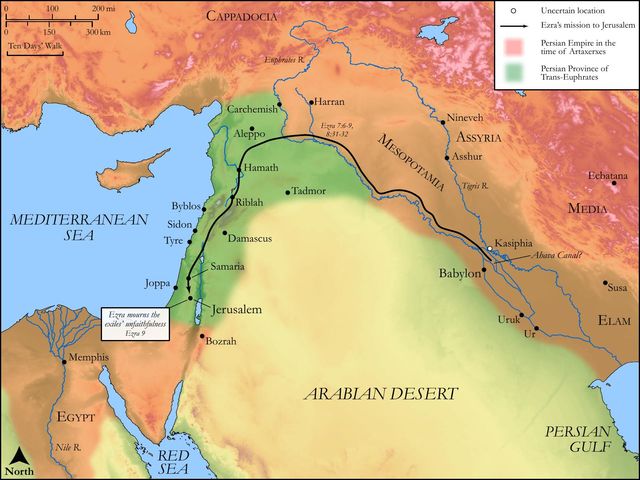
See on the biblical-era map
Study this verse
Public-domain commentary
Matthew Henry
From his Commentary on the Whole Bible. Henry comments on passages, not single verses — this entry covers Ezra 7:1–10. His three-level outline is real structure in the source text, so it is rendered as structure.
Here is, I. Ezra's pedigree. He was one of the sons of Aaron, a priest. Him God chose to be an instrument of good to Israel, that he might put honour upon the priesthood, the glory of which had been much eclipsed by the captivity. He is said to be the son of Seraiah, that Seraiah, as is supposed, whom the king of Babylon put to death when he sacked Jerusalem, Kg2 25:18, Kg2 25:21. If we take the shortest computation, it was seventy-five years since Seraiah died; many reckon it much longer, and, because they suppose Ezra called out in the prime of his time to public service, do therefore think that Seraiah was not his immediate parent, but his grandfather or great-grandfather, but that he was the first eminent person that occurred in his genealogy upwards, which is carried up here as high as Aaron, yet leaving out many for brevity-sake, which may be supplied from Ch1 6:4, etc. He was a younger brother, or his father was Jozadak, the father of Jeshua, so that he was not high priest, but nearly allied to the high priest.
II.His character. Though of the younger house, his personal qualifications made him very eminent.
1.He was a man of great learning, a scribe, a ready scribe, in the law of Moses, Ezr 7:6. He was very much conversant with the scriptures, especially the writings of Moses, had the words ready and was well acquainted with the sense and meaning of them. It is to be feared that learning ran low among the Jews in Babylon; but Ezra was instrumental to revive it. The Jews say that he collected and collated all the copies of the law he could find out, and published an accurate edition of it, with all the prophetical books, historical and poetical, that were given by divine inspiration, and so made up the canon of the Old Testament, with the addition of the prophecies and histories of his own time. If he was raised up of God, and qualified and inclined to do this, all generations have reason to call him blessed, and to bless God for him. God sent to the Jews prophets and scribes, Mat 23:34. Ezra went under the latter denomination. Now that prophecy was about to cease it was time to promote scripture-knowledge, pursuant to the counsel of God by the last of the prophets, Mal 4:4. Remember the law of Moses. Gospel ministers are called scribes instructed to the kingdom of heaven (Mat 13:52), New Testament scribes. It was a pity that such a worthy name as this should be worn, as it was in the degenerate ages of the Jewish church, by men who were professed enemies to Christ and his gospel (Woe unto you, scribes and Pharisees), who were learned in the letter of the law, but strangers to the spirit of it.
2.He was a man of great piety and holy zeal (Ezr 7:10): He had prepared his heart to seek the law of the Lord, etc.
(1.)That which he chose for his study was the law of the Lord. The Chaldeans, among whom he was born and bred, were famed for literature, especially the study of the stars, to which, being a studious man, we may suppose that Ezra was tempted to apply himself. But he got over the temptation; the law of his God was more to him than all the writings of their magicians and astrologers, which he knew enough of with good reason to despise them.
(2.)He sought the law of the Lord, that is, he made it his business to enquire into it, searched the scriptures, and sought the knowledge of God, of his mind and will, in the scriptures, which is to be found there, but not without seeking.
(3.)He made conscience of doing according to it; he set it before him as his rule, formed his sentiments and temper by it, and managed himself in his whole conversation according to it. This use we must make of our knowledge of the scriptures; for happy are we if we do what we know of the will of God.
(4.)He set himself to teach Israel the statutes and judgments of that law. What he knew he was willing to communicate for the good of others; for the ministration of the Spirit is given to every man to profit withal. But observe the method: he first learned and then taught, sought the law of the Lord and so laid up a good treasure, and then instructed others and laid out what he had laid up. He also first did and then taught, practised the commandments himself and then directed others in the practice of them; thus his example confirmed his doctrine.
(5.)He prepared his heart to do all this, or he fixed his heart. He took pains in his studies, and thoroughly furnished himself for what he designed, and then put on resolution to proceed and persevere in them, and thus he became a ready scribe. Moses in Egypt, Ezra in Babylon, and both in captivity, were wonderfully fitted for eminent services to the church.
III.His expedition to Jerusalem for the good of his country:
He went up from Babylon (Ezr 7:6), and, in four months' time, came to Jerusalem, Ezr 7:8. It was strange that such a man as he staid so long in Babylon after his brethren had gone up; but God sent him not thither till he had work for him to do there; and none went but those whose spirits God raised to go up. Some think that this Artaxerxes was the same with that Darius whose decree we had (ch. 6), and that Ezra came the very year after the temple was finished: that was the sixth year, this the seventh (v. 8), so Dr. Lightfoot. My worthy and learned friend, lately deceased, Mr. Talents, in his chronological tables, places it about fifty-seven years after the finishing of the temple; others further on. I have only to observe,
1.How kind the king was to him. He granted him all his request, whatever he desired to put him into a capacity to serve his country.
2.How kind his people were to him. When he went many more went with him, because they desired not to stay in Babylon when he had gone thence, and because they would venture to dwell in Jerusalem when he had gone thither.
3.How kind his God was to him. He obtained this favour from his king and country by the good hand of the Lord that was upon him, v. 6, 9. Note, Every creature is that to us which God makes it to be, and from him our judgment proceeds. As we must see the events that shall occur in the hand of God, so we must see the hand of God in the events that do occur, and acknowledge him with thankfulness when we have reason to call it his good hand.
Historical interpretation
Historical reception
1 surviving comment on this verse from the historical church.
For Ezra had prepared his heart, etc. Oh, what great virtue of this saying, what sublimity of merit, for a man to prepare his heart for the obedience of the divine will, and to be able to say: "My heart is ready, O God, my heart is ready; I will sing, and I will chant a psalm to the Lord" (Psalm LVI)! That is, I will exult in the Lord with my whole soul, and I will accomplish in the execution of works what has been commanded by Him. Therefore, he prepared his heart to investigate and rewrite the law of the Lord, which the devouring flame had consumed. He also prepared so that he himself might first fulfill this by doing, and thus open his mouth to teach others. This can similarly be understood of the Lord Jesus; for He prepared His heart to investigate the law of the Lord, as He divinely provided for Himself a man He would take up, who would not only be without sin but also full of grace and truth, because with no law of sin conflicting in Him, He would keep the law of God without any contradiction of mind or flesh. Hence, He says in the Psalm: “In the volume of the book it is written of me: I desired to do your will, O my God, and your law is in the midst of my heart” (Psalm XXXIX). Likewise, the Lord investigated the law of God, because, setting aside the traditions of the Pharisees, He taught how the Holy Scripture was to be understood mystically, what spiritual secrets were hidden under the cover of the letter; because He showed that the decrees of the Gospel, which He brought to the world, were more perfect, more acceptable to God the Father, than those He had previously sent through Moses. Hence, He Himself says: "You have heard that it was said to the ancients, 'You shall love your neighbor, and hate your enemy': but I say to you, love your enemies;" and so forth.
Continue studying Ezra 7:10 across the web’s major study libraries — every link below opens this exact verse, chapter, or book on the destination site.
Read & Compare
 BibleGatewayThis verse in more than 200 translations and 70 languages.
 Bible.comThe YouVersion reader — hundreds of translations, reading plans, and highlights.
 ESV.orgCrossway's official English Standard Version reader.
 NET BibleThe NET translation with 60,000+ translators' notes on every rendering decision.
 STEP BibleTyndale House's free study tool — original text, vocabulary, and scholarly resources.
 BibliaLogos Bible Software's free web reader.
 USCCBThe New American Bible (Revised Edition) with the U.S. bishops' study notes.
Commentaries
 BibleHub CommentariesDozens of classic commentaries on this verse, gathered on one page.
 StudyLightMore than 100 commentary sets — the largest collection on the web.
 BibleRefPlain-English commentary on what this verse means, verse by verse.
 Enduring WordDavid Guzik's free commentary on this chapter, widely used by Bible teachers.
 Bible Study ToolsVerse commentary alongside Greek and Hebrew study aids.
Original Language & Research
- BibleHub InterlinearThe verse word by word — original language, transliteration, and English.
- BibleHub LexiconEvery word's original-language definition and Strong's entry.
 Blue Letter BibleDeep-study tools — Strong's numbers, concordance, and word studies.
 SefariaThe Hebrew text with Rashi and centuries of Jewish commentary.
Sermons, Hymns & Audio


TrulyRandomVerse is not affiliated with these sites and doesn’t control their content. They’re linked because they’re genuinely useful.
Summary
Ezra 7:10 stands as a foundational declaration regarding the character and divine calling of Ezra, a pivotal figure in the post-exilic restoration of Judah. This verse profoundly encapsulates his personal and unwavering commitment to God's revealed Word, outlining a three-fold spiritual discipline: a deliberate and intentional preparation of his heart, diligent seeking and faithful obedience to the Law of the LORD, and a dedicated public ministry of teaching its statutes and judgments to the people of Israel. It portrays Ezra as an exemplary model of integrated devotion, where deep internal resolve not only precedes but also powerfully enables and sustains external service, thereby establishing the spiritual bedrock essential for the community's renewal and adherence to the covenant.
Context
ShowHideLiterary Context
Ezra 7 marks a significant transition within the book of Ezra, shifting the narrative focus from the initial return of exiles and the rebuilding of the Temple under Zerubbabel and Joshua (chapters 1-6) to the second major wave of returnees led by Ezra. This chapter specifically introduces Ezra, detailing his distinguished priestly lineage, his profound expertise as "a scribe skilled in the Law of Moses" (Ezra 7:6), and the remarkable divine favor he received from King Artaxerxes I, which empowered him to undertake his crucial mission. Ezra 7:10 functions as the theological linchpin of this introduction, providing the underlying spiritual motivation and divine enablement for Ezra's leadership. It explains why Ezra was uniquely qualified and chosen for this task of spiritual and reform, immediately preceding the detailed account of his journey to Jerusalem and the comprehensive royal decree that sanctioned his work. The preceding verses establish his external credentials and divine backing, while this verse unveils his indispensable inner disposition and spiritual mandate.
Historical & Cultural Context
The events described in Ezra 7 unfold approximately 60 years after the completion of the Second Temple (around 516 BC) and nearly 80 years following the initial return from Babylonian exile. During this period, the Jewish community that had resettled in Judah, despite having rebuilt the Temple, faced significant spiritual challenges. They often exhibited complacency, syncretism, and a struggle to fully re-establish their identity and practices in accordance with the Mosaic Covenant. Living under the vast Persian Empire, they required a leader who possessed not only deep spiritual conviction but also the administrative acumen to navigate imperial authority while upholding divine law. Ezra, uniquely positioned as both a priest and a highly skilled scribe, was ideally suited for this context. Scribes of this era were far more than mere copyists; they were authoritative interpreters, teachers, and enforcers of the Law, wielding considerable religious and legal influence. His mission, officially sanctioned by Artaxerxes I, was to restore covenant fidelity, purify the community from foreign influences, and re-establish true worship, addressing the ongoing challenges of maintaining a distinct, holy identity in a post-exilic, multi-cultural environment.
Key Themes
ShowHideEzra 7:10 powerfully contributes to several overarching themes that resonate throughout the book of Ezra and the broader post-exilic prophetic and historical narratives. Firstly, it underscores the Centrality of the Law of the LORD, presenting it not as a burdensome collection of rules, but as the foundational blueprint for Israel's covenant identity, spiritual flourishing, and national well-being. Ezra's personal commitment "to seek," "to do," and "to teach" the Law exemplifies this theme, highlighting its indispensable role. Secondly, the verse illuminates the intricate interplay between Divine Providence and Human Responsibility. While the narrative clearly demonstrates God's sovereign orchestration of Ezra's journey and the securing of royal favor (Ezra 7:6 and Ezra 7:9), Ezra's personal "preparation of heart" vividly illustrates the essential human response of intentional devotion, diligent effort, and faithful obedience. Thirdly, Ezra 7:10 establishes a profound model of Godly Leadership and Spiritual Reformation. Ezra's leadership is depicted as being deeply rooted in personal integrity and an unwavering commitment to the Word of God. This provides a timeless template for effective spiritual renewal that progresses from individual transformation to communal instruction and, ultimately, to societal change, echoing the ancient call for diligent obedience and teaching found in passages like Deuteronomy 6:6-7.
Exposition and Analysis
ShowHideKey Word Analysis
ShowHideThe verb "kûwn" (כּוּן), appearing here in its Hiphil stem, signifies "to establish," "to fix," "to make firm," or "to direct." When specifically applied to the "heart" (לֵבָב, lêbâb'), it conveys a profound sense of deliberate intention, resolute determination, and steadfast purpose. Ezra's devotion was not born of fleeting emotion or accidental circumstance; it was a conscious, unwavering setting of his will, intellect, and affections towards God's Law. This indicates a deep, internal commitment that served as the foundational prerequisite for all his subsequent external actions and ministry.
The verb "dârash" (דָּרַשׁ) implies a diligent, earnest, and persistent inquiry, investigation, or pursuit. It transcends a superficial reading or casual glance; it denotes a profound desire to understand, to delve deeply into the meaning, and to earnestly inquire of God's will as revealed in His Law. This "seeking" is active, thorough, and implies a dedicated pursuit of truth, wisdom, and divine revelation, often with the nuance of consulting or frequenting a source of authority.
The verb "lâmad" (לָמַד), used here in the Piel stem, means "to cause to learn," "to instruct," or "to teach." It denotes an active, intentional role in imparting knowledge, understanding, and practical skills to others. This highlights the crucial progression from Ezra's personal devotion and obedience to a public, pedagogical ministry. Ezra's teaching was not merely academic dissemination; it was aimed at cultivating genuine learning, fostering obedience, and ensuring the practical application of the Law within the community of Israel.
Verse Breakdown
ShowHide"For Ezra had prepared his heart"
This opening clause immediately establishes the internal disposition that serves as the bedrock for Ezra's entire ministry. The "heart" (לֵבָב, lêbâb') in ancient Hebrew thought is not merely the seat of emotions but encompasses the totality of a person's inner being—their will, intellect, emotions, moral core, and decision-making capacity. Ezra's deliberate "preparation" signifies a conscious, intentional, and resolute act of aligning his entire being with God's purposes, setting his will firmly and unreservedly on the path of divine obedience and service. This foundational spiritual discipline is presented as the indispensable prerequisite for all that follows.
"to seek the law of the LORD, and to do [it]"
This phrase articulates the first two, deeply interdependent aspects of Ezra's profound engagement with God's Word. "To seek the law of the LORD" emphasizes diligent study, deep understanding, earnest inquiry, and persistent meditation on God's commands and principles. It speaks of an intellectual and spiritual pursuit that aims for comprehensive comprehension. Crucially, this diligent seeking is immediately and inextricably paired with "and to do [it]," highlighting that Ezra's pursuit of knowledge was never merely academic or theoretical. His commitment extended directly to practical obedience, demonstrating that true understanding of God's Word must inevitably translate into lived experience, faithful action, and consistent adherence. The bracketed "it" in the KJV accurately clarifies that the object of "doing" is the Law itself.
"and to teach in Israel statutes and judgments"
This final clause describes the natural and necessary outflow of Ezra's personal devotion and obedience into a public, communal ministry. Having personally sought, understood, and obeyed the Law, Ezra was then uniquely qualified, divinely compelled, and morally obligated to impart this divine wisdom to others. "Statutes and judgments" are specific, comprehensive terms for God's laws, encompassing both the fixed decrees (statutes) and the righteous legal decisions or ordinances (judgments), emphasizing the holistic nature of his instruction. This teaching was not just theoretical dissemination but was aimed at practical application within the community of Israel, ensuring that the entire nation would not only understand but also live by God's covenant requirements, thereby fostering national spiritual renewal.
Literary Devices
ShowHideEzra 7:10 masterfully employs several literary devices to convey its profound and enduring message. Most notably, it exhibits a clear Triadic Structure or Progression, outlining three distinct yet intrinsically interconnected stages of Ezra's engagement with the Law: to "seek," to "do," and to "teach." This progression is not merely descriptive but profoundly prescriptive, emphasizing a holistic and integrated approach to divine revelation, moving seamlessly from intellectual understanding (seeking) to practical application (doing) and finally to communal dissemination (teaching). This structure underscores the comprehensive nature of true spiritual devotion. The verse also utilizes Emphasis through its concise yet weighty declaration, strategically placing Ezra's internal disposition—his "prepared heart"—as the foundational and primary element. This highlights the critical primacy of the heart's posture and intentionality in all spiritual matters. Furthermore, the phrase "Law of the LORD" functions as a powerful Metonymy for the entire revealed will of God, encompassing all His commands, principles, and covenant requirements, thereby representing the entirety of divine instruction given to Israel.
Theological and Thematic Connections
ShowHideEzra 7:10 offers profound theological insights into the very nature of true devotion, effective spiritual leadership, and the transformative power of God's Word. It establishes a timeless and universal principle: genuine engagement with divine revelation begins with an intentional, internal commitment of the heart, a deliberate setting of one's will towards God's purposes. This internal resolve then naturally progresses to diligent study and earnest inquiry, leading inevitably to practical obedience and faithful application of God's truth in one's life. Ultimately, this personal transformation culminates in the faithful instruction of others, as the overflow of a life lived in accordance with God's will. This sequence underscores that authentic spiritual authority and lasting impact flow from personal integrity and a lived experience of God's truth, rather than from mere intellectual knowledge, positional power, or outward display. The verse beautifully illustrates the dynamic interplay between divine grace (God's good hand upon Ezra) and essential human responsibility (Ezra's prepared heart), demonstrating that God sovereignly uses and empowers those who earnestly commit themselves to His revealed purposes. Implicitly, the verse teaches that the spiritual health and flourishing of a community are directly tied to its collective adherence to God's Law, and that committed, Spirit-empowered individuals are instrumental in fostering and sustaining such adherence.
Reflection and Application
ShowHideEzra 7:10 provides a powerful and enduring blueprint for every believer and leader in every generation. It challenges us to move beyond superficial or sporadic engagement with God's Word, calling us instead to cultivate a deep, intentional, and transformative relationship with divine truth. The initial call to "prepare our hearts" is a profound summons to conscious spiritual discipline, an invitation to deliberately set our will, affections, and intellect on seeking God's truth with earnestness and humility. This preparation is not a one-time event but an ongoing posture of receptivity and openness to divine instruction, a continual yielding of our inner being to the Lord. From this prepared heart flows the diligent "seeking" – a commitment to consistent study, prayerful meditation, and earnest inquiry into the Scriptures, striving for deeper understanding. Yet, knowledge without action is incomplete and ultimately barren; Ezra's example compels us to "do" what we learn, translating biblical principles into practical obedience in every sphere of our lives, allowing God's Word to shape our character, choices, and conduct. Finally, this profound progression culminates in "teaching," reminding us that our personal transformation is meant to bear fruit in the lives of others, whether through formal ministry, informal discipleship, mentoring, or simply living out our faith authentically and consistently before a watching world. Ezra's life stands as a powerful testament that genuine spiritual impact and lasting influence begin with a heart wholly devoted to God and His Word.
Questions for Reflection
ShowHideFAQ
ShowHideWhat does it mean for Ezra to have "prepared his heart"?
ShowHideTo "prepare his heart" (Hebrew: kûwn lêbâb) signifies a deliberate, resolute, and unwavering commitment of one's entire inner being—including will, intellect, emotions, and moral core—to a specific, divine purpose. It is far more than a casual interest; it represents a conscious, intentional act of setting one's mind and affections firmly and unreservedly towards God's will as revealed in His Law. For Ezra, this meant a profound, intentional devotion to understanding, obeying, and teaching God's commands. It implies a disciplined spiritual posture, free from distraction, wavering, or half-heartedness, ready to receive and respond to divine instruction. This internal readiness and steadfast resolve were the foundational prerequisites for his exceptionally effective ministry and leadership.
Is Ezra's three-fold commitment ("seek, do, teach") a model for all believers today?
ShowHideAbsolutely. Ezra's three-fold commitment provides a timeless and universally applicable model for every believer's engagement with God's Word and their spiritual journey. First, we are called to "seek" the Law of the LORD, which for us means diligently studying, meditating on, and understanding the entirety of the Scriptures with earnestness and prayer (Psalm 1:2). Second, this diligent seeking must inevitably lead to "doing" – applying what we learn in practical obedience, translating biblical principles into our daily lives, and living out God's commands in every sphere (James 1:22). Finally, having personally experienced the transformative power and truth of God's Word, we are then equipped, compelled, and called to "teach" or share these life-giving truths with others, whether through formal ministry, intentional discipleship, or simply by living a life that consistently exemplifies Christ's teachings and the principles of His Kingdom (Matthew 28:19-20). This progression from personal devotion to outward influence remains foundational for genuine spiritual growth, effective witness, and fruitful ministry in the church and the world.
Christ-Centered Fulfillment
ShowHideWhile Ezra 7:10 vividly describes a man utterly devoted to God's Law, its ultimate fulfillment and deeper theological significance are profoundly realized in the person and work of Jesus Christ. Ezra's diligent "seeking" and "doing" of the Law, though exemplary, merely foreshadow the perfect obedience of Christ, who unequivocally declared, "Do not think that I have come to abolish the Law or the Prophets; I have not come to abolish them but to fulfill them" (Matthew 5:17). Jesus embodies the Law in its purest, most profound form, living a life of flawless devotion, perfect righteousness, and complete obedience that no human, not even the devout Ezra, could ever perfectly achieve. Furthermore, Ezra's commitment "to teach in Israel statutes and judgments" finds its supreme expression in Jesus, the ultimate Teacher and the very Word Incarnate, who perfectly revealed God's will, truth, and character (John 1:1). He taught with unparalleled authority, not merely interpreting the Law but fulfilling its spirit, unveiling its deepest meaning, and bringing its ultimate redemptive purpose to glorious light. For believers today, the "preparation of heart" and the empowering ability to "seek, do, and teach" are no longer achieved through human effort or legalistic striving alone, but are graciously empowered by the indwelling Holy Spirit, who enables us to live out the righteous requirements of the Law through faith in Christ Jesus (Romans 8:4). Thus, Ezra's exemplary devotion serves as a prophetic pointer to the One who perfectly fulfilled the Law and now empowers us, by grace, to live in its truth and righteousness.