


Matthew 7:24
Bible text: King James Version (1769 Blayney text) · Public domain
Bible text: King James Version with Strong's numbers · Public domain
Bible text: Berean Standard Bible · Public domain
Bible text: American Standard Version (1901) · Public domain
Bible text: World English Bible, Messianic edition · Public domain
Bible text: Geneva Bible (1599) · Public domain
Bible text: Young's Literal Translation · Public domain
- ΠᾶςPasEveryoneG3956A-NSMAdjective Nominative Singular Masculine
- οὖνounthereforeG3767CONJConjunction
- ὅστιςhostiswhoeverG3748R-NSMRelative pronoun Nominative Singular Masculine
- ἀκούειakoueihearsG191V-PAI-3SVerb Present Active Indicative 3rd Singular
- μουmouMyG3165P-1GSPersonal pronoun Genitive 1st Singular
- τοὺςtous<the>G3588T-APMDefinite article Accusative Plural Masculine
- λόγουςlogouswordsG3056N-APMNoun Accusative Plural Masculine
- τούτουςtoutoustheseG3778D-APMDemonstrative pronoun Accusative Plural Masculine
- καὶkaiandG2532CONJConjunction
- ποιεῖpoieidoesG4160V-PAI-3SVerb Present Active Indicative 3rd Singular
- αὐτούςautousthemG846P-APMPersonal pronoun Accusative Plural Masculine
- ὁμοιωθήσεταιhomoiōthēsetaihe will be likeG3666V-FPI-3SVerb Future Passive Indicative 3rd Singular
- ἀνδρὶandria manG435N-DSMNoun Dative Singular Masculine
- φρονίμῳphronimōwiseG5429A-DSMAdjective Dative Singular Masculine
- ὅστιςhostiswhoG3748R-NSMRelative pronoun Nominative Singular Masculine
- ᾠκοδόμησενōkodomēsenbuiltG3618V-AAI-3SVerb Aorist Active Indicative 3rd Singular
- αὐτοῦautouhisG846P-GSMPersonal pronoun Genitive Singular Masculine
- τὴνtēn<the>G3588T-ASFDefinite article Accusative Singular Feminine
- οἰκίανoikianhouseG3614N-ASFNoun Accusative Singular Feminine
- ἐπὶepiuponG1909PREPPreposition
- τὴνtēntheG3588T-ASFDefinite article Accusative Singular Feminine
- πέτρανpetranrockG4073N-ASFNoun Accusative Singular Feminine
English is a literal word-by-word gloss of the Greek, not the KJV's wording. Why?
This is the original text the KJV's translators worked from — each Greek word with its own literal English meaning in this verse, prepared by scholars at Tyndale House, Cambridge. The KJV translates whole sentences, not word by word, so its wording differs: one Greek word can become several English words, and the KJV may choose “charity” where the gloss reads “love”. Both are faithful — they answer different questions. For the KJV's own rendering, switch to the KJV text.
Details
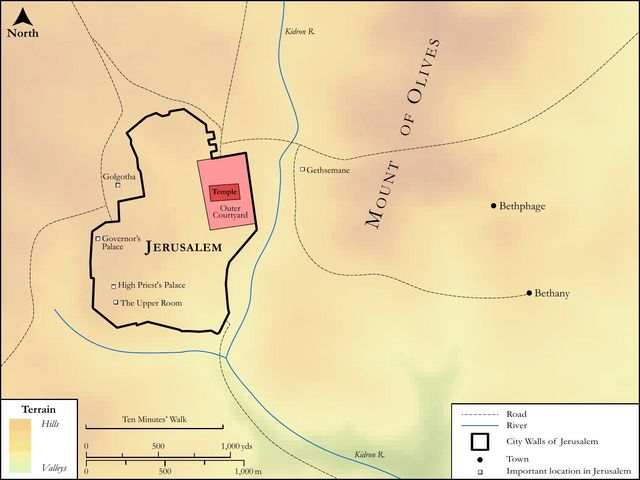
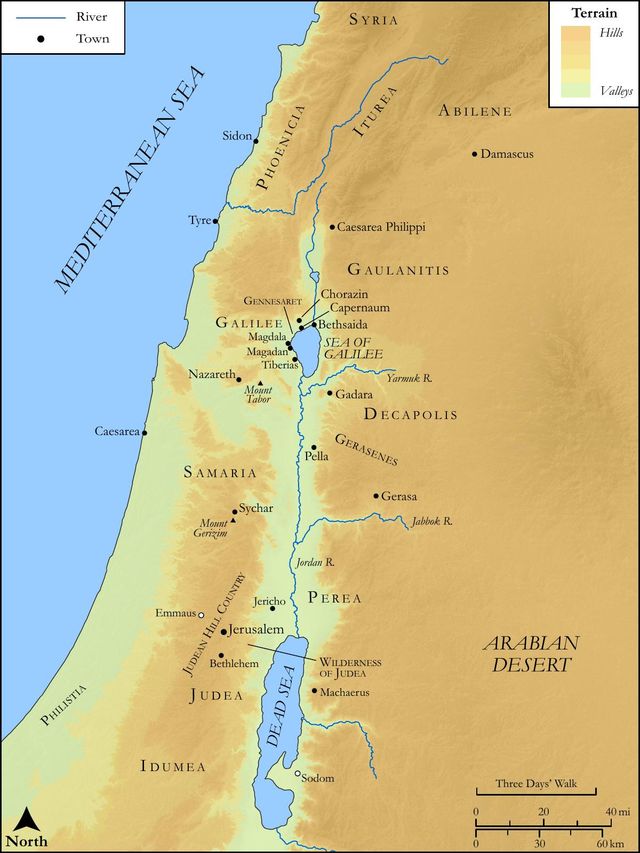
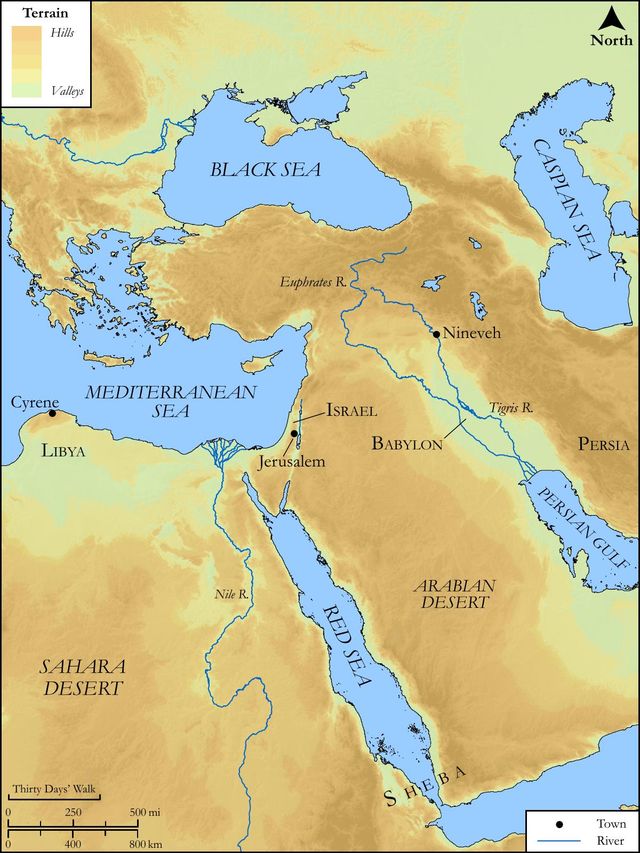
See on the biblical-era maps
Study this verse
Public-domain commentary
Matthew Henry
From his Commentary on the Whole Bible. Henry comments on passages, not single verses — this entry covers Matthew 7:21–29. His four-level outline is real structure in the source text, so it is rendered as structure.
We have here the conclusion of this long and excellent sermon, the scope of which is to show the indispensable necessity of obedience to the commands of Christ; this is designed to clench the nail, that it might fix in a sure place: he speaks this to his disciples, that sat at his feet whenever he preached, and followed him wherever he went. Had he sought his own praise among men, he would have said, that was enough; but the religion he came to establish is in power, not in word only (Co1 4:20), and therefore something more is necessary.
I.He shows, by a plain remonstrance, that an outward profession of religion, however remarkable, will not bring us to heaven, unless there be a correspondent conversation, Mat 7:21-23. All judgment is committed to our Lord Jesus; the keys are put into his hand; he has power to prescribe new terms of life and death, and to judge men according to them: now this is a solemn declaration pursuant to that power. Observe here,
1.Christ's law laid down, Mat 7:21. Not every one that saith, Lord, Lord, shall enter into the kingdom of heaven, into the kingdom of grace and glory. It is an answer to that question, Psa 15:1. Who shall sojourn in thy tabernacle? - the church militant; and who shall dwell in thy holy hill? - the church triumphant. Christ here shows,
(1.)That it will not suffice to say, Lord, Lord; in word and tongue to own Christ for our Master, and to make addresses to him, and professions of him accordingly: in prayer to God, in discourse with men, we must call Christ, Lord, Lord; we say well, for so he is (Joh 13:13); but can we imagine that this is enough to bring us to heaven, that such a piece of formality as this should be so recompensed, or that he who knows and requires the heart should be so put off with shows for substance? Compliments among men are pieces of civility that are returned with compliments, but they are never paid as real services; and can they then be of an account with Christ? There may be a seeming importunity in prayer, Lord, Lord: but if inward impressions be not answerable to outward expressions, we are but as sounding brass and a tinkling cymbal. This is not to take us off from saying, Lord, Lord; from praying, and being earnest in prayer, from professing Christ's name, and being bold in professing it, but from resting in these, in the form of godliness, without the power.
(2.)That it is necessary to our happiness that we do the will of Christ, which is indeed the will of his Father in heaven. The will of God, as Christ's Father, is his will in the gospel, for there he is made known, as the Father of our Lord Jesus Christ: and in him our Father. Now this is his will, that we believe in Christ, that we repent of sin, that we live a holy life, that we love one another. This is his will, even our sanctification. If we comply not with the will of God, we mock Christ in calling him Lord, as those did who put on him a gorgeous robe, and said, Hail, King of the Jews. Saying and doing are two things, often parted in conversation of men: he that said, I go, sir, stirred never a step (Mat 21:30); but these two things God has joined in his command, and let no man that puts them asunder think to enter into the kingdom of heaven.
2.The hypocrite's plea against the strictness of this law, offering other things in lieu of obedience, Mat 7:22. The plea is supposed to be in that day, that great day, when every man shall appear in his own colours; when the secrets of all hearts shall be manifest, and among the rest, the secret pretences with which sinners now support their vain hopes. Christ knows the strength of their cause, and it is but weakness; what they now harbour in their bosoms, they will then produce in arrest of judgment to stay the doom, but is will be in vain. They put in their plea with great importunity, Lord, Lord; and with great confidence, appealing to Christ concerning it; Lord, does thou not know,
(1.)That we have prophesied in thy name? Yes, it may be so; Balaam and Caiaphas were overruled to prophesy, and Saul was against his will among the prophets, yet that did not save them. These prophesied in his name, but he did not send them; they only made use of his name to serve a turn. Note, A man may be a preacher, may have gifts for the ministry, and an external call to it, and perhaps some success in it, and yet be a wicked man; may help others to heaven, and yet come short himself.
(2.)That in thy name we have cast out devils? That may be too; Judas cast out devils, and yet was a son of perdition. Origen says, that in his time so prevalent was the name of Christ to cast out devils, that sometimes it availed when named by wicked Christians. A man might cast devils out of others, and yet have a devil, nay, be a devil himself.
(3.)That in thy name we have done many wonderful works. There may be a faith of miracles, where there is no justifying faith; none of that faith which works by love and obedience. Gifts of tongues and healing would recommend men to the world, but it is real holiness or sanctification that is accepted of God. Grace and love are a more excellent way than removing mountains, or speaking with the tongues of men and of angels, Co1 13:1, Co1 13:2. Grace will bring a man to heaven without working miracles, but working miracles will never bring a man to heaven without grace. Observe, That which their heart was upon, in doing these works, and which they confided in, was the wonderfulness of them. Simon Magus wondered at the miracles (Act 8:13), and therefore would give any money for power to do the like. Observe, They had not many good works to plead: they could not pretend to have done many gracious works of piety and charity; one such would have passed better in their account than many wonderful works, which availed not at all, while they persisted in disobedience. Miracles have now ceased, and with them this plea; but do not carnal hearts still encourage themselves in their groundless hopes, with the like vain supports? They think they shall go to heaven, because they have been of good repute among professors of religion, have kept fasts, and given alms, and have been preferred in the church; as if this would atone for their reigning pride, worldliness, and sensuality; and want of love to God and man. Bethel is their confidence (Jer 48:13), they are haughty because of the holy mountain (Zep 3:11); and boast that they are the temple of the Lord, Jer 7:4. Let us take heed of resting in external privileges and performances, lest we deceive ourselves, and perish eternally, as multitudes do, with a lie in our right hand.
3.The rejection of this plea as frivolous. The same that is the Law-Maker (Mat 7:21) is here the Judge according to that law (Mat 7:23), and he will overrule the plea, will overrule it publicly; he will profess to them with all possible solemnity, as sentence is passed by the Judge, I never knew you, and therefore depart from me, ye that work iniquity. - Observe,
(1.)Why, and upon what ground, he rejects them and their plea - because they were workers for iniquity. Note, It is possible for men to have a great name for piety, and yet to be workers of iniquity; and those that are so will receive the greater damnation. Secret haunts of sin, kept under the cloak of a visible profession, will be the ruin of the hypocrites. Living in known sin nullifies men's pretensions, be they ever so specious.
(2.)How it is expressed; I never knew you; "I never owned you as my servants, no, not when you prophesied in my name, when you were in the height of your profession, and were most extolled." This intimates, that if he had ever known them, as the Lord knows them that are his, had ever owned them and loved them as his, he would have known them, and owned them, and loved them, to the end; but he never did know them, for he always knew them to be hypocrites, and rotten at heart, as he did Judas; therefore, says he, depart from me. Has Christ need of such guests? When he came in the flesh, he called sinners to him (Mat 9:13), but when he shall come again in glory, he will drive sinners from him. They that would not come to him to be saved, must depart from him to be damned. To depart from Christ is the very hell of hell; it is the foundation of all the misery of the damned, to be cut off from all hope of benefit from Christ and he mediation. Those that go no further in Christ's service than a bare profession, he does not accept, nor will he own them in the great day. See from what a height of hope men may fall into the depth of misery! How they may go to hell, by the gates of heaven! This should be an awakening word to all Christians. If a preacher, one that cast out devils, and wrought miracles, be disowned of Christ for working iniquity; what will become of us, if we be found such? And if we be such, we shall certainly be found such. At God's bar, a profession of religion will not bear out any man in the practice and indulgence of sin; therefore let every one that names the name of Christ, depart from all iniquity.
II.He shows, by a parable, that hearing these sayings of Christ will not make us happy, if we do not make conscience of doing them; but that if we hear them and do them, we are blessed in our deed, Mat 7:24-27.
1.The hearers of Christ's word are here divided into two sorts; some that hear, and do what they hear; others that hear and do not. Christ preached now to a mixed multitude, and he thus separates them, one from the other, as he will at the great day, when all nations shall be gathered before him. Christ is still speaking from heaven by his word and Spirits, speaks by ministers, by providences, and of those that hear him there are two sorts.
(1.)Some that hear his sayings and do them: blessed be God that there are any such, though comparatively few. To hear Christ is not barely to give him the hearing, but to obey him. Note, It highly concerns us all to do what we hear of the saying of Christ. It is a mercy that we hear his sayings: Blessed are those ears, Mat 13:16, Mat 13:17. But, if we practise not what we hear, we receive that grace in vain. To do Christ's sayings is conscientiously to abstain from the sins that he forbids, and to perform the duties that he requires. Our thoughts and affections, our words and actions, the temper of our minds, and the tenour of our lives, must be conformable to the gospel of Christ; that is the doing he requires. All the sayings of Christ, not only the laws he has enacted, but the truths he has revealed, must be done by us. They are a light, not only to our eyes, but to our feet, and are designed not only to inform our judgments, but to reform our hearts and lives: nor do we indeed believe them, if we do not live up to them. Observe, It is not enough to hear Christ's sayings, and understand them, hear them, and remember them, hear them, and talk of them, repeat them, dispute for them; but we must hear, and do them. This do, and thou shalt live. Those only that hear, and do, are blessed (Luk 11:28; Joh 13:17), and are akin to Christ. Mat 12:50.
(2.)There are others who hear Christ's sayings and do them not; their religion rests in bare hearing, and goes no further; like children that have the rickets, their heads swell with empty notions, and indigested opinions, but their joints are weak, and they heavy and listless; they neither can stir, nor care to stir, in any good duty; they hear God's words, as if they desired to know his ways, like a people that did righteousness, but they will not do them, Eze 33:30, Eze 33:31; Isa 58:2. Thus they deceive themselves, as Micah, who thought himself happy, because he had a Levite to be his priest, though he had not the Lord to be his God. The seed is sown, but it never comes up; they see their spots in the glass of the word, but wash them off, Jam 1:22, Jam 1:24. Thus they put a cheat upon their own souls; for it is certain, if our hearing be not the means of our obedience, it will be the aggravation of our disobedience. Those who only hear Christ's sayings, and do them not, sit down in the midway to heaven, and that will never bring them to their journey's end. They are akin to Christ only by the half-blood, and our law allows not such to inherit.
2.These two sorts of hearers are here represented in their true characters, and the state of their case, under the comparison of two builders; one was wise, and built upon a rock, and his building stood in a storm; the other foolish, and built upon the sand, and his building fell.
Now, (1.) The general scope of this parable teaches us that the only way to make sure work for our souls and eternity is, to hear and do the sayings of the Lord Jesus, these sayings of his in this sermon upon the mount, which is wholly practical; some of them seem hard sayings to flesh and blood, but they must be done; and thus we lay up in store a good foundation for the time to come (Ti1 6:19); a good bond, so some read it; a bond of God's making, which secures salvation upon gospel-terms, that is a good bond; not one of our own devising, which brings salvation to our own fancies. They make sure the good part, who, like Mary, when they hear the word of Christ, sit at his feet in subjection to it: Speak, Lord, for thy servant heareth.
(2.)The particular parts of it teach us divers good lessons.
[1.]That we have every one of us a house to build, and that house is our hope for heaven. It ought to be our chief and constant care, to make our calling and election sure, and so we make our salvation sure; to secure a title to heaven's happiness, and then to get the comfortable evidence of it; to make it sure, and sure to ourselves, that when we fail, we shall be received into everlasting habitations. Many never mind this: it is the furthest thing from their thoughts; they are building for this world, as if they were to be here always, but take no care to build for another world. All who take upon them a profession of religion, profess to enquire, what they shall do to be saved; how they may get to heaven at last, and may have a well-grounded hope of it in the mean time.
[2.]That there is a rock provided for us to build this house upon, and that rock is Christ. He is laid for a foundation, and other foundation can no may lay, Isa 28:16; Co1 3:11. He is our Hope, Ti1 1:1. Christ in us is so; we must ground our hopes of heaven upon the fulness of Christ's merit, for the pardon of sin, the power of his Spirit, for the sanctification of our nature, and the prevalency of his intercession, for the conveyance of all that good which he has purchased for us. There is that in him, as he is made known, and made over, to us in the gospel, which is sufficient to redress all our grievances, and to answer all the necessities of our case, so that he is a Saviour to the uttermost. The church is built upon this Rock, and so is every believer. He is strong and immovable as a rock; we may venture our all upon him, and shall not be made ashamed of our hope.
[3.]That there is a remnant, who by hearing and doing the sayings of Christ, build their hopes upon this Rock; and it is their wisdom. Christ is our only Way to the Father, and the obedience of faith is our only way to Christ: for to them that obey him, and to them only, he becomes the Author of eternal salvation. Those build upon Christ, who having sincerely consented to him, as their Prince and Saviour, make it their constant care to conform to all the rules of his holy religion, and therein depend entirely upon him for assistance from God, and acceptance with him, and count every thing but loss and dung that they may win Christ, and be found in him. Building upon a rock requires care and pains: they that would make their calling and election sure, must give diligence. They are wise builders who begin to build so as they may be able to finish (Luk 14:30), and therefore lay a firm foundation.
[4.]That there are many who profess that they hope to go to heaven, but despise this Rock, and build their hopes upon the sand; which is done without much pains, but it is their folly. Every thing besides Christ is sand. Some build their hopes upon their worldly prosperity, as if they were a sure token of God's favour, Hos 12:8. Others upon their external profession of religion, the privileges they enjoy, and the performances they go through in that profession, and the reputation they have got by it. They are called Christians, were baptized, go to church, hear Christ's word, say their prayers, and do nobody any harm, and, if they perish, God help a great many! This is the light of their own fire, which they walk in; this is that, upon which, with a great deal of assurance, they venture; but it is all sand, took weak to bear such a fabric as our hopes of heaven.
[5.]That there is a storm coming, that will try what our hopes are bottomed on; will try every man's work (Co1 3:13); will discover the foundation, Hab 3:13. Rain, and floods, and wind, will beat upon the house; the trial is sometimes in this world; when tribulation and persecution arise because of the word, then it will be seen, who only heard the word, and who heard and practiced it; then when we have occasion to use our hopes, it will be tried whether they were right, and well-grounded, or not. However, when death and judgment come, then the storm comes, and it will undoubtedly come, how calm soever things may be with us now. Then every thing else will fail us but these hopes, and then, if ever, they will be turned into everlasting fruition.
[6.]That those hopes which are built upon Christ the Rock will stand, and will stand the builder in stead when the storm comes; they will be his preservation, both from desertion, and from prevailing disquiet. His profession will not wither; his comforts will not fail; they will be his strength and song, as an anchor of the soul, sure and steadfast. When he comes to the last encounter, those hopes will take off the terror of death and the grave; will carry him cheerfully through that dark valley; will be approved by the Judge; will stand the test of the great day; and will be crowned with endless glory, Co2 1:12; Ti2 4:7, Ti2 4:8. Blessed is that servant, whom his Lord, when he comes, finds so doing, so hoping.
[7.]That those hopes which foolish builders ground upon any thing but Christ, will certainly fail them on a stormy day; will yield them no true comfort and satisfaction in trouble, in the hour of death, and in the day of judgment; will be no fence against temptations to apostacy, in a time of persecution. When God takes away the soul, where is the hope of the hypocrite? Job 27:8. It is as the spider's web, and as the giving up of the ghost. He shall lean upon his house, but it shall not stand, Job 8:14, Job 8:15. It fell in the storm, when the builder had most need of it, and expected it would be a shelter to him. It fell when it was too late to build another: when a wicked man dies, his expectation perishes; then, when he thought it would have been turned into fruition, it fell, and great was the fall of it. It was a great disappointment to the builder; the shame and loss were great. The higher men's hopes have been raised, the lower they fall. It is the sorest ruin of all that attends formal professors; witness Capernaum's doom.
III.In the two last verses, we are told what impressions Christ's discourse made upon the auditory.
It was an excellent sermon; and it is probable that he said more than is here recorded; and doubtless the delivery of it from the mouth of him, into whose lips grace was poured, did mightily set if off. Now,
1.They were astonished at this doctrine; it is to be feared that few of them were brought by it to follow him: but for the present, they were filled with wonder. Note, It is possible for people to admire good preaching, and yet to remain in ignorance and unbelief; to be astonished, and yet not sanctified.
2.The reason was because he taught them as one having authority, and not as the scribes. The scribes pretended to as much authority as any teachers whatsoever, and were supported by all the external advantages that could be obtained, but their preaching was mean, and flat, and jejune: they spake as those what were not themselves masters of what they preached: the word did not come from them with any life or force; they delivered it as a school-boy says his lesson; but Christ delivered his discourse, as a judge gives his charge. He did indeed, dominari in conscionibus - deliver his discourses with a tone of authority; his lessons were law; his word a word of command. Christ, upon the mountain, showed more true authority, than the scribes in Moses's seat. Thus when Christ teaches by his Spirit in the soul, he teaches with authority. He says, Let there be light, and there is light.
Historical interpretation
Five Centuries of Reception
8 surviving comments on this verse. Each one is dated, so this reads as a timeline rather than a list.
Select a marker to jump to its quote. Markers stagger vertically where authors wrote within a few decades of each other.
Otherwise; By the showers He signifies the allurements of smooth and gently invading pleasures, with which the faith is at first watered as with spreading rills, afterwards comes down the rush of torrent floods, that is, the motions of fiercer desire, and lastly, the whole force of the driving tempests rages against it, that is, the universal spirits of the Devil's reign attack it.
Having now, you see, finished all, having discoursed accurately of all virtue, and pointed out the pretenders to it, of divers kinds, both such as for display fast and make prayers, and such as come in the sheep's hide; and them too that spoil it, whom He also called swine and dogs: He proceeds to signify how great is the profit of virtue even here, and how great the mischief of wickedness, by saying, "Whosoever therefore heareth these sayings of mine, and doeth them, shall be likened unto a wise man."
As thus: What they shall suffer who do not (although they work miracles), ye have heard; but ye should know also what such as obey all these sayings shall enjoy; not in the world to come only, but even here. "For whosoever," saith He, "heareth these sayings of mine, and doeth them, shall be likened to a wise man."
Seest thou how He varies His discourse; at one time saying, "Not every one that saith unto me, Lord, Lord," and revealing Himself; at another time, "He that doeth the will of my Father;" and again, bringing in Himself as judge, "For many will say to me in that day, Lord, Lord, have we not prophesied in thy name, and I will say, I know you not." And here again He indicates Himself to have the power over all, this being why He said, "Whosoever heareth these sayings of mine."
Thus whereas all His discourse had been touching the future; of a kingdom, and an unspeakable reward and consolation, and the like; His will is, out of things here also to give them their fruits, and to signify how great is the strength of virtue even in the present life. What then is this her strength? To live in safety, to be easily subdued by no terror, to stand superior to all that despitefully use us. To this what can be equal? For this, not even he that wears the diadem can provide for himself, but that man who follows after virtue. For he alone is possessed of it in full abundance: in the ebb and flow of the things present he enjoys a great calm. The truly marvellous thing being this, that not in fair weather, but when the storm is vehement, and the turmoil great, and the temptations continual, he cannot be shaken ever so little.
Because there would be some who would admire the things that were said by the Lord, but would not add that showing forth of them which is in action, He threatens them before, saying, Every man that hears these words of mine, and does them, shall be likened to a wise man.
(Verse 24) Depart from me, you who practice iniquity. Therefore, everyone who hears these words of mine and does them will be like a wise man who built his house on the rock. He did not say, 'you who have practiced iniquity,' so as not to seem to take away repentance, but rather 'you who practice,' that is, those who, up until the present hour, when the time of judgment comes, though they do not have the power to sin, still have the inclination.
Or otherwise; On sand which is loose and cannot be bound into one mass, all the doctrine of heretics is built so as to fall.
(Serm. in Mont. in fin.) Otherwise; Rain, when it is put to denote any evil, is understood as the darkness of superstition; rumours of men are compared to winds; the flood signifies the lust of the flesh, as it were flowing over the land, and because what is brought on by prosperity is broken off by adversity. None of these things does he fear who has his house founded upon a rock, that is, who not only hears the command of the Lord, but who also does it. And in all these he submits himself to danger, who hears and does not. For no man confirms in himself what the Lord commands, or himself hears, but by doing it. But it should be noted, that when he said, He that heareth these words of mine, He shows plainly enough that this sermon is made complete by all those precepts by which the Christian life is formed, so that with good reason they that desire to live according to them, may be compared to one that builds on a rock.
For death separates the soul from the body, but changes not the purpose of the heart.
He said not, I will account him that hears and does, as wise; but, He shall be likened to a wise man. He then that is likened is a man; but to whom is he likened? To Christ; but Christ is the wise man who has built His house, that is, the Church, upon a rock, that is, upon the strength of the faith. The foolish man is the Devil, who has built his house, that is, all the ungodly, upon the sand, that is, the insecurity of unbelief, or upon the carnal, who are called the sand on account of their barrenness; both because they do not cleave together, but are scattered through the diversity of their opinions, and because they are innumerable. The rain is the doctrine that waters a man, the clouds are those from which the rain falls. Some are raised by the Holy Spirit, as the Apostles and Prophets, and some by the spirit of the Devil, as are the heretics. The good winds are the spirits of the different virtues, or the Angels who work invisibly in the senses of men, and lead them to good. The bad winds are the unclean spirits. The good floods are the Evangelists and teachers of the people; the evil floods are men full of an unclean spirit, and overflowing with many words; such are philosophers and the other professors of worldly wisdom, out of whose belly come rivers of dead water. The Church then which Christ has founded, neither the rain of false doctrine shall sap, nor the blast of the Devil overturn, nor the rush of mighty floods remove. Nor does it contradict this, that certain of the Church do fall; for not all that are called Christians, are Christ's, but, The Lord knows them that are his. (2 Tim. 2:19.) But against that house that the Devil has built comes down the rain of true doctrine, the winds, that is, the graces of the Spirit, or the Angels; the floods, that is, the four Evangelists and the rest of the wise; and so the house falls, that is, the Gentile world, that Christ may rise; and the ruin of that house was great, its errors broken up, its falsehoods laid open, its idols throughout the whole world broken down. He then is like unto Christ, who hears Christ's words, and does them; for he builds on a rock, that is, upon Christ, who is all good, so that on whatsoever kind of good any one shall build, he may seem to have built upon Christ. But as the Church built by Christ cannot be thrown down, so any such Christian who has built himself upon Christ, no adversity can overthrow, according to that, Who shall separate us from the love of Christ? (Rom. 8:35.) Like to the Devil is he that hears the words of Christ, and does them not. For words that are heard, and are not done, are likened to sand, they are dispersed and shed abroad. For the sand signifies all evil, or even worldly goods. For as the Devil's house is overthrown, so such as are built upon the sand are destroyed and fall. And great is that ruin if he have suffered any thing to fail of the foundation of faith; but not if he have committed fornication, or homicide, because he has whence he may arise through penitence, as David.
Or the great ruin is to be understood that with which the Lord will say to them that hear and do not, Go ye into everlasting fire. (Mat. 25:41.)
Continue studying Matthew 7:24 across the web’s major study libraries — every link below opens this exact verse, chapter, or book on the destination site.
Read & Compare
 BibleGatewayThis verse in more than 200 translations and 70 languages.
 Bible.comThe YouVersion reader — hundreds of translations, reading plans, and highlights.
 ESV.orgCrossway's official English Standard Version reader.
 NET BibleThe NET translation with 60,000+ translators' notes on every rendering decision.
 STEP BibleTyndale House's free study tool — original text, vocabulary, and scholarly resources.
 BibliaLogos Bible Software's free web reader.
 USCCBThe New American Bible (Revised Edition) with the U.S. bishops' study notes.
Commentaries
 BibleHub CommentariesDozens of classic commentaries on this verse, gathered on one page.
 StudyLightMore than 100 commentary sets — the largest collection on the web.
 BibleRefPlain-English commentary on what this verse means, verse by verse.
 Enduring WordDavid Guzik's free commentary on this chapter, widely used by Bible teachers.
 Bible Study ToolsVerse commentary alongside Greek and Hebrew study aids.
Original Language & Research
- BibleHub InterlinearThe verse word by word — original language, transliteration, and English.
- BibleHub LexiconEvery word's original-language definition and Strong's entry.
 Blue Letter BibleDeep-study tools — Strong's numbers, concordance, and word studies.
 CNTR CollationThe earliest Greek manuscripts of this verse, collated letter by letter.
Sermons, Hymns & Audio


TrulyRandomVerse is not affiliated with these sites and doesn’t control their content. They’re linked because they’re genuinely useful.
Summary
Matthew 7:24 serves as a profound capstone to Jesus' Sermon on the Mount, articulating the non-negotiable link between hearing Christ's teachings and actively obeying them. This verse introduces the powerful parable of the two builders, establishing a foundational principle that true spiritual wisdom is demonstrated not merely by intellectual assent or verbal profession, but by the practical application of Jesus' words, which alone provides an unshakable foundation for life in the face of inevitable trials.
Context
ShowHideLiterary Context
This verse stands as the climactic exhortation of the Sermon on the Mount (Matthew chapters 5-7), Jesus' most extensive recorded discourse on kingdom ethics and discipleship. Following teachings on righteousness, prayer, judgment, and the "narrow gate," Jesus transitions from instruction to direct challenge. The immediate verses that follow, Matthew 7:25-27, provide the vivid parable illustrating the consequences of obedience versus disobedience, making this verse the interpretive key to the entire parable and a summary of the Sermon's practical demand.
Historical & Cultural Context
Jesus' audience, comprised of Jewish disciples and a broader crowd, would have been familiar with the wisdom tradition prevalent in the Old Testament, where wisdom was often equated with practical righteousness and fear of the Lord (e.g., Proverbs 9:10). Building practices in ancient Palestine often involved constructing homes on unstable ground, especially in wadis (dry riverbeds) that could become torrents during flash floods. The imagery of a house built on rock versus sand would have resonated deeply, as it spoke to a common, existential threat to property and life, making the spiritual analogy immediately comprehensible and impactful.
Key Themes
ShowHideThe verse powerfully encapsulates several overarching themes of the Sermon on the Mount and Jesus' ministry. It underscores the theme of Obedience as True Wisdom, contrasting intellectual knowledge with practical application, aligning with the wisdom literature's emphasis on living out truth (e.g., James 1:22). It also highlights The Foundation of Life, presenting Jesus' words as the solid, enduring bedrock upon which a stable and resilient life must be built, echoing the concept of Christ himself as the cornerstone (e.g., Ephesians 2:20). Finally, it emphasizes Authentic Discipleship and Action, challenging superficial religiosity and demanding a faith that translates into transformative living, distinguishing genuine followers from mere professors (Matthew 7:21).
Exposition and Analysis
ShowHideKey Word Analysis
ShowHideThis term (G191) implies more than mere physical hearing; it denotes attentive listening that leads to understanding, reception, and a readiness to respond. It suggests a hearing that is not passive but engaged, taking in the message with a view to internalizing and acting upon it.
The verb (G4160) signifies active performance, execution, or making. It contrasts sharply with simply hearing. To "do" Jesus' sayings means to put them into practice, to obey them, to shape one's life, decisions, and character according to their precepts. It is the tangible manifestation of internal conviction.
This feminine noun (G4073) refers to a large, solid mass of rock, a bedrock, or a cliff, as opposed to a smaller stone (lithos). In this context, it symbolizes an immovable, stable, and enduring foundation. It represents the unyielding truth and reliability of Jesus' teachings and, by extension, His very person, as the ultimate source of stability.
Verse Breakdown
ShowHide"Therefore whosoever heareth these sayings of mine"
The introductory "Therefore" (G3767, oûn) signals a conclusion or summary drawn from the preceding teachings of the Sermon on the Mount. "Whosoever" (G3956, pâs G3748, hóstis) emphasizes the universal applicability of this principle. The crucial element is "heareth" (G191, akoúō), which implies not just auditory reception but a comprehensive understanding and acceptance of "these sayings of mine" (G5128, toútous G3056, lógos G3450, moû), referring to the entirety of Jesus' authoritative teachings in the Sermon.
"and doeth them"
This phrase introduces the indispensable component of obedience. The conjunction "and" (G2532, kaí) links hearing with doing (G4160, poiéō), making it clear that true wisdom requires both. It is the active implementation of Jesus' words (G846, autós) that distinguishes genuine discipleship.
"I will liken him unto a wise man"
Here, Jesus employs a simile (G3666, homoióō) to draw a direct comparison. The individual who hears and obeys is likened to a "wise man" (G5429, phrónimos G435, anḗr). This "wisdom" (G5429) is not mere intellectual prowess but practical sagacity and discretion, demonstrating sound judgment in the most crucial aspect of life: building one's spiritual foundation.
"which built his house upon a rock"
This clause introduces the central metaphor of the parable. The "wise man" is characterized by his deliberate choice to build his "house" (G3614, oikía), representing one's life, faith, and eternal destiny, "upon" (G1909, epí) a "rock" (G4073, pétra). This "building" (G3618, oikodoméō) signifies the intentional construction of one's life choices, character, and spiritual practices on an unshakeable, secure foundation.
Literary Devices
ShowHideMatthew 7:24 is rich in literary devices that enhance its impact and memorability. The most prominent is the Simile that likens the obedient hearer to a wise builder. This comparison immediately sets up the subsequent Parable of the two builders (though the parable itself begins in the next verse, this verse establishes its premise). Within the simile, the "house" and "rock" function as powerful Metaphors: the house represents one's life, and the rock symbolizes the steadfast, immovable foundation provided by Jesus' teachings. There is an implicit Contrast established between the wise builder and the foolish builder (who will be introduced in the following verse), highlighting the divergent outcomes of obedience versus disobedience. The entire verse functions as an Exhortation, a direct and urgent call to action, demanding a practical response to divine truth. The use of simple, concrete imagery makes the profound spiritual truth accessible and unforgettable for all listeners.
Theological and Thematic Connections
ShowHideThis foundational verse underscores a core biblical principle: true faith is always active and obedient. It challenges any notion of passive belief or intellectual assent divorced from transformed living. The "rock" upon which the wise man builds is not merely a set of abstract doctrines, but the living, authoritative words of Jesus Christ, which embody God's will and wisdom. To build one's life on this rock means to align one's values, decisions, and actions with the teachings of the Kingdom of God as revealed by Jesus. This commitment to practical obedience is presented as the ultimate wisdom, ensuring stability and endurance in the face of life's inevitable storms, thereby demonstrating the authenticity of one's discipleship and the security of one's eternal hope.
Reflection and Application
ShowHideMatthew 7:24 compels us to deeply examine the very foundation of our lives. In a world characterized by shifting values, transient trends, and constant uncertainty, Jesus' words offer an unwavering anchor. This verse challenges us to move beyond merely "hearing" sermons, reading the Bible, or agreeing with Christian doctrines, and to actively "do" what Christ commands. It asks whether our faith is merely intellectual or if it translates into tangible, daily obedience in our relationships, finances, ethics, and priorities. Building on the rock means making intentional choices to align our lives with the Sermon on the Mount's radical call to love, humility, integrity, and righteousness. When the storms of life inevitably come—whether personal crises, societal upheavals, or spiritual attacks—only a life built on the solid ground of Christ's teachings, lived out in obedience, will stand firm.
Questions for Reflection
ShowHideFAQ
ShowHideWhat does Jesus mean by "these sayings of mine" and why is it so important to "do them"?
ShowHideBy "these sayings of mine," Jesus refers specifically to the teachings He has just delivered throughout the Sermon on the Mount, encompassing profound ethical, moral, and spiritual principles for living in God's kingdom. This includes teachings on righteousness, prayer, judgment, love for enemies, and the pursuit of God's kingdom. It is crucial to "do them" because Jesus presents obedience as the definitive mark of true wisdom and authentic discipleship. Merely hearing or acknowledging His words without putting them into practice is likened to building a house on sand, which will collapse when tested (Matthew 7:26-27). Active obedience demonstrates genuine faith, transforms character, and provides an unshakeable foundation for enduring life's inevitable storms, ensuring one's spiritual stability and eternal security.
Christ-Centered Fulfillment
ShowHideMatthew 7:24 finds its ultimate Christ-centered fulfillment in Jesus Himself being the embodiment and source of the "rock" upon which a wise life is built. While the "sayings" are His teachings, the very foundation of those teachings, and indeed, the foundation of all true wisdom, is Christ Himself. He is not merely the one who speaks the words, but the living Word (John 1:1) made flesh, the wisdom of God personified (1 Corinthians 1:24). To hear and do His sayings is to align oneself with His very nature and character. Furthermore, the "rock" is a powerful Old Testament metaphor for God's steadfastness and salvation (e.g., Deuteronomy 32:4). In the New Testament, this "rock" is explicitly identified with Christ, the spiritual rock that accompanied Israel in the wilderness (1 Corinthians 10:4). Therefore, building one's life upon Jesus' words is inextricably linked to building one's life upon Jesus Christ Himself, the only sure and eternal foundation (1 Corinthians 3:11), in whom are hidden all the treasures of wisdom and knowledge (Colossians 2:3).