


1 Corinthians 3:11
Bible text: King James Version (1769 Blayney text) · Public domain
Bible text: Berean Standard Bible · Public domain
Bible text: American Standard Version (1901) · Public domain
Bible text: World English Bible, Messianic edition · Public domain
Bible text: Geneva Bible (1599) · Public domain
Bible text: Young's Literal Translation · Public domain
- θεμέλιονthemelionFoundationG2310N-ASMNoun Accusative Singular Masculine
- γὰρgarforG1063CONJConjunction
- ἄλλονallonanotherG243A-ASMAdjective Accusative Singular Masculine
- οὐδεὶςoudeisno [one]G3762A-NSMAdjective Nominative Singular Masculine
- δύναταιdunataiis ableG1410V-PNI-3SVerb Present Middle Or Passive Deponent Indicative 3rd Singular
- θεῖναιtheinaito layG5087V-2AANVerb 2nd Aorist Active Infinitive
- παρὰparabesidesG3844PREPPreposition
- τὸνtonthe [one]G3588T-ASMDefinite article Accusative Singular Masculine
- κείμενονkeimenonbeing already laidG2749V-PNP-ASMVerb Present Middle Or Passive Deponent Participle Accusative Singular Masculine
- ὅςhoswhichG3739R-NSMRelative pronoun Nominative Singular Masculine
- ἐστινestinisG1510V-PAI-3SVerb Present Active Indicative 3rd Singular
- ἸησοῦςIēsousJesusG2424N-NSM-PNoun Nominative Singular Masculine Individual
- ὁho<the>G3588T-NSMDefinite article Nominative Singular Masculine
- ΧριστόςChristosChristG5547N-NSM-TNoun Nominative Singular Masculine Title
English is a literal word-by-word gloss of the Greek, not the KJV's wording. Why?
This is the original text the KJV's translators worked from — each Greek word with its own literal English meaning in this verse, prepared by scholars at Tyndale House, Cambridge. The KJV translates whole sentences, not word by word, so its wording differs: one Greek word can become several English words, and the KJV may choose “charity” where the gloss reads “love”. Both are faithful — they answer different questions. For the KJV's own rendering, switch to the KJV text.
Details
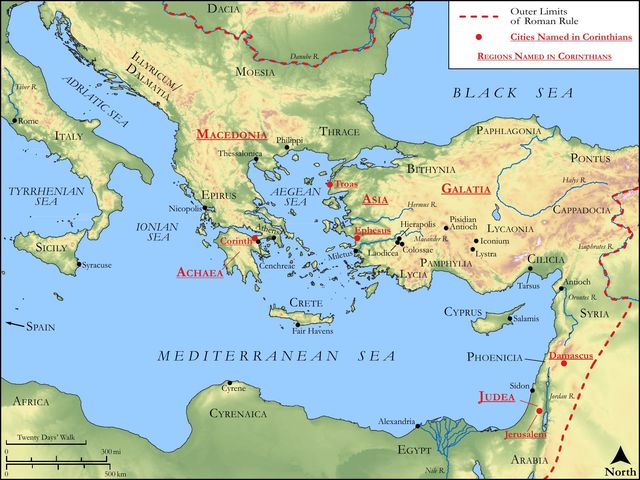
See on the biblical-era maps

Study this verse
Public-domain commentary
Matthew Henry
From his Commentary on the Whole Bible. Henry comments on passages, not single verses — this entry covers 1 Corinthians 3:11–15. His three-level outline is real structure in the source text, so it is rendered as structure.
Here the apostle informs us what foundation he had laid at the bottom of all his labours among them - even Jesus Christ, the chief corner-stone, Eph 2:20. Upon this foundation all the faithful ministers of Christ build. Upon this rock all the Christians found their hopes. Those that build their hopes of heaven on any other foundation build upon the sand. Other foundation can no man lay besides what is laid - even Jesus Christ. Note, The doctrine of our Saviour and his mediation is the principal doctrine of Christianity. It lies at the bottom, and is the foundation, of all the rest. Leave out this, and you lay waste all our comforts, and leave no foundation for our hopes as sinners. It is in Christ only that God is reconciling a sinful world to himself, Co2 5:19. But of those that hold the foundation, and embrace the general doctrine of Christ's being the mediator between God and man, there are two sorts: -
I.Some build upon this foundation gold, silver, and precious stones (Co1 3:12), namely, those who receive and propagate the pure truths of the gospel, who hold nothing but the truth as it is in Jesus, and preach nothing else. This is building well upon a good foundation, making all of apiece, when ministers not only depend upon Christ as the great prophet of the church, and take him for their guide and infallible teacher, but receive and spread the doctrines he taught, in their purity, without any corrupt mixtures, without adding or diminishing.
II.Others build wood, hay, and stubble, on this foundation; that is, though they adhere to the foundation, they depart from the mind of Christ in many particulars, substitute their own fancies and inventions in the room of his doctrines and institutions, and build upon the good foundation what will not abide the test when the day of trial shall come, and the fire must make it manifest, as wood, hay, and stubble, will not bear the trial by fire, but must be consumed in it. There is a time coming when a discovery will be made of what men have built on this foundation: Every man's work shall be made manifest, shall be laid open to view, to his own view and that of others. Some may, in the simplicity of their hearts, build wood and stubble on the good foundation, and know not, all the while, what they have been doing; but in the day of the Lord their own conduct shall appear to them in its proper light. Every man's work shall be made manifest to himself, and made manifest to others, both those that have been misled by him and those that have escaped his errors. Now we may be mistaken in ourselves and others; but there is a day coming that will cure all our mistakes, and show us ourselves, and show us our actions in the true light, without covering or disguise: For the day shall declare it (that is, every man's work), because it shall be revealed by fire; and the fire shall try every man's work, of what sort it is, Co1 3:13. The day shall declare and make it manifest, the last day, the great day of trial; see Co1 4:5. Though some understand it of the time when the Jewish nation was destroyed and their constitution thereby abolished, when the superstructure which judaizing teachers would have raised on the Christian foundation was manifested to be no better than hay and stubble, that would not bear the trial. The expression carries in it a plain allusion to the refiner's art, in which the fire separates and distinguishes the dross from the gold and silver; as it also will silver and gold and precious stones, that will endure the fire, from wood and hay and stubble, that will be consumed in it. Note, There is a day coming that will as nicely distinguish one man from another, and one man's work from another's, as the fire distinguishes gold from dross, or metal that will bear the fire from other materials that will be consumed in it. In that day,
1.Some men's works will abide the trial - will be found standard. It will appear that they not only held the foundation, but that they built regularly and well upon it - that they laid on proper materials, and in due form and order. The foundation and the superstructure were all of a piece. The foundation-truths, and those that had a manifest connection with them, were taught together. It may not be so easy to discern this connection now, nor know what works will abide the trial then; but that day will make a full discovery. And such a builder shall not, cannot fail of a reward. He will have praise and honour in that day, and eternal recompence after it. Note, Fidelity in the ministers of Christ will meet with a full and ample reward in a future life. Those who spread true and pure religion in all the branches of it, and whose work will abide in the great day, shall receive a reward. And, Lord, how great! how much exceeding their deserts!
2.There are others whose works shall be burnt (Co1 3:15), whose corrupt opinions and doctrines, or vain inventions and usages in the worship of God, shall be discovered, disowned, and rejected, in that day - shall be first manifested to be corrupt, and then disapproved of God and rejected. Note, The great day will pluck off all disguises, and make things appear as they are: He whose work shall be burnt will suffer loss. If he have built upon the right foundation wood and hay and stubble, he will suffer loss. His weakness and corruption will be the lessening of his glory, though he may in the general have been an honest and an upright Christian. This part of his work will be lost, turning no way to his advantage, though he himself may be saved. Observe, Those who hold the foundation of Christianity, though they build hay, wood, and stubble, upon it, may be saved. This may help to enlarge our charity. We should not reprobate men for their weakness: for nothing will damn men but wickedness. He shall be saved, yet so as by fire, saved out of the fire. He himself shall be snatched out of that flame which will consume his work. This intimates that it will be difficult for those that corrupt and deprave Christianity to be saved. God will have no mercy on their works, though he may pluck them as brands out of the burning. On this passage of scripture the papists found their doctrine of purgatory, which is certainly hay and stubble: a doctrine never originally fetched from scripture, but invented in barbarous ages, to feed the avarice and ambition of the clergy, at the cost of those who would rather part with their money than their lusts, for the salvation of their souls. It can have no countenance from this text,
(1.)Because this is plainly meant of a figurative fire, not of a real one: for what real fire can consume religious rites or doctrines?
(2.)Because this fire is to try men's works, of what sort they are; but purgatory-fire is not for trial, not to bring men's actions to the test, but to punish for them. They are supposed to be venial sins, not satisfied for in this life, for which satisfaction must be made by suffering the fire of purgatory.
(3.)Because this fire is to try every man's works, those of Paul and Apollos, as well as those of others. Now, no papists will have the front to say apostles must have passed through purgatory fires.
Historical interpretation
Three Centuries of Reception
7 surviving comments on this verse. Each one is dated, so this reads as a timeline rather than a list.
Select a marker to jump to its quote. Markers stagger vertically where authors wrote within a few decades of each other.
If, then, the whole creation is supported by the Son of God, what think ye of those who are called by Him, and bear the name of the Son of God, and walk in His commandments? do you see what kind of persons He supports? Those who bear His name with their whole heart. He Himself, accordingly, became a foundation to them, and supports them with joy, because they are not ashamed to bear His name.
And was it not Paul himself who was there foretold, destined "to be taken away from Judah"-that is, from Judaism-for the erection of Christianity, in order "to lay that only foundation, which is Christ? " Of this work the Creator also by the same prophet says, "Behold, I lay in Sion for a foundation a precious stone and honourable; and he that resteth thereon shall not be confounded.
The other apostles laid this foundation among the Jews, while Paul and Barnabas laid it among the Gentiles.
But let us suppose it possible that any one, by natural and innate goodness, should gain true virtues, such a man as we have heard that Cimon was at Athens, who both gave alms to the needy, and entertained the poor, and clothed the naked; yet, when that one thing which is of the greatest importance is wanting-the acknowledgment of God-then all those good things are superfluous and empty, so that in pursuing them he has laboured in vain. For all his justice will resemble a human body which has no head, in which, although all the limbs are in their proper position, and figure, and proportion, yet, since that is wanting which is the chief thing of all, it is destitute both of life and of all sensation.
Nobody can lay another foundation, because even if some people are heretics, they do not teach except in the name of Christ. They cannot commend the inventions of their error in any other way. So through the dignity of his name they try to make contradictory and absurd ideas acceptable.
"For other foundation can no man lay than that is laid, which is Jesus Christ."
I say, no man can lay it so long as he is a master-builder; but if he lay it, he ceases to be a master-builder.
See how even from men's common notions he proves the whole of his proposition. His meaning is this: "I have preached Christ, I have delivered unto you the foundation. Take heed how you build thereon, lest haply it be in vainglory, lest haply so as to draw away the disciples unto men." Let us not then give heed unto the heresies. "For other foundation can no man lay than that which is laid." Upon this then let us build, and as a foundation let us cleave to it, as a branch to a vine; and let there be no interval between us and Christ. For if there be any interval, immediately we perish. For the branch by its adherence draws in the fatness, and the building stands because it is cemented together. Since, if it stand apart it perishes, having nothing whereon to support itself. Let us not then merely keep hold of Christ, but let us be cemented to Him, for if we stand apart, we perish. "For they who withdraw themselves far from Thee, shall perish;" so it is said. Let us cleave then unto Him, and let us cleave by our works. "For he that keepeth my commandments, the same abideth in Me." And accordingly, there are many images whereby He brings us into union. Thus, if you mark it, He is "the Head," we are "the body:" can there be any empty interval between the head and body? He is "a Foundation," we "a building:" He "a Vine," we "branches:" He "the Bridegroom," we "the bride:" He "the Shepherd," we "the sheep;" He is "the Way," we "they who walk therein." Again, we are "a temple," He "the Indweller:" He "the First-Begotten," we "the brethren:" He "the Heir," we "the heirs together with Him:" He "the Life," we "the living:" He "the Resurrection," we "those who rise again:" He "the Light," we "the enlightened." All these things indicate unity; and they allow no void interval, not even the smallest. For he that removes but to a little distance will go on till he has become very far distant. For so the body, receiving though it be but a small cut by a sword, perishes: and the building, though there be but a small chink, falls to decay: and the branch, though it be but a little while cut off from the root, becomes useless. So that this trifle is no trifle, but is even almost the whole. Whensoever then we commit some little fault or even negligence, let us not overlook that little; since this, being disregarded, quickly becomes great. So also when a garment hath begun to be torn and is neglected, it is apt to prolong its rent all throughout; and a roof, when a few tiles have fallen, being disregarded, brings down the whole house.
It should not be denied that this is the distinctive basis of the orthodox faith, just because it is shared between us and certain heretics as well. For if we think carefully about the meaning of Christ we shall see that among some of the heretics who want to be called Christians, the name of Christ is held in honor, but the reality to which the name points is not.
Continue studying 1 Corinthians 3:11 across the web’s major study libraries — every link below opens this exact verse, chapter, or book on the destination site.
Read & Compare
 BibleGatewayThis verse in more than 200 translations and 70 languages.
 Bible.comThe YouVersion reader — hundreds of translations, reading plans, and highlights.
 ESV.orgCrossway's official English Standard Version reader.
 NET BibleThe NET translation with 60,000+ translators' notes on every rendering decision.
 STEP BibleTyndale House's free study tool — original text, vocabulary, and scholarly resources.
 BibliaLogos Bible Software's free web reader.
 USCCBThe New American Bible (Revised Edition) with the U.S. bishops' study notes.
Commentaries
 BibleHub CommentariesDozens of classic commentaries on this verse, gathered on one page.
 StudyLightMore than 100 commentary sets — the largest collection on the web.
 BibleRefPlain-English commentary on what this verse means, verse by verse.
 Enduring WordDavid Guzik's free commentary on this chapter, widely used by Bible teachers.
 Bible Study ToolsVerse commentary alongside Greek and Hebrew study aids.
Original Language & Research
- BibleHub InterlinearThe verse word by word — original language, transliteration, and English.
- BibleHub LexiconEvery word's original-language definition and Strong's entry.
 Blue Letter BibleDeep-study tools — Strong's numbers, concordance, and word studies.
 CNTR CollationThe earliest Greek manuscripts of this verse, collated letter by letter.
Sermons, Hymns & Audio


TrulyRandomVerse is not affiliated with these sites and doesn’t control their content. They’re linked because they’re genuinely useful.
Summary
The Apostle Paul's declaration in 1 Corinthians 3:11 asserts the singular and unalterable nature of the Christian foundation: Jesus Christ Himself. This foundational truth is presented within the context of church building, emphasizing that while various ministers may construct upon this base, the base itself is divinely established and cannot be replaced or supplemented by human wisdom, leadership, or any other alternative. It serves as a critical theological anchor for the church's identity, mission, and unity, ensuring that all genuine Christian endeavor rests upon the person and work of Christ.
Context
ShowHideLiterary Context
This verse is a pivotal statement within Paul's broader argument against the divisions and spiritual immaturity plaguing the Corinthian church. In 1 Corinthians 1, Paul addresses the factions forming around different leaders (Paul, Apollos, Cephas). By 1 Corinthians 3, he shifts to an agricultural metaphor (planting and watering) and then to a building metaphor. He identifies himself as a "wise masterbuilder" who has laid the foundation (1 Corinthians 3:10), and others are now building upon it. Verse 11 clarifies that this foundation is exclusively Jesus Christ, setting the stage for the subsequent discussion about the quality of the building materials and the testing by fire (1 Corinthians 3:12-15). The verse thus functions as the unshakeable premise upon which all Christian ministry and life must be constructed.
Historical & Cultural Context
Corinth was a bustling, cosmopolitan city, known for its wealth, trade, and diverse philosophical schools and religious cults. This environment fostered a culture of intellectual pride and a tendency to elevate human leaders and wisdom. The Corinthian believers, many of whom were new converts from paganism, brought some of these cultural tendencies into the church, leading to rivalries and an overemphasis on eloquent speech or specific personalities rather than the simple truth of the gospel. Paul's use of building metaphors would have been readily understood in a city undergoing significant construction and known for its architectural prowess. The idea of a "foundation" (Greek: themelios) was crucial for any stable structure, especially in a region prone to earthquakes. Paul leverages this common understanding to convey a profound spiritual truth, countering their human-centered boasting with a divinely centered reality.
Key Themes
ShowHide1 Corinthians 3:11 contributes significantly to several key themes within the letter and broader Pauline theology. Firstly, it underscores the exclusivity and supremacy of Christ, asserting that He alone is the basis for salvation, Christian life, and the church. This directly counters the Corinthian tendency to elevate human leaders. Secondly, it highlights the divine establishment of the church's foundation, emphasizing that it is "laid" by God, not by human design or choice. This reinforces the idea that the church is God's building (1 Corinthians 3:9). Thirdly, the verse speaks to unity in Christ, implying that despite diverse ministries and gifts, all believers and all true Christian work share a common, unchanging foundation, which should transcend human divisions. Finally, it sets the stage for the theme of accountability for ministry, as the quality of what is built upon this foundation will be tested (1 Corinthians 3:13).
Exposition and Analysis
ShowHideKey Word Analysis
ShowHideThis word refers to the base, groundwork, or cornerstone of a building. It denotes something solid, stable, and essential upon which everything else rests. In a figurative sense, as used here, it signifies the fundamental principle or basis of a system, belief, or community. Paul uses it to emphasize the absolute necessity and immovability of Christ as the bedrock of the Christian faith and the church.
This term means "different" or "another of the same kind." Its use here emphasizes the singularity and uniqueness of the foundation. There is no alternative, no substitute, and no additional foundation that can be legitimately laid alongside or instead of Jesus Christ. It highlights the exclusivity of Christ's role.
This verb, in the perfect tense, signifies a completed action with continuing results. The foundation has been laid and remains laid. This highlights its permanence, immutability, and divine establishment. It is not something that can be undone or changed; it is a fixed reality, already put in place by God.
Verse Breakdown
ShowHide"For other foundation can no man lay"
This opening clause immediately establishes the impossibility of an alternative. The particle "For" (G1063, gár) introduces the reason or explanation for the preceding statements about building. The emphatic "no man" (G3762, oudeís) combined with "can lay" (G1410, dýnamai and G5087, títhēmi) underscores the absolute prohibition and futility of attempting to establish any other basis for the Christian faith or the church. Human efforts, wisdom, or leaders are utterly incapable of providing a true foundation.
"than that is laid"
This phrase points to a pre-existing, established reality. The passive voice ("is laid," G2749, keîmai) strongly implies a divine agent. The foundation is not something humanly conceived or constructed; it has been divinely set in place. It is a given, an unchangeable truth that God Himself has provided, making any human attempt to "lay" another foundation not just futile, but presumptuous.
"which is Jesus Christ."
This concluding declaration explicitly identifies the divinely laid foundation. The relative pronoun "which" (G3739, hós) points back to "that is laid," unequivocally naming "Jesus Christ" (G2424, Iēsoûs and G5547, Christós) as the sole, unalterable foundation. This is not merely a doctrine about Christ, but the very person of Christ—His life, death, resurrection, and ongoing Lordship—that constitutes the bedrock of Christian faith and the church.
Literary Devices
ShowHidePaul employs a powerful Metaphor in 1 Corinthians 3:11, comparing the church to a building and Jesus Christ to its foundation. This architectural imagery is highly effective, as the concept of a stable foundation is universally understood as essential for any enduring structure. By stating that "no man can lay" another foundation, Paul uses Hyperbole or Emphasis to underscore the absolute exclusivity and divine origin of Christ's role. The structure of the sentence, particularly the definitive declaration "which is Jesus Christ," functions as a strong Affirmation or Identification, leaving no room for ambiguity about the identity of this foundational element. This clear, concise statement serves as a theological anchor, grounding the entire discussion of Christian ministry and community in the person of Christ.
Theological and Thematic Connections
ShowHide1 Corinthians 3:11 is a cornerstone of Christian Christology and Ecclesiology. Theologically, it asserts the absolute centrality and supremacy of Jesus Christ in all matters of faith and practice. He is not merely a good teacher or a historical figure, but the very ground upon which salvation and the church are built. This verse challenges any attempt to supplement Christ with human wisdom, traditions, or personal achievements, affirming that He is wholly sufficient. Ecclesiologically, it defines the nature of the church as fundamentally Christ-centered. The church's unity, stability, and purpose derive solely from its common foundation in Christ, calling believers to transcend divisions rooted in human allegiances and to focus on their shared Lord. This truth undergirds the entire Christian life, from individual salvation to corporate worship and mission.
Reflection and Application
ShowHide1 Corinthians 3:11 offers profound implications for both individual believers and the corporate church. For individuals, it calls for a rigorous self-examination: on what foundation are we truly building our lives, our hopes, our values, and our eternal security? Is it on fleeting successes, human approval, personal achievements, or the unchanging, divinely established person of Jesus Christ? A life built on anything less than Christ is ultimately unstable and vulnerable to collapse. For the church, this verse serves as a perpetual reminder that all ministries, doctrines, programs, and evangelistic efforts must be firmly rooted in and flow from Jesus Christ. Any deviation, any attempt to introduce "other foundations" like cultural relevance for its own sake, human philosophy, or charismatic personalities, ultimately compromises the integrity and stability of God's building. Our unity, our purpose, and our power come from our shared commitment to this singular, unshakeable foundation.
Questions for Reflection
ShowHideFAQ
ShowHideWhat does Paul mean by "other foundation can no man lay"?
ShowHidePaul means that when it comes to the spiritual edifice of the Christian faith and the church, there is only one legitimate and divinely appointed foundation: Jesus Christ. No human being, through their wisdom, power, or religious innovation, can establish an alternative or supplementary basis. Any attempt to do so is futile and ultimately builds on sand, as Jesus Himself warned in Matthew 7:24-27. This statement emphasizes the absolute uniqueness and sufficiency of Christ as the bedrock upon which all true Christian life and community must be built. It is a declaration of Christ's unparalleled authority and indispensable role.
Christ-Centered Fulfillment
ShowHide1 Corinthians 3:11 finds its ultimate Christ-centered fulfillment in the very person and work of Jesus Christ, who is not merely a concept or a doctrine, but the living, resurrected Lord. He is the incarnate Word (John 1:14), God made flesh, who perfectly revealed the Father. His atoning death on the cross (Romans 5:8) and victorious resurrection (Romans 4:25) are the historical and theological bedrock upon which all hope for salvation rests. As the chief cornerstone (Ephesians 2:20), He unites Jew and Gentile into one new humanity, forming the very structure of God's household. He is the head of the church (Colossians 1:18), providing its direction, life, and growth. Every aspect of His being—His perfect obedience, His sacrificial love, His authoritative teaching, His conquering of sin and death, and His ongoing intercession—establishes Him as the only secure and eternal foundation. To build on Christ is to build on the very Son of God, the one through whom all things were created and in whom all things hold together (Colossians 1:16-17).