


2 Chronicles 20:33
Bible text: King James Version (1769 Blayney text) · Public domain
Bible text: Berean Standard Bible · Public domain
Bible text: American Standard Version (1901) · Public domain
Bible text: World English Bible, Messianic edition · Public domain
Bible text: Geneva Bible (1599) · Public domain
Bible text: Young's Literal Translation · Public domain
- אַךְ'akhonlyH389AdvAdverb
- הַבָּמוֹתha·ba·Motthe high placesH1116Art ¦ N-fpNoun Plural Feminine Absoluteהַtheבָּמוֹתhigh places
- לֹאlo'notH3808NegParticle Negative
- סָרוּSa·ruthey were removedH5493V-Qal-Perf-3cpVerb Qal Perfect 3rd Plural common gender
- וְעוֹדve·'odand stillH5750Conj-w ¦ Adj-msAdjective Numerical Singular Masculine Absoluteוְandעוֹדstill
- הָעָםha·'Amthe peopleH5971Art ¦ N-msNoun Singular Masculine Absoluteהָtheעָםpeople
- לֹאlo'notH3808NegParticle Negative
- הֵכִינוּhe·Khi·nuthey directedH3559V-Hiphil-Perf-3cpVerb Hiphil Perfect 3rd Plural common gender
- לְבָבָםle·va·Vamtheir heartH3824N-msc ¦ 3mpNoun Singular Masculine Constructלְבָבָheartםtheir
- לֵאלֹהֵיle·lo·Heito [the] God ofH430Prep-l ¦ N-mpcNoun Plural Masculine Constructלֵtoאלֹהֵי[the] God of
- אֲבֹתֵיהֶם'a·vo·tei·Hemtheir ancestorsH1N-fpc ¦ 3mpNoun Plural Feminine Constructאֲבֹתֵיancestorsהֶםtheir
English is a literal word-by-word gloss of the Hebrew, not the KJV's wording. Why?
This is the original text the KJV's translators worked from — each Hebrew word with its own literal English meaning in this verse, prepared by scholars at Tyndale House, Cambridge. The KJV translates whole sentences, not word by word, so its wording differs: one Hebrew word can become several English words, and the KJV may choose “the LORD” where the gloss reads “Yahweh”. Both are faithful — they answer different questions. For the KJV's own rendering, switch to the KJV text.
Details
See on the biblical-era map
Study this verse
Public-domain commentary
Matthew Henry
From his Commentary on the Whole Bible. Henry comments on passages, not single verses — this entry covers 2 Chronicles 20:31–37.
We are now drawing towards the close of the history of Jehoshaphat's reign, for a further account of which those who lived when this book was published were referred to an authentic history of it, written by Jehu the prophet (Ch2 19:2), which was then extant, Ch2 20:34. This was the general character of his reign, that he did that which was right in the sight of the Lord, kept close to the worship of God himself and did what he could to keep his people close to it. But two things are here to be lamented: - 1. The people still retained a partiality for the high places, Ch2 20:33. Those that were erected to the honour of strange gods were taken away (Ch2 17:6); but those where the true God was worshipped, being less culpable, were thought allowable, and Jehoshaphat was loth to disoblige the people so far as to take them away, for as yet they had not prepared their hearts to serve the God of their fathers. They complied with Jehoshaphat's reformation because they could not for shame do otherwise, but they were not hearty in it, did not direct their hearts to God in it, did not act in it from any good principle nor with any zeal or resolution: and the best magistrates cannot bring to pass what they would, in reformation, when the people are cool in it. 2. Jehoshaphat himself still retained a partiality for the house of Ahab, because he had married his son to a daughter of that family, though he had been plainly reproved for it and had like to have smarted for it. He saw and knew that Ahaziah, the son of Ahab, did very wickedly, and therefore could not expect to prosper; yet he joined himself with him, not in war, as with his father, but in trade, became his partner in an East India fleet bound for Ophir, Ch2 20:35, Ch2 20:36. There is an emphasis laid upon the time - after this, after God had done such great things for him, without any such scandalous and pernicious confederacies, given him not only victory, but wealth, yet after this to go and join himself with a wicked king was very ungrateful. After God had given him such a deliverance as this should he again break God's commandments, and join in affinity with the people of these abominations? What could he expect but that God should be angry with him? Ezr 9:13, Ezr 9:14. Yet he sends to him, to show him his error and bring him to repentance, (1.) By a prophet, who foretold the blasting of his project, Ch2 20:37. And, (2.) By a storm, which broke the ships in the port before they set sail, by which he was warned to break off his alliance with Ahaziah; and it seems he took the warning, for, when Ahaziah afterwards pressed him to join with him, he would not, Kg1 22:49. See how pernicious a thing it is to join in friendship and society with evil-doers. It is a hard matter to break off from it. A man may much better keep himself from being taken in the snare than recover himself out of it.
Continue studying 2 Chronicles 20:33 across the web’s major study libraries — every link below opens this exact verse, chapter, or book on the destination site.
Read & Compare
 BibleGatewayThis verse in more than 200 translations and 70 languages.
 Bible.comThe YouVersion reader — hundreds of translations, reading plans, and highlights.
 ESV.orgCrossway's official English Standard Version reader.
 NET BibleThe NET translation with 60,000+ translators' notes on every rendering decision.
 STEP BibleTyndale House's free study tool — original text, vocabulary, and scholarly resources.
 BibliaLogos Bible Software's free web reader.
 USCCBThe New American Bible (Revised Edition) with the U.S. bishops' study notes.
Commentaries
 BibleHub CommentariesDozens of classic commentaries on this verse, gathered on one page.
 StudyLightMore than 100 commentary sets — the largest collection on the web.
 BibleRefPlain-English commentary on what this verse means, verse by verse.
 Enduring WordDavid Guzik's free commentary on this chapter, widely used by Bible teachers.
 Bible Study ToolsVerse commentary alongside Greek and Hebrew study aids.
Original Language & Research
- BibleHub InterlinearThe verse word by word — original language, transliteration, and English.
- BibleHub LexiconEvery word's original-language definition and Strong's entry.
 Blue Letter BibleDeep-study tools — Strong's numbers, concordance, and word studies.
 SefariaThe Hebrew text with Rashi and centuries of Jewish commentary.
Sermons, Hymns & Audio


TrulyRandomVerse is not affiliated with these sites and doesn’t control their content. They’re linked because they’re genuinely useful.
Summary
Second Chronicles 20:33 offers a poignant assessment of the spiritual state of Judah during the otherwise largely righteous reign of King Jehoshaphat. Despite significant reforms, a commitment to seeking the Lord, and a miraculous divine deliverance, the verse reveals a persistent spiritual compromise: the "high places," centers of unauthorized worship, remained because the people's hearts were not fully prepared or committed to the God of their fathers. This highlights the critical distinction between outward religious conformity and genuine, internal devotion, underscoring that true spiritual transformation requires a prepared, undivided heart.
Context
ShowHideLiterary Context
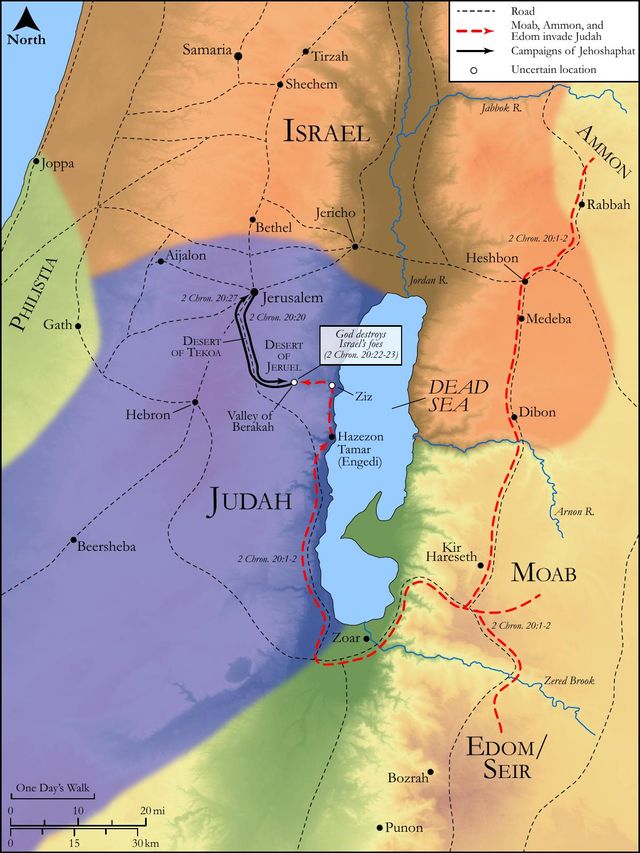
This verse serves as a crucial concluding assessment of King Jehoshaphat's reign, immediately following the climactic account of God's miraculous deliverance of Judah from the combined forces of Ammon, Moab, and Mount Seir. This victory, detailed in 2 Chronicles 20:1-30, was achieved not through military might, but through prayer, praise, and trusting in the Lord. Earlier in his reign, Jehoshaphat is lauded for his commitment to seeking the Lord and for initiating significant reforms, including sending Levites and priests throughout Judah to teach the Law (2 Chronicles 17:7-9). He even made efforts to remove some high places and Asherah poles (2 Chronicles 17:6). However, verse 33 acts as a significant caveat, tempering the otherwise positive portrayal of his rule by revealing a persistent, deeper spiritual issue within the populace that even a righteous king and divine intervention could not fully resolve. It sets up a tension between royal piety and popular spiritual apathy.
Historical & Cultural Context
The "high places" (Hebrew: bamot) were ancient, often elevated, sites of worship scattered throughout the land of Israel. Prior to the construction of the Jerusalem Temple, some of these sites might have been used for legitimate Yahwistic worship, but after the Temple's completion, God commanded the centralization of worship in Jerusalem (Deuteronomy 12:2-5). Despite this command, the high places persisted, often becoming centers for syncretistic worship, blending the worship of Yahweh with pagan practices (like Baal or Asherah worship) or offering sacrifices in ways not sanctioned by Mosaic Law. Kings like Asa (1 Kings 15:14) and Jehoshaphat attempted to eradicate them, but their deep roots in popular piety, local traditions, and convenience made complete removal exceedingly difficult. Their continued existence in Judah signifies a widespread cultural attachment to local shrines and a reluctance among the people to fully adhere to God's command for centralized, pure worship, highlighting the challenge of enacting comprehensive religious reform against ingrained popular sentiment.
Key Themes
ShowHideThis verse powerfully contributes to several overarching themes prominent in the book of Chronicles. Firstly, it underscores the theme of incomplete reform or partial obedience, demonstrating that even under devout leadership and after experiencing God's manifest power, the spiritual health of a nation is ultimately contingent on the genuine heart-commitment of its people, not merely external decrees or royal initiatives. Secondly, it emphasizes the centrality of the heart in biblical theology; true worship and obedience are not merely outward acts but stem from an internal disposition. The phrase "prepared their hearts" points to a volitional act of aligning one's will, affections, and intentions with God, a concept deeply rooted in the Deuteronomic call to love God with all one's heart, soul, and might (Deuteronomy 6:5). Finally, the verse highlights the recurring tension between royal piety and popular spiritual compromise, a motif seen throughout the history of the divided kingdom, where the spiritual failures of the people often undermined the best efforts of even righteous kings, leading to cycles of judgment and restoration.
Exposition and Analysis
ShowHideKey Word Analysis
ShowHideMeaning "an elevation; height, high place, wave." These refer to elevated sites, often on hills or mounds, used for religious worship. In the Old Testament, while some bamot may have been legitimate altars before the Temple's construction, after the centralization of worship in Jerusalem, they became associated with unauthorized, and often syncretistic or pagan, worship. Their continued existence, as noted in this verse, signified a deviation from pure Yahwistic worship and a lingering attachment to practices God had forbidden, symbolizing a divided loyalty.
A primitive root meaning "to be erect (i.e. stand perpendicular); hence (causatively) to set up, in a great variety of applications, whether literal (establish, fix, prepare, apply), or figurative (appoint, render sure, proper or prosperous)." When applied to the heart, it denotes a deliberate, intentional, and resolute decision to fix one's devotion and will towards a specific purpose or deity. It implies a readiness, a steadfastness, and an unwavering commitment to align one's inner being with God's will.
Meaning "the heart (as the most interior organ); [phrase] bethink themselves, breast, comfortably, courage, ((faint), (tender-) heart(-ed), midst, mind, [idiom] unawares, understanding." In biblical anthropology, the "heart" is not merely the seat of emotion but the totality of the inner person—the center of intellect, will, conscience, and moral character. To "prepare one's heart" means to align one's entire inner being, including thoughts, intentions, and desires, with God. The lack of such preparation signifies a divided will, a lack of full resolve, and an inner resistance to complete obedience and exclusive devotion.
Verse Breakdown
ShowHide"Howbeit the high places were not taken away"
This opening clause serves as a significant qualification to the otherwise positive assessment of Jehoshaphat's reign. Despite his personal piety, his initial efforts to remove some high places (2 Chronicles 17:6), and even God's recent miraculous deliverance of the nation, the widespread, unauthorized worship sites remained. This indicates the deep-seated nature of this spiritual problem within the nation, suggesting that the king's reforms, while commendable, did not achieve a complete purge of these idolatrous or syncretistic practices across the entire populace.
"for as yet the people had not prepared their hearts"
This is the crucial explanatory clause, providing the core reason for the persistence of the high places. The failure was not primarily due to the king's lack of effort or God's inability, but to the spiritual condition of the people themselves. Their "hearts"—their inner will, devotion, and commitment—were not fully aligned with God. This implies a lack of genuine, internal transformation and an unwillingness to fully abandon traditional, albeit unapproved, forms of worship for exclusive devotion to Yahweh. It points to a deep-seated spiritual apathy or resistance to total commitment.
"unto the God of their fathers"
This phrase emphasizes the covenantal relationship God had established with Israel through Abraham, Isaac, and Jacob. It highlights that the people's spiritual deficiency was a failure to uphold their ancestral covenant, to fully embrace the God who had faithfully delivered and sustained their forefathers throughout history. It underscores the historical and theological weight of their spiritual lukewarmness, as they were turning away from or only partially committing to the very God who had defined their identity and destiny as a nation.
Literary Devices
ShowHideThe verse employs several literary devices to convey its profound spiritual message with impactful brevity. Contrast is prominently featured, setting the generally positive portrayal of Jehoshaphat's reign and God's recent deliverance against the persistent problem of the high places. This creates a tension that highlights the complexity of spiritual reform and the distinction between a king's piety and the nation's spiritual state. The "high places" themselves function as powerful Symbolism, representing not just physical locations but the deep-seated spiritual compromise, divided loyalties, and incomplete obedience within the nation. Their continued presence is a tangible manifestation of an internal spiritual issue—a heart not fully yielded to God. Furthermore, the phrase "prepared their hearts" is a potent Idiom, common in Hebrew scripture, which metaphorically describes the internal disposition of one's will, intentions, and affections. This idiom underscores that true worship is not merely external ritual but an internal, volitional commitment. The verse's concise nature, acting as a concluding summary of Jehoshaphat's reign, also gives it a Didactic quality, serving as a cautionary lesson about the necessity of genuine heart-transformation for lasting spiritual purity and national well-being.
Theological and Thematic Connections
ShowHideThis verse offers a profound theological insight into the nature of true worship and obedience, emphasizing that external conformity without internal transformation is ultimately insufficient and unsustainable. It highlights that God desires not just outward acts of piety or the removal of physical idols, but a heart fully devoted to Him, echoing the prophetic call for internal righteousness over mere ritual (Isaiah 1:11-17). The persistence of the high places, despite Jehoshaphat's earnest efforts and God's recent miraculous deliverance, underscores the human propensity for spiritual compromise and the inherent difficulty of eradicating deeply ingrained patterns of idolatry or syncretism without a fundamental, internal change of heart. This truth resonates throughout biblical history, demonstrating that true spiritual reform and genuine obedience must begin from within, individually and collectively, as God seeks those who worship Him in spirit and truth.
Reflection and Application
ShowHideThe enduring presence of the high places in Judah, despite the king's righteousness and God's powerful intervention, serves as a timeless spiritual mirror for believers today. It compels us to look beyond outward appearances, religious activities, and even public declarations of faith, to the true condition of our hearts. Are there "high places" in our lives—areas of compromise, divided loyalties, or cherished habits that subtly compete with our full devotion to God? These may not be physical altars, but could manifest as an unbridled pursuit of wealth, comfort, approval from others, self-righteousness, or even the subtle idolatry of self-sufficiency, subtly diverting our hearts from exclusive worship of the Lord. The verse reminds us that genuine spiritual growth and lasting transformation are not merely about removing external idols or adhering to religious rules, but about a deep, intentional "preparation of the heart"—a continuous process of aligning our will, desires, and affections with God's. It calls for an honest self-examination, a willingness to surrender every competing allegiance, and a fervent prayer for an undivided heart, fully committed to the God who has revealed Himself to us.
Questions for Reflection
ShowHideFAQ
ShowHideWhat exactly were "high places" and why were they a problem for the people of Judah?
ShowHide"High places" (Hebrew: bamot) were elevated sites, often on hilltops or mounds, that served as local centers for religious worship and sacrifice in ancient Israel. While some may have been used for legitimate worship of Yahweh before the construction of the Temple in Jerusalem, they became problematic because God commanded the centralization of worship at one designated place, the Temple in Jerusalem (Deuteronomy 12:5-6). Over time, these high places frequently became associated with syncretistic practices, blending the worship of Yahweh with unauthorized rituals or even pagan deities (like Baal or Asherah worship). Their continued existence symbolized a divided heart, a lack of full commitment to God's prescribed ways, and a stubborn adherence to popular, localized traditions over divine command.
Why couldn't King Jehoshaphat remove all the high places if he was generally considered a righteous king?
ShowHideWhile Jehoshaphat was indeed a righteous king who initiated significant reforms and personally removed some high places (2 Chronicles 17:6), 2 Chronicles 20:33 explains the underlying reason for their persistence: "for as yet the people had not prepared their hearts unto the God of their fathers." This indicates that the problem was not merely an external one that could be solved by royal decree alone. The "high places" were deeply ingrained in popular religious practice and tradition, representing a spiritual and cultural inertia. Without a genuine, internal transformation and a willing heart among the general populace, any external reform would be incomplete or temporary. It highlights the limitation of even the best human leadership when the hearts of the people are not fully yielded to God.
What does it mean for the people to have "not prepared their hearts" unto the God of their fathers?
ShowHideIn biblical thought, the "heart" (lev) refers to the core of a person's being—their intellect, will, emotions, and conscience. To "prepare one's heart" means to set one's will, intentions, and affections firmly and resolutely towards God. It implies a conscious, deliberate choice to be fully committed, devoted, and obedient to Him. When the people had "not prepared their hearts," it signifies a lack of genuine inner resolve, a divided loyalty, and an unwillingness to fully abandon old ways for complete and exclusive devotion to the God of their covenant. It was a failure of internal disposition, preventing true and lasting spiritual purity and leading to continued spiritual compromise.
Christ-Centered Fulfillment
ShowHideThe persistence of the high places in 2 Chronicles 20:33, rooted in the people's unprepared hearts, powerfully foreshadows humanity's ongoing struggle with sin and divided allegiance, a struggle that only finds its ultimate and complete resolution in Jesus Christ. The Old Testament kings, even the most righteous like Jehoshaphat, could only effect external, temporary reforms; they could not change the fundamental condition of the human heart, which is inherently rebellious and prone to idolatry (Jeremiah 17:9). This verse underscores the deep-seated spiritual problem that necessitated a new covenant and a radical transformation from within. Jesus, the true and perfect King, does what no earthly monarch or human effort could: He offers a spiritual circumcision of the heart, removing the old nature and empowering a new life through the indwelling Holy Spirit (Colossians 2:11-13). Through His atoning sacrifice on the cross, Christ removes the ultimate "high place"—the idolatry of self and sin—and enables believers to truly prepare their hearts, not by human effort or external decree, but by grace through faith. He is the one who empowers His followers to worship God "in spirit and truth" (John 4:23-24), establishing a kingdom where devotion is not to physical altars or external rituals, but to the living God, with hearts made new and fully yielded to Him, fulfilling the promise of a new heart and a new spirit (Ezekiel 36:26-27).