


2 Chronicles 20:35
- וְאַחֲרֵיכֵןve·'a·cha·rei·Khenand after thisH310Conj-w ¦ Adj-mpc ¦ AdvAdjective Numerical Plural Masculine Constructוְandאַחֲרֵיafterכֵןthis
- אֶתְחַבַּר'et·cha·Barhe made an allianceH2266V-Pual-Perf-3msVerb Pual Perfect 3rd Singular Masculine
- יְהוֹשָׁפָטye·ho·sha·FatJehoshaphatH3092N-proper-mNoun Proper Masculine
- מֶלֶךְMe·lekh[the] king ofH4428N-mscNoun Singular Masculine Construct
- יְהוּדָהye·hu·DahJudahH3063N-properNoun Proper Location
- עִם'imwithH5973PrepPreposition
- אֲחַזְיָה'a·chaz·YahAhaziahH274N-proper-mNoun Proper Masculine
- מֶלֶךְMe·lekh[the] king ofH4428N-mscNoun Singular Masculine Construct
- יִשְׂרָאֵלYis·ra·'ElIsraelH3478N-properNoun Proper Location
- הוּאhu'heH1931Pro-3msPronoun Personal 3rd Singular Masculine
- הִרְשִׁיעַhir·Shi·a'he acted wickedlyH7561V-Hiphil-Perf-3msVerb Hiphil Perfect 3rd Singular Masculine
- לַעֲשׂוֹתla·'a·Sotto doH6213Prep-l ¦ V-Qal-InfVerb Qal Infinitive Constructלַtoעֲשׂוֹתdo
English is a literal word-by-word gloss of the Hebrew, not the KJV's wording. Why?
This is the original text the KJV's translators worked from — each Hebrew word with its own literal English meaning in this verse, prepared by scholars at Tyndale House, Cambridge. The KJV translates whole sentences, not word by word, so its wording differs: one Hebrew word can become several English words, and the KJV may choose “the LORD” where the gloss reads “Yahweh”. Both are faithful — they answer different questions. For the KJV's own rendering, switch to the KJV text.
Details
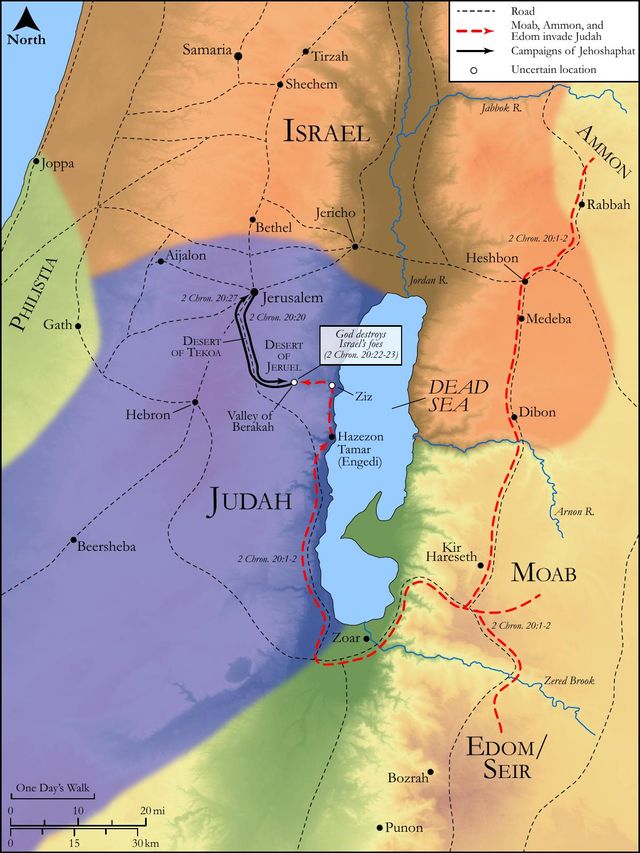
See on the biblical-era map
Study this verse
Public-domain commentary
Matthew Henry
From his Commentary on the Whole Bible. Henry comments on passages, not single verses — this entry covers 2 Chronicles 20:31–37.
We are now drawing towards the close of the history of Jehoshaphat's reign, for a further account of which those who lived when this book was published were referred to an authentic history of it, written by Jehu the prophet (Ch2 19:2), which was then extant, Ch2 20:34. This was the general character of his reign, that he did that which was right in the sight of the Lord, kept close to the worship of God himself and did what he could to keep his people close to it. But two things are here to be lamented: - 1. The people still retained a partiality for the high places, Ch2 20:33. Those that were erected to the honour of strange gods were taken away (Ch2 17:6); but those where the true God was worshipped, being less culpable, were thought allowable, and Jehoshaphat was loth to disoblige the people so far as to take them away, for as yet they had not prepared their hearts to serve the God of their fathers. They complied with Jehoshaphat's reformation because they could not for shame do otherwise, but they were not hearty in it, did not direct their hearts to God in it, did not act in it from any good principle nor with any zeal or resolution: and the best magistrates cannot bring to pass what they would, in reformation, when the people are cool in it. 2. Jehoshaphat himself still retained a partiality for the house of Ahab, because he had married his son to a daughter of that family, though he had been plainly reproved for it and had like to have smarted for it. He saw and knew that Ahaziah, the son of Ahab, did very wickedly, and therefore could not expect to prosper; yet he joined himself with him, not in war, as with his father, but in trade, became his partner in an East India fleet bound for Ophir, Ch2 20:35, Ch2 20:36. There is an emphasis laid upon the time - after this, after God had done such great things for him, without any such scandalous and pernicious confederacies, given him not only victory, but wealth, yet after this to go and join himself with a wicked king was very ungrateful. After God had given him such a deliverance as this should he again break God's commandments, and join in affinity with the people of these abominations? What could he expect but that God should be angry with him? Ezr 9:13, Ezr 9:14. Yet he sends to him, to show him his error and bring him to repentance, (1.) By a prophet, who foretold the blasting of his project, Ch2 20:37. And, (2.) By a storm, which broke the ships in the port before they set sail, by which he was warned to break off his alliance with Ahaziah; and it seems he took the warning, for, when Ahaziah afterwards pressed him to join with him, he would not, Kg1 22:49. See how pernicious a thing it is to join in friendship and society with evil-doers. It is a hard matter to break off from it. A man may much better keep himself from being taken in the snare than recover himself out of it.
Continue studying 2 Chronicles 20:35 across the web’s major study libraries — every link below opens this exact verse, chapter, or book on the destination site.
Read & Compare
 BibleGatewayThis verse in more than 200 translations and 70 languages.
 Bible.comThe YouVersion reader — hundreds of translations, reading plans, and highlights.
 ESV.orgCrossway's official English Standard Version reader.
 NET BibleThe NET translation with 60,000+ translators' notes on every rendering decision.
 STEP BibleTyndale House's free study tool — original text, vocabulary, and scholarly resources.
 BibliaLogos Bible Software's free web reader.
 USCCBThe New American Bible (Revised Edition) with the U.S. bishops' study notes.
Commentaries
 BibleHub CommentariesDozens of classic commentaries on this verse, gathered on one page.
 StudyLightMore than 100 commentary sets — the largest collection on the web.
 BibleRefPlain-English commentary on what this verse means, verse by verse.
 Enduring WordDavid Guzik's free commentary on this chapter, widely used by Bible teachers.
 Bible Study ToolsVerse commentary alongside Greek and Hebrew study aids.
Original Language & Research
- BibleHub InterlinearThe verse word by word — original language, transliteration, and English.
- BibleHub LexiconEvery word's original-language definition and Strong's entry.
 Blue Letter BibleDeep-study tools — Strong's numbers, concordance, and word studies.
 SefariaThe Hebrew text with Rashi and centuries of Jewish commentary.
Sermons, Hymns & Audio


TrulyRandomVerse is not affiliated with these sites and doesn’t control their content. They’re linked because they’re genuinely useful.
Summary
Second Chronicles 20:35 records a perplexing and pivotal decision by Jehoshaphat, king of Judah, to form a commercial alliance with Ahaziah, the notoriously wicked king of Israel. This verse stands in stark contrast to the preceding narrative, which details God's magnificent and miraculous deliverance of Judah from a vast invading army, highlighting a profound paradox: a king who largely sought the Lord and had just witnessed divine intervention nevertheless chose to enter into a partnership with a monarch characterized by extreme ungodliness. This ill-fated venture, undertaken for perceived economic gain, underscores the persistent human tendency to compromise spiritual principles for worldly advantages, even after experiencing profound spiritual victories.
Context
ShowHideLiterary Context
This verse is strategically placed immediately following the climactic account of God's miraculous deliverance of Judah from the Moabite, Ammonite, and Meunite coalition in 2 Chronicles 20:1-30. Jehoshaphat's reign is consistently portrayed by the Chronicler as one of piety and reform, marked by a sincere desire to seek the Lord and restore true worship. However, the narrative also highlights a recurring flaw in Jehoshaphat's character: his propensity for forming unwise alliances with the idolatrous northern kingdom of Israel. This specific alliance with Ahaziah echoes his earlier, equally problematic, partnership with Ahaziah's father, Ahab, which nearly cost Jehoshaphat his life in battle, as detailed in 2 Chronicles 18. The immediate consequence of this alliance with Ahaziah is detailed in 2 Chronicles 20:37, where the prophet Eliezer pronounces divine judgment, leading to the destruction of the ships built for their joint venture. The placement of this verse, directly after such a profound demonstration of God's direct intervention, serves to emphasize the gravity and surprising nature of Jehoshaphat's spiritual lapse.
Historical & Cultural Context
Jehoshaphat reigned over the Southern Kingdom of Judah (c. 870-848 BC), generally upholding the Davidic covenant and promoting reforms against idolatry. His reign was largely prosperous and stable, often attributed to his faithfulness to Yahweh. Ahaziah, on the other hand, was the son of the infamous Ahab and Jezebel, reigning over the Northern Kingdom of Israel (c. 850-849 BC). He continued in the deeply entrenched idolatrous practices of his parents, particularly the worship of Baal, as explicitly stated in 1 Kings 22:51-53. The alliance described in 2 Chronicles 20:35 was for a commercial purpose: building ships to sail to Tarshish (or perhaps from Ezion-geber, as implied by the location in 2 Chronicles 20:36) for trade. Such maritime ventures were ambitious and costly, requiring significant resources and cooperation. For Jehoshaphat to engage in such a deep partnership with a king so openly hostile to Yahweh worship represented a profound compromise of his spiritual convictions and a disregard for the clear divine warnings against associating with wicked nations, as found throughout the Mosaic Law (e.g., Deuteronomy 7:1-4).
Key Themes
ShowHideThis verse powerfully contributes to several overarching themes within 2 Chronicles and the broader biblical narrative. Firstly, it highlights the Danger of Ungodly Alliances. Despite Jehoshaphat's generally righteous character and his recent experience of God's miraculous intervention, he repeatedly fell prey to the temptation of forming political and economic partnerships with the wicked kings of Israel. This serves as a stark warning that even devout individuals can compromise their faith for perceived worldly benefits or strategic advantages. Secondly, it underscores the Consequences of Disobedience and Compromise. The narrative immediately reveals that God's displeasure with this "very wicked" union resulted in the destruction of the ships (2 Chronicles 20:37), illustrating that even well-intentioned but misguided actions, especially those involving spiritual compromise, can invite divine discipline. Finally, the verse reinforces the consistent biblical call for God's People to Remain Distinct and Separate. The covenant relationship with Yahweh demanded a unique identity and separation from the corrupting influences of pagan nations and their practices. Jehoshaphat's repeated failure in this area serves as a cautionary tale about the importance of maintaining spiritual integrity and avoiding "unequal yokes" that can undermine one's walk with God, a theme echoed profoundly in the New Testament (e.g., 2 Corinthians 6:14-18).
Exposition and Analysis
ShowHideKey Word Analysis
ShowHideThis primitive root (H2266) signifies to unite, to associate, to bind oneself together, or to be a companion. Its use here emphasizes Jehoshaphat's active decision to enter into a relationship with Ahaziah. It's not a passive encounter but a deliberate act of forming a bond or partnership. In other contexts, châbar can refer to joining in a conspiracy or engaging in illicit magical practices, underscoring the potentially negative connotations of such an association when the parties are morally disparate. The choice of this verb highlights the deep level of association Jehoshaphat sought.
This proper noun (H274), derived from a root meaning "Jah has seized," identifies the specific king of Israel with whom Jehoshaphat allied. Ahaziah's identity is crucial because the Chronicler immediately qualifies him as one "who did very wickedly." His name itself, containing "Jah" (a shortened form of Yahweh), ironically contrasts with his profound ungodliness, inherited from his parents Ahab and Jezebel, making him a symbol of the Northern Kingdom's apostasy.
This primitive root (H7561) denotes being guilty, condemned, or acting contrary to divine law. It describes a state of moral depravity and active wrongdoing, often in direct opposition to God's covenant. The KJV's "very wickedly" adds an adverbial intensification to the Hebrew, emphasizing the extreme nature of Ahaziah's ungodliness. This was not merely a flawed character but one deeply entrenched in rebellion against Yahweh, making Jehoshaphat's alliance with him particularly egregious in God's eyes and setting the stage for divine judgment.
Verse Breakdown
ShowHide"And after this did Jehoshaphat king of Judah"
This opening phrase is crucial for understanding the verse's theological weight. The temporal marker "after this" directly links Jehoshaphat's action to the preceding miraculous deliverance from the Ammonites, Moabites, and Meunites in 2 Chronicles 20:1-30. It highlights the surprising and disappointing nature of his decision, as it comes immediately after a profound demonstration of God's power, faithfulness, and ability to deliver without human assistance. It suggests a lapse in judgment or a failure to fully internalize the lesson of complete reliance on God, indicating a spiritual amnesia or a return to pragmatic, worldly thinking.
"join himself with Ahaziah king of Israel"
This clause identifies the specific nature of Jehoshaphat's error: forming an alliance with the king of the Northern Kingdom. Historically, the relationship between Judah and Israel was complex, often marked by conflict or uneasy alliances. For Jehoshaphat, a king largely devoted to Yahweh, to "join himself" (Hebrew châbar, implying a deep association) with Ahaziah, who was known for his idolatry and wickedness, represented a significant spiritual compromise. The alliance, as revealed in 2 Chronicles 20:36, was for the purpose of building ships for trade, indicating a pursuit of economic gain over spiritual discernment and obedience.
"who did very wickedly"
This concluding descriptor of Ahaziah is the critical theological qualifier of the verse and the primary reason for God's displeasure. It explicitly states the moral character of Jehoshaphat's chosen partner. Ahaziah's wickedness was not a minor flaw but a deep-seated, active rebellion against God, inherited from his parents, Ahab and Jezebel (1 Kings 22:51-53). The stark contrast between Jehoshaphat's general piety and Ahaziah's profound ungodliness underscores the severity of Jehoshaphat's compromise and sets the stage for the divine judgment that immediately follows.
Literary Devices
ShowHideThe Chronicler employs several literary devices to emphasize the significance of Jehoshaphat's actions and their theological implications. Juxtaposition is prominently featured, placing Jehoshaphat's pious character and recent divine deliverance immediately before his alliance with the "very wicked" Ahaziah. This sharp contrast highlights the surprising and incongruous nature of the king's choice, underscoring the spiritual blindness that can follow even great spiritual victories. There is also a strong element of Irony, as a king who just experienced God fighting for him, requiring no human effort, then turns to a human alliance with a wicked king for a commercial venture. This suggests a failure to fully trust in God's provision and guidance, ironically seeking worldly advantage after witnessing divine omnipotence. Furthermore, the verse serves as a form of Foreshadowing, hinting at the negative consequences that will inevitably follow such a spiritually ill-advised partnership, which are quickly revealed in the subsequent verses with the destruction of the ships. The Chronicler's concise and pointed description of Ahaziah as "very wickedly" also functions as a Theological Commentary, guiding the reader's interpretation and judgment of Jehoshaphat's actions.
Theological and Thematic Connections
ShowHideThe account of Jehoshaphat's alliance with Ahaziah serves as a profound theological lesson on the dangers of spiritual compromise and the importance of discerning associations. Even a king who largely walked in the ways of the Lord could be swayed by the allure of political stability or economic gain, leading him to disregard God's clear call for separation from wickedness. This narrative underscores that past spiritual victories do not inoculate believers from future temptations to compromise. God's holiness demands that His people maintain a distinct identity, unblemished by the pervasive influences of a world hostile to His ways. The immediate divine judgment on this alliance demonstrates that God takes seriously the integrity of His people and their commitment to His standards, even in seemingly secular endeavors. It is a timeless reminder that true prosperity and security are found in obedience and reliance on God, not in alliances that dilute one's spiritual convictions.
Reflection and Application
ShowHideJehoshaphat's error in 2 Chronicles 20:35 offers timeless wisdom for believers today. It serves as a potent reminder that even after experiencing profound spiritual victories and divine favor, we remain susceptible to compromise. The temptation to form "unequal yokes"—whether in business partnerships, romantic relationships, close friendships, or even ministry collaborations—with those who do not share a fundamental commitment to God's principles is ever-present. Such alliances, though seemingly offering practical advantages or worldly success, can subtly erode our spiritual discernment, dilute our witness, and ultimately invite divine displeasure. This passage calls us to exercise vigilant discernment in all our associations, recognizing that our choices in companionship and partnership have profound spiritual consequences. True success and enduring blessing are found not in compromising with wickedness for perceived gain, but in unwavering obedience and steadfast reliance on God alone. It challenges us to ask whether the pursuit of worldly gain or comfort is subtly leading us to compromise our distinct identity as followers of Christ.
Questions for Reflection
ShowHideFAQ
ShowHideWhy did Jehoshaphat, a generally good king, make such a bad alliance, especially after a miraculous victory?
ShowHideJehoshaphat was indeed a king who largely sought the Lord and enacted reforms in Judah. However, the biblical narrative consistently portrays him as prone to political pragmatism and a desire for peace or economic advantage, even at the cost of spiritual compromise. His alliance with Ahaziah, following a pattern established with Ahaziah's father Ahab (1 Kings 22), suggests that despite his piety, he struggled with fully trusting God in all areas, particularly foreign policy and commerce. The miraculous victory in 2 Chronicles 20 might have paradoxically led to a temporary lapse in vigilance, a common human tendency to relax spiritual guard after a period of intense reliance on God. He may have believed he could control the terms of the alliance or that his good influence would somehow mitigate Ahaziah's wickedness, underestimating the corrupting power of such a union and failing to heed past prophetic warnings.
What were the consequences of this alliance between Jehoshaphat and Ahaziah?
ShowHideThe consequences of this unholy alliance were swift and clear. Immediately following the formation of the partnership, the prophet Eliezer son of Dodavahu confronted Jehoshaphat, declaring that because he had "joined yourself with Ahaziah, the Lord will destroy your works" (2 Chronicles 20:37). True to the prophecy, the ships they had built for their joint commercial venture were wrecked and unable to sail to Tarshish. This divine intervention served as a direct judgment against Jehoshaphat's compromise, demonstrating God's displeasure with His people forming deep associations with those who openly defy Him. It underscored that God's blessing and protection are contingent upon obedience and separation from wickedness, not on worldly alliances or perceived strategic advantages.
Christ-Centered Fulfillment
ShowHideThe narrative of Jehoshaphat's misguided alliance with Ahaziah, despite his generally righteous reign, powerfully foreshadows the ultimate call for separation and purity found in Christ. While the Old Testament law and narratives like this one emphasize physical and relational separation from pagan influences, the New Covenant reveals that true separation is not merely external but an internal transformation wrought by the indwelling Holy Spirit. Jesus Christ perfectly embodied this principle, living a life of absolute purity and non-compromise with the world's wickedness, even while ministering among sinners. He called His disciples to be "in the world but not of the world" (John 17:15-16), a spiritual separation empowered by His sacrifice and resurrection. Through Christ, believers are made a "chosen race, a royal priesthood, a holy nation, a people for his own possession" (1 Peter 2:9), called to reflect His light and righteousness. The New Testament's warning against being "unequally yoked with unbelievers" (2 Corinthians 6:14) is the ultimate fulfillment of the Old Testament principle exemplified by Jehoshaphat's failure; it is a call to live consistently with our identity as temples of the living God, having "no fellowship with the unfruitful works of darkness" (Ephesians 5:11), but rather exposing them through lives transformed by the power of Christ. Our union with Christ demands a corresponding separation from all that is contrary to His holy character, ensuring that our partnerships and pursuits glorify Him alone.