


2 Chronicles 20:32
- וַיֵּלֶךְvai·Ye·lekhand he walkedH1980Conj-w ¦ V-Qal-ConsecImperf-3msVerb Qal Consecutive Imperfect 3rd Singular Masculineוַandיֵּלֶךְhe walked
- בְּדֶרֶךְbe·De·rekhin [the] way ofH1870Prep-b ¦ N-cscNoun Singular common gender Constructבְּinדֶרֶךְ[the] way of
- אָבִיו'a·Vivhis fatherH1N-msc ¦ 3msNoun Singular Masculine Constructאָבִיfatherוhis
- אָסָא'a·Sa'AsaH609N-proper-mNoun Proper Masculine
- וְלֹאve·lo'and notH3808Conj-w ¦ NegParticle Negativeוְandלֹאnot
- סָרsarhe turned asideH5493V-Qal-Perf-3msVerb Qal Perfect 3rd Singular Masculine
- מִמֶּנָּהmi·Me·nahfrom itH4480Prep ¦ 3fsPrepositionמִמֶּfromנָּהit
- לַעֲשׂוֹתla·'a·Sotto doH6213Prep-l ¦ V-Qal-InfVerb Qal Infinitive Constructלַtoעֲשׂוֹתdo
- הַיָּשָׁרhai·ya·Sharthe rightH3477Art ¦ Adj-msAdjective Singular Masculine Absoluteהַtheיָּשָׁרright
- בְּעֵינֵיbe·'ei·Neiin [the] eyes ofH5869Prep-b ¦ N-fdcNoun Dual Feminine Constructבְּinעֵינֵי[the] eyes of
- יְהוָהYah·wehYahwehH3068N-properNoun Proper Title
English is a literal word-by-word gloss of the Hebrew, not the KJV's wording. Why?
This is the original text the KJV's translators worked from — each Hebrew word with its own literal English meaning in this verse, prepared by scholars at Tyndale House, Cambridge. The KJV translates whole sentences, not word by word, so its wording differs: one Hebrew word can become several English words, and the KJV may choose “the LORD” where the gloss reads “Yahweh”. Both are faithful — they answer different questions. For the KJV's own rendering, switch to the KJV text.
Details
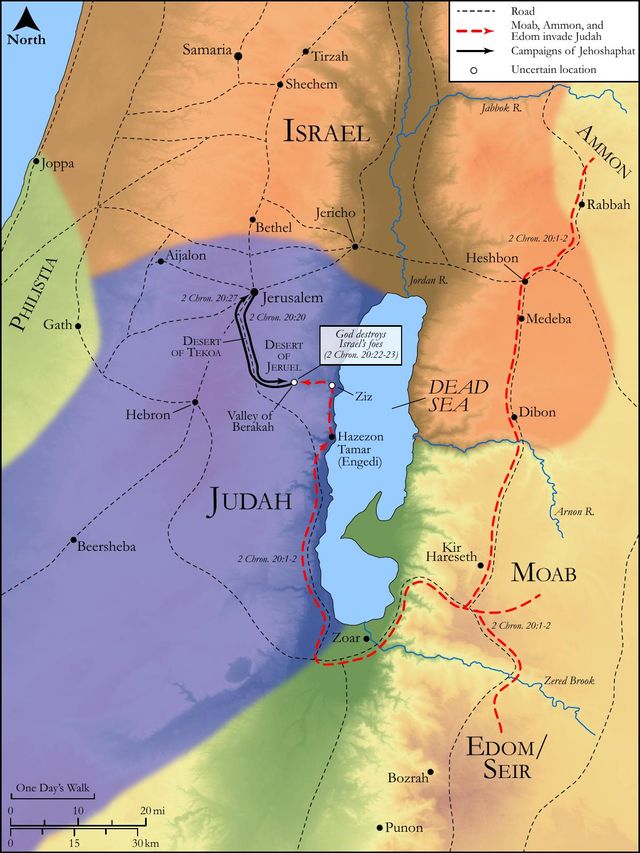
See on the biblical-era map
Study this verse
Public-domain commentary
Matthew Henry
From his Commentary on the Whole Bible. Henry comments on passages, not single verses — this entry covers 2 Chronicles 20:31–37.
We are now drawing towards the close of the history of Jehoshaphat's reign, for a further account of which those who lived when this book was published were referred to an authentic history of it, written by Jehu the prophet (Ch2 19:2), which was then extant, Ch2 20:34. This was the general character of his reign, that he did that which was right in the sight of the Lord, kept close to the worship of God himself and did what he could to keep his people close to it. But two things are here to be lamented: - 1. The people still retained a partiality for the high places, Ch2 20:33. Those that were erected to the honour of strange gods were taken away (Ch2 17:6); but those where the true God was worshipped, being less culpable, were thought allowable, and Jehoshaphat was loth to disoblige the people so far as to take them away, for as yet they had not prepared their hearts to serve the God of their fathers. They complied with Jehoshaphat's reformation because they could not for shame do otherwise, but they were not hearty in it, did not direct their hearts to God in it, did not act in it from any good principle nor with any zeal or resolution: and the best magistrates cannot bring to pass what they would, in reformation, when the people are cool in it. 2. Jehoshaphat himself still retained a partiality for the house of Ahab, because he had married his son to a daughter of that family, though he had been plainly reproved for it and had like to have smarted for it. He saw and knew that Ahaziah, the son of Ahab, did very wickedly, and therefore could not expect to prosper; yet he joined himself with him, not in war, as with his father, but in trade, became his partner in an East India fleet bound for Ophir, Ch2 20:35, Ch2 20:36. There is an emphasis laid upon the time - after this, after God had done such great things for him, without any such scandalous and pernicious confederacies, given him not only victory, but wealth, yet after this to go and join himself with a wicked king was very ungrateful. After God had given him such a deliverance as this should he again break God's commandments, and join in affinity with the people of these abominations? What could he expect but that God should be angry with him? Ezr 9:13, Ezr 9:14. Yet he sends to him, to show him his error and bring him to repentance, (1.) By a prophet, who foretold the blasting of his project, Ch2 20:37. And, (2.) By a storm, which broke the ships in the port before they set sail, by which he was warned to break off his alliance with Ahaziah; and it seems he took the warning, for, when Ahaziah afterwards pressed him to join with him, he would not, Kg1 22:49. See how pernicious a thing it is to join in friendship and society with evil-doers. It is a hard matter to break off from it. A man may much better keep himself from being taken in the snare than recover himself out of it.
Continue studying 2 Chronicles 20:32 across the web’s major study libraries — every link below opens this exact verse, chapter, or book on the destination site.
Read & Compare
 BibleGatewayThis verse in more than 200 translations and 70 languages.
 Bible.comThe YouVersion reader — hundreds of translations, reading plans, and highlights.
 ESV.orgCrossway's official English Standard Version reader.
 NET BibleThe NET translation with 60,000+ translators' notes on every rendering decision.
 STEP BibleTyndale House's free study tool — original text, vocabulary, and scholarly resources.
 BibliaLogos Bible Software's free web reader.
 USCCBThe New American Bible (Revised Edition) with the U.S. bishops' study notes.
Commentaries
 BibleHub CommentariesDozens of classic commentaries on this verse, gathered on one page.
 StudyLightMore than 100 commentary sets — the largest collection on the web.
 BibleRefPlain-English commentary on what this verse means, verse by verse.
 Enduring WordDavid Guzik's free commentary on this chapter, widely used by Bible teachers.
 Bible Study ToolsVerse commentary alongside Greek and Hebrew study aids.
Original Language & Research
- BibleHub InterlinearThe verse word by word — original language, transliteration, and English.
- BibleHub LexiconEvery word's original-language definition and Strong's entry.
 Blue Letter BibleDeep-study tools — Strong's numbers, concordance, and word studies.
 SefariaThe Hebrew text with Rashi and centuries of Jewish commentary.
Sermons, Hymns & Audio


TrulyRandomVerse is not affiliated with these sites and doesn’t control their content. They’re linked because they’re genuinely useful.
Summary
Second Chronicles 20:32 offers a succinct yet profound assessment of King Jehoshaphat's reign, affirming his consistent and unwavering commitment to the divine standards set forth by the Lord. This commendation, coming after the dramatic account of God's miraculous deliverance of Judah from an overwhelming enemy coalition, highlights Jehoshaphat's overall character of faithfulness and his steadfast determination to align his rule with God's will, echoing the righteous legacy of his father, Asa.
Context
ShowHideLiterary Context
This verse serves as a concluding evaluative statement for King Jehoshaphat's reign, immediately following the detailed narrative of his prayer and the miraculous victory over the Ammonites, Moabites, and inhabitants of Mount Seir in 2 Chronicles 20. The Chronicler frequently employs such summary evaluations for the kings of Judah, often comparing them to their predecessors. While the preceding chapters detail specific events, including Jehoshaphat's moments of spiritual lapse (such as his alliance with Ahab in 2 Chronicles 18 and the subsequent rebuke in 2 Chronicles 19:2), this verse offers a holistic, positive assessment of his overall trajectory and the dominant character of his rule. It frames his reign as one marked by general faithfulness, despite specific missteps, emphasizing his consistent return to God's path.
Historical & Cultural Context
King Jehoshaphat reigned over Judah for 25 years (c. 870-846 BC), succeeding his father Asa. During this period, the kingdom of Judah was distinct from the northern kingdom of Israel, which often experienced rapid changes in dynasty and widespread idolatry. In Judah, the Davidic dynasty provided a measure of stability, and the kings were frequently judged by their adherence to the Mosaic covenant and the worship of Yahweh alone. Jehoshaphat's reign was notable for significant religious reforms, including sending Levites and priests throughout the land to teach the Law, as recorded in 2 Chronicles 17:7-9. The phrase "doing that which was right in the sight of the LORD" was a standard theological and historical judgment applied to kings, indicating their alignment with God's revealed will and the covenant stipulations, rather than human opinion or political expediency. This cultural expectation placed a heavy burden of spiritual leadership on the monarch.
Key Themes
ShowHideThe verse encapsulates several key themes central to the Chronicler's theological agenda. First, Righteous Leadership is paramount, as Jehoshaphat's reign is characterized by a commitment to God's will, in stark contrast to many kings who "did evil in the sight of the LORD." His efforts to restore proper worship and teach the Law exemplify this. Second, Generational Faithfulness is highlighted by the phrase "walked in the way of Asa his father." This emphasizes the positive influence of a godly heritage, demonstrating how a righteous predecessor like Asa (2 Chronicles 14:4) could lay a foundation for continued spiritual devotion in the next generation. Third, Consistency in Obedience is underscored by the declaration that he "departed not from it." This signifies that Jehoshaphat's faith was not merely a fleeting moment but a sustained commitment throughout his rule, even when faced with immense pressure or temptation, reflecting a life of perseverance in righteousness. Finally, Divine Approval is the ultimate commendation, as "doing that which was right in the sight of the LORD" signifies God's favorable assessment of his character and actions, serving as the ultimate standard by which all kings in Judah were judged in the historical books.
Exposition and Analysis
ShowHideKey Word Analysis
ShowHideyâlak is a primitive root meaning "to walk" literally or figuratively. In this context, it is a common biblical idiom for one's lifestyle, conduct, or course of life. It signifies not just physical movement but the entire trajectory and character of a person's existence. When applied to a king, it describes the consistent pattern of his reign and decisions. To "walk in the way of Asa" means to emulate his example, adopting his principles and practices, particularly his commitment to Yahweh worship and covenant faithfulness.
çûwr means "to turn off" or "remove." The phrase "departed not" (לֹא סָר, lo sar) conveys steadfastness, constancy, and unwavering commitment. It indicates that Jehoshaphat did not turn aside, deviate, or stray from the path set by his father and, more importantly, from the path of righteousness prescribed by God's Law. This emphasizes a sustained, persistent obedience throughout his reign, despite challenges or temptations to compromise.
yâshâr means "straight" (literally or figuratively), implying moral rectitude, integrity, and adherence to divine standards. This word is central to the recurring theological formula "doing that which was right in the sight of the LORD" (הַיָּשָׁר בְּעֵינֵי יְהוָה, hayyashar be'eyney Yᵉhôvâh). The crucial qualifier "in the sight of the LORD" (H5869, ʻayin, for "sight"; H3068, Yᵉhôvâh, for "LORD") means that the judgment is based on God's objective perspective and His revealed will, not on human opinion, political success, or personal preference. It signifies divine approval and alignment with the covenant.
Verse Breakdown
ShowHide"And he walked in the way of Asa his father"
This clause establishes a direct link between Jehoshaphat's reign and that of his father, Asa. It signifies that Jehoshaphat intentionally adopted and maintained the righteous principles and practices that characterized Asa's rule, particularly his efforts to eliminate idolatry and promote the singular worship of Yahweh. This highlights the positive influence of a godly heritage and the importance of emulating virtuous predecessors in leadership.
"and departed not from it"
This phrase emphasizes Jehoshaphat's steadfastness and consistency in his adherence to the righteous path established by Asa and, implicitly, by God's covenant. It suggests a sustained commitment to obedience, indicating that his faithfulness was not a temporary phase but a defining characteristic of his entire reign. Despite moments of error or misjudgment, his overall direction remained fixed on God's ways, demonstrating resilience and a heart inclined toward divine standards.
"doing [that which was] right in the sight of the LORD"
This culminating statement serves as the divine verdict on Jehoshaphat's rule. It is the highest commendation a king could receive in the Chronicler's evaluation. "Doing right" implies adherence to the Mosaic Law, promoting justice, and maintaining pure worship. The crucial addition "in the sight of the LORD" underscores that this righteousness was not merely humanly perceived but divinely affirmed, reflecting a life lived in conscious awareness of God's omnipresence and according to His holy standards.
Literary Devices
ShowHideThe verse employs several significant literary devices that enhance its meaning and impact. Formulaic Language is evident in the recurring phrase "doing that which was right in the sight of the LORD," which functions as a theological evaluation standard throughout the books of Kings and Chronicles. This consistent formula provides a clear framework for assessing the moral and spiritual quality of each king's reign. Idiom is present in "walked in the way," a common Hebrew expression that metaphorically describes one's lifestyle or course of action, emphasizing the totality and consistency of Jehoshaphat's conduct. Furthermore, the verse utilizes Continuity by explicitly linking Jehoshaphat's actions to those of his father, Asa, highlighting the transmission of a righteous legacy and the importance of intergenerational faithfulness. This connection also serves as a form of Theological Evaluation, as the Chronicler's primary purpose is to assess the kings based on their adherence to the covenant and their promotion of true worship, making this verse a concise summary of Jehoshaphat's positive spiritual standing.
Theological and Thematic Connections
ShowHideThis verse powerfully articulates the biblical emphasis on consistent obedience and the profound significance of living a life that receives divine approval. Jehoshaphat's commitment to "walk in the way of Asa" and to "depart not from it" illustrates the call for believers to maintain steadfastness in their faith journey, drawing inspiration from godly examples while ultimately seeking to please God above all else. His reign, though not without blemish, serves as a testament to the fact that a life oriented towards God's standards, even if imperfect, is ultimately commended by Him. This pursuit of righteousness "in the sight of the LORD" reflects a deep understanding that true success and integrity are measured by divine rather than human metrics, underscoring the covenantal relationship between God and His people, where faithfulness is both expected and rewarded.
Reflection and Application
ShowHideThe enduring message of 2 Chronicles 20:32 for contemporary believers is one of profound encouragement and challenge regarding the nature of our spiritual walk. Jehoshaphat's life reminds us that true faithfulness is not merely about grand, isolated acts of piety, but about a consistent, sustained trajectory of obedience that defines our entire existence. We are called to emulate those who have walked faithfully before us, learning from their wisdom and courage, yet always discerning what is truly "right in the sight of the LORD" for our own lives. In a world that often prioritizes human approval or fleeting success, this verse redirects our focus to God's eternal perspective, urging us to live with an awareness of His constant gaze and to seek His commendation above all else. Our journey of faith is a continuous "walk," and the call is to "depart not" from the path of righteousness, even when it is difficult or unpopular, trusting that our steadfastness is seen and valued by our Heavenly Father.
Questions for Reflection
ShowHideFAQ
ShowHideWas Jehoshaphat perfect, given this verse's commendation?
ShowHideNo, the Chronicler's evaluation of Jehoshaphat, while overwhelmingly positive, is a holistic assessment of his overall reign and character, not an assertion of sinless perfection. The biblical narrative itself records instances where Jehoshaphat made significant misjudgments. For example, his alliance with King Ahab of Israel, a notoriously wicked king, led to a disastrous military campaign (2 Chronicles 18) and drew a sharp rebuke from the prophet Jehu, who declared, "Should you help the wicked and love those who hate the LORD? Because of this, wrath is on you from the LORD" (2 Chronicles 19:2). However, the Chronicler emphasizes Jehoshaphat's willingness to repent and his subsequent efforts to promote righteousness and justice throughout Judah (2 Chronicles 19:4-11). Therefore, 2 Chronicles 20:32 summarizes the dominant and defining characteristic of his rule: a general and consistent orientation towards God's will, despite occasional failures.
What is the significance of the phrase "in the sight of the LORD"?
ShowHideThe phrase "in the sight of the LORD" is profoundly significant as it underscores the ultimate standard by which all human actions, especially those of leaders, are judged in the biblical narrative. It means that Jehoshaphat's righteousness was not based on human opinion, political expediency, or popular acclaim, but on God's objective, holy, and discerning perspective. This phrase highlights God's omnipresence and His role as the supreme Judge. It implies that Jehoshaphat lived with a conscious awareness of God's gaze and sought to align his conduct with the divine covenant and the revealed Law, rather than with the shifting values of the world. For the Chronicler, this divine approval was the true measure of a king's success and faithfulness, demonstrating that true authority and righteousness flow from obedience to God.
Christ-Centered Fulfillment
ShowHideKing Jehoshaphat's commendation for "walking in the way of Asa his father, and departed not from it, doing that which was right in the sight of the LORD" finds its ultimate and perfect fulfillment in Jesus Christ. While Jehoshaphat, like all human kings, had moments of deviation and imperfection, Jesus perfectly embodies the righteous King who flawlessly walked in the way of His Father. From His humble birth to His sacrificial death, Christ consistently did "that which was right in the sight of the LORD," never once departing from the Father's will (John 8:29). He is the true and greater Son of David, whose reign is characterized by absolute righteousness and unwavering obedience, as He was "without sin" (Hebrews 4:15) and "became obedient to death—even death on a cross" (Philippians 2:8). Furthermore, what Jehoshaphat strove for imperfectly, Christ accomplished perfectly, not only for Himself but for all who believe. Through His atoning work, believers are united with Him, enabling them to "walk in newness of life" (Romans 6:4) and to increasingly do what is right in God's sight, not by their own strength, but by the power of the indwelling Holy Spirit, fulfilling the righteous requirement of the law in them (Romans 8:3-4). Jesus is the perfect example and the divine enabler of true, consistent righteousness.