


2 Chronicles 16:7
Bible text: King James Version (1769 Blayney text) · Public domain
Bible text: King James Version with Strong's numbers · Public domain
Bible text: Berean Standard Bible · Public domain
Bible text: American Standard Version (1901) · Public domain
Bible text: World English Bible, Messianic edition · Public domain
Bible text: Geneva Bible (1599) · Public domain
Bible text: Young's Literal Translation · Public domain
- וּבָעֵתu·va·'Etand at the timeH6256Conj-w ¦ Prep-b ¦ N-csNoun Singular common gender Absoluteוּandבָat theעֵתtime
- הַהִיאha·Hi'<the> thatH1931Art ¦ Pro-3fsPronoun Personal 3rd Singular Feminineהַ<the>הִיאthat
- בָּאba'he cameH935V-Qal-Perf-3msVerb Qal Perfect 3rd Singular Masculine
- חֲנָנִיcha·Na·niHananiH2607N-proper-mNoun Proper Masculine
- הָרֹאֶהha·ro·'Ehthe seerH7203Art ¦ N-msNoun Singular Masculine Absoluteהָtheרֹאֶהseer
- אֶל'eltoH413PrepPreposition
- אָסָא'a·Sa'AsaH609N-proper-mNoun Proper Masculine
- מֶלֶךְMe·lekh[the] king ofH4428N-mscNoun Singular Masculine Construct
- יְהוּדָהye·hu·DahJudahH3063N-properNoun Proper Location
- וַיֹּאמֶרvai·Yo·merand he saidH559Conj-w ¦ V-Qal-ConsecImperf-3msVerb Qal Consecutive Imperfect 3rd Singular Masculineוַandיֹּאמֶרhe said
- אֵלָיו'e·Lavto himH413Prep ¦ 3msPrepositionאֵלָיtoוhim
- בְּהִשָּׁעֶנְךָbe·hi·Sha·'en·khabecause depending youH8172Prep-b ¦ V-Niphal-Inf ¦ 2msVerb Niphal Infinitive Constructבְּbecauseהִשָּׁעֶנְdependingךָyou
- עַל'alonH5921PrepPreposition
- מֶלֶךְMe·lekh[the] king ofH4428N-mscNoun Singular Masculine Construct
- אֲרָם'a·RamAramH758N-properNoun Proper Location
- וְלֹאve·Lo'and notH3808Conj-w ¦ NegParticle Negativeוְandלֹאnot
- נִשְׁעַנְתָּnish·'An·tayou dependedH8172V-Niphal-Perf-2msVerb Niphal Perfect 2nd Singular Masculine
- עַל'alonH5921PrepPreposition
- יְהוָהYah·wehYahwehH3068N-properNoun Proper Title
- אֱלֹהֶיךָ'e·lo·Hei·khayour GodH430N-mpc ¦ 2msNoun Plural Masculine ConstructאֱלֹהֶיGodךָyour
- עַל'althere-H5921PrepPreposition
- כֵּןKen-foreH3651AdvAdverb
- נִמְלַטnim·Latit has escapedH4422V-Niphal-Perf-3msVerb Niphal Perfect 3rd Singular Masculine
- חֵילcheil[the] army ofH2428N-mscNoun Singular Masculine Construct
- מֶלֶךְMe·lekh[the] king ofH4428N-mscNoun Singular Masculine Construct
- אֲרָם'a·RamAramH758N-properNoun Proper Location
- מִיָּדֶךָmi·ya·De·khafrom your handH3027Prep-m ¦ N-csc ¦ 2msNoun Singular common gender Constructמִfromיָּדֶhandךָyour
English is a literal word-by-word gloss of the Hebrew, not the KJV's wording. Why?
This is the original text the KJV's translators worked from — each Hebrew word with its own literal English meaning in this verse, prepared by scholars at Tyndale House, Cambridge. The KJV translates whole sentences, not word by word, so its wording differs: one Hebrew word can become several English words, and the KJV may choose “the LORD” where the gloss reads “Yahweh”. Both are faithful — they answer different questions. For the KJV's own rendering, switch to the KJV text.
Details
See on the biblical-era map
Study this verse
Public-domain commentary
Matthew Henry
From his Commentary on the Whole Bible. Henry comments on passages, not single verses — this entry covers 2 Chronicles 16:7–14. His three-level outline is real structure in the source text, so it is rendered as structure.
Here is, I. A plain and faithful reproof given to Asa by a prophet of the Lord, for making this league with Baasha. The reprover was Hanani the seer, the father of Jehu, another prophet, whom we read of Kg1 16:1; Ch2 19:2. We observed several things amiss in Asa's treaty with Benhadad. But that which the prophet here charges upon him as the greatest fault he was guilty of in that matter is his relying on the king of Syria and not on the Lord his God, Ch2 16:7. He thought that, though God was on his side, this would not stand him in stead unless he had Benhadad on his side, that God either could not or would not help him, but he must take this indirect course to help himself. Note, God is much displeased when he is distrusted and when an arm of flesh is relied on more than his power and goodness. By putting our confidence in God we give honour to him, and therefore he thinks himself affronted if we give that honour to another. He plainly tells the king that herein he had done foolishly, Ch2 16:9. It is a foolish thing to lean on a broken reed, when we have the rock of ages to rely upon. To convince him of his folly he shows him,
1.That he acted against his experience, Ch2 16:8. He, of all men, had no reason to distrust God, who had found him such a present powerful helper, by whom he had been made to triumph over a threatening enemy, as his father before him, because he relied upon the Lord his God, Ch2 13:18; Ch2 14:11. "What!" said the prophet, "Were not the Ethiopians and the Lubim a huge host, enough to swallow up a kingdom? And yet, because thou didst rely on the Lord, he delivered them into thy hand; and was not he sufficient to help thee against Baasha?" Note, The many experiences we have had of the goodness of God to us aggravate our distrust of him. Has he not helped us in six troubles? And have we any reason to suspect him in the seventh? But see how deceitful our hearts are! We trust in God when we have nothing else to trust to, when need drives us to him; but, when we have other things to stay on, we are apt to stay too much on them and to lean on our own understanding as long as that has any thing to offer; but a believing confidence will be in God only, when a smiling world courts it most.
2.That he acted against his knowledge of God and his providence, Ch2 16:9. Asa could not be ignorant that the eyes of the Lord run to and fro through the earth, strongly to hold with those (so it may be read) whose heart is perfect towards him; that is,
(1.)That God governs the world in infinite wisdom, and the creatures, and all their actions, are continually under his eye. The eye of Providence is quick-sighted - it runs; it is intent - it runs to and fro; it reaches far - through the whole earth, no corner of which is from under it, not the most dark or distant; and his eye directs his hand, and the arm of his power; for he shows himself strong. Does Satan walk to and fro in the earth? Providence runs to and fro, is never out of the way, never to seek, never at a loss.
(2.)That God governs the world for the good of his people, does all in pursuance of the counsels of his love concerning their salvation, all for Jacob his servant's sake, and Israel his elect, Isa 45:4. Christ is head over all things to his church, Eph 1:22.
(3.)That those whose hearts are upright with him may be sure of his protection and have all the reason in the world to depend upon it. He is able to protect them in the way of their duty (for wisdom and might are his), and he actually intends their protection. A practical disbelief of this is at the bottom of all our departures from God and double-dealing with him. Asa could not trust God and therefore made court to Benhadad.
3.That he acted against his interest.
(1.)He had lost an opportunity of checking the growing greatness of the king of Syria, (Ch2 16:7): His host has escaped out of thy hand, which otherwise would have joined with Baasha's and fallen with it.
(2.)He had incurred God's displeasure and henceforth must expect no peace, but the constant alarms of war, Ch2 16:9. Those that cannot find in their hearts to trust God forfeit his protection and throw themselves out of it.
II.Asa's displeasure at this reproof.
Though it came from God by one that was known to be his messenger, though the reproof was just and the reasoning fair, and all intended for his good, yet he was wroth with the seer for telling him of his folly; nay, he was in a rage with him, Ch2 16:10. Is this Asa? Is this he whose heart was perfect with the Lord all his days? Well, let him that thinks he stands take heed lest he fall. A wise man, and yet in a rage! An Israelite, and yet in a rage with a prophet! A good man, and yet impatient of reproof, and that cannot bear to be told of his faults! Lord, what is man, when God leaves him to himself? Those that idolize their own conduct cannot bear contradiction; and those that indulge a peevish passionate temper may be transported by it into impieties as well as into indecencies, and will, some time or other, fly in the face of God himself. See what gall and wormwood this root of bitterness bore.
1.In his rage he committed the prophet to the jail, put him in a prison-house, as a malefactor, in the stocks (so some read it,) or into little-ease. God's prophets meet with many that cannot bear reproof, but take it much amiss, yet they must do their duty.
2.Having proceeded thus far, he oppressed some of the people, probably such as owned the prophet in his sufferings, or were known to be his particular friends. He that abused his power for the persecuting of God's prophet was left to himself further to abuse it for the crushing of his own subjects, whereby he weakened himself and lost his interest. Most persecutors have been tyrants.
III.His sickness.
Two years before he died he was diseased in his feet (Ch2 16:12), afflicted with the gout in a high degree. He had put the prophet in the stocks, and now God put him in the stocks; so his punishment answered his sin. His disease was exceedingly great; it came to the height (so some); it flew up to his head (so others), and then it was mortal. This was his affliction; but his sin was that in his disease, instead of seeking to the Lord for relief, he sought to the physicians. His making use of physicians was his duty; but trusting to them, and expecting that from them which was to be had from God only, were his sin and folly. The help of creatures must always be used with an eye to the Creator, and in dependence upon him, who makes every creature that to us which it is, and without whom the most skilful and faithful are physicians of no value. Some think that these physicians were strangers to the commonwealth of Israel, and were a sort of conjurers, to whom he applied as if there were not a God in Israel.
IV.His death and burial.
His funeral had something of extraordinary solemnity in it, Ch2 16:14. They made a very magnificent burying for him. I am loth to think (as some do) that he himself ordered this funeral pomp, and that it was an instance of his vanity, that he would be buried like the Gentiles, and not after the way of the Jews. It is said indeed, He digged the sepulchre for himself, as one mindful of his grave; but I am willing to believe that this funeral pomp was rather an expression of the great respect his people retained for him, notwithstanding the failings and infirmities of his latter days. It was agreed to do him honour at his death. Note, The eminent piety and usefulness of good men ought to be remembered to their praise, though they have had their blemishes. Let their faults be buried in their graves, while their services are remembered over their graves. He that said, There is not a just man that doeth good and sinneth not, yet said also, The memory of the just is blessed; and let it be so.
Continue studying 2 Chronicles 16:7 across the web’s major study libraries — every link below opens this exact verse, chapter, or book on the destination site.
Read & Compare
 BibleGatewayThis verse in more than 200 translations and 70 languages.
 Bible.comThe YouVersion reader — hundreds of translations, reading plans, and highlights.
 ESV.orgCrossway's official English Standard Version reader.
 NET BibleThe NET translation with 60,000+ translators' notes on every rendering decision.
 STEP BibleTyndale House's free study tool — original text, vocabulary, and scholarly resources.
 BibliaLogos Bible Software's free web reader.
 USCCBThe New American Bible (Revised Edition) with the U.S. bishops' study notes.
Commentaries
 BibleHub CommentariesDozens of classic commentaries on this verse, gathered on one page.
 StudyLightMore than 100 commentary sets — the largest collection on the web.
 BibleRefPlain-English commentary on what this verse means, verse by verse.
 Enduring WordDavid Guzik's free commentary on this chapter, widely used by Bible teachers.
 Bible Study ToolsVerse commentary alongside Greek and Hebrew study aids.
Original Language & Research
- BibleHub InterlinearThe verse word by word — original language, transliteration, and English.
- BibleHub LexiconEvery word's original-language definition and Strong's entry.
 Blue Letter BibleDeep-study tools — Strong's numbers, concordance, and word studies.
 SefariaThe Hebrew text with Rashi and centuries of Jewish commentary.
Sermons, Hymns & Audio


TrulyRandomVerse is not affiliated with these sites and doesn’t control their content. They’re linked because they’re genuinely useful.
Summary
Second Chronicles 16:7 records the dramatic confrontation between Hanani the seer and King Asa of Judah, delivering a divine rebuke for Asa's decision to form an alliance with the king of Syria rather than relying on the Lord God. This pivotal moment underscores the spiritual principle that trust in human strength or political maneuvering, even if seemingly effective in the short term, constitutes a profound failure of faith, leading to missed divine opportunities and future consequences for those who forsake divine dependence for worldly expedience.
Context
ShowHideLiterary Context
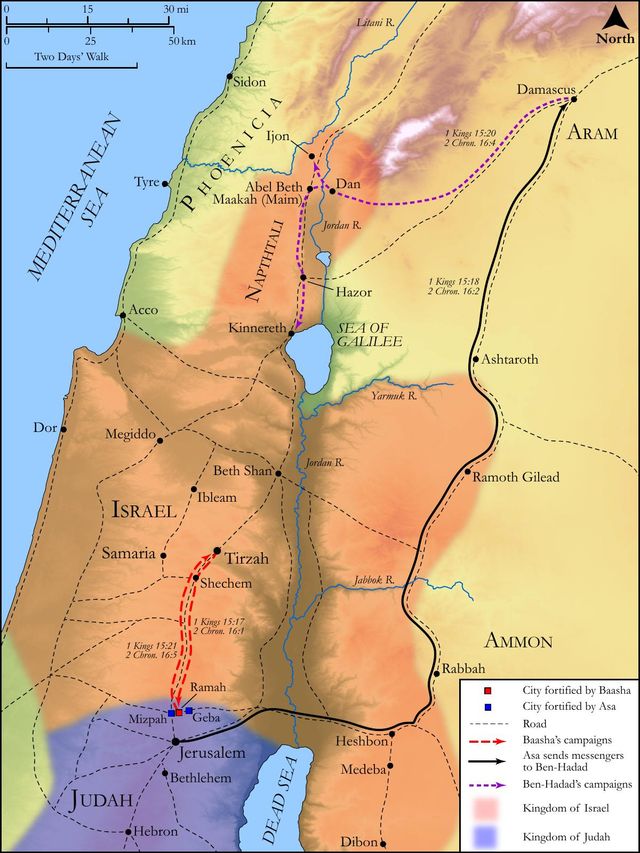
This verse serves as a crucial inflection point in the narrative of King Asa's reign, signaling a significant decline from his earlier demonstrated faithfulness. The preceding chapters, particularly 2 Chronicles 14 and 2 Chronicles 15, portray Asa as a zealous reformer who genuinely sought the Lord, leading Judah in a spiritual revival and experiencing miraculous deliverance from a vast Ethiopian army through prayer and divine intervention, as detailed in 2 Chronicles 14:9-15. However, the immediate preceding verses, 2 Chronicles 16:1-6, describe Asa's response to an invasion by Baasha, king of Israel. Instead of turning to God as he had before, Asa emptied the treasuries of the Lord's house and his own house to bribe Ben-hadad, king of Syria, into breaking his treaty with Israel and attacking Baasha. While this strategy achieved the immediate objective of diverting Baasha, Hanani's prophetic message in this verse reveals God's profound displeasure, indicating that the means employed were more significant than the earthly outcome. The verses following, 2 Chronicles 16:8-14, detail Asa's angry reaction to the rebuke, his imprisonment of Hanani, and his subsequent reliance on physicians rather than the Lord during his illness, culminating in his death. This narrative arc powerfully illustrates the dangers of spiritual compromise and the dire consequences of rejecting divine counsel.
Historical & Cultural Context
King Asa reigned over the Kingdom of Judah during the 9th century BCE, a period characterized by ongoing geopolitical tensions and frequent conflicts between the divided kingdoms of Judah and Israel. The northern kingdom of Israel, under kings like Baasha, often posed a direct threat to Judah's security and sovereignty. In this volatile environment, forming strategic alliances with powerful regional states, such as Syria (Aram), was a common and often necessary geopolitical strategy for smaller kingdoms seeking to gain an advantage, protect their borders, or expand their influence. However, for the kings of Judah, who were bound by a covenant with Yahweh, such alliances frequently presented a profound theological dilemma: would they place their trust and security in the military and political strength of foreign nations and their pagan deities, or would they rely solely on the covenant faithfulness, omnipotence, and protective power of Yahweh, their God? The role of the "seer" or prophet, exemplified by Hanani, was absolutely crucial in ancient Israel. Prophets served as God's direct spokespersons, often challenging kings and leaders to uphold the covenant, reminding them of God's law, and delivering divine judgment or promises. Their authority derived solely from God, placing them in a unique and often perilous position to rebuke the powerful, even at great personal risk. Asa's decision to rely on Syria, despite God's previous miraculous interventions on his behalf, tragically reflects a common human tendency to prioritize tangible, immediate solutions over unseen divine power and faithfulness.
Key Themes
ShowHideThe central theme powerfully illuminated by 2 Chronicles 16:7 is the paramount importance of sole reliance on God. Asa's tragic shift from trusting God for miraculous victory against the Ethiopians, as seen in 2 Chronicles 14:11, to relying on a pagan king against Baasha, highlights the constant spiritual battle between faith and self-sufficiency that every believer faces. This verse also powerfully demonstrates the consequences of spiritual compromise and disobedience. Hanani's declaration that "the host of the king of Syria escaped out of thine hand" implies a missed opportunity for a greater, more decisive, and God-given victory, signaling that even seemingly successful human strategies can lead to profound spiritual loss and future trouble. Furthermore, the passage underscores the vital role of prophetic ministry in calling God's people, including their leaders, back to uncompromising faithfulness. Hanani's courageous confrontation exemplifies God's active involvement in the lives of His people and His unwavering desire for their wholehearted devotion, even when it means delivering uncomfortable truths that challenge human pride and short-sightedness.
Exposition and Analysis
ShowHideKey Word Analysis
ShowHideThis verb, derived from a primitive root meaning "to support one's self," vividly conveys the idea of leaning on, resting upon, depending on, or trusting for support. When Hanani states that Asa "hast relied on the king of Syria, and not relied on the LORD thy God," he is not merely pointing out a tactical error but a fundamental shift in Asa's spiritual posture. Asa had chosen to place his entire weight, confidence, and security upon a human king and his military might, rather than on the Almighty God who had previously proven Himself faithful and powerful. This word encapsulates the essence of Asa's spiritual failure: a profound and misplaced trust.
This term refers to one who "sees" or "perceives" divinely, often through visions or direct revelation from God. A râʼâh was a type of prophet, distinguished by their ability to receive and communicate divine insight. Hanani's title as "the seer" emphasizes that his message to Asa was not merely human opinion or political commentary, but a direct, divinely inspired word from God. It highlights the authoritative and unchallengeable nature of the rebuke, underscoring that Asa was rejecting God's counsel, not merely a human advisor's.
This word carries a broad semantic range, encompassing "a force, whether of men, means or other resources; an army, wealth, virtue, valor, strength." In this context, it specifically refers to the military "army" or "forces" of the king of Syria. Hanani's declaration that this "host... escaped out of thine hand" implies that God had intended for Asa to achieve a decisive and complete victory over the Syrian army, perhaps even capturing or destroying it. Asa's reliance on human strategy prevented this greater, God-ordained triumph, demonstrating that a misplaced trust can lead to missed divine opportunities for comprehensive victory.
Verse Breakdown
ShowHide"And at that time Hanani the seer came to Asa king of Judah, and said unto him"
This opening clause immediately establishes the setting and the nature of the encounter. "At that time" precisely links the prophetic confrontation to Asa's recent actions of forming an alliance with Syria, indicating God's immediate response to the king's choices. The arrival of Hanani, identified specifically as "the seer," is crucial; it signals that the words to follow are not merely human counsel or political critique, but a direct, authoritative prophetic utterance—a message from God Himself delivered to the reigning monarch. This sets a serious and solemn tone for the divine rebuke that is about to be unveiled.
"Because thou hast relied on the king of Syria, and not relied on the LORD thy God"
This is the theological core and the heart of the divine accusation. The powerful repetition of "relied" (Hebrew: shâʻan') starkly highlights Asa's fundamental sin: a profound and misplaced trust. His transgression was not simply in making a political alliance, which might have been a pragmatic choice in human terms, but in where he placed his ultimate dependence and security. He chose to lean on the fleeting power and unreliable promises of a human king and his military might (the king of Syria) rather than on the unfailing divine power and covenant faithfulness of "the LORD thy God," the very God who had previously delivered him miraculously from overwhelming odds. This reveals a catastrophic failure of faith and a direct breach of covenant trust.
"therefore is the host of the king of Syria escaped out of thine hand"
This clause declares the immediate and direct consequence of Asa's misplaced reliance. The phrase "escaped out of thine hand" signifies a profound missed opportunity for a greater, God-given victory. While Asa's human strategy did achieve its immediate tactical goal of deterring Baasha, Hanani reveals that God had intended a more complete and decisive triumph over the Syrian army itself, perhaps even preventing the need for such an alliance in the first place. This implies a significant loss of divine blessing, a forfeiture of a more glorious victory, and a foreshadowing of future troubles for Judah. It powerfully demonstrates that even seemingly successful human efforts, when born of unbelief and a lack of reliance on God, can lead to greater spiritual and practical losses in the long run.
Literary Devices
ShowHideThe primary literary device at play in 2 Chronicles 16:7 is Prophetic Rebuke, where a divinely appointed messenger confronts a leader with their sin and its immediate consequences. This is characterized by direct address and a clear, unambiguous statement of transgression. Furthermore, the verse employs stark Contrast, setting Asa's reliance on "the king of Syria" against his profound failure to rely on "the LORD thy God." This powerful juxtaposition highlights the spiritual dichotomy and the fundamental choice Asa made, emphasizing the exclusivity of true dependence on God. There is also a clear Cause-and-Effect relationship ("Because... therefore..."), which explicitly links Asa's lack of faith and misplaced trust directly to the negative outcome of a missed divine opportunity and a forfeiture of a greater victory. Finally, a subtle Irony is present: Asa's human strategy appeared to "succeed" in deterring Baasha, yet from God's perspective, it resulted in a spiritual failure, a lost opportunity for a more glorious, God-ordained victory, and ultimately, a decline in Asa's reign.
Theological and Thematic Connections
ShowHideThe profound message of 2 Chronicles 16:7 resonates deeply with the broader biblical emphasis on trusting God above all human efforts or resources. Asa's failure serves as a stark reminder that even those with a history of profound faith and divine deliverance can waver, choosing tangible, earthly solutions over unseen divine power and wisdom. This verse teaches a crucial theological truth: God values the means by which we achieve our objectives as much as the objectives themselves, and that true security, lasting victory, and ultimate blessing are found only in Him. It challenges the common human inclination to lean on our own understanding, strategic alliances, accumulated wealth, or perceived strength, rather than on the unfailing wisdom, omnipotence, and sovereign strength of the Almighty God. It underscores that reliance on anything other than God is a form of spiritual idolatry, diverting the heart's ultimate allegiance.
Reflection and Application
ShowHideThe account of King Asa in 2 Chronicles 16:7 offers a timeless and piercing challenge to believers today, urging us to examine the true object of our reliance. In a world that constantly pressures us to place our security and hope in visible, tangible resources—financial stability, political influence, personal connections, or our own intellect and strength—this verse calls us back to radical and unwavering dependence on God alone. It reminds us that even when our human strategies seem to yield immediate, tangible results, God sees the heart of our reliance. Are we seeking His counsel first, or are we turning to Him only as a last resort, after exhausting all other options? Asa's story warns that a seemingly successful outcome, if achieved through a lack of faith and a misplaced trust, can still be a profound spiritual defeat, leading to missed opportunities for God's greater glory and hindering deeper personal growth in Him. True peace, enduring strength, and genuine victory come from a complete and unwavering trust in God's provision, power, and perfect timing, even when the path seems uncertain or counter-intuitive to human wisdom. This passage compels us to ask: where is our trust truly placed when faced with life's challenges?
Questions for Reflection
ShowHideFAQ
ShowHideWhy was Asa's alliance with Syria considered a sin if it achieved its goal of stopping Baasha?
ShowHideAsa's alliance with Syria was considered a sin not because it failed strategically in the short term (it did indeed deter Baasha), but because it represented a fundamental failure of faith and a profound misplaced reliance. God had previously demonstrated His miraculous power on Asa's behalf against a much larger Ethiopian army when Asa fully trusted Him, as recorded in 2 Chronicles 14:9-15. In this instance, instead of seeking God's intervention or relying on His proven faithfulness, Asa chose to empty the treasuries of the Lord's house to bribe a pagan king. The sin was in the means and the heart attitude behind the action: a lack of trust in God's ability and willingness to deliver, and a preference for human wisdom and power over divine omnipotence. Hanani's rebuke emphasizes that by relying on Syria, Asa missed out on a greater, God-given victory over the Syrian host itself, demonstrating that even apparent successes can come at a spiritual cost and lead to missed divine blessings and future complications.
Christ-Centered Fulfillment
ShowHideThe narrative of Asa's misplaced reliance in 2 Chronicles 16:7 powerfully foreshadows the ultimate and perfect reliance found in Jesus Christ. Asa, a king of Judah, failed to fully trust the Lord, leading to a prophetic rebuke, a missed opportunity, and a decline in his reign. In stark contrast, Jesus, the true King of Judah and the Son of God, perfectly embodied complete and unwavering reliance on the Father throughout His earthly ministry. From His profound dependence during His temptation in the wilderness, where He resisted relying on His own divine power to satisfy His needs or gain worldly dominion (Matthew 4:1-11), to His constant declaration that He could do nothing of His own accord but only what He saw the Father doing (John 5:19), Christ lived a life of absolute dependence. Where Asa relied on a foreign king and earthly treasures, Jesus relied on the Spirit of God to cast out demons (Matthew 12:28) and to perform miracles, always giving glory to the Father. His ultimate act of reliance was in submitting to the Father's will even unto death on the cross (Luke 22:42), knowing that the Father would raise Him up. Thus, Asa's failure highlights humanity's propensity to trust in fleeting, earthly power, while Christ's perfect life and atoning work provide the ultimate example and the very means for us to truly "rely on the LORD our God" (Hebrews 12:2), finding in Him the victory, security, and eternal life that no human alliance, strength, or wisdom could ever provide.