


2 Chronicles 36:22
Bible text: King James Version (1769 Blayney text) · Public domain
Bible text: King James Version with Strong's numbers · Public domain
Bible text: Berean Standard Bible · Public domain
Bible text: American Standard Version (1901) · Public domain
Bible text: World English Bible, Messianic edition · Public domain
Bible text: Geneva Bible (1599) · Public domain
Bible text: Young's Literal Translation · Public domain
- וּבִשְׁנַתu·vish·Natand in yearH8141Conj-w ¦ Prep-b ¦ N-fscNoun Singular Feminine Constructוּandבִinשְׁנַתyear
- אַחַת'a·ChatoneH259N-fsNoun Singular Feminine Absolute
- לְכוֹרֶשׁle·Kho·reshof CyrusH3566Prep-l ¦ N-proper-mNoun Proper MasculineלְofכוֹרֶשׁCyrus
- מֶלֶךְMe·lekh[the] king ofH4428N-mscNoun Singular Masculine Construct
- פָּרַסpa·RasPersiaH6539N-properNoun Proper Location
- לִכְלוֹתlikh·Lotto fulfillH3615Prep-l ¦ V-Qal-InfVerb Qal Infinitive Constructלִtoכְלוֹתfulfill
- דְּבַרde·var[the] word ofH1697N-mscNoun Singular Masculine Construct
- יְהוָהYah·wehYahwehH3068N-properNoun Proper Title
- בְּפִיbe·Fiby [the] mouth ofH6310Prep-b ¦ N-mscNoun Singular Masculine Constructבְּbyפִי[the] mouth of
- יִרְמְיָהוּyir·me·Ya·huJeremiahH3414N-proper-mNoun Proper Masculine
- הֵעִירhe·'Irhe stirred upH5782V-Hiphil-Perf-3msVerb Hiphil Perfect 3rd Singular Masculine
- יְהוָהYah·wehYahwehH3068N-properNoun Proper Title
- אֶת'et<obj.>H853DirObjMParticle Object Indicator
- רוּחַRu·ach[the] spirit ofH7307N-fscNoun Singular Feminine Construct
- כּוֹרֶשׁKo·reshCyrusH3566N-proper-mNoun Proper Masculine
- מֶלֶךְMe·lekh[the] king ofH4428N-mscNoun Singular Masculine Construct
- פָּרַסpa·RasPersiaH6539N-properNoun Proper Location
- וַיַּעֲבֶרvai·ya·'a·verand he caused to passH5674Conj-w ¦ V-Hiphil-ConsecImperf-3msVerb Hiphil Consecutive Imperfect 3rd Singular Masculineוַandיַּעֲבֶרhe caused to pass
- קוֹלkOla proclamationH6963N-msNoun Singular Masculine Absolute
- בְּכָלbe·kholin allH3605Prep-b ¦ N-mscNoun Singular Masculine Constructבְּinכָלall
- מַלְכוּתוֹmal·khu·Tohis kingdomH4438N-fsc ¦ 3msNoun Singular Feminine Constructמַלְכוּתkingdomוֹhis
- וְגַםve·gamand alsoH1571Conj-w ¦ AdvAdverbוְandגַםalso
- בְּמִכְתָּבbe·mikh·Tavin writingH4385Prep-b ¦ N-msNoun Singular Masculine Absoluteבְּinמִכְתָּבwriting
- לֵאמֹרle·Mor<to> sayingH559Prep-l ¦ V-Qal-InfVerb Qal Infinitive Constructלֵ<to>אמֹרsaying
English is a literal word-by-word gloss of the Hebrew, not the KJV's wording. Why?
This is the original text the KJV's translators worked from — each Hebrew word with its own literal English meaning in this verse, prepared by scholars at Tyndale House, Cambridge. The KJV translates whole sentences, not word by word, so its wording differs: one Hebrew word can become several English words, and the KJV may choose “the LORD” where the gloss reads “Yahweh”. Both are faithful — they answer different questions. For the KJV's own rendering, switch to the KJV text.
Details
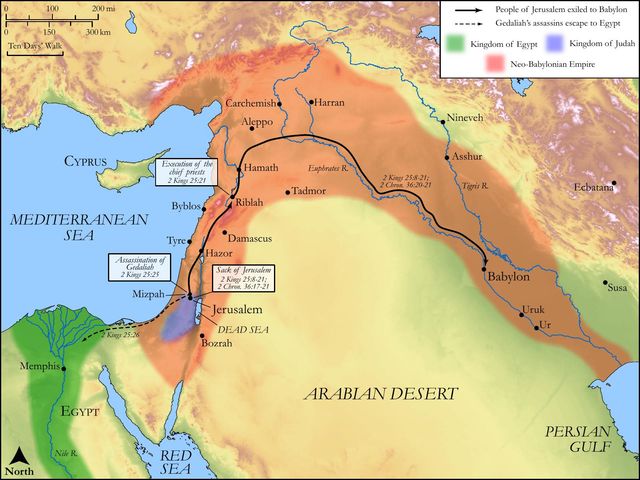
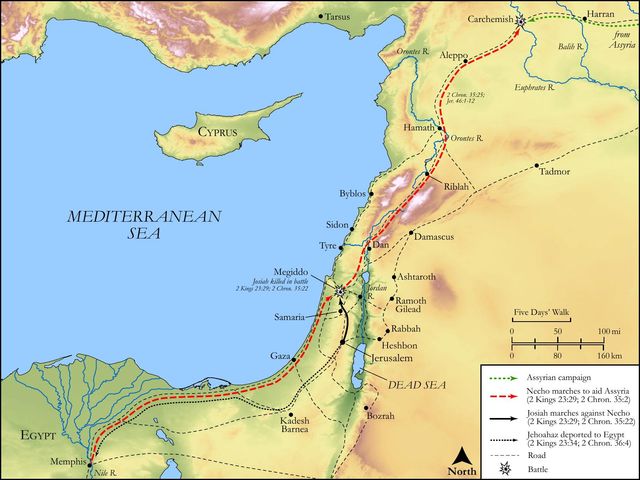
See on the biblical-era maps
Study this verse
Public-domain commentary
Matthew Henry
From his Commentary on the Whole Bible. Henry comments on passages, not single verses — this entry covers 2 Chronicles 36:22–23.
These last two verses of this book have a double aspect. 1. They look back to the prophecy of Jeremiah, and show how that was accomplished, Ch2 36:22. God had, by him, promised the restoring of the captives and the rebuilding of Jerusalem, at the end of seventy years; and that time to favour Sion, that set time, came at last. After a long and dark night the day-spring from on high visited them. God will be found true to every word he has spoken. 2. They look forward to the history of Ezra, which begins with the repetition of these last two verses. They are there the introduction to a pleasant story; here they are the conclusion of a very melancholy one; and so we learn from them that, though God's church be cast down, it is not cast off, though his people be corrected, they are not abandoned, though thrown into the furnace, yet not lost there, nor left there any longer than till the dross be separated. Though God contend long, he will not contend always. The Israel of God shall be fetched out of Babylon in due time, and even the dry bones made to live. It may be long first; but the vision is for an appointed time, and at the end it shall speak and not lie; therefore, though it tarry, wait for it.
Continue studying 2 Chronicles 36:22 across the web’s major study libraries — every link below opens this exact verse, chapter, or book on the destination site.
Read & Compare
 BibleGatewayThis verse in more than 200 translations and 70 languages.
 Bible.comThe YouVersion reader — hundreds of translations, reading plans, and highlights.
 ESV.orgCrossway's official English Standard Version reader.
 NET BibleThe NET translation with 60,000+ translators' notes on every rendering decision.
 STEP BibleTyndale House's free study tool — original text, vocabulary, and scholarly resources.
 BibliaLogos Bible Software's free web reader.
 USCCBThe New American Bible (Revised Edition) with the U.S. bishops' study notes.
Commentaries
 BibleHub CommentariesDozens of classic commentaries on this verse, gathered on one page.
 StudyLightMore than 100 commentary sets — the largest collection on the web.
 BibleRefPlain-English commentary on what this verse means, verse by verse.
 Enduring WordDavid Guzik's free commentary on this chapter, widely used by Bible teachers.
 Bible Study ToolsVerse commentary alongside Greek and Hebrew study aids.
Original Language & Research
- BibleHub InterlinearThe verse word by word — original language, transliteration, and English.
- BibleHub LexiconEvery word's original-language definition and Strong's entry.
 Blue Letter BibleDeep-study tools — Strong's numbers, concordance, and word studies.
 SefariaThe Hebrew text with Rashi and centuries of Jewish commentary.
Sermons, Hymns & Audio


TrulyRandomVerse is not affiliated with these sites and doesn’t control their content. They’re linked because they’re genuinely useful.
Summary
Second Chronicles 36:22 stands as a profound turning point in the biblical narrative, marking the divinely orchestrated conclusion of the Babylonian exile and the dawn of Israel's restoration. This pivotal verse seamlessly bridges the historical account of Judah's persistent rebellion and subsequent judgment with the miraculous return from captivity, explicitly attributing the actions of Cyrus, the Persian king, to the sovereign hand of the LORD. It thus initiates the precise fulfillment of Jeremiah's prophecy, setting the stage for the monumental rebuilding of the Temple and the re-establishment of the nation.
Context
ShowHideLiterary Context
This verse opens the concluding statement of the book of 2 Chronicles, providing a dramatic shift from the preceding narrative of Judah's persistent apostasy, the subsequent divine judgment, and the devastating Babylonian captivity (2 Chronicles 36:15-21). After detailing the destruction of Jerusalem and the Temple, and the seventy-year desolation of the land, 2 Chronicles 36:22 abruptly introduces a new era of hope and divine intervention. It effectively acts as a narrative bridge, linking the historical accounts of the monarchy and exile to the post-exilic period, with its almost identical opening found in Ezra 1:1, signaling a seamless continuation of God's redemptive plan across different biblical books. This verse, which opens the closing passage of the book, ensures that the book of Chronicles, despite the judgment that precedes it, ultimately points towards God's faithfulness and future restoration.
Historical & Cultural Context
The historical backdrop is the rise of the Persian Empire under Cyrus the Great, following his conquest of Babylon in 539 BC. Babylon had previously conquered Judah and exiled its people, destroying Jerusalem and the Temple. Cyrus's reign initiated a new policy towards conquered peoples, which was remarkably benevolent compared to previous empires. Instead of forced assimilation or perpetual subjugation, Cyrus often allowed exiled populations to return to their homelands and rebuild their temples, a policy detailed in the "Cyrus Cylinder." This was a significant departure from the practice of earlier conquerors such as the Assyrians and Babylonians. For the Jewish exiles, this decree was not merely a political maneuver but a miraculous act of liberation, directly fulfilling prophecies given decades earlier. The reference to "the first year of Cyrus" highlights the immediate and impactful nature of this new geopolitical reality on the exiled community.
Key Themes
ShowHideThis verse powerfully encapsulates several overarching themes central to the Chronicler's theology and the broader biblical narrative. Firstly, it underscores Divine Sovereignty and Control, emphasizing that even powerful pagan rulers like Cyrus are instruments in God's hands, their wills "stirred up" by the LORD to accomplish His purposes (compare Proverbs 21:1). Secondly, it highlights the Fulfillment of Prophecy, explicitly stating that Cyrus's actions were designed to "accomplish the word of the LORD spoken by the mouth of Jeremiah." This refers primarily to Jeremiah's prophecies concerning the seventy-year exile and the subsequent return (e.g., Jeremiah 25:11 and Jeremiah 29:10). Furthermore, it echoes Isaiah's remarkable prophecy, which even named Cyrus centuries before his birth, calling him God's "shepherd" and "anointed" one (e.g., Isaiah 44:28 and Isaiah 45:1). Lastly, the verse introduces the theme of Restoration and Hope, signaling the end of a period of judgment and the beginning of God's merciful initiative to bring His people back to their land and rebuild their spiritual center.
Exposition and Analysis
ShowHideKey Word Analysis
ShowHideThis verb (H5782) means "to rouse," "to awaken," or "to incite." In this context, it signifies a divine prompting or supernatural influence. It implies that Cyrus's decision was not merely a political calculation or an act of personal benevolence, but a direct, intentional intervention by the LORD into the will and disposition of a foreign king. This highlights God's absolute sovereignty over human affairs and His ability to use any means, even unexpected ones, to achieve His redemptive purposes.
The Hebrew word (H7307) is rich in meaning, encompassing "wind," "breath," and "spirit." Here, it refers to the inner disposition, will, or inclination of Cyrus, specifically of a rational being including its expression and functions. When the text states the LORD "stirred up the spirit of Cyrus," it means God directly influenced his inner being, his thoughts, and his motivations, leading him to issue the specific decree that would allow the exiles to return. This demonstrates God's intimate involvement in the hearts of rulers, guiding them according to His divine plan.
The verb (H3615) means "to complete," "to finish," or "to bring to an end/pass." Its use here is crucial, as it explicitly links Cyrus's actions to the fulfillment of divine prophecy. It signifies that God's word, spoken through His prophet Jeremiah, was not merely a prediction but a divine promise that would inevitably come to pass at the appointed time. This emphasizes God's faithfulness and the certainty of His prophetic declarations.
Verse Breakdown
ShowHide"Now in the first year of Cyrus king of Persia,"
This phrase establishes the precise historical setting for the momentous decree. The "first year of Cyrus" (539/538 BC) marks the immediate aftermath of his conquest of Babylon, signaling a new geopolitical order and the beginning of the post-exilic period for Judah. It anchors the divine action firmly within human history.
"that the word of the LORD [spoken] by the mouth of Jeremiah might be accomplished,"
This clause explicitly states the divine purpose behind Cyrus's actions. It highlights God's faithfulness to His prophetic word, specifically referring to Jeremiah's prophecies concerning the seventy-year duration of the Babylonian exile and the subsequent return of the Jewish people to their land. God's plan is unfolding precisely as declared.
"the LORD stirred up the spirit of Cyrus king of Persia,"
This is the theological heart of the verse. It asserts God's absolute sovereignty over all earthly rulers, even a powerful pagan monarch like Cyrus. The LORD supernaturally influenced Cyrus's will and intentions, prompting him to issue the decree. This was not a random act of kindness by Cyrus, but a direct, divine intervention to achieve God's redemptive purposes for His people.
"that he made a proclamation throughout all his kingdom, and [put it] also in writing, saying,"
This describes the practical outcome of God's divine prompting. Cyrus's decree was not a mere informal suggestion but an official, kingdom-wide proclamation, formally documented and disseminated. This ensures its authority and widespread impact, setting the legal and administrative framework for the Jewish exiles to return to Judah and rebuild the Temple.
Literary Devices
ShowHideThe verse employs several significant literary devices. It functions as a powerful Narrative Bridge, seamlessly connecting the tragic end of the monarchy and the exile in 2 Chronicles with the hopeful beginning of the return and rebuilding in Ezra. The near-verbatim repetition in Ezra 1:1 emphasizes this continuity and divine orchestration. A profound theological device is the explicit declaration of Divine Sovereignty, where the text directly attributes Cyrus's actions to the LORD's intervention ("the LORD stirred up the spirit of Cyrus"). This underscores God's ultimate control over human history and even the hearts of kings. The verse also utilizes Fulfillment of Prophecy as a central theme, highlighting the reliability of God's word by explicitly stating that Cyrus's decree was to "accomplish the word of the LORD spoken by the mouth of Jeremiah." This serves as a powerful affirmation of God's faithfulness to His covenant promises, even after long periods of judgment and seeming delay, echoing earlier prophecies like those found in Isaiah 45:1.
Theological and Thematic Connections
ShowHideThis verse is a profound testament to God's unwavering faithfulness and His absolute sovereignty over all of creation and human history. It demonstrates that even in periods of severe judgment and apparent abandonment, God remains actively at work, orchestrating global events and influencing the hearts of powerful leaders to fulfill His redemptive purposes. The explicit mention of Jeremiah's prophecy being accomplished underscores the reliability and certainty of God's Word, reminding believers that His promises will ultimately prevail, regardless of the obstacles or the passage of time. This divine intervention, leading to the return from exile, foreshadows God's broader plan of restoration for His people, both physically and spiritually, culminating in the ultimate restoration found in Christ.
Reflection and Application
ShowHideThe message of 2 Chronicles 36:22 resonates deeply with believers today, offering profound encouragement and a robust foundation for faith. It reminds us that even when circumstances seem dire, and God's people are enduring periods of judgment, discipline, or waiting, the Lord remains sovereignly in control. He is actively working behind the scenes, orchestrating world events and influencing the hearts of leaders, often in ways we cannot perceive, to bring about His ultimate purposes. This verse encourages us to trust in God's perfect timing and His unwavering faithfulness, knowing that His promises will always be accomplished. It challenges us to look beyond immediate political or social realities and recognize the unseen hand of God at work, bringing about His redemptive plan for His people and for the world. In times of despair or uncertainty, this passage offers a powerful reminder that God's plan of restoration will ultimately prevail.
Questions for Reflection
ShowHideFAQ
ShowHideWhy does 2 Chronicles end with this verse, and why is it so similar to Ezra 1:1?
ShowHide2 Chronicles 36:22 opens the close of the Chronicler's history of Israel, which largely focuses on the Davidic monarchy and the Temple, culminating in the judgment of exile. Ending with Cyrus's decree provides a powerful note of hope and divine faithfulness, showing that even after severe discipline, God's covenant promises of restoration endure. The near-identical wording with Ezra 1:1 serves as a deliberate literary and theological bridge. It signals that the account of the return from exile and the rebuilding of the Temple (detailed in Ezra-Nehemiah) is not a separate story but a direct continuation and fulfillment of God's ongoing redemptive plan, emphasizing the unity of God's work across different historical periods and biblical books. It assures the reader that God's story for His people did not end in despair but continued with new hope.
Christ-Centered Fulfillment
ShowHideThe divine orchestration of Cyrus's decree in 2 Chronicles 36:22 profoundly foreshadows the ultimate work of Christ. Just as the LORD "stirred up the spirit of Cyrus" to release His people from physical captivity and enable the rebuilding of the earthly Temple, so too did God the Father send His Son, Jesus Christ, to accomplish a far greater liberation. Jesus is the true Lamb of God, who takes away the sin of the world, setting humanity free from the bondage of sin and death, a spiritual exile far more profound than the Babylonian one. The fulfillment of Jeremiah's prophecy through Cyrus points to Christ as the ultimate fulfillment of all prophecy, the one in whom all God's promises find their "Yes" and "Amen" (2 Corinthians 1:20). Furthermore, Isaiah's prophecy identifying Cyrus as God's "shepherd" and "anointed" one (Isaiah 44:28; Isaiah 45:1) finds its perfect and complete realization in Jesus, the Good Shepherd who lays down His life for the sheep and the Messiah, the Anointed One, who establishes an eternal kingdom. The return to the land and the rebuilding of the Temple under Cyrus prefigure the new covenant reality where believers, reconciled to God through Christ, become the living stones of a spiritual house, with Christ Himself as the cornerstone of God's new and eternal dwelling place among humanity.