


Isaiah 44:28
Bible text: King James Version (1769 Blayney text) · Public domain
Bible text: King James Version with Strong's numbers · Public domain
Bible text: Berean Standard Bible · Public domain
Bible text: American Standard Version (1901) · Public domain
Bible text: World English Bible, Messianic edition · Public domain
Bible text: Geneva Bible (1599) · Public domain
Bible text: Young's Literal Translation · Public domain
- הָאֹמֵרha·'o·Merwho saysH559Art ¦ V-Qal-Prtcpl-msVerb Qal Participle Singular Masculine Absoluteהָwhoאֹמֵרsays
- לְכוֹרֶשׁle·Kho·reshof CyrusH3566Prep-l ¦ N-proper-mNoun Proper MasculineלְofכוֹרֶשׁCyrus
- רֹעִיro·'Imy shepherdH7462V-Qal-Prtcpl-ms ¦ 1csVerb Qal Participle Singular Masculine Constructרֹעִshepherdיmy
- וְכָלve·kholand allH3605Conj-w ¦ N-mscNoun Singular Masculine Constructוְandכָלall
- חֶפְצִיchef·Tzimy desireH2656N-msc ¦ 1csNoun Singular Masculine Constructחֶפְצִdesireיmy
- יַשְׁלִםyash·Limhe will performH7999V-Hiphil-Imperf-3msVerb Hiphil Imperfect 3rd Singular Masculine
- וְלֵאמֹרve·le·Morand to sayH559Conj-w ¦ Prep-l ¦ V-Qal-InfVerb Qal Infinitive Constructוְandלֵtoאמֹרsay
- לִירוּשָׁלִַםli·ru·sha·Limof JerusalemH3389Prep-l ¦ N-properNoun Proper LocationלִofירוּשָׁלִַםJerusalem
- תִּבָּנֶהti·ba·Nehlet it be rebuiltH1129V-Niphal-Imperf-3fsVerb Niphal Imperfect 3rd Singular Feminine
- וְהֵיכָלve·hei·Khaland [the] templeH1964Conj-w ¦ N-msNoun Singular Masculine Absoluteוְandהֵיכָל[the] temple
- תִּוָּסֵדti·va·Sedlet it be refoundedH3245V-Niphal-Imperf-3fsVerb Niphal Imperfect 3rd Singular Feminine
English is a literal word-by-word gloss of the Hebrew, not the KJV's wording. Why?
This is the original text the KJV's translators worked from — each Hebrew word with its own literal English meaning in this verse, prepared by scholars at Tyndale House, Cambridge. The KJV translates whole sentences, not word by word, so its wording differs: one Hebrew word can become several English words, and the KJV may choose “the LORD” where the gloss reads “Yahweh”. Both are faithful — they answer different questions. For the KJV's own rendering, switch to the KJV text.
Details
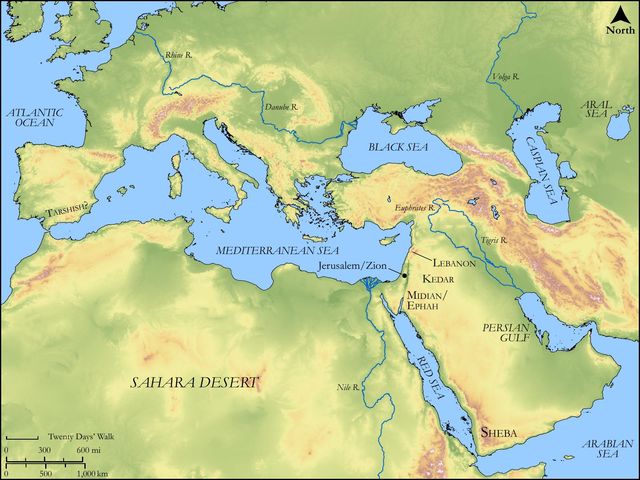
See on the biblical-era map
Study this verse
Public-domain commentary
Matthew Henry
From his Commentary on the Whole Bible. Henry comments on passages, not single verses — this entry covers Isaiah 44:21–28. His four-level outline is real structure in the source text, so it is rendered as structure.
In these verses we have,
I.The duty which Jacob and Israel, now in captivity, were called to, that they might be qualified and prepared for the deliverance designed them. Our first care must be to get good by our afflictions, and then we may hope to get out of them. The duty is expressed in two words: Remember and return, as in the counsel to Ephesus, Rev 2:4, Rev 2:5. 1. "Remember these, O Jacob! Remember what thou hast been told of the folly of idolatry, and let the convictions thou art now under be ready to thee whenever thou art tempted to that sin. Remember that thou art my servant, and therefore must not serve other masters." 2. Return unto me, Isa 44:22. It is the great concern of those who have backslidden from God to hasten their return to him; and this is that which he calls them to when they are in affliction, and when he is returning to them in a way of mercy.
II.The favours which Jacob and Israel, now in captivity, were assured of; and what is here promised to them upon their remembering and returning to God is in a spiritual sense promised to all that in like manner return to God. It is a very comfortable word, for more is implied in it than is expressed (Isa 44:21): "O Israel! thou shalt not be forgotten of me, though for the present thou seemest to be so." When we begin to remember God he will begin to remember us; nay, it is he that remembers us first. Now observe here,
1.The grounds upon which God's favourable intentions to his people were built and on which they might build their expectations from him. He will deliver them out of captivity; for,
(1.)They are his servants, and therefore he has a just quarrel with those that detain them. Let my people go, that they may serve me. The servants of the King of kings are under special protection.
(2.)He formed them into a people, formed them from the womb, Isa 44:24. From the first beginning of their increase into a nation they were under his particular care and government, more than any other people; their national constitution was of his framing, and his covenant with them was the charter by which they were incorporated. They are his, and he will save them.
(3.)He has redeemed them formerly, has many a time redeemed them out of great distress, and he is still the same, in the same relation to them, has the same concern for them. "Therefore return unto me, for I have redeemed thee, Isa 44:22. Whither wilt thou go, but to me?" Having redeemed them, as well as formed them, he has acquired a further title to them and propriety in them, which is a good reason why they should dutifully return to him and why he will graciously return to them. The Lord has redeemed Jacob; he is about to do it (Isa 44:23); he has determined to do it; for he is the Lord their Redeemer, Isa 44:24. Note, The work of redemption which God has by his Son wrought for us encourages us to hope for all promised blessings from him. He that has redeemed us at so vast an expense will not lose his purchase.
(4.)He has glorified himself in them (Isa 44:23), and therefore will do so still, Joh 12:28. It is matter of comfort to us to see God's glory interested in the deliverances of the church; for therefore he will certainly redeem Jacob, because thus he will glorify himself. And this assures us that he will perfect the redemption of his saints by Jesus Christ, because there is a day set when he will be glorified and admired in them all.
(5.)He has pardoned their sins, which were the cause of their calamity and the only obstruction to their deliverance, Isa 44:22. Therefore he will break the yoke of captivity from off their necks, because he has blotted out, as a thick cloud, their transgressions. Note,
[1.]Our transgressions and our sins are as a cloud, a thick cloud; they interpose between heaven and earth, and for a time suspend and intercept the correspondence between the upper and lower world (sin separates between us and God, Isa 59:2); they threaten a storm, a deluge of wrath, as thick clouds do, which God will rain upon sinners. Psa 11:6.
[2.]When God pardons sin he blots out this cloud, this thick cloud, so that the intercourse with heaven is laid open again. God looks down upon the soul with favour; the soul looks up to him with pleasure. The cloud is scattered by the influence of the Sun of righteousness. It is only through Christ that sin is pardoned. When sin is pardoned, like a cloud that is scattered, it appears no more, it is quite gone. The iniquity of Jacob shall be sought for, and not found, Jer 50:20. And the comforts that flow into the soul when sin is pardoned are like the clear shining after clouds and rain.
2.The universal joy which the deliverance of God's people should bring along with it (Isa 44:23): Sing, O you heavens! This intimates,
(1.)That the whole creation shall have cause for joy and rejoicing in the redemption of God's people; to that it is owing that it subsists (that it is rescued from the curse which the sin of man brought upon the ground) and that it is again put into a capacity of answering the ends of its being, and is assured that though now it groans, being burdened, it shall at last be delivered from the bondage of corruption. The greatest establishment of the world is the kingdom of God in it, Psa 96:11-13; Psa 98:7-9.
(2.)That the angels shall rejoice in it, and the inhabitants of the upper world. The heavens shall sing, for the Lord has done it. And there is joy in heaven when God and man are reconciled (Luk 15:7), joy when Babylon falls, Rev 18:20.
(3.)That those who lay at the greatest distance, even the inhabitants of the Gentile world, should join in these praises, as sharing in these joys. The lower parts of the earth, the forest and the trees there, shall bring in the tribute of thanksgiving for the redemption of Israel.
3.The encouragement we have to hope that though great difficulties, and such as have been thought insuperable, lie in the way of the church's deliverance, yet, when the time for it shall come, they shall all be got over with ease; for thus saith Israel's Redeemer, I am the Lord that maketh all things, did make them at first and am still making them; for providence is a continued creation. All being, power, life, emotion, and perfection, are from God. He stretches forth the heavens alone, has no help nor needs any; and the earth too he spreads abroad by himself, and by his own power. Man was not by him when he did it (Job 38:4), nor did any creature advise or assist; only his own eternal wisdom and Word was by him then as one brought up with him, Pro 8:30. His stretching out the heavens by himself denotes the boundless extent of his power. The strongest man, if he has to stretch a thing out, must get somebody or other to lend a hand; but God stretched out the vast expanse and keeps it still upon the stretch, himself, by his own power. Let not Israel be discouraged then; nothing is too hard for him to do that made the world, Psa 124:8. And, having made all things, he can make what use he pleases of all, and has it in his power to serve his own purposes by them.
4.The confusion which this would put upon the oracles of Babylon, by the confutation it would give them, Isa 44:25. God, by delivering his people out of Babylon, would frustrate the tokens of the liars, of all the lying prophets, that said the Babylonian monarchy had many ages yet to live, and pretended to ground their predictions upon some token, some sign or other, which, according to the rules of their arts, foreboded its prosperity. How mad will these conjurors grow with vexation when they see that their skill fails them, and that the contrary happens to that which they so coveted and were so confident of. Nor would it only baffle their pretended prophets, but their celebrated politicians too: He turns the wise men backward. Finding they cannot go on with their projects, they are forced to quit them; and so he makes the judges fools, and makes their knowledge foolish. Those that are made acquainted with Christ see all the knowledge they had before to be foolishness in comparison with the knowledge of him. And those that are adversaries to him will find all their counsels, like Ahitophel's, turned into foolishness, and themselves taken in their own craftiness, Co1 3:19.
5.The confirmation which this would give to the oracles of God, which the Jews had distrusted and their enemies despised: God confirms the word of his servant (Isa 44:26); he confirms it by accomplishing it in its season; and performs the counsel of the messengers whom he hath many a time sent to his people, to tell them what great blessings he had in store for them. Note, The exact fulfilling of the prophecies of scripture is a confirmation of the truth of the whole book and an incontestable evidence of its divine origin and authority.
6.The particular favours God designed for his people, that were now in captivity, Isa 44:26-28. These were foretold long before they went into captivity, that they might see reason to expect a correction, but no reason to fear a final destruction.
(1.)It is here supposed that Jerusalem, and the cities of Judah, should for a time lie in ruins, dispeopled and uninhabited; but it is promised that they shall be rebuilt and repeopled. When Isaiah lived, Jerusalem and the cities of Judah were full of inhabitants; but they will be emptied, burnt, and destroyed. It was then hard to believe that concerning such strong and populous cities. But the justice of God will do that; and, when that is done, it will be hard to believe that ever they will recover themselves again, and yet the zeal of the Lord of hosts will do that to. God has said to Jerusalem, Thou shalt be inhabited; for, while the world stands, God will have a church in it, and therefore he will raise up those who shall say to Jerusalem, Thou shalt be built; for, if it be not built, it cannot be inhabited, Psa 69:35, Psa 69:36. When God's time shall have come for the building up of his church, let him alone to find both houses for his people (for they shall not lie exposed) and people for his houses, for they shall not stand empty. The cities of Judah too shall again be built. The Assyrian army under Sennacherib only took them, and then, upon the defeat of that army, they returned undamaged to the right owners; but the Chaldean army demolished them, and by carrying away the inhabitants left them to go to decay of themselves; for, if less judgments prevail not to humble and reform men, God will send greater. Yet these desolations shall not be perpetual. God will raise up the wastes and decayed places thereof; for he will not contend for ever. The city of strangers, when it is ruined, shall never be built (Isa 25:2), but the city of God's own children is but discontinued for a time.
(2.)It is here supposed that the temple too should be destroyed, and lie for a time rased to the foundations; but it is promised that the foundation of it shall again be laid, and no doubt built upon. As the desolation of the sanctuary was to all the pious Jews the most mournful part of the destruction, so the restoration and re-establishment of it would be the most joyful part of the deliverance. What joy can they have in the rebuilding of Jerusalem if the temple there be not rebuilt? for it is that which makes it a holy city and truly beautiful. This therefore was the chief thing that the Jews had at heart and had in view in their return; therefore they would go back to Jerusalem, to build the house of the Lord God of Israel there, Ezr 1:3.
(3.)It is here supposed that very great difficulties would lie in the way of this deliverance, which it would be impossible for them to wade through; but it is promised that by a divine power they shall all be removed (Isa 44:27): God saith to the deep, Be dry; so he did when he brought Israel out of Egypt, and so he will again when he brings them out of Babylon, if there be occasion. Who art thou, O great mountain? Dost thou stand in the way? Before Zerubbabel, the commander-in-chief of the returning captives, thou shalt become a plain, Zac 4:7. So, Who art thou, O great deep? Dost thou retard their passage and think to block it up? Thou shalt be dry, and thy rivers that supply thee shall be dried up. When Cyrus took Babylon by draining the river Euphrates into many channels, and so making it passable for his army, this was fulfilled. Note, Whatever obstructions lie in the way of Israel's redemption, God can remove them with a word's speaking.
(4.)It is here supposed that none of the Jews themselves would be able by might and power to force their way out of Babylon but it is promised that God will raise up a stranger from afar off, that shall fairly open the way for them, and now at length he names the very man, many scores of years before he was born or thought of (Isa 44:28): That saith of Cyrus, He is my shepherd. Israel is his people, and the sheep of his pasture. These sheep are now in the midst of wolves, in the hands of the thief and robber; they are impounded for trespass. Now Cyrus shall be his shepherd, employed by him to release these sheep, and to take care of their return to their own green pasture again. "In this he shall perform all my pleasure, shall bring about what is purposed by me and will be highly pleasing to me." Note,
[1.]The most contingent things are certain to the divine prescience. He knew who was the person, and what was his name, that should be the deliverer of his people, and, when he pleased, he could let his church know it, that, when they heard of such a name beginning to be talked of in the world, they might lift up their heads with joy, knowing that their redemption drew nigh.
[2.]It is the greatest honour of the greatest men to be employed for God as instruments of his favour to his people. It was more the praise of Cyrus to be God's shepherd than to be emperor of Persia.
[3.]God makes what use he pleases of men, of mighty men, of those that act with the greatest freedom; and, when they think to do as they please, he can overrule them, and make them do as he pleases. Nay, in those very things wherein they are serving themselves, and look no further than that, God is serving his own purposes by them and making them to perform all his pleasure. Rich princes shall do what poor prophets have foretold.
Historical interpretation
Historical reception
1 surviving comment on this verse from the historical church.
(Verse 24 and following) Thus says the Lord, your redeemer, and your creator from the womb: I am the Lord, the maker of all things, stretching out the heavens alone, establishing the earth, with no one beside me. Making the signs of the diviners void, and driving the soothsayers mad; turning the wise men backward, and making their knowledge foolish. Fulfilling the word of my servant, and performing the counsel of my messengers. I say to Jerusalem: you shall be inhabited, and to the cities of Judah: you shall be rebuilt, and its desolate places I will restore. I say to the depths: be desolate, and I will dry up your rivers. I say to Cyrus: you are my shepherd, and you will fulfill all my desires. I say to Jerusalem: you will be rebuilt; and to the temple: you will be founded. LXX: Thus says the Lord who redeemed you, and formed you from the womb. I am the Lord, who fills all things: I alone stretched out the heavens, and established the earth. Who else has dispersed the signs of the pythons, and the divinations from the heart? Who turns wise men backward, and makes their counsel foolish. And I establish the word of my son, and I approve the true counsel of the Angels. I say to Jerusalem, you will be inhabited: and to the cities of Judah: you will be built, and its desolate places will be restored. I say to the abyss, you will be desolated, and I will dry up your rivers. I say to Cyrus, so that he may understand, and do all my will; I say to Jerusalem, you will be built: and I will establish my holy house. With the idols and injustices of Israel destroyed, and sins cleansed, when every creature will rejoice together; and according to the faith of the Gospel (Luke 15), the Angels will rejoice in heaven for the repentance of sinners, the power of God is described, that it is not great for him to redeem Jacob, and to restore Israel, whom he formed from the womb. And if this seems significant to someone, let it not be difficult for them who alone stretches out the heavens. As it is written elsewhere: He who stretches out the heavens like a skin (Ps. CIII, 2). Not that the Son is excluded from the stretching out of the heavens: For all things were made through him, and without him was not anything made that was made (John I, 3), but so that, as we have often said, idols may be excluded by this understanding. For even in the Proverbs of Solomon, from the person of Christ, the power of God and the wisdom of God is said: When he established the heavens, I was with him (Prov. VIII, 27). For he himself spoke, and they were made; he himself commanded, and they were created (Psalm 148:5; Psalm 33:9). And: By the word of the Lord the heavens were established, and all the power of them by the breath of his mouth (Psalm 33:6). We frequently proclaim these things so that no occasion is given to the heretics to blaspheme Christ. In the stability of the earth, when he was establishing its foundations, there was no one with God except him who was in it. Therefore, when the appointed time of the predetermined mystery arrives, so that all idols are destroyed and the knowledge of the one true God is preached in the world, he will destroy and overthrow all the prophecies of the divine, the pythonesses, and the soothsayers, along with the signs and wonders by which they have deceived the human race. And he will show that the wisdom of the philosophers, which is itself the greatest part of error, is foolish, since by no means can human thoughts comprehend the wisdom of God. And furthermore, the word of the boy, or his servant, about whom we spoke earlier, and the advice of his messengers, will accomplish these things: namely, the Apostles and all the teachers, who will proclaim the will of their master to the nations. Therefore, he himself, who will accomplish such great things, whose power I have described in a few words, also says to Jerusalem, which will be destroyed by the Babylonians, before it is destroyed, that it will be inhabited again by the people, and to the cities of Judea, that they will be restored, and he will raise up its desolations, so that all may be filled with cultivators. Therefore, whoever says that Jerusalem, and Judah, and its deserts should be inhabited, and built, and restored, he is saying that Babylon, which is the deep or abyss, should be made desolate and your rivers should be dried up, along with all the power of kings. And because he had said the deep and abyss, he appropriately added the translation of rivers, about which even the Psalmist sings: By the rivers of Babylon, there we sat down and wept (Psalm 137:1). And he who restores Jerusalem, destroys Babylon. He also says to Cyrus, the king of the Persians, who first destroyed Babylon and the Chaldeans: you are my shepherd, or as the Septuagint translated, so that you may understand. The reason for this difference is clear. For the Hebrew word Roi, if we read it with the letter Res (ר), it is understood as my shepherd; if we read it with the letter Daleth (ד), it means my knowing or understanding, which are distinguished by a small apex, and therefore are often confused. It is written at the beginning of Ezra, that by the edict of Cyrus, the king of the Persians and Medes, the captivity of the people of Israel was released, and those who wanted to return were sent back to Jerusalem under Zerubbabel, the son of Shealtiel, and Joshua, the son of Josedech the high priest. For to him the Lord inspired to do his will, and to fulfill his commandments. Significantly, he added, I say to you Jerusalem, you shall be built, and to the Temple, you shall be founded. For under Cyrus, it was commanded to build Jerusalem and the Temple, of which only the foundations were laid while he was alive. However, under Darius, in his second year, with the prophets Haggai and Zechariah, the building of the Temple was begun.
Continue studying Isaiah 44:28 across the web’s major study libraries — every link below opens this exact verse, chapter, or book on the destination site.
Read & Compare
 BibleGatewayThis verse in more than 200 translations and 70 languages.
 Bible.comThe YouVersion reader — hundreds of translations, reading plans, and highlights.
 ESV.orgCrossway's official English Standard Version reader.
 NET BibleThe NET translation with 60,000+ translators' notes on every rendering decision.
 STEP BibleTyndale House's free study tool — original text, vocabulary, and scholarly resources.
 BibliaLogos Bible Software's free web reader.
 USCCBThe New American Bible (Revised Edition) with the U.S. bishops' study notes.
Commentaries
 BibleHub CommentariesDozens of classic commentaries on this verse, gathered on one page.
 StudyLightMore than 100 commentary sets — the largest collection on the web.
 BibleRefPlain-English commentary on what this verse means, verse by verse.
 Enduring WordDavid Guzik's free commentary on this chapter, widely used by Bible teachers.
 Bible Study ToolsVerse commentary alongside Greek and Hebrew study aids.
Original Language & Research
- BibleHub InterlinearThe verse word by word — original language, transliteration, and English.
- BibleHub LexiconEvery word's original-language definition and Strong's entry.
 Blue Letter BibleDeep-study tools — Strong's numbers, concordance, and word studies.
 SefariaThe Hebrew text with Rashi and centuries of Jewish commentary.
Sermons, Hymns & Audio


TrulyRandomVerse is not affiliated with these sites and doesn’t control their content. They’re linked because they’re genuinely useful.
Summary
Isaiah 44:28 is a profound prophetic declaration showcasing God's absolute sovereignty and meticulous control over human history. It uniquely names Cyrus, a pagan Persian king, over a century before his birth, identifying him as God's chosen "shepherd" to accomplish a specific divine purpose: the decree for the rebuilding of Jerusalem and the laying of the temple's foundation. This verse powerfully underscores God's foreknowledge and His ability to orchestrate the actions of even ungodly rulers to fulfill His covenant promises to His people, ensuring His divine "pleasure" is performed.
Context
ShowHideLiterary Context
This verse is situated within the "Book of Comfort" (Isaiah 40-55), a section primarily addressed to the exiles in Babylon, offering hope and assurance of their future return and restoration. Chapters 40-48 emphasize God's incomparable power, His unique role as the only true God, and His ability to declare the future. Specifically, Isaiah 44:24-28 forms a powerful declaration of Yahweh as the sole Creator and Redeemer, contrasting Him with the impotence of idols. Verse 28 serves as the climactic statement of God's redemptive plan, immediately following a declaration of His power to frustrate the omens of liars and make diviners mad, while confirming the word of His servants. It sets the stage for the specific calling of Cyrus in Isaiah 45, where God further elaborates on His purpose for this foreign king.
Historical & Cultural Context
The prophecy of Isaiah was delivered in the 8th century BC, long before the Babylonian Empire rose to prominence and exiled the people of Judah in the 6th century BC. At the time of this prophecy, the kingdom of Judah was still intact, though facing threats from Assyria. The Babylonian captivity, the destruction of Jerusalem, and the temple's desolation were still future events. The naming of Cyrus, the founder of the Persian Achaemenid Empire, is extraordinary because he would not conquer Babylon until 539 BC, over 150 years after Isaiah's ministry. Cyrus's policy of allowing conquered peoples to return to their homelands and rebuild their temples was revolutionary for its time, contrasting sharply with the Assyrian and Babylonian practices of forced resettlement. This specific, detailed foretelling of a future pagan king and his precise actions highlights the supernatural origin of Isaiah's message, affirming God's unparalleled control over historical events.
Key Themes
ShowHideIsaiah 44:28 powerfully contributes to several overarching themes in the book of Isaiah. Firstly, it underscores God's absolute sovereignty over all nations and rulers, demonstrating that He raises up and brings down kings according to His divine will, even using pagan leaders as His instruments (as seen in Isaiah 10:5 regarding Assyria). Secondly, it reinforces the theme of God's unique foreknowledge, proving His deity by His ability to declare the end from the beginning, unlike the impotent idols (a theme prevalent throughout Isaiah 40-48). Thirdly, the verse is a pivotal expression of God's promise of restoration for His exiled people and their land. Despite the impending judgment and desolation, God assures them of a future return and the rebuilding of Jerusalem and its sacred temple, a promise that would provide immense hope during the seventy years of captivity (as prophesied in Jeremiah 29:10).
Exposition and Analysis
ShowHideKey Word Analysis
ShowHideThis proper noun identifies Koresh, the Persian king, by name. The explicit naming of an individual over a century before his birth, coupled with the precise details of his future actions, serves as an undeniable testament to God's unparalleled foreknowledge and His direct involvement in orchestrating human history to fulfill His divine plan.
A primitive root meaning "to tend a flock; i.e. pasture it; intransitively, to graze (literally or figuratively); generally to rule; by extension, to associate with (as a friend)." While often used for God Himself (e.g., Psalm 23:1) or for righteous Israelite leaders, its application to Cyrus signifies his role as God's appointed agent. He would gather and lead God's people (the exiled Israelites) back to their land, performing a specific, divinely ordained task of leadership and care for God's "flock," albeit without personal knowledge of his divine commission.
Meaning "pleasure; hence (abstractly) desire; concretely, a valuable thing; hence (by extension) a matter (as something in mind)." This term emphasizes that Cyrus's actions, though seemingly his own political decisions driven by imperial policy, were ultimately aligned with and executed God's sovereign will. It highlights that God's deepest desire and purpose for His people's restoration were precisely what Cyrus would perform, underscoring the divine orchestration behind human events.
Verse Breakdown
ShowHide"That saith of Cyrus, He is my shepherd"
This clause reveals God's direct, personal designation of Cyrus. By calling a pagan king "my shepherd," God asserts His ownership and authority over Cyrus, indicating that Cyrus, though unaware of his divine appointment, would act as God's instrument. The term "shepherd" implies leadership, guidance, and care, signifying Cyrus's role in leading the Jewish exiles back to their land.
"and shall perform all my pleasure"
This phrase emphasizes the divine orchestration behind Cyrus's actions. His decree to allow the Jews to return and rebuild was not merely a political maneuver but the direct fulfillment of God's sovereign will and purpose. God's "pleasure" refers to His desired outcome, His plan for the restoration of His people and their worship, which Cyrus would perfectly execute.
"even saying to Jerusalem, Thou shalt be built"
This is a direct prophetic command and promise concerning the physical restoration of the city. Jerusalem, which would be devastated by the Babylonians, is assured of its future reconstruction. This promise offered immense hope to a people facing or enduring exile and desolation, affirming God's unwavering commitment to His covenant city.
"and to the temple, Thy foundation shall be laid"
This final clause specifies the rebuilding of the temple (Hebrew, hêykâl, H1964), the spiritual heart of Israel. The laying of the foundation (Hebrew, yâçad, H3245) signifies the commencement of the rebuilding process, which was crucial for the restoration of proper worship and the covenant relationship between God and His people. This detail further highlights the precision and certainty of God's prophetic word.
Literary Devices
ShowHideIsaiah 44:28 employs several powerful literary devices to convey its profound message. The primary device is Prophecy, specifically Predictive Prophecy, which is demonstrated by the explicit naming of Cyrus over a century before his birth and the detailed description of his future actions concerning Jerusalem and the temple. This serves as irrefutable evidence of God's omniscience and His unique ability to declare the future, distinguishing Him from false gods. The use of Metaphor is evident in God's designation of Cyrus as "my shepherd." While Cyrus was a political ruler, the "shepherd" metaphor imbues his role with divine purpose and care, implying that he would guide and gather God's scattered flock (Israel) back to their land, much like a shepherd tends his sheep. Furthermore, the verse uses Personification by depicting God "saying" to Jerusalem and the temple, as if they are sentient beings capable of receiving commands. This rhetorical flourish emphasizes the directness and certainty of God's decree for their restoration. Finally, there is a clear Parallelism in the promises for Jerusalem and the temple ("Thou shalt be built" and "Thy foundation shall be laid"), reinforcing the comprehensive nature of the promised restoration.
Theological and Thematic Connections
ShowHideIsaiah 44:28 is a profound testament to God's absolute sovereignty, demonstrating His meticulous control over human history and His ability to use even pagan rulers to accomplish His divine purposes. It underscores that God is not limited by human will or political power, but rather orchestrates events to fulfill His covenant promises. This verse provides immense comfort, assuring God's people that His plans for their restoration and blessing will inevitably come to pass, regardless of present circumstances or the might of empires. It highlights God's faithfulness to His word and His unwavering commitment to His people, even when they are in exile and seemingly abandoned, proving that His "pleasure" will always be performed.
Reflection and Application
ShowHideIsaiah 44:28 offers profound encouragement and a powerful perspective for believers navigating a complex world. It reminds us that God's sovereign hand is always at work, even in the most unexpected places and through the most unlikely individuals. When we observe political leaders or global events that seem contrary to God's will, this verse calls us to remember that God can use anyone, even those who do not acknowledge Him, to accomplish His ultimate purposes. It fosters a deep trust in God's overarching plan, providing hope amidst chaos and despair. Just as God promised to rebuild a desolate Jerusalem, He is the God who can bring restoration and renewal to our broken lives, communities, and even nations. Our task is to remain faithful, pray for those in authority (as 1 Timothy 2:1-2 encourages), and trust that God's "pleasure" will ultimately be performed, bringing His perfect will to fruition in His timing.
Questions for Reflection
ShowHideFAQ
ShowHideWho was Cyrus, and why is he significant in biblical prophecy?
ShowHideCyrus (also known as Cyrus the Great) was the founder of the Achaemenid Persian Empire, which conquered the Babylonian Empire in 539 BC. He is significant in biblical prophecy because Isaiah, writing over a century before Cyrus's birth, explicitly named him and foretold his specific role in allowing the Jewish exiles to return to Jerusalem and rebuild their temple. This unparalleled predictive prophecy, fulfilled precisely as recorded in Ezra 1:1-4, serves as a powerful testament to God's unique foreknowledge and His control over human history.
Why does God call a pagan king like Cyrus "my shepherd"?
ShowHideThe term "shepherd" (Hebrew: râʻâh) typically denotes leadership, care, and guidance, often used for God Himself or for righteous leaders of Israel. Applying it to Cyrus, a gentile king, signifies that he was God's chosen instrument, uniquely appointed for a specific, divinely ordained task. He was not a spiritual shepherd of Israel in the covenant sense, but rather a political "shepherd" who would gather God's scattered flock (the Jewish exiles) and lead them back to their land to fulfill God's redemptive purposes, specifically the rebuilding of Jerusalem and its temple. This highlights God's ability to use anyone, regardless of their faith or background, to accomplish His sovereign will and perform His "pleasure."
Christ-Centered Fulfillment
ShowHideWhile Cyrus served as God's instrument to physically rebuild Jerusalem and its temple, his role powerfully foreshadows the ultimate and perfect "Shepherd" and "Builder" whom God would send: Jesus Christ. Just as Cyrus was God's appointed agent to gather His scattered people and restore their worship, Jesus is the Good Shepherd who lays down His life for the sheep, gathering the lost sheep of Israel and indeed, all who believe, into His eternal fold. He is the one who performs all of God's ultimate pleasure, not merely in a political sense, but in the spiritual and eternal redemption of humanity. Jesus declared, "I will build my church, and the gates of hell shall not prevail against it," signifying a spiritual rebuilding far greater than any physical structure. He is the true Temple, the very place where God dwells among His people (John 2:19-21), and through His sacrifice on the cross, He laid the unbreakable foundation for a new covenant and a spiritual house built of living stones (1 Peter 2:5). Thus, Cyrus's divinely orchestrated mission points forward to Christ, who perfectly fulfills God's pleasure by establishing His eternal kingdom and building His church, the true spiritual Jerusalem, where God's presence resides forever.