


Daniel 10:1
Bible text: King James Version (1769 Blayney text) · Public domain
Bible text: King James Version with Strong's numbers · Public domain
Bible text: Berean Standard Bible · Public domain
Bible text: American Standard Version (1901) · Public domain
Bible text: World English Bible, Messianic edition · Public domain
Bible text: Geneva Bible (1599) · Public domain
Bible text: Young's Literal Translation · Public domain
- בִּשְׁנַתbish·Natin yearH8141Prep-b ¦ N-fscNoun Singular Feminine Constructבִּinשְׁנַתyear
- שָׁלוֹשׁsha·Lo·oshthreeH7969Adj-csAdjective Numerical Singular common gender Absolute
- לְכוֹרֶשׁle·Kho·reshof CyrusH3566Prep-l ¦ N-proper-mNoun Proper MasculineלְofכוֹרֶשׁCyrus
- מֶלֶךְMe·lekh[the] king ofH4428N-mscNoun Singular Masculine Construct
- פָּרַסpa·RasPersiaH6539N-properNoun Proper Location
- דָּבָרda·Vara wordH1697N-msNoun Singular Masculine Absolute
- נִגְלָהnig·Lahit was revealedH1540V-Niphal-Perf-3msVerb Niphal Perfect 3rd Singular Masculine
- לְדָנִיֵּאלle·da·ni·Yelto DanielH1840Prep-l ¦ N-proper-mNoun Proper MasculineלְtoדָנִיֵּאלDaniel
- אֲשֶׁר'a·SherwhomH834RelParticle Relative
- נִקְרָאnik·Ra'it had been calledH7121V-Niphal-Perf-3msVerb Niphal Perfect 3rd Singular Masculine
- שְׁמוֹshe·Mohis nameH8034N-msc ¦ 3msNoun Singular Masculine Constructשְׁמnameוֹhis
- בֵּלְטְשַׁאצַּרbe·le·te·sha·TzarBelteshazzarH1095N-proper-mNoun Proper Masculine
- וֶאֱמֶתve·'e·Metand [was] truthH571Conj-w ¦ N-fsNoun Singular Feminine Absoluteוֶandאֱמֶת[was] truth
- הַדָּבָרha·da·Varthe wordH1697Art ¦ N-msNoun Singular Masculine Absoluteהַtheדָּבָרword
- וְצָבָאve·tza·Va'and a warH6635Conj-w ¦ N-msNoun Singular Masculine Absoluteוְandצָבָאa war
- גָדוֹלga·DolgreatH1419Adj-msAdjective Singular Masculine Absolute
- וּבִיןu·Vinand he understoodH995Conj-w ¦ V-Qal-ConsecPerf-3msVerb Qal Consecutive Perfect 3rd Singular Masculineוּandבִיןhe understood
- אֶת'et<obj.>H853DirObjMParticle Object Indicator
- הַדָּבָרha·da·Varthe wordH1697Art ¦ N-msNoun Singular Masculine Absoluteהַtheדָּבָרword
- וּבִינָהu·Vi·nahand understandingH998Conj-w ¦ N-fsNoun Singular Feminine Absoluteוּandבִינָהunderstanding
- לוֹlo[belonged] to himPrep-l ¦ 3msSuffix Personal 3rd Singular Masculineל[belonged] toוֹhim
- בַּמַּרְאֶהba·mar·'Ehby the visionH4758Prep-b ¦ N-msNoun Singular Masculine Absoluteבַּby theמַּרְאֶהvision
English is a literal word-by-word gloss of the Hebrew, not the KJV's wording. Why?
This is the original text the KJV's translators worked from — each Hebrew word with its own literal English meaning in this verse, prepared by scholars at Tyndale House, Cambridge. The KJV translates whole sentences, not word by word, so its wording differs: one Hebrew word can become several English words, and the KJV may choose “the LORD” where the gloss reads “Yahweh”. Both are faithful — they answer different questions. For the KJV's own rendering, switch to the KJV text.
Details
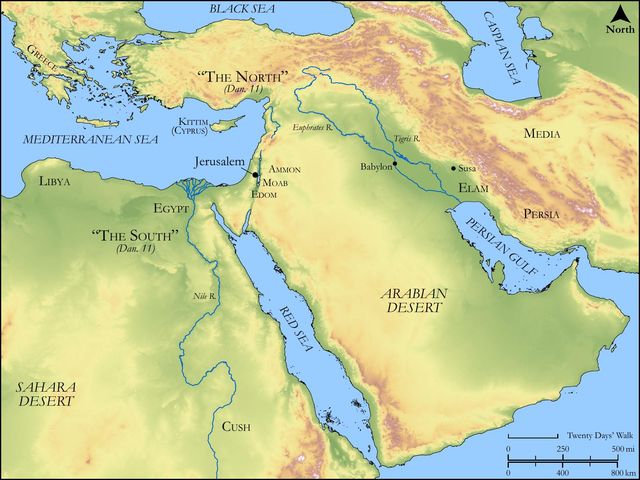
See on the biblical-era map
Study this verse
Public-domain commentary
Matthew Henry
From his Commentary on the Whole Bible. Henry comments on passages, not single verses — this entry covers Daniel 10:1–9. His two-level outline is real structure in the source text, so it is rendered as structure.
This vision is dated in the third year of Cyrus, that is, of his reign after the conquest of Babylon, his third year since Daniel became acquainted with him and a subject to him. Here is,
I.A general idea of this prophecy (Dan 10:1):
The thing was true; every word of God is so; it was true that Daniel had such a vision, and that such and such things were said. This he solemnly attests upon the word of a prophet. Et hoc paratus est verificare - He was prepared to verify it; and, if it was a word spoken from heaven, no doubt it is stedfast and may be depended upon. But the time appointed was long, as long as to the end of the reign of Antiochus, which was 300 years, a long time indeed when it is looked upon as to come. Nay, and because it is usual with the prophets to glance at things spiritual and eternal, there is that in this prophecy which looks in type as far forward as to the end of the world and the resurrection of the dead; and then he might well say, The time appointed was long. It was, however, made as plain to him as if it had been a history rather than a prophecy; he understood the thing; so distinctly was it delivered to him, and received by him, that he could say he had understanding of the vision. It did not so much operate upon his fancy as upon his understanding.
II.An account of Daniel's mortification of himself before he had this vision, not in expectation of it, nor, when he prayed that solemn prayer ch. 9, does it appear that he had any expectation of the vision in answer to it, but purely from a principle of devotion and pious sympathy with the afflicted people of God. He was mourning full three weeks (Dan 10:2), for his own sins and the sins of his people, and their sorrows. Some think that the particular occasion of his mourning was slothfulness and indifference of many of the Jews, who, though they had liberty to return to their own land, continued still in the land of their captivity, not knowing how to value the privileges offered them; and perhaps it troubled him the more because those that did so justified themselves by the example of Daniel, though they had not that reason to stay behind which he had. Others think that it was because he heard of the obstruction given to the building of the temple by the enemies of the Jews, who hired counsellors against them, to frustrate their purpose (Ezr 4:4, Ezr 4:5), all the days of Cyrus, and gained their point from his son Cambyses, or Artaxerxes, who governed while Cyrus was absent in the Scythian war. Note, Good men cannot but mourn to see how slowly the work of God goes on in the world and what opposition it meets with, how weak its friends are and how active its enemies. During the days of Daniel's mourning he ate no pleasant bread; he could not live without meat, but he ate little, and very sparingly, and mortified himself in the quality as well as the quantity of what he ate, which may truly be reckoned fasting, and a token of humiliation and sorrow. He did not eat the pleasant bread he used to eat, but that which was course and unpalatable, which he would not be tempted to eat any more of than was just necessary to support nature. As ornaments, so delicacies, are very disagreeable to a day of humiliation. Daniel ate no flesh, drank no wine, nor anointed himself, for those three week's time, Dan 10:3. Though he was now a very old man, and might plead that the decay of his nature required what was nourishing, though he was a very great man, and might plead that, being used to dainty meats, he could not do without them, it would prejudice his health if he were, yet, when it was both to testify and to assist his devotion, he could thus deny himself; let this be noted to the shame of many young people in the common ranks of life who cannot persuade themselves thus to deny themselves.
III.A description of that glorious person whom Daniel saw in vision, which, it is generally agreed, could be no other that Christ himself, the eternal Word. He was by the side of the river Hiddekel (Dan 10:4), probably walking there, not for diversion, but devotion and contemplation, as Isaac walked in the field, to meditate; and, being a person of distinction, he had his servants attending him at some distance. There he looked up, and saw one man Christ Jesus. It must be he, for he appears in the same resemblance wherein he appeared to St. John in the isle of Patmos, Rev 1:13-15. His dress was priestly, for he is the high priest of our profession, clothed in linen, as the high priest himself was on the day of atonement, that great day; his loins were girded (in St. John's vision his paps were girded) with a golden girdle of the finest gold, that of Uphaz, for every thing about Christ is the best in its kind. The girding of the loins denotes his ready and diligent application to his work, as his Father's servant, in the business of our redemption. His shape was amiable, his body like the beryl, a precious stone of a sky-colour. His countenance was awful, and enough to strike a terror on the beholders, for his face was as the appearance of lightning, which dazzles the eyes, both brightens and threatens. His eyes were bright and sparkling, as lamps of fire. His arms and feet shone like polished brass, Dan 10:6. His voice was loud, and strong, and very piercing, like the voice of a multitude. The vox Dei - voice of God can overpower the vox populi - voice of the people. Thus glorious did Christ appear, and it should engage us,
1.To think highly and honourably of him. Now consider how great this man is, and in all things let him have the pre-eminence.
2.To admire his condescension for us and our salvation. Over all this splendour he drew a veil when he took upon him the form of a servant, and emptied himself.
IV.The wonderful influence that this appearance had upon Daniel and his attendants, and the terror that it struck upon him and them.
1.His attendants saw not the vision; it was not fit that they should be honoured with the sight of it. There is a divine revelation vouchsafed to all, from converse with which none are excluded who do not exclude themselves; but such a vision must be peculiar to Daniel, who was a favourite. Paul's companions were aware of the light, but saw no man, Act 9:7; Act 22:9. Note, It is the honour of those who are beloved of God that, what is hidden from others, is known to them. Christ manifests himself to them, but not to the world, Joh 14:22. But, though they saw not the vision, they were seized with an unaccountable trembling; either from the voice they heard, or from some strange concussion or vibration of the air they felt, so it was that a great quaking fell upon them, so that they fled to hide themselves, probably among the willows that grew by the river's side. Note, Many have a spirit of bondage to fear who never receive a spirit of adoption, to whom Christ has been, and will be, never otherwise than a terror. Now the fright that Daniel's attendants were in is a confirmation of the truth of the vision; it could not be Daniel's fancy, or the product of a heated imagination of his own, or it had a real, powerful, and strange effect upon those about him.
2.He himself saw it, and saw it alone, but he was not able to bear the sight of it. It not only dazzled his eyes, but overwhelmed his spirit, so that there remained no strength in him, Dan 10:8. He said, as Moses himself, I exceedingly fear and quake. His spirits were all so employed, either in an intense speculation of the glory of this vision or in the fortifying of his heart against the terror of it, that his body was left in a manner lifeless and spiritless. He had no vigour in him, and was but one remove from a dead carcase; he looked as pale as death, his colour was gone, his comeliness in him was turned into corruption, and he retained no strength. Note, the greatest and best of men cannot bear the immediate discoveries of the divine glory; no man can see it and live; it is next to death to see a glimpse of it, as Daniel here; but glorified saints see Christ as he is and can bear the sight. But, though Daniel was thus dispirited with the vision of Christ, yet he heard the voice of his words and knew what he said. Note, We must take heed lest our reverence of God's glory, by which we should be awakened to hear his voice both in his word and in his providence, should degenerate into such a dread of him as will disable or indispose us to hear it. It should seem that when the vision of Christ terrified Daniel the voice of his words soon pacified and composed him, silenced his fear, and laid him to sleep in a holy security and serenity of mind: When I heard the voice of his words I fell into a slumber, a sweet slumber, on my face, and my face towards the ground. When he saw the vision he threw himself prostrate, into a posture of the most humble adoration, and dropped asleep, not as careless of what he heard and saw, but charmed with it. Note, How dreadful soever Christ may appear to those who are under convictions of sin, and in terror by reason of it, there is enough in his word to quiet their spirits and make them easy, if they will but attend to it and apply it.
Historical interpretation
Four Centuries of Reception
4 surviving comments on this verse. Each one is dated, so this reads as a timeline rather than a list.
Select a marker to jump to its quote. Markers stagger vertically where authors wrote within a few decades of each other.
Verse 1. "In the third year of Cyrus, King of the Persians, a word was revealed unto Daniel, who was surnamed Belteshazzar, and it was a true word and great strength. For there is need of understanding in a vision." And how is it that we read at the end of the first vision, "And Daniel lived until the first year of Cyrus the King"? Well then, we understand that he enjoyed his former high position among the Chaldeans and was clothed in purple and fine linen right up until the first year of King Cyrus, when Cyrus overthrew the Chaldeans, and afterwards Daniel commenced service under Darius, the son of Ahasuerus of the Median line, who reigned over the kingdom of the Chaldeans. Or else, indeed, that Darius had already died in whose first year Daniel had learned of the mystery of the seventy weeks, and he is now relating that he beheld these things in the third year of King Cyrus. "And it was a true word and great strength" refers either to the strength of the God who was going to perform these things or to the strength of the prophet who would comprehend them.
To some it seems that Daniel is mistaken about the time and the one writing the book from the beginning puts “in the third year” instead of “in the first year.” And the proof of this is that the blessed Daniel says right after the beginning of the prophecy, “And Daniel continued until year one of King Cyrus.” For if the prophet had lived only up until the first year of Cyrus’ reign, the critic says, how could he have seen the revelation in the third year? Now I think that the former does not indicate the stated time nor does “the first year of Cyrus’ reign” mark the end of blessed Daniel’s life. For he does not say “until the first year of Cyrus the king” but “for year one.” As it appears to me, he intends to instruct those encountering the prophetic book that he survived until Cyrus, king of the Persians, who set free those Jewish captives.
Quite suitably he calls it “a word” and “a vision.” He saw holy angels; he also heard them conversing and from them learned accurately the things that would happen. And he says that the word was “true” so that all might receive the things about to be spoken without any doubts.
It is evident that Daniel lived up to the third year [of Cyrus] and beyond, even though at the beginning of the book we read “until the first year of the king Cyrus.”
Continue studying Daniel 10:1 across the web’s major study libraries — every link below opens this exact verse, chapter, or book on the destination site.
Read & Compare
 BibleGatewayThis verse in more than 200 translations and 70 languages.
 Bible.comThe YouVersion reader — hundreds of translations, reading plans, and highlights.
 ESV.orgCrossway's official English Standard Version reader.
 NET BibleThe NET translation with 60,000+ translators' notes on every rendering decision.
 STEP BibleTyndale House's free study tool — original text, vocabulary, and scholarly resources.
 BibliaLogos Bible Software's free web reader.
 USCCBThe New American Bible (Revised Edition) with the U.S. bishops' study notes.
Commentaries
 BibleHub CommentariesDozens of classic commentaries on this verse, gathered on one page.
 StudyLightMore than 100 commentary sets — the largest collection on the web.
 BibleRefPlain-English commentary on what this verse means, verse by verse.
 Enduring WordDavid Guzik's free commentary on this chapter, widely used by Bible teachers.
 Bible Study ToolsVerse commentary alongside Greek and Hebrew study aids.
Original Language & Research
- BibleHub InterlinearThe verse word by word — original language, transliteration, and English.
- BibleHub LexiconEvery word's original-language definition and Strong's entry.
 Blue Letter BibleDeep-study tools — Strong's numbers, concordance, and word studies.
 SefariaThe Hebrew text with Rashi and centuries of Jewish commentary.
Sermons, Hymns & Audio


TrulyRandomVerse is not affiliated with these sites and doesn’t control their content. They’re linked because they’re genuinely useful.
Summary
Daniel 10:1 serves as the crucial introduction to Daniel's final and most extensive prophetic vision, spanning chapters 10-12. This verse precisely dates the revelation to the third year of Cyrus's reign, identifies Daniel by both his Hebrew and Babylonian names, asserts the absolute truthfulness of the forthcoming prophecy, and highlights its distant future fulfillment. It also underscores Daniel's divinely granted capacity to comprehend the profound and complex divine message he received.
Context
ShowHideLiterary Context
Daniel 10:1 immediately follows Daniel's intense prayer and the subsequent angelic visitation in Daniel 9, where he received a prophecy concerning the seventy weeks. This verse marks a shift to a new, distinct, and highly detailed vision that will occupy the remainder of the book. While previous visions in Daniel 7 and Daniel 8 focused on successive world empires, the vision introduced in Daniel 10 through Daniel 12 delves into the specific conflicts between the "king of the North" and the "king of the South," culminating in the ultimate eschatological events, including the resurrection and the end times. This introductory verse sets the solemn and weighty tone for the profound disclosures that follow.
Historical & Cultural Context
The "third year of Cyrus king of Persia" places this vision around 536 BC, approximately two years after Cyrus's decree allowing the Jewish exiles to return to Jerusalem (as recorded in Ezra 1:1-4). While many Jews had already begun their journey back to Judah under Zerubbabel, Daniel, now an old man, remained in Babylon, likely still serving in a governmental capacity. His continued presence in the foreign court underscores his enduring faithfulness and God's sovereign purpose in keeping him there to receive these final, crucial revelations. The mention of his Babylonian name, "Belteshazzar," a name given to him at the beginning of his exile (Daniel 1:7), serves as a poignant reminder of his long history in pagan lands and his unwavering identity as God's servant despite his surroundings.
Key Themes
ShowHideThis introductory verse encapsulates several overarching themes prevalent throughout the book of Daniel. Firstly, it highlights the theme of Divine Revelation, emphasizing that God actively discloses His will and future plans to His chosen servants, not through human speculation but through direct divine impartation. Secondly, the declaration that "the thing [was] true" underscores the Truth and Certainty of Prophecy, affirming the absolute reliability and veracity of God's word, regardless of its complexity or the distant nature of its fulfillment. Thirdly, the phrase "the time appointed [was] long" points to the Long-Term Prophecy and Eschatology, indicating that the vision concerns events far into the future, particularly those related to the end times, the fate of Israel, and the ultimate conflict between good and evil, a theme that culminates in passages like Daniel 12:4. Finally, Daniel's ability to grasp the message ("he understood the thing, and had understanding of the vision") emphasizes the theme of Understanding and Discernment, showcasing God's empowerment of His servants to comprehend profound spiritual truths, a recurring motif throughout Daniel's prophetic experiences.
Exposition and Analysis
ShowHideKey Word Analysis
ShowHideFrom the root meaning "to speak," this multifaceted Hebrew word refers to a "word," "matter," "event," or "decree." In this context, it denotes the comprehensive prophetic message or divine communication that is about to be revealed to Daniel, encompassing both spoken words and the events they describe. Its repeated use ("a thing was revealed," "the thing was true," "he understood the thing") emphasizes the singular, weighty nature of this particular divine disclosure.
A primitive root meaning "to denude," "uncover," or "disclose." Figuratively, it signifies making known what was previously hidden or secret. Here, it highlights the divine origin of the message; it was not Daniel's own insight but a direct unveiling by God, emphasizing God's initiative in communicating His sovereign plan.
Meaning "great" in any sense, this word is used here in conjunction with "time appointed" (Hebrew, tsâbâʼ' H6635, meaning a "mass of persons," "army," or "appointed time/service"). The phrase "the time appointed was long" (literally, "the appointed time was great" or "a great host/duration") signifies that the events prophesied would span a very extended period, extending far into the future and culminating in the eschatological age. This specific usage underscores the extensive scope and distant fulfillment of the vision.
Derived from the verb "to see," this noun refers to an "appearance," "sight," or "vision" (mental or real). It specifies the mode of revelation Daniel received, indicating a divinely granted perception of future events, often involving symbolic imagery or direct communication from an angelic messenger.
Verse Breakdown
ShowHide"In the third year of Cyrus king of Persia"
This opening clause precisely dates the vision to approximately 536 BC, establishing a specific historical anchor for the prophecy. It places the event after the initial return of the exiles but while Daniel was still alive and active in Babylon, highlighting God's continued engagement with His servant even in his advanced age.
"a thing was revealed unto Daniel, whose name was called Belteshazzar"
This identifies the recipient of the divine message as Daniel, emphasizing that the content was not of human origin but a direct revelation from God. The inclusion of his Babylonian name, Belteshazzar, serves as a literary device reminding the reader of Daniel's long history in exile and his dual identity, rooted in both his heritage and his foreign context.
"and the thing [was] true, but the time appointed [was] long"
This crucial phrase affirms two key aspects of the prophecy: its absolute veracity and its distant fulfillment. "The thing was true" assures the reader of the divine reliability and certainty of the message, while "the time appointed was long" indicates that the events described would unfold over an extended period, pointing towards future generations and ultimately the eschatological climax.
"and he understood the thing, and had understanding of the vision"
This final clause highlights Daniel's spiritual acumen and divine empowerment. It signifies that Daniel, through God's grace, was able to grasp the meaning and implications of the complex divine message, distinguishing him as a prophet uniquely gifted with discernment. The repetition of "understood" (from different but related Hebrew roots, bîyn H995 and bîynâh H998) emphasizes the depth of his comprehension.
Literary Devices
ShowHideDaniel 10:1 employs several literary devices to set the stage for the profound prophecy that follows. The use of Repetition is evident in the repeated mention of "thing" (dâbâr), which underscores the singular importance and comprehensive nature of the revelation. This repetition emphasizes that the entire prophetic message, not just a part of it, is the subject of divine disclosure and human comprehension. Foreshadowing is present in the phrase "the time appointed [was] long," which hints at the extensive temporal scope of the vision, preparing the reader for prophecies that stretch far into the future, culminating in the end times. The very act of a "thing was revealed" serves as a form of Divine Disclosure, highlighting God's active role as the primary communicator and the ultimate source of truth. Furthermore, the inclusion of Daniel's Babylonian name, Belteshazzar, acts as a subtle Allusion to his earlier experiences in the book, reminding the reader of his consistent character and God's faithfulness throughout his long life in exile.
Theological and Thematic Connections
ShowHideDaniel 10:1 grounds the subsequent prophecies in the absolute truth and sovereign timing of God. It underscores the theological principle that God is not silent but actively reveals His purposes to humanity, particularly to His faithful servants. This revelation is not arbitrary but is always "true," reflecting God's unchanging character and the certainty of His word. The emphasis on the "long" appointed time for fulfillment teaches believers about God's patience and His panoramic view of history, which unfolds according to His perfect schedule, often far beyond human immediate comprehension. This divine perspective calls for a deep trust in God's ultimate plan, even when its details are complex or its culmination seems distant.
Reflection and Application
ShowHideDaniel 10:1 offers profound lessons for contemporary believers. Just as Daniel received a vision whose fulfillment was "long," we are reminded that God's plans often unfold over generations, requiring patience and steadfast faith. We may not see the immediate culmination of every divine promise or prophecy, but we are called to trust in the absolute truthfulness of God's word. Daniel's diligent pursuit of understanding and his subsequent comprehension of the vision challenge us to engage deeply with Scripture, seeking discernment through prayer and study, knowing that God desires for us to grasp His truths. This verse encourages us to live with an eternal perspective, understanding that our present circumstances are part of a larger, divinely orchestrated narrative that is moving towards a certain future. It provides immense comfort in the reliability of God's promises and warnings, urging us to align our lives with His sovereign will, confident that His word will surely come to pass.
Questions for Reflection
ShowHideFAQ
ShowHideWhy is Daniel still in Babylon in the third year of Cyrus, after the decree for return?
ShowHideWhile Cyrus's decree in Ezra 1 allowed the Jewish exiles to return to Jerusalem, not all of them immediately did so. Many, like Daniel, had established lives and positions in Babylon over decades. Daniel, by this time, was likely in his late 80s or early 90s, having served multiple Babylonian and Persian kings. His continued presence in Babylon highlights his enduring influence and God's sovereign purpose in keeping him there to receive these final, crucial revelations concerning the future of Israel and the world. His life demonstrates faithfulness and service even in a foreign land, long after many of his countrymen had departed.
What is the significance of the phrase "the time appointed was long"?
ShowHideThis phrase, "the time appointed was long" (Hebrew: tsâbâʼ gâdôwl), is highly significant. It literally means "the appointed time was great" or "a great host/duration." It indicates that the vision Daniel received concerns events that would not be fulfilled in the immediate future but would span a very extended period, stretching far into the distant future. This points to the eschatological nature of the prophecies in Daniel 10-12 and emphasizes that God's redemptive plan unfolds over vast stretches of history, culminating in the end times. It assures the reader that the prophecies are not for Daniel's immediate generation but for future generations, leading to the ultimate conclusion of human history.
Christ-Centered Fulfillment
ShowHideDaniel 10:1, in its declaration of a "true" word revealed for a "long" appointed time, powerfully foreshadows the ultimate revelation and fulfillment found in Jesus Christ. The "thing" revealed to Daniel, though complex and distant, ultimately points to the unfolding of God's redemptive plan, which finds its climax and consummation in Christ. While God "at various times and in various ways spoke in time past to the fathers by the prophets," as Hebrews 1:1 states, He has "in these last days spoken to us by His Son" (Hebrews 1:2). The truthfulness of Daniel's vision is ultimately guaranteed by the One who is "the way, the truth, and the life" (John 14:6). The "long" appointed time for the vision's fulfillment encompasses the entire inter-advent period, from Christ's first coming, which initiated the "last days," to His glorious second coming, which will bring all prophecy to its final, visible completion. Jesus Himself is the "Alpha and the Omega," the beginning and the end of God's historical plan (Revelation 1:8). Thus, Daniel's final vision, introduced in this verse, is part of the grand narrative of God's sovereign rule, culminating in the establishment of Christ's eternal kingdom, which will never be destroyed (Daniel 2:44).