


1 Corinthians 3:19
Bible text: King James Version (1769 Blayney text) · Public domain
Bible text: Berean Standard Bible · Public domain
Bible text: American Standard Version (1901) · Public domain
Bible text: World English Bible, Messianic edition · Public domain
Bible text: Geneva Bible (1599) · Public domain
Bible text: Young's Literal Translation · Public domain
- ἡhēTheG3588T-NSFDefinite article Nominative Singular Feminine
- γὰρgarforG1063CONJConjunction
- σοφίαsophiawisdomG4678N-NSFNoun Nominative Singular Feminine
- τοῦtouof theG3588T-GSMDefinite article Genitive Singular Masculine
- κόσμουkosmouworldG2889N-GSMNoun Genitive Singular Masculine
- τούτουtoutouthisG3778D-GSMDemonstrative pronoun Genitive Singular Masculine
- μωρίαmōriafoolishnessG3472N-NSFNoun Nominative Singular Feminine
- παρὰparawithG3844PREPPreposition
- τῷtō<the>G3588T-DSMDefinite article Dative Singular Masculine
- θεῷtheōGodG2316N-DSM-TNoun Dative Singular Masculine Title
- ἐστινestinisG1510V-PAI-3SVerb Present Active Indicative 3rd Singular
- γέγραπταιgegraptaiIt has been writtenG1125V-RPI-3SVerb Perfect Passive Indicative 3rd Singular
- γάρ·garforG1063CONJConjunction
- ὁho[He is] the [One]G3588T-NSMDefinite article Nominative Singular Masculine
- δρασσόμενοςdrassomenoscatchingG1405V-PNP-NSMVerb Present Middle Or Passive Deponent Participle Nominative Singular Masculine
- τοὺςtoustheG3588T-APMDefinite article Accusative Plural Masculine
- σοφοὺςsophouswiseG4680A-APMAdjective Accusative Plural Masculine
- ἐνeninG1722PREPPreposition
- τῇtēatheG3588T-DSFDefinite article Dative Singular Feminine
- πανουργίᾳpanourgiacraftinessG3834N-DSFNoun Dative Singular Feminine
- αὐτῶν·autōnof themG846P-GPMPersonal pronoun Genitive Plural Masculine
English is a literal word-by-word gloss of the Greek, not the KJV's wording. Why?
This is the original text the KJV's translators worked from — each Greek word with its own literal English meaning in this verse, prepared by scholars at Tyndale House, Cambridge. The KJV translates whole sentences, not word by word, so its wording differs: one Greek word can become several English words, and the KJV may choose “charity” where the gloss reads “love”. Both are faithful — they answer different questions. For the KJV's own rendering, switch to the KJV text.
Details
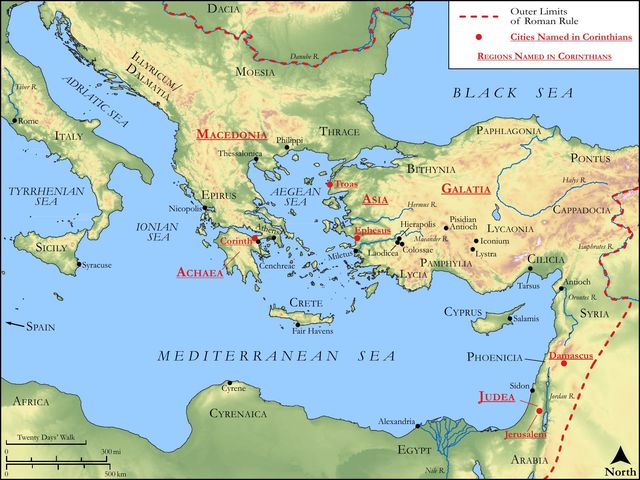
See on the biblical-era maps

Study this verse
Public-domain commentary
Matthew Henry
From his Commentary on the Whole Bible. Henry comments on passages, not single verses — this entry covers 1 Corinthians 3:18–20.
Here he prescribes humility, and a modest opinion of themselves, for the remedy of the irregularities in the church of Corinth, the divisions and contests among them: "Let no man deceive himself, Co1 3:18. Do not be led away from the truth and simplicity of the gospel by pretenders to science and eloquence, by a show of deep learning, or a flourish of words, by rabbis, orators, or philosophers." Note, We are in great danger of deceiving ourselves when we have too high an opinion of human wisdom and arts; plain and pure Christianity will be likely to be despised by those who can suit their doctrines to the corrupt taste of their hearers, and set them off with fine language, or support them with a show of deep and strong reasoning. But he who seems to be wise must become a fool that he may be wise. He must be sensible of his own ignorance, and lament it; he must distrust his own understanding, and not lean on it. To have a high opinion of our wisdom is but to flatter ourselves, and self-flattery is the very next step to self-deceit. The way to true wisdom is to sink our opinion of our own to a due level, and be willing to be taught of God. He must become a fool who would be truly and thoroughly wise. The person who resigns his own understanding, that he may follow the instruction of God, is in the way to true and everlasting wisdom. The meek will he guide in judgment, the meek will he teach his way, Psa 25:9. He that has a low opinion of his own knowledge and powers will submit to better information; such a person may be informed and improved by revelation: but the proud man, conceited of his own wisdom and understanding, will undertake to correct even divine wisdom itself, and prefer his own shallow reasonings to the revelations of infallible truth and wisdom. Note, We must abase ourselves before God if we would be either truly wise or good: For the wisdom of this world is foolishness with God, Co1 3:19. The wisdom which worldly men esteem (policy, philosophy, oratory) is foolishness with God. It is so in a way of comparison with his wisdom. He chargeth his angels with folly (Job 4:18), and much more the wisest among the children of men. His understanding is infinite, Psa 147:5. There can be no more comparison between his wisdom and ours than between his power and being and ours. There is no common measure by which to compare finite and infinite. And much more is the wisdom of man foolishness with God when set in competition with his. How justly does he despise, how easily can he baffle and confound it! He taketh the wise in their own craftiness (Job 5:13), he catches them in their own nets, and entangles them in their own snares: he turns their most studies, plausible, and promising schemes against themselves, and ruins them by their own contrivance. Nay, He knows the thoughts of the wise, that they are vain (Co1 3:20), that they are vanity, Psa 94:11. Note, God has a perfect knowledge of the thoughts of men, the deepest thoughts of the wisest men, their most secret counsels and purposes: nothing is hidden from him, but all things are naked and bare before him, Heb 4:13. And he knows them to be vanity. The thoughts of the wisest men in the world have a great mixture of vanity, of weakness and folly, in them; and before God their wisest and best thoughts are very vanity, compared, I mean, with his thoughts of things. And should not all this teach us modesty, diffidence in ourselves, and a deference to the wisdom of God, make us thankful for his revelations, and willing to be taught of God, and not be led away by specious pretences to human wisdom and skill, from the simplicity of Christ, or a regard to his heavenly doctrine? Note, He who would be wise indeed must learn of God, and not set his own wisdom up in competition with God's.
Historical interpretation
Two Centuries of Reception
8 surviving comments on this verse. Each one is dated, so this reads as a timeline rather than a list.
Select a marker to jump to its quote. Markers stagger vertically where authors wrote within a few decades of each other.
For on the believer alone, who is separated entirely from the rest, who by the Scripture are called wild beasts, rests the head of the universe, the kind and gentle Word, "who taketh the wise in their own craftiness. For the Lord knoweth the thoughts of the wise, that they axe vain; ".
This, then, "the wisdom of the world is foolishness with God "and of those who are "the wise the Lord knoweth their thoughts that they are vain."
With what God? Even if the ancient Scriptures have contributed nothing in support of our view thus far, an excellent testimony turns up in what (the apostle) here adjoins: "For it is written, He taketh the wise in their own craftiness; and again, The Lord knoweth the thoughts of the wise, that they are vain." For in general we may conclude for certain that he could not possibly have cited the authority of that God whom he was bound to destroy, since he would not teach for Him.
But when they say, "What has undergone death is dead," and, "Enjoy life whilst you live," and, "After death all things come to an end, even death itself; "then I must remember both that "the heart of man is ashes," according to the estimate of God, and that the very "Wisdom of the world is foolishness," (as the inspired word) pronounces it to be. Then, if even the heretic seek refuge in the depraved thoughts of the vulgar, or the imaginations of the world, I must say to him: Part company with the heathen, O heretic! for although you are all agreed in imagining a God, yet while you do so in the name of Christ, so long as you deem yourself a Christian, you are a different man from a heathen: give him back his own views of things, since he does not himself learn from yours.
For the wisdom of this world is foolishness with God.
I was vainly puffed up, and increased wisdom; not the wisdom which God has given, but that wisdom of which Paul says, "The wisdom of this world is foolishness with God." For in this Solomon had also an experience surpassing prudence, and above the measure of all the ancients. Consequently he shows the vanity of it, as what follows in like manner demonstrates: "And my heart uttered many things: I knew wisdom, and knowledge, and parables, and sciences." But this was not the genuine wisdom or knowledge, but that which, as Paul says, puffeth up. He spake, moreover, as it is written, three thousand parables. But these were not parables of a spiritual kind, but only such as fit the common polity of men; as, for instance, utterances about animals or medicines. For which reason he has added in a tone of raillery, "I knew that this also is the spirit's choice." He speaks also of the multitude of knowledge, not the knowledge of the Holy Spirit, but that which the prince of this world works, and which he conveys to men in order to overreach their souls, with officious questions as to the measures of heaven, the position of earth, the bounds of the sea.
Do you alone, imbued with the true power of wisdom and understanding, see something wholly different and profound? Do you alone perceive that all these things are trifles? you alone, that those things are mere words and childish absurdities which we declare are about to come to us from the supreme Ruler? Whence, pray, has so much wisdom been given to you? whence so much subtlety and wit? Or from what scientific training have you been able to gain so much wisdom, to derive so much foresight? Because you are skilled in declining verbs and nouns by cases and tenses, and in avoiding barbarous words and expressions; because you have learned either to express yourselves in harmonious, and orderly, and fitly-disposed language, or to know when it is rude and unpolished; because you have stamped on your memory the Fornix of Lucilius, and Marsyas of Pomponius; because you know what the issues to be proposed in lawsuits are, how many kinds of cases there are, how many ways of pleading, what the genus is, what the species, by what methods an opposite is distinguished from a contrary,-do you therefore think that you know what is false, what true, what can or cannot be done, what is the nature of the lowest and highest? Have the well-known words never rung in your ears, that the wisdom of man is foolishness with God?
"For the wisdom of this world is foolishness with God." For not only it contributes nothing, but it even hinders. We must then withdraw ourselves from it, as doing harm. Dost thou mark with what a high hand he carries off the spoils of victory, having proved that so far from profiting us at all, it is even an opponent?
And he is not content with his own arguments, but he has also adduced testimony again, saying, "For it is written, He taketh the wise in their own craftiness." By "craftiness," i.e. by their own arms getting the better of them. For seeing that they made use of their wisdom to the doing away of all need of God, by it and no other thing He refuted them, shewing that they were specially in need of God. How and by what method? Because having by it become fools, by it, as was meet, they were taken. For they who supposed that they needed not God, were reduced to so great a strait as to appear inferior to fishermen and unlettered persons; and from that time forth to be unable to do without them. Wherefore he saith, "In their own craftiness" He took them. For the saying "I will destroy their wisdom," was spoken in regard to its introducing nothing useful; but this, "who taketh the wise in their own craftiness," with a view of shewing the power of God.
The wisdom of this world is that which lacks the grace of God. It is purely human in character.
Continue studying 1 Corinthians 3:19 across the web’s major study libraries — every link below opens this exact verse, chapter, or book on the destination site.
Read & Compare
 BibleGatewayThis verse in more than 200 translations and 70 languages.
 Bible.comThe YouVersion reader — hundreds of translations, reading plans, and highlights.
 ESV.orgCrossway's official English Standard Version reader.
 NET BibleThe NET translation with 60,000+ translators' notes on every rendering decision.
 STEP BibleTyndale House's free study tool — original text, vocabulary, and scholarly resources.
 BibliaLogos Bible Software's free web reader.
 USCCBThe New American Bible (Revised Edition) with the U.S. bishops' study notes.
Commentaries
 BibleHub CommentariesDozens of classic commentaries on this verse, gathered on one page.
 StudyLightMore than 100 commentary sets — the largest collection on the web.
 BibleRefPlain-English commentary on what this verse means, verse by verse.
 Enduring WordDavid Guzik's free commentary on this chapter, widely used by Bible teachers.
 Bible Study ToolsVerse commentary alongside Greek and Hebrew study aids.
Original Language & Research
- BibleHub InterlinearThe verse word by word — original language, transliteration, and English.
- BibleHub LexiconEvery word's original-language definition and Strong's entry.
 Blue Letter BibleDeep-study tools — Strong's numbers, concordance, and word studies.
 CNTR CollationThe earliest Greek manuscripts of this verse, collated letter by letter.
Sermons, Hymns & Audio


TrulyRandomVerse is not affiliated with these sites and doesn’t control their content. They’re linked because they’re genuinely useful.
Summary
First Corinthians 3:19 profoundly declares that what humanity esteems as wisdom is utterly foolish in the sight of God, underscoring a radical inversion of values between the divine and the worldly. Paul supports this assertion by quoting an ancient proverb, revealing that God actively thwarts and ensnares those who rely on their own cunning intellect, turning their very cleverness into their downfall. This verse serves as a foundational statement on the nature of true wisdom, emphasizing humility and reliance on God over human intellectual pride.
Context
ShowHideLiterary Context
This verse is a pivotal statement within Paul's broader argument in 1 Corinthians chapters 1-4. Paul is addressing severe divisions within the Corinthian church, which were largely fueled by an over-reliance on human wisdom, rhetorical skill, and allegiance to prominent leaders (like Paul, Apollos, or Cephas). He has just urged believers to "become a fool" in the world's eyes to become truly wise in God's eyes (1 Corinthians 3:18). Verse 19 provides the theological justification for this counter-intuitive command, explaining why worldly wisdom is antithetical to divine wisdom and how God deals with human arrogance. It functions as a concluding thought to his immediate argument about the futility of human wisdom in the spiritual realm.
Historical & Cultural Context
Corinth was a bustling, cosmopolitan city renowned for its intellectual and philosophical pursuits. Greek culture, particularly its emphasis on rhetoric, sophistry, and philosophical debate, heavily influenced the Corinthians. Many believers, perhaps recent converts from paganism, brought these cultural values into the church, leading to a competitive spirit where leaders were judged by their eloquence and followers aligned themselves with specific teachers based on their perceived intellectual superiority. Paul's letter challenges this deeply ingrained cultural mindset, asserting that the Gospel's power does not lie in persuasive words of human wisdom but in the demonstration of the Spirit and of power (1 Corinthians 2:4). The quotation from the Old Testament further grounds his argument in a long-standing biblical tradition of God's opposition to human pride.
Key Themes
ShowHideThe overarching theme is the contrast between divine wisdom and worldly wisdom. Paul consistently argues that what the world considers wise—eloquence, philosophical depth, strategic cunning—is fundamentally at odds with God's perspective and plan, which often appears "foolish" to human eyes, such as the message of the cross (1 Corinthians 1:18). This leads to the theme of God's sovereignty and the humiliation of human pride. God actively intervenes to frustrate human schemes, demonstrating His ultimate control and His opposition to self-exaltation. The verse also implicitly calls for humility and dependence on God, urging believers to abandon self-reliance and embrace a posture of spiritual receptivity to God's truth, which is revealed by the Spirit (1 Corinthians 2:10).
Exposition and Analysis
ShowHideKey Word Analysis
ShowHideThis term (G4678) refers broadly to sagacity, knowledge, or skill, whether human or divine. In this context, "wisdom of this world" denotes human intellectual prowess, philosophical systems, rhetorical skill, and strategic cunning that operates independently of or in opposition to God. It encompasses the worldly criteria by which people judge intelligence and effectiveness, often leading to pride and self-sufficiency.
Derived from the root of "moron," this word (G3472) signifies silliness, absurdity, or utter nonsense. Paul uses it to describe God's radical assessment of worldly wisdom. What the world considers intelligent, God declares to be utterly devoid of true value or insight, demonstrating a complete inversion of human and divine perspectives.
This term (G3834) denotes adroitness, but specifically in a negative sense, implying cunning, trickery, or unscrupulous cleverness. It suggests a manipulative or deceitful ingenuity, often employed to achieve self-serving ends. The word highlights that worldly wisdom is not merely mistaken but can be actively deceptive and self-serving, leading to its own undoing by God.
Verse Breakdown
ShowHide"For the wisdom of this world is foolishness with God."
This opening clause establishes a profound theological antithesis. Paul asserts that human intellectual achievements, philosophical systems, and worldly strategies, when viewed from God's eternal and omniscient perspective, are not merely inadequate but are utterly nonsensical and absurd. This is not to say that all human knowledge is inherently bad, but that wisdom derived from purely human reasoning, apart from divine revelation and humility, fails to grasp ultimate truth and spiritual reality. It is a radical re-evaluation of what truly constitutes "wisdom."
"For it is written, He taketh the wise in their own craftiness."
This second clause provides scriptural proof for the preceding statement, quoting Job 5:13. The phrase "it is written" (G1125, gráphō) signifies the divine authority of the Old Testament. God does not merely dismiss worldly wisdom; He actively intervenes to expose and frustrate it. The verb "taketh" (G1405, drássomai) implies grasping or entrapping. God ensnares the cunning in their own schemes, turning their manipulative cleverness back upon themselves. This demonstrates God's sovereignty over human affairs and His active opposition to pride and self-reliance, ensuring that human efforts to circumvent Him ultimately fail.
Literary Devices
ShowHidePaul employs several powerful literary devices in this verse. The most prominent is Antithesis, starkly contrasting "the wisdom of this world" with "foolishness with God." This creates a dramatic tension and highlights the radical difference between human and divine perspectives. There is also profound Irony at play: those who consider themselves wise are precisely the ones God "takes" or entraps, and they are caught in their "own craftiness." Their very ingenuity becomes their undoing. Finally, Paul uses Allusion (specifically a direct Quotation) from the Old Testament (Job 5:13), lending ancient scriptural authority and weight to his contemporary argument. This quotation serves as a powerful reminder that God's opposition to human pride and self-sufficiency is a timeless principle.
Theological and Thematic Connections
ShowHideThis verse is a cornerstone of Paul's theology of wisdom, asserting God's absolute supremacy over human intellect and His active role in humbling the proud. It underscores the biblical principle that true wisdom begins with the fear of the Lord and a humble submission to His ways, rather than reliance on human ingenuity or philosophical systems. The cross, which appears as foolishness to the world, is God's ultimate demonstration of wisdom and power, confounding the wise and saving those who believe. This divine inversion of values challenges believers to re-evaluate their sources of truth and guidance, prioritizing God's revelation over worldly acclaim or intellectual sophistication.
Reflection and Application
ShowHideFirst Corinthians 3:19 calls believers to a radical reorientation of their values, especially concerning what constitutes true wisdom. In a world that often glorifies intellectual achievement, strategic cunning, and self-reliance, Paul reminds us that God's standards are entirely different. We are challenged to discern carefully the influences shaping our thinking and decision-making, ensuring that we are not subtly adopting the "wisdom of this world" in our spiritual lives, our churches, or our personal pursuits. True wisdom is not found in conforming to worldly patterns or philosophies but in a humble, Spirit-led reliance on God's Word and His paradoxical ways. This verse encourages us to embrace the "foolishness" of the Gospel, trusting that God's seemingly illogical methods are ultimately the most profound and effective. It reminds us that our greatest strength lies not in our own intellect or cleverness, but in our complete dependence on the infinite wisdom of God.
Questions for Reflection
ShowHideFAQ
ShowHideWhat does Paul mean by "the wisdom of this world"?
ShowHideBy "the wisdom of this world," Paul refers to human intellectual systems, philosophical schools, rhetorical prowess, and strategic cunning that operate independently of or in opposition to God. It encompasses the prevailing cultural values and intellectual standards of the age, particularly those that prioritize human reason and self-sufficiency over divine revelation. In Corinth, this often manifested as an over-reliance on eloquent speech and philosophical debate, which led to pride and divisions within the church, as highlighted in 1 Corinthians 1:17-25.
Why is worldly wisdom "foolishness with God"?
ShowHideWorldly wisdom is "foolishness with God" because it fails to grasp ultimate reality, which is found in God Himself. It operates from a limited, fallen perspective, often driven by human pride and a desire for self-glory. From God's infinite, holy, and omniscient viewpoint, human attempts to understand or control reality apart from Him are utterly absurd and futile. God's wisdom, exemplified in the seemingly weak and foolish message of the cross, is infinitely superior and ultimately triumphs over all human schemes, as seen throughout 1 Corinthians chapter 1.
Christ-Centered Fulfillment
ShowHideFirst Corinthians 3:19 finds its ultimate Christ-centered fulfillment in the person and work of Jesus Christ, who embodies God's true wisdom and perfectly demonstrates the "foolishness" of God that is wiser than men. The cross, the central event of Christian faith, is the epitome of this divine paradox. To the world, a crucified Messiah was a scandal and an absurdity—a sign of weakness and defeat. Yet, through this "foolish" act, God accomplished the salvation of humanity, confounding the wisdom of the wise and nullifying the understanding of the prudent (1 Corinthians 1:20-25). Jesus, though appearing humble and vulnerable, was the very power and wisdom of God (1 Corinthians 1:24). His life, death, and resurrection perfectly illustrate how God "takes the wise in their own craftiness," as the religious and political leaders who conspired against Him ultimately fulfilled God's redemptive plan, unknowingly ensnared by their own schemes to eliminate Him (Acts 4:27-28). Thus, Christ stands as the living embodiment of God's wisdom, inviting us to abandon worldly cleverness and find true wisdom and life in Him alone (Colossians 2:3).