


1 Corinthians 1:19
Bible text: King James Version (1769 Blayney text) · Public domain
Bible text: Berean Standard Bible · Public domain
Bible text: American Standard Version (1901) · Public domain
Bible text: World English Bible, Messianic edition · Public domain
Bible text: Geneva Bible (1599) · Public domain
Bible text: Young's Literal Translation · Public domain
- γέγραπταιgegraptaiIt has been writtenG1125V-RPI-3SVerb Perfect Passive Indicative 3rd Singular
- γάρ·garforG1063CONJConjunction
- ἀπολῶapolōI will destroyG622V-FAI-1SVerb Future Active Indicative 1st Singular
- τὴνtēntheG3588T-ASFDefinite article Accusative Singular Feminine
- σοφίανsophianwisdomG4678N-ASFNoun Accusative Singular Feminine
- τῶνtōnof theG3588T-GPMDefinite article Genitive Plural Masculine
- σοφῶνsophōnwiseG4680A-GPMAdjective Genitive Plural Masculine
- καὶkaiandG2532CONJConjunction
- τὴνtēntheG3588T-ASFDefinite article Accusative Singular Feminine
- σύνεσινsunesinintelligenceG4907N-ASFNoun Accusative Singular Feminine
- τῶνtōnof theG3588T-GPMDefinite article Genitive Plural Masculine
- συνετῶνsunetōnintelligentG4908A-GPMAdjective Genitive Plural Masculine
- ἀθετήσωathetēsōI will frustrateG114V-FAI-1SVerb Future Active Indicative 1st Singular
English is a literal word-by-word gloss of the Greek, not the KJV's wording. Why?
This is the original text the KJV's translators worked from — each Greek word with its own literal English meaning in this verse, prepared by scholars at Tyndale House, Cambridge. The KJV translates whole sentences, not word by word, so its wording differs: one Greek word can become several English words, and the KJV may choose “charity” where the gloss reads “love”. Both are faithful — they answer different questions. For the KJV's own rendering, switch to the KJV text.
Details
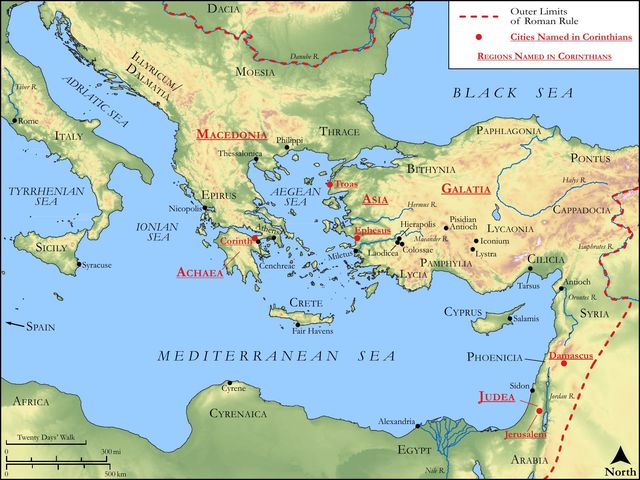
See on the biblical-era maps

Study this verse
Public-domain commentary
Matthew Henry
From his Commentary on the Whole Bible. Henry comments on passages, not single verses — this entry covers 1 Corinthians 1:17–31. His three-level outline is real structure in the source text, so it is rendered as structure.
We have here,
I.The manner in which Paul preached the gospel, and the cross of Christ:
Not with the wisdom of words (Co1 1:17), the enticing words of man's wisdom (Co1 2:4), the flourish of oratory, or the accuracies of philosophical language, upon which the Greeks so much prided themselves, and which seem to have been the peculiar recommendations of some of the heads of the faction in this church that most opposed this apostle. He did not preach the gospel in this manner, lest the cross of Christ should be of no effect, lest the success should be ascribed to the force of art, and not of truth; not to the plain doctrine of a crucified Jesus, but to the powerful oratory of those who spread it, and hereby the honour of the cross be diminished or eclipsed. Paul had been bred up himself in Jewish learning at the feet of Gamaliel, but in preaching the cross of Christ he laid his learning aside. He preached a crucified Jesus in plain language, and told the people that that Jesus who was crucified at Jerusalem was the Son of God and Saviour of men, and that all who would be saved must repent of their sins, and believe in him, and submit to his government and laws. This truth needed no artificial dress; it shone out with the greatest majesty in its own light, and prevailed in the world by its divine authority, and the demonstration of the Spirit, without any human helps. The plain preaching of a crucified Jesus was more powerful than all the oratory and philosophy of the heathen world.
II.We have the different effects of this preaching:
To those who perish it is foolishness, but to those who are saved it is the power of God, Co1 1:18. It is to the Jews a stumbling-block, and to the Greeks foolishness; but unto those who are called, both Jews and Greeks, Christ the power of God and the wisdom of God, Co1 1:23, Co1 1:24.
1.Christ crucified is a stumbling-block to the Jews. They could not get over it. They had a conceit that their expected Messiah was to be a great temporal prince, and therefore would never own one who made so mean an appearance in life, and died so accursed a death, for their deliverer and king. They despised him, and looked upon him as execrable, because he was hanged on a tree, and because he did not gratify them with a sign to their mind, though his divine power shone out in innumerable miracles. The Jews require a sign, Co1 1:22. See Mat 12:38.
2.He was to the Greeks foolishness. They laughed at the story of a crucified Saviour, and despised the apostles' way of telling it. They sought for wisdom. They were men of wit and reading, men that had cultivated arts and sciences, and had, for some ages, been in a manner the very mint of knowledge and learning. There was nothing in the plain doctrine of the cross to suit their taste, nor humour their vanity, nor gratify a curious and wrangling temper: they entertained it therefore with scorn and contempt. What, hope to be saved by one that could not save himself! And trust in one who was condemned and crucified as a malefactor, a man of mean birth and poor condition in life, and cut off by so vile and opprobrious a death! This was what the pride of human reason and learning could not relish. The Greeks thought it little better than stupidity to receive such a doctrine, and pay this high regard to such a person: and thus were they justly left to perish in their pride and obstinacy. Note, It is just with God to leave those to themselves who pour such proud contempt on divine wisdom and grace.
3.To those who are called and saved he is the wisdom of God, and the power of God. Those who are called and sanctified, who receive the gospel, and are enlightened by the Spirit of God, discern more glorious discoveries of God's wisdom and power in the doctrine of Christ crucified than in all his other works. Note, Those who are saved are reconciled to the doctrine of the cross, and led into an experimental acquaintance with the mysteries of Christ crucified.
III.We have here the triumphs of the cross over human wisdom, according to the ancient prophecy (Isa 29:14):
I will destroy the wisdom of the wise, and bring to nothing the understanding of the prudent. Where is the wise? Where is the scribe? Where is the disputer of this world? Hath not God made foolish the wisdom of this world? Co1 1:19, Co1 1:20, All the valued learning of this world was confounded, baffled, and eclipsed, by the Christian revelation and the glorious triumphs of the cross. The heathen politicians and philosophers, the Jewish rabbis and doctors, the curious searchers into the secrets of nature, were all posed and put to a nonplus. This scheme lay out of the reach of the deepest statesmen and philosophers, and the greatest pretenders to learning both among the Jews and Greeks. When God would save the world, he took a way by himself; and good reason, for the world by wisdom knew not God, Co1 1:21. All the boasted science of the heathen world did not, could not, effectually bring home the world to God. In spite of all their wisdom, ignorance still prevailed, iniquity still abounded. Men were puffed up by their imaginary knowledge, and rather further alienated from God; and therefore it pleased him, by the foolishness of preaching, to save those that believe. By the foolishness of preaching - not such in truth, but in vulgar reckoning.
1.The thing preached was foolishness in the eyes of worldly-wise men. Our living through one who died, our being blessed by one who was made a curse, our being justified by one who was himself condemned, was all folly and inconsistency to men blinded with self-conceit and wedded to their own prejudices and the boasted discoveries of their reason and philosophy.
2.The manner of preaching the gospel was foolishness to them too. None of the famous men for wisdom or eloquence were employed to plant the church or propagate the gospel. A few fishermen were called out, and sent upon this errand. These were commissioned to disciple the nations: these vessels chosen to convey the treasure of saving knowledge to the world. There was nothing in them that at first view looked grand or august enough to come from God; and the proud pretenders to learning and wisdom despised the doctrine for the sake of those who dispensed it. And yet the foolishness of God is wiser than men, Co1 1:25. Those methods of divine conduct that vain men are apt to censure as unwise and weak have more true, solid, and successful wisdom in them, than all the learning and wisdom that are among men: "You see your calling, brethren, how that not many wise men after the flesh, not many mighty, not many noble, are called, Co1 1:26, etc. You see the state of Christianity; not many men of learning, or authority, or honourable extraction, are called." There is a great deal of meanness and weakness in the outward appearance of our religion. For,
(1.)Few of distinguished character in any of these respects were chosen for the work of the ministry. God did not choose philosophers, nor orators, nor statesmen, nor men of wealth and power and interest in the world, to publish the gospel of grace and peace. Not the wise men after the flesh, though men would apt to think that a reputation for wisdom and learning might have contributed much to the success of the gospel. Not the mighty and noble, however men might be apt to imagine that secular pomp and power would make way for its reception in the world. But God seeth not as man seeth. He hath chosen the foolish things of the world, the weak things of the world, the base and despicable things of the world, men of mean birth, of low rank, of no liberal education, to be the preachers of the gospel and planters of the church. His thoughts are not as our thoughts, nor his ways as our ways. He is a better judge than we what instruments and measures will best serve the purposes of his glory.
(2.)Few of distinguished rank and character were called to be Christians. As the teachers were poor and mean, so generally were the converts. Few of the wise, and mighty, and noble, embraced the doctrine of the cross. The first Christians, both among Jews and Greeks, were weak, and foolish, and base; men of mean furniture as to their mental improvements, and very mean rank and condition as to their outward estate; and yet what glorious discoveries are there of divine wisdom in the whole scheme of the gospel, and in this particular circumstance of its success!
IV.We have an account how admirably all is fitted, 1.
To beat down the pride and vanity of men. God hath chosen the foolish things of the world to confound the wise - men of no learning to confound the most learned; the weak things of the world to confound the might - men of mean rank and circumstances to confound and prevail against all the power and authority of earthly kings; and base things, and things which are despised - things which men have in the lowest esteem, or in the utmost contempt, to pour contempt and disgrace on all they value and have in veneration; and things which are not, to bring to nought (to abolish) things that are - the conversion of the Gentiles (of whom the Jews had the most contemptuous and vilifying thoughts) was to open a way to the abolishing of that constitution of which they were so fond, and upon which they valued themselves so much as for the sake of it to despise the rest of the world. It is common for the Jews to speak of the Gentiles under this character, as things that are not. Thus, in the apocryphal book of Esther, she is brought in praying that God would not give his sceptre to those who are not, Esth. 14:11. Esdras, in one of the apocryphal books under his name, speaks to God of the heathen as those who are reputed as nothing, 2 Esdras 6:56, 57. And the apostle Paul seems to have this common language of the Jews in his view when he calls Abraham the father of us all before him whom he believed, God, who calleth those things that are not as though they were, Rom 4:17. The gospel is fitted to bring down the pride of both Jews and Greeks, to shame the boasted science and learning of the Greeks, and to take down that constitution on which the Jews valued themselves and despised all the world besides, that no flesh should glory in his presence (Co1 1:29), that there might be no pretence for boasting. Divine wisdom alone had the contrivance of the method of redemption; divine grace alone revealed it, and made it known. It lay, in both respects, out of human reach. And the doctrine and discovery prevailed, in spite of all the opposition it met with from human art or authority: so effectually did God veil the glory and disgrace the pride of man in all. The gospel dispensation is a contrivance to humble man. But, 2. It is as admirably fitted to glorify God. There is a great deal of power and glory in the substance and life of Christianity. Though the ministers were poor and unlearned, and the converts generally of the meanest rank, yet the hand of the Lord went along with the preachers, and was mighty in the hearts of the hearers; and Jesus Christ was made both to ministers and Christians what was truly great and honourable. All we have we have from God as the fountain, and in and through Christ as the channel of conveyance. He is made of God to us wisdom, righteousness, sanctification, and redemption (Co1 1:30): all we need, or can desire. We are foolishness, ignorant and blind in the things of God, with all our boasted knowledge; and he is made wisdom to us. We are guilty, obnoxious to justice; and he is made righteousness, our great atonement and sacrifice. We are depraved and corrupt; and he is made sanctification, the spring of our spiritual life; from him, the head, it is communicated to all the members of his mystical body by his Holy Spirit. We are in bonds, and he is made redemption to us, our Saviour and deliverer. Observe, Where Christ is made righteousness to any soul, he is also made sanctification. He never discharges from the guilt of sin, without delivering from the power of it; and he is made righteousness and sanctification, that he may in the end be made complete redemption, may free the soul from the very being of sin, and loose the body from the bonds of the grave: and what is designed in all is that all flesh may glory in the Lord, Co1 1:31. Observe, It is the will of God that all our glorifying should be in the Lord: and, our salvation being only through Christ, it is thereby effectually provided that it should be so. Man is humbled, and God glorified and exalted, by the whole scheme.
Historical interpretation
Two Centuries of Reception
6 surviving comments on this verse. Each one is dated, so this reads as a timeline rather than a list.
Select a marker to jump to its quote. Markers stagger vertically where authors wrote within a few decades of each other.
And of such it is said, "I will destroy the wisdom of the wise: I will bring to nothing the understanding of the prudent." The apostle accordingly adds, "Where is the wise? Where is the scribe? Where is the disputer of this world?" setting in contradistinction to the scribes, the disputers of this world, the philosophers of the Gentiles. "Hath not God made foolish the wisdom of the world?" which is equivalent to, showed it to be foolish, and not true, as they thought.
Now, both the people (of Israel) by their transgression of His laws, and the whole race of mankind by their neglect of natural duty, had both sinned and rebelled against the Creator. Marcion's god, however, could not have been offended, both because he was unknown to everybody, and because he is incapable of being irritated. What grace, therefore, can be had of a god who has not been offended? What peace from one who has never experienced rebellion? "The cross of Christ," he says, "is to them that perish foolishness; but unto such as shall obtain salvation, it is the power of God and the wisdom of God." And then, that we may known from whence this comes, he adds: "For it is written, `I will destroy the wisdom of the wise, and will bring to nothing the understanding of the prudent.' "
But how remote is our (Catholic) verity from the artifices of this heretic, when it dreads to arouse the anger of God, and firmly believes that He produced all things out of nothing, and promises to us a restoration from the grave of the same flesh (that died) and holds without a blush that Christ was born of the virgin's womb! At this, philosophers, and heretics, and the very heathen, laugh and jeer. For "God hath chosen the foolish things of the world to confound the wise" -that God, no doubt, who in reference to this very dispensation of His threatened long before that He would "destroy the wisdom of the wise."
By doing this, God shows that actions speak louder than words. Commentary on Paul’s Epistles.
"For it is written, I will destroy the wisdom of the wise, and the prudence of the prudent will I reject." Nothing from himself which might give offence, does he advance up to this point; but first he comes to the testimony of the Scripture, and then furnished with boldness from thence, adopts more vehement words.
Paul speaks about the wisdom of this world and not merely the eloquence, for God has given it also. It was God who divided the languages and gave each one its own character. It was he who gave the Greek language its splendor. But those who abuse these gifts have prepared food for deception and have preached false tales. What Paul objects to is not their eloquence as such but the false teaching which lies behind it.
Continue studying 1 Corinthians 1:19 across the web’s major study libraries — every link below opens this exact verse, chapter, or book on the destination site.
Read & Compare
 BibleGatewayThis verse in more than 200 translations and 70 languages.
 Bible.comThe YouVersion reader — hundreds of translations, reading plans, and highlights.
 ESV.orgCrossway's official English Standard Version reader.
 NET BibleThe NET translation with 60,000+ translators' notes on every rendering decision.
 STEP BibleTyndale House's free study tool — original text, vocabulary, and scholarly resources.
 BibliaLogos Bible Software's free web reader.
 USCCBThe New American Bible (Revised Edition) with the U.S. bishops' study notes.
Commentaries
 BibleHub CommentariesDozens of classic commentaries on this verse, gathered on one page.
 StudyLightMore than 100 commentary sets — the largest collection on the web.
 BibleRefPlain-English commentary on what this verse means, verse by verse.
 Enduring WordDavid Guzik's free commentary on this chapter, widely used by Bible teachers.
 Bible Study ToolsVerse commentary alongside Greek and Hebrew study aids.
Original Language & Research
- BibleHub InterlinearThe verse word by word — original language, transliteration, and English.
- BibleHub LexiconEvery word's original-language definition and Strong's entry.
 Blue Letter BibleDeep-study tools — Strong's numbers, concordance, and word studies.
 CNTR CollationThe earliest Greek manuscripts of this verse, collated letter by letter.
Sermons, Hymns & Audio


TrulyRandomVerse is not affiliated with these sites and doesn’t control their content. They’re linked because they’re genuinely useful.
Summary
In 1 Corinthians 1:19, the Apostle Paul quotes from the prophet Isaiah to underscore a profound theological truth: God's divine wisdom operates on principles fundamentally distinct from and infinitely superior to human understanding. This verse serves as a pivotal declaration in Paul's broader argument challenging the Corinthian church's over-reliance on worldly eloquence, philosophical acumen, and human-centric wisdom, asserting that God actively nullifies such wisdom when it stands in opposition to His revealed truth, particularly the message of the cross.
Context
ShowHideLiterary Context
Paul's letter to the Corinthians addresses significant divisions and spiritual immaturity within the church. Immediately preceding this verse, in 1 Corinthians 1:18, Paul introduces the "message of the cross" as foolishness to those perishing but the power of God to those being saved. Verse 19, a direct quotation from Isaiah 29:14, provides Old Testament prophetic backing for his assertion that God deliberately confounds and dismantles human wisdom. This sets the stage for Paul's extended discourse in chapters 1 and 2, where he systematically contrasts worldly wisdom with God's wisdom, culminating in the declaration that Christ Himself is the wisdom of God (1 Corinthians 1:24).
Historical & Cultural Context
The city of Corinth was a prominent Roman colony, a bustling commercial hub known for its wealth, diverse population, and a strong emphasis on rhetoric, philosophy, and intellectual prowess, particularly Greek philosophical traditions. Public speaking and eloquent argumentation were highly valued, often leading to social status and influence. Within the Corinthian church, this cultural backdrop contributed to factions forming around admired leaders who possessed oratorical skills or intellectual sophistication (e.g., Paul, Apollos, Cephas). Paul's argument directly confronts this cultural veneration of human wisdom, asserting that God's plan of salvation, centered on a crucified Messiah, was a stumbling block to Jews and foolishness to Gentiles precisely because it defied their established intellectual and religious frameworks.
Key Themes
ShowHideThis verse powerfully contributes to several overarching themes in 1 Corinthians. It highlights the stark contrast between Divine and Human Wisdom, demonstrating that God's ways are not merely different but actively oppose and nullify human intellectual pride. It underscores God's Sovereignty, asserting His ultimate power to dismantle and render ineffective the intellectual schemes and self-assuredness of humanity. Furthermore, it reinforces the theme of The Offense and Power of the Cross, as the message of a crucified Messiah was the ultimate challenge to both Jewish religious expectations and Greek philosophical wisdom, thereby proving that God's "foolishness" is wiser than human wisdom and God's "weakness" is stronger than human strength, as articulated in 1 Corinthians 1:25.
Exposition and Analysis
ShowHideKey Word Analysis
ShowHideMeaning "to destroy fully (reflexively, to perish, or lose), literally or figuratively." In this context, it signifies God's decisive act of rendering human wisdom utterly ineffective, bringing it to ruin or causing it to fail in its perceived purpose. It's not merely a weakening but a complete nullification.
Meaning "wisdom (higher or lower, worldly or spiritual)." Here, it refers specifically to human wisdom, particularly the intellectual and philosophical systems of the world that presume to understand truth apart from or in opposition to God's revelation. Paul consistently uses this term in 1 Corinthians to distinguish between worldly intellectualism and the spiritual understanding that comes from God.
Meaning "to set aside, i.e. (by implication) to disesteem, neutralize or violate." This word reinforces "destroy," emphasizing God's active role in making human understanding of no effect, rendering it void or invalid. It implies a deliberate act of rejection or annulment by God.
Verse Breakdown
ShowHide"For it is written,"
This introductory phrase signals that Paul is quoting from Scripture, specifically Isaiah 29:14. By grounding his argument in the Old Testament, Paul emphasizes that God's pattern of subverting human wisdom is not a new concept but a consistent theme throughout salvation history, lending divine authority to his message.
"I will destroy the wisdom of the wise,"
This clause declares God's sovereign intent and power to dismantle and render ineffective the intellectual constructs and perceived insights of those considered "wise" by worldly standards. The "wisdom" here refers to human intellectual achievements, philosophical systems, and self-derived knowledge that often lead to pride and a rejection of divine revelation. God's action is not a mere critique but an active, decisive destruction of its efficacy and authority.
"and will bring to nothing the understanding of the prudent."
This parallel clause reinforces the first, using synonymous terms to emphasize the comprehensive nature of God's action. "Understanding" (G4907, sýnesis') refers to mental comprehension or intelligence, while "prudent" (G4908, synetós') describes those who possess such sagacity. God's promise is to nullify, invalidate, and make utterly useless the intellectual discernment and shrewdness of those who rely on their own capabilities rather than on Him. This highlights God's absolute supremacy over all human intellectual endeavors.
Literary Devices
ShowHideThe primary literary device employed here is Quotation/Allusion, as Paul directly quotes from Isaiah 29:14 (likely from the Septuagint, the Greek Old Testament). This serves to establish the theological continuity between the Old Testament prophetic tradition and the New Testament message, demonstrating that God's pattern of confounding human wisdom is an enduring principle. There is also clear Contrast/Antithesis between God's action ("I will destroy," "will bring to nothing") and human attributes ("wisdom of the wise," "understanding of the prudent"), highlighting the fundamental opposition and power differential between divine and human intellect. Furthermore, the phrasing carries a degree of Hyperbole, emphasizing the completeness of God's nullification of human wisdom, signifying that it will be utterly ineffective and powerless in the face of God's plan.
Theological and Thematic Connections
ShowHide1 Corinthians 1:19 articulates a foundational theological truth: God's wisdom is not merely superior to human wisdom but actively works to expose and dismantle it when it becomes a barrier to His truth. This principle underscores the necessity of humility in approaching divine revelation, recognizing that true understanding originates from God, not from human intellectual prowess or philosophical systems. The message of the cross, seemingly foolish by worldly standards, is precisely God's chosen means to demonstrate this truth, revealing His power and wisdom in a way that confounds the self-assuredness of humanity. This divine strategy ensures that no human can boast before God, and that salvation is entirely a work of His grace and power, not dependent on human cleverness or achievement.
Reflection and Application
ShowHideThis verse serves as a profound call to humility for every believer. In a world that often elevates intellectual achievement, academic credentials, and sophisticated arguments, 1 Corinthians 1:19 reminds us that true spiritual insight and the path to salvation are not found through human ingenuity or worldly philosophies. Our faith should not rest on the persuasive words of human wisdom, but on the power of God (1 Corinthians 2:5). This does not devalue learning or critical thinking, but rather reorients them, placing them under the authority of God's revealed truth. It encourages us to discern carefully between what the world deems wise and what God declares to be true, embracing the "foolishness" of the gospel as the ultimate wisdom. Ultimately, it calls us to a posture of dependence on God, trusting that His ways, though often counter-intuitive to human reason, are always perfect and ultimately triumphant.
Questions for Reflection
ShowHideFAQ
ShowHideDoes God condemn all human knowledge or intellect?
ShowHideNo, God does not condemn all human knowledge or intellect. The Bible consistently values wisdom and understanding (e.g., Proverbs 2:6, James 1:5). However, 1 Corinthians 1:19, in context, condemns human wisdom that is self-sufficient, proud, or actively opposes God's truth, particularly the message of salvation through Christ. It targets the intellectual arrogance that believes it can understand God or achieve salvation apart from divine revelation. God's desire is for our intellect to be submitted to Him, used for His glory, and illuminated by His Spirit.
What is "worldly wisdom" that God destroys?
ShowHide"Worldly wisdom" (or "wisdom of the wise" and "understanding of the prudent" in this verse) refers to human intellectual systems, philosophical constructs, and cultural values that operate independently of or in opposition to God's revealed truth. It is wisdom that relies solely on human reason, empirical observation, or cultural consensus, often leading to pride, self-reliance, and a rejection of the seemingly simple or paradoxical truths of the gospel. Examples include philosophical systems that deny the existence of God, moral frameworks that reject divine law, or any intellectual pursuit that elevates human thought above divine revelation, as seen in Romans 1:21-22.
Christ-Centered Fulfillment
ShowHide1 Corinthians 1:19 finds its ultimate and most profound fulfillment in the person and work of Jesus Christ. The "wisdom of the wise" and the "understanding of the prudent" were utterly confounded by the advent of a Messiah who came not as a conquering king or a philosophical guru, but as a humble servant, crucified on a cross. This message of a crucified Savior, which was a "stumbling block to Jews and foolishness to Gentiles" (1 Corinthians 1:23), was precisely God's chosen method to demonstrate His supreme wisdom and power. Christ Himself is declared to be "the power of God and the wisdom of God" (1 Corinthians 1:24), embodying the divine wisdom that surpasses all human intellect. In Him "are hidden all the treasures of wisdom and knowledge" (Colossians 2:3). Therefore, God's promise to destroy human wisdom is fulfilled as the world's intellectual systems are exposed as inadequate and futile in comparison to the profound, saving wisdom revealed in Christ's cross and resurrection, which offers true life and understanding that no human philosophy could ever conceive.