


1 Corinthians 1:22
Bible text: King James Version (1769 Blayney text) · Public domain
Bible text: Berean Standard Bible · Public domain
Bible text: American Standard Version (1901) · Public domain
Bible text: World English Bible, Messianic edition · Public domain
Bible text: Geneva Bible (1599) · Public domain
Bible text: Young's Literal Translation · Public domain
- ἐπειδὴepeidēSeeing thatG1894CONJConjunction
- καὶkaibothG2532CONJConjunction
- ἸουδαῖοιIoudaioiJewsG2453N-NPM-PGNoun Nominative Plural Masculine Person Gentilic
- σημεῖαsēmeiasignsG4592N-APNNoun Accusative Plural Neuter
- αἰτοῦσινaitousinask forG154V-PAI-3PVerb Present Active Indicative 3rd Plural
- καὶkaiandG2532CONJConjunction
- ἝλληνεςHellēnesGreeksG1672N-NPM-LGNoun Nominative Plural Masculine Location Gentilic
- σοφίανsophianwisdomG4678N-ASFNoun Accusative Singular Feminine
- ζητοῦσινzētousinseekG2212V-PAI-3PVerb Present Active Indicative 3rd Plural
English is a literal word-by-word gloss of the Greek, not the KJV's wording. Why?
This is the original text the KJV's translators worked from — each Greek word with its own literal English meaning in this verse, prepared by scholars at Tyndale House, Cambridge. The KJV translates whole sentences, not word by word, so its wording differs: one Greek word can become several English words, and the KJV may choose “charity” where the gloss reads “love”. Both are faithful — they answer different questions. For the KJV's own rendering, switch to the KJV text.
Details
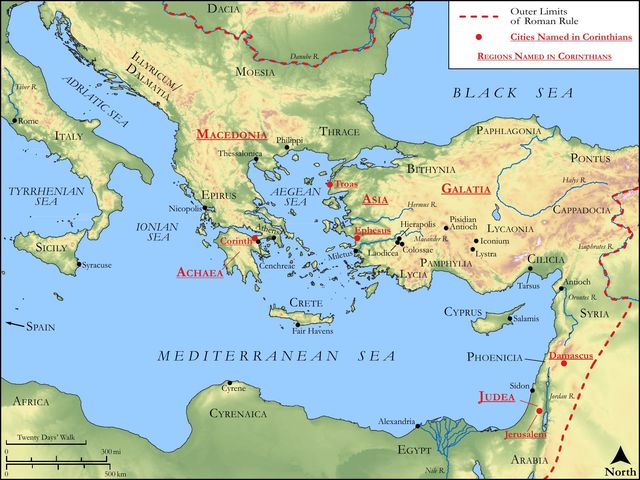
See on the biblical-era maps

Study this verse
Public-domain commentary
Matthew Henry
From his Commentary on the Whole Bible. Henry comments on passages, not single verses — this entry covers 1 Corinthians 1:17–31. His three-level outline is real structure in the source text, so it is rendered as structure.
We have here,
I.The manner in which Paul preached the gospel, and the cross of Christ:
Not with the wisdom of words (Co1 1:17), the enticing words of man's wisdom (Co1 2:4), the flourish of oratory, or the accuracies of philosophical language, upon which the Greeks so much prided themselves, and which seem to have been the peculiar recommendations of some of the heads of the faction in this church that most opposed this apostle. He did not preach the gospel in this manner, lest the cross of Christ should be of no effect, lest the success should be ascribed to the force of art, and not of truth; not to the plain doctrine of a crucified Jesus, but to the powerful oratory of those who spread it, and hereby the honour of the cross be diminished or eclipsed. Paul had been bred up himself in Jewish learning at the feet of Gamaliel, but in preaching the cross of Christ he laid his learning aside. He preached a crucified Jesus in plain language, and told the people that that Jesus who was crucified at Jerusalem was the Son of God and Saviour of men, and that all who would be saved must repent of their sins, and believe in him, and submit to his government and laws. This truth needed no artificial dress; it shone out with the greatest majesty in its own light, and prevailed in the world by its divine authority, and the demonstration of the Spirit, without any human helps. The plain preaching of a crucified Jesus was more powerful than all the oratory and philosophy of the heathen world.
II.We have the different effects of this preaching:
To those who perish it is foolishness, but to those who are saved it is the power of God, Co1 1:18. It is to the Jews a stumbling-block, and to the Greeks foolishness; but unto those who are called, both Jews and Greeks, Christ the power of God and the wisdom of God, Co1 1:23, Co1 1:24.
1.Christ crucified is a stumbling-block to the Jews. They could not get over it. They had a conceit that their expected Messiah was to be a great temporal prince, and therefore would never own one who made so mean an appearance in life, and died so accursed a death, for their deliverer and king. They despised him, and looked upon him as execrable, because he was hanged on a tree, and because he did not gratify them with a sign to their mind, though his divine power shone out in innumerable miracles. The Jews require a sign, Co1 1:22. See Mat 12:38.
2.He was to the Greeks foolishness. They laughed at the story of a crucified Saviour, and despised the apostles' way of telling it. They sought for wisdom. They were men of wit and reading, men that had cultivated arts and sciences, and had, for some ages, been in a manner the very mint of knowledge and learning. There was nothing in the plain doctrine of the cross to suit their taste, nor humour their vanity, nor gratify a curious and wrangling temper: they entertained it therefore with scorn and contempt. What, hope to be saved by one that could not save himself! And trust in one who was condemned and crucified as a malefactor, a man of mean birth and poor condition in life, and cut off by so vile and opprobrious a death! This was what the pride of human reason and learning could not relish. The Greeks thought it little better than stupidity to receive such a doctrine, and pay this high regard to such a person: and thus were they justly left to perish in their pride and obstinacy. Note, It is just with God to leave those to themselves who pour such proud contempt on divine wisdom and grace.
3.To those who are called and saved he is the wisdom of God, and the power of God. Those who are called and sanctified, who receive the gospel, and are enlightened by the Spirit of God, discern more glorious discoveries of God's wisdom and power in the doctrine of Christ crucified than in all his other works. Note, Those who are saved are reconciled to the doctrine of the cross, and led into an experimental acquaintance with the mysteries of Christ crucified.
III.We have here the triumphs of the cross over human wisdom, according to the ancient prophecy (Isa 29:14):
I will destroy the wisdom of the wise, and bring to nothing the understanding of the prudent. Where is the wise? Where is the scribe? Where is the disputer of this world? Hath not God made foolish the wisdom of this world? Co1 1:19, Co1 1:20, All the valued learning of this world was confounded, baffled, and eclipsed, by the Christian revelation and the glorious triumphs of the cross. The heathen politicians and philosophers, the Jewish rabbis and doctors, the curious searchers into the secrets of nature, were all posed and put to a nonplus. This scheme lay out of the reach of the deepest statesmen and philosophers, and the greatest pretenders to learning both among the Jews and Greeks. When God would save the world, he took a way by himself; and good reason, for the world by wisdom knew not God, Co1 1:21. All the boasted science of the heathen world did not, could not, effectually bring home the world to God. In spite of all their wisdom, ignorance still prevailed, iniquity still abounded. Men were puffed up by their imaginary knowledge, and rather further alienated from God; and therefore it pleased him, by the foolishness of preaching, to save those that believe. By the foolishness of preaching - not such in truth, but in vulgar reckoning.
1.The thing preached was foolishness in the eyes of worldly-wise men. Our living through one who died, our being blessed by one who was made a curse, our being justified by one who was himself condemned, was all folly and inconsistency to men blinded with self-conceit and wedded to their own prejudices and the boasted discoveries of their reason and philosophy.
2.The manner of preaching the gospel was foolishness to them too. None of the famous men for wisdom or eloquence were employed to plant the church or propagate the gospel. A few fishermen were called out, and sent upon this errand. These were commissioned to disciple the nations: these vessels chosen to convey the treasure of saving knowledge to the world. There was nothing in them that at first view looked grand or august enough to come from God; and the proud pretenders to learning and wisdom despised the doctrine for the sake of those who dispensed it. And yet the foolishness of God is wiser than men, Co1 1:25. Those methods of divine conduct that vain men are apt to censure as unwise and weak have more true, solid, and successful wisdom in them, than all the learning and wisdom that are among men: "You see your calling, brethren, how that not many wise men after the flesh, not many mighty, not many noble, are called, Co1 1:26, etc. You see the state of Christianity; not many men of learning, or authority, or honourable extraction, are called." There is a great deal of meanness and weakness in the outward appearance of our religion. For,
(1.)Few of distinguished character in any of these respects were chosen for the work of the ministry. God did not choose philosophers, nor orators, nor statesmen, nor men of wealth and power and interest in the world, to publish the gospel of grace and peace. Not the wise men after the flesh, though men would apt to think that a reputation for wisdom and learning might have contributed much to the success of the gospel. Not the mighty and noble, however men might be apt to imagine that secular pomp and power would make way for its reception in the world. But God seeth not as man seeth. He hath chosen the foolish things of the world, the weak things of the world, the base and despicable things of the world, men of mean birth, of low rank, of no liberal education, to be the preachers of the gospel and planters of the church. His thoughts are not as our thoughts, nor his ways as our ways. He is a better judge than we what instruments and measures will best serve the purposes of his glory.
(2.)Few of distinguished rank and character were called to be Christians. As the teachers were poor and mean, so generally were the converts. Few of the wise, and mighty, and noble, embraced the doctrine of the cross. The first Christians, both among Jews and Greeks, were weak, and foolish, and base; men of mean furniture as to their mental improvements, and very mean rank and condition as to their outward estate; and yet what glorious discoveries are there of divine wisdom in the whole scheme of the gospel, and in this particular circumstance of its success!
IV.We have an account how admirably all is fitted, 1.
To beat down the pride and vanity of men. God hath chosen the foolish things of the world to confound the wise - men of no learning to confound the most learned; the weak things of the world to confound the might - men of mean rank and circumstances to confound and prevail against all the power and authority of earthly kings; and base things, and things which are despised - things which men have in the lowest esteem, or in the utmost contempt, to pour contempt and disgrace on all they value and have in veneration; and things which are not, to bring to nought (to abolish) things that are - the conversion of the Gentiles (of whom the Jews had the most contemptuous and vilifying thoughts) was to open a way to the abolishing of that constitution of which they were so fond, and upon which they valued themselves so much as for the sake of it to despise the rest of the world. It is common for the Jews to speak of the Gentiles under this character, as things that are not. Thus, in the apocryphal book of Esther, she is brought in praying that God would not give his sceptre to those who are not, Esth. 14:11. Esdras, in one of the apocryphal books under his name, speaks to God of the heathen as those who are reputed as nothing, 2 Esdras 6:56, 57. And the apostle Paul seems to have this common language of the Jews in his view when he calls Abraham the father of us all before him whom he believed, God, who calleth those things that are not as though they were, Rom 4:17. The gospel is fitted to bring down the pride of both Jews and Greeks, to shame the boasted science and learning of the Greeks, and to take down that constitution on which the Jews valued themselves and despised all the world besides, that no flesh should glory in his presence (Co1 1:29), that there might be no pretence for boasting. Divine wisdom alone had the contrivance of the method of redemption; divine grace alone revealed it, and made it known. It lay, in both respects, out of human reach. And the doctrine and discovery prevailed, in spite of all the opposition it met with from human art or authority: so effectually did God veil the glory and disgrace the pride of man in all. The gospel dispensation is a contrivance to humble man. But, 2. It is as admirably fitted to glorify God. There is a great deal of power and glory in the substance and life of Christianity. Though the ministers were poor and unlearned, and the converts generally of the meanest rank, yet the hand of the Lord went along with the preachers, and was mighty in the hearts of the hearers; and Jesus Christ was made both to ministers and Christians what was truly great and honourable. All we have we have from God as the fountain, and in and through Christ as the channel of conveyance. He is made of God to us wisdom, righteousness, sanctification, and redemption (Co1 1:30): all we need, or can desire. We are foolishness, ignorant and blind in the things of God, with all our boasted knowledge; and he is made wisdom to us. We are guilty, obnoxious to justice; and he is made righteousness, our great atonement and sacrifice. We are depraved and corrupt; and he is made sanctification, the spring of our spiritual life; from him, the head, it is communicated to all the members of his mystical body by his Holy Spirit. We are in bonds, and he is made redemption to us, our Saviour and deliverer. Observe, Where Christ is made righteousness to any soul, he is also made sanctification. He never discharges from the guilt of sin, without delivering from the power of it; and he is made righteousness and sanctification, that he may in the end be made complete redemption, may free the soul from the very being of sin, and loose the body from the bonds of the grave: and what is designed in all is that all flesh may glory in the Lord, Co1 1:31. Observe, It is the will of God that all our glorifying should be in the Lord: and, our salvation being only through Christ, it is thereby effectually provided that it should be so. Man is humbled, and God glorified and exalted, by the whole scheme.
Historical interpretation
Two Centuries of Reception
6 surviving comments on this verse. Each one is dated, so this reads as a timeline rather than a list.
Select a marker to jump to its quote. Markers stagger vertically where authors wrote within a few decades of each other.
Why, then, you will ask, did you think it fit that such an arrangement should be adopted in your memoranda? Because there is great danger in divulging the secret of the true philosophy to those, whose delight it is unsparingly to speak against everything, not justly; and who shout forth all kinds of names and words indecorously, deceiving themselves and beguiling those who adhere to them. "For the Hebrews seek signs "as the apostle says, "and the Greeks seek after wisdom."
Since then the man, not the god, of the world in his wisdom knew not God, whom indeed he ought to have known (both the Jew by his knowledge of the Scriptures, and all the human race by their knowledge of God's works), therefore that God, who was not acknowledged in His wisdom, resolved to smite men's knowledge with His foolishness, by saving all those who believe in the folly of the preached cross. "Because the Jews require signs," who ought to have already made up their minds about God, "and the Greeks seek after wisdom," who rely upon their own wisdom, and not upon God's. If, however, it was a new god that was being preached, what sin had the Jews committed, in seeking after signs to believe; or the Greeks, when they hunted after a wisdom which they would prefer to accept? Thus the very retribution which overtook both Jews and Greeks proves that God is both a jealous God and a Judge, inasmuch as He infatuated the world's wisdom by an angry and a judicial retribution.
"Because the Jews require a sign, and the Creeks seek after wisdom: but we preach Christ crucified, to the Jews indeed a stumbling-block, and to the Gentiles foolishness; but to them that are called, both Jews and Greeks, Christ the power of God and the wisdom of God."
The Jews seek signs because they do not reject the possibility that things like this can happen. What they want to know is whether it has actually occurred, like Aaron’s rod, which sprouted and bore fruit, and Jonah who spent three days and nights in the belly of the whale before being spewed out alive. But the Greeks seek wisdom, refusing to believe anything which does not accord with human reason.
Next, to shew the power of the Cross, he saith, "For Jews ask for signs and Greeks seek after wisdom: but we preach Christ crucified, unto Jews a stumbling-block, and unto Greeks foolishness; but unto them that are called, both Jews and Greeks, Christ the Power of God, and the Wisdom of God."
Vast is the import of the things here spoken! For he means to say how by contraries God hath overcome, and how the Gospel is not of man. What he saith is something of this sort. When, saith he, we say unto the Jews, Believe; they answer, Raise the dead, Heal the demoniacs, Shew unto us signs. But instead thereof what say we? That He was crucified, and died, who is preached. And this is enough, not only to fail in drawing over the unwilling, but even to drive away those even who are willing. Nevertheless, it drives not away, but attracts and holds fast and overcomes. Again; the Greeks demand of us a rhetorical style, and the acuteness of sophistry. But preach we to these also the Cross, and that which in the case of the Jews seems weakness, this in the case of the Greeks is foolishness. Wherefore, when we not only fail in producing what they demand, but also produce the very opposites of their demand; (for the Cross has not merely no appearance of being a sign sought out by reasoning, but even the very annihilation of a sign;-is not merely deemed no proof of power, but a conviction of weakness;-not merely no display of wisdom, but a suggestion of foolishness;)-when therefore they who seek for signs and wisdom not only receive not the things which they ask, but even hear the contrary to what they desire, and then by means of contraries are persuaded;-how is not the power of Him that is preached unspeakable? As if to some one tempest-tost and longing for a haven, you were to shew not a haven but another wilder portion of the sea, and so could make him follow with thankfulness? Or as if a physician could attract to himself the man that was wounded and in need of remedies, by promising to cure him not with drugs, but with burning of him again! For this is a result of great power indeed. So also the Apostles prevailed, not simply without a sign, but even by a thing which seemed contrary to all the known signs. Which thing also Christ did in the case of the blind man. For when He would heal him, He took away the blindness by a thing that increased it: i.e. He put on clay. As then by means of clay He healed the blind man, so also by means of the Cross He brought the world to Himself. That certainly was adding an offence, not taking an offence away. So did He also in creation, working out things by their contraries. With sand, for instance, He walled in the sea, having made the weak a bridle to the strong. He placed the earth upon water, having taken order that the heavy and the dense should be borne on the soft and fluid. By means of the prophets again with a small piece of wood He raised up iron from the bottom. In like manner also with the Cross He hath drawn the world to Himself. For as the water beareth up the earth, so also the Cross beareth up the world. You see now, it is proof of great power and wisdom, to convince by means of the things which tell directly against us. Thus the Cross seems to be matter of offence; and yet far from offending, it even attracts.
The Jews want signs, because that is what the prophets gave them, but even then they do not believe. The Greeks, on the other hand, want clever academic arguments.
Continue studying 1 Corinthians 1:22 across the web’s major study libraries — every link below opens this exact verse, chapter, or book on the destination site.
Read & Compare
 BibleGatewayThis verse in more than 200 translations and 70 languages.
 Bible.comThe YouVersion reader — hundreds of translations, reading plans, and highlights.
 ESV.orgCrossway's official English Standard Version reader.
 NET BibleThe NET translation with 60,000+ translators' notes on every rendering decision.
 STEP BibleTyndale House's free study tool — original text, vocabulary, and scholarly resources.
 BibliaLogos Bible Software's free web reader.
 USCCBThe New American Bible (Revised Edition) with the U.S. bishops' study notes.
Commentaries
 BibleHub CommentariesDozens of classic commentaries on this verse, gathered on one page.
 StudyLightMore than 100 commentary sets — the largest collection on the web.
 BibleRefPlain-English commentary on what this verse means, verse by verse.
 Enduring WordDavid Guzik's free commentary on this chapter, widely used by Bible teachers.
 Bible Study ToolsVerse commentary alongside Greek and Hebrew study aids.
Original Language & Research
- BibleHub InterlinearThe verse word by word — original language, transliteration, and English.
- BibleHub LexiconEvery word's original-language definition and Strong's entry.
 Blue Letter BibleDeep-study tools — Strong's numbers, concordance, and word studies.
 CNTR CollationThe earliest Greek manuscripts of this verse, collated letter by letter.
Sermons, Hymns & Audio


TrulyRandomVerse is not affiliated with these sites and doesn’t control their content. They’re linked because they’re genuinely useful.
Summary
1 Corinthians 1:22 succinctly captures the distinct expectations and cultural leanings of the Jews and the Greeks, laying the groundwork for Paul's radical assertion about the nature and method of God's salvation. It highlights how the Jewish demand for miraculous authentication and the Greek pursuit of intellectual sophistication created inherent obstacles to their acceptance of the Gospel message, particularly the "foolishness" of a crucified Messiah.
Context
ShowHideLiterary Context
This verse is deeply embedded within Paul's opening argument in 1 Corinthians 1, where he confronts the Corinthian church's divisions and their overemphasis on human wisdom, eloquence, and charismatic leaders. Paul has just declared that the message of the cross is "foolishness to those who are perishing, but to us who are being saved it is the power of God" (1 Corinthians 1:18). Verse 22 serves as an explanation for why the cross was perceived as foolish or a stumbling block by different audiences, setting the stage for Paul's subsequent declaration in 1 Corinthians 1:23-24 that Christ crucified is both a "stumbling block to Jews and foolishness to Gentiles, but to those who are called, both Jews and Greeks, Christ the power of God and the wisdom of God."
Historical & Cultural Context
The city of Corinth was a bustling, cosmopolitan hub, strategically located with a diverse population. It was known for its wealth, its moral laxity, and its vibrant intellectual and philosophical scene, particularly influenced by Greek thought. Public discourse and rhetorical skill were highly valued. Within this context, the "Greeks" represent the broader Gentile world, heavily influenced by Hellenistic philosophy that prized logic, eloquent argumentation, and abstract wisdom. Conversely, the "Jews" represent those steeped in the Old Testament tradition, accustomed to God's intervention through powerful signs and wonders, from the Exodus plagues to the miracles of the prophets. They anticipated a Messiah who would come with undeniable displays of divine power, not one who would suffer a humiliating death on a cross.
Key Themes
ShowHideThis verse powerfully contributes to several key themes in 1 Corinthians and Pauline theology. It underscores the contrasting expectations of humanity versus God's methods, highlighting how human criteria for truth and power often diverge sharply from divine revelation. It also introduces the theme of the Gospel's challenge to human pride, demonstrating that God deliberately chose a way of salvation that subverts human intellectual and spiritual arrogance. The cross, far from being a sign of weakness or foolishness, is presented as the ultimate revelation of God's counter-intuitive wisdom and power, which often operates through what appears humble or weak to the world, as seen in 1 Corinthians 1:21.
Exposition and Analysis
ShowHideKey Word Analysis
ShowHideOf uncertain derivation; to ask (in genitive case); to beg, call for, crave, desire, or demand. This term indicates a strong expectation or prerequisite, suggesting that the Jews were not merely open to signs but actively sought and demanded them as validation for divine claims, reflecting a deep-seated cultural and historical expectation for miraculous proof of God's activity.
Neuter of a presumed derivative of the base of σημαίνω; an indication, especially one that is ceremonially or supernaturally significant, often referring to a miracle, wonder, or token that authenticates a divine message or messenger. For the Jews, signs were crucial for discerning true prophets from false ones and for confirming the Messiah's identity.
From Ἑλλάς; a Hellen (Grecian) or inhabitant of Hellas; by extension a Greek-speaking person, especially a non-Jew. In this context, "Greeks" represents the Gentile world, particularly those influenced by Hellenistic culture and philosophy, which valued intellectual discourse, logical reasoning, and philosophical insight above all else.
Of uncertain affinity; to seek (literally or figuratively); specially, (by Hebraism) to worship (God), or (in a bad sense) to plot (against life). Here, it implies an earnest pursuit, a diligent investigation, or a philosophical quest for understanding and truth through intellectual means.
From σοφός; wisdom (higher or lower, worldly or spiritual). In the Greek context, this refers to philosophical knowledge, intellectual prowess, skilled rhetoric, and profound insight, which was the ultimate goal of their intellectual endeavors.
Verse Breakdown
ShowHide"For the Jews require a sign,"
This clause identifies the primary expectation of the Jewish people. Rooted in their history of divine intervention, from the Exodus to the prophetic ministries, Jews consistently looked for miraculous demonstrations of God's power and authentication of His messengers. They expected a Messiah who would perform grand signs to confirm His identity and usher in His kingdom, making the crucified Messiah a profound contradiction to their understanding of divine power and glory.
"and the Greeks seek after wisdom:"
This clause highlights the contrasting, yet equally demanding, expectation of the Hellenistic world. Greeks, particularly those in a city like Corinth, were deeply immersed in philosophical traditions that prioritized intellectual inquiry, logical argumentation, and eloquent rhetoric. They sought truth through human reason and philosophical discourse, finding the message of a crucified God utterly irrational and "foolish" by their intellectual standards.
Literary Devices
ShowHide1 Corinthians 1:22 masterfully employs Parallelism and Antithesis to underscore the divergent worldviews it describes. The two clauses are structurally parallel ("the Jews require a sign" / "the Greeks seek after wisdom"), creating a balanced yet contrasting presentation. This Antithesis is central, highlighting the fundamental difference in what each group values and seeks as evidence for truth: one demands supernatural verification, the other intellectual validation. This stark contrast sets the stage for Paul's argument that the Gospel, particularly the "word of the cross," intentionally defies both sets of human expectations, revealing a divine wisdom that transcends and even confounds human wisdom and power.
Theological and Thematic Connections
ShowHideThis verse is pivotal in understanding the universal challenge of the Gospel. It illustrates how human expectations, whether rooted in religious tradition or philosophical reasoning, can become barriers to embracing God's counter-intuitive plan of salvation. The Jewish demand for signs reflects a desire for external validation and power displays, reminiscent of their ancestors who constantly tested God (Exodus 17:7). The Greek pursuit of wisdom, while seemingly noble, often led to intellectual arrogance, where human reason became the ultimate arbiter of truth, as Paul notes elsewhere that "professing to be wise, they became fools" (Romans 1:22). The Gospel, centered on a crucified Messiah, intentionally subverts these expectations, revealing a God whose power is perfected in weakness and whose wisdom is revealed in what the world deems foolish.
Reflection and Application
ShowHide1 Corinthians 1:22 remains profoundly relevant in contemporary society, as people continue to approach faith with preconceived notions and demands. Some still seek sensational experiences, miraculous interventions, or tangible "signs" as prerequisites for belief, while others insist on intellectual satisfaction, logical consistency, and philosophical alignment with their existing worldviews before they will consider the claims of Christ. Paul's message challenges us to recognize that God's ways often transcend and even defy human expectations. True faith in Christ frequently calls us to move beyond what our intellect can fully grasp or what our senses can immediately verify. It reminds us that the power of God is not always revealed in what is grand or intellectually appealing to the world, but often in what seems humble, weak, or even foolish from a human perspective. The core message of Christ crucified and risen remains the central truth, powerful enough to transform lives, regardless of whether it meets human demands for signs or wisdom.
Questions for Reflection
ShowHideFAQ
ShowHideWhy did Jews "require a sign" and Greeks "seek after wisdom"?
ShowHideThe Jewish people, throughout their history recorded in the Old Testament, had experienced God's intervention through powerful miraculous "signs" (e.g., the plagues in Egypt, the parting of the Red Sea, manna from heaven). They expected their Messiah to come with similar, undeniable displays of divine power to authenticate His claims and establish His kingdom. For them, a crucified Messiah was a "stumbling block" (1 Corinthians 1:23) because it contradicted their understanding of a powerful, conquering deliverer. The Greeks, on the other hand, lived in a culture deeply influenced by philosophy and intellectual discourse, particularly prominent in a city like Corinth. They valued logical reasoning, eloquent argumentation, and profound intellectual "wisdom" above all else. The idea of salvation through a humble, crucified figure seemed utterly irrational and "foolishness" (1 Corinthians 1:23) to their philosophical minds, lacking the intellectual sophistication they sought.
Christ-Centered Fulfillment
ShowHideWhile Jews demanded a sign and Greeks sought wisdom, the Gospel presents Christ Himself as the ultimate fulfillment that transcends both expectations. Jesus did perform many "signs" during His earthly ministry, but He often rebuked those who sought them merely for spectacle, pointing instead to the "sign of Jonah" – His death and resurrection (Matthew 12:39-40). The cross, though a "stumbling block" to Jews and "foolishness" to Gentiles, is precisely where God's true power and wisdom are most profoundly revealed. In Christ, "are hidden all the treasures of wisdom and knowledge" (Colossians 2:3). He is not merely a dispenser of wisdom or a performer of signs; He is the very "power of God and the wisdom of God" (1 Corinthians 1:24). Through His crucifixion, God demonstrated a wisdom that confounds human intellect and a power that operates through apparent weakness, ultimately offering salvation that is accessible not through human demands or reasoning, but through faith in the crucified and risen Lord.