


2 Chronicles 30:9
- כִּיkiforH3588PrtParticle Conditional
- בְשׁוּבְכֶםve·shu·ve·Khemwhen return youH7725Prep-b ¦ V-Qal-Inf ¦ 2mpVerb Qal Infinitive Constructבְwhenשׁוּבְreturnכֶםyou
- עַל'altoH5921PrepPreposition
- יְהוָהYah·wehYahwehH3068N-properNoun Proper Title
- אֲחֵיכֶם'a·chei·Khemyour relativesH251N-mpc ¦ 2mpNoun Plural Masculine Constructאֲחֵיrelativesכֶםyour
- וּבְנֵיכֶםu·ve·nei·Khemand your childrenH1121Conj-w ¦ N-mpc ¦ 2mpNoun Plural Masculine Constructוּandבְנֵיchildrenכֶםyour
- לְרַחֲמִיםle·ra·cha·Mimto compassion<s>H7356Prep-l ¦ N-mpNoun Plural Masculine Absoluteלְtoרַחֲמִיםcompassion<s>
- לִפְנֵיlif·Nei<to> beforeH6440Prep-l ¦ N-mpcNoun Plural Masculine Constructלִ<to>פְנֵיbefore
- שׁוֹבֵיהֶםshoei·Hemtheir captorsH7617V-Qal-Prtcpl-mp ¦ 3mpVerb Qal Participle Plural Masculine Constructשׁוֹבֵיcaptorsהֶםtheir
- וְלָשׁוּבve·la·Shuvand to returnH7725Conj-w ¦ Prep-l ¦ V-Qal-InfVerb Qal Infinitive Constructוְandלָtoשׁוּבreturn
- לָאָרֶץla·'A·retzto the landH776Prep-l ¦ N-fsNoun Singular Feminine Absoluteלָto theאָרֶץland
- הַזֹּאתha·Zot<the> thisH2063Art ¦ PrtParticle Demonstrativeהַ<the>זֹּאתthis
- כִּיkiforH3588PrtParticle Conditional
- חַנּוּןcha·Nun[is] graciousH2587Adj-msAdjective Singular Masculine Absolute
- וְרַחוּםve·ra·Chumand compassionateH7349Conj-w ¦ Adj-msAdjective Singular Masculine Absoluteוְandרַחוּםcompassionate
- יְהוָהYah·wehYahwehH3068N-properNoun Proper Title
- אֱלֹהֵיכֶם'e·lo·hei·Khemyour GodH430N-mpc ¦ 2mpNoun Plural Masculine ConstructאֱלֹהֵיGodכֶםyour
- וְלֹאve·lo'and notH3808Conj-w ¦ NegParticle Negativeוְandלֹאnot
- יָסִירya·Sirhe will turn asideH5493V-Hiphil-Imperf-3msVerb Hiphil Imperfect 3rd Singular Masculine
- פָּנִיםpa·NimfaceH6440N-mpNoun Plural Masculine Absolute
- מִכֶּםmi·Kemfrom youPrep-m ¦ 2mpSuffix Personal 2nd Plural Masculineמִfromכֶּםyou
- אִם'imifH518PrtParticle Conditional
- תָּשׁוּבוּta·Shu·vuyou will turn backH7725V-Qal-Imperf-2mpVerb Qal Imperfect 2nd Plural Masculine
- אֵלָיו'e·Lavto himH413Prep ¦ 3msPrepositionאֵלָיtoוhim
English is a literal word-by-word gloss of the Hebrew, not the KJV's wording. Why?
This is the original text the KJV's translators worked from — each Hebrew word with its own literal English meaning in this verse, prepared by scholars at Tyndale House, Cambridge. The KJV translates whole sentences, not word by word, so its wording differs: one Hebrew word can become several English words, and the KJV may choose “the LORD” where the gloss reads “Yahweh”. Both are faithful — they answer different questions. For the KJV's own rendering, switch to the KJV text.
Details
See on the biblical-era map
Study this verse
Public-domain commentary
Matthew Henry
From his Commentary on the Whole Bible. Henry comments on passages, not single verses — this entry covers 2 Chronicles 30:1–12. His four-level outline is real structure in the source text, so it is rendered as structure.
Here is, I. A passover resolved upon. That annual feast was instituted as a memorial of the bringing of the children of Israel out of Egypt. It happened that the reviving of the temple service fell within the appointed days of that feast, the seventeenth day of the first month: this brought that forgotten solemnity to mind. "What shall we do," says Hezekiah, "about the passover? It is a very comfortable ordinance, and has been long neglected. How shall we revive it? The time has elapsed for this year; we cannot go about it immediately; the congregation is thin, the people have not notice, the priests are not prepared, Ch2 30:3. Must we defer it till another year?" Many, it is likely, were for deferring it; but Hezekiah considered that by that time twelve-month the good affections of the people would cool, and it would be too long to want the benefit of the ordinance; and therefore, finding a proviso in the law of Moses that particular persons who were unclean in the first month might keep the passover the fourteenth day of the second month and be accepted (Num 9:11), he doubted not but that it might be extended to the congregation. Whereupon they resolved to keep the passover in the second month. Let the circumstance give way to the substance, and let not the thing itself be lost upon a nicety about the time. It is good striking while the iron is hot, and taking people when they are in a good mind. Delays are dangerous.
II.A proclamation issued out to give notice of this passover and to summon the people to it.
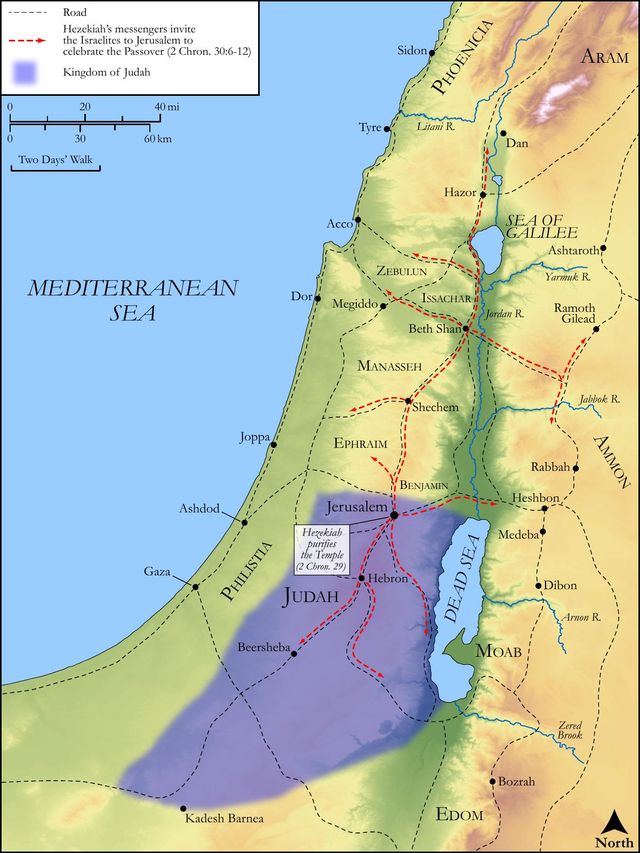
1.An invitation was sent to the ten revolted tribes to stir them up to come and attend this solemnity. Letters were written to Ephraim and Manasseh to invite them to Jerusalem to keep this passover (Ch2 30:1), not with any political design, to bring them back to the house of David, but with a pious design to bring them back to the Lord God of Israel. "Let them take whom they will for their king," says Hezekiah, "so they will but take him for their God." The matters in difference between Judah and Israel, either upon a civil or sacred account, shall not hinder but that if the people of Israel will sincerely return to the Lord their God Hezekiah will bid them as welcome to the passover as any of his own subjects. Expresses are sent post throughout all the tribes of Israel with memorials earnestly pressing the people to take this opportunity of returning to the God from whom they had revolted. Now here we have,
(1.)The contents of the circular letters that were despatched upon the occasion, in which Hezekiah discovers a great concern both for the honour of God and for the welfare of the neighbouring kingdom, the prosperity of which he seems passionately desirous of, though he not only received no toll, tribute, or custom, from it, but it had often, and not long since, been vexatious to his kingdom. This is rendering good for evil. Observe,
[1.]What it is which he presses them to (Ch2 30:8): "Yield yourselves unto the Lord. Before you can come into communion with him you must come into covenant with him." Give the hand to the Lord (so the word is), that is, "Consent to take him for your God." A bargain is confirmed by giving the hand. "Strike this bargain. Join yourselves to him in an everlasting covenant. Subscribe with the hand to be his, Isa 44:5. Give him your hand, in token of giving him your heart. Lay your hand to his plough. Devote yourselves to his service, to work for him. Yield to him," that is, "Come up to his terms, come under his government, stand it not out any longer against him." "Yield to him, to be absolutely and universally at his command, at his disposal, to be, and do, and have, and suffer, whatever he pleases. In order to this, be not stiff-necked as your fathers were; let not your corrupt and wicked wills rise up in resistance of and rebellion against the will of God. Say not that you will do what you please, but resolve to do what he pleases." There is in the carnal mind a stiffness, an obstinacy, an unaptness to comply with God. We have it from our fathers; it is bred in the bone with us. This must be conquered; and the will that had in it a spirit of contradiction must be melted into the will of God; and to his yoke the neck that was an iron sinew must be bowed and fitted. In pursuance of this resignation to God, he presses them to enter into his sanctuary, that is, to attend upon him in that place which he had chosen, to put his name there, and serve him in the ordinances which he had appointed. "The doors of the sanctuary are now opened, and you have liberty to enter; the temple service is now revived, and you are welcome to join in it." The king says, Come; the princes and priests say, Come; whosoever will, let him come. This he calls (Ch2 30:6) turning to the Lord God; for they had forsaken him, and worshipped other gods. Repent now, and be converted. Thus those who through grace have turned to God themselves should do all they can to bring others back to him.
[2.]What arguments he uses to persuade them to do this. First, "You are children of Israel, and therefore stand related, stand obliged, to the God of Israel, from whom you have revolted." Secondly, "The God you are called to return to is the God of Abraham, Isaac, and Jacob, a God in covenant with your first fathers, who served him and yielded themselves to him; and it was their honour and happiness that they did so." Thirdly, "Your late fathers that forsook him and trespassed against him have been given up to desolation; their apostasy and idolatry have been their ruin, as you see (Ch2 30:7); let their harms be your warnings." Fourthly, "You yourselves are but a remnant narrowly escaped out of the hands of the kings of Assyria (Ch2 30:6), and therefore are concerned to put yourselves under the protection of the God of your fathers, that you be not quite swallowed up." Fifthly, "This is the only way of turning away the fierceness of God's anger from you (Ch2 30:8), which will certainly consume you if you continue stiff-necked." Lastly, "If you return to God in a way of duty, he will return to you in a way of mercy." This he begins with (Ch2 30:6) and concludes with, Ch2 30:9. In general, "You will find him gracious and merciful, and one that will not turn away his face from you, if you seek him, notwithstanding the provocations you have given him." Particularly, "You may hope that he will turn again the captivity of your brethren that are carried away, and bring them back to their own land." Could any thing be expressed more pathetically, more movingly? Could there be a better cause, or could it be better pleaded?
(2.)The entertainment which Hezekiah's messengers and message met with. It does not appear that Hoshea, who was now king of Israel, took any umbrage from, or gave any opposition to, the dispersing of these proclamations through his kingdom, nor that he forbade his subjects to accept the invitation. He seems to have left them entirely to their liberty. They might go to Jerusalem to worship if they pleased; for, though he did evil, yet not like the kings of Israel that were before him, Kg2 17:2. He saw ruin coming upon his kingdom, and, if any of his subjects would try this expedient to prevent it, they had his full permission. But, for the people,
[1.]The generality of them slighted the call and turned a deaf ear to it. The messengers went from city to city, some to one and some to another, and used pressing entreaties with the people to come up to Jerusalem to keep the passover; but they were so far from complying with the message that they abused those that brought it, laughed them to scorn, and mocked them (Ch2 30:10), not only refused, but refused with disdain. Tell them of the God of Abraham! they knew him not, they had other gods to serve, Baal and Ashtaroth. Tell them of the sanctuary! their high places were as good. Tell them of God's mercy and wrath! they neither dreaded the one nor desired the other. No marvel that the king's messengers were thus despitefully used by this apostate race when God's messengers were so, his servants the prophets, who produced credentials from him. The destruction of the kingdom of the ten tribes was now at hand. It was but two or three years after this that the king of Assyria laid siege to Samaria, which ended in the captivity of those tribes. Just before this they had not only a king of their own that permitted them to return to God's sanctuary, but a king of Judah that earnestly invited them to do it. Had they generally accepted this invitation, it might have prevented their ruin; but their contempt of it hastened and aggravated it, and left them inexcusable.
[2.]Yet there were some few that accepted the invitation. The message, though to some it was a savour of death unto death, was to others a savour of life unto life, Ch2 30:11. In the worst of times God has had a remnant; so he had here, many of Asher, Manasseh, and Zebulun (here is no mention of any out of Ephraim, though some of that tribe are mentioned, Ch2 30:18), humbled themselves, and came to Jerusalem, that is, were sorry for their sins and submitted to God. Pride keeps men from yielding themselves to the Lord; when that is brought down, the work is done.
2.A command was given to the men of Judah to attend this solemnity; and they universally obeyed it, v. 12. They did it with one heart, were all of a mind in it, and the hand of God gave them that one heart; for it is in the day of power that Christ's subjects are made willing. It is God that works both to will and to do. When people, at any time, manifest an unexpected forwardness to do that which is good, we must acknowledge that hand of God in it.
Continue studying 2 Chronicles 30:9 across the web’s major study libraries — every link below opens this exact verse, chapter, or book on the destination site.
Read & Compare
 BibleGatewayThis verse in more than 200 translations and 70 languages.
 Bible.comThe YouVersion reader — hundreds of translations, reading plans, and highlights.
 ESV.orgCrossway's official English Standard Version reader.
 NET BibleThe NET translation with 60,000+ translators' notes on every rendering decision.
 STEP BibleTyndale House's free study tool — original text, vocabulary, and scholarly resources.
 BibliaLogos Bible Software's free web reader.
 USCCBThe New American Bible (Revised Edition) with the U.S. bishops' study notes.
Commentaries
 BibleHub CommentariesDozens of classic commentaries on this verse, gathered on one page.
 StudyLightMore than 100 commentary sets — the largest collection on the web.
 BibleRefPlain-English commentary on what this verse means, verse by verse.
 Enduring WordDavid Guzik's free commentary on this chapter, widely used by Bible teachers.
 Bible Study ToolsVerse commentary alongside Greek and Hebrew study aids.
Original Language & Research
- BibleHub InterlinearThe verse word by word — original language, transliteration, and English.
- BibleHub LexiconEvery word's original-language definition and Strong's entry.
 Blue Letter BibleDeep-study tools — Strong's numbers, concordance, and word studies.
 SefariaThe Hebrew text with Rashi and centuries of Jewish commentary.
Sermons, Hymns & Audio


TrulyRandomVerse is not affiliated with these sites and doesn’t control their content. They’re linked because they’re genuinely useful.
Summary
2 Chronicles 30:9 encapsulates a powerful divine assurance, delivered through King Hezekiah's messengers, that God's inherent character is one of boundless grace and mercy. This verse serves as a profound motivation for the people of Israel and Judah, particularly those in captivity, to return to the Lord. It promises that a sincere turning back to God will be met with divine compassion, leading to the miraculous restoration of their scattered brethren and children to their homeland, for the Lord will never turn His face away from those who earnestly seek Him.
Context
ShowHideLiterary Context
This verse is strategically placed within King Hezekiah's sweeping reforms, immediately following his restoration of temple worship in 2 Chronicles 29. Hezekiah's next bold move was to invite all Israel, from Dan to Beersheba, to Jerusalem for a nationwide Passover celebration, an event that had been neglected for centuries (2 Chronicles 30:1-5). The verse itself is part of the urgent plea carried by Hezekiah's messengers to the remnants of the Northern Kingdom, recorded in 2 Chronicles 30:6-9. It functions as the theological bedrock of the invitation, providing the compelling reason for the people to overcome their spiritual apathy and historical divisions. The promise of God's compassion and the return of captives directly addresses their most pressing fears and hopes, making the call to repentance tangible and deeply personal.
Historical & Cultural Context
King Hezekiah ruled Judah in the late 8th century BC, a period dominated by the formidable Assyrian Empire. Decades earlier, in 722 BC, the Northern Kingdom of Israel had fallen to Assyria, resulting in the brutal deportation and scattering of its population across the Assyrian Empire (2 Kings 17:6). Many Israelites were living as captives, while those who remained in the land were often spiritually compromised, having adopted pagan practices. Judah, too, had suffered under the idolatrous reign of Hezekiah's father, Ahaz, bringing the nation to spiritual and political decline. The Passover, a central feast commemorating Israel's miraculous deliverance from Egyptian bondage (Exodus 12), was a powerful symbol of God's covenant faithfulness and redemptive power. Hezekiah's invitation to observe it, uniquely extended to the remnants of the Northern Kingdom, was not merely a religious act but a profound statement aiming to re-establish national identity and unity under Yahweh, despite the deep-seated divisions and the harsh geopolitical realities of Assyrian dominance. The promise of "compassion before them that lead them captive" would have offered immense hope to a people whose families were enslaved or dispersed.
Key Themes
ShowHideThis verse powerfully articulates several core themes central to the Chronicler's theology and the broader biblical narrative. Firstly, Repentance and Divine Restoration is paramount, positing that a genuine "turn again unto the LORD" is the indispensable prerequisite for God's compassionate intervention and the restoration of what was lost, including the literal return of captives to their homeland. This highlights a profound principle: God's willingness to restore when His people return to Him, as seen in numerous instances throughout Israel's history. Secondly, the verse underscores God's Gracious and Merciful Character, presenting Him as "gracious and merciful" (Hebrew: channun and rachum), attributes frequently paired to describe His benevolent nature and covenant faithfulness (Exodus 34:6). These qualities assure the people that God desires their well-being and will not reject their sincere repentance, even after prolonged apostasy. Thirdly, the phrase "will not turn away his face from you" emphasizes God's Enduring Presence and Favor. This idiom signifies God's attentiveness, acceptance, and willingness to engage in fellowship with His people when they seek Him. It contrasts sharply with instances where God might hide His face due to sin (Psalm 27:9), indicating His readiness to restore intimate communion and provide divine favor.
Exposition and Analysis
ShowHideKey Word Analysis
ShowHideThis term (H2587) denotes God's unmerited favor, kindness, and willingness to show clemency and give generously, even to the undeserving. It speaks of God's disposition to bestow grace and mercy, not as a response to human merit, but out of His inherent goodness. In the context of 2 Chronicles 30:9, it assures the people that God's disposition towards them is one of benevolent favor, ready to extend kindness despite their past idolatry and rebellion.
Derived from the root racham (H7356), meaning "womb," rachûwm (H7349) conveys a deep, compassionate, and tender love, akin to a parent's profound empathy for their child. It speaks of a visceral pity and compassion that moves God to act on behalf of those in distress. When paired with channûwn, it paints a comprehensive picture of God's character as one who not only gives freely but also feels deeply and acts compassionately towards His suffering people, particularly those in captivity.
The Hebrew word pânîym (H6440) literally means "face." The idiom "to turn away one's face" signifies rejection, disfavor, or a refusal to acknowledge or respond. Conversely, "not turning away one's face" implies attentiveness, acceptance, approval, and a willingness to engage in fellowship and respond to prayer. In this verse, it is a powerful assurance that God will not ignore or reject their repentance but will fully embrace them and listen to their pleas, signifying His restored presence and favor.
Verse Breakdown
ShowHide"For if ye turn again unto the LORD"
This clause establishes the fundamental condition for divine intervention. The phrase "turn again" (Hebrew: shûwb, H7725) signifies repentance, a complete turning back from sin and idolatry to God (H3068). It implies a change of heart, direction, and allegiance, emphasizing that human initiative in seeking God is a prerequisite for His promised response.
"your brethren and your children [shall find] compassion before them that lead them captive"
This is the immediate, tangible promise contingent upon their repentance. It speaks to the plight of the exiled Northern Kingdom, whose "brethren" (H251) and "children" (H1121) were in bondage. "Compassion" (H7356) here means favor or mercy. The promise is that God will supernaturally work through the hearts of their captors (H7617), influencing them to show kindness, leniency, or even facilitate the release of the Israelites held in foreign lands, demonstrating God's sovereign power over human authorities.
"so that they shall come again into this land"
This clause articulates the ultimate goal and glorious outcome of God's compassion: the physical return of the scattered exiles to their ancestral "land" (H776). This promise was incredibly significant for a people whose identity was deeply tied to their land and covenant inheritance, offering hope for national and familial restoration.
"for the LORD your God [is] gracious and merciful"
This is the theological foundation and absolute guarantee of the preceding promises. The assurance of God's character—His inherent grace (channûwn, H2587) and deep compassion (rachûwm, H7349)—is the reason the people can trust He will fulfill His word. It's not based on their merit, but on His unchanging nature (H3068, H430).
"and will not turn away [his] face from you, if ye return unto him"
This reiterates and reinforces the conditional nature of the promise while emphasizing God's unwavering receptiveness. It assures the people that if they genuinely "return" (H7725) to Him, He will not "turn away" (H5493) His "face" (H6440) from them but will be fully present, attentive, and responsive to their needs, signifying renewed covenant relationship and divine favor.
Literary Devices
ShowHideThe verse employs several impactful Literary Devices. Foremost is the Conditional Clause structure ("For if... then..."), which clearly delineates the cause-and-effect relationship between human repentance and divine response. This structure highlights the covenantal nature of God's relationship with His people, where obedience (returning to Him) unlocks blessings (compassion and restoration). There is also a powerful Repetition of the core condition: "if ye turn again unto the LORD" and "if ye return unto him." This reiteration serves to emphasize the singular, non-negotiable requirement for experiencing God's promised favor, driving home the central message of repentance. Furthermore, the phrase "will not turn away his face" is an example of Anthropomorphism, attributing a human-like action (turning one's face) to God. This device makes God's character and intentions more relatable and understandable to a human audience. The "face" itself functions as a Metonymy or Symbolism for God's presence, favor, and attentiveness. Not turning away His face symbolizes His acceptance, willingness to listen, and active engagement with His people, contrasting with the hiding of His face, which signifies displeasure or judgment.
Theological and Thematic Connections
ShowHide2 Chronicles 30:9 profoundly articulates the enduring biblical truth that God's character is fundamentally defined by grace and mercy, and that His disposition towards humanity is one of redemptive love. This verse echoes a consistent theme throughout Scripture: God's readiness to forgive and restore those who genuinely turn to Him, regardless of the depth of their past transgressions or the severity of their current circumstances. It underscores the principle that human repentance is met not with condemnation, but with divine compassion that can miraculously alter even the most dire situations, such as captivity and exile. The promise of "compassion before them that lead them captive" demonstrates God's sovereign power to work through any human authority or circumstance to achieve His redemptive purposes for His people. This divine attribute is the bedrock of all hope for restoration, both individually and corporately, across all dispensations.
Reflection and Application
ShowHideThe timeless message of 2 Chronicles 30:9 resonates deeply with believers today, offering profound encouragement and a clear path to spiritual renewal. It reminds us that no matter how far we may have strayed, how deeply we have sinned, or how insurmountable our "captivity" (whether literal, spiritual, or emotional) may seem, God's character remains constant: He is eternally gracious and merciful. A genuine "turning again unto the LORD" – a heartfelt repentance, a conscious decision to reorient our lives towards Him – is the key that unlocks His compassionate response. This isn't a promise contingent on our perfection, but on our posture of humility and desire to return. It assures us that God's "face" will not be turned away; He is always attentive, ready to receive, forgive, and restore. This applies to personal spiritual backsliding, broken relationships, communal apathy, or even societal decay. Just as He promised to bring exiles home, He promises to bring us home to His presence, healing, and hope when we seek Him with all our hearts.
Questions for Reflection
ShowHideFAQ
ShowHideWhy was Hezekiah's call so significant, especially for the Northern Kingdom?
ShowHideHezekiah's call was profoundly significant because it sought to transcend centuries of political and religious division between Judah (the Southern Kingdom) and Israel (the Northern Kingdom), which had split after Solomon's reign. The Northern Kingdom had largely abandoned Yahweh worship for idolatry, culminating in its fall to Assyria and the scattering of its people decades prior to Hezekiah's reign (2 Kings 17:6). By inviting all of Israel to Jerusalem for Passover, Hezekiah was making a bold theological statement: that despite political boundaries and historical grievances, they were still one people under God's covenant. This invitation was an act of faith, appealing to a remnant to remember their true identity and return to the Lord, offering hope for spiritual and even physical reunification.
How does "compassion before them that lead them captive" work practically?
ShowHideThis phrase implies God's sovereign ability to influence the hearts and actions of human authorities, even those who are pagan or hostile. Practically, this could manifest in various ways: captors might show unusual leniency, grant improved conditions, or even facilitate the release and return of captives. We see similar divine interventions in other biblical narratives, such as God moving the heart of Cyrus, the Persian king, to issue a decree allowing the Jewish exiles to return to Jerusalem and rebuild the temple (Ezra 1:1-4). It demonstrates that God's power is not limited by political or military might, but He can work through any means to bring about His redemptive purposes for His people.
Is this promise only for physical return to the land, or does it have broader spiritual implications?
ShowHideWhile the immediate context of 2 Chronicles 30:9 clearly refers to the physical return of the exiled Israelites to their land, its theological principles extend far beyond a literal geographical restoration. The promise of God's compassion and non-rejection upon repentance carries profound spiritual implications for all believers. It signifies the restoration of fellowship with God, deliverance from spiritual bondage (the "captivity" of sin), and the return to a state of spiritual flourishing. Just as the physical land was a symbol of God's presence and blessing for Israel, spiritual restoration means being brought back into the presence and favor of God, where true life and freedom are found. The verse thus serves as an enduring promise of spiritual renewal and reconciliation for anyone who turns to the Lord.
Christ-Centered Fulfillment
ShowHideThe promise of God's grace and mercy, and His willingness to restore those who turn to Him in 2 Chronicles 30:9, finds its ultimate and most profound fulfillment in Jesus Christ. He is the very embodiment of God's "gracious and merciful" character, perfectly revealing the Father's heart (John 1:14). While Hezekiah's call was to return to the law and temple worship, Jesus's call is to "repent, and believe the gospel" (Mark 1:15), inviting all humanity to turn from the captivity of sin to the freedom of God's kingdom. Through His atoning sacrifice on the cross, Jesus became the Lamb of God who takes away the sin of the world, thereby removing the barrier of sin that had caused God to "turn away His face." Now, through faith in Christ, believers are not merely shown compassion but are fully reconciled to God, brought near by the blood of Jesus (Ephesians 2:13). The spiritual "return to this land" is realized in our adoption as children of God and our inheritance in His eternal kingdom, where we have bold access to the throne of grace (Hebrews 4:16) and are no longer alienated but brought into intimate fellowship with the Father through the Son. Christ's work ensures that God's face is eternally turned towards His redeemed people, shining upon them with favor and peace.