


2 Chronicles 26:5
- וַיְהִיvay·Hiand he wasH1961Conj-w ¦ V-Qal-ConsecImperf-3msVerb Qal Consecutive Imperfect 3rd Singular Masculineוַandיְהִיhe was
- לִדְרֹשׁlid·Roshto seekH1875Prep-l ¦ V-Qal-InfVerb Qal Infinitive Constructלִtoדְרֹשׁseek
- אֱלֹהִים'E·lo·HimGodH430N-mpNoun Plural Masculine Absolute
- בִּימֵיbi·Meiin [the] days ofH3117Prep-b ¦ N-mpcNoun Plural Masculine Constructבִּinימֵי[the] days of
- זְכַרְיָהוּze·khar·Ya·huZechariahH2148N-proper-mNoun Proper Masculine
- הַמֵּבִיןha·me·Vinwho was skilledH995Art ¦ V-Hiphil-Prtcpl-msVerb Hiphil Participle Singular Masculine Absoluteהַwhoמֵּבִיןwas skilled
- בִּרְאֹתbir·'Otin [the] seeing ofH7200Prep-b ¦ V-Qal-InfVerb Qal Infinitive Constructבִּinרְאֹת[the] seeing of
- הָאֱלֹהִיםha·'E·lo·Him<the> GodH430Art ¦ N-mpNoun Plural Masculine Absoluteהָ<the>אֱלֹהִיםGod
- וּבִימֵיu·vi·Meiand in [the] days ofH3117Conj-w ¦ Prep-b ¦ N-mpcNoun Plural Masculine Constructוּandבִinימֵי[the] days of
- דָּרְשׁוֹda·re·Shohe seekingH1875V-Qal-Inf ¦ 3msVerb Qal Infinitive Constructדָּרְשׁseekingוֹhe
- אֶת'et<obj.>H853DirObjMParticle Object Indicator
- יְהוָהYah·wehYahwehH3068N-properNoun Proper Title
- הִצְלִיחוֹhitz·li·Chohe made prosper himH6743V-Hiphil-Perf-3ms ¦ 3msVerb Hiphil Perfect 3rd Singular Masculineהִצְלִיחhe made prosperוֹhim
- הָאֱלֹהִיםha·'E·lo·Him<the> GodH430Art ¦ N-mpNoun Plural Masculine Absoluteהָ<the>אֱלֹהִיםGod
English is a literal word-by-word gloss of the Hebrew, not the KJV's wording. Why?
This is the original text the KJV's translators worked from — each Hebrew word with its own literal English meaning in this verse, prepared by scholars at Tyndale House, Cambridge. The KJV translates whole sentences, not word by word, so its wording differs: one Hebrew word can become several English words, and the KJV may choose “the LORD” where the gloss reads “Yahweh”. Both are faithful — they answer different questions. For the KJV's own rendering, switch to the KJV text.
Details
See on the biblical-era map
Study this verse
Public-domain commentary
Matthew Henry
From his Commentary on the Whole Bible. Henry comments on passages, not single verses — this entry covers 2 Chronicles 26:1–15. His three-level outline is real structure in the source text, so it is rendered as structure.
We have here an account of two things concerning Uzziah: -
I.His piety.
In this he was not very eminent or zealous; yet he did that which was right in the sight of the Lord. He kept up the pure worship of the true God as his father did, and was better than his father, inasmuch as we have no reason to think he ever worshipped idols as his father did, no, not in his latter days, when his heart was lifted up. It is said (Ch2 26:5), He sought God in the days of Zechariah, who, some think, was the son of the Zechariah whom his grandfather Joash slew. This Zechariah was one that had understanding in the visions of God, either the visions which he himself was favoured with or the visions of the preceding prophets. He was well versed in prophecy, and conversed much with the upper world, was an intelligent, devout, good man; and, it seems, had great influence with Uzziah. Happy are the great men who have such about them and are willing to be advised by them; but unhappy those who seek God only while they have such with them and have not a principle in themselves to bear them out to the end.
II.His prosperity.
1.In general, as long as he sought the Lord, and minded religion, God made him to prosper. Note,
(1.)Those only prosper whom God makes to prosper; for prosperity is his gift.
(2.)Religion and piety are very friendly to outward prosperity. Many have found and owned this, that as long as they sought the Lord and kept close to their duty they prospered; but since they forsook God every thing has gone cross.
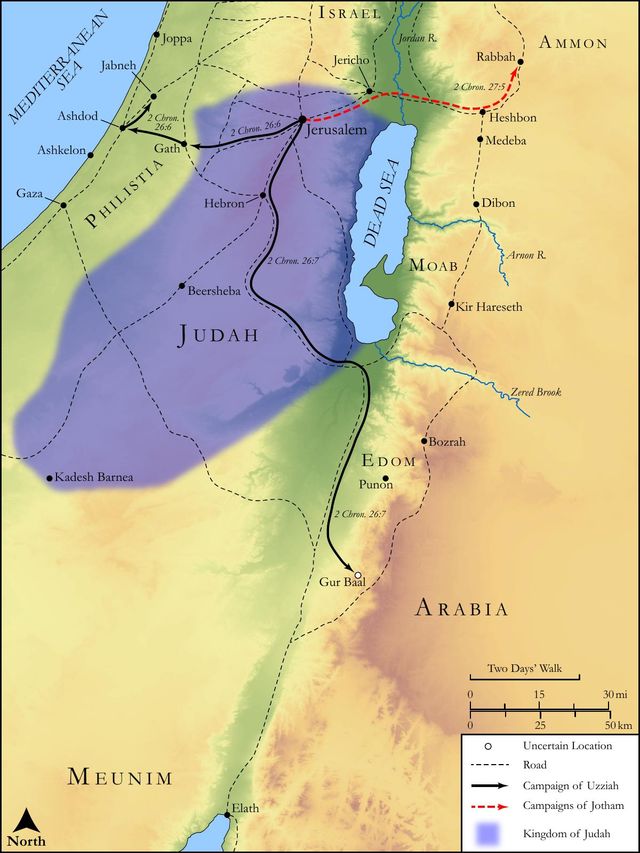
2.Here are several particular instances of his prosperity: - (1.) His success in his wars: God helped him (Ch2 26:7), and then he triumphed over the Philistines (those old enemies of God's people), demolished the fortifications of their cities, and put garrisons of his own among them, Ch2 26:6. He obliged the Ammonites to pay him tribute, Ch2 26:8. He made all quiet about him, and kept them in awe. (2.) The greatness of his fame and reputation. His name was celebrated throughout all the neighbouring countries (Ch2 26:8) and it was a good name, a name for good things with God and good people. This is true fame, and makes a man truly honourable. (3.) His buildings. While he acted offensively abroad, he did not neglect the defence of his kingdom at home, but built towers in Jerusalem and fortified them, Ch2 26:9. Much of the wall of Jerusalem was in his father's time broken down, particularly at the corner gate. But his best fortification of Jerusalem was his close adherence to the worship of God: if his father had not forsaken this the wall of Jerusalem would not have been broken down. While he fortified the city, he did not forget the country, but built towers in the desert too (Ch2 26:10), to protect the country people from the inroads of the plunderers, bands of whom sometimes alarmed them and plundered them, as Ch2 21:16. (4.) His husbandry. He dealt much in cattle and corn, employed many hands, and got much wealth by his dealing; for he took a pleasure in it: he loved husbandry (Ch2 21:10), and probably did himself inspect his affairs in the country, which was no disparagement to him, but an advantage, as it encouraged industry among his subjects. It is an honour to the husbandman's calling that one of the most illustrious princes of the house of David followed it and loved it. He was not one of those that delight in war, nor did he addict himself to sport and pleasure, but delighted in the innocent and quiet employments of the husbandman. (5.) His standing armies. He had, as it should seem, two military establishments. [1.] A host of fighting men that were to make excursions abroad. These went out to war by bands, Ch2 21:11. They fetched in spoil from the neighbouring countries by way of reprisal for the depredations they had so often made upon Judah, [2.] Another army for guards and garrisons, that were ready to defend the country in case it should be invaded, Ch2 21:12, Ch2 21:13. So great were their number and valour that they made war with mighty power; no enemy durst face them, or, at least, could stand before them. Men unarmed can do little in war. Uzziah therefore furnished himself with a great armoury, whence his soldiers were supplied with arms offensive and defensive (Ch2 21:14), spears, bows, and slings, shields, helmets, and habergeons: swords are not mentioned, because it is probable that every man had a sword of his own, which he wore constantly. Engines were invented, in his time, for annoying besiegers with darts and stones shot from the towers and bulwarks, Ch2 21:15. What a pity it is that the wars and fightings which come from men's lusts have made it necessary for cunning men to employ their skill in inventing instruments of death.
Continue studying 2 Chronicles 26:5 across the web’s major study libraries — every link below opens this exact verse, chapter, or book on the destination site.
Read & Compare
 BibleGatewayThis verse in more than 200 translations and 70 languages.
 Bible.comThe YouVersion reader — hundreds of translations, reading plans, and highlights.
 ESV.orgCrossway's official English Standard Version reader.
 NET BibleThe NET translation with 60,000+ translators' notes on every rendering decision.
 STEP BibleTyndale House's free study tool — original text, vocabulary, and scholarly resources.
 BibliaLogos Bible Software's free web reader.
 USCCBThe New American Bible (Revised Edition) with the U.S. bishops' study notes.
Commentaries
 BibleHub CommentariesDozens of classic commentaries on this verse, gathered on one page.
 StudyLightMore than 100 commentary sets — the largest collection on the web.
 BibleRefPlain-English commentary on what this verse means, verse by verse.
 Enduring WordDavid Guzik's free commentary on this chapter, widely used by Bible teachers.
 Bible Study ToolsVerse commentary alongside Greek and Hebrew study aids.
Original Language & Research
- BibleHub InterlinearThe verse word by word — original language, transliteration, and English.
- BibleHub LexiconEvery word's original-language definition and Strong's entry.
 Blue Letter BibleDeep-study tools — Strong's numbers, concordance, and word studies.
 SefariaThe Hebrew text with Rashi and centuries of Jewish commentary.
Sermons, Hymns & Audio


TrulyRandomVerse is not affiliated with these sites and doesn’t control their content. They’re linked because they’re genuinely useful.
Summary
Second Chronicles 26:5 serves as a foundational theological statement regarding the early reign of King Uzziah (also known as Azariah) of Judah. This verse establishes a direct correlation between his earnest and consistent pursuit of God and the subsequent divine enablement that led to his remarkable prosperity and success. It highlights the significant spiritual mentorship provided by Zechariah, a man of divine insight, whose guidance was instrumental in shaping Uzziah's initial devotion, thereby setting the stage for understanding the triumphs and eventual tragic downfall that characterized his lengthy rule.
Context
ShowHideLiterary Context
This verse is strategically positioned at the outset of the Chronicler's account of Uzziah's reign in 2 Chronicles 26. Following Uzziah's ascension to the throne at the tender age of sixteen, the Chronicler immediately introduces the theological principle that undergirds his early successes. The Chronicler's overarching theological framework consistently links the faithfulness or unfaithfulness of Judah's kings directly to the nation's and the king's personal prosperity or decline. Verse 5 acts as the interpretive key for the detailed list of Uzziah's accomplishments that follow, including his military victories, building projects, and agricultural innovations, as described in 2 Chronicles 26:6-15. Crucially, the phrase "as long as he sought the LORD" functions as a powerful literary foreshadowing, subtly hinting at the later, tragic turn in Uzziah's reign when his pride led him to act presumptuously against God's law, resulting in his leprosy and eventual downfall, vividly recounted in 2 Chronicles 26:16-21.
Historical & Cultural Context
King Uzziah ruled the Southern Kingdom of Judah for an impressive 52 years during the 8th century BC (c. 792–740 BC), a period marked by relative political stability, economic growth, and territorial expansion for Judah. In ancient Israelite culture, it was common for kings to seek divine guidance through prophets or wise advisors. This tradition is exemplified by figures like Nathan counseling King David, or Elijah and Elisha ministering to various kings of Israel. Zechariah's role as a spiritual counselor to Uzziah fits squarely within this established pattern, underscoring the vital importance of seeking divine wisdom through divinely appointed channels. The concept of "prosperity" (Hebrew: tsalach) in this historical context was holistic, encompassing not only material wealth but also military strength, agricultural abundance, successful infrastructure projects, and a favorable reputation among surrounding nations, all of which were understood as direct blessings from Yahweh for covenant faithfulness.
Key Themes
ShowHideThe central theological message of 2 Chronicles 26:5 is the Principle of Seeking God. This theme emphasizes a deliberate, earnest, and ongoing pursuit of divine wisdom, guidance, and favor, often expressed through prayer, obedience to God's commands, and reliance on His presence. This active seeking is presented as the direct catalyst for Divine Prosperity and Blessing, demonstrating God's responsiveness to a devoted heart. The verse also highlights the crucial Role of Spiritual Counsel, as exemplified by Zechariah, underscoring the importance of godly mentors or prophets in guiding leaders and individuals toward righteousness and discernment. Perhaps most significantly, the phrase "as long as he sought the LORD" introduces the profound theme of Conditional Blessing. This is a hallmark of the Chronicler's theology, which posits that God's continued favor and prosperity are contingent upon sustained faithfulness and humility. This conditional clause sets up the stark contrast with Uzziah's later pride and disobedience, which led to the cessation of God's blessing and his eventual downfall, vividly described in 2 Chronicles 26:16, serving as a powerful cautionary tale.
Exposition and Analysis
ShowHideKey Word Analysis
ShowHideA primitive root, this verb (H1875) properly means to tread or frequent; usually to follow (for pursuit or search); by implication, to seek or ask; specifically to worship. It signifies a diligent, earnest, and intentional pursuit, inquiry, or investigation. It implies more than a casual glance or a fleeting thought; rather, it denotes a committed and active seeking, often involving prayer, meditation on God's law, and obedience to His will. When applied to seeking God, it conveys a deep devotion and reliance on divine direction, which is presented as the prerequisite for God's responsive blessing.
A primitive root, this term (H995) means to separate mentally (or distinguish), i.e., generally understand. It refers to discernment, insight, and intelligent comprehension. In the context of Zechariah, it indicates a spiritual perspicacity, an ability to grasp and interpret divine revelations or "visions of God." It implies not just intellectual knowledge but a profound spiritual wisdom that enables one to correctly perceive and communicate God's will.
A primitive root, this verb (H6743) means to push forward, in various senses (literal or figurative, transitive or intransitive); to succeed, advance, or be profitable. It often carries the connotation of divine enablement or being made successful by God. In Uzziah's case, as detailed in the surrounding verses, this prosperity was multifaceted, encompassing military victories, successful building projects, agricultural advancements, and a strong reputation, all attributed directly to God's active hand.
Verse Breakdown
ShowHide"And he sought God in the days of Zechariah,"
This initial clause establishes King Uzziah's foundational spiritual orientation during the early period of his reign. The active verb "sought" (H1875, dârash') emphasizes his intentional, diligent, and earnest pursuit of God. The specific mention of "Zechariah" (H2148, Zᵉkaryâh) highlights the presence and profound influence of a particular spiritual mentor, indicating that Uzziah's seeking was not merely an internal disposition but was guided, perhaps even initiated and sustained, by wise and godly counsel.
"who had understanding in the visions of God:"
This phrase further qualifies Zechariah, identifying him as a prophet or a man uniquely gifted with divine insight. His "understanding" (H995, bîyn') in "visions" (H7200, râʼâh) of God (H430, ʼĕlôhîym) suggests he possessed a spiritual perspicacity, an ability to grasp and interpret divine revelations. This underscores his legitimacy as a channel of divine communication, providing authoritative spiritual guidance that Uzziah evidently heeded, emphasizing the importance of discerning spiritual counsel in a king's reign.
"and as long as he sought the LORD,"
This crucial conditional clause introduces a temporal limitation to Uzziah's prosperity. The phrase "as long as" (H3117, yôwm) directly links the continuation of God's blessing to the ongoing nature of Uzziah's faithfulness and diligence in seeking the LORD (H3068, Yᵉhôvâh). This serves as a potent literary and theological foreshadowing, hinting at the eventual cessation of his seeking and the subsequent reversal of his fortunes, a key theological point for the Chronicler regarding the conditional nature of divine favor.
"God made him to prosper."
This final clause states the direct, divine consequence of Uzziah's diligent pursuit of God. The explicit subject "God" (H430, ʼĕlôhîym) emphasizes that his prosperity was not merely a result of his own efforts, military prowess, or good fortune, but a direct act of divine favor and enablement. The verb "made him to prosper" (H6743, tsâlach') highlights God's active and sovereign role in bringing about Uzziah's multifaceted success, encompassing military victories, building projects, and overall flourishing.
Literary Devices
ShowHideThe verse employs several significant literary devices to convey its profound theological message. A prominent device is the Conditional Clause, explicitly stated in the structure "and as long as he sought the LORD, God made him to prosper." This clear cause-and-effect relationship underscores the Chronicler's theological agenda: sustained obedience and seeking God lead directly to divine blessing and prosperity. This also functions as powerful Foreshadowing, subtly hinting at a future cessation of Uzziah's diligent seeking and the subsequent change in his fortune, which is tragically fulfilled in 2 Chronicles 26:16 when his pride leads to his downfall. The Repetition of the verb "sought" ("sought God" and "sought the LORD") underscores the central action and its profound significance, reinforcing the idea that consistent spiritual devotion is paramount for experiencing God's favor. Finally, the verse clearly demonstrates Divine Causation, with God explicitly identified as the active agent who "made him to prosper," attributing Uzziah's success directly to divine intervention and favor rather than human prowess or ingenuity alone.
Theological and Thematic Connections
ShowHideSecond Chronicles 26:5 encapsulates a core theological principle prevalent throughout the Old Testament, particularly emphasized in the Deuteronomistic history and the Chronicler's work: the direct correlation between human faithfulness to God and divine blessing or judgment. Uzziah's early reign serves as a powerful illustration of this "retribution theology," where diligent seeking of God leads directly to prosperity and flourishing. This principle extends beyond individual kings to the nation as a whole, emphasizing that national well-being is intrinsically tied to collective obedience and devotion to Yahweh. The verse also highlights the enduring importance of spiritual guidance and discernment, as Zechariah's role was crucial in channeling divine wisdom to Uzziah during his initial period of success. Ultimately, the conditional nature of Uzziah's prosperity, explicitly stated as "as long as he sought the LORD," serves as a profound cautionary tale, reminding readers that God's blessings are often contingent upon sustained faithfulness, humility, and an ongoing commitment to His ways.
Reflection and Application
ShowHideThe account of Uzziah's early reign in 2 Chronicles 26:5 offers timeless wisdom and a powerful challenge for believers today. It profoundly reminds us that a life diligently and earnestly devoted to seeking God is the true foundation for lasting success and holistic flourishing, not merely in material terms, but in every aspect of our being—spiritual, emotional, relational, and vocational. Just as Uzziah benefited immensely from Zechariah's spiritual guidance, we are called to actively seek out wise, godly counsel and mentorship in our own lives, recognizing that God often speaks and guides us through others who possess "understanding in the visions of God." This verse prompts us to critically examine the depth and consistency of our own "seeking" – is it a casual inquiry, a reactive plea in times of trouble, or an earnest, consistent, and proactive pursuit of God through prayer, diligent study of His Word, and obedient application of His commands? While the New Testament expands our understanding of "prosperity" to include spiritual blessings, peace, contentment in Christ, and fruitfulness for His kingdom, the underlying principle remains: prioritizing our relationship with God is the non-negotiable key to experiencing His blessings, discerning His purpose, and walking in His guidance in a comprehensive and fulfilling way. The conditional nature of Uzziah's prosperity also serves as a sober reminder that sustained faithfulness, humility, and vigilance against pride are essential to maintaining God's favor and avoiding the pitfalls that can lead to spiritual and personal decline.
Questions for Reflection
ShowHideFAQ
ShowHideWho was Zechariah, and what was his role in Uzziah's life?
ShowHideZechariah, as mentioned in 2 Chronicles 26:5, is described as a figure "who had understanding in the visions of God." While the biblical text provides no further specific details about his identity (e.g., whether he was a prophet, priest, or sage from a known prophetic lineage), his description strongly suggests he was a wise spiritual advisor or prophet to King Uzziah. His role was pivotal: he provided divine guidance and insight, helping Uzziah to "seek God" and understand His will. This highlights the importance of godly counsel for leaders, a theme seen throughout the Old Testament, where prophets often advised kings (e.g., Nathan advising David in 2 Samuel 7). Zechariah's influence was clearly instrumental in the initial, successful and prosperous period of Uzziah's reign.
What does "sought God" truly mean in this context?
ShowHideThe Hebrew word translated "sought" is dârash (H1875), which implies a diligent, earnest, and intentional pursuit of God. It signifies much more than a casual inquiry or a superficial religious act. In this context, it refers to Uzziah's deep devotion, his reliance on divine direction, and his active engagement with God's will. This would have involved consistent prayer, diligent obedience to God's commands (likely through adherence to the Mosaic Law), and a proactive seeking of God's wisdom in all his decisions as king. This active and consistent seeking is presented as the direct cause of Uzziah's prosperity, contrasting sharply with his later prideful actions and eventual downfall when he ceased to prioritize seeking the Lord (2 Chronicles 26:16).
Was Uzziah's prosperity solely material, or did it encompass more?
ShowHideWhile the subsequent verses in 2 Chronicles 26 detail significant material and military successes (e.g., extensive building projects, military victories over surrounding nations, agricultural development, and a strong reputation that spread far and wide), biblical prosperity (H6743, tsâlach) often encompasses a broader, more holistic sense of well-being. For Uzziah, this included not only material wealth but also military strength, administrative success, agricultural abundance, and overall divine favor that led to the flourishing of his kingdom and the security of his people. It reflects a comprehensive prosperity that goes beyond mere financial gain, encompassing peace, security, and the thriving of the nation under righteous leadership, all seen as direct blessings from God.
Christ-Centered Fulfillment
ShowHideWhile Uzziah's prosperity was a direct, yet conditional, result of his seeking God, his story ultimately points to the perfect and unconditional fulfillment found in Jesus Christ. Uzziah's diligent "seeking" foreshadows Christ, who perfectly and consistently sought the Father's will in every aspect of His life, always doing what pleased Him (John 8:29). Unlike Uzziah, whose prosperity was contingent upon his continued faithfulness and eventually ceased due to his pride and disobedience, Christ's obedience was flawless, securing for His followers an eternal and unconditional spiritual prosperity. Through Christ, believers receive not merely temporal blessings but "every spiritual blessing in the heavenly places" (Ephesians 1:3) and the promise that "in Christ all the fullness of the Deity lives in bodily form" (Colossians 2:9). Furthermore, the "understanding in the visions of God" that Zechariah possessed is now made available to all believers through the indwelling Holy Spirit, whom Christ sent to guide us into all truth and teach us how to truly "seek the Lord" and live in accordance with His perfect will (John 14:26, Romans 8:26-27). Thus, Uzziah's experience, with its conditional blessings and eventual downfall, serves as a powerful Old Testament shadow pointing to the ultimate and perfect source of wisdom, guidance, and true, lasting prosperity found only in Christ, "in whom are hidden all the treasures of wisdom and knowledge" (Colossians 2:3).