


Daniel 2:19
Bible text: King James Version (1769 Blayney text) · Public domain
Bible text: Berean Standard Bible · Public domain
Bible text: American Standard Version (1901) · Public domain
Bible text: World English Bible, Messianic edition · Public domain
Bible text: Geneva Bible (1599) · Public domain
Bible text: Young's Literal Translation · Public domain
- אֱדַיִן'e·Da·yinthenH116AdvAdverb
- לְדָנִיֵּאלle·da·ni·Yelto DanielH1841Prep-l ¦ N-proper-mNoun Proper MasculineלְtoדָנִיֵּאלDaniel
- בְּחֶזְוָאbe·chez·Va'in vision theH2376Prep-b ¦ N-cs ¦ ArtNoun Singular common gender Definiteבְּinחֶזְוָvisionאthe
- דִיdiofH1768ConjConjunction
- לֵילְיָאleil·Ya'night theH3916N-cs ¦ ArtNoun Singular common gender Definiteלֵילְיָnightאthe
- רָזָהra·Zah'secret theH7328N-cs ¦ ArtNoun Singular common gender Definiteרָזָsecretהthe
- גֲלִיga·Liit was revealedH1541V-Peil-Perf-3msVerb Peil Perfect 3rd Singular Masculine
- אֱדַיִן'e·Da·yinthenH116AdvAdverb
- דָּנִיֵּאלda·ni·YelDanielH1841N-proper-mNoun Proper Masculine
- בָּרִךְba·Rikhhe blessedH1289V-Pael-Perf-3msVerb Pael Perfect 3rd Singular Masculine
- לֶאֱלָהּle·'e·Lah<obj.> [the] God ofH426Prep-l ¦ N-cscNoun Singular common gender Constructלֶ<obj.>אֱלָהּ[the] God of
- שְׁמַיָּאshe·mai·Ya'heavens theH8065N-mp ¦ ArtNoun Plural Masculine Definiteשְׁמַיָּheavensאthe
English is a literal word-by-word gloss of the Hebrew, not the KJV's wording. Why?
This is the original text the KJV's translators worked from — each Hebrew word with its own literal English meaning in this verse, prepared by scholars at Tyndale House, Cambridge. The KJV translates whole sentences, not word by word, so its wording differs: one Hebrew word can become several English words, and the KJV may choose “the LORD” where the gloss reads “Yahweh”. Both are faithful — they answer different questions. For the KJV's own rendering, switch to the KJV text.
Details
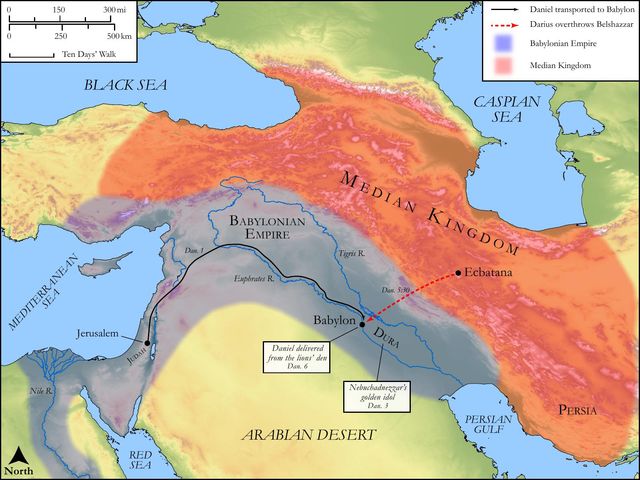
See on the biblical-era map
Study this verse
Public-domain commentary
Matthew Henry
From his Commentary on the Whole Bible. Henry comments on passages, not single verses — this entry covers Daniel 2:14–23. His four-level outline is real structure in the source text, so it is rendered as structure.
When the king sent for his wise men to tell them his dream, and the interpretation of it (Dan 2:2), Daniel, it seems, was not summoned to appear among them; the king, though he was highly pleased with him when he examined him, and thought him ten times wiser than the rest of his wise men, yet forgot him when he had most occasion for him; and no wonder, when all was done in a heat, and nothing with a cool and deliberate thought. But Providence so ordered it; that the magicians being nonplussed might be the more taken notice of, and so the more glory might redound to the God of Daniel. But, though Daniel had not the honour to be consulted with the rest of the wise men, contrary to all law and justice, by an undistinguishing sentence, he stands condemned with them, and till he has notice brought him to prepare for execution he knows nothing of the matter. How miserable is the case of those who live under arbitrary government, as this of Nebuchadnezzar's! How happy are we, whose lives are under the protection of the law and methods of justice, and lie not thus at the mercy of a peevish and capricious prince!
We have found already, in Ezekiel, that Daniel was famous both for prudence and prayer; as a prince he had power with God and by man; by prayer he had power with God, by prudence he had power with man, and in both he prevailed. Thus did he find favour and good understanding in the sight of both, and in these verses we have a remarkable instance of both.
I.Daniel by prudence knew how to deal with men, and he prevailed with them.
When Arioch, the captain of the guard, that was appointed to slay all the wise men of Babylon, the whole college of them, seized Daniel (for the sword of tyranny, like the sword of war, devours one as well as another), he answered with counsel and wisdom (Dan 2:14); he did not fall into a passion, and reproach the king as unjust and barbarous, much less did he contrive how to make resistance, but mildly asked, Why is the decree so hasty? Dan 2:15. And whereas the rest of the wise men had insisted upon it that it was utterly impossible for him ever to have his demand gratified, which did but make him more outrageous, Daniel undertakes, if he may but have a little time allowed him, to give the king all the satisfaction he desired, Dan 2:16. The king, being now sensible of his error in not sending for Daniel sooner, whose character he began to recollect, was soon prevailed upon to respite the judgment, and make trial of Daniel. Note, The likeliest method to turn away wrath, even the wrath of a king, which is as the messenger of death, is by a soft answer, by that yielding which pacifies great offences; thus, though where the word of a king is there is power, yet even that word may be repelled, and that so as to be repealed; and so some read it here (Dan 2:14): Then Daniel returned, and stayed the counsel and edict, through Arioch, the king's provost-marshal.
II.Daniel knew how by prayer to converse with God, and he found favour with him, both in petition and in thanksgiving, which are the two principal parts of prayer. Observe,
1.His humble petition for this mercy, that God would discover to him what was the king's dream, and the interpretation of it. When he had gained time he did not go to consult with the rest of the wise men whether there was anything in their art, in their books, that might be of use in this matter, but went to his house, there to be alone with God, for from him alone, who is the Father of lights, he expected this great gift. Observe,
(1.)He did not only pray for this discovery himself, but he engaged his companions to pray for it too. He made the thing known to those who had been all along his bosom-friends and associates, requesting that they would desire mercy of God concerning this secret, Dan 2:17, Dan 2:18. Though Daniel was probably their senior, and every way excelled them, yet he engaged them as partners with him in this matter, Vis unita fortior - The union of forces produces greater force. See Est 4:16. Note, Praying friends are valuable friends; it is good to have an intimacy with and an interest in those that have fellowship with God and an interest at the throne of grace; and it well becomes the greatest and best of men to desire the assistance of the prayers of others for them. St. Paul often entreats his friends to pray for him. Thus we must show that we put a value upon our friends, upon prayer, upon their prayers.
(2.)He was particular in this prayer, but had an eye to, and a dependence upon, the general mercy of God: That they would desire the mercies of the God of heaven concerning this secret, Dan 2:18. We ought in prayer to look up to God as the God of heaven, a God above us, and who has dominion over us, to whom we owe adoration and allegiance, a God of power, who can do everything. Our savior has taught us to pray to God as our Father in heaven. And, whatever good we pray for, our dependence must be upon the mercies of God for it, and an interest in those mercies we must desire; we can expect nothing by way of recompence for our merits, but all as the gift of God's mercies. They desired mercy concerning this secret. Note, Whatever is the matter of our care must be the matter of our prayer; we must desire mercy of God concerning this thing and the other thing that occasions us trouble and fear. God gives us leave to be humbly free with him, and in prayer to enter into the detail of our wants and burdens. Secret things belong to the Lord our God, and therefore, if there be any mercy we stand in need of that concerns a secret, to him we must apply; and, though we cannot in faith pray for miracles, yet we may in faith pray to him who has all hearts in his hand, and who in his providence does wonders without miracles, for the discovery of that which is out of our view and the obtaining of that which is out of our reach, as far as is for his glory and our good, believing that to him nothing is hidden, nothing is hard.
(3.)Their plea with God was the imminent peril they were in; they desired mercy of God in this matter, that so Daniel and his fellows might not perish with the rest of the wise men of Babylon, that the righteous might not be destroyed with the wicked. Note, When the lives of good and useful men are in danger it is time to be earnest with God for mercy for them, as for Peter in prison, Act 12:5.
(4.)The mercy which Daniel and his fellows prayed for was bestowed. The secret was revealed unto Daniel in a night-vision, Dan 2:19. Some think he dreamed the same dream, when he was asleep, that Nebuchadnezzar had dreamed; it should rather seem that when he was awake, and continuing instant in prayer, and watching in the same, the dream itself, and the interpretation of it, were communicated to him by the ministry of an angel, abundantly to his satisfaction. Note, The effectual fervent prayer of righteous men avails much. There are mysteries and secrets which by prayer we are let into; with that key the cabinets of heaven are unlocked, for Christ has said, Thus knock, and it shall be opened unto you.
2.His grateful thanksgiving for this mercy when he had received it: Then Daniel blessed the God of heaven, Dan 2:19. He did not stay till he had told it to the king, and seen whether he would own it to be his dream or no, but was confident that it was so, and that he had gained his point, and therefore he immediately turned his prayers into praises. As he had prayed in a full assurance that God would do this for him, so he gave thanks in a full assurance that he had done it; and in both he had an eye to God as the God of heaven. His prayer was not recorded, but his thanksgiving is. Observe,
(1.)The honour he gives to God in this thanksgiving, which he studies to do in a great variety and copiousness of expression: Blessed be the name of God for ever and ever. There is that for ever in God which is to be blessed and praised; it is unchangeably and eternally in him. And it is to be blessed for ever and ever; as the matter of praise is God's eternal perfection, so the work of praise shall be everlastingly in the doing.
[1.]He gives to God the glory of what he is in himself: Wisdom and might are his, wisdom and courage (so some); whatever is fit to be done he will do; whatever he will do he can do, he dares do, and he will be sure to do it in the best manner, for he has infinite wisdom to design and contrive and infinite power to execute and accomplish. With him are strength and wisdom, which in men are often parted.
[2.]He gives him the glory of what he is to the world of mankind. He has a universal influence and agency upon all the children of men, and all their actions and affairs. Are the times changed? Is the posture of affairs altered? Does every thing lie open to mutability? It is God that changes the times and the seasons, and the face of them. No change comes to pass by chance, but according to the will and counsel of God. Are those that were kings removed and deposed? Do they abdicate? Are they laid aside? It is God that removes kings. Are the poor raised out of the dust, to be set among princes? It is God that sets up kings; and the making and unmaking of kings is a flower of his crown who is the fountain of all power, King of kings and Lord of lords. Are there men that excel others in wisdom, philosophers and statesmen, that think above the common rate, contemplative penetrating men? It is God that gives wisdom to the wise, whether they be so wise as to acknowledge it or no; they have it not of themselves, but it is he that gives knowledge to those that know understanding, which is a good reason why we should not be proud of our knowledge, and why we should serve and honour God with it and make it our business to know him.
[3.]He gives him the glory of this particular discovery. He praises him, First, For that he could make such a discovery (Dan 2:22): He reveals the deep and secret things which are hidden from the eyes of all living. It was he that revealed to man what is true wisdom when none else could (Job 28:27, Job 28:28); it is he that reveals things to come to his servants and prophets. He does himself perfectly discern and distinguish that which is most closely and most industriously concealed, for he will bring into judgment every secret thing; the truth will be evident in the great day. He knows what is in the darkness, and what is done in the darkness, for that hides not from him, Psa 139:11, Psa 139:12. The light dwells with him, and he dwells in the light (Ti1 6:16), and yet, as to us, he makes darkness his pavilion. Some understand it of the light of prophecy and divine revelation, which dwells with God and is derived from him; for he is the Father of lights, of all lights; they are all at home in him. Secondly, For that he had made this discovery to him. Here he has an eye to God as the God of his fathers; for, though the Jews were now captives in Babylon, yet they were beloved for their father's sake. He praises God, who is the fountain of wisdom and might, for the wisdom and might he had given him, wisdom to know this great secret and might to bear the discovery. Note, What wisdom and might we have we must acknowledge to be God's gift. Thou hast made this known to me, Dan 2:23. What was hidden from the celebrated Chaldeans, who made the interpreting of dreams their profession, is revealed to Daniel, a captive-Jew, a babe, much their junior. God would hereby put honour upon the Spirit of prophecy just when he was putting contempt upon the spirit of divination. Was Daniel thus thankful to God for making known that to him which was the saving of the lives of him and his fellows? Much more reason have we to be thankful to him for making known to us the great salvation of the soul, to us and not to the world, to us and not to the wise and prudent.
(2.)The respect he puts upon his companions in this thanksgiving. Though it was by his prayers principally that this discovery was obtained, and to him that it was made, yet he owns their partnership with him, both in praying for it (it is what we desired of thee) and in enjoying it - Thou hast made known unto us the king's matter. Either they were present with Daniel when the discovery was made to him, or as soon as he knew it he told it them (heurēka, heurēka - I have found it, I have found it), that those who had assisted him with their prayers might assist him in their praises; his joining them with him is an instance of his humility and modesty, which well become those that are taken into communion with God. Thus St. Paul sometimes joins Sylvanus, Timotheus, or some other minister, with himself in the inscriptions to many of his epistles. Note, What honour God puts upon us we should be willing that our brethren may share with us in.
Historical interpretation
Historical reception
1 surviving comment on this verse from the historical church.
Verse 19. "And Daniel blessed the God of heaven, and spoke, saying..." In contrast to those who occupy themselves with this world and delude the earthly minded with demonic arts and illusions, Daniel blessed the God of heaven. For the gods who did not create heaven and earth will pass away.
Continue studying Daniel 2:19 across the web’s major study libraries — every link below opens this exact verse, chapter, or book on the destination site.
Read & Compare
 BibleGatewayThis verse in more than 200 translations and 70 languages.
 Bible.comThe YouVersion reader — hundreds of translations, reading plans, and highlights.
 ESV.orgCrossway's official English Standard Version reader.
 NET BibleThe NET translation with 60,000+ translators' notes on every rendering decision.
 STEP BibleTyndale House's free study tool — original text, vocabulary, and scholarly resources.
 BibliaLogos Bible Software's free web reader.
 USCCBThe New American Bible (Revised Edition) with the U.S. bishops' study notes.
Commentaries
 BibleHub CommentariesDozens of classic commentaries on this verse, gathered on one page.
 StudyLightMore than 100 commentary sets — the largest collection on the web.
 BibleRefPlain-English commentary on what this verse means, verse by verse.
 Enduring WordDavid Guzik's free commentary on this chapter, widely used by Bible teachers.
 Bible Study ToolsVerse commentary alongside Greek and Hebrew study aids.
Original Language & Research
- BibleHub InterlinearThe verse word by word — original language, transliteration, and English.
- BibleHub LexiconEvery word's original-language definition and Strong's entry.
 Blue Letter BibleDeep-study tools — Strong's numbers, concordance, and word studies.
 SefariaThe Hebrew text with Rashi and centuries of Jewish commentary.
Sermons, Hymns & Audio


TrulyRandomVerse is not affiliated with these sites and doesn’t control their content. They’re linked because they’re genuinely useful.
Summary
Daniel 2:19 marks the pivotal moment when God, in direct response to Daniel's fervent prayer, supernaturally revealed King Nebuchadnezzar's forgotten dream and its interpretation. This verse powerfully underscores God's unique omnipotence and active involvement in human affairs, demonstrating His unparalleled ability to disclose hidden mysteries. Simultaneously, it showcases Daniel's immediate and profound response of blessing the "God of heaven," acknowledging His divine intervention, faithfulness, and supreme authority.
Context
ShowHideLiterary Context
This verse serves as the dramatic climax and turning point within the narrative of Daniel chapter 2. King Nebuchadnezzar, deeply troubled by a forgotten dream, issues a life-or-death decree: his wise men must not only interpret the dream but first recount its content, or face execution. This impossible demand places Daniel and his companions in mortal peril. In response, Daniel, exhibiting remarkable faith and courage, requests time from the king. He then gathers his friends, Hananiah, Mishael, and Azariah, to earnestly seek "mercy from the God of heaven concerning this secret" (Daniel 2:18). Daniel 2:19 immediately follows this desperate prayer, signifying God's swift, direct, and miraculous answer. This divine intervention then sets the stage for Daniel's magnificent prayer of praise and thanksgiving in Daniel 2:20-23.
Historical & Cultural Context
The events of Daniel 2 are set during the nascent years of the Babylonian exile, specifically within the reign of King Nebuchadnezzar II (c. 605-562 BC). Daniel and his three friends were among the Jewish elite deported to Babylon following the first siege of Jerusalem. In this polytheistic empire, the king wielded absolute power, and his word was unquestionable law. The Chaldean "wise men"—a collective of astrologers, enchanters, and sorcerers—served as royal advisors, but their reliance on human wisdom and pagan divination stood in stark contrast to Daniel's unwavering dependence on the one true God. The king's decree to execute all wise men for their inability to reveal his dream highlights the extreme stakes and the profound spiritual and political tension of the moment. This dramatic backdrop serves to powerfully demonstrate God's absolute supremacy over all earthly powers, false deities, and human limitations.
Key Themes
ShowHideDaniel 2:19 encapsulates several overarching themes prevalent throughout the entire book of Daniel. Firstly, it emphatically highlights Divine Revelation, emphasizing that genuine wisdom and foreknowledge of the future emanate solely from God, specifically identified as the "God of heaven," in direct opposition to the futile attempts of human intellect or pagan practices. Secondly, the verse powerfully illustrates the Efficacy of Prayer, demonstrating God's immediate responsiveness to the fervent and faithful prayers of His servants, even amidst the most dire and seemingly impossible circumstances. Thirdly, it profoundly affirms God's Sovereignty, showcasing His supreme authority over all earthly rulers and empires, His ability to hold the future in His hands, and His meticulous orchestration of events according to His divine purpose. Finally, Daniel's immediate and heartfelt response of blessing God introduces and exemplifies the theme of Immediate Gratitude and Worship, setting a profound example for believers to promptly acknowledge and praise God's faithfulness and intervention in their lives.
Exposition and Analysis
ShowHideKey Word Analysis
ShowHideThis term (H7328) refers to a profound mystery, something deeply hidden or concealed that is beyond human comprehension, discovery, or even recollection. In this context, it underscores the absolute impossibility for human wisdom or pagan divination to uncover the king's forgotten dream, thereby magnifying the divine nature of its subsequent revelation. It is a truth that only the transcendent God can disclose.
This word (H1541) signifies a divine disclosure, an unveiling or uncovering of something previously hidden from human sight or knowledge. It implies an active, intentional, and sovereign act on God's part to make known what was unknown and unknowable by any other means. The use of this term highlights God's initiative, power, and direct communication in penetrating the veil of mystery, directly imparting truth to His chosen servant, Daniel.
This term (H1289), when applied to God, denotes an act of profound adoration, praise, and thanksgiving. It implies Daniel's immediate and humble recognition of God's goodness, power, and faithfulness. It is a response of kneeling in humble reverence and acknowledging God's supreme authority and benevolent intervention, signifying not merely a casual expression of gratitude but a deep, worshipful act of acknowledging His worthiness.
Verse Breakdown
ShowHide"Then was the secret revealed unto Daniel in a night vision."
This clause describes the divine action. The adverb "Then" signifies the immediate and direct consequence of Daniel and his friends' earnest prayer, highlighting God's swift responsiveness. The "secret" (King Nebuchadnezzar's forgotten dream and its interpretation) was not discovered through human effort or intellectual prowess but was supernaturally "revealed" by God. The means of revelation, a "night vision," points to a direct, prophetic encounter with God, a common mode of divine communication in the Old Testament, emphatically underscoring the authenticity and divine origin of the message, distinguishing it from human conjecture or pagan divination.
"Then Daniel blessed the God of heaven."
This clause describes Daniel's immediate and profoundly appropriate response to God's revelation. The repeated "Then" emphasizes the promptness and priority of his reaction. Upon receiving the life-saving and kingdom-altering revelation, Daniel did not immediately rush to the king or celebrate his own deliverance. Instead, his first and foremost action was to turn his attention to God, offering heartfelt praise and thanksgiving. Calling God "the God of heaven" underscores His supreme authority, transcendence, and universal dominion, sharply distinguishing Him from the impotent, localized gods of Babylon and acknowledging Him as the singular, true source of all wisdom, power, and salvation.
Literary Devices
ShowHideDaniel 2:19 masterfully employs several literary devices to convey its profound theological and narrative message. Juxtaposition is powerfully evident in the stark contrast between the "secret"—a hidden, life-threatening enigma that baffled all human wisdom—and its immediate "revelation," which brings clarity, deliverance, and establishes God's supremacy. This highlights God's unique power to transform impossible situations. The repetition of "Then" at the beginning of both clauses serves as a prominent instance of Anaphora, emphasizing the immediate cause-and-effect relationship: God's decisive revelation is instantly met with Daniel's worshipful praise. This also creates a sense of rapid, divinely orchestrated action and a fitting human response. The "night vision" itself functions as a form of Theophany or divine manifestation, a direct, supernatural communication from God, underscoring the miraculous nature of the event and God's personal, intimate involvement with His servant. Finally, the phrase "God of heaven" is a significant Epithet, a descriptive title that emphasizes God's transcendent power, universal sovereignty, and unique identity, contrasting Him sharply with the earthly, limited, and false deities worshipped in Babylon.
Theological and Thematic Connections
ShowHideDaniel 2:19 profoundly reveals God's character as the ultimate revealer of mysteries, distinguishing Him from all false gods and human wisdom. It affirms that true knowledge and understanding, especially concerning divine plans and future events, originate solely from Him. This moment underscores God's active engagement with His people and His world, demonstrating that He hears and answers prayer, intervening directly in human history to accomplish His purposes and vindicate His faithful servants. Daniel's immediate response of blessing God models a theology of prompt and fervent gratitude, recognizing God's supremacy and goodness as the only source of such profound revelation and deliverance.
Reflection and Application
ShowHideDaniel 2:19 offers a powerful and enduring message for believers facing their own "impossible" situations, whether personal, professional, or spiritual. It reminds us that no challenge is too great, and no mystery too profound, for the "God of heaven." When we encounter circumstances that overwhelm human wisdom, defy logical solutions, or seem to have no earthly recourse, this verse calls us to emulate Daniel's example: to turn to God in earnest, believing prayer, confident that He is able and willing to reveal what is hidden and provide the wisdom, clarity, or intervention we desperately need. Furthermore, Daniel's immediate response of blessing God teaches us the vital importance of prompt and heartfelt gratitude. Our first reaction to God's faithfulness and intervention should be adoration and praise, acknowledging His power, goodness, and sovereignty in our lives. This practice not only honors God but also cultivates a spirit of thankfulness and deepens our faith, fostering a profound dependence on Him as the ultimate source of all wisdom and provision.
Questions for Reflection
ShowHideFAQ
ShowHideWhy was the secret revealed to Daniel in a night vision, and what is its significance?
ShowHideThe secret was revealed to Daniel in a night vision as a direct, supernatural act of divine communication. This method of revelation, common in biblical history (e.g., Genesis 46:2; Job 33:15-16), underscores that the knowledge came directly from God, not from human insight, pagan divination, or Daniel's own intellect. It authenticates the message as divine and demonstrates God's unique ability to disclose hidden truths, distinguishing Him from the false gods and futile practices of Babylon. The "night vision" emphasizes the intimate and personal nature of God's communication with His faithful servant, highlighting that God actively engages with those who seek Him.
What is the significance of Daniel blessing "the God of heaven"?
ShowHideDaniel's act of blessing "the God of heaven" is profoundly significant, especially within the polytheistic and idolatrous context of Babylon. It is a powerful declaration of God's absolute supremacy, transcendence, and universal dominion. While Nebuchadnezzar worshipped many gods and relied on his Chaldean wise men, Daniel immediately attributes the revelation and deliverance to the one true God, who rules from the heavens and is sovereign over all earthly kingdoms and powers. This title, "God of heaven," contrasts sharply with the localized, limited deities of the Babylonian pantheon and affirms the universal authority and unique power of the God of Israel. It is an act of worship that acknowledges God as the sole source of wisdom, power, and salvation in a moment of extreme crisis, setting an example of proper allegiance and worship in a hostile environment.
Christ-Centered Fulfillment
ShowHideThe revelation of the "secret" to Daniel in a night vision powerfully foreshadows the ultimate and most profound revelation of God's eternal mystery in the person of Jesus Christ. Just as Daniel received a hidden truth from the "God of heaven" that saved lives and established God's sovereignty, so too did God reveal the ultimate "secret" of His redemptive plan through His Son. The apostle Paul speaks of Christ as the "mystery of God, in whom are hidden all the treasures of wisdom and knowledge" (Colossians 2:2-3). What was previously concealed for ages and generations in the Old Testament, the "mystery that has been kept hidden for ages and generations, but is now disclosed to the Lord's people" (Colossians 1:26), is fully and perfectly revealed in Christ's person and redemptive work. He is the very wisdom of God incarnate (1 Corinthians 1:30), the one who perfectly reveals the Father, for "No one has ever seen God, but the one and only Son, who is himself God and is in closest relationship with the Father, has made him known" (John 1:18). Daniel's immediate blessing of the "God of heaven" upon receiving the revelation prefigures the worship due to Christ, who is God incarnate, the ultimate revealer of divine truth, and the one through whom all spiritual blessings flow. In Christ, the "secret" of God's eternal purpose to reconcile humanity to Himself is fully unveiled, bringing not just a temporary reprieve from death, but eternal life and salvation to all who believe.