


Genesis 46:2
Bible text: King James Version (1769 Blayney text) · Public domain
Bible text: Berean Standard Bible · Public domain
Bible text: American Standard Version (1901) · Public domain
Bible text: World English Bible, Messianic edition · Public domain
Bible text: Geneva Bible (1599) · Public domain
Bible text: Young's Literal Translation · Public domain
- וַיֹּאמֶרvai·Yo·merand he saidH559Conj-w ¦ V-Qal-ConsecImperf-3msVerb Qal Consecutive Imperfect 3rd Singular Masculineוַandיֹּאמֶרhe said
- אֱלֹהִים'E·lo·HimGodH430N-mpNoun Plural Masculine Absolute
- לְיִשְׂרָאֵלle·Yis·ra·'Elto IsraelH3478Prep-l ¦ N-proper-mNoun Proper MasculineלְtoיִשְׂרָאֵלIsrael
- בְּמַרְאֹתbe·mar·'Otin [the] visions ofH4759Prep-b ¦ N-fpcNoun Plural Feminine Constructבְּinמַרְאֹת[the] visions of
- הַלַּיְלָהha·Lay·lahthe nightH3915Art ¦ N-msNoun Singular Masculine Absoluteהַtheלַּיְלָהnight
- וַיֹּאמֶרvai·Yo·merand he saidH559Conj-w ¦ V-Qal-ConsecImperf-3msVerb Qal Consecutive Imperfect 3rd Singular Masculineוַandיֹּאמֶרhe said
- יַעֲקֹבya·'a·KoO JacobH3290N-proper-mNoun Proper Masculine
- יַעֲקֹבya·'a·KoJacobH3290N-proper-mNoun Proper Masculine
- וַיֹּאמֶרvai·Yo·merand he saidH559Conj-w ¦ V-Qal-ConsecImperf-3msVerb Qal Consecutive Imperfect 3rd Singular Masculineוַandיֹּאמֶרhe said
- הִנֵּנִיhi·Ne·nihere [am] IH2009Prt ¦ 1csParticle Interjectionהִנֵּhere [am]נִיI
English is a literal word-by-word gloss of the Hebrew, not the KJV's wording. Why?
This is the original text the KJV's translators worked from — each Hebrew word with its own literal English meaning in this verse, prepared by scholars at Tyndale House, Cambridge. The KJV translates whole sentences, not word by word, so its wording differs: one Hebrew word can become several English words, and the KJV may choose “the LORD” where the gloss reads “Yahweh”. Both are faithful — they answer different questions. For the KJV's own rendering, switch to the KJV text.
Details
See on the biblical-era maps


Study this verse
Public-domain commentary
Matthew Henry
From his Commentary on the Whole Bible. Henry comments on passages, not single verses — this entry covers Genesis 46:1–4. His three-level outline is real structure in the source text, so it is rendered as structure.
The divine precept is, In all thy ways acknowledge God; and the promise annexed to it is, He shall direct thy paths. Jacob has here a very great concern before him, not only a journey, but a removal, to settle in another country, a change which was very surprising to him (for he never had any other thoughts than to live and die in Canaan), and which would be of great consequence to his family for a long time to come. Now here we are told,
I.How he acknowledged God in this way.
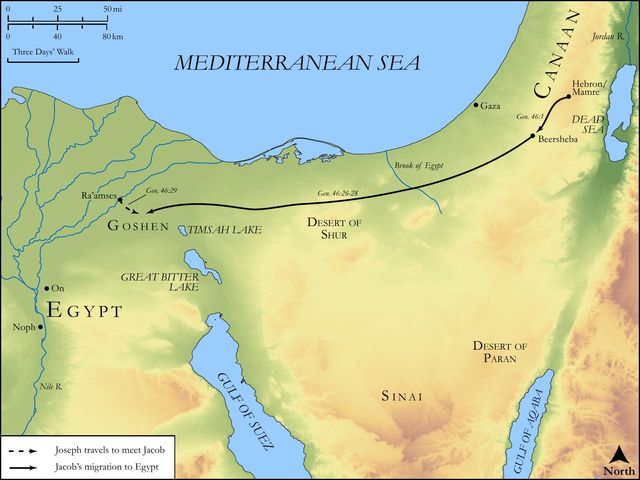
He came to Beersheba, from Hebron, where he now dwelt; and there he offered sacrifices to the God of his father Isaac, Gen 46:1. He chose that place, in remembrance of the communion which his father and grandfather had with God in that place. Abraham called on God there (Gen 21:33), so did Isaac (Gen 26:25), and therefore Jacob made it the place of his devotion, the rather because it lay in his way. In his devotion, 1. He had an eye to God as the God of his father Isaac, that is, a God in covenant with him; for by Isaac the covenant was entailed upon him. God had forbidden Isaac to go down to Egypt when there was a famine in Canaan (Gen 26:2), which perhaps Jacob calls to mind when he consults God as the God of his father Isaac, with this thought, "Lord, though I am very desirous to see Joseph, yet if thou forbid me to go down to Egypt, as thou didst my father Isaac, I will submit, and very contentedly stay where I am." 2. He offered sacrifices, extraordinary sacrifices, besides those at his stated times; these sacrifices were offered, (1.) By way of thanksgiving for the late blessed change of the face of his family, for the good news he had received concerning Joseph, and for the hopes he had of seeing him. Note, We should give God thanks for the beginnings of mercy, though they are not yet perfected; and this is a decent way of begging further mercy. (2.) By way of petition for the presence of God with him in his intended journey; he desired by these sacrifices to make his peace with God, to obtain the forgiveness of sin, that he might take no guilt along with him in this journey, for that is a bad companion. By Christ, the great sacrifice, we must reconcile ourselves to God, and offer up our requests to him. (3.) By way of consultation. The heathen consulted their oracles by sacrifice. Jacob would not go till he had asked God's leave: "Shall I go down to Egypt, or back to Hebron?" Such must be our enquiries in doubtful cases; and, though we cannot expect immediate answers from heaven, yet, if we diligently attend to the directions of the word, conscience, and providence, we shall find it is not in vain to ask counsel of God.
II.How God directed his paths:
In the visions of the night (probably the very next night after he had offered his sacrifices, as Ch2 1:7) God spoke unto him, Gen 46:2. Note, Those who desire to keep up communion with God shall find that it never fails on his side. If we speak to him as we ought, he will not fail to speak to us. God called him by name, by his old name, Jacob, Jacob, to remind him of his low estate; his present fears did scarcely become an Israel. Jacob, like one well acquainted with the visions of the Almighty, and ready to obey them, answers, "Here I am, ready to receive orders:" and what has God to say to him?
1.He renews the covenant with him: I am God, the God of thy father (Gen 46:3); that is, "I am what thou ownest me to be: thou shalt find me a God, a divine wisdom and power engaged for thee; and thou shalt find me the God of thy father, true to the covenant made with him."
2.He encourages him to make this removal of his family: Fear not to go down into Egypt. It seems, though Jacob, upon the first intelligence of Joseph's life and glory in Egypt, resolved, without any hesitation, I will go and see him; yet, upon second thoughts, he saw some difficulties in it, which he knew not well how to get over. Note, Even those changes that seem to have in them the greatest joys and hopes, yet have an alloy of cares and fears, Nulla est sincera voluptas - There is no unmingled pleasure. We must always rejoice with trembling. Jacob had many careful thoughts about this journey, which God took notice of.
(1.)He was old, 130 years old; and it is mentioned as one of the infirmities of old people that they are afraid of that which is high, and fears are in the way, Ecc 12:5. It was a long journey, and Jacob was unfit for travel, and perhaps remembered that his beloved Rachel died in a journey.
(2.)He feared lest his sons should be tainted with the idolatry of Egypt, and forget the God of their fathers, or enamoured with the pleasures of Egypt, and forget the land of promise.
(3.)Probably he thought of what God had said to Abraham concerning the bondage and affliction of his seed (Gen 15:13), and was apprehensive that his removal to Egypt would issue in that. Present satisfactions should not take us off from the consideration and prospect of future inconveniences, which possibly may arise from what now appears most promising.
(4.)He could not think of laying his bones in Egypt. But, whatever his discouragements were, this was enough to answer them all, Fear not to go down into Egypt.
3.He promises him comfort in the removal. (1.) That he should multiply in Egypt: "I will there, where thou fearest that thy family will sink and be lost, make it a great nation. That is the place Infinite Wisdom has chosen for the accomplishment of that promise." (2.) That he should have God's presence with him: I will go down with thee into Egypt. Note, Those that go whither God sends them shall certainly have God with them, and that is enough to secure them wherever they are and to silence their fears; we may safely venture even into Egypt if God go down with us. (3.) That neither he nor his should be lost in Egypt: I will surely bring thee up again. Though Jacob died in Egypt, yet this promise was fulfilled, [1.] In the bringing up of his body, to be buried in Canaan, about which, it appears, he was very solicitous, Gen 49:29, Gen 49:32. [2.] In the bringing up of his seed to be settled in Canaan. Whatever low or darksome valley we are called into at any time, we may be confident, if God go down with us into it, that he will surely bring us up again. If he go with us down to death, he will surely bring us up again to glory. (4.) That living and dying, his beloved Joseph should be a comfort to him: Joseph shall put his hand upon thine eyes. This is a promise that Joseph should live as long as he lived, that he should be with him at his death, and close his eyes with all possible tenderness and respect, as the dearest relations used to do. Probably Jacob, in the multitude of this thought within him, had been wishing that Joseph might do this last office of love for him: Ille meos oculos comprimat - Let him close my eyes; and God thus answered him in the letter of his desire. Thus God sometimes gratifies the innocent wishes of his people, and makes not only their death happy, but the very circumstances of it agreeable.
Continue studying Genesis 46:2 across the web’s major study libraries — every link below opens this exact verse, chapter, or book on the destination site.
Read & Compare
 BibleGatewayThis verse in more than 200 translations and 70 languages.
 Bible.comThe YouVersion reader — hundreds of translations, reading plans, and highlights.
 ESV.orgCrossway's official English Standard Version reader.
 NET BibleThe NET translation with 60,000+ translators' notes on every rendering decision.
 STEP BibleTyndale House's free study tool — original text, vocabulary, and scholarly resources.
 BibliaLogos Bible Software's free web reader.
 USCCBThe New American Bible (Revised Edition) with the U.S. bishops' study notes.
Commentaries
 BibleHub CommentariesDozens of classic commentaries on this verse, gathered on one page.
 StudyLightMore than 100 commentary sets — the largest collection on the web.
 BibleRefPlain-English commentary on what this verse means, verse by verse.
 Enduring WordDavid Guzik's free commentary on this chapter, widely used by Bible teachers.
 Bible Study ToolsVerse commentary alongside Greek and Hebrew study aids.
Original Language & Research
- BibleHub InterlinearThe verse word by word — original language, transliteration, and English.
- BibleHub LexiconEvery word's original-language definition and Strong's entry.
 Blue Letter BibleDeep-study tools — Strong's numbers, concordance, and word studies.
 SefariaThe Hebrew text with Rashi and centuries of Jewish commentary.
Sermons, Hymns & Audio


TrulyRandomVerse is not affiliated with these sites and doesn’t control their content. They’re linked because they’re genuinely useful.
Summary
Genesis 46:2 records a profound divine encounter where God directly communicates with Jacob (Israel) through a night vision, offering crucial reassurance and guidance as the patriarch contemplates the momentous journey to Egypt to reunite with his long-lost son Joseph. This pivotal interaction underscores God's active and personal involvement in the lives of His covenant people, providing comfort, clarity, and direction amidst significant life transitions and profound uncertainty.
Context
ShowHideLiterary Context
Genesis 46:2 is situated at a critical juncture in the patriarchal narrative, immediately following Jacob's receipt of the astonishing news that Joseph is alive and ruler in Egypt (Genesis 45:28). This news prompts Jacob's decision to journey to Egypt. Before embarking, however, Jacob pauses at Beersheba, a place hallowed by previous divine encounters with Abraham and Isaac (Genesis 26:24), to offer sacrifices to God. This act signifies his seeking divine counsel and approval for a move that would take him and his family out of the Promised Land, a land divinely covenanted to his forefathers. The verse thus sets the stage for God's direct intervention, providing the necessary divine mandate and comfort for this unprecedented relocation.
Historical & Cultural Context
In the days of the patriarchs, significant journeys and major life decisions, especially those involving the relocation of an entire family and its possessions, were often undertaken with great deliberation and, for the faithful, with a reliance on divine guidance. Leaving the land of Canaan, which was the promised inheritance of Abraham's descendants, would have been a profoundly weighty decision for Jacob. The practice of seeking divine oracles, dreams, or visions before such undertakings was common. "Visions of the night" were understood as a direct, supernatural mode of revelation, distinct from ordinary dreams, conveying authoritative divine messages. For Jacob, who had experienced profound divine encounters throughout his life (e.g., Genesis 28:12-15), this specific mode of communication would have carried immense weight and certainty.
Key Themes
ShowHideThis verse powerfully contributes to several overarching themes in Genesis and the broader biblical narrative. It highlights God's sovereign providence and meticulous oversight of His covenant plan, demonstrating that even a seemingly drastic move like going to Egypt is part of His larger design to preserve and multiply His people, ultimately fulfilling the promises made to Abraham (Genesis 12:2-3). The verse also underscores the theme of divine guidance and reassurance, as God actively intervenes to alleviate Jacob's potential fears and provide clear direction. Furthermore, the intimate address "Jacob, Jacob" reinforces the theme of God's personal relationship with His chosen patriarchs, emphasizing His intimate knowledge and care for His people, a theme echoed throughout the narratives of Abraham, Isaac, and Jacob.
Exposition and Analysis
ShowHideKey Word Analysis
ShowHideThis plural form, used here with a singular verb, refers specifically to the supreme God. Its usage emphasizes God's majesty, power, and ultimate authority as the one true deity who initiates and directs Jacob's journey. The term denotes the divine being who is sovereign over all creation and actively involved in the affairs of humanity, particularly in His covenant relationship with Israel.
Derived from a root meaning "to see," this term denotes a divine revelation, often in a waking state or a heightened spiritual experience, distinct from an ordinary dream. It implies a direct, clear, and divinely initiated communication, ensuring Jacob understood that the message was from God Himself and not a product of his own thoughts or anxieties. The "visions of the night" signify a supernatural encounter, emphasizing the gravity and certainty of the divine message.
This primitive root is a broad term meaning "to say," encompassing a wide range of verbal communication, from a simple utterance to a solemn declaration or command. In this context, it signifies God's direct, intentional, and authoritative communication to Jacob. The repetition of this verb ("spake... and said") underscores the divine initiative and the clarity with which God conveyed His message to the patriarch, leaving no room for doubt about the origin or purpose of the revelation.
Verse Breakdown
ShowHide"And God spake unto Israel in the visions of the night"
This clause establishes the divine initiative and the specific mode of revelation. God, identified by His covenant name "Israel" (given to Jacob in Genesis 35:10), actively initiates communication. The phrase "visions of the night" indicates a direct, supernatural encounter, distinct from a mere dream, conveying a clear and authoritative message. This highlights God's sovereign choice to reveal His will and presence to Jacob at a critical juncture, providing clarity and comfort when human wisdom might falter.
"and said, Jacob, Jacob"
The repetition of Jacob's personal name is a significant rhetorical device in Hebrew scripture. It conveys a sense of urgency, deep personal address, and profound importance, often preceding a momentous divine instruction or revelation. Similar double calls are found in other biblical narratives, such as God calling to Samuel or Moses, signifying that the recipient is being singled out for a vital purpose and that God is speaking with intense focus, tenderness, and a desire for immediate attention. This repetition underscores the intimate and personal nature of God's relationship with Jacob, affirming His intimate knowledge and profound care for the patriarch.
"And he said, Here [am] I"
Jacob's immediate and concise response, hineni (Hebrew for "Here am I"), is a classic biblical affirmation of readiness, attentiveness, and availability to God's call. It signifies not merely physical presence but a spiritual posture of submission, humility, and willingness to listen and obey. Despite any potential apprehension about leaving the Promised Land, Jacob's reply demonstrates his deep-seated faith and his readiness to receive and act upon divine instruction, setting the stage for the subsequent divine promises and commands.
Literary Devices
ShowHideGenesis 46:2 employs several literary devices to enhance its impact and meaning. The most prominent is Repetition, specifically the doubling of Jacob's name ("Jacob, Jacob"). This literary technique is used throughout the Old Testament to convey urgency, deep personal address, and the profound importance of the message that follows. It serves to capture the recipient's full attention and underscore the gravity and tenderness of the divine call, indicating that God is speaking directly and intimately to Jacob about a matter of great consequence. Furthermore, the verse participates in the broader literary pattern of a Divine Call Narrative. This pattern typically involves God initiating contact, identifying the recipient, issuing a call or command, and the recipient responding. Jacob's immediate "Here am I" (hineni) is a quintessential response in such narratives, signaling his readiness and availability to God's will, even before the specific instructions are given. This pattern emphasizes the sovereign initiative of God and the necessary posture of obedient faith from His chosen servants.
Theological and Thematic Connections
ShowHideGod's direct communication to Jacob in Genesis 46:2 profoundly illustrates His active and personal involvement in the lives of His people, particularly during times of significant transition, uncertainty, or fear. This encounter reveals God's unwavering commitment to His covenant promises, demonstrating that even a journey seemingly away from the Promised Land is meticulously orchestrated within His sovereign plan for the preservation and multiplication of His chosen nation. It highlights that God knows His people intimately, addresses them with care and urgency, and expects a posture of readiness and obedience, assuring them of His abiding presence and guidance through every step of their journey.
Reflection and Application
ShowHideGenesis 46:2 offers profound insights for contemporary believers, reminding us of God's enduring faithfulness and personal engagement in our lives. Just as God intimately addressed Jacob in his moment of significant transition and potential apprehension, He continues to offer guidance and reassurance to us today. When faced with daunting decisions, uncertainties about the future, or major life changes, we are called to seek God's counsel through prayer, diligent study of Scripture, and attentive listening to the Holy Spirit, trusting that He is faithful to His promises and will direct our paths. Jacob's immediate and humble response, "Here am I," serves as a powerful model for our own readiness to listen attentively and obey God's voice, even when His plan leads us to unfamiliar or challenging territories. This posture of availability is crucial, as it positions us to receive divine instruction and experience God's sovereign hand at work for our ultimate good and His glory, transforming our anxieties into opportunities for deeper trust and obedience.
Questions for Reflection
ShowHideFAQ
ShowHideWhy did God speak to Jacob in a "vision of the night"?
ShowHideGod often communicated with His patriarchs and prophets through dreams and visions, especially during the night, to convey messages with clarity, solemnity, and divine authority, often bypassing the distractions of daily life. This method emphasizes the supernatural origin of the message and its critical importance, ensuring Jacob understood that the directive to go to Egypt was from God Himself, not merely a human decision or a product of his own anxieties. It underscores the divine initiative in guiding His covenant people.
What is the significance of the repetition "Jacob, Jacob"?
ShowHideIn Hebrew, the repetition of a name signifies urgency, deep personal affection, and the profound importance of the message that follows. It's a literary device used to capture the full attention of the recipient and underscore the gravity and tenderness of the divine call, indicating that God is speaking directly and intimately to Jacob about a matter of great consequence for his life and the future of his descendants. It highlights the personal nature of God's relationship with His chosen ones.
What does Jacob's response, "Here am I" (hineni), signify?
ShowHideHineni is a common biblical response indicating not just physical presence, but a spiritual readiness, attentiveness, and willingness to obey God's command or receive His instruction. It conveys a posture of humble submission and availability, signifying that Jacob was prepared to listen and respond to whatever God would reveal, despite any personal reservations about leaving Canaan. It is a response of faith and commitment to God's sovereign will.
Christ-Centered Fulfillment
ShowHideGenesis 46:2, with God's personal call to Jacob and His promise of presence, finds its ultimate and most profound fulfillment in Jesus Christ. The divine voice calling "Jacob, Jacob" prefigures Christ's own intimate call to His disciples, "Follow me" (Matthew 4:19), inviting individuals into a personal relationship and a divinely guided journey that transcends earthly limitations. Just as God promised to go down to Egypt with Jacob (Genesis 46:4) and bring him back, Christ is Emmanuel, "God with us" (Matthew 1:23), the incarnate Word who tabernacled among us (John 1:14). He promises His abiding presence with His followers through all life's uncertainties, even to the end of the age (Matthew 28:20), assuring us, "I will never leave you nor forsake you" (Hebrews 13:5). The preservation of the nascent nation of Israel through their sojourn in Egypt, initiated by this divine encounter, was crucial for the lineage through which the Messiah would eventually come, demonstrating God's meticulous sovereign plan to bring salvation to humanity through the person and redemptive work of Jesus Christ, the ultimate fulfillment of all God's promises.