


Exodus 3:4
Bible text: King James Version (1769 Blayney text) · Public domain
Bible text: King James Version with Strong's numbers · Public domain
Bible text: Berean Standard Bible · Public domain
Bible text: American Standard Version (1901) · Public domain
Bible text: World English Bible, Messianic edition · Public domain
Bible text: Geneva Bible (1599) · Public domain
Bible text: Young's Literal Translation · Public domain
- וַיַּרְאvai·Yar'and he sawH7200Conj-w ¦ V-Qal-ConsecImperf-3msVerb Qal Consecutive Imperfect 3rd Singular Masculineוַandיַּרְאhe saw
- יְהוָהYah·wehYahwehH3068N-properNoun Proper Title
- כִּיkithatH3588PrtParticle Conditional
- סָרsarhe had turned asideH5493V-Qal-Perf-3msVerb Qal Perfect 3rd Singular Masculine
- לִרְאוֹתlir·'otto lookH7200Prep-l ¦ V-Qal-InfVerb Qal Infinitive Constructלִtoרְאוֹתlook
- וַיִּקְרָאvai·yik·Ra'and he calledH7121Conj-w ¦ V-Qal-ConsecImperf-3msVerb Qal Consecutive Imperfect 3rd Singular Masculineוַandיִּקְרָאhe called
- אֵלָיו'e·Lavto himH413Prep ¦ 3msPreposition Definiteאֵלָיtoוhim
- אֱלֹהִים'E·lo·HimGodH430N-mpNoun Plural Masculine Absolute
- מִתּוֹךְmi·Tokhfrom [the] middle ofH8432Prep-m ¦ N-mscNoun Singular Masculine Constructמִfromתּוֹךְ[the] middle of
- הַסְּנֶהha·se·Nehthe bushH5572Art ¦ N-msNoun Singular Masculine Absoluteהַtheסְּנֶהbush
- וַיֹּאמֶרvai·Yo·merand he saidH559Conj-w ¦ V-Qal-ConsecImperf-3msVerb Qal Consecutive Imperfect 3rd Singular Masculineוַandיֹּאמֶרhe said
- מֹשֶׁהmo·ShehO MosesH4872N-proper-mNoun Proper Masculine
- מֹשֶׁהmo·ShehMosesH4872N-proper-mNoun Proper Masculine
- וַיֹּאמֶרvai·Yo·merand he saidH559Conj-w ¦ V-Qal-ConsecImperf-3msVerb Qal Consecutive Imperfect 3rd Singular Masculineוַandיֹּאמֶרhe said
- הִנֵּנִיhi·Ne·nihere [am] IH2009Prt ¦ 1csParticle Interjectionהִנֵּhere [am]נִיI
English is a literal word-by-word gloss of the Hebrew, not the KJV's wording. Why?
This is the original text the KJV's translators worked from — each Hebrew word with its own literal English meaning in this verse, prepared by scholars at Tyndale House, Cambridge. The KJV translates whole sentences, not word by word, so its wording differs: one Hebrew word can become several English words, and the KJV may choose “the LORD” where the gloss reads “Yahweh”. Both are faithful — they answer different questions. For the KJV's own rendering, switch to the KJV text.
Details
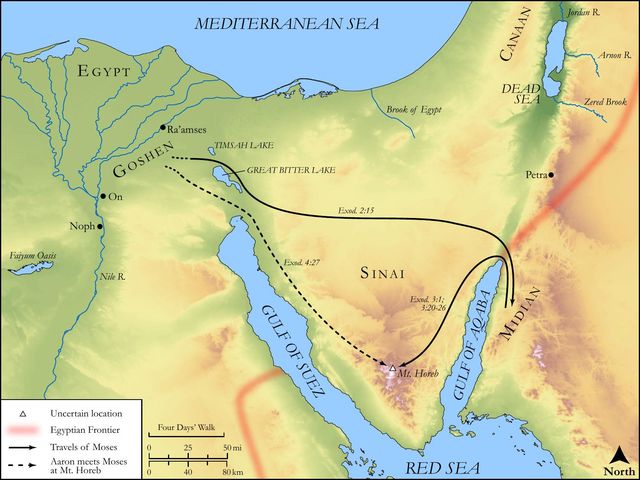
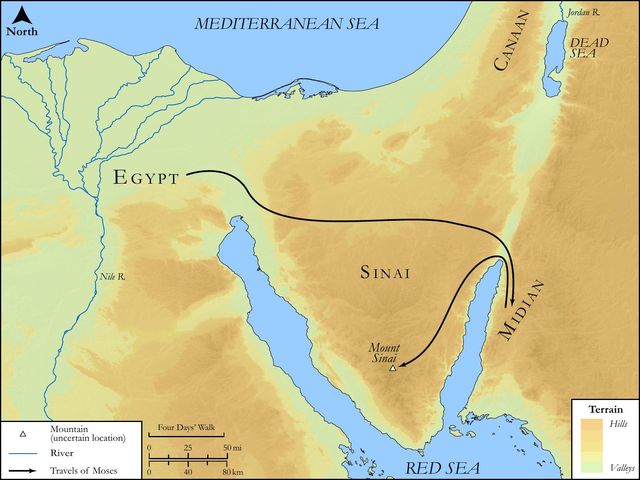
See on the biblical-era maps

Study this verse
Public-domain commentary
Matthew Henry
From his Commentary on the Whole Bible. Henry comments on passages, not single verses — this entry covers Exodus 3:1–6. His four-level outline is real structure in the source text, so it is rendered as structure.
The years of the life of Moses are remarkably divided into three forties: the first forty he spent as a prince in Pharaoh's court, the second a shepherd in Midian, the third a king in Jeshurun; so changeable is the life of men, especially the life of good men. He had now finished his second forty, when he received his commission to bring Israel out of Egypt. Note, Sometimes it is long before God calls his servants out of that work which of old he designed them for, and has been graciously preparing them for. Moses was born to be Israel's deliverer, and yet not a word is said of it to him till he is eighty years of age. Now obverve,
I.How this appearance of God to him found him employed.
He was keeping the flock (tending sheep) near mount Horeb, Exo 3:1. This was a poor employment for a man of his parts and education, yet he rests satisfied with it, and thus learns meekness and contentment to a high degree, for which he is more celebrated in sacred writ than for all his other learning. Note,
1.In the calling to which we are called we should abide, and not be given to change.
2.Even those that are qualified for great employments and services must not think it strange if they be confined to obscurity; it was the lot of Moses before them, who foresaw nothing to the contrary but that he should die, as he had lived a great while, a poor despicable shepherd. Let those that think themselves buried alive be content to shine like lamps in their sepulchres, and wait till God's time come for setting them on a candlestick. Thus employed Moses was, when he was honoured with this vision. Note,
(1.)God will encourage industry. The shepherds were keeping their flocks when they received the tidings of our Saviour's birth, Luk 2:8. Satan loves to find us idle; God is well pleased when he find us employed.
(2.)Retirement is a good friend to our communion with God. When we are alone, the Father is with us. Moses saw more of God in a desert than ever he had seen in Pharaoh's court.
II.What the appearance was.
To his great surprise he saw a bush burning, when he perceived no fire either from earth or heaven to kindle it, and, which was more strange, it did not consume, Exo 3:2. It was an angel of the Lord that appeared to him; some think, a created angel, who speaks in the language of him that sent him; others, the second person, the angel of the covenant, who is himself Jehovah. It was an extraordinary manifestation of the divine presence and glory; what was visible was produced by the ministry of an angel, but he heard God in it speaking to him.
1.He saw a flame of fire; for our God is a consuming fire. When Israel's deliverance out of Egypt was promised to Abraham, he saw a burning lamp, which signified the light of joy which that deliverance should cause (Gen 15:17); but now it shines brighter, as a flame of fire, for God in that deliverance brought terror and destruction to his enemies, light and heat to his people, and displayed his glory before all. See Isa 10:17.
2.This fire was not in a tall and stately cedar, but in a bush, a thorny bush, so the word signifies; for God chooses the weak and despised things of the world (such as Moses, now a poor shepherd), with them to confound the wise; he delights to beautify and crown the humble.
3.The bush burned, and yet was not consumed, an emblem of the church now in bondage in Egypt, burning in the brick-kilns, yet not consumed; perplexed, but not in despair; cast down, but not destroyed.
III.The curiosity Moses had to enquire into this extraordinary sight:
I will turn aside and see, Exo 3:3. He speaks as one inquisitive and bold in his enquiry; whatever it was, he would, if possible, know the meaning of it. Note, Things revealed belong to us, and we ought diligently to enquire into them.
IV.The invitation he had to draw near, yet with a caution not to come too near, nor rashly.
1.God gave him a gracious call, to which he returned a ready answer, Exo 3:4. When God saw that he took notice of the burning bush, and turned aside to see it, and left his business to attend it, then God called to him. If he had carelessly neglected it as an ignis fatuus - a deceiving meteor, a thing not worth taking notice of, it is probable that God would have departed, and said nothing to him; but, when he turned aside, God called to him. Note, Those that would have communion with God must attend upon him, and approach to him, in those ordinances wherein he is pleased to manifest himself, and his power and glory, though it be in a bush; they must come to the treasure, though in an earthen vessel. Those that seek God diligently shall find him, and find him their bountiful rewarder. Draw nigh to God, and he will draw nigh to you. God called him by name, Moses, Moses. This which he heard could not but surprise him much more than what he saw. The word of the Lord always went along with the glory of the Lord, for every divine vision was designed for divine revelation, Job 4:16, etc.; Job 32:14-15. Divine calls are then effectual,
(1.)When the Spirit of God makes them particular, and calls us by name. The word calls, Ho, every one! The Spirit, by the application of that, calls, Ho, such a one! I know thee by name, Exo 33:12.
(2.)When we return an obedient answer to them, as Moses here, "Here am I, what saith my Lord unto his servant? Here am I, not only to hear what is said, but to do what I am bidden."
2.God gave him a needful caution against rashness and irreverence in his approach,
(1.)He must keep his distance; draw near, but not too near; so near as to hear, but not so near as to pry. His conscience must be satisfied, but not his curiosity; and care must be taken that familiarity do not breed contempt. Note, In all our approaches to God, we ought to be deeply affected with the infinite distance there is between us and God, Ecc 5:2. Or this may be taken as proper to the Old Testament dispensation, which was a dispensation of darkness, bondage, and terror, from which the gospel happily frees us, giving us boldness to enter into the holiest, and inviting us to draw near.
(2.)He must express his reverence, and his readiness to obey: Put off thy shoes from off thy feet, as a servant. Putting off the shoe was then what putting off the hat is now, a token of respect and submission. "The ground, for the present, is holy ground, made so by this special manifestation of the divine presence, during the continuance of which it must retain this character; therefore tread not on that ground with soiled shoes." Keep thy foot, Ecc 5:1. Note, We ought to approach to God with a solemn pause and preparation; and, though bodily exercise alone profits little, yet we ought to glorify God with our bodies, and to express our inward reverence by a grave and reverent behaviour in the worship of God, carefully avoiding everything that looks light, and rude, and unbecoming the awfulness of the service.
V.The solemn declaration God made of his name, by which he would be known to Moses: I am the God of thy father, Exo 3:6.
1.He lets him know that it is God who speaks to him, to engage his reverence and attention, his faith and obedience; for this is enough to command all these: I am the Lord. Let us always hear the word as the word of God, Th1 2:13.
2.He will be known as the God of his father, his pious father Amram, and the God of Abraham, Isaac, and Jacob, his ancestors, and the ancestors of all Israel, for whom God was now about to appear. By this God designed,
(1.)To instruct Moses in the knowledge of another world, and to strengthen his belief of a future state. Thus it is interpreted by our Lord Jesus, the best expositor of scripture, who from this proves that the dead are raised, against the Sadducees. Moses, says he, showed it at the bush (Luk 20:37), that is, God there showed it to him, and in him to us, Mat 22:31, etc. Abraham was dead, and yet God is the God of Abraham; therefore Abraham's soul lives, to which God stands in relation; and, to make his soul completely happy, his body must live again in due time. This promise made unto the fathers, that God would be their God, must include a future happiness; for he never did anything for them in this world sufficient to answer to the vast extent and compass of that great word, but, having prepared for them a city, he is not ashamed to be called their God, Heb 11:16; and see Act 26:6, Act 26:7; Act 24:15.
(2.)To assure Moses of the fulfillment of all those particular promises made to the fathers. He may confidently expect this, for by these words it appears that God remembered his covenant, Exo 2:24. Note,
[1.]God's covenant-relation to us as our God is the best support in the worst of times, and a great encouragement to our faith in particular promises.
[2.]When we are conscious to ourselves of our own great unworthiness we may take comfort from God's relation to our fathers, Ch2 20:6.
VI.The solemn impression this made upon Moses:
He hid his face, as one both ashamed and afraid to look upon God. Now that he knew it was a divine light his eyes were dazzled with it; he was not afraid of a burning bush till he perceived that God was in it. Yea, though God called himself the God of his father, and a God in covenant with him, yet he was afraid. Note,
1.The more we see of God the more cause we shall see to worship him with reverence and godly fear.
2.Even the manifestations of God's grace and covenant-love should increase our humble reverence of him.
Historical interpretation
Historical reception
3 surviving comments on this verse. Each one is dated, so this reads as a timeline rather than a list.
Select a marker to jump to its quote. Markers stagger vertically where authors wrote within a few decades of each other.
Why should we despair that God should speak in men, who spoke in the thorn bush? God did not despise the bush. Would that he might also give light to my thorns. Perhaps some may wonder that there is some light even in our thorns. Some of our thorns will not burn. There will be some whose shoes shall be put off their feet at the sound of my voice, that the steps of the mind may be freed from bodily hindrances.
Was the Lord speaking through an angel? Or was the Lord that angel who has been called the “angel of great counsel” and is understood to be Christ? For Scripture said above, “the angel of the Lord appeared to him.”
This is why he summons Moses by his fatherly voice, addresses him with paternal love and invites him to be the liberator of his people. Why should I say more? He makes him a god; he sets him up as a god before Pharaoh. He makes him a god, fortifies him with signs, arms him with virtues, wins wars through mere commands, grants to him as a soldier victory gained by a mere word. By his orders he concedes him a triumph and leads him through all the crowns of virtues to his own friendship, gives him an opportunity to share in his heavenly kingdom and allows him to be a legislator. However, Moses received all this that he might love—that at length he might be so inflamed with the love of God that he would burn with it himself and encourage others to have it too.
Continue studying Exodus 3:4 across the web’s major study libraries — every link below opens this exact verse, chapter, or book on the destination site.
Read & Compare
 BibleGatewayThis verse in more than 200 translations and 70 languages.
 Bible.comThe YouVersion reader — hundreds of translations, reading plans, and highlights.
 ESV.orgCrossway's official English Standard Version reader.
 NET BibleThe NET translation with 60,000+ translators' notes on every rendering decision.
 STEP BibleTyndale House's free study tool — original text, vocabulary, and scholarly resources.
 BibliaLogos Bible Software's free web reader.
 USCCBThe New American Bible (Revised Edition) with the U.S. bishops' study notes.
Commentaries
 BibleHub CommentariesDozens of classic commentaries on this verse, gathered on one page.
 StudyLightMore than 100 commentary sets — the largest collection on the web.
 BibleRefPlain-English commentary on what this verse means, verse by verse.
 Enduring WordDavid Guzik's free commentary on this chapter, widely used by Bible teachers.
 Bible Study ToolsVerse commentary alongside Greek and Hebrew study aids.
Original Language & Research
- BibleHub InterlinearThe verse word by word — original language, transliteration, and English.
- BibleHub LexiconEvery word's original-language definition and Strong's entry.
 Blue Letter BibleDeep-study tools — Strong's numbers, concordance, and word studies.
 SefariaThe Hebrew text with Rashi and centuries of Jewish commentary.
Sermons, Hymns & Audio


TrulyRandomVerse is not affiliated with these sites and doesn’t control their content. They’re linked because they’re genuinely useful.
Summary
Exodus 3:4 describes the pivotal moment of divine initiative where the LORD, observing Moses' inquisitive turning toward the unconsumed burning bush, personally calls out to him. This direct, intimate summons, marked by the repetition of Moses' name, elicits an immediate and profound response of availability from Moses, "Here am I," signifying his readiness for the profound encounter and subsequent divine commission.
Context
ShowHideLiterary Context
This verse is the climax of an introductory narrative (Exodus 3:1-6) that sets the stage for Moses' divine commissioning. Preceding it, Exodus 3:1-3 establishes Moses' humble role as a shepherd in Midian, far from the Egyptian court. The sudden appearance of the burning bush, which defies natural laws by not being consumed, serves as an undeniable sign of divine presence. Moses' decision to "turn aside to see" (Exodus 3:3) is crucial, indicating his curiosity and attentiveness, which God then responds to. Following this verse, Exodus 3:5-6 immediately reveals God's holiness and self-identification, preparing Moses for the weighty task of leading Israel out of bondage.
Historical & Cultural Context
Moses, having fled Egypt after killing an Egyptian (Exodus 2:11-15), has spent forty years in the wilderness of Midian, a period of obscurity and preparation. The setting, "the backside of the desert" near "the mountain of God, even Horeb" (Exodus 3:1), emphasizes Moses' isolation and the sacredness of the location. Mountains were often places of divine encounter in Scripture, from Moriah to Horeb itself. The act of a deity calling an individual by name was a powerful and personal act, signifying a unique relationship and a specific purpose, often for a significant mission.
Key Themes
ShowHideExodus 3 introduces several foundational themes. The primary theme is Divine Revelation and Initiative, as God actively seeks out and speaks to Moses, rather than waiting to be sought. This encounter also highlights God's Holiness and Transcendence, demonstrated by the miraculous fire and the sacred ground (Exodus 3:5). Furthermore, it establishes the theme of Personal Calling and Commissioning, where God chooses an individual for a specific, monumental task, as seen in God's subsequent instructions to Moses in Exodus 3:7-10. Moses' response, "Here am I," also introduces the theme of Human Availability and Obedience to the divine call.
Exposition and Analysis
ShowHideKey Word Analysis
ShowHideThis is the covenant name of God, often translated as "Jehovah" or "the Lord." It signifies God as the self-Existent or Eternal One, emphasizing His unchanging, sovereign nature and His personal relationship with His people. The use of this name here indicates that the God who calls Moses is the same God who established a covenant with Abraham, Isaac, and Jacob.
This word means "to see, literally or figuratively." In this context, it conveys God's active observation and perception. It's not a passive seeing, but an attentive, intentional observation of Moses' actions and heart, leading to divine intervention. God "saw" Moses' curiosity and responded to it.
Meaning "to call out to," or "address by name." This word emphasizes the direct, vocal, and personal nature of God's communication. It signifies a divine summons, a deliberate act of choosing and engaging with Moses, setting him apart for a specific purpose.
Meaning "drawing out (of the water), i.e. rescued." The repetition of Moses' name ("Moses, Moses") is a significant Hebrew literary device. It serves to gain full attention, convey urgency, and underscore the deeply personal and intimate nature of the divine address. It's a direct, unmistakable summons to the individual.
Verse Breakdown
ShowHide"And when the LORD saw that he turned aside to see"
This clause highlights God's divine initiative and omniscience. God is not merely present but actively observing Moses' response to the miraculous sight. Moses' act of "turning aside" (Hebrew: çûwr, H5493) signifies a deliberate choice to investigate, a moment of curiosity that God honors by initiating communication. It underscores that God often meets us in our moments of seeking and attentiveness.
"God called unto him out of the midst of the bush, and said, Moses, Moses."
This is the core of the divine encounter. The "God" (Hebrew: ʼĕlôhîym, H430), the supreme God, speaks directly from the very source of the miraculous phenomenon. The repetition of Moses' name is a powerful, intimate, and urgent summons, demanding his full attention and signaling the profound significance of the impending message. It transforms a moment of curiosity into a personal, divine appointment.
"And he said, Here [am] I."
Moses' immediate and concise response, "Here am I" (Hebrew: hinnēnî), is a profound declaration of availability, readiness, and attentiveness. It is not merely an acknowledgment of his physical location but a posture of willingness to listen, to obey, and to be present for whatever God is about to reveal or command. This response is a hallmark of biblical figures called by God (e.g., Abraham, Samuel, Isaiah).
Literary Devices
ShowHideThe verse employs several potent literary devices. Theophany is central, as God manifests His presence through the burning bush, a visual and auditory phenomenon that defies natural explanation and signifies divine holiness. The repetition of "Moses, Moses" is a powerful rhetorical device, emphasizing urgency, intimacy, and the personal nature of the divine call, ensuring Moses' undivided attention. Moses' response, "Here am I," is an example of idiom, a common Hebrew expression (hinnēnî) that conveys not just physical presence but a profound spiritual readiness and availability. The entire scene is imbued with symbolism, where the unconsumed bush represents God's enduring presence and power, and the fire, His holiness and purifying nature.
Theological and Thematic Connections
ShowHideExodus 3:4 is foundational for understanding the nature of God's interaction with humanity. It unequivocally demonstrates God's sovereignty and His active role in initiating a relationship and calling individuals to service, rather than waiting for human petition. This divine initiative underscores that salvation history is God-driven, not human-driven. The personal nature of the call, marked by the repetition of Moses' name, establishes a pattern of God's intimate knowledge of and specific purpose for individuals. It highlights that God sees, knows, and responds to human curiosity and readiness, transforming ordinary moments into sacred encounters.
Reflection and Application
ShowHideThe encounter at the burning bush in Exodus 3:4 offers profound lessons for contemporary believers. It reminds us that God is actively attentive to our lives, even in our mundane routines or periods of wilderness. Like Moses, we are called to cultivate a spirit of attentiveness, to "turn aside to see" the extraordinary in the ordinary, to notice God's presence and activity around us. God often speaks not in grand pronouncements but in moments that pique our spiritual curiosity. Our response to God's call should mirror Moses' "Here am I"—a posture of immediate availability, humble readiness, and a willingness to engage with God's purposes, whatever they may be. This verse challenges us to move beyond passive observation to active engagement with the divine, trusting that God's call, though personal, is always for a greater redemptive purpose.
Questions for Reflection
ShowHideFAQ
ShowHideWhy did God repeat Moses' name ("Moses, Moses")?
ShowHideThe repetition of a name in Hebrew scripture, such as "Moses, Moses" or "Abraham, Abraham" (as seen in Genesis 22:11), is a powerful literary and rhetorical device. It is used to convey extreme urgency, deep intimacy, and the profound significance of the impending message or command. It serves to capture the individual's full attention, signaling that what is about to be said is of paramount importance and requires an immediate, focused response. It transforms a general address into a deeply personal summons.
What is the significance of Moses' response, "Here am I"?
ShowHideMoses' response, "Here am I" (Hebrew: hinnēnî), is far more than a simple statement of physical location. It is a profound theological and spiritual declaration. It signifies a posture of immediate readiness, complete availability, and attentive willingness to listen, obey, and be present for whatever divine purpose is about to be revealed. It indicates a heart that is open to God's will and prepared to engage in the divine task, regardless of its difficulty or implications. This response is a model for all who are called by God, demonstrating submission and receptivity.
Does God still call individuals today in a similar way?
ShowHideWhile direct, audible calls from a miraculous phenomenon like a burning bush are exceptionally rare today, the principle of God calling individuals remains profoundly active. God continues to call people into relationship with Him, into discipleship, and into specific ministries and vocations. This call often comes through various means: through the clear teachings of His written Word, through the inner prompting of the Holy Spirit, through the wise counsel of the community of believers, and through the circumstances of life. The essence of the call—God's initiative and our required "Here am I" response—remains unchanged, inviting believers into a life of purpose and service.
Christ-Centered Fulfillment
ShowHideExodus 3:4, with its depiction of God's direct revelation and personal call to Moses, finds its ultimate and most complete fulfillment in Jesus Christ. The burning bush was a temporary, localized manifestation of God's presence and holiness, a pre-incarnate glimpse of the divine. In Christ, however, God's presence is fully and eternally incarnate; Jesus is the very "radiance of God's glory and the exact representation of his being" (Hebrews 1:3). He is the ultimate "Word of God" through whom God speaks most clearly and definitively to humanity (John 1:1-3, Hebrews 1:1-2). Moreover, Jesus perfectly embodied the "Here am I" response to the Father's will, declaring, "I have come to do your will, O God" (Hebrews 10:7). Through Christ, God's personal call is extended to all who believe, inviting them into an intimate relationship and commissioning them for His kingdom work, echoing the divine initiative and personal summons first seen at the burning bush, but now made accessible through the indwelling Spirit (John 14:16-17).