


Exodus 3:5
Bible text: King James Version (1769 Blayney text) · Public domain
Bible text: Berean Standard Bible · Public domain
Bible text: American Standard Version (1901) · Public domain
Bible text: World English Bible, Messianic edition · Public domain
Bible text: Geneva Bible (1599) · Public domain
Bible text: Young's Literal Translation · Public domain
- וַיֹּאמֶרvai·Yo·merand he saidH559Conj-w ¦ V-Qal-ConsecImperf-3msVerb Qal Consecutive Imperfect 3rd Singular Masculineוַandיֹּאמֶרhe said
- אַל'almay notH408NegParticle Negative
- תִּקְרַבtik·Ravyou draw nearH7126V-Qal-Imperf-2msVerb Qal Imperfect 2nd Singular Masculine
- הֲלֹםha·LomhereH1988AdvAdverb
- שַׁלshaltake offH5394V-Qal-Imp-2msVerb Qal Imperative 2nd Singular Masculine
- נְעָלֶיךָne·'a·Lei·khayour sandalsH5275N-mpc ¦ 2msNoun Plural Masculine Constructנְעָלֶיsandalsךָyour
- מֵעַלme·'Alfrom onH5921Prep-m ¦ PrepPrepositionמֵfromעַלon
- רַגְלֶיךָrag·Lei·khayour feetH7272N-fdc ¦ 2msNoun Dual Feminine Constructרַגְלֶיfeetךָyour
- כִּיkiforH3588PrtParticle Conditional
- הַמָּקוֹםha·ma·Komthe placeH4725Art ¦ N-msNoun Singular Masculine Absoluteהַtheמָּקוֹםplace
- אֲשֶׁר'a·SherwhichH834RelParticle Relative
- אַתָּה'a·TahyouH859Pro-2msPronoun Personal 2nd Singular Masculine
- עוֹמֵדo·Med[are] standingH5975V-Qal-Prtcpl-msVerb Qal Participle Singular Masculine Absolute
- עָלָיו'a·Lavon itH5921Prep ¦ 3msPreposition Definiteעָלָיonוit
- אַדְמַת'ad·mat[is] ground ofH127N-fscNoun Singular Feminine Construct
- קֹדֶשׁKo·deshholinessH6944N-msNoun Singular Masculine Absolute
- הוּאHu'itH1931Pro-3msPronoun Personal 3rd Singular Masculine
English is a literal word-by-word gloss of the Hebrew, not the KJV's wording. Why?
This is the original text the KJV's translators worked from — each Hebrew word with its own literal English meaning in this verse, prepared by scholars at Tyndale House, Cambridge. The KJV translates whole sentences, not word by word, so its wording differs: one Hebrew word can become several English words, and the KJV may choose “the LORD” where the gloss reads “Yahweh”. Both are faithful — they answer different questions. For the KJV's own rendering, switch to the KJV text.
Details
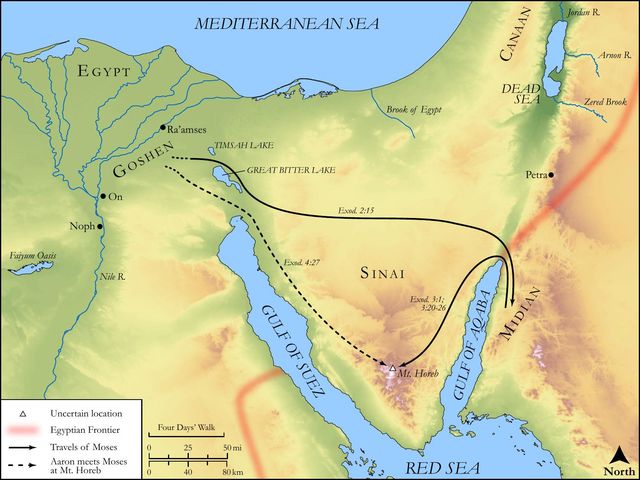
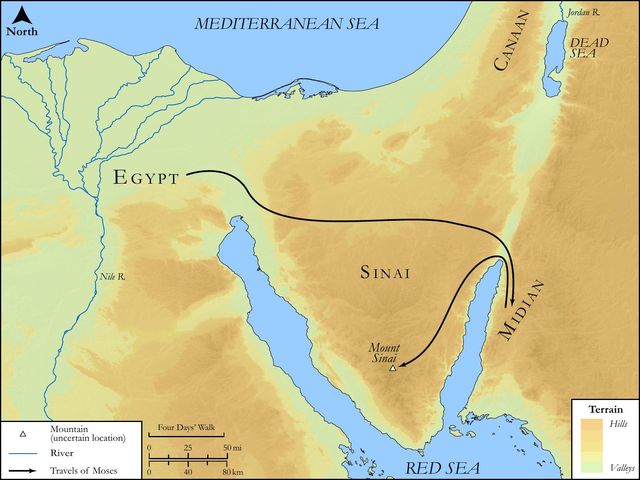
See on the biblical-era maps

Study this verse
Public-domain commentary
Matthew Henry
From his Commentary on the Whole Bible. Henry comments on passages, not single verses — this entry covers Exodus 3:1–6. His four-level outline is real structure in the source text, so it is rendered as structure.
The years of the life of Moses are remarkably divided into three forties: the first forty he spent as a prince in Pharaoh's court, the second a shepherd in Midian, the third a king in Jeshurun; so changeable is the life of men, especially the life of good men. He had now finished his second forty, when he received his commission to bring Israel out of Egypt. Note, Sometimes it is long before God calls his servants out of that work which of old he designed them for, and has been graciously preparing them for. Moses was born to be Israel's deliverer, and yet not a word is said of it to him till he is eighty years of age. Now obverve,
I.How this appearance of God to him found him employed.
He was keeping the flock (tending sheep) near mount Horeb, Exo 3:1. This was a poor employment for a man of his parts and education, yet he rests satisfied with it, and thus learns meekness and contentment to a high degree, for which he is more celebrated in sacred writ than for all his other learning. Note,
1.In the calling to which we are called we should abide, and not be given to change.
2.Even those that are qualified for great employments and services must not think it strange if they be confined to obscurity; it was the lot of Moses before them, who foresaw nothing to the contrary but that he should die, as he had lived a great while, a poor despicable shepherd. Let those that think themselves buried alive be content to shine like lamps in their sepulchres, and wait till God's time come for setting them on a candlestick. Thus employed Moses was, when he was honoured with this vision. Note,
(1.)God will encourage industry. The shepherds were keeping their flocks when they received the tidings of our Saviour's birth, Luk 2:8. Satan loves to find us idle; God is well pleased when he find us employed.
(2.)Retirement is a good friend to our communion with God. When we are alone, the Father is with us. Moses saw more of God in a desert than ever he had seen in Pharaoh's court.
II.What the appearance was.
To his great surprise he saw a bush burning, when he perceived no fire either from earth or heaven to kindle it, and, which was more strange, it did not consume, Exo 3:2. It was an angel of the Lord that appeared to him; some think, a created angel, who speaks in the language of him that sent him; others, the second person, the angel of the covenant, who is himself Jehovah. It was an extraordinary manifestation of the divine presence and glory; what was visible was produced by the ministry of an angel, but he heard God in it speaking to him.
1.He saw a flame of fire; for our God is a consuming fire. When Israel's deliverance out of Egypt was promised to Abraham, he saw a burning lamp, which signified the light of joy which that deliverance should cause (Gen 15:17); but now it shines brighter, as a flame of fire, for God in that deliverance brought terror and destruction to his enemies, light and heat to his people, and displayed his glory before all. See Isa 10:17.
2.This fire was not in a tall and stately cedar, but in a bush, a thorny bush, so the word signifies; for God chooses the weak and despised things of the world (such as Moses, now a poor shepherd), with them to confound the wise; he delights to beautify and crown the humble.
3.The bush burned, and yet was not consumed, an emblem of the church now in bondage in Egypt, burning in the brick-kilns, yet not consumed; perplexed, but not in despair; cast down, but not destroyed.
III.The curiosity Moses had to enquire into this extraordinary sight:
I will turn aside and see, Exo 3:3. He speaks as one inquisitive and bold in his enquiry; whatever it was, he would, if possible, know the meaning of it. Note, Things revealed belong to us, and we ought diligently to enquire into them.
IV.The invitation he had to draw near, yet with a caution not to come too near, nor rashly.
1.God gave him a gracious call, to which he returned a ready answer, Exo 3:4. When God saw that he took notice of the burning bush, and turned aside to see it, and left his business to attend it, then God called to him. If he had carelessly neglected it as an ignis fatuus - a deceiving meteor, a thing not worth taking notice of, it is probable that God would have departed, and said nothing to him; but, when he turned aside, God called to him. Note, Those that would have communion with God must attend upon him, and approach to him, in those ordinances wherein he is pleased to manifest himself, and his power and glory, though it be in a bush; they must come to the treasure, though in an earthen vessel. Those that seek God diligently shall find him, and find him their bountiful rewarder. Draw nigh to God, and he will draw nigh to you. God called him by name, Moses, Moses. This which he heard could not but surprise him much more than what he saw. The word of the Lord always went along with the glory of the Lord, for every divine vision was designed for divine revelation, Job 4:16, etc.; Job 32:14-15. Divine calls are then effectual,
(1.)When the Spirit of God makes them particular, and calls us by name. The word calls, Ho, every one! The Spirit, by the application of that, calls, Ho, such a one! I know thee by name, Exo 33:12.
(2.)When we return an obedient answer to them, as Moses here, "Here am I, what saith my Lord unto his servant? Here am I, not only to hear what is said, but to do what I am bidden."
2.God gave him a needful caution against rashness and irreverence in his approach,
(1.)He must keep his distance; draw near, but not too near; so near as to hear, but not so near as to pry. His conscience must be satisfied, but not his curiosity; and care must be taken that familiarity do not breed contempt. Note, In all our approaches to God, we ought to be deeply affected with the infinite distance there is between us and God, Ecc 5:2. Or this may be taken as proper to the Old Testament dispensation, which was a dispensation of darkness, bondage, and terror, from which the gospel happily frees us, giving us boldness to enter into the holiest, and inviting us to draw near.
(2.)He must express his reverence, and his readiness to obey: Put off thy shoes from off thy feet, as a servant. Putting off the shoe was then what putting off the hat is now, a token of respect and submission. "The ground, for the present, is holy ground, made so by this special manifestation of the divine presence, during the continuance of which it must retain this character; therefore tread not on that ground with soiled shoes." Keep thy foot, Ecc 5:1. Note, We ought to approach to God with a solemn pause and preparation; and, though bodily exercise alone profits little, yet we ought to glorify God with our bodies, and to express our inward reverence by a grave and reverent behaviour in the worship of God, carefully avoiding everything that looks light, and rude, and unbecoming the awfulness of the service.
V.The solemn declaration God made of his name, by which he would be known to Moses: I am the God of thy father, Exo 3:6.
1.He lets him know that it is God who speaks to him, to engage his reverence and attention, his faith and obedience; for this is enough to command all these: I am the Lord. Let us always hear the word as the word of God, Th1 2:13.
2.He will be known as the God of his father, his pious father Amram, and the God of Abraham, Isaac, and Jacob, his ancestors, and the ancestors of all Israel, for whom God was now about to appear. By this God designed,
(1.)To instruct Moses in the knowledge of another world, and to strengthen his belief of a future state. Thus it is interpreted by our Lord Jesus, the best expositor of scripture, who from this proves that the dead are raised, against the Sadducees. Moses, says he, showed it at the bush (Luk 20:37), that is, God there showed it to him, and in him to us, Mat 22:31, etc. Abraham was dead, and yet God is the God of Abraham; therefore Abraham's soul lives, to which God stands in relation; and, to make his soul completely happy, his body must live again in due time. This promise made unto the fathers, that God would be their God, must include a future happiness; for he never did anything for them in this world sufficient to answer to the vast extent and compass of that great word, but, having prepared for them a city, he is not ashamed to be called their God, Heb 11:16; and see Act 26:6, Act 26:7; Act 24:15.
(2.)To assure Moses of the fulfillment of all those particular promises made to the fathers. He may confidently expect this, for by these words it appears that God remembered his covenant, Exo 2:24. Note,
[1.]God's covenant-relation to us as our God is the best support in the worst of times, and a great encouragement to our faith in particular promises.
[2.]When we are conscious to ourselves of our own great unworthiness we may take comfort from God's relation to our fathers, Ch2 20:6.
VI.The solemn impression this made upon Moses:
He hid his face, as one both ashamed and afraid to look upon God. Now that he knew it was a divine light his eyes were dazzled with it; he was not afraid of a burning bush till he perceived that God was in it. Yea, though God called himself the God of his father, and a God in covenant with him, yet he was afraid. Note,
1.The more we see of God the more cause we shall see to worship him with reverence and godly fear.
2.Even the manifestations of God's grace and covenant-love should increase our humble reverence of him.
Historical interpretation
Seven Centuries of Reception
12 surviving comments on this verse. Each one is dated, so this reads as a timeline rather than a list.
Select a marker to jump to its quote. Markers stagger vertically where authors wrote within a few decades of each other.
And when forty years were expired, there appeared to him in the wilderness of mount Sina an angel of the Lord in a flame of fire in a bush. When Moses saw it, he wondered at the sight: and as he drew near to behold it, the voice of the Lord came unto him, Saying, I am the God of thy fathers, the God of Abrham, and the God of Isaac, and the God of Jacob. Then Moses trembled, and durst not behold. Then said the Lord to him, Put off thy shoes from thy feet: for the place where thou standest is holy ground. [Exodus 3:5] I have seen, I have seen the affliction of my people which is in Egypt, and I have heard their groaning, and am come down to deliver them. And now come, I will send thee into Egypt.
“Remove your sandals” and go trample the Egyptians. See, it is thirty years past the time of their picking. Up to this point, Moses proceeded without fear. But when he saw a sight that was more than his eyes [could bear], he hid his face out of fear of looking at God the way he looked at the angel.
And as to shoes, let him who is about to touch the holy land which the feet of God have trodden, put them off, as Moses did upon the mount, that he may bring there nothing dead; nothing to come between man and God.
He willingly shook off his royal dignity like so much dust which is stripped off by the stomping of the feet. He banished himself from human society for forty years and lived alone, focusing steadfastly in undistracted solitude on the contemplation of invisible things. After this he was illuminated by the inexpressible light and freed the lower part of his soul from the dead garment made of skin.
Such was Moses, of whom it is said: Take off the sandals from your feet (Exodus 3:5), so that he, in calling the people to the kingdom of God, might first lay aside the trappings of the flesh and walk with a naked spirit and the mark of the mind.
Stand therefore firm in your hearts, that no one overthrow you, that no one be able to make you fall. The Apostle has taught us what it is "to stand," that is what was said to Moses: "The place whereon thou standest is holy ground;" for no one stands unless he stand by faith, unless he stands fixed in the determination of his own heart.
For it is said to Moses when he was desiring to draw nearer: “Put off your shoes from your feet,” how much more must we free the feet of our soul from the bonds of the body and clear our steps from all connection with this world.
Pass by like Moses, that you may see the God of Abraham and of Isaac and of Jacob and that you may see a great vision. This is a great vision, but if you wish to see it, remove the sandals from your feet, remove every bond of iniquity, remove the bonds of the world, leave behind the sandals which are earthly. Likewise Jesus sent the apostles without sandals, without money, gold and silver, so that they would not carry earthly things with them. For the man who seeks the good is praised not for his sandals but for the swiftness and grace of his feet, as Scripture says, “How beautiful are the feet of those who preach the gospel of peace, of those who bring glad tidings of good things!” Therefore remove the sandals from your feet, that they may be beautiful for preaching the gospel.
If Moses, when he attempted to draw near the burning bush, was prohibited until he should remove the shoes from his feet, how should you not free yourself of every thought that is colored by passion seeing that you wish to see One who is beyond every thought and perception?
What are the shoes? Well, what are the shoes we wear? Leather from dead animals. The hides of dead animals are what we protect our feet with. So what are we being ordered to do? To give up dead works. This is symbolically what he instructs Moses to do in his honor, when the Lord says to him, “Take off your shoes. For the place you are standing in is holy ground.” There’s no holier ground than the church of God, is there? So as we stand in it let us take off our shoes, let us give up dead works.
Finally see what the Lord said to Moses and Joshua: “Remove the strap of your shoe, for the place where you stand is holy ground.” Can this be understood according to the letter, beloved brethren? How could that ground upon which they trod be holy, since doubtless it was like the rest of the earth? However, notice carefully what was said: “For the place whereon you stand is holy ground.” That is to say, Christ, whose figure you bear and of whom you seem to be a type, is holy ground. True holy ground is the body of our Lord Jesus Christ through whom everything heavenly and earthly is sanctified.
The burning bush was an image of God’s mother, and when Moses was about to approach it, God said, “Do not come near; put off your shoes from your feet, for the place on which you are standing is holy ground.” Now if the ground where Moses saw an image of the Theotokos is holy ground, how much more holy is the image itself? Not only is it holy, I daresay, but the holy of holies.
Continue studying Exodus 3:5 across the web’s major study libraries — every link below opens this exact verse, chapter, or book on the destination site.
Read & Compare
 BibleGatewayThis verse in more than 200 translations and 70 languages.
 Bible.comThe YouVersion reader — hundreds of translations, reading plans, and highlights.
 ESV.orgCrossway's official English Standard Version reader.
 NET BibleThe NET translation with 60,000+ translators' notes on every rendering decision.
 STEP BibleTyndale House's free study tool — original text, vocabulary, and scholarly resources.
 BibliaLogos Bible Software's free web reader.
 USCCBThe New American Bible (Revised Edition) with the U.S. bishops' study notes.
Commentaries
 BibleHub CommentariesDozens of classic commentaries on this verse, gathered on one page.
 StudyLightMore than 100 commentary sets — the largest collection on the web.
 BibleRefPlain-English commentary on what this verse means, verse by verse.
 Enduring WordDavid Guzik's free commentary on this chapter, widely used by Bible teachers.
 Bible Study ToolsVerse commentary alongside Greek and Hebrew study aids.
Original Language & Research
- BibleHub InterlinearThe verse word by word — original language, transliteration, and English.
- BibleHub LexiconEvery word's original-language definition and Strong's entry.
 Blue Letter BibleDeep-study tools — Strong's numbers, concordance, and word studies.
 SefariaThe Hebrew text with Rashi and centuries of Jewish commentary.
Sermons, Hymns & Audio


TrulyRandomVerse is not affiliated with these sites and doesn’t control their content. They’re linked because they’re genuinely useful.
Summary
Exodus 3:5 marks a pivotal moment in salvation history, capturing God's direct command to Moses from the burning bush, instructing him to remove his shoes because the ground upon which he stands is consecrated by divine presence. This profound instruction establishes a foundational principle of reverence, humility, and purity required when encountering the Almighty, setting a precedent for all future interactions with the sacred and revealing the transformative power of God's manifest holiness.
Context
ShowHideLiterary Context
This verse is situated within the dramatic narrative of Moses' initial encounter with God at the burning bush on Mount Horeb (also known as Mount Sinai). Moses, a shepherd tending his flock, is drawn by the miraculous sight of a bush ablaze yet unconsumed. As he turns aside to investigate this extraordinary phenomenon, God calls out to him from the midst of the bush, initiating a dialogue that will profoundly alter the course of Israelite history and Moses' own destiny. The command to remove his shoes, given immediately as Moses approaches, serves as God's non-negotiable instruction, establishing the sanctity of the location and the necessary posture of reverence before any further revelation of His divine identity or redemptive purpose. It precedes God's self-identification as the God of Abraham, Isaac, and Jacob in Exodus 3:6 and the subsequent commission of Moses to deliver Israel.
Historical & Cultural Context
Among the Hebrews, the removal of footwear was a widely recognized and deeply symbolic gesture of respect, humility, and submission, as Joshua was likewise commanded before the captain of the LORD's host. This practice was common when entering sacred spaces, temples, or in the presence of royalty or a deity. Shoes, often soiled from travel, were considered defiling in holy places, signifying a need for purification and a separation from the common, earthly realm. Furthermore, removing shoes could also symbolize a relinquishing of personal rights or ownership, indicating that the ground belonged to another, in this case, God. The setting, Mount Horeb, would later become the site where the Law was given, reinforcing its significance as a place of divine encounter and covenant establishment, as described in Exodus 19.
Key Themes
ShowHideExodus 3:5 contributes significantly to several major theological and narrative themes within the book of Exodus and the broader Pentateuch. Firstly, it powerfully introduces the theme of Divine Holiness and God's absolute otherness, emphasizing that His presence inherently sanctifies and transforms the ordinary. Secondly, it establishes the theme of Reverence and Humility as essential prerequisites for approaching God, setting a precedent for all future worship and interaction with the divine, a theme echoed in the detailed regulations for the Tabernacle and priestly service later in Exodus and Leviticus. Thirdly, it underscores Divine Initiative and Separation, showing that while God initiates the encounter, He also maintains His distinct, exalted nature, requiring a respectful boundary. This moment lays the groundwork for the concept of a "holy nation" set apart by God, as articulated in Exodus 19:6.
Exposition and Analysis
ShowHideKey Word Analysis
ShowHideThis word, translated as "holy," signifies a state of being set apart, consecrated, or dedicated to God. It denotes separation from the common or profane for a sacred purpose, implying inherent purity and distinctness. In this context, it emphasizes that the ground's sanctity is not intrinsic but derives solely from God's manifest presence, which consecrates and distinguishes it.
Translated as "ground," this term refers to the earth, soil, or land. Its connection to the Hebrew word for "man" (ʼâdâm) highlights the earthly, mundane nature of the physical world. The transformation of this ordinary "ground" into "holy ground" by God's presence underscores the radical impact of divine encounter on creation.
Meaning "place" or "spot," this word refers to a specific locality. When combined with "holy," it emphasizes that holiness can be localized and manifested in a particular space due to God's direct and active presence. It is not an abstract concept but a tangible reality experienced at a defined point in space and time.
Verse Breakdown
ShowHide"And he said, Draw not nigh hither"
This initial command from God serves as a divine boundary-setting. It immediately establishes God's authority and the sacredness of the space, indicating that casual approach is forbidden. While God initiates the encounter, He simultaneously asserts His transcendence and the need for a respectful distance, emphasizing His distinct and exalted nature from humanity.
"put off thy shoes from off thy feet"
This is a direct, practical instruction requiring Moses to perform a symbolic act. As discussed in the context, removing shoes was a widely understood gesture of reverence, humility, and purification in Israel. It signifies Moses' acknowledgment of God's supreme authority, majesty, and unapproachable glory, demanding an attitude of profound awe and submission. It also implies a shedding of the earthly and profane before entering the divine presence.
"for the place whereon thou standest [is] holy ground"
This clause provides the divine rationale for the command. The ground itself is not inherently holy; rather, it is consecrated and made "holy ground" by the immediate, manifest presence of God. This statement underscores the transformative power of God's holiness, which imbues ordinary creation with sacredness, setting it apart for divine purposes and demanding a corresponding reverence from those who approach.
Literary Devices
ShowHideExodus 3:5 is rich in literary devices that amplify its theological significance. The most prominent is Theophany, the visible manifestation of God to humanity, which is central to the entire burning bush narrative. God's voice from the unconsumed bush is a miraculous display of His power and presence. Symbolism is profoundly employed through the command to remove shoes. The act symbolizes humility, reverence, and purification, representing Moses' shedding of earthly concerns and his submission to divine authority. The "holy ground" itself is a powerful Symbol of God's immanent presence and the transformative power of His holiness, which renders an ordinary place sacred. This also functions as a form of Metonymy, where "holy ground" stands in for the holy presence of God that sanctifies it. The entire scene creates a sense of Awe and Wonder, preparing both Moses and the reader for the momentous divine revelation that follows.
Theological and Thematic Connections
ShowHideExodus 3:5 profoundly illustrates God's transcendent holiness, revealing that His very presence transforms the ordinary into the sacred. This encounter establishes a foundational theological principle: God is absolutely distinct from His creation, yet capable of entering it and consecrating specific spaces through His manifest glory. The command to Moses lays the groundwork for all true worship, which must be characterized by deep reverence, humility, and an acute awareness of God's majesty and purity. It teaches that approaching God is not a casual endeavor but demands a posture of awe and a recognition of His absolute otherness. This concept of holiness imparted by divine presence extends throughout Scripture, from the Tabernacle and Temple, where God's dwelling made spaces sacred, to the New Covenant, where believers themselves become temples of the Holy Spirit.
Reflection and Application
ShowHideExodus 3:5 offers profound and enduring lessons for believers today. While we are no longer commanded to literally remove our shoes in every act of worship, the underlying principle of reverence remains paramount. This passage calls us to cultivate a deep awareness that God's presence can sanctify any place or moment, urging us to approach Him in prayer, worship, and daily life with an attitude of profound humility and awe. This means recognizing His majesty in all circumstances, fostering a lifestyle where our thoughts, words, and actions reflect our respect for the divine. Just as Moses was commanded to humble himself before the Holy One, we too are to approach God with a spirit of humility, recognizing our unworthiness and His boundless grace, even as we are invited to draw near with confidence to the throne of grace through Christ. This verse reminds us that true worship is not merely ritualistic but a posture of the heart that acknowledges God's supreme holiness and our dependence on Him.
Questions for Reflection
ShowHideFAQ
ShowHideWhy did God command Moses to remove his shoes, specifically?
ShowHideAmong the Hebrews, removing one's footwear was a common and deeply symbolic gesture of respect, humility, and submission, particularly when entering a sacred space, a temple, or appearing before a king or deity. Shoes, being in contact with the dust and defilement of the common world, were removed as an act of purification and reverence. For Moses, this command underscored the profound sanctity of the ground, not due to any inherent quality of the soil, but because it was consecrated by the immediate, manifest presence of God. It was an act of purification and acknowledgment of the divine majesty he was about to encounter, preparing him for the momentous revelation that followed in Exodus 3:6-10.
Does "holy ground" imply that some physical locations are more sacred than others for believers today?
ShowHideIn the Old Testament, specific places like the burning bush site, the Tabernacle, and the Temple became "holy ground" because God chose to manifest His presence there in a unique way. However, under the New Covenant, the concept of God's presence has expanded. Through the indwelling of the Holy Spirit, believers themselves become "temples of the Holy Spirit" (1 Corinthians 6:19), and wherever two or three are gathered in Christ's name, He is present (Matthew 18:20). While dedicated places of worship are valuable for corporate gathering and can foster a sense of reverence, the emphasis shifts from the intrinsic holiness of a physical location to the holiness imparted by God's presence among His people and within individual hearts. True reverence is now a posture of the heart, recognizing that all of life can be lived in God's holy presence, making every place potentially "holy ground" when we are consciously aware of His presence.
Christ-Centered Fulfillment
ShowHideExodus 3:5, with its powerful depiction of a holy God requiring reverent approach and a consecrated space, finds its ultimate and most profound fulfillment in Jesus Christ. While Moses stood on ground made temporarily holy by God's localized presence, Christ Himself is the incarnate God, the ultimate "holy ground" where divinity and humanity perfectly and permanently meet. He is the living Tabernacle, the true Temple (John 2:19-21), through whom God's presence dwells fully among us. Jesus bridges the chasm between a holy God and sinful humanity, making it possible for us to approach God not with fear and distance, but with confidence and intimacy (Hebrews 4:16). Through His perfect sacrifice on the cross, Christ not only cleanses us from sin but also sanctifies us, making believers themselves a "holy priesthood" (1 Peter 2:5) and "temples of the Holy Spirit" (1 Corinthians 6:19). Thus, the awe and reverence commanded at the burning bush are now directed towards Christ, through whom we have perpetual access to the Father, no longer needing a specific physical location to encounter the Holy One, for He has opened a new and living way into the very presence of God.