


Joshua 5:15
Bible text: King James Version (1769 Blayney text) · Public domain
Bible text: King James Version with Strong's numbers · Public domain
Bible text: Berean Standard Bible · Public domain
Bible text: American Standard Version (1901) · Public domain
Bible text: World English Bible, Messianic edition · Public domain
Bible text: Geneva Bible (1599) · Public domain
Bible text: Young's Literal Translation · Public domain
- וַיֹּאמֶרvai·yo·Merand he saidH559Conj-w ¦ V-Qal-ConsecImperf-3msVerb Qal Consecutive Imperfect 3rd Singular Masculineוַandיֹּאמֶרhe said
- שַׂרsar[the] commander ofH8269N-mscNoun Singular Masculine Construct
- צְבָאtze·Va'[the] army ofH6635N-mscNoun Singular Masculine Construct
- יְהוָהYah·wehYahwehH3068N-properNoun Proper Title
- אֶל'eltoH413PrepPreposition
- יְהוֹשֻׁעַye·ho·Shu·a'JoshuaH3091N-proper-mNoun Proper Masculine
- שַׁלshaltake offH5394V-Qal-Imp-2msVerb Qal Imperative 2nd Singular Masculine
- נַעַלְךָna·'al·Khayour sandalH5275N-fsc ¦ 2msNoun Singular Feminine Constructנַעַלְsandalךָyour
- מֵעַלme·'Alfrom onH5921Prep-m ¦ PrepPrepositionמֵfromעַלon
- רַגְלֶךָrag·Le·khayour footH7272N-fsc ¦ 2msNoun Singular Feminine Constructרַגְלֶfootךָyour
- כִּיkiforH3588PrtParticle Conditional
- הַמָּקוֹםha·ma·Komthe placeH4725Art ¦ N-msNoun Singular Masculine Absoluteהַtheמָּקוֹםplace
- אֲשֶׁר'a·SherwhichH834RelParticle Relative
- אַתָּה'a·TahyouH859Pro-2msPronoun Personal 2nd Singular Masculine
- עֹמֵד'o·Med[are] standingH5975V-Qal-Prtcpl-msVerb Qal Participle Singular Masculine Absolute
- עָלָיו'a·Lavon itH5921Prep ¦ 3msPreposition Definiteעָלָיonוit
- קֹדֶשׁKo·desh[is] a holy placeH6944N-msNoun Singular Masculine Absolute
- הוּאHu'itH1931Pro-3msPronoun Personal 3rd Singular Masculine
- וַיַּעַשׂvai·Ya·'asand he didH6213Conj-w ¦ V-Qal-ConsecImperf-3msVerb Qal Consecutive Imperfect 3rd Singular Masculineוַandיַּעַשׂhe did
- יְהוֹשֻׁעַye·ho·Shu·a'JoshuaH3091N-proper-mNoun Proper Masculine
- כֵּןKenthusH3651AdvAdverb
English is a literal word-by-word gloss of the Hebrew, not the KJV's wording. Why?
This is the original text the KJV's translators worked from — each Hebrew word with its own literal English meaning in this verse, prepared by scholars at Tyndale House, Cambridge. The KJV translates whole sentences, not word by word, so its wording differs: one Hebrew word can become several English words, and the KJV may choose “the LORD” where the gloss reads “Yahweh”. Both are faithful — they answer different questions. For the KJV's own rendering, switch to the KJV text.
Details
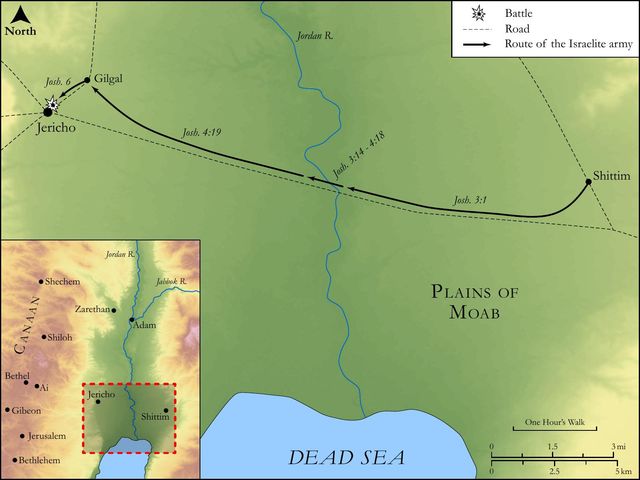
See on the biblical-era map
Study this verse
Public-domain commentary
Matthew Henry
From his Commentary on the Whole Bible. Henry comments on passages, not single verses — this entry covers Joshua 5:13–15. His three-level outline is real structure in the source text, so it is rendered as structure.
We have hitherto found God often speaking to Joshua, but we read not till now of any appearance of God's glory to him; now that his difficulties increased his encouragements were increased in proportion. Observe,
I.The time when he was favoured with this vision.
It was immediately after he had performed the great solemnities of circumcision and the passover; then God made himself known to him. Note, We may then expect the discoveries of the divine grace when we are found in the way of our duty and are diligent and sincere in our attendance on holy ordinances.
II.The place where he had this vision.
It was by Jericho; in Jericho, so the word is; in it by faith and hope, though as yet he had not begun to lay siege to it; in it in thought and expectation; or in the fields of Jericho, hard by the city. There, it should seem, he was all alone, fearless of danger, because sure of the divine protection. There he was (some think) meditating and praying; and to those who are so employed God often graciously manifests himself. Or perhaps there he was to take a view of the city, to observe its fortifications, and contrive how to attack it; and perhaps he was at a loss within himself how to make his approaches, when God came and directed him. Note, God will help those that help themselves. Vigilantibus non dormientibus succurrit lex - The law succours those who watch, not those who sleep. Joshua was in his post as a general, when God came and made himself known as Generalissimo.
III.The appearance itself.
Joshua, as is usual with those that are full of thought and care, was looking downwards, his eyes fixed on the ground, when of a sudden he was surprised with the appearance of a man who stood before him at some little distance, which obliged him to lift up his eyes, and gave a diversion to his musings, v. 13. He appeared to him as a man, but a considerable man, and one fit to be taken notice of. Now, 1. We have reason to think that this man was the Son of God, the eternal Word, who, before he assumed the human nature for a perpetuity, frequently appeared in a human shape. So bishop Patrick thinks, consonant to the judgment of the fathers. Joshua gave him divine honours, and he received them, which a created angel would not have done, and he is called Jehovah, Jos 6:2. 2. He here appeared as a soldier, with his sword drawn in his hand. To Abraham in his tent he appeared as a traveller; to Joshua in the field as a man of war. Christ will be to his people what their faith expects and desires. Christ had his sword drawn, which served, (1.) To justify the war Joshua was engaging in, and to show him that it was of God, who gave him commission to kill and slay. If the sovereign draw the sword, this proclaims war, and authorizes the subject to do so too. The sword is then well drawn when Christ draws it, and gives the banner to those that fear him, to be displayed because of the truth, Psa 60:4. (2.) To encourage him to carry it on with vigour; for Christ's sword drawn in his hand denotes how ready he is for the defence and salvation of his people, who through him shall do valiantly. His sword turns every way.
IV.The bold question with which Joshua accosted him; he did not send a servant, but stepped up to him himself, and asked, Art thou for us or for our adversaries? which intimates his readiness to entertain him if he were for them, and to fight him if he were against them. This shows,
1.His great courage and resolution. He was not ruffled by the suddenness of the appearance, nor daunted with the majesty and bravery which no doubt appeared in the countenance of the person he saw; but, with a presence of mind that became so great a general, put this fair question to him. God had bidden Joshua be courageous, and by this it appears that he was so; for what God by his word requires of his people he does by his grace work in them.
2.His great concern for the people and their cause; so heartily has he embarked in the interests of Israel that none shall stand by him with the face of a man but he will know whether he be a friend or a foe. It should seem, he suspected him for an enemy, a Goliath that had come to defy the armies of the living God, and to give him a challenge. Thus apt are we to look upon that as against us which is most for us. The question plainly implies that the cause between the Israelites and the Canaanites, between Christ and Beelzebub, will not admit of a neutrality. He that is not with us is against us.
V.The account he gave of himself, Jos 5:14.
"Nay, not for your adversaries, you may be sure, but as captain of the host of the Lord have I now come, not only for you as a friend, but over you as commander in chief." Here were now, as of old (Gen 32:2), Mahanaim, two hosts, a host of Israelites ready to engage the Canaanites and a host of angels to protect them therein, and he, as captain of both, conducts the host of Israel and commands the host of angels to their assistance. Perhaps in allusion to this Christ is called the captain of our salvation (Heb 2:10), and a leader and commander to the people, Isa 55:4. Those cannot but be victorious that have such a captain. He now came as captain to review the troops, to animate them, and to give the necessary orders for the besieging of Jericho.
VI.The great respect Joshua paid him when he understood who he was; it is probable that he perceived, not only by what he said but by some other sensible indications, that he was a divine person, and not a man.
1.Joshua paid homage to him: He fell on his face to the earth and did worship. Joshua was himself general of the forces of Israel, and yet he was far from looking with jealousy upon this stranger, who produced a commission as captain of the Lord's host above him; he did not offer to dispute his claims, but cheerfully submitted to him as his commander. It will become the greatest of men to be humble and reverent in their addresses to God.
2.He begged to receive commands and directions from him: What saith my Lord unto his servant? His former question was not more bold and soldier-like than this was pious and saint-like; nor was it any disparagement to the greatness of Joshua's spirit thus to humble himself when he had to do with God: even crowned heads cannot bow to low before the throne of the Lord Jesus, who is King of kings, Psa 2:10, Psa 2:11; Psa 72:10, Psa 72:11; Rev 19:16. Observe,
(1.)The relation he owns between himself and Christ, that Christ was his Lord and himself his servant and under his command, Christ his Captain and himself a soldier under him, to do as he is bidden, Mat 8:9. Note, The foundation of all acceptable obedience is laid in a sincere dedication of ourselves, as servants to Jesus Christ as our Lord, Psa 16:2.
(2.)The enquiry he makes pursuant to this relation: What saith my Lord? which implies an earnest desire to know the will of Christ, and a cheerful readiness and resolution to do it. Joshua owns himself an inferior officer, and stands to receive orders. This temper of mind shows him fit for the post he was in; for those know best how to command that know how to obey.
VII.The further expressions of reverence which this divine captain required from Joshua (Jos 5:15):
Loose thy shoe from off thy foot, in token of reverence and respect (which with us are signified by uncovering the head), and as an acknowledgment of a divine presence, which, while it continued there, did in a manner sanctify the place and dignify it. We are accustomed to say of a person for whom we have a great affection that we love the very ground he treads upon; thus Joshua must show his reverence for this divine person, he must not tread the ground he stood on with his dirty shoes, Ecc 5:1. Outward expressions of inward reverence, and a religious awe of God, well become us, and are required of us, whenever we approach to him in solemn ordinances. Bishop Patrick well observes here that the very same orders that God gave to Moses at the bush, when he was sending him to bring Israel out of Egypt (Exo 3:5), her here gives to Joshua, for the confirming of his faith in the promise he had lately given him, that as he had been with Moses so he would be with him, Jos 1:5. Had Moses such a presence of God with him as, when it became sensible, sanctified the ground? So had Joshua.
And (lastly) Hereby he prepares him to receive the instructions he was about to give him concerning the siege of Jericho, which this captain of the Lord's host had now come to give Israel possession of.
Historical interpretation
Fifteen Centuries of Reception
4 surviving comments on this verse. Each one is dated, so this reads as a timeline rather than a list.
Select a marker to jump to its quote. Markers stagger vertically where authors wrote within a few decades of each other.
And in what manner is Jericho holy ground since it is retained by the enemies? This indicates, and not by accident, that the chief of the army of the power of the Lord sanctifies every place to which he comes, for Jericho itself was not a holy place. But because the chief of the army of God came there, the place is said to be holy. I also dare something more and say that even the place where Moses stood was not holy through Moses himself but because the Lord stood with him. The presence of the Lord had sanctified the place; and on that account, it is said to him, “Loosen the latchet of your sandal; for the place on which you stand is holy ground.”
Now, grasp the mystical meaning of Holy Writ. As long as we are walking through the wilderness, it is necessary that we wear sandals to cover and protect our feet, but when we shall have entered the Land of Promise, we shall hear with Jesus [Joshua], the son of Nave [Nun]: “Remove your sandals from your feet, for the place upon which you are standing is holy.” When, therefore, we enter into the kingdom of heaven, we shall have no need of sandals or for protection against this world, but—to give you a new thought—we shall follow the Lamb that has been slain for us.
A brother asked a hermit, ‘Is it good to be always repenting?’ He answered, ‘We have seen Joshua the son of Nun; it was when he was lying prostrate on his face that God appeared to him’ (cf. Josh. 5:14).
Worshipping: Not with divine honour, but with a religious veneration of an inferior kind, suitable to the dignity of his person.
Continue studying Joshua 5:15 across the web’s major study libraries — every link below opens this exact verse, chapter, or book on the destination site.
Read & Compare
 BibleGatewayThis verse in more than 200 translations and 70 languages.
 Bible.comThe YouVersion reader — hundreds of translations, reading plans, and highlights.
 ESV.orgCrossway's official English Standard Version reader.
 NET BibleThe NET translation with 60,000+ translators' notes on every rendering decision.
 STEP BibleTyndale House's free study tool — original text, vocabulary, and scholarly resources.
 BibliaLogos Bible Software's free web reader.
 USCCBThe New American Bible (Revised Edition) with the U.S. bishops' study notes.
Commentaries
 BibleHub CommentariesDozens of classic commentaries on this verse, gathered on one page.
 StudyLightMore than 100 commentary sets — the largest collection on the web.
 BibleRefPlain-English commentary on what this verse means, verse by verse.
 Enduring WordDavid Guzik's free commentary on this chapter, widely used by Bible teachers.
 Bible Study ToolsVerse commentary alongside Greek and Hebrew study aids.
Original Language & Research
- BibleHub InterlinearThe verse word by word — original language, transliteration, and English.
- BibleHub LexiconEvery word's original-language definition and Strong's entry.
 Blue Letter BibleDeep-study tools — Strong's numbers, concordance, and word studies.
 SefariaThe Hebrew text with Rashi and centuries of Jewish commentary.
Sermons, Hymns & Audio


TrulyRandomVerse is not affiliated with these sites and doesn’t control their content. They’re linked because they’re genuinely useful.
Summary
Joshua 5:15 records a profound and pivotal divine encounter between Joshua and a mysterious figure identified as the "Captain of the LORD'S host," immediately preceding Israel's first major military engagement in the Promised Land, the conquest of Jericho. This momentous interaction serves as a spiritual commissioning for Joshua, echoing Moses' encounter at the burning bush, where the ground is declared holy due to the direct, manifest presence of God. The command for Joshua to remove his shoes signifies an essential posture of reverence, humility, and absolute submission to divine authority, powerfully establishing that God Himself is the true commander of Israel's forces and the ultimate source of their impending victory. Joshua's immediate and unquestioning obedience underscores his readiness to follow God's supreme leadership into the challenges ahead.
Context
ShowHideLiterary Context
This verse is strategically placed at a critical juncture in the book of Joshua, serving as a climactic spiritual preparation before the military conquest begins. It immediately follows a series of significant events that underscore Israel's renewed covenant relationship with God: the miraculous crossing of the Jordan River, which mirrored the Red Sea crossing; the circumcision of the new generation at Gilgal, signifying the renewal of the Abrahamic covenant; and the observance of Passover in the Promised Land, commemorating their deliverance. These acts collectively establish Israel's spiritual readiness. The appearance of the "Captain of the LORD's host" then serves as a direct divine commissioning and reassurance to Joshua, occurring just before the narrative shifts to the detailed account of the fall of Jericho, the formidable first city in Canaan. This encounter emphasizes that the upcoming battles are not merely human endeavors but God's battles, fought under His supreme command and authority.
Historical & Cultural Context
The command to "loose thy shoe from off thy foot" carries profound historical and cultural weight in Israel. Removing sandals was a recognized gesture of respect, humility, and reverence when entering a sacred space, a temple, or standing before a person of great authority, royalty, or a deity. This practice symbolized the removal of defilement or the recognition of one's unworthiness in the presence of the divine, as well as a posture of submission. The most famous parallel, explicitly referenced in the text, is Exodus 3:5, where Moses receives the identical command at the burning bush, indicating that Joshua is now standing on ground made holy by the direct, manifest presence of God Himself. The setting at Gilgal, near Jericho, was also culturally significant as the initial encampment and spiritual center for Israel upon entering Canaan, a fitting location for such a profound covenant renewal and divine encounter.
Key Themes
ShowHideThe central and overarching theme of Joshua 5:15 is the absolute holiness and sovereignty of God. The declaration that the ground is "holy" underscores that God's presence transforms ordinary space into sacred ground, demanding immediate and profound reverence and awe. This highlights God's transcendence and His unique nature. Another prominent theme is divine leadership and military strategy. The "Captain of the LORD's host" reveals that the conquest of Canaan is not merely a human military campaign but a divinely orchestrated war, with God Himself as the supreme commander. This encounter reassures Joshua that victory will come not through Israel's strength or cunning, but through God's power and strategic direction, echoing the commissioning promise in Joshua 1:9 to be strong and courageous because God is with him. Finally, human submission and obedience are powerfully highlighted through Joshua's immediate and unquestioning compliance, demonstrating the necessary posture of faith, humility, and trust required for God's chosen leaders and His people to successfully fulfill His purposes.
Exposition and Analysis
ShowHideKey Word Analysis
ShowHideMeaning "a head person (of any rank or class); captain (that had rule), chief (captain), general, governor, keeper, lord,(-task-)master, prince(-ipal), ruler, steward." In this context, it denotes a high-ranking military commander, a "prince" or "chief" of the LORD's army. The title suggests not merely a human leader but one invested with supreme authority, often interpreted as a divine or pre-incarnate figure.
Meaning "properly, a sandal tongue; by extension a sandal or slipper (sometimes as a symbol of occupancy, a refusal to marry, or of something valueless); dryshod, (pair of) shoe((-latchet), -s)." The "shoe" here refers specifically to the sandal worn on the foot, which, when removed, signifies a ritual act of humility, reverence, and acknowledgment of sacred space or superior presence.
Meaning "a sacred place or thing; rarely abstract, sanctity; consecrated (thing), dedicated (thing), hallowed (thing), holiness, ([idiom] most) holy ([idiom] day, portion, thing), saint, sanctuary." In this verse, the ground is declared "holy" not by its intrinsic nature, but because of the immediate, manifest presence of God, who is inherently set apart and sacred. It implies a separation from the common or profane, demanding a particular reverence and awe.
Verse Breakdown
ShowHide"And the captain of the LORD'S host said unto Joshua"
This opening clause introduces the divine speaker, whose title immediately establishes his supreme authority and military leadership over a heavenly, not earthly, army. The encounter is direct and personal, signaling a crucial moment of divine revelation and commissioning specifically for Joshua as the leader of Israel.
"Loose thy shoe from off thy foot; for the place whereon thou standest [is] holy"
This is the core divine command, a direct echo of the instruction given to Moses at the burning bush. The act of removing shoes is a symbolic gesture of profound reverence, humility, and submission, acknowledging the sacredness of the space. The ground is declared "holy" not due to any inherent quality, but solely because of the immediate, tangible, and awe-inspiring presence of God Himself, who is fundamentally holy and demands a consecrated response.
"And Joshua did so"
Joshua's immediate and unquestioning obedience to the divine command highlights his humility, faith, and complete submission to divine authority. This swift compliance demonstrates his readiness to follow God's direct instructions without hesitation, a vital quality for the leader of God's people as they embark on the monumental task of conquering Canaan and fulfilling God's covenant promises.
Literary Devices
ShowHideJoshua 5:15 employs several significant literary devices to convey its profound theological message. The most prominent is Parallelism, specifically an intertextual parallel with the account of Moses at the burning bush in Exodus 3:5. The identical command to "loose thy shoe from off thy foot; for the place whereon thou standest is holy" immediately links Joshua's experience to Moses' foundational encounter with God, thereby validating Joshua's leadership and establishing the divine authority behind the impending conquest as a continuation of God's redemptive work. Symbolism is also central to the verse, with the act of removing shoes symbolizing humility, reverence, and the recognition of sacred space and divine presence. The "holy ground" itself is symbolic of God's immanent presence and the sacred nature of His covenant dealings with Israel. Furthermore, the appearance of the "Captain of the LORD'S host" is widely interpreted as a Theophany or, more specifically, a Christophany, a visible manifestation of God or the pre-incarnate Christ. This literary and theological device underscores the direct divine involvement and supreme leadership in Israel's military campaigns, elevating the narrative beyond mere human conflict to a divinely orchestrated holy war.
Theological and Thematic Connections
ShowHideJoshua 5:15 profoundly articulates the theological truth that God's presence sanctifies and demands absolute reverence. The encounter establishes God's absolute sovereignty over His people and their endeavors, particularly in the context of the conquest of the Promised Land, which is revealed to be a divine initiative. It teaches that true victory and success come not from human strength, military prowess, or strategic brilliance alone, but from humble submission to divine leadership and an awe-filled recognition of God's inherent holiness. This moment serves as a spiritual anchor for Joshua and the nation, reminding them that they are participants in God's grand redemptive plan, requiring a posture of deep awe, unwavering faith, and immediate obedience. The encounter also underscores the continuity of God's covenant relationship, as Joshua is commissioned in a manner reminiscent of Moses.
Reflection and Application
ShowHideJoshua 5:15 offers timeless and profound lessons for believers today, calling us to cultivate a deep and abiding sense of reverence and humility in the presence of God. Just as Joshua was commanded to remove his shoes, we are invited to "take off" our self-sufficiency, pride, preconceived notions, and any distractions when we approach the Lord in worship, prayer, service, or even in our daily lives. Recognizing that all ground where God is truly present is holy ground should fundamentally transform our perspective on everyday existence, reminding us that God's holiness can permeate every aspect of our lives, demanding our awe and respect. This encounter also provides immense reassurance: when we face daunting challenges—our personal or communal "Jerichos"—we are not alone. The "Captain of the LORD'S host" is our ultimate leader, and true victory is found not in relying solely on our own strength, wisdom, or strategic brilliance, but in humbly submitting to His divine authority and trusting in His perfect strategy. Our spiritual preparation, marked by humility, obedience, and an awareness of God's holy presence, is paramount before engaging in any significant endeavor for the Kingdom of God.
Questions for Reflection
ShowHideFAQ
ShowHideWho was the "Captain of the LORD'S host" mentioned in Joshua 5:15?
ShowHideThe "Captain of the LORD'S host" is widely interpreted by biblical scholars as a Christophany, which is a pre-incarnate appearance of Jesus Christ. This figure is not identified as an angel, but rather as a divine being who accepts worship (unlike angels, who consistently refuse it, as seen in Revelation 22:8-9). The title itself, "Captain of the LORD'S host," suggests a supreme military commander of God's heavenly army, indicating divine authority over all creation and especially over the affairs of His people. His appearance to Joshua underscores that God Himself, through His pre-incarnate Son, is the true leader and strategist of Israel's conquest of Canaan, offering direct divine reassurance and commissioning. This encounter powerfully reinforces the theme that the battles Israel was about to undertake were God's battles, fought under His ultimate command and for His glory.
Why was Joshua commanded to remove his shoes, and what is the significance of "holy ground"?
ShowHideThe command for Joshua to remove his shoes (or sandals) was a common and deeply significant cultural and religious practice in Israel. It symbolized reverence, humility, and submission when entering a sacred space, a temple, or standing before a person of great authority or a deity. It also suggested removing any defilement or recognizing one's unworthiness in the immediate presence of the divine. The declaration that "the place whereon thou standest is holy" signifies that the ground itself is not inherently sacred, but it becomes consecrated and set apart by the immediate, manifest presence of God. This is a direct and intentional parallel to Moses' encounter with God at the burning bush in Exodus 3:5, emphasizing that Joshua is experiencing a moment of profound divine revelation and commissioning, similar in weight and significance to that of his predecessor, validating his leadership and the divine nature of the mission ahead.
Christ-Centered Fulfillment
ShowHideThe appearance of the "Captain of the LORD'S host" in Joshua 5:15 is a powerful Christophany, a pre-incarnate manifestation of Jesus Christ, who is the true and ultimate commander of God's people throughout salvation history. Just as this divine Captain led Israel into the physical Promised Land, Jesus Christ is the one who leads His church, the new Israel, into their spiritual battles against sin, death, and the powers of darkness, and ultimately into their eternal inheritance. He is not merely a general but the very head of the church, the one who leads captivity captive through His triumph on the cross and resurrection. The holiness of the ground in Joshua's encounter foreshadows the ultimate holiness that Christ Himself provides; through His perfect life, atoning sacrifice, and resurrection, He makes us holy and righteous, enabling us to draw near to God with confidence into the heavenly sanctuary. As the true "Captain of our salvation" (Hebrews 2:10), Jesus not only commands but also empowers His followers, ensuring victory over sin and death and leading them into the rest that remains for the people of God, a spiritual reality that far surpasses the physical land of Canaan.