


Joshua 5:14
Bible text: King James Version (1769 Blayney text) · Public domain
Bible text: King James Version with Strong's numbers · Public domain
Bible text: Berean Standard Bible · Public domain
Bible text: American Standard Version (1901) · Public domain
Bible text: World English Bible, Messianic edition · Public domain
Bible text: Geneva Bible (1599) · Public domain
Bible text: Young's Literal Translation · Public domain
- וַיֹּאמֶרvai·Yo·merand he saidH559Conj-w ¦ V-Qal-ConsecImperf-3msVerb Qal Consecutive Imperfect 3rd Singular Masculineוַandיֹּאמֶרhe said
- לֹאLo'In-H3808NegParticle Negative
- כִּיkideedH3588PrtParticle Conditional
- אֲנִי'a·NiIH589Pro-1csPronoun Personal 1st Singular common gender
- שַׂרsar[am] [the] commander ofH8269N-mscNoun Singular Masculine Construct
- צְבָאtze·va'[the] army ofH6635N-mscNoun Singular Masculine Construct
- יְהוָהYah·wehYahwehH3068N-properNoun Proper Title
- עַתָּה'a·TahnowH6258AdvAdverb
- בָאתִיVa·tiI have comeH935V-Qal-Perf-1csVerb Qal Perfect 1st Singular common gender
- וַיִּפֹּלvai·yi·Poland he fellH5307Conj-w ¦ V-Qal-ConsecImperf-3msVerb Qal Consecutive Imperfect 3rd Singular Masculineוַandיִּפֹּלhe fell
- יְהוֹשֻׁעַye·ho·Shu·a'JoshuaH3091N-proper-mNoun Proper Masculine
- אֶל'eltoH413PrepPreposition
- פָּנָיוpa·Navhis faceH6440N-mpc ¦ 3msNoun Plural Masculine Constructפָּנָיfaceוhis
- אַרְצָה'ar·tzah[the] ground towardsH776N-fs ¦ SfxNoun Singular Feminine Absoluteאַרְצָ[the] groundהtowards
- וַיִּשְׁתָּחוּvai·yish·Ta·chuand he bowed downH7812Conj-w ¦ V-Hishtaphel-ConsecImperf-3msVerb Hishtaphel Consecutive Imperfect 3rd Singular Masculineוַandיִּשְׁתָּחוּhe bowed down
- וַיֹּאמֶרvai·Yo·merand he saidH559Conj-w ¦ V-Qal-ConsecImperf-3msVerb Qal Consecutive Imperfect 3rd Singular Masculineוַandיֹּאמֶרhe said
- לוֹloto <the> himPrep-l ¦ 3msSuffix Personal 3rd Singular Masculineלto <the>וֹhim
- מָהmahwhat?H4100InterrogPronoun Interrogative
- אֲדֹנִי'a·do·Ni[is] my lordH113N-msc ¦ 1csNoun Singular Masculine Constructאֲדֹנִ[is] lordיmy
- מְדַבֵּרme·da·BersayingH1696V-Piel-Prtcpl-msVerb Piel Participle Singular Masculine Absolute
- אֶל'el<to>H413PrepPreposition
- עַבְדּוֹav·Dohis servantH5650N-msc ¦ 3msNoun Singular Masculine Constructעַבְדּservantוֹhis
English is a literal word-by-word gloss of the Hebrew, not the KJV's wording. Why?
This is the original text the KJV's translators worked from — each Hebrew word with its own literal English meaning in this verse, prepared by scholars at Tyndale House, Cambridge. The KJV translates whole sentences, not word by word, so its wording differs: one Hebrew word can become several English words, and the KJV may choose “the LORD” where the gloss reads “Yahweh”. Both are faithful — they answer different questions. For the KJV's own rendering, switch to the KJV text.
Details
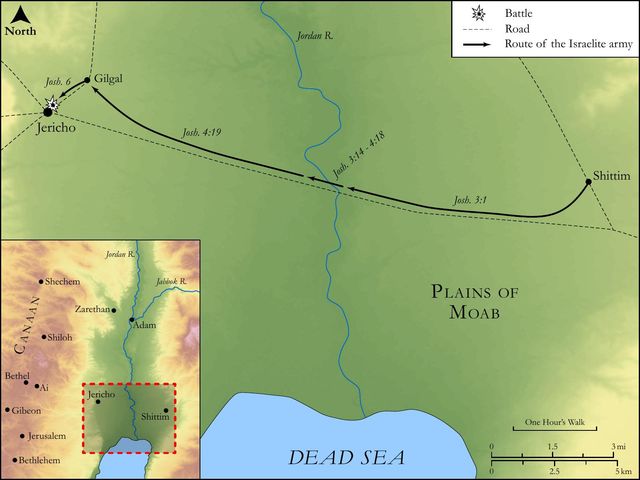
See on the biblical-era map
Study this verse
Public-domain commentary
Matthew Henry
From his Commentary on the Whole Bible. Henry comments on passages, not single verses — this entry covers Joshua 5:13–15. His three-level outline is real structure in the source text, so it is rendered as structure.
We have hitherto found God often speaking to Joshua, but we read not till now of any appearance of God's glory to him; now that his difficulties increased his encouragements were increased in proportion. Observe,
I.The time when he was favoured with this vision.
It was immediately after he had performed the great solemnities of circumcision and the passover; then God made himself known to him. Note, We may then expect the discoveries of the divine grace when we are found in the way of our duty and are diligent and sincere in our attendance on holy ordinances.
II.The place where he had this vision.
It was by Jericho; in Jericho, so the word is; in it by faith and hope, though as yet he had not begun to lay siege to it; in it in thought and expectation; or in the fields of Jericho, hard by the city. There, it should seem, he was all alone, fearless of danger, because sure of the divine protection. There he was (some think) meditating and praying; and to those who are so employed God often graciously manifests himself. Or perhaps there he was to take a view of the city, to observe its fortifications, and contrive how to attack it; and perhaps he was at a loss within himself how to make his approaches, when God came and directed him. Note, God will help those that help themselves. Vigilantibus non dormientibus succurrit lex - The law succours those who watch, not those who sleep. Joshua was in his post as a general, when God came and made himself known as Generalissimo.
III.The appearance itself.
Joshua, as is usual with those that are full of thought and care, was looking downwards, his eyes fixed on the ground, when of a sudden he was surprised with the appearance of a man who stood before him at some little distance, which obliged him to lift up his eyes, and gave a diversion to his musings, v. 13. He appeared to him as a man, but a considerable man, and one fit to be taken notice of. Now, 1. We have reason to think that this man was the Son of God, the eternal Word, who, before he assumed the human nature for a perpetuity, frequently appeared in a human shape. So bishop Patrick thinks, consonant to the judgment of the fathers. Joshua gave him divine honours, and he received them, which a created angel would not have done, and he is called Jehovah, Jos 6:2. 2. He here appeared as a soldier, with his sword drawn in his hand. To Abraham in his tent he appeared as a traveller; to Joshua in the field as a man of war. Christ will be to his people what their faith expects and desires. Christ had his sword drawn, which served, (1.) To justify the war Joshua was engaging in, and to show him that it was of God, who gave him commission to kill and slay. If the sovereign draw the sword, this proclaims war, and authorizes the subject to do so too. The sword is then well drawn when Christ draws it, and gives the banner to those that fear him, to be displayed because of the truth, Psa 60:4. (2.) To encourage him to carry it on with vigour; for Christ's sword drawn in his hand denotes how ready he is for the defence and salvation of his people, who through him shall do valiantly. His sword turns every way.
IV.The bold question with which Joshua accosted him; he did not send a servant, but stepped up to him himself, and asked, Art thou for us or for our adversaries? which intimates his readiness to entertain him if he were for them, and to fight him if he were against them. This shows,
1.His great courage and resolution. He was not ruffled by the suddenness of the appearance, nor daunted with the majesty and bravery which no doubt appeared in the countenance of the person he saw; but, with a presence of mind that became so great a general, put this fair question to him. God had bidden Joshua be courageous, and by this it appears that he was so; for what God by his word requires of his people he does by his grace work in them.
2.His great concern for the people and their cause; so heartily has he embarked in the interests of Israel that none shall stand by him with the face of a man but he will know whether he be a friend or a foe. It should seem, he suspected him for an enemy, a Goliath that had come to defy the armies of the living God, and to give him a challenge. Thus apt are we to look upon that as against us which is most for us. The question plainly implies that the cause between the Israelites and the Canaanites, between Christ and Beelzebub, will not admit of a neutrality. He that is not with us is against us.
V.The account he gave of himself, Jos 5:14.
"Nay, not for your adversaries, you may be sure, but as captain of the host of the Lord have I now come, not only for you as a friend, but over you as commander in chief." Here were now, as of old (Gen 32:2), Mahanaim, two hosts, a host of Israelites ready to engage the Canaanites and a host of angels to protect them therein, and he, as captain of both, conducts the host of Israel and commands the host of angels to their assistance. Perhaps in allusion to this Christ is called the captain of our salvation (Heb 2:10), and a leader and commander to the people, Isa 55:4. Those cannot but be victorious that have such a captain. He now came as captain to review the troops, to animate them, and to give the necessary orders for the besieging of Jericho.
VI.The great respect Joshua paid him when he understood who he was; it is probable that he perceived, not only by what he said but by some other sensible indications, that he was a divine person, and not a man.
1.Joshua paid homage to him: He fell on his face to the earth and did worship. Joshua was himself general of the forces of Israel, and yet he was far from looking with jealousy upon this stranger, who produced a commission as captain of the Lord's host above him; he did not offer to dispute his claims, but cheerfully submitted to him as his commander. It will become the greatest of men to be humble and reverent in their addresses to God.
2.He begged to receive commands and directions from him: What saith my Lord unto his servant? His former question was not more bold and soldier-like than this was pious and saint-like; nor was it any disparagement to the greatness of Joshua's spirit thus to humble himself when he had to do with God: even crowned heads cannot bow to low before the throne of the Lord Jesus, who is King of kings, Psa 2:10, Psa 2:11; Psa 72:10, Psa 72:11; Rev 19:16. Observe,
(1.)The relation he owns between himself and Christ, that Christ was his Lord and himself his servant and under his command, Christ his Captain and himself a soldier under him, to do as he is bidden, Mat 8:9. Note, The foundation of all acceptable obedience is laid in a sincere dedication of ourselves, as servants to Jesus Christ as our Lord, Psa 16:2.
(2.)The enquiry he makes pursuant to this relation: What saith my Lord? which implies an earnest desire to know the will of Christ, and a cheerful readiness and resolution to do it. Joshua owns himself an inferior officer, and stands to receive orders. This temper of mind shows him fit for the post he was in; for those know best how to command that know how to obey.
VII.The further expressions of reverence which this divine captain required from Joshua (Jos 5:15):
Loose thy shoe from off thy foot, in token of reverence and respect (which with us are signified by uncovering the head), and as an acknowledgment of a divine presence, which, while it continued there, did in a manner sanctify the place and dignify it. We are accustomed to say of a person for whom we have a great affection that we love the very ground he treads upon; thus Joshua must show his reverence for this divine person, he must not tread the ground he stood on with his dirty shoes, Ecc 5:1. Outward expressions of inward reverence, and a religious awe of God, well become us, and are required of us, whenever we approach to him in solemn ordinances. Bishop Patrick well observes here that the very same orders that God gave to Moses at the bush, when he was sending him to bring Israel out of Egypt (Exo 3:5), her here gives to Joshua, for the confirming of his faith in the promise he had lately given him, that as he had been with Moses so he would be with him, Jos 1:5. Had Moses such a presence of God with him as, when it became sensible, sanctified the ground? So had Joshua.
And (lastly) Hereby he prepares him to receive the instructions he was about to give him concerning the siege of Jericho, which this captain of the Lord's host had now come to give Israel possession of.
Historical interpretation
Fifteen Centuries of Reception
8 surviving comments on this verse. Each one is dated, so this reads as a timeline rather than a list.
Select a marker to jump to its quote. Markers stagger vertically where authors wrote within a few decades of each other.
What is it that Jesus [Joshua] teaches us through this? That, doubtless, which the apostle says: "Do not believe every spirit, but test if it is from God." Therefore, Jesus [Joshua] recognized not only something from God but that which is God; for certainly he would not have worshiped unless he had recognized God. For who else is chief of the army of the powers of God except our Lord Jesus Christ? For every heavenly army, whether angels or archangels, whether powers or "dominions or principalities or authorities," all these that were made through him, wage war under the chief himself, who is the chief of chiefs and who distributes sovereignty to the sovereigns. For he himself is the one who says in the gospel, "Have power over ten cities," and, to another, "Have power over five cities." This is the one who has returned after accepting the kingdom.
And as Joshua, the successor of Moses, was about to fight against the former possessors of Palestine, his enemies, foreign and most ungodly races, he rightly appears to him with a sword drawn and pointed against the enemy, showing by the vision that he himself is about to attack the ungodly with an unseen sword and with divine power, the fellow soldier and the fellow combatant of his people. Wherefore he gives himself the name of Chief and Captain of the Lord to suit the occasion. - "Proof of the Gospel 5.19"
Joshua, the successor of Moses, calls the leader of the heavenly angels and archangels and of the supernal powers and as if he were the power and wisdom of the Father, entrusted with the second rank of sovereignty and rule over all, “prince of the host of the Lord,” although he saw him only in the form and shape of a man. At any rate, it is written: “And it came to pass, when Joshua was in the field of the city of Jericho, he lifted up his eyes, and saw a man standing over against him, holding a drawn sword, and he went to him and said: ‘Are you one of ours, or of our adversaries?’ And he said to him, ‘I am prince of the host of the Lord and I have now come.’ And Joshua fell on his face to the ground and said to him, ‘What does my Lord command to his servant?’ And the prince of the Lord said to Joshua, ‘Loose your shoe from off your feet, for the place on which you stand is a holy place.’ ” Here, too, you will perceive from the identity of words that this is no other than he who also spoke to Moses.
A brother asked a hermit, ‘Is it good to be always repenting?’ He answered, ‘We have seen Joshua the son of Nun; it was when he was lying prostrate on his face that God appeared to him’ (cf. Josh. 5:14).
Divine providence surrounds all persons at all times, but it is not visible except to those who have purified their souls of sin and think about God at all times. To these it is luminously revealed at that time; because when they have undergone great temptations for the sake of truth, then they receive the faculty to perceive sensibly as if with eyes of flesh also when necessary, even palpably, according to the kind and cause of the temptation, as if for greater encouragement.So it was with Jacob and Joshua son of Nun, Hananiah and his companions, Peter and others to whom the form of a man appeared to encourage them and to console their faith.
Joshua, the son of Nun, and Daniel bowed in veneration before an angel of God, but they did not adore him. For adoration is one thing, and that which is offered in order to honor something of great excellence is another.
Joshua the son of Nun did not see the angel as he is by nature, but an image, for an angel by nature is not visible to bodily eyes, yet he fell down and worshiped, and Daniel did likewise. Yet an angel is a creature, a servant and minister of God, but not God. And they fell down in worship before the angels, not as God, but as God’s ministering spirits. Shall I not make images of friends? Shall I not honor them, not as gods but as the images of God’s friends? Neither Joshua nor Daniel worshiped the angels they saw as gods. Neither do I worship an image as god, but through the images of Christ and of the holy Theotokos and of the saints, I bring worship and honor to God, because of the reverence with which I honor his friends. God did not unite himself with angelic nature but with human nature. God did not become an angel; he became a man by nature and in truth.
Prince of the host of the Lord: St. Michael, who is called prince of the people of Israel, Dan. 10. 21.
Continue studying Joshua 5:14 across the web’s major study libraries — every link below opens this exact verse, chapter, or book on the destination site.
Read & Compare
 BibleGatewayThis verse in more than 200 translations and 70 languages.
 Bible.comThe YouVersion reader — hundreds of translations, reading plans, and highlights.
 ESV.orgCrossway's official English Standard Version reader.
 NET BibleThe NET translation with 60,000+ translators' notes on every rendering decision.
 STEP BibleTyndale House's free study tool — original text, vocabulary, and scholarly resources.
 BibliaLogos Bible Software's free web reader.
 USCCBThe New American Bible (Revised Edition) with the U.S. bishops' study notes.
Commentaries
 BibleHub CommentariesDozens of classic commentaries on this verse, gathered on one page.
 StudyLightMore than 100 commentary sets — the largest collection on the web.
 BibleRefPlain-English commentary on what this verse means, verse by verse.
 Enduring WordDavid Guzik's free commentary on this chapter, widely used by Bible teachers.
 Bible Study ToolsVerse commentary alongside Greek and Hebrew study aids.
Original Language & Research
- BibleHub InterlinearThe verse word by word — original language, transliteration, and English.
- BibleHub LexiconEvery word's original-language definition and Strong's entry.
 Blue Letter BibleDeep-study tools — Strong's numbers, concordance, and word studies.
 SefariaThe Hebrew text with Rashi and centuries of Jewish commentary.
Sermons, Hymns & Audio


TrulyRandomVerse is not affiliated with these sites and doesn’t control their content. They’re linked because they’re genuinely useful.
Summary
Joshua 5:14 records a pivotal encounter where Israel's leader, Joshua, is confronted by a mysterious divine figure, identified as the "Captain of the host of the LORD," on the eve of the Jericho campaign. This moment profoundly reorients Joshua's understanding of the impending conquest, revealing that the true commander of Israel's forces is not Joshua himself, but God. Joshua's immediate response of prostration and humble inquiry signifies his complete submission to divine authority, establishing a crucial theological precedent for the entire conquest and for all future endeavors of God's people.
Context
ShowHideLiterary Context
This significant encounter immediately follows a series of crucial covenant renewals and preparations for the Israelites in the land of Canaan. After miraculously crossing the Jordan River, the new generation of Israelite males, born during the wilderness wandering, underwent circumcision at Gilgal, fulfilling the covenant sign that had been neglected (see Joshua 5:2-9). Subsequently, the Israelites celebrated the Passover, commemorating their deliverance from Egypt, and began eating the produce of the land, signaling the cessation of the miraculous manna provision (see Joshua 5:10-12). With these spiritual and physical preparations complete, Joshua, likely surveying the formidable city of Jericho, is suddenly confronted by a "man" with a drawn sword (see Joshua 5:13). Joshua's initial, pragmatic question, "Art thou for us, or for our adversaries?", sets the stage for the divine revelation in verse 14, which transcends human allegiances and redefines the nature of the upcoming war.
Historical & Cultural Context
The setting is the plains of Jericho, a heavily fortified and strategically vital city guarding the central route into Canaan. For ancient Israel, warfare was not merely a geopolitical conflict but often a "holy war" (Hebrew: חֶרֶם, ḥerem), where God Himself was understood to fight on behalf of His people, and victory was attributed to divine intervention rather than human military prowess alone. Leaders like Joshua were expected to consult God before battle, with divine guidance being paramount. The act of falling on one's face (prostration) and worshipping was a common cultural expression of profound reverence, submission, and adoration, typically reserved for kings, high officials, or, most significantly, for deity. The "host of the LORD" would have been understood in a military culture as God's heavenly army, suggesting a divine power far superior to any earthly force, signifying that the true battle was spiritual and divinely led.
Key Themes
ShowHideJoshua 5:14 profoundly contributes to several overarching themes in the book of Joshua and the broader biblical narrative. Foremost is the theme of Divine Sovereignty and Leadership. The appearance of the "Captain of the host of the LORD" unequivocally declares that God, not Joshua, is the ultimate commander of Israel's military campaign. This encounter serves to humble Joshua and reorient his understanding of leadership, shifting focus from human strategy and military strength to absolute reliance on divine direction and power. It also reinforces the theme of Obedience and Submission, as Joshua's immediate prostration and humble inquiry, "What saith my lord unto his servant?", model the posture required for all who would serve God. Furthermore, the nature of this figure, widely interpreted as a Christophany (a pre-incarnate appearance of Jesus Christ), highlights the theme of God's Active Presence with His people, assuring them of His direct involvement in fulfilling His covenant promises, a consistent motif throughout the Pentateuch, as seen in the burning bush encounter with Moses (e.g., Exodus 3:2-5).
Exposition and Analysis
ShowHideKey Word Analysis
ShowHideThis term (H8269) denotes a chief, prince, ruler, or commander. While it can be used for earthly military commanders (e.g., Genesis 21:22), it is also employed for angelic princes (e.g., Daniel 10:13). Here, combined with "host of the LORD," it signifies supreme authority over divine, spiritual forces, distinguishing this figure from any earthly general and pointing to a heavenly commander.
This word (H6635) refers to a mass of persons, especially an army. While often referring to an earthly army or multitude, tsâbâʼ also frequently denotes the "host of heaven"—celestial bodies or, more pertinently here, the angelic armies of God (e.g., 1 Kings 22:19). The phrase "host of the LORD" unequivocally points to God's divine, spiritual forces, indicating that the commander is not merely a human ally but one who commands the very armies of heaven.
This primitive root (H7812) means "to depress," "to prostrate (oneself)," or "to do obeisance." While it can be used for showing respect to humans (e.g., Genesis 23:7), when combined with falling "on his face to the earth" and directed towards a figure who accepts it in this context, it carries the full weight of religious adoration due only to God (e.g., Genesis 24:26). The acceptance of Joshua's worship by this figure is a strong indicator of his divine nature.
Verse Breakdown
ShowHide"And he said, Nay; but [as] captain of the host of the LORD am I now come."
The mysterious figure's response directly addresses Joshua's prior question ("Art thou for us, or for our adversaries?"). By saying "Nay," he dismisses the notion of taking sides in a human conflict, indicating that his presence transcends partisan allegiances. Instead, he declares his true identity and purpose: he has come as the supreme commander of God's heavenly armies. This statement immediately elevates the nature of the war from a geopolitical struggle to a divine campaign, asserting God's ultimate authority and active leadership over Israel's mission.
"And Joshua fell on his face to the earth, and did worship,"
Joshua's immediate and profound reaction demonstrates his recognition of the divine nature of the figure standing before him. Falling on his face signifies ultimate humility, complete submission, and profound reverence. The act of "did worship" (from shâchâh) indicates an act of religious adoration, which in the Old Testament is primarily reserved for God alone. This is a crucial moment of spiritual epiphany for Joshua, acknowledging that he stands in the presence of God Himself or a divine manifestation representing God's very presence and authority.
"and said unto him, What saith my lord unto his servant?"
This question marks a complete and profound shift in Joshua's posture and understanding. From questioning allegiance, Joshua now expresses complete readiness to receive divine instruction. The use of "my lord" (Hebrew: אֲדֹנִי, ʼâdôwn, H113), while capable of referring to a human superior, in this context, coupled with Joshua's prostration and worship, strongly implies a recognition of divine lordship. Joshua, the earthly military commander, now humbly positions himself as a servant awaiting orders from the true, supreme Commander of Israel.
Literary Devices
ShowHideThe primary literary device at play in Joshua 5:14 is Theophany or, more specifically, Christophany. This refers to a visible manifestation of God or, as many theologians believe, a pre-incarnate appearance of Jesus Christ. The figure's acceptance of Joshua's worship, which angels typically refuse (e.g., Revelation 19:10), strongly supports a divine identity. The Dialogue between Joshua and the Captain is concise yet profoundly impactful, serving to reveal the shift in authority and Joshua's humble submission. The Symbolism of the drawn sword (from Joshua 5:13) signifies readiness for battle, divine judgment, and the warrior aspect of God. Joshua's Prostration is also deeply symbolic, representing complete surrender, reverence, and acknowledgment of divine majesty and authority.
Theological and Thematic Connections
ShowHideJoshua 5:14 serves as a profound theological anchor, establishing the foundational truth that the battles of God's people are ultimately His battles, fought under His supreme command. This encounter underscores the principle that human leadership, no matter how capable or divinely appointed, must always operate under ultimate divine authority and direction. It reorients Joshua's perspective from a human-centric military strategy to a God-centered one, where victory is assured not by Israel's strength, numbers, or tactical genius, but by the active presence and omnipotent power of the "Captain of the host of the LORD." This divine encounter sets the stage for the unique and seemingly illogical strategy for Jericho, emphasizing that God's ways are higher than human ways, and His power is absolute. It is a powerful reminder that true success in God's kingdom comes through humble submission and unwavering obedience to His revealed will, recognizing that God Himself leads His people into their inheritance.
Reflection and Application
ShowHideThe encounter at Jericho's gates offers timeless and profound lessons for believers navigating the challenges of life and ministry. Just as Joshua learned that he was not the ultimate commander of Israel's forces, we are powerfully reminded that God is sovereign over all our circumstances, our struggles, our aspirations, and our spiritual warfare. Our "battles," whether spiritual, professional, relational, or personal, are not ours alone to fight, but are ultimately His. This calls for a profound shift from self-reliance and human strategizing to absolute divine dependence. We are invited to adopt Joshua's posture of humility, falling on our faces in worship and asking, with complete surrender, "What saith my Lord unto His servant?" True spiritual leadership and effective living in God's kingdom flow from this place of humble submission and a readiness to obey God's unique, often counter-intuitive, instructions. When we face daunting tasks, seemingly insurmountable obstacles, or spiritual opposition, Joshua 5:14 encourages us to seek not merely God's help or blessing, but His active command, trusting that the "Captain of the host of the LORD" is already present, leading the way to victory according to His perfect and powerful plan.
Questions for Reflection
ShowHideFAQ
ShowHideWho was the Captain of the Host of the LORD?
ShowHideThe identity of the "Captain of the host of the LORD" is a subject of significant theological discussion, but the prevailing and most robust interpretation among evangelical scholars is that this figure was a Christophany—a pre-incarnate appearance of Jesus Christ. Several compelling factors support this view: the figure accepts Joshua's worship, which angels consistently refuse, directing worship only to God (see Revelation 19:10 and Revelation 22:8-9); the figure declares the ground holy and commands Joshua to remove his sandals, a prerogative of God alone (compare with Exodus 3:5 at the burning bush); and the title "Captain of the host of the LORD" suggests a divine commander, not merely an angelic messenger, possessing ultimate authority over God's heavenly armies. While some interpret the figure as a high-ranking angel, the immediate acceptance of worship and the declaration of holy ground strongly point to a divine being, indeed, the Son of God Himself.
Why did Joshua worship him?
ShowHideJoshua worshipped the Captain because he recognized the divine nature and supreme authority of the figure standing before him. Joshua's initial question in Joshua 5:13 was pragmatic, seeking to know if the armed man was an ally or an enemy in the upcoming military campaign. However, the Captain's response, identifying himself as the commander of God's heavenly armies and demanding reverence, immediately revealed his divine status. Joshua, a seasoned leader deeply familiar with God's presence and power from his time with Moses, understood that this was no ordinary man or angel, but a manifestation of God Himself. His act of falling on his face and worshipping was an appropriate and immediate response to encountering divine majesty and authority, signifying his complete submission, reverence, and recognition of the true Commander of Israel.
What is the significance of this encounter for the conquest of Jericho?
ShowHideThis encounter is supremely significant for the conquest of Jericho because it fundamentally shifts the entire paradigm of the battle from a human military operation to a divinely led campaign. Prior to this, Joshua was the military commander, planning strategy and leading the people. After this encounter, he realizes that God Himself is the ultimate Commander of Israel's forces. This revelation prepares Joshua to receive and obey the unconventional, seemingly illogical instructions for taking Jericho (see Joshua 6:2-5), which would have made no sense from a human military perspective. The encounter assures Joshua that God is actively present, leading His people, and that victory will come not through Israel's might or military tactics, but through divine power and unwavering obedience to God's specific, often miraculous, commands. It instills profound confidence and redefines the nature of Israel's mission as a holy war under God's direct, sovereign command.
Christ-Centered Fulfillment
ShowHideThe appearance of the "Captain of the host of the LORD" in Joshua 5:14 is powerfully understood as a Christophany, a pre-incarnate manifestation of Jesus Christ, who is the true and eternal Commander of God's people. Just as this divine figure came to assume leadership over Israel's earthly conquest, so too does Christ lead His church in its spiritual battles against sin, death, and the powers of darkness (see Ephesians 6:12). He is the one "appointed heir of all things, through whom also he created the world" (see Hebrews 1:2), and the one who leads "many sons to glory" as the "author of their salvation" (see Hebrews 2:10). The drawn sword in the Captain's hand foreshadows Christ's ultimate authority and righteous judgment, as depicted in Revelation where He returns as the triumphant warrior, "King of Kings and Lord of Lords" (see Revelation 19:11-16). Joshua's immediate worship and humble submission to this divine Captain prefigure the worship and obedience due to Jesus Christ, who alone is worthy of all adoration and whose commands lead to ultimate victory, abundant life, and eternal salvation (see John 14:15). He is the true Captain of our salvation, leading us through every spiritual Jericho.