


Genesis 17:3
Bible text: King James Version (1769 Blayney text) · Public domain
Bible text: Berean Standard Bible · Public domain
Bible text: American Standard Version (1901) · Public domain
Bible text: World English Bible, Messianic edition · Public domain
Bible text: Geneva Bible (1599) · Public domain
Bible text: Young's Literal Translation · Public domain
- וַיִּפֹּלvai·yi·Poland he fellH5307Conj-w ¦ V-Qal-ConsecImperf-3msVerb Qal Consecutive Imperfect 3rd Singular Masculineוַandיִּפֹּלhe fell
- אַבְרָם'av·RamAbramH87N-proper-mNoun Proper Masculine
- עַל'alonH5921PrepPreposition
- פָּנָיוpa·Navhis faceH6440N-mpc ¦ 3msNoun Plural Masculine Constructפָּנָיfaceוhis
- וַיְדַבֵּרvay·da·Berand he spokeH1696Conj-w ¦ V-Piel-ConsecImperf-3msVerb Piel Consecutive Imperfect 3rd Singular Masculineוַandיְדַבֵּרhe spoke
- אִתּוֹ'i·Towith himH854Prep ¦ 3msPreposition Definiteאִתּwithוֹhim
- אֱלֹהִים'E·lo·HimGodH430N-mpNoun Plural Masculine Absolute
- לֵאמֹרle·Mor<to> sayingH559Prep-l ¦ V-Qal-InfVerb Qal Infinitive Constructלֵ<to>אמֹרsaying
English is a literal word-by-word gloss of the Hebrew, not the KJV's wording. Why?
This is the original text the KJV's translators worked from — each Hebrew word with its own literal English meaning in this verse, prepared by scholars at Tyndale House, Cambridge. The KJV translates whole sentences, not word by word, so its wording differs: one Hebrew word can become several English words, and the KJV may choose “the LORD” where the gloss reads “Yahweh”. Both are faithful — they answer different questions. For the KJV's own rendering, switch to the KJV text.
Details
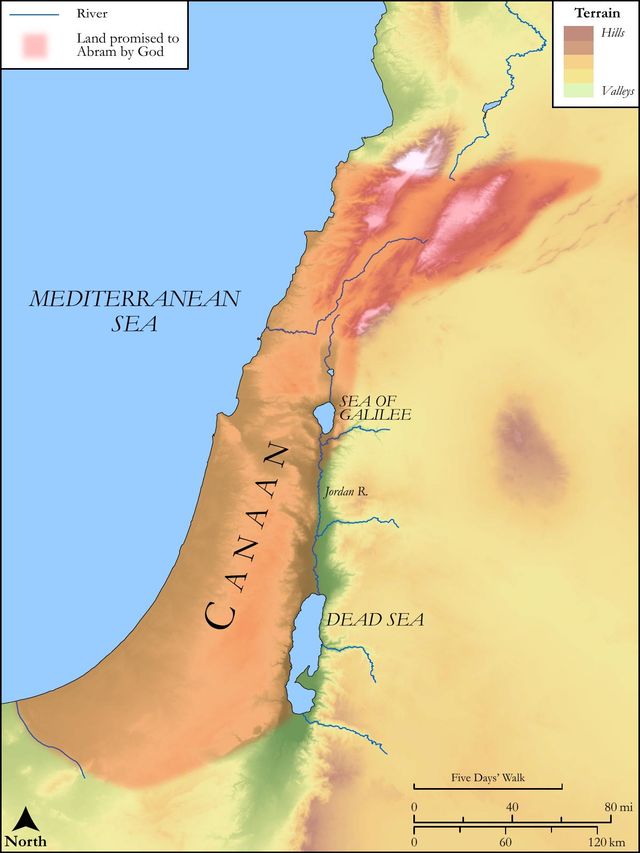
See on the biblical-era maps


Study this verse
Public-domain commentary
Matthew Henry
From his Commentary on the Whole Bible. Henry comments on passages, not single verses — this entry covers Genesis 17:1–3. His four-level outline is real structure in the source text, so it is rendered as structure.
Here is, I. The time when God made Abram this gracious visit: When he was ninety-nine years old, full thirteen years after the birth of Ishmael. 1. So long, it should seem, God's extraordinary appearances to Abram were intermitted; and all the communion he had with God was only in the usual was of ordinances and providences. Note, There are some special comforts which are not the daily bread, no, not of the best saints, but they are favoured with them now and then. On this side heaven they have convenient food, but not a continual feast. 2. So long the promise of Isaac was deferred. (1.) Perhaps to correct Abram's over-hasty marrying of Hagar. Note, The comforts we sinfully anticipate are justly delayed. (2.) That Abram and Sarai being so far stricken in age God's power, in this matter, might be the more magnified, and their faith the more tried. See Deu 32:36; Joh 11:6, Joh 11:15. (3.) That a child so long waited for might be an Isaac, a son indeed, Isa 54:1.
II.The way in which God made this covenant with him:
The Lord appeared to Abram, in the shechinah, some visible display of God's immediate glorious presence with him. Note, God first makes himself known to us, and gives us a sight of him by faith, and then takes us into his covenant.
III.The posture Abram put himself into upon this occasion: He fell on his face while God talked with him, Gen 17:3.
1.As one overcome by the brightness of the divine glory, and unable to bear the sight of it, though he had seen it several times before. Daniel and John did likewise, though they were also acquainted with the visions of the Almighty, Dan 8:17; Dan 10:9, Dan 10:15; Rev 1:17. Or,
2.As one ashamed of himself, and blushing to think of the honours done to one so unworthy. He looks upon himself with humility, and upon God with reverence, and, in token of both, falls on his face, putting himself into a posture of adoration. Note,
(1.)God graciously condescends to talk with those whom he takes into covenant and communion with himself. He talks with them by his word, Pro 6:22. He talks with them by his Spirit, Joh 14:26. This honour have all his saints.
(2.)Those that are admitted into fellowship with God are, and must be, very humble and very reverent in their approaches to him. If we say we have fellowship with him, and the familiarity breeds contempt, we deceive ourselves.
(3.)Those that would receive comfort from God must set themselves to give glory to God and to worship at his footstool.
IV.The general scope and summary of the covenant laid down as the foundation on which all the rest was built; it is no other than the covenant of grace still made with all believers in Jesus Christ, Gen 17:1. Observe here,
1.What we may expect to find God to us: I am the Almighty God. By this name he chose to make himself known to Abram rather than by his name Jehovah, Exo 6:3. He used it to Jacob, Gen 28:3; Gen 43:14; Gen 48:3. It is the name of God that is mostly used throughout the book of Job, at least in the discourses of that book. After Moses, Jehovah is more frequently used, and this, El-shaddai, very rarely; it bespeaks the almighty power of God, either,
(1.)As an avenger, from shôdeh he laid waste, so some; and they think God took this title from the destruction of the old world. This is countenanced by Isa 13:6, and Joe 1:15. Or,
(2.)As a benefactor shin for 'ăsher who, and day sufficient. He is a God that is enough; or, as our old English translation reads it here very significantly, I am God all-sufficient. Note, The God with whom we have to do is a God that is enough.
[1.]He is enough in himself; he is self-sufficient; he has every thing, and he needs not any thing.
[2.]He is enough to us, if we be in covenant with him: we have all in him, and we have enough in him, enough to satisfy our most enlarged desires, enough to supply the defect of every thing else, and to secure to us a happiness for our immortal souls. See Psa 16:5, Psa 16:6; Psa 73:25.
2.What God requires that we should be to him. The covenant is mutual: Walk before me, and be thou perfect, that is, upright and sincere; for herein the covenant of grace is well-ordered that sincerity is our gospel perfection. Observe,
(1.)That to be religious is to walk before God in our integrity; it is to set God always before us, and to think, and speak, and act, in every thing, as those that are always under his eye. It is to have a constant regard to his word as our rule and to his glory as our end in all our actions, and to be continually in his fear. It is to be inward with him, in all the duties of religious worship, for in them particularly we walk before God (Sa1 2:30), and to be entire for him, in all holy conversation. I know no religion but sincerity.
(2.)That upright walking with God is the condition of our interest in his all-sufficiency. If we neglect him, or dissemble with him, we forfeit the benefit and comfort of our relation to him.
(3.)A continual regard to God's all-sufficiency will have a great influence upon our upright walking with him.
Historical interpretation
Three Centuries of Reception
2 surviving comments on this verse. Each one is dated, so this reads as a timeline rather than a list.
Select a marker to jump to its quote. Markers stagger vertically where authors wrote within a few decades of each other.
(Chapter 17—Verse 3 and following) And the Lord spoke to him, saying: Behold, my covenant is with you, and you shall be the father of a multitude of nations, and your name shall no longer be called Abram, but your name shall be Abraham, for I have made you the father of many nations. It should be noted that wherever we read Testament in Greek, in the Hebrew language it is the word covenant or pact, that is, Berith (). The Hebrews say that God, from his name, which is the Tetragrammaton among them, added the letter He to Abraham and Sarah: for he was first called Abram (), which means lofty father, and later he was called Abraham (), which means father of many: for what follows nations is not part of the name, but is understood. It is not surprising, therefore, that when it seems that the letter Α has been added among the Greeks and us: we have called it the Hebrew letter He added; for the language of that tongue is to write with He (ה), but to read with A (א): just as, on the contrary, the letter A is often pronounced as He.
Abram fell face down. We read that in the earlier places of sacred history, holy men invoked the Lord, offered him sacrifices of praise, and lived innocently in his sight, but none had fallen face down before the Lord before Abram. However, the more superior gifts he received compared to the previous ones, the greater thanks he gave to the Giver of gifts by humbling himself; and because in falling to the ground he humbly recalled his fragility, he immediately deserved to sublimely recognize the eminence of divine power. For it follows:
Continue studying Genesis 17:3 across the web’s major study libraries — every link below opens this exact verse, chapter, or book on the destination site.
Read & Compare
 BibleGatewayThis verse in more than 200 translations and 70 languages.
 Bible.comThe YouVersion reader — hundreds of translations, reading plans, and highlights.
 ESV.orgCrossway's official English Standard Version reader.
 NET BibleThe NET translation with 60,000+ translators' notes on every rendering decision.
 STEP BibleTyndale House's free study tool — original text, vocabulary, and scholarly resources.
 BibliaLogos Bible Software's free web reader.
 USCCBThe New American Bible (Revised Edition) with the U.S. bishops' study notes.
Commentaries
 BibleHub CommentariesDozens of classic commentaries on this verse, gathered on one page.
 StudyLightMore than 100 commentary sets — the largest collection on the web.
 BibleRefPlain-English commentary on what this verse means, verse by verse.
 Enduring WordDavid Guzik's free commentary on this chapter, widely used by Bible teachers.
 Bible Study ToolsVerse commentary alongside Greek and Hebrew study aids.
Original Language & Research
- BibleHub InterlinearThe verse word by word — original language, transliteration, and English.
- BibleHub LexiconEvery word's original-language definition and Strong's entry.
 Blue Letter BibleDeep-study tools — Strong's numbers, concordance, and word studies.
 SefariaThe Hebrew text with Rashi and centuries of Jewish commentary.
Sermons, Hymns & Audio


TrulyRandomVerse is not affiliated with these sites and doesn’t control their content. They’re linked because they’re genuinely useful.
Summary
Genesis 17:3 captures Abram's immediate and profound response of falling on his face, a posture signifying deep reverence, humility, and absolute submission in the presence of the Almighty. This dramatic physical act sets the solemn tone for the reconfirmation and expansion of God's covenant promises, marking a pivotal moment where divine revelation meets human awe, preparing Abram to receive significant new details concerning his lineage, his name change, and the enduring sign of the covenant.
Context
ShowHideLiterary Context
This verse immediately follows God's appearance to Abram, who is now 99 years old, years after the initial covenant promises in Genesis 12:1-3 and the formal covenant ceremony in Genesis 15. The preceding chapter, Genesis 16, details Abram and Sarai's attempt to fulfill God's promise of an heir through human means, resulting in the birth of Ishmael. This divine encounter in Genesis 17 therefore represents a fresh, sovereign initiative from God to reaffirm His original, unconditional promise, correct human missteps, and introduce new, specific terms, including the covenant sign of circumcision and the promise of a son through Sarai. Abram's humble posture underscores his readiness to receive this renewed and expanded divine word.
Historical & Cultural Context
In Scripture, prostration—falling on one's face—was a common gesture of profound respect, submission, and adoration before a superior, whether a king, a deity, or a divine messenger. It conveyed an acknowledgment of the other's supreme authority and one's own subordinate status. For Abram, a chieftain of considerable wealth and influence, this act was not merely a cultural formality but a deeply personal and spiritual expression of his recognition of God's absolute sovereignty and holiness. Such a posture would have been understood by his contemporaries as the ultimate sign of deference, signaling his complete availability and willingness to obey the divine pronouncement.
Key Themes
ShowHideGenesis 17:3 contributes significantly to several overarching themes within the book of Genesis and the broader biblical narrative. It highlights the theme of Divine Initiative and Sovereignty, as God, not Abram, initiates this crucial encounter, demonstrating His unwavering commitment to His covenant purposes despite human failings, as seen in Genesis 16. It powerfully illustrates Human Humility and Reverence in the face of divine majesty, a recurring motif where individuals like Moses (Exodus 34:8) and Joshua (Joshua 5:14) adopt similar postures. Furthermore, this verse sets the stage for the theme of Covenant Expansion and Reaffirmation, as God is about to transform Abram's identity and introduce new covenant stipulations, moving the narrative towards the fulfillment of the promise of a vast lineage and a land, as initially promised in Genesis 12.
Exposition and Analysis
ShowHideKey Word Analysis
ShowHideA primitive root meaning "to fall," with a wide range of applications including physical collapse, prostration, or even metaphorical falling into ruin or being cast down. In this context, it specifically denotes falling on the face, signifying an act of humble submission, awe, and worship before a superior being, especially God. It implies an overwhelming sense of the divine presence that compels one to physically lower oneself in reverence.
A plural noun (though always singular in meaning) referring to "the face" or "presence." When combined with "fell" (nâphal), the phrase "fell on his face" (נָפַל עַל־פָּנָיו, naphal al-panav') is a common biblical idiom expressing the deepest form of humility, worship, and submission. It indicates a complete surrender of self and an acknowledgment of the other's supreme authority and holiness.
A plural noun used here (and frequently throughout the Old Testament) to refer to the supreme God. While grammatically plural, when used with a singular verb (as here, "talked"), it functions as a singular noun, emphasizing God's majesty, power, and comprehensive nature. The use of this majestic plural underscores the overwhelming and awe-inspiring nature of the divine being with whom Abram is interacting.
Verse Breakdown
ShowHide"And Abram fell on his face"
This clause describes Abram's immediate, involuntary, and profound physical response to God's appearance. The act of falling on his face is a universal biblical gesture signifying deep reverence, submission, and worship. It communicates an overwhelming sense of awe and a recognition of God's supreme majesty, holiness, and authority. This posture prepares Abram's heart and mind to receive the divine message with humility and readiness to obey.
"and God talked with him, saying,"
This second clause highlights the divine initiative in the encounter. Despite Abram's prostration, it is God who sovereignly chooses to speak (Hebrew: dâbar' H1696) and reveal His will. This emphasizes God's active engagement with humanity and His unwavering commitment to His covenant promises. The phrase "saying" (Hebrew: ʼâmar' H559) introduces the direct discourse that follows, indicating that the subsequent verses contain God's explicit words of covenant renewal and instruction.
Literary Devices
ShowHideThe verse employs several significant literary devices. Symbolism is prominent in Abram's act of "falling on his face," which is a powerful visual symbol of profound humility, reverence, and submission before the divine. This physical posture symbolizes an inner spiritual state of awe and worship, indicating Abram's complete deference to God's authority. The phrase "God talked with him" utilizes Anthropomorphism, attributing the human act of speaking to God. This device makes the divine interaction relatable and comprehensible to human understanding, emphasizing the personal and direct nature of God's communication with Abram. Furthermore, the verse functions as a form of Narrative Foreshadowing, setting a solemn and reverent tone for the momentous covenant renewal that is about to unfold in the subsequent verses. Abram's posture prepares the reader for the gravity and significance of the divine pronouncements that follow, signaling a pivotal moment in the biblical narrative.
Theological and Thematic Connections
ShowHideAbram's response in Genesis 17:3 profoundly illustrates that true encounter with the living God elicits a response of deep reverence and humble submission. It underscores the absolute sovereignty and holiness of God, before whom even a great patriarch like Abram must prostrate himself. This divine encounter also highlights God's unwavering faithfulness, as He initiates a renewed conversation to reconfirm and expand His covenant promises, demonstrating that His plans are not thwarted by human failings or delays. The verse implicitly teaches that receptivity to divine revelation often requires a posture of humility, a willingness to listen and obey, acknowledging God as the ultimate authority and source of all truth.
Reflection and Application
ShowHideAbram's immediate and unhesitating act of falling on his face in Genesis 17:3 provides a profound template for our own posture before God. In a world that often exalts self-sufficiency and human autonomy, this passage calls us to cultivate a spirit of profound humility and reverence. It reminds us that approaching the Creator of the universe demands an acknowledgment of His supreme majesty, holiness, and authority. This isn't about fear, but about a deep, loving awe that recognizes His infinite greatness and our finite nature. When we truly grasp who God is, our natural response should be one of humble adoration, preparing our hearts to listen attentively to His voice and receive His divine instruction. This posture of humility not only honors God but also opens us up to a deeper understanding of His will and a more profound experience of His presence, reinforcing His steadfast faithfulness to His promises, even when they seem long delayed or human actions complicate their fulfillment.
Questions for Reflection
ShowHideFAQ
ShowHideWhy did Abram fall on his face in response to God?
ShowHideAbram's act of falling on his face (Hebrew: naphal al panav) signifies profound reverence, humility, and submission in the presence of the Almighty God. It is a physical manifestation of deep awe and worship, acknowledging God's supreme majesty, holiness, and authority. This posture is consistently used throughout the Old Testament to denote complete deference to a superior being or, more significantly, to God Himself. It indicates a heart prepared to receive and obey divine instruction, recognizing God's absolute sovereignty over all things. This act of prostration is a powerful symbol of his spiritual readiness for the momentous covenant revelation that follows.
Christ-Centered Fulfillment
ShowHideAbram's posture of humble submission before God's speaking in Genesis 17:3 finds its ultimate fulfillment and transformation in Jesus Christ. While Abram bowed in awe before the transcendent God, Christ, as the Word made flesh, perfectly embodies the divine initiative of God "talking with" humanity, bringing God's very presence and voice into the world (John 1:14). Jesus, though fully divine, also demonstrated perfect humility and obedience, not merely falling on His face, but humbling Himself even to the point of death on a cross (Philippians 2:8). Through His life, death, and resurrection, Christ perfectly fulfilled the covenant promises initiated with Abraham, becoming the ultimate seed through whom all nations would be blessed (Galatians 3:16). In Christ, God's covenant is not merely reaffirmed but eternally secured, inviting all believers to a posture of faith, worship, and obedient love that mirrors Abram's reverence, but now directed towards the One who is both God's final and complete revelation and the perfect human response to divine majesty (Hebrews 1:1-2).